61st Amendment of Indian Constitution — Voting Age Reduced from 21 to 18
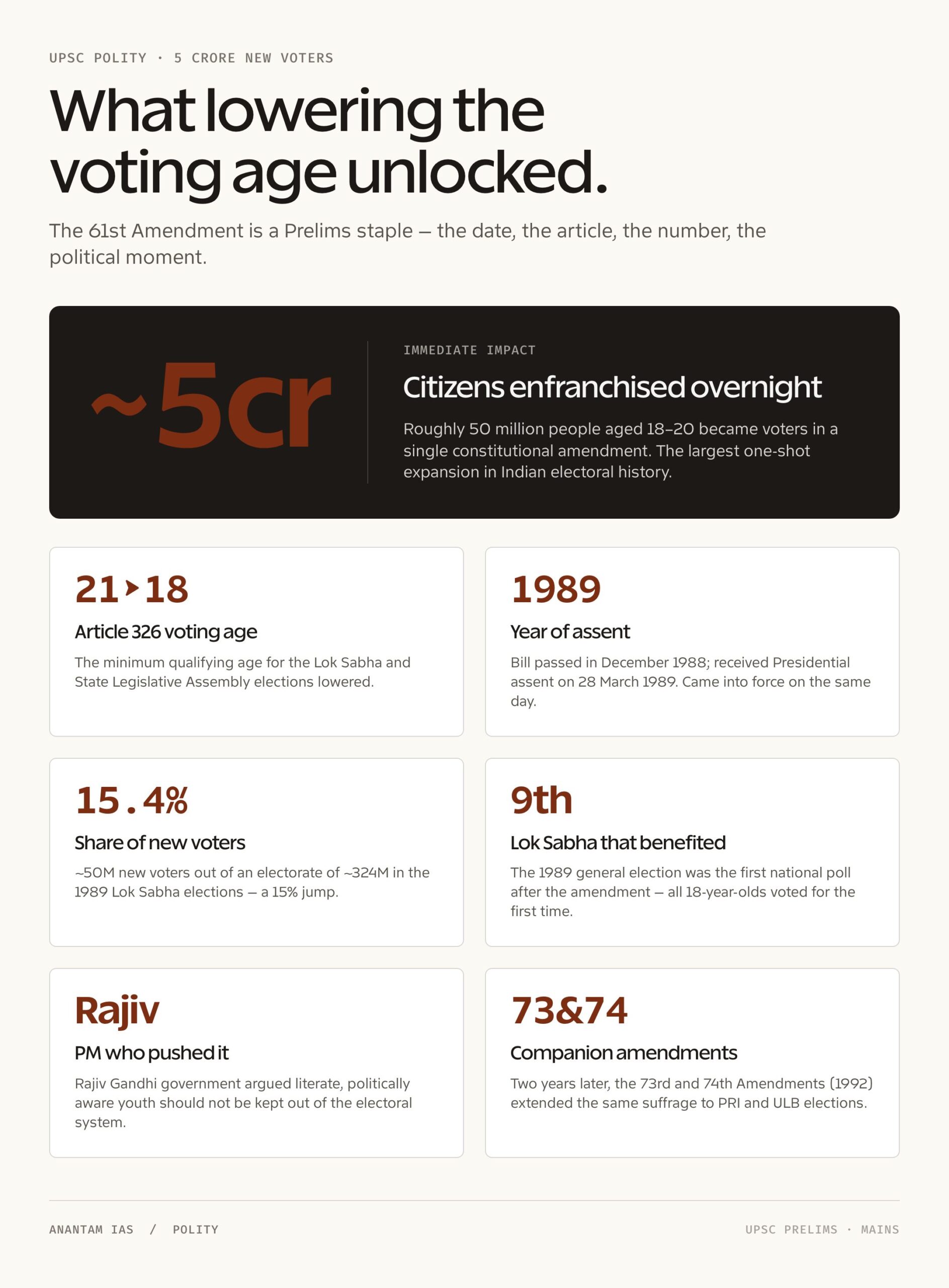
The 61 amendment of indian constitution did one thing — and it did it cleanly. It reduced the voting age in India from 21 years to 18 years by amending Article 326.
The 61 amendment of indian constitution did one thing — and it did it cleanly. It reduced the voting age in India from 21 years to 18 years by amending Article 326. That single change added roughly 5 crore young voters to the electoral roll overnight. Most aspirants memorise the year and stop there. Don’t… because the politics of why Rajiv Gandhi pushed this through in 1988–89, the Article 326 mechanism, and the electoral consequences are what UPSC actually tests. Here’s the full read — exact provisions, parliamentary timeline, the Constituent Assembly debate that originally fixed 21, and why this is a Mains favourite.
What is the 61st Amendment of Indian Constitution?
The Constitution (Sixty-first Amendment) Act, 1988 lowered the minimum voting age in India from 21 years to 18 years for elections to the Lok Sabha and State Legislative Assemblies. It amended Article 326 of the Indian Constitution, which lays down the principle of universal adult suffrage.
The Bill was passed by Lok Sabha on 15 December 1988 and Rajya Sabha on 21 December 1988. It received Presidential assent from R. Venkataraman on 28 March 1989, and came into force the same day. The Act is officially titled the Constitution (Sixty-first Amendment) Act, 1988 — note the Act bears the year of passage (1988), even though assent was 1989.
Three quick facts for revision:
- 61st Amendment — 1988 / 1989 — voting age reduced from 21 to 18.
- Article 326 — the only constitutional article amended.
- Approximately 5 crore (50 million) new voters added to the electoral roll, expanding India’s voting-age population by about 13.5%.
Why was the 61st Amendment passed?
OK, here’s the political context most coaching notes skim over…
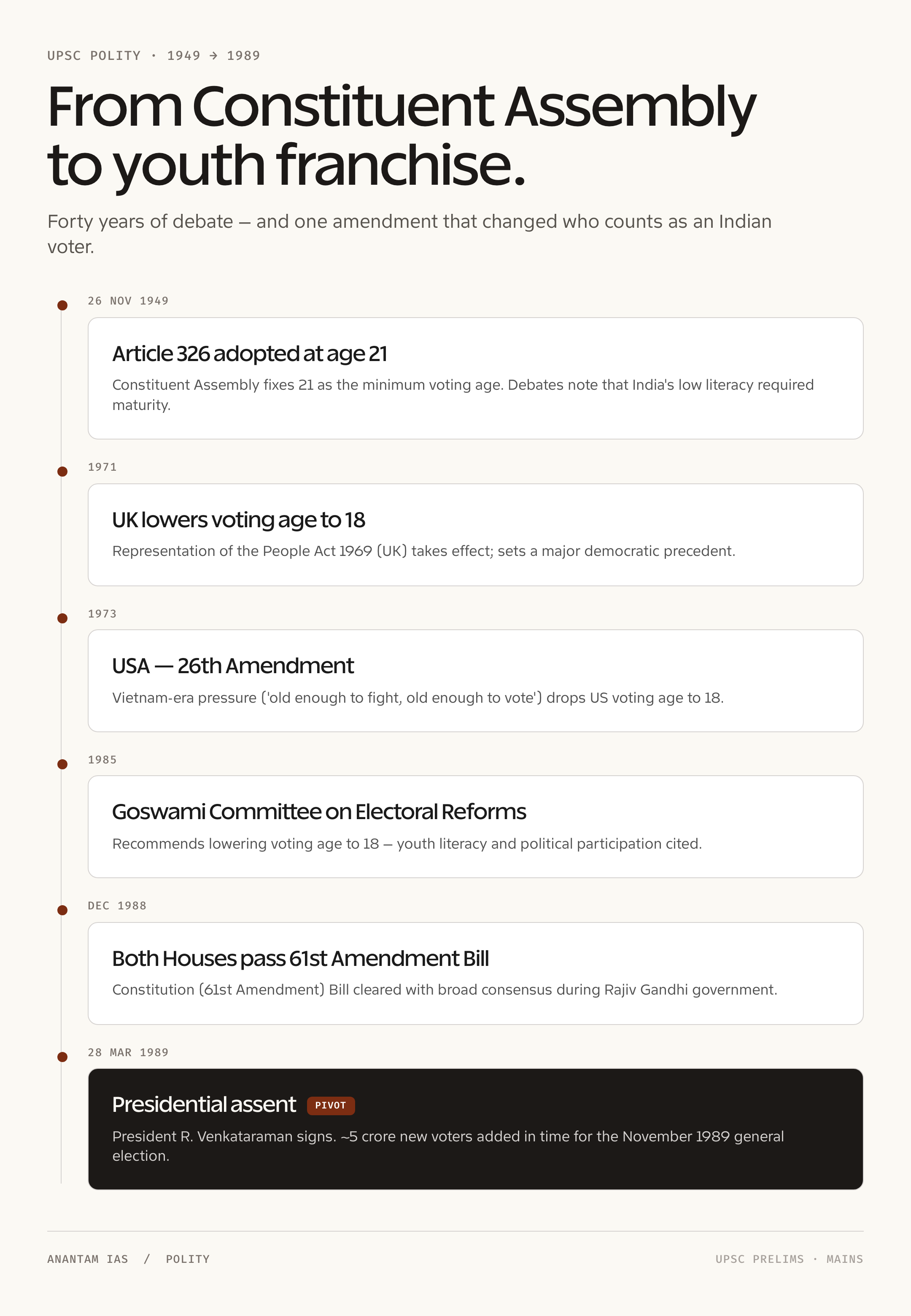
When the Constituent Assembly framed the Indian Constitution, Article 326 set the voting age at 21. The reasoning, debated through 1948–49, was largely conservative: in a newly independent country with low literacy, lawmakers wanted voters who had reached a certain maturity. The age of 21 had been the standard in colonial-era electoral rolls.
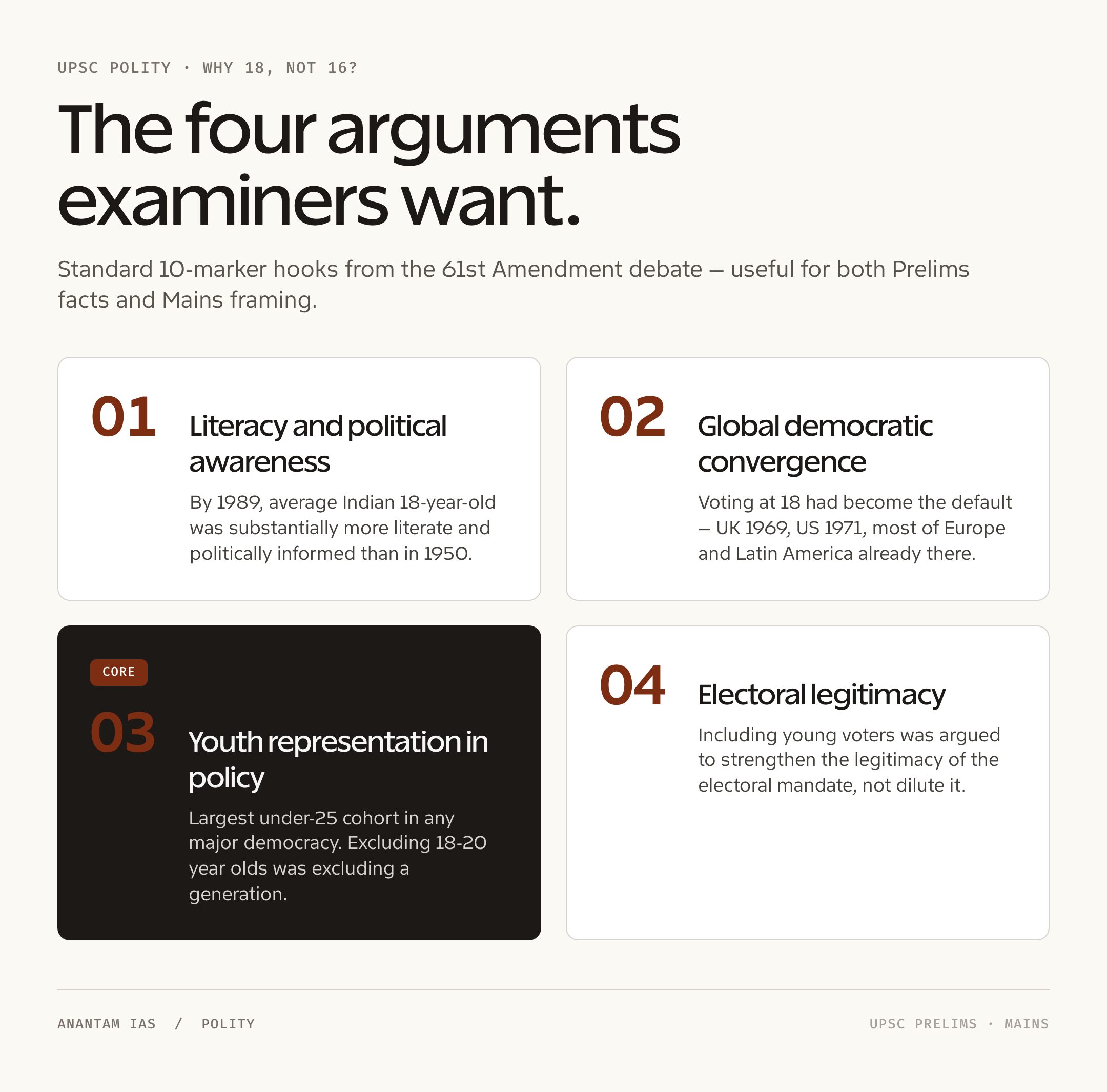
By the late 1980s, three things had changed:
- Literacy had risen sharply — youth literacy in particular.
- The Education Commission and youth organisations had argued through the 1970s and 1980s that a person legally an adult at 18 (under the Indian Majority Act, 1875) should also be a voter at 18.
- Internationally, most democracies — UK, US, France, Germany — had already moved to 18, many in the 1970s.
Prime Minister Rajiv Gandhi, who had won the 1984 general election with the largest mandate in Indian electoral history, framed the move politically as empowering youth. The Constitution (Sixty-first Amendment) Bill was introduced in December 1988. It passed both Houses with overwhelming cross-party support… the Janata Dal opposition supported it. The Communist parties supported it. Even sceptics in Congress voted yes.
The story in five steps:
- 1950 — Article 326 sets voting age at 21.
- 1971 — UK lowers voting age from 21 to 18 (Representation of the People Act, 1969).
- 1986 — Education Commission recommendations on youth participation.
- 15–21 December 1988 — Lok Sabha and Rajya Sabha pass the Bill.
- 28 March 1989 — Presidential assent; Act comes into force.
What did the 61st amendment of indian constitution change?
The 61st amendment of indian constitution is the shortest meaningful amendment in the Polity syllabus. It changed exactly one thing in one article. Here’s the precise effect.
1. Article 326 — the substitution
Before the 61st Amendment, Article 326 read:
“The elections to the House of the People and to the Legislative Assembly of every State shall be on the basis of adult suffrage; that is to say, every person who is a citizen of India and who is not less than twenty-one years of age on such date as may be fixed in that behalf by or under any law made by the appropriate Legislature and is not otherwise disqualified under this Constitution or any law made by the appropriate Legislature on the ground of non-residence, unsoundness of mind, crime or corrupt or illegal practice, shall be entitled to be registered as a voter at any such election.”
The 61st Amendment substituted “twenty-one” with “eighteen” — and that’s the only textual change in the Constitution.
Three downstream effects:
- Electoral rolls revised — the Election Commission undertook a special revision in 1989 to add 18–20 year olds to the rolls before the 1989 general election.
- Representation of the People Act, 1950 — Section 19 was correspondingly amended.
- Subordinate election rules — Conduct of Elections Rules, 1961 and state assembly rules were updated.
2. What it did NOT change
A clean exam point: the amendment touched only Article 326. It did not change:
- The minimum age for contesting elections — still 25 for the Lok Sabha and State Assemblies (Article 84 and Article 173), and 30 for the Rajya Sabha and State Legislative Councils.
- The age of majority — that’s governed by the Indian Majority Act, 1875 (already 18 since 1875).
- Local body elections — separately governed, but most states already followed 18.
- Eligibility to stand for President or Vice-President — minimum 35 years, unchanged.
For the wider electoral framework, see Election Commission of India — Article 324.
The 5-crore impact — what it did to India’s electorate
This is the GS-grade detail. After the 1989 amendment:
- About 5 crore (50 million) new voters were added — roughly 7% of the country’s total population at the time.
- About 13.5% of the voting-age population was newly enfranchised.
- The 1989 general election — held November 1989, which Rajiv Gandhi went on to lose — was the first to use the lowered voting age.
- By 2024, Election Commission data showed that 18–22 year olds make up around 8.5% of registered voters — over 8 crore in absolute numbers.
Honestly, I’ve watched aspirants over-rotate on the political irony — Rajiv Gandhi enfranchised the youth and lost the election… but for a Mains answer, lead with the institutional fact, not the irony. The youth vote becoming a permanent factor in Indian elections is the outcome worth citing.
Voting age — India vs world
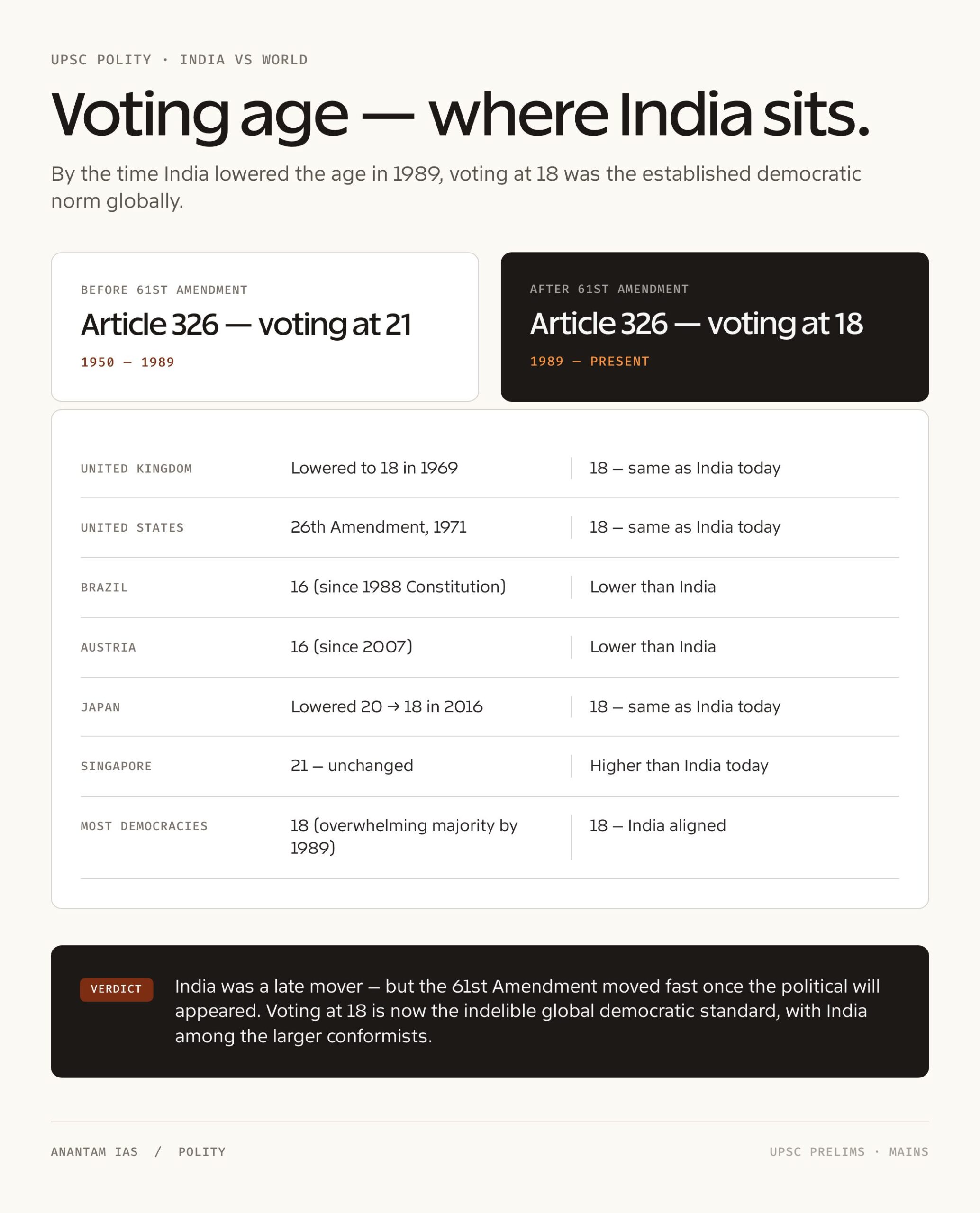
| Country | Voting age | Year set |
|---|---|---|
| India | 18 | 1989 (61st Amendment) |
| United Kingdom | 18 | 1969 (Scotland 16 for some elections) |
| United States | 18 | 1971 (26th Amendment, US Constitution) |
| Germany | 18 | 1970 |
| France | 18 | 1974 |
| Brazil | 16 (optional 16, mandatory 18–70) | 1988 Constitution |
| Japan | 18 | 2015 (lowered from 20) |
| Saudi Arabia | 18 (limited elections) | 2015 |
| Austria | 16 | 2007 |
| Bangladesh | 18 | 1972 |
India was a relatively late mover among major democracies, but the size of the cohort enfranchised in one go made the impact especially significant.
Why this matters for UPSC
Three exam zones to know cold:
- Prelims — Article 326, year of assent (1989), Act year (1988), Prime Minister (Rajiv Gandhi), President (R. Venkataraman). UPSC asked a related question in CSE Prelims 2017 and again in 2022.
- Mains GS Paper II — Polity — “Discuss the impact of the 61st Constitutional Amendment on India’s electoral democracy.” A standard 10–15 marker.
- Mains GS Paper II — Governance — “Examine the role of constitutional amendments in expanding political participation.” Use the 61st alongside the 73rd and 74th (panchayats and municipalities) for a strong comparative answer.
Look, examiners love this exact framing: “How does the 61st Amendment connect Article 326 with the broader principle of universal adult suffrage?” Answer with: 1950 baseline (21), 1989 amendment (18), Article 326 mechanism, 5 crore new voters… and the global comparison.
For the broader list of constitutional amendments, see the linked guide. The 61st sits at #61 in the sequence — after the 52nd (anti-defection, 1985) and before the 73rd–74th (panchayati raj, 1992).
Common misconceptions
Myth 1: “The 61 amendment of indian constitution lowered the age for contesting elections too.” Wrong. The minimum age for contesting Lok Sabha and State Assembly elections is still 25 (Article 84 and Article 173). The amendment only changed the voting age, not the contesting age.
Myth 2: “The 61st Amendment was passed in 1989.” Half-true. The Act is officially the Constitution (Sixty-first Amendment) Act, 1988 — Parliament passed it in December 1988. Presidential assent and entry into force came on 28 March 1989.
Myth 3: “The amendment was opposed by the Opposition.” Wrong. It passed with cross-party support — Janata Dal and the Communist parties backed it. There was no significant opposition in the Lok Sabha record.
Myth 4: “India was the first country in Asia to lower voting age to 18.” Wrong. Bangladesh had the voting age at 18 from 1972 onwards. Several other Asian countries — including the Philippines — lowered theirs before India.
Myth 5: “The 61th amendment of indian constitution amended both Article 326 and Article 84.” Wrong. It amended only Article 326. Article 84 (minimum age for Lok Sabha membership) is unchanged at 25 to this day.
How to revise this in 30 minutes
Source priority for Mains-grade depth:
- Laxmikanth — *Indian Polity — Chapter on amendments and on elections.
- NCERT — *Democratic Politics, Class 9 and 10 — for the universal adult suffrage principle.
- PRS Legislative Brief — Constitution (Sixty-first Amendment) Act, 1988.
- Election Commission of India — *Statistical Reports of General Elections, 1989*.
- The Wikipedia summary of the Sixty-first Amendment (good for cross-reference dates).
Make a one-page note with: Article 326, 1988 (passage) / 1989 (assent), Rajiv Gandhi, R. Venkataraman, 5 crore new voters, no change to Article 84, parallel to UK 1969 and US 1971. That’s any 10-marker.
Frequently Asked Questions
When was the 61st Amendment of Indian Constitution passed?
Lok Sabha passed it on 15 December 1988 and Rajya Sabha on 21 December 1988. President R. Venkataraman gave assent on 28 March 1989, and the Act came into force the same day.
Which article did the 61st Amendment change?
Article 326 of the Constitution, which lays down universal adult suffrage for elections to the Lok Sabha and State Legislative Assemblies. The word u0022twenty-oneu0022 was substituted with u0022eighteen.u0022
What was the voting age in India before the 61st Amendment?
Before 28 March 1989, the voting age was 21 years, as originally fixed by Article 326 of the Constitution adopted in 1949–50.
Did the 61 amendment of indian constitution lower the contesting age too?
No. The minimum age for contesting Lok Sabha and State Assembly elections remains 25 (Article 84 and Article 173). The amendment only lowered the voting age.
Who was the Prime Minister when the 61st Amendment was passed?
Rajiv Gandhi was Prime Minister. The Bill passed Parliament in December 1988 and was assented to in March 1989, just months before he lost the November 1989 general election.
How many new voters did the 61st Amendment add?
Approximately 5 crore (50 million) new voters were added — about 13.5% of the voting-age population at the time, or roughly 7% of the total Indian population.
Why was the voting age originally fixed at 21?
The Constituent Assembly debated the question in 1948–49 and chose 21 as a balance between universal suffrage and the political maturity standard inherited from colonial-era electoral rolls. The Indian Majority Act, 1875 had already set 18 as the age of majority, but the Assembly preferred 21 for voting.
Did the 61st Amendment change anything about elections beyond the voting age?
No. It only amended Article 326. Provisions about election conduct, the Election Commission, the qualification age for candidates, and constituency rules were unaffected. The Representation of the People Act, 1950 was correspondingly amended by ordinary legislation.