7th Schedule of Indian Constitution — Union, State and Concurrent Lists (UPSC Polity)
If you skip the 7th schedule of indian constitution, you can't answer half the federalism questions UPSC sets.
If you skip the 7th schedule of indian constitution, you can’t answer half the federalism questions UPSC sets. Centre-state disputes, GST, agriculture laws, education policy, the All India Services tussle — all of it traces back to which list a subject sits on. Aspirants treat the 7th Schedule like a phone book to memorise. Wrong approach. Treat it as the operating system of Indian federalism. Once you see the architecture — Union List, State List, Concurrent List, all governed by Article 246 — every centre-state dispute starts to make sense. This is the definitive 2026 explainer with current subject counts, recent amendments, and the disputes that actually appear in question papers.
What is the 7th Schedule of the Indian Constitution?
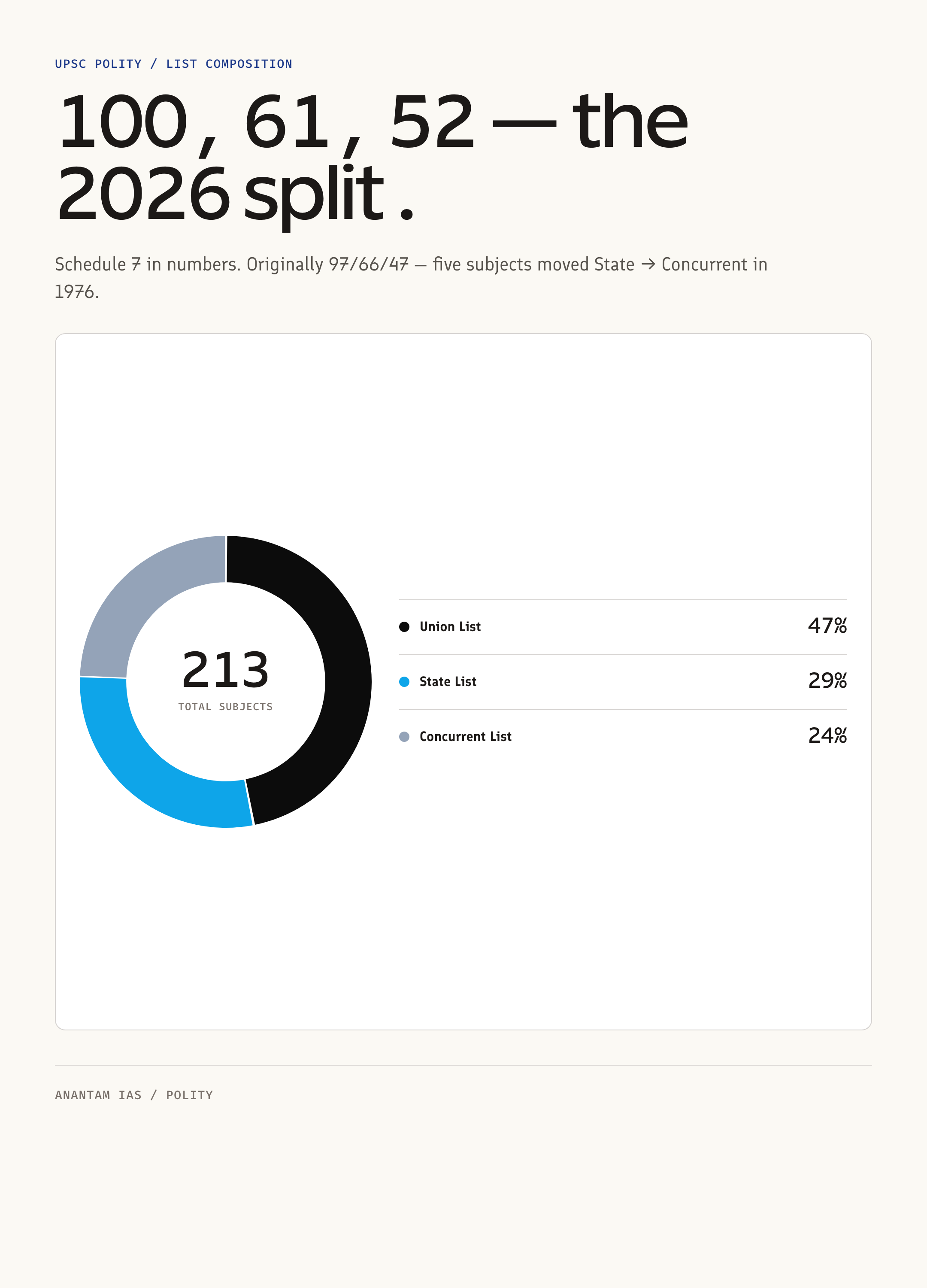
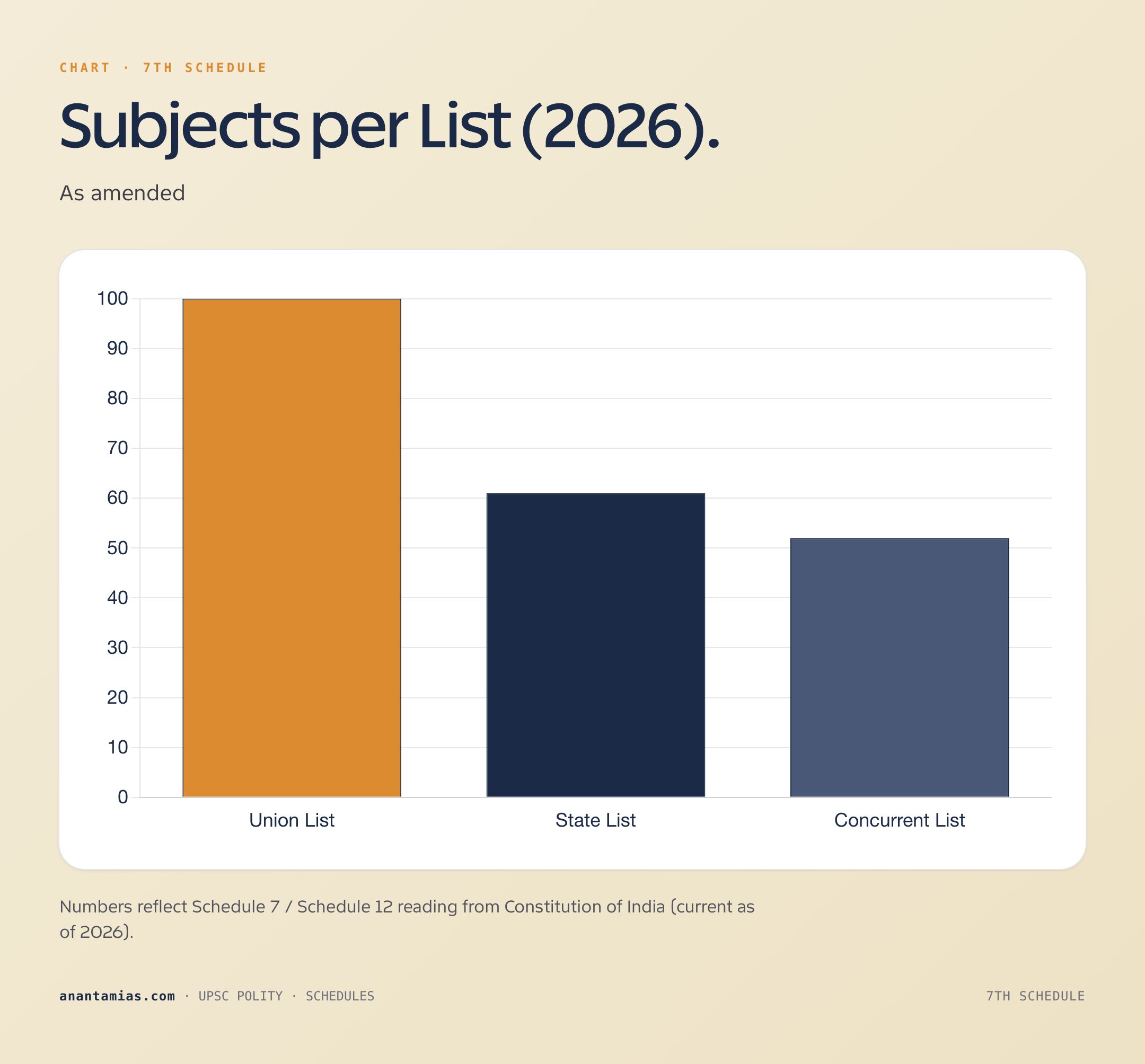
The 7th Schedule of the Indian Constitution distributes legislative powers between the Union and the States through three lists — the Union List (List I), the State List (List II), and the Concurrent List (List III) — read with Article 246. As of 2026, the lists contain 100 subjects (Union), 61 subjects (State), and 52 subjects (Concurrent) respectively. The Schedule is the constitutional foundation of Indian federalism.
Article 246 — the operative provision
Schedule 7 doesn’t operate alone. Article 246 is the gateway. It says:
- Article 246(1) — Parliament has exclusive power to make laws on Union List subjects.
- Article 246(2) — Parliament and State Legislatures can make laws on Concurrent List subjects.
- Article 246(3) — State Legislatures have exclusive power on State List subjects.
- Article 246(4) — Parliament can legislate even on State subjects for any part of India not in a state (e.g., UTs without legislatures).
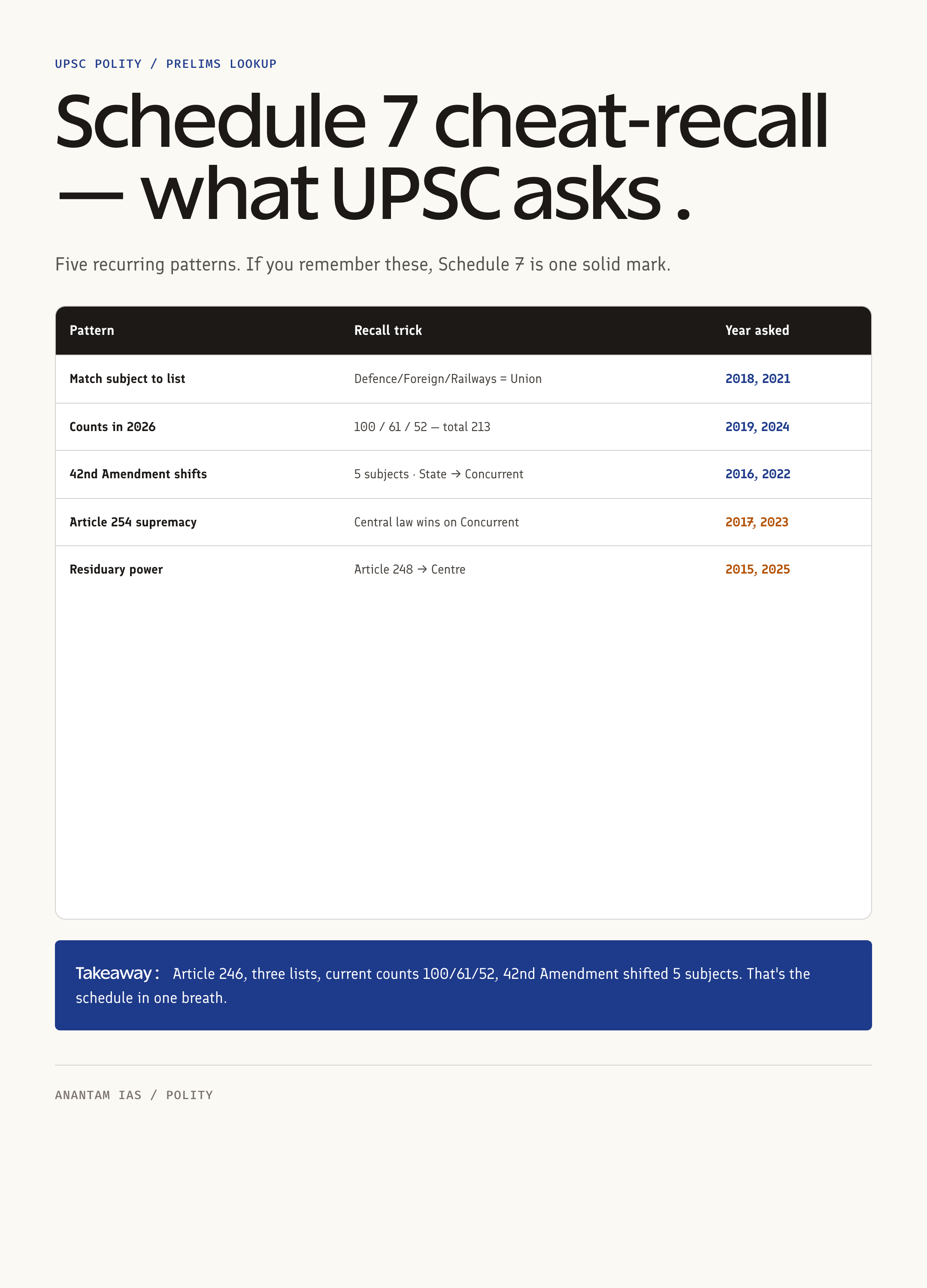
Add to this Article 254 — the conflict-resolution rule. If a state law and a central law on a Concurrent List subject clash, the central law prevails unless the state law was reserved for Presidential assent and got it. This is the bit aspirants forget. Article 254 is the reason Centre-State disputes on, say, agriculture or labour, end up in court.
Three lists at a glance — current subject counts (2026)
The numbers have shifted from 1950. Subjects have been moved between lists by amendments. Here’s the current snapshot.
| List | Original (1950) | Current (2026) | Net change | Examples |
|---|---|---|---|---|
| Union List (List I) | 97 | 100 | +3 | Defence, Foreign affairs, Atomic energy, Railways, Currency |
| State List (List II) | 66 | 61 | -5 | Police, Public health, Agriculture, Local government |
| Concurrent List (List III) | 47 | 52 | +5 | Criminal law, Marriage and divorce, Education, Forests |
How the subject counts changed — the amendment trail
This is where most coaching shortcuts fail. They give you “97 / 66 / 47” — the 1950 figures — and stop. UPSC asks the current count. You need the amendment trail.
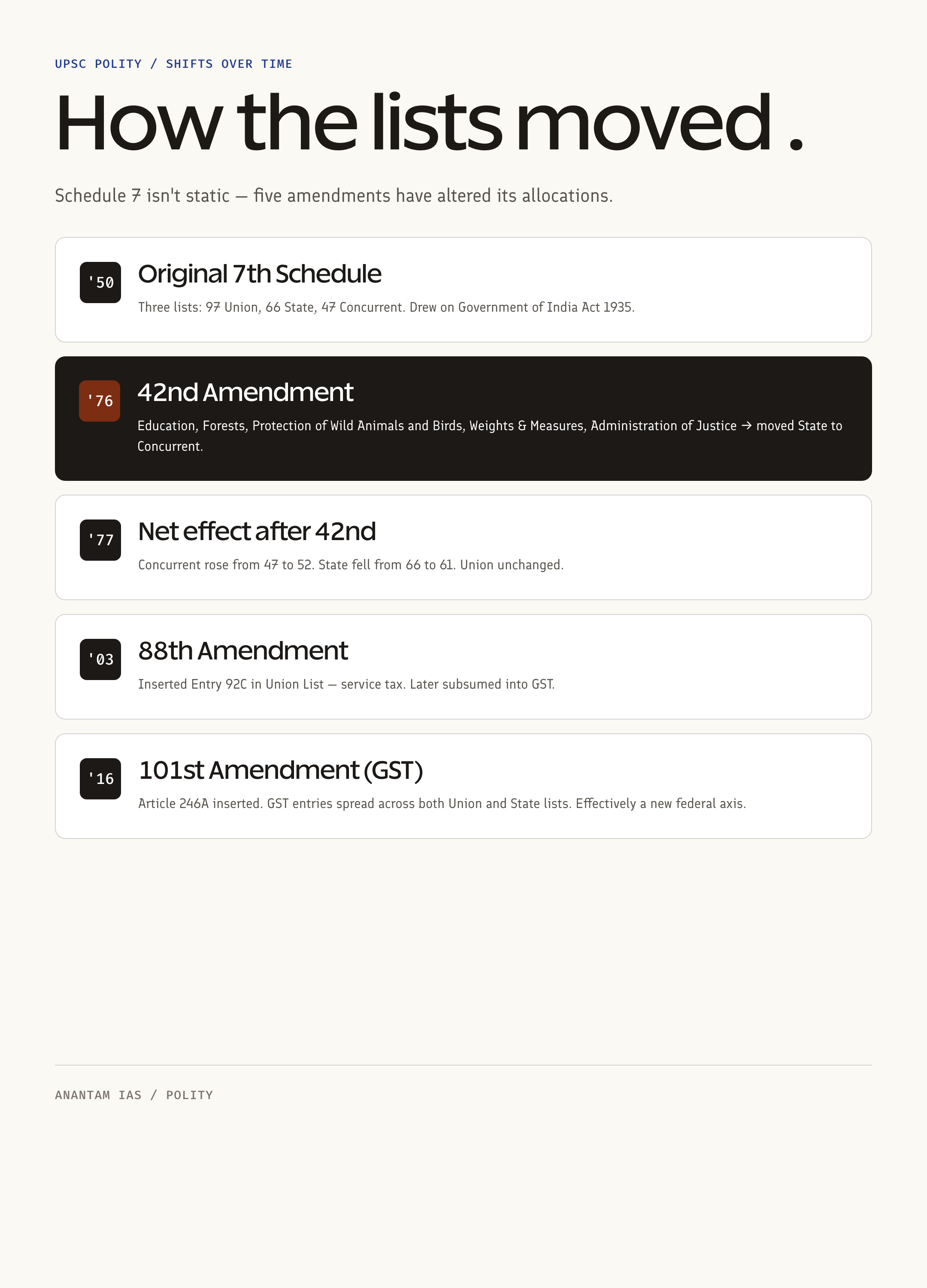
The biggest mover was the 42nd Amendment, 1976 — Indira Gandhi’s “Mini-Constitution.” It pulled five subjects from State List to Concurrent List:
- Education (entry 25 of Concurrent List)
- Forests (entry 17A)
- Protection of wild animals and birds (entry 17B)
- Weights and measures (entry 33A)
- Administration of justice — constitution and organisation of all courts except Supreme Court and High Courts (entry 11A)
That’s why the State List shrunk by 5 subjects and the Concurrent List grew by 5. Net change tracks perfectly.
The Union List saw small additions over time — entries on extension of jurisdiction of Union laws, certain co-operatives at the Union level, taxes on services. The 101st Amendment, 2016 that brought in GST also restructured tax entries — Article 246A was inserted as a special provision for GST, and certain entries (like services tax) were absorbed into the GST framework.
For the broader federal architecture, anchor with Federalism in India and Federalism in India: Features & Centre-State Relations.
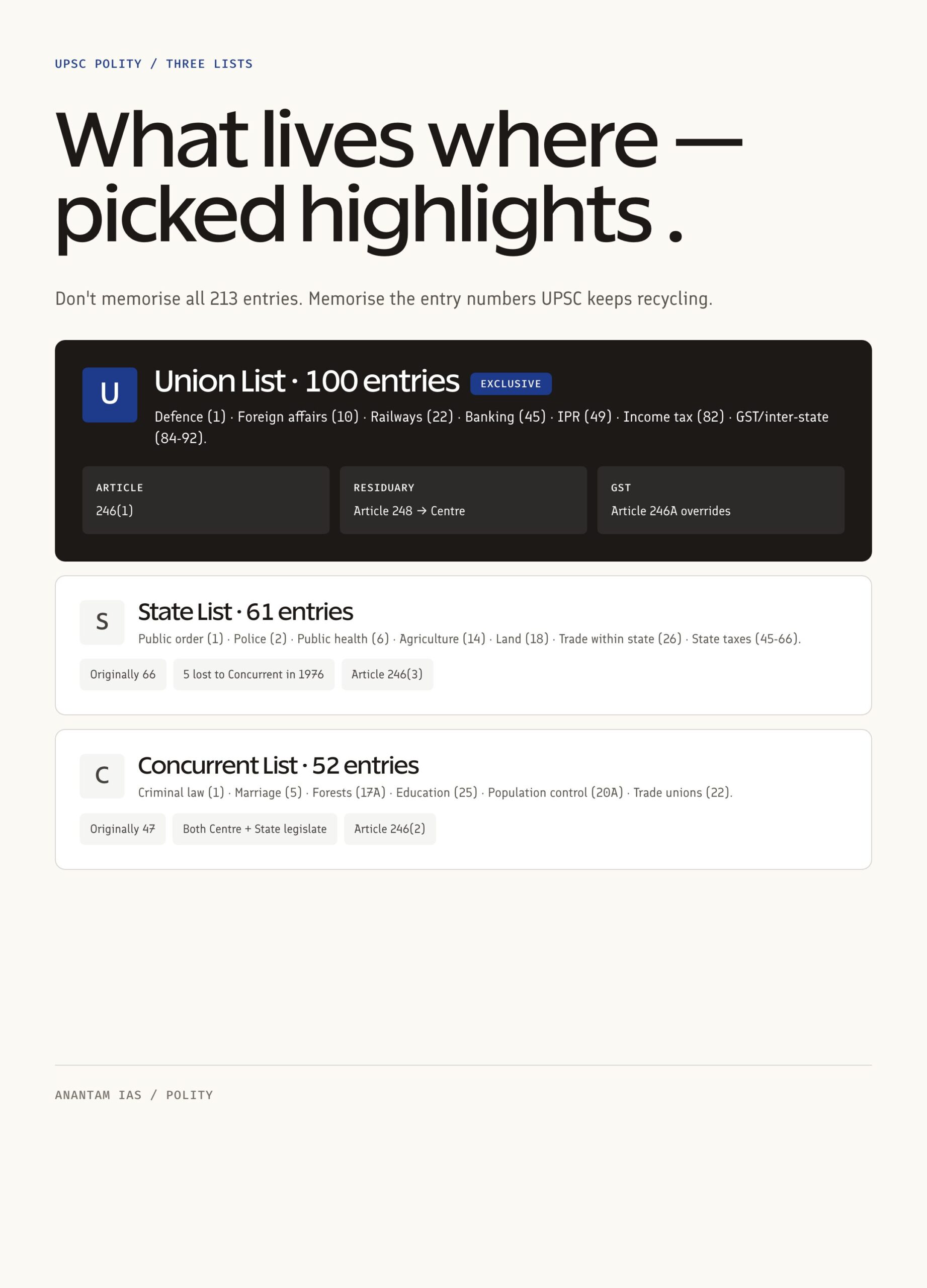
Union List — what’s on it and why
The Union List has 100 entries covering subjects of national importance — the ones where uniformity across India is essential.
Major heads:
- Defence and security — entries 1–8 (Defence of India, Naval/Military/Air Forces, atomic energy, CBI, central police forces)
- Foreign affairs — entries 9–17 (foreign affairs, diplomatic relations, UN, treaties, war and peace, citizenship, extradition)
- Communications — entries 22–31 (railways, highways of national importance, shipping, aviation, posts, telegraphs, broadcasting)
- Currency, banking, insurance — entries 35–47
- Inter-state trade and commerce — entries 41–43
- Major taxes — entries 82–92B (income tax other than agriculture, customs, corporation tax, certain excises)
- Union services — entry 70 (UPSC), entry 70 (All India Services — also linked to Article 312)
The logic is uniformity. You can’t have 28 different defence policies. You can’t have 28 different currencies. You can’t have 28 different sets of foreign treaties.
State List — what’s on it and why it keeps shrinking
The State List has 61 entries covering matters of local interest where states are best placed to decide.
Major heads:
- Public order and police — entries 1, 2 (police, public order)
- Local government — entries 5
- Public health and sanitation — entry 6
- Agriculture — entry 14
- Land — entries 18, 45 (land rights, taxes on agricultural income)
- Trade and commerce within the state — entry 26
- Production and supply of goods — entry 27
- Industries (other than those declared to be of Union interest) — entry 24
The shrinkage matters. Subjects keep moving “up” — from State to Concurrent, sometimes from State to Union via Parliament’s residuary power. Education was a State subject until 1976. Forests too. Critics argue Indian federalism has a built-in centralising drift — and the 7th Schedule’s amendment history is the evidence.
Concurrent List — the most contested space
This is where the action happens. Both Parliament and State Legislatures can legislate on the same subject. When they conflict, Article 254 kicks in — central law prevails.
Major heads:
- Criminal law — entries 1, 2 (IPC equivalent now BNS, CrPC equivalent now BNSS)
- Civil procedure — entry 13
- Marriage and divorce — entry 5
- Property law — entry 6 (transfer of property other than agricultural land)
- Bankruptcy and insolvency — entry 9
- Trade unions, industrial disputes — entry 22
- Social security and social insurance — entry 23
- Education — entry 25 (added by 42nd Amendment, 1976)
- Forests — entry 17A (added by 42nd Amendment)
- Drugs and poisons — entry 19
Residuary powers — Article 248
Anything not in any of the three lists falls to Parliament under Article 248 read with entry 97 of the Union List. This is unusual — most federal constitutions (the US, Australia) reserve residuary powers for the states. India follows the Canadian model — residuary with the centre. This is one of the strongest indicators that Indian federalism leans federal-with-unitary-bias, or what scholars call “quasi-federal.”
Recent centre-state disputes anchored in the 7th Schedule
Examiners love asking about real disputes. Here are the post-2020 cases that matter.
1. Agriculture laws (2020–2021). The three farm laws — Farmers’ Produce Trade Act, Farmers Empowerment Act, Essential Commodities Amendment — were challenged on the ground that “agriculture” is entry 14 of the State List. The centre argued they were trade-and-commerce measures (Concurrent and Union entries 33, 42). Laws repealed in November 2021 before the SC could rule decisively.
2. GST and fiscal federalism. The 101st Amendment (2016) inserted Article 246A, creating a special concurrent power for both Centre and States to make GST laws. This bypassed the usual three-list system. The GST Council under Article 279A is the implementing body. See Fiscal Federalism in India.
3. Police vs Centre. Police is entry 2 of the State List. The IB and CBI are Union concerns. Tamil Nadu, West Bengal and others have repeatedly contested CBI’s general consent — a state-list assertion against perceived Union overreach.
4. Education policy (NEP 2020). Education is on the Concurrent List. NEP is a central policy framework, but implementation requires state buy-in. Tamil Nadu and Kerala have raised three-language formula objections.
5. NCT of Delhi disputes. The Government of NCT of Delhi (Amendment) Act, 2021 expanded the Lieutenant Governor’s powers, leading to challenges in Government of NCT of Delhi v. Union of India and the SC’s May 2023 ruling, followed by the 2023 amendment. Article 239AA places certain entries (services, public order, police, land) outside the Delhi government’s purview.
For more on this dynamic, see Cooperative & Competitive Federalism.
Why the 7th Schedule matters for UPSC
This Schedule is everywhere in the syllabus.
Prelims: – 2014 — direct question on lists – 2018 — entry on services in the State List – 2020 — Concurrent List subjects – 2023 — Article 246 framing – 2024 — agriculture and the State List
Mains GS Paper II: – “Examine the changing nature of Indian federalism through the lens of the 7th Schedule.” – “Discuss the implications of the 42nd Amendment’s transfer of Education and Forests to the Concurrent List.” – “How do recent centre-state disputes reflect tensions in the distribution of legislative powers?”
GS Paper III: GST and the 101st Amendment; impact on fiscal federalism.
Essay: Federalism beyond text; cooperation versus contestation.
Interview: Why is residuary power with the Centre? Why was agriculture kept on the State List? Why is policing not on the Concurrent List?
Common misconceptions
Myth 1: The Union List has 97 subjects. Wrong. That’s the 1950 figure. Currently 100 subjects (some sources still cite 97 — they haven’t updated). Always cite “originally 97, currently 100.”
Myth 2: The State List has 66 subjects. Wrong. 61 currently — five moved to Concurrent List by the 42nd Amendment in 1976.
Myth 3: When central and state laws conflict, the state law always loses. Wrong. Under Article 254(2), if the state law was reserved for the President’s consideration and assent, the state law prevails in that state — though Parliament can subsequently override.
Myth 4: Residuary powers are with the states. Wrong. India follows the Canadian model. Residuary with the Union (Article 248, entry 97 of List I).
Myth 5: GST replaced the entire Schedule 7 tax architecture. Wrong. GST replaced most indirect taxes via Article 246A. Income tax, customs, corporation tax remain under the Union List. State taxes on alcohol, petroleum, stamp duty, vehicles remain under the State List.
How to revise this in 30 minutes
- Laxmikanth, Indian Polity, Chapter 13 (Centre-State Relations) — 12 minutes. Memorise the headings, not all 213 entries.
- NCERT Class 11, Indian Constitution at Work, Chapter 7 — 5 minutes for the federal frame.
- Pick three landmark disputes — State of West Bengal v. Union of India (1963), S.R. Bommai v. Union of India (1994), Government of NCT of Delhi v. Union of India (2018, 2023) — 8 minutes.
- Skim PRS analysis of GST and the 101st Amendment — 5 minutes.
Frequently Asked Questions
How many subjects are in the 7th Schedule as of 2026?
Total 213 — Union List 100, State List 61, Concurrent List 52.
Which article connects to the 7th Schedule?
Article 246. It distributes legislative powers between the Union and the States.
Which amendment moved Education to the Concurrent List?
The 42nd Amendment, 1976.
What happens when central and state laws conflict on a Concurrent List subject?
Article 254 — central law prevails, unless the state law was reserved for Presidential assent and got it.
Where do residuary powers lie in India?
With Parliament — Article 248 read with entry 97 of the Union List.
What is Article 246A?
A special provision for GST inserted by the 101st Amendment (2016). It gives both Parliament and State Legislatures concurrent power to make GST laws.
Is u0022policeu0022 a state or central subject?
State subject — entry 2 of the State List.
Is u0022agricultureu0022 a state or central subject?
State subject — entry 14 of the State List. This was central to the 2020-21 farm laws controversy.