9th Schedule of Indian Constitution — Article 31B, Judicial Review & IR Coelho Case
UPSC guide to the 9th Schedule of the Indian Constitution — 1st Amendment 1951, Article 31B, Kesavananda Bharati, IR Coelho verdict, entries, and controversies.
The Ninth Schedule of the Indian Constitution was added by the First Constitutional Amendment Act, 1951, to shield certain laws from judicial review on the ground of violation of Fundamental Rights. Inserted alongside Article 31B, the Schedule was originally designed to protect agrarian and land reform laws from being struck down by courts. Over the decades, the Schedule has grown to include over 280 laws — and has become the site of a long-running constitutional tussle over parliamentary sovereignty vs judicial review. The landmark IR Coelho judgment (2007) settled the matter by bringing the Ninth Schedule within the scope of the Basic Structure doctrine. This is a critical topic for UPSC Prelims and GS Paper II (Indian Polity).
Origin — The First Constitutional Amendment, 1951
Background
Soon after the Constitution came into force (26 January 1950), several land reform laws passed by state governments were struck down by High Courts on the grounds that they violated:
- Right to Property under Article 19(1)(f) and Article 31
- Right to Equality under Article 14
For example:
- The Bihar Land Reforms Act, 1950 was struck down by the Patna High Court in Kameshwar Singh v. State of Bihar.
- Similar challenges threatened zamindari abolition across the country.
Response — 1st Amendment (1951)
Prime Minister Jawaharlal Nehru and Law Minister B.R. Ambedkar introduced the First Amendment to:
- Insert Article 31A — protecting laws providing for acquisition of estates.
- Insert Article 31B — providing blanket immunity to laws listed in the newly-created Ninth Schedule.
- Initially, the Ninth Schedule contained 13 laws — mostly state-level land reform statutes.
Article 31B — The Legal Shield
Article 31B reads:
"Without prejudice to the generality of the provisions contained in Article 31A, none of the Acts and Regulations specified in the Ninth Schedule nor any of the provisions thereof shall be deemed to be void, or ever to have become void, on the ground that such Act, Regulation or provision is inconsistent with, or takes away or abridges any of the rights conferred by, any provisions of this Part…"
Key Features of Article 31B
| Feature | Explanation |
|---|---|
| Retrospective operation | Law is valid from the date of enactment, even if earlier struck down |
| Complete immunity | Protection from all Fundamental Rights in Part III |
| Wider scope than Article 31A | Article 31A protects only certain categories (estates, industrial undertakings); Article 31B protects any law placed in the Schedule |
| Exception | Does not protect against violation of other parts of the Constitution (Basic Structure) |
Evolution of the Ninth Schedule
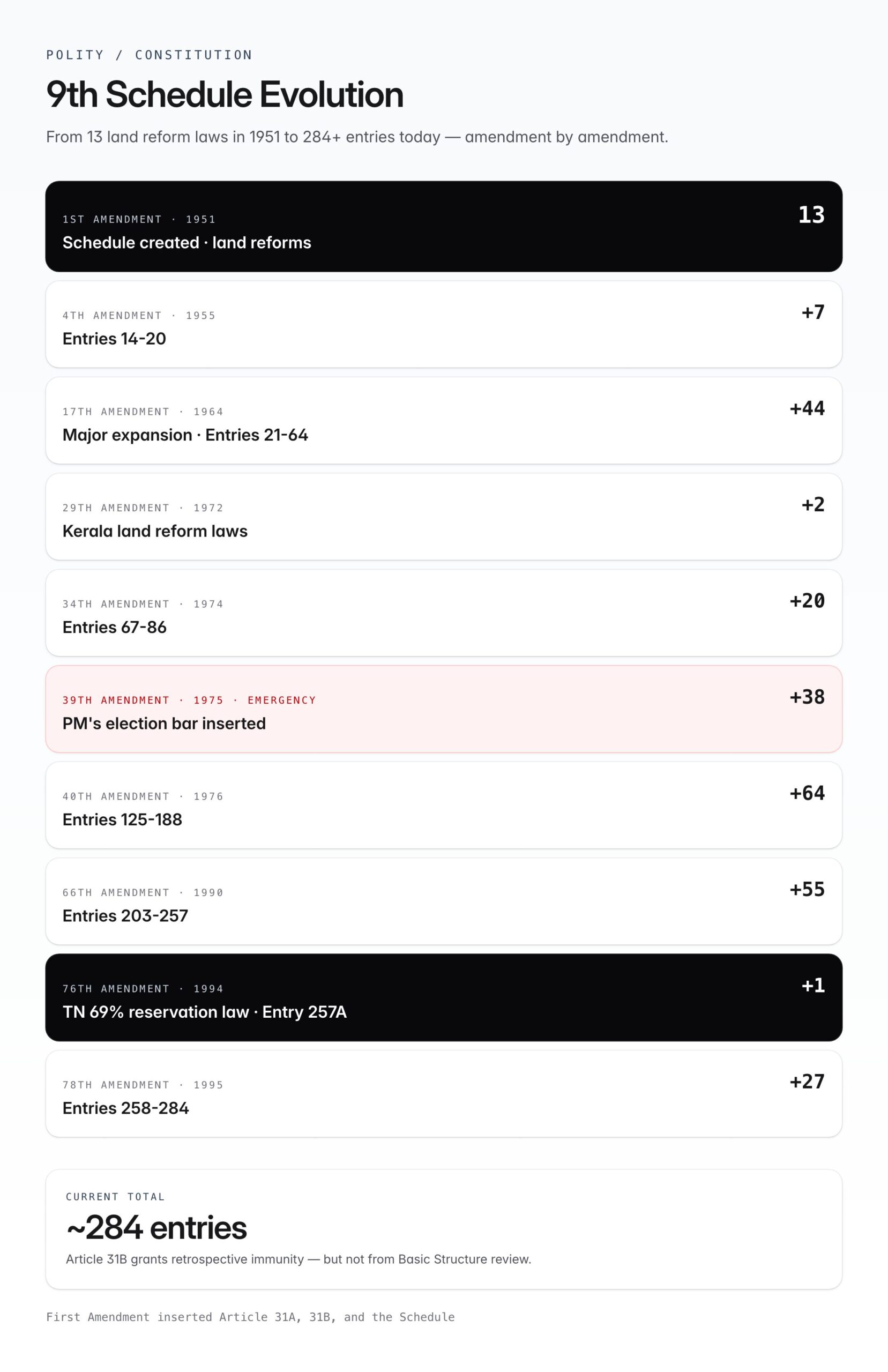
The Ninth Schedule has grown substantially:
| Amendment | Year | Entries Added |
|---|---|---|
| 1st Amendment | 1951 | Entries 1-13 (land reforms) |
| 4th Amendment | 1955 | Entries 14-20 |
| 17th Amendment | 1964 | Entries 21-64 (major expansion) |
| 29th Amendment | 1972 | Entries 65-66 (Kerala land reform laws) |
| 34th Amendment | 1974 | Entries 67-86 |
| 39th Amendment | 1975 | Entries 87-124 (Emergency-era insertions, including the PM's election challenge bar) |
| 40th Amendment | 1976 | Entries 125-188 |
| 47th Amendment | 1984 | Entries 189-202 |
| 66th Amendment | 1990 | Entries 203-257 |
| 76th Amendment | 1994 | Entry 257A — Tamil Nadu 69% reservation law |
| 78th Amendment | 1995 | Entries 258-284 |
Currently, the Ninth Schedule contains approximately 284 entries.
Key Laws in the Ninth Schedule
| Category | Examples |
|---|---|
| Land reform / zamindari abolition | Bihar Land Reforms Act, 1950; Uttar Pradesh Zamindari Abolition and Land Reforms Act, 1950 |
| Ceiling on land holdings | Various state Ceiling Acts |
| Tenancy reform | Kerala Land Reforms Act |
| Reservations | Tamil Nadu Backward Classes (Reservation) Act, 1993 — providing 69% reservation |
| Coal nationalisation | Coal Mines (Nationalisation) Act, 1973 |
| Monopolies regulation | Various industry-specific nationalisation statutes |
| Industrial laws | Essential Commodities Act, certain amendments |
The Tamil Nadu 69% reservation law (Entry 257A) is particularly noteworthy — it preserves reservations beyond the 50% cap set by the Supreme Court in Indra Sawhney (1992).
The Basic Structure Doctrine — Setting the Stage
Kesavananda Bharati Case (1973)
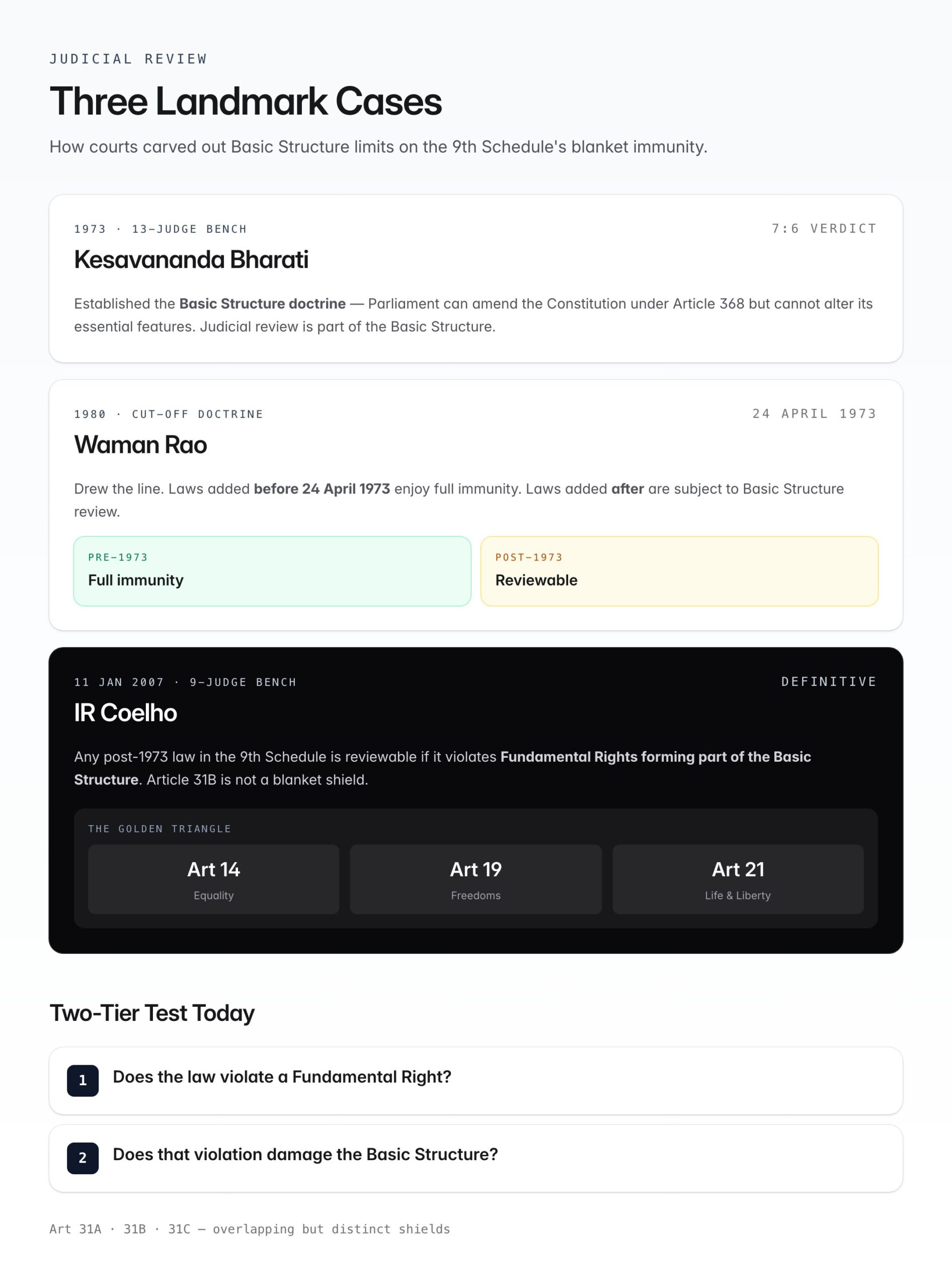
In Kesavananda Bharati v. State of Kerala, the Supreme Court by a 7:6 majority held:
- Parliament has wide powers to amend the Constitution under Article 368.
- However, it cannot alter the "Basic Structure" of the Constitution.
- Judicial review was held to be a part of the Basic Structure.
This set the stage for revisiting the blanket immunity of Article 31B.
Waman Rao Case (1980)
The Supreme Court in Waman Rao v. Union of India drew a crucial line:
- Laws placed in the Ninth Schedule before 24 April 1973 (the date of the Kesavananda judgment) enjoy full immunity.
- Laws added after 24 April 1973 are subject to judicial review if they violate the Basic Structure or Fundamental Rights forming part of it.
IR Coelho Case (2007) — The Definitive Verdict
IR Coelho v. State of Tamil Nadu (also known as the Ninth Schedule Case) was decided by a 9-judge Constitution Bench of the Supreme Court on 11 January 2007.
Key Holdings
| Principle | Explanation |
|---|---|
| Post-1973 laws subject to review | Any law placed in the Ninth Schedule after 24 April 1973 can be challenged if it violates Fundamental Rights forming part of the Basic Structure |
| Rights that are Basic Structure | Articles 14, 19, 21 and the Golden Triangle are part of the Basic Structure and cannot be abrogated |
| Rights-based test | The challenge must show that the law damages or destroys the essence of these fundamental rights |
| No blanket immunity | Article 31B cannot provide a blanket shield when the Basic Structure is violated |
| Validity of pre-1973 entries affirmed | Waman Rao ruling on pre-1973 laws remains undisturbed |
Significance of IR Coelho
- Reaffirmed the supremacy of the Basic Structure doctrine.
- Restored judicial review as the ultimate safeguard of Fundamental Rights.
- Created a two-tier test for Ninth Schedule challenges: (i) Does the law violate a Fundamental Right? (ii) Does that violation damage the Basic Structure?
Controversies and Criticism
- Emergency-era misuse (1975-77) — the 39th Amendment placed the law protecting Indira Gandhi's election from judicial scrutiny in the Schedule, widely seen as abuse.
- Reservation debates — the Tamil Nadu 69% law and similar provisions raise questions about judicial limits on caste-based reservations.
- Parliamentary overreach — the Schedule has been used to insert statutes that have little to do with land reforms (its original purpose).
- Federalism concerns — most entries are state laws; the Centre's power to immunise state laws via constitutional amendments raises federalism debates.
Comparison — Article 31A, 31B, 31C
| Article | Scope of Protection |
|---|---|
| Article 31A | Laws relating to estates, industrial undertakings, amalgamation, mineral rights — protected against Articles 14 and 19 |
| Article 31B | All laws placed in the Ninth Schedule — protected against all Fundamental Rights (subject to Basic Structure) |
| Article 31C | Laws giving effect to Directive Principles in Articles 39(b) and 39(c) — protected against Articles 14 and 19 |
Current Position
- Laws added to the Ninth Schedule before 24 April 1973 — immune from judicial review.
- Laws added to the Ninth Schedule after 24 April 1973 — subject to judicial review on the ground of violating the Basic Structure, including Fundamental Rights that form part of it (Articles 14, 19, 21).
- Article 31B is not an absolute shield — it operates within the framework of the Basic Structure doctrine.
UPSC Relevance
GS Paper II: Indian Constitution — Historical Underpinnings, Evolution, Features, Amendments, Significant Provisions; Judicial Review; Basic Structure Doctrine.
Prelims key points:
- The Ninth Schedule was added by the First Constitutional Amendment Act, 1951, along with Article 31B.
- Its original purpose was to protect land reform (zamindari abolition) laws from judicial review.
- Article 31B grants retrospective immunity from Fundamental Rights to all laws placed in the Schedule.
- The Schedule currently contains approximately 284 entries.
- Kesavananda Bharati (1973) established the Basic Structure doctrine.
- Waman Rao (1980) held that post-24 April 1973 entries are subject to Basic Structure review.
- IR Coelho v. State of Tamil Nadu (2007) — 9-judge bench ruled that laws added to the Ninth Schedule after 24 April 1973 are subject to judicial review if they violate the Basic Structure (Articles 14, 19, 21).
- The Tamil Nadu 69% reservation law was placed in the Ninth Schedule by the 76th Amendment (1994).
- Article 31B is distinct from Article 31A (estates) and Article 31C (DPSP implementation).