Disclosure: this guide contains Amazon affiliate links. As an Amazon Associate, Anantam IAS earns from qualifying purchases — at no extra cost to you.
Introduction
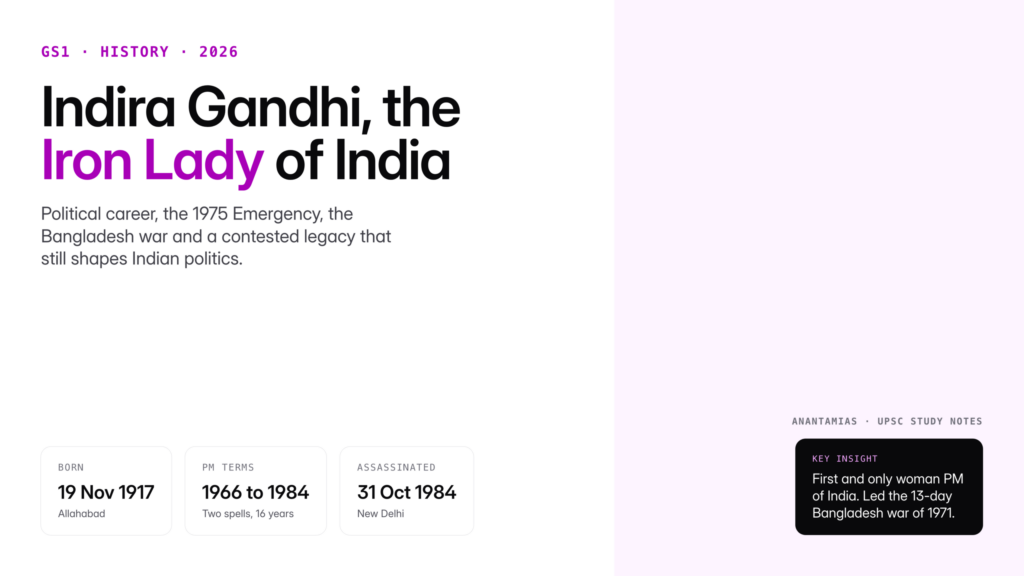
Indira Priyadarshini Gandhi was the third Prime Minister of India and, as of 2026, the only woman to have held that office. She served from January 1966 to March 1977 and again from January 1980 until her assassination on 31 October 1984. Her sixteen years at the helm of Indian government are among the most decisive in the country’s post-Independence history, shaping the idiom of the Indian state, the texture of its federalism, the economic direction of a generation, and the collective memory of what a democracy can survive.
For a civil services aspirant, the life of Indira Gandhi sits across three papers. It is modern Indian history in GS Paper 1, Indian polity in GS Paper 2 through the Emergency and the 42nd Amendment, and international relations through the 1971 Bangladesh war and the Indo-Soviet Treaty. This note organises the biography, career and legacy around the decisions and episodes you are most likely to be examined on, from bank nationalisation to Operation Blue Star.
Quick Facts at a Glance
| Attribute | Detail |
|---|---|
| Full Name | Indira Priyadarshini Gandhi (née Nehru) |
| Date of Birth | 19 November 1917, Allahabad, United Provinces |
| Date of Death | 31 October 1984, New Delhi |
| Father | Jawaharlal Nehru, first Prime Minister of India |
| Husband | Feroze Gandhi, journalist and parliamentarian |
| First Term as PM | 24 January 1966 to 24 March 1977 |
| Second Term as PM | 14 January 1980 to 31 October 1984 |
| Party | Indian National Congress, later Congress (R) and Congress (I) |
| Notable Title | First and only woman Prime Minister of India |
Background and Historical Context
Indira Gandhi was born into the Nehru-Gandhi family at Anand Bhavan in Allahabad, the only child of Jawaharlal Nehru and Kamala Nehru. Her childhood coincided with the peak years of the Indian freedom struggle, and she grew up amid the comings and goings of Mahatma Gandhi, Sarojini Naidu and the senior Congress leadership at Anand Bhavan. As a schoolgirl she formed the Vanar Sena, or monkey brigade, of children who helped the freedom struggle by carrying messages and watching over protesters.
Her formal education moved between Swiss schools, Shantiniketan under Rabindranath Tagore and Somerville College, Oxford, which she attended but did not formally complete owing to ill health. She married Feroze Gandhi, a Parsi journalist and later a Congress parliamentarian from Rae Bareli, in 1942. The couple had two sons, Rajiv and Sanjay, both of whom would later play central roles in her political life.
She cut her political teeth as her father’s hostess and travelling companion through the 1950s, meeting every major world leader of the era. She served as Congress President in 1959, overseeing the controversial dismissal of the elected communist government of Kerala under E M S Namboodiripad, an early signal of her willingness to centralise decision-making. After Nehru’s death in May 1964, Prime Minister Lal Bahadur Shastri inducted her into the Cabinet as Minister for Information and Broadcasting, a training ground for the national office she would assume eighteen months later when Shastri died suddenly in Tashkent in January 1966.
Key Features of Her Political Career
From Goongi Gudiya to Indomitable Leader
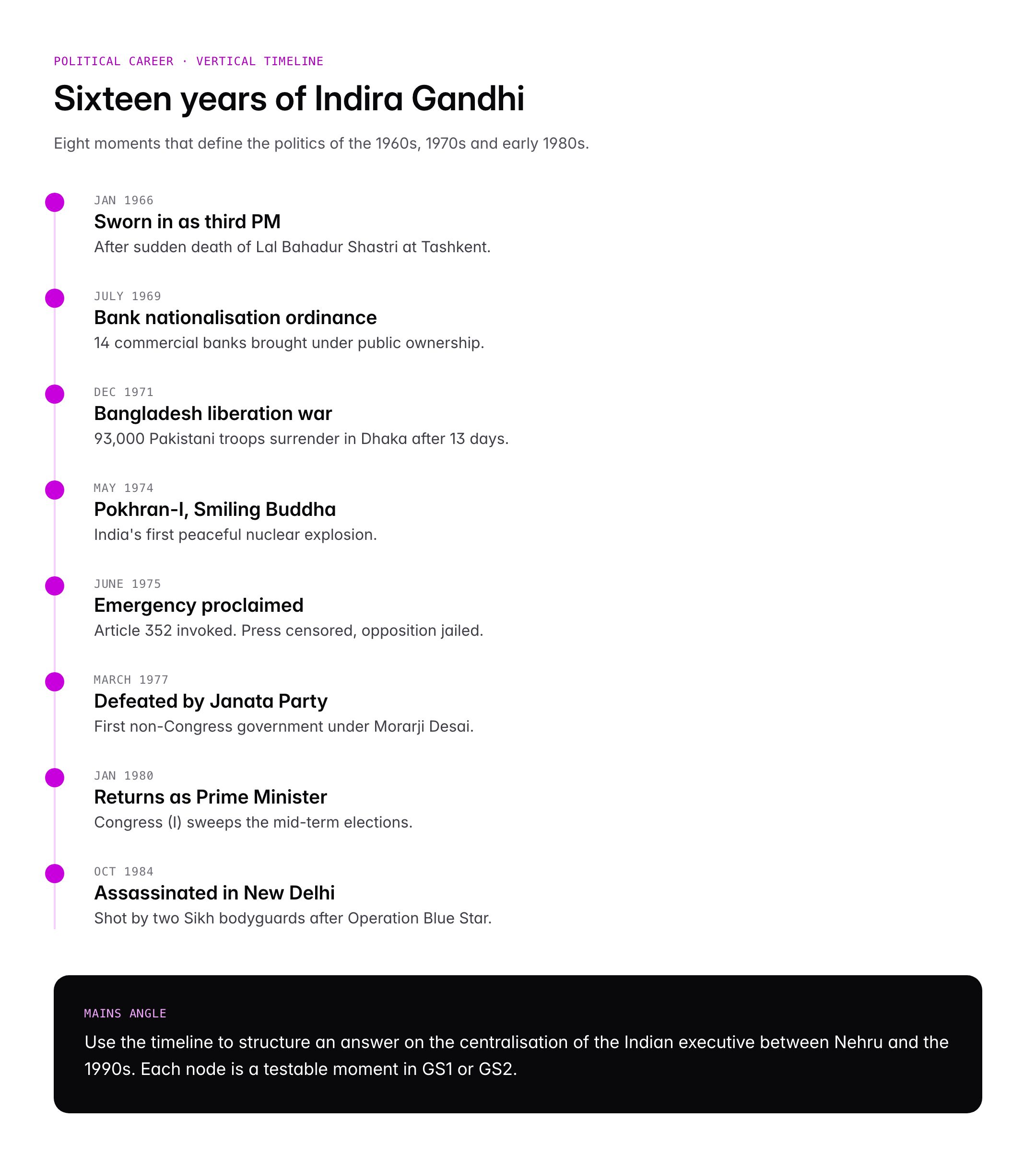
The Congress Parliamentary Board chose Indira Gandhi as Shastri’s successor in January 1966, partly because veterans of the Syndicate, led by K Kamaraj, believed she would be pliable. Opposition socialist leader Ram Manohar Lohia called her a goongi gudiya, or dumb doll. The label proved premature. Within three years she had split the Congress, ejected the Syndicate and emerged as the undisputed leader of the Congress (R), or Requisitionists.
Bank Nationalisation and Privy Purses, 1969 to 1971
In July 1969 the government promulgated an ordinance to nationalise fourteen major commercial banks holding over 85 percent of deposits. Though struck down briefly by the Supreme Court in the R C Cooper case, the move was re-legislated and became the defining act of her first term. In 1971 she abolished the privy purses and privileges of erstwhile princes through the 26th Constitutional Amendment. These two moves, combined with the Garibi Hatao campaign, delivered the 1971 Lok Sabha elections with a two-thirds majority.
1971 Bangladesh War
In December 1971 India intervened in the Bangladesh liberation struggle after the Pakistani military’s crackdown in East Pakistan sent nearly ten million refugees across the border. A thirteen-day war ended with the surrender of 93,000 Pakistani troops in Dhaka, the creation of Bangladesh and the Simla Agreement of 1972. It remains the most decisive military-political achievement of any Indian government, and President V V Giri conferred the Bharat Ratna on her in 1971.
The Emergency, 1975 to 1977
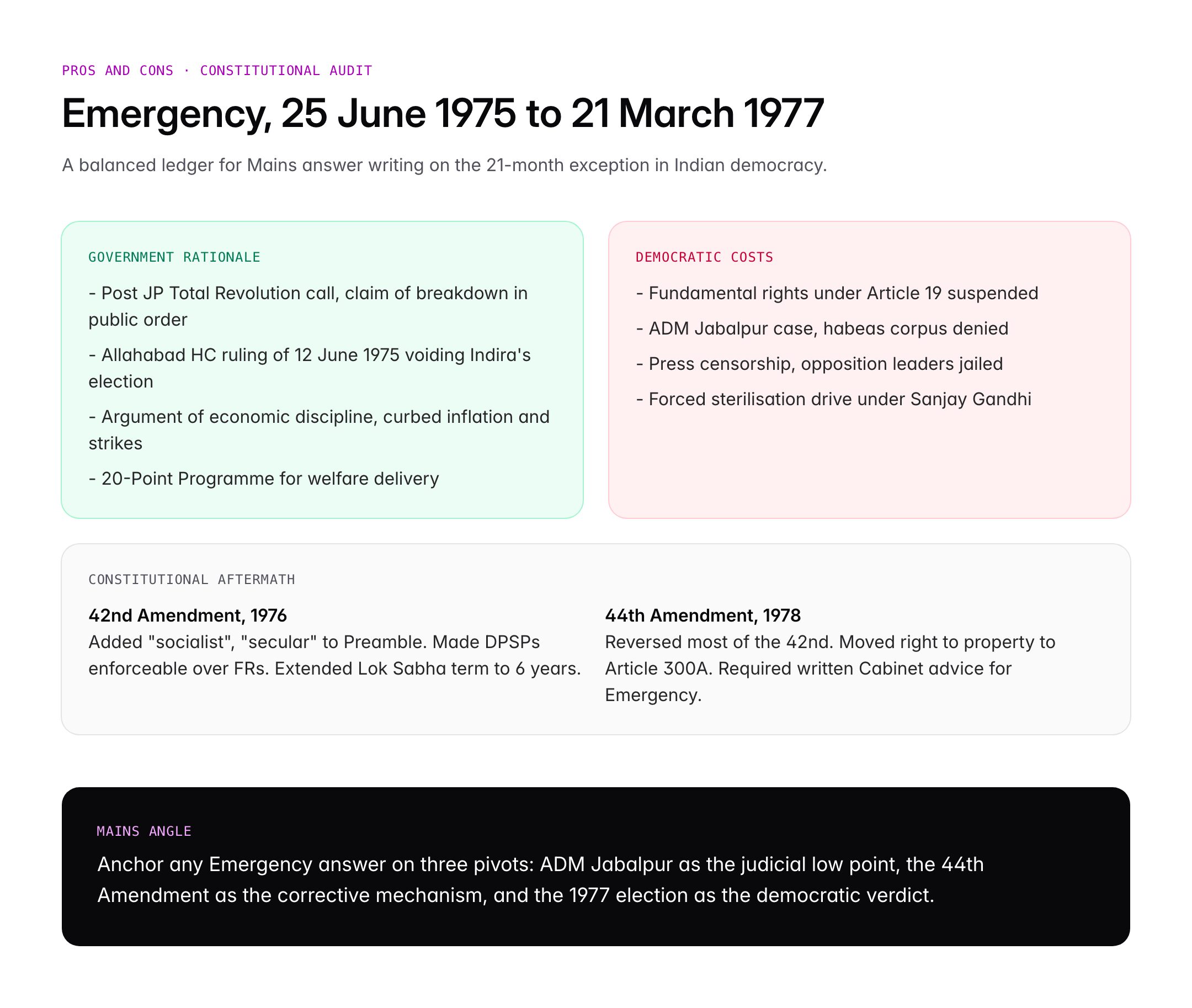
On 12 June 1975 the Allahabad High Court, in the Raj Narain vs Indira Gandhi case, set aside her election from Rae Bareli on grounds of electoral malpractice. On 25 June 1975 President Fakhruddin Ali Ahmed proclaimed a national Emergency under Article 352. The next 21 months suspended fundamental rights under Article 19, postponed elections, censored the press, arrested tens of thousands of opposition leaders including Jayaprakash Narayan, and enabled the 42nd Amendment, sometimes called a mini-Constitution. The Emergency ended in March 1977 when elections returned a Janata Party government led by Morarji Desai, the first non-Congress government at the Centre.
Return and Second Term, 1980 to 1984
The Janata experiment collapsed in 1979. Indira Gandhi won the January 1980 elections on a slogan promising stability and returned as Prime Minister. Her second term was marked by the Asiad Games of 1982, the Non-Aligned Movement summit of 1983, the space mission of Rakesh Sharma in 1984, and growing turmoil in Punjab that culminated in Operation Blue Star at the Golden Temple in June 1984. On 31 October 1984 she was assassinated by two of her Sikh bodyguards in the garden of her residence at 1 Safdarjung Road.
Significance for UPSC and General Knowledge
- The Emergency is the single most important case study for GS Paper 2 topics on fundamental rights, the basic structure doctrine and emergency provisions under Articles 352, 356 and 360.
- Bank nationalisation and the abolition of privy purses are GS Paper 3 anchors for the shift from Fabian planning to state socialism in India.
- The 1971 war offers a definitive GS Paper 2 and essay case study on India’s neighbourhood diplomacy, the Indo-Soviet Treaty and humanitarian intervention.
- Operation Blue Star and the subsequent riots link to GS Paper 4 discussions on secularism, ethical dilemmas of state action and minority rights.
- Her presidency of the Non-Aligned Movement and leadership at Cancun are high-yield points on the global South and North-South dialogue.
- She is the only recipient of the Bharat Ratna while serving as Prime Minister until 2026, an oft-asked Prelims factoid.
Detailed Analysis: Reign and Administration
Economic restructuring during Indira Gandhi’s first term pulled the Indian economy firmly into the state-directed orbit. In addition to bank nationalisation in 1969, her government nationalised the general insurance industry in 1972, the coal mines in 1973 and Indian Oil in 1974. The Monopolies and Restrictive Trade Practices Act, 1969 and the Foreign Exchange Regulation Act, 1973, or FERA, sharply restricted private capital, particularly foreign investment. The Green Revolution, launched by her predecessor, reached fruition under her watch with record wheat and rice output and the near elimination of ship-to-mouth food imports from the United States.
Constitutional restructuring produced amendments that are still debated in courtrooms and classrooms. The 24th Amendment, 1971 made Parliament’s amending power unambiguous. The 25th Amendment, 1971 curtailed the right to property and shielded land reform laws from judicial review. The landmark Kesavananda Bharati judgment of 1973 responded by articulating the basic structure doctrine, a check on Parliament’s amending power that remains the single most consequential doctrine in Indian constitutional law.
The Emergency period compressed into 21 months some of the deepest departures from constitutional practice since Independence. The 42nd Amendment, 1976, altered the Preamble to add the words socialist and secular, made the Directive Principles enforceable against Fundamental Rights, and extended the term of the Lok Sabha from five to six years. The 44th Amendment, 1978, passed by the Janata government, reversed most of these changes, moving the right to property from Part III to Article 300A and requiring written Cabinet advice before an Emergency can be proclaimed.
Foreign policy in Indira Gandhi’s years swung from Non-Alignment in rhetoric to a clear tilt towards the Soviet Union in practice. The Indo-Soviet Treaty of Peace, Friendship and Cooperation, 1971 underwrote Indian confidence during the Bangladesh war. She presided over the first peaceful nuclear explosion at Pokhran in May 1974, code-named Smiling Buddha. In 1983 she chaired the Non-Aligned Movement summit in New Delhi and in 1981 represented the South at the North-South summit in Cancun.
Punjab and the final months were defined by the rise of the Sikh separatist movement under Jarnail Singh Bhindranwale, his entrenchment inside the Golden Temple and Operation Blue Star from 1 to 8 June 1984. The military action, though militarily successful, alienated large sections of the Sikh community and preceded her assassination on 31 October 1984 and the anti-Sikh riots that followed.
Comparative Perspective
| Dimension | Jawaharlal Nehru | Indira Gandhi | Rajiv Gandhi |
|---|---|---|---|
| Years in office | 1947-1964 | 1966-1977, 1980-1984 | 1984-1989 |
| Economic posture | Mixed economy, planning | Statist socialism, nationalisation | Cautious liberalisation, computerisation |
| Signature domestic move | Five-Year Plans | Bank nationalisation, 1969 | Anti-Defection Law, 1985 |
| Foreign policy | Non-Alignment | Indira Doctrine, 1971 war | Sri Lanka IPKF, ASEAN outreach |
| Constitutional imprint | Planning Commission | 42nd Amendment, Emergency | 52nd, 61st (voting age to 18) Amendments |
The comparison highlights Indira Gandhi’s distinct signature. Where Nehru built institutions and Rajiv tried to modernise them, Indira Gandhi concentrated executive power, redirected the economy towards the state and placed India on the global map as a regional power.
Controversies and Debates
The Emergency of 1975 to 1977 remains the central ethical question of Indira Gandhi’s career. Scholars such as Granville Austin, Ramachandra Guha and Bipan Chandra have documented the suspension of fundamental rights, the ADM Jabalpur judgment in which the Supreme Court denied habeas corpus relief during Emergency, and excesses such as the mass sterilisation drive overseen by her son Sanjay Gandhi. Defenders argue that the Emergency responded to genuine public order breakdowns and to a total revolution call by Jayaprakash Narayan.
Other contested episodes include the imposition of President’s Rule on non-Congress state governments, particularly Kerala in 1959 when she was Congress President and the DMK government in Tamil Nadu in 1976. The economic record is also debated, with critics pointing to the slow Hindu rate of growth and licence-permit raj that reached its peak in her years, and supporters pointing to the public-sector base that supported later liberalisation.
Prelims Pointers
- Indira Gandhi was born on 19 November 1917 in Allahabad.
- She served two terms as Prime Minister of India, 1966-1977 and 1980-1984.
- She became the first and so far only woman Prime Minister of India in January 1966.
- Fourteen commercial banks were nationalised through an ordinance on 19 July 1969.
- The 25th, 26th and 42nd Constitutional Amendments are associated with her tenure.
- The Kesavananda Bharati case was decided in April 1973 during her first term.
- The Emergency was proclaimed on 25 June 1975 under Article 352 on grounds of internal disturbance.
- India’s first peaceful nuclear test, code-named Smiling Buddha, was conducted on 18 May 1974 at Pokhran.
- The Indo-Soviet Treaty of Peace, Friendship and Cooperation was signed on 9 August 1971.
- She was awarded the Bharat Ratna in 1971 after the Bangladesh war.
- Operation Blue Star was conducted at the Golden Temple, Amritsar, from 1 to 8 June 1984.
- She was assassinated on 31 October 1984 at 1 Safdarjung Road, New Delhi.
Mains Practice Questions
Q1. “The Emergency of 1975 exposed both the fragility and the resilience of Indian democracy.” Discuss, with reference to the constitutional, political and judicial consequences of the period. (15 marks, 250 words)
- Outline the proclamation of Emergency under Article 352 and the 42nd Amendment.
- Analyse institutional damage through ADM Jabalpur and restoration through the 44th Amendment and judicial review.
- Conclude with the role of the 1977 election as evidence of democratic resilience.
Q2. Evaluate the contribution of Indira Gandhi’s tenure to the conduct of Indian foreign policy and India’s rise as a regional power in South Asia. (15 marks, 250 words)
- Discuss the 1971 war, Simla Agreement and creation of Bangladesh.
- Analyse the Indo-Soviet Treaty, Pokhran I and NAM leadership.
- Conclude with the long-term effects on the Indian neighbourhood and strategic autonomy.
Conclusion
Indira Gandhi’s sixteen years at the centre of Indian politics made her the most consequential national leader between Nehru and Modi. She converted the Congress from a federal umbrella into a personalised vehicle, recentralised economic decision-making, and placed India firmly on the strategic map of South Asia after the creation of Bangladesh. She also presided over the most serious democratic rupture in the history of the Republic and paid, by her life, for the Punjab decisions of her last year in office.
For an aspirant her record is a lesson in the ambivalence of political power. Institutions can be built and they can be bent in the same career. Strong leadership can deliver a war in thirteen days and it can also suspend fundamental rights for twenty-one months. A good Mains or Essay answer on Indira Gandhi carries this tension forward rather than collapsing it into hagiography or caricature.
Frequently Asked Questions
Who was Indira Gandhi?
Indira Priyadarshini Gandhi was the third Prime Minister of India, serving from January 1966 to March 1977 and again from January 1980 until her assassination on 31 October 1984. The only daughter of Jawaharlal Nehru, she remains the first and only woman to have held the office of Prime Minister of India and led the country through the 1971 Bangladesh war and the 1975 Emergency.
Why is Indira Gandhi important for UPSC preparation?
Her career is tested across GS Papers 1, 2 and 3 of the Mains syllabus. The 1975 Emergency, bank nationalisation, 42nd Amendment, Kesavananda Bharati case, the 1971 Bangladesh war, Pokhran I and the Indo-Soviet Treaty all trace to her tenure. Ethics and case-study questions draw on Operation Blue Star and the anti-Sikh riots that followed her assassination.
How is Indira Gandhi related to the Nehru-Gandhi family and the Congress party?
She was the only child of Jawaharlal Nehru and Kamala Nehru and the mother of Rajiv and Sanjay Gandhi. She served as Congress President in 1959 and split the party in 1969 into Congress (O) and Congress (R). After the 1977 defeat she formed Congress (I), which became the mainline Congress. Her family name comes from her husband Feroze Gandhi, unrelated to Mahatma Gandhi.
When was the Emergency declared by Indira Gandhi?
Indira Gandhi advised President Fakhruddin Ali Ahmed to proclaim a national Emergency under Article 352 of the Constitution on 25 June 1975, citing internal disturbance. It lasted 21 months and was lifted on 21 March 1977. During this period fundamental rights were suspended, opposition leaders were jailed, and the 42nd Constitutional Amendment was enacted.
What were the major economic reforms under Indira Gandhi?
Her government nationalised fourteen major commercial banks in July 1969, abolished privy purses through the 26th Amendment in 1971, nationalised general insurance in 1972, coal mines in 1973 and Indian Oil in 1974. The MRTP Act of 1969 and FERA of 1973 restricted monopolies and foreign investment. The Green Revolution matured during her first term, ending dependence on PL-480 wheat imports.
What was India’s role in the 1971 Bangladesh liberation war under Indira Gandhi?
When Pakistan’s military crackdown in East Pakistan triggered a refugee exodus of nearly ten million into India, Indira Gandhi authorised military support to the Mukti Bahini and formal intervention in December 1971. A thirteen-day war ended with the surrender of about 93,000 Pakistani troops in Dhaka on 16 December 1971 and the creation of Bangladesh. The Simla Agreement followed in July 1972.
What was Operation Blue Star and how is it linked to Indira Gandhi’s assassination?
Operation Blue Star was the Indian Army action at the Golden Temple complex in Amritsar between 1 and 8 June 1984 to flush out Jarnail Singh Bhindranwale and armed militants. The operation damaged the Akal Takht and alienated sections of the Sikh community. On 31 October 1984 Indira Gandhi was shot by two of her Sikh security guards, Beant Singh and Satwant Singh, at her residence in New Delhi.
What is the legacy of Indira Gandhi in Indian politics?
Her legacy is contested. Admirers credit her with the liberation of Bangladesh, the peaceful nuclear test of 1974, the Green Revolution’s consolidation and her role in the Non-Aligned Movement. Critics hold her accountable for the Emergency, the centralisation of the Congress party, the slow Hindu rate of growth and the alienation of Punjab. Both strands shape her standing in the Indian political imagination.
Tell Google you want more of this.
Add Anantam IAS as a preferred sourceOne tap, and this site shows up more often in your own Top Stories, AI Overviews and AI Mode. Remove it any time.