Allotropes of Carbon: Diamond, Graphite, Fullerenes, Graphene Guide
Allotropes of carbon include diamond, graphite, fullerenes, graphene, and carbon nanotubes. Complete UPSC guide to structures and uses.
The allotropes of carbon are the different structural forms in which the element carbon exists, each with distinct physical properties despite identical chemical composition. Carbon's ability to form four covalent bonds and to catenate with itself produces an extraordinary range of allotropes, from the hardest natural substance (diamond) to one of the softest (graphite), and from zero-dimensional cage molecules (fullerenes) to one-dimensional carbon nanotubes and two-dimensional graphene. Because carbon allotropes underpin everything from jewellery and pencil leads to semiconductor research and battery electrodes, they appear regularly in UPSC Prelims, Science and Technology sections of GS III, and current affairs on materials science.
What Are Allotropes
Allotropy is the property of certain chemical elements to exist in two or more different physical forms in the same physical state. The different forms are called allotropes, and they differ in how their atoms are arranged in space.
Allotropes of carbon are broadly divided into two families:
- Crystalline allotropes — atoms arranged in an orderly, repeating lattice. Includes diamond, graphite, fullerenes, carbon nanotubes, and graphene.
- Amorphous allotropes — atoms arranged without long-range order. Includes coal, coke, charcoal, lamp black, and carbon black.
The property differences among allotropes arise purely from bonding geometry and hybridisation (sp, sp², sp³), not from any difference in elemental identity.
Crystalline Allotropes
Diamond
Diamond is a three-dimensional network of carbon atoms, each sp³-hybridised and bonded tetrahedrally to four neighbours. This rigid lattice makes diamond:
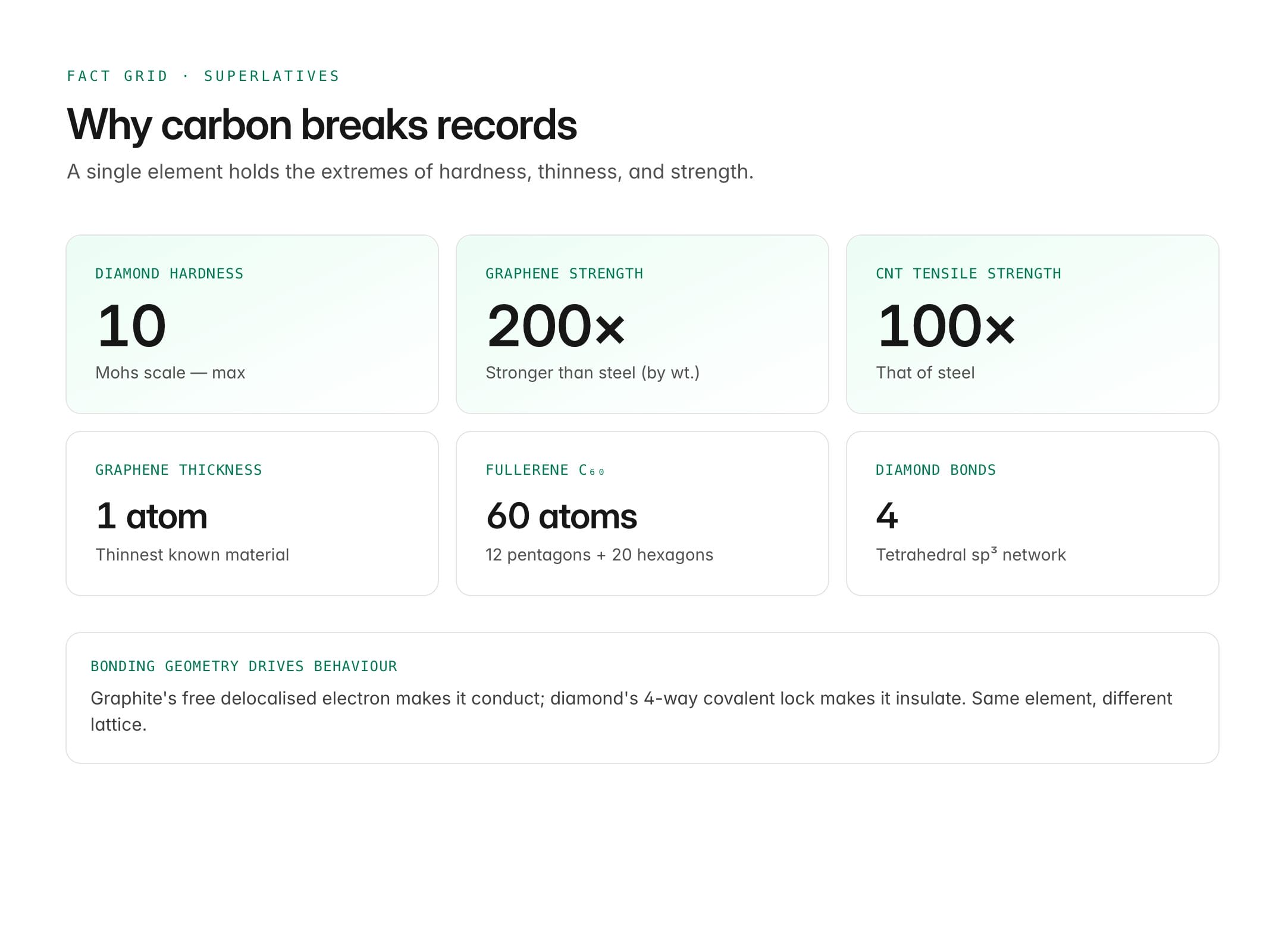
- The hardest naturally occurring substance (10 on the Mohs scale).
- An electrical insulator (no free electrons) but an excellent thermal conductor.
- Transparent to visible light, with a high refractive index.
Uses include cutting and drilling tools, abrasives, heat sinks in electronics, and gemstones. Synthetic diamonds are produced by high-pressure, high-temperature (HPHT) and chemical vapour deposition (CVD) processes.
Graphite
Graphite is a layered structure in which each carbon is sp²-hybridised and bonded to three neighbours in a hexagonal plane. Layers are held together by weak van der Waals forces, so they slide easily. Key properties:
- Soft and slippery (used in pencils and as a lubricant).
- Conducts electricity because one electron per atom is delocalised in the layer.
- High melting point and chemical inertness.
Graphite is central to electrodes, lithium-ion battery anodes, nuclear reactor moderators, and refractory crucibles.
Fullerenes
Fullerenes are closed-cage molecules made entirely of carbon. The most famous, Buckminsterfullerene (C₆₀), is a soccer-ball-shaped molecule of 60 atoms arranged in 12 pentagons and 20 hexagons. Discovered in 1985 by Curl, Kroto, and Smalley (Nobel Prize in Chemistry, 1996), fullerenes opened nanotechnology as a field. Applications include drug delivery research, superconductors, and photovoltaics.
Carbon Nanotubes (CNTs)
Carbon nanotubes are cylindrical rolls of graphene sheets. They can be single-walled (SWCNT) or multi-walled (MWCNT). CNTs exhibit:
- Tensile strength ~100 times that of steel at a fraction of the weight.
- Metallic or semiconducting behaviour depending on chirality.
- Excellent thermal conductivity.
Uses include composites for aerospace, field-effect transistors, and water filtration membranes.
Graphene
Graphene is a single two-dimensional sheet of sp²-bonded carbon atoms in a hexagonal lattice. Isolated in 2004 by Andre Geim and Konstantin Novoselov (Nobel Prize in Physics, 2010), it is:
- The thinnest known material (one atom thick).
- ~200 times stronger than steel by weight.
- An exceptional conductor of heat and electricity.
Graphene is being explored for flexible electronics, ultra-fast transistors, sensors, and next-generation batteries.
Amorphous Allotropes
Amorphous carbons lack crystalline order and are typically produced by partial combustion or thermal decomposition of organic matter.
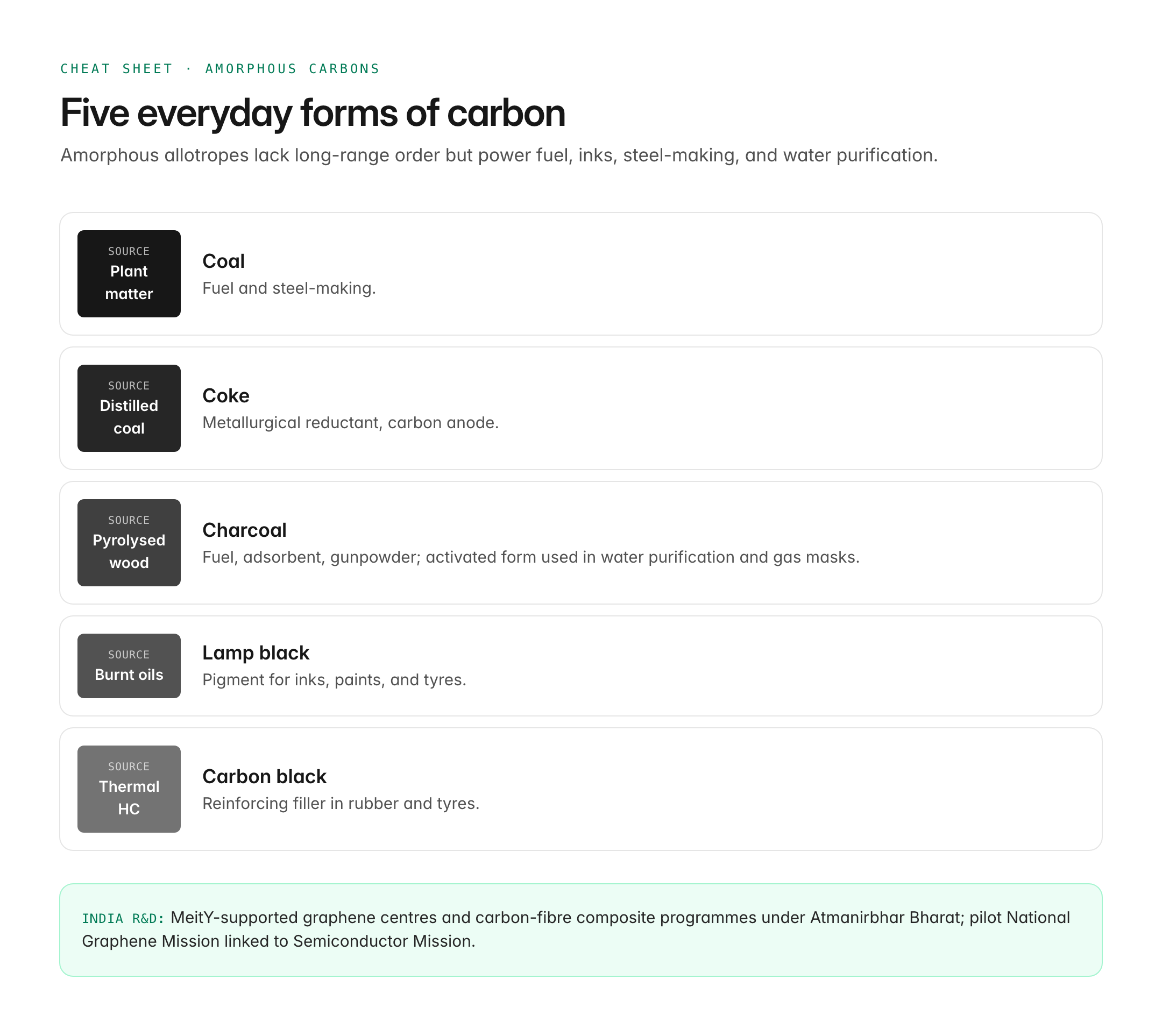
| Form | Source | Common Use |
|---|---|---|
| Coal | Buried plant matter, geological time | Fuel, steel-making |
| Coke | Destructive distillation of coal | Metallurgy, carbon anode |
| Charcoal | Pyrolysis of wood | Fuel, adsorbent, gunpowder |
| Lamp black | Incomplete combustion of oils | Inks, paints, tyres |
| Carbon black | Thermal decomposition of hydrocarbons | Rubber reinforcement |
Activated charcoal, with its high internal surface area, is widely used for water purification, gas masks, and medical detoxification.
Comparing Key Allotropes
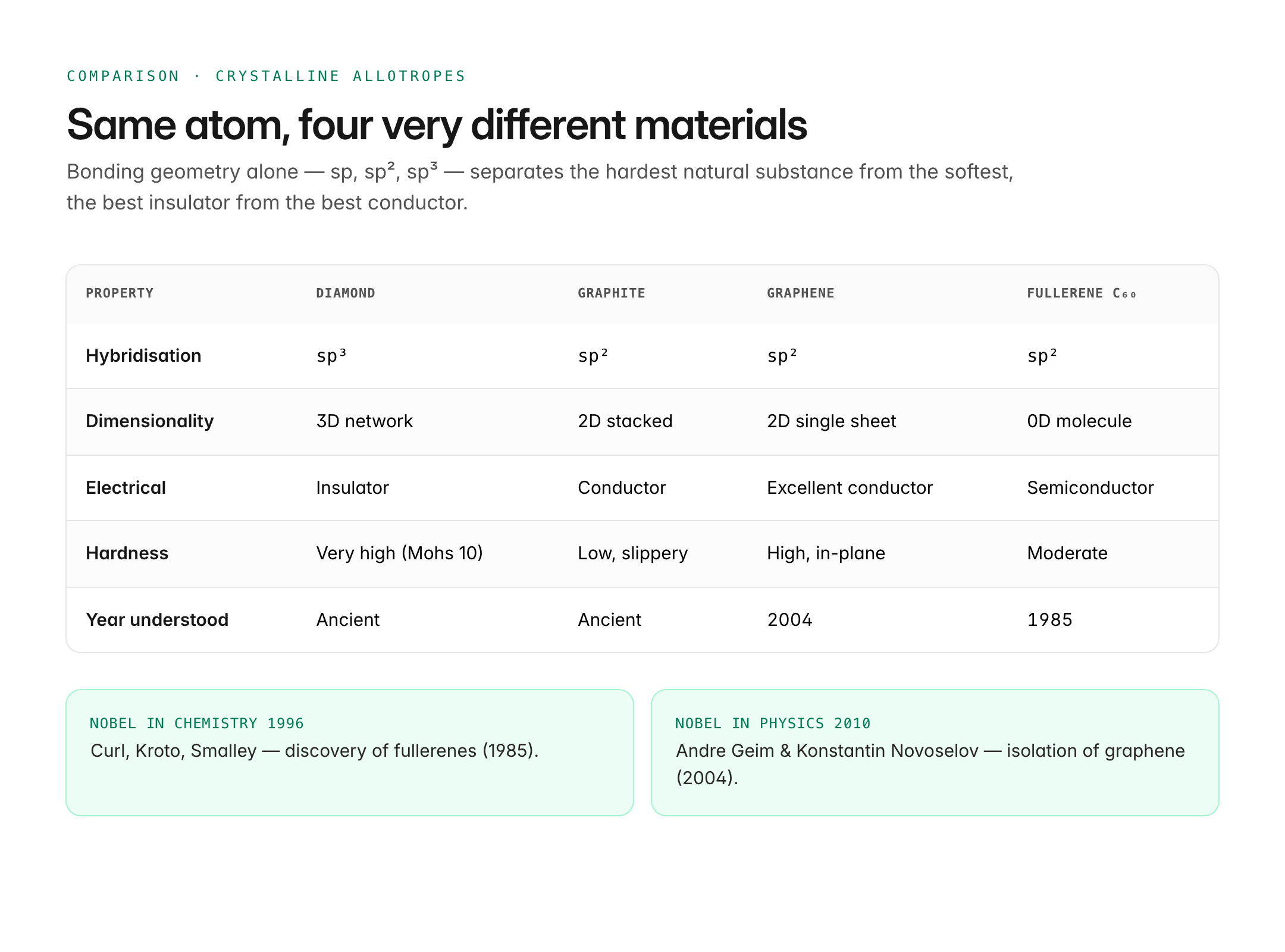
| Property | Diamond | Graphite | Graphene | Fullerene C₆₀ |
|---|---|---|---|---|
| Hybridisation | sp³ | sp² | sp² | sp² |
| Dimensionality | 3D | 2D stacked | 2D single sheet | 0D molecule |
| Electrical conductivity | Insulator | Conductor | Excellent conductor | Semiconductor |
| Hardness | Very high | Low | High (in-plane) | Moderate |
| Year understood | Ancient | Ancient | 2004 | 1985 |
The contrast between diamond (hardest) and graphite (softest crystalline) is a classic UPSC factual comparison.
Significance and Applications
Carbon allotropes are foundational to modern materials science. Their significance spans:
- Energy storage — graphite anodes and graphene-based supercapacitors.
- Electronics — graphene and CNT transistors as potential post-silicon candidates.
- Medicine — fullerene-based drug delivery and MRI contrast agents.
- Environment — activated carbon for pollution control; graphene membranes for desalination.
- Strategic materials — synthetic diamonds for precision tooling and quantum sensors.
India has dedicated research programmes on graphene (through MeitY-supported centres) and on carbon fibre composites for defence and aerospace under the Atmanirbhar Bharat initiative.
UPSC Relevance
Prelims focus: identification of allotropes, hybridisation state, conductivity pattern (graphite conducts, diamond does not), discoverers of fullerenes (1985) and graphene (2004), and Nobel Prize years. Matching-type questions often pair allotrope with use.
Mains GS angle:
- GS III — developments in science and technology, nanotechnology, indigenous materials research.
- Application-based questions on emerging materials for batteries, semiconductors, and clean energy.
Sample PYQ angle: UPSC has asked about graphene's properties and applications (Prelims 2012-style factual), and about the role of advanced materials in strategic sectors. Answers should distinguish bonding geometry, illustrate with two or three allotropes, and connect to current Indian R&D missions like the National Graphene Mission pilot and the Semiconductor Mission.