Graphene is a single, two-dimensional layer of carbon atoms arranged in a perfect honeycomb lattice. Just one atom thick, it is the thinnest material ever isolated, and yet roughly 200 times stronger than steel, the best electrical and thermal conductor known at room temperature, and almost completely transparent. Its 2004 isolation by Andre Geim and Konstantin Novoselov at the University of Manchester — using nothing more exotic than ordinary scotch tape and a lump of graphite — won them the 2010 Nobel Prize in Physics and launched the global "2D-materials" revolution.
For UPSC, graphene is a flagship example of how fundamental science crosses into strategic materials policy. It sits squarely under GS III — Science & Technology, with strong overflow into Economy (manufacturing competitiveness) and Environment (clean-energy applications).
What is graphene — the underlying science
Graphite, the soft black material in pencils, is made of millions of stacked layers of carbon held together loosely by van der Waals forces. Graphene is what you get when you isolate a single one of those layers.
Carbon has four valence electrons. In graphene, three of them form sp² hybridised covalent bonds with neighbouring carbons, creating a planar hexagonal lattice. The fourth electron sits in a delocalised π-orbital above and below the sheet. These free π electrons travel almost without scattering, giving graphene its astonishing electronic properties.
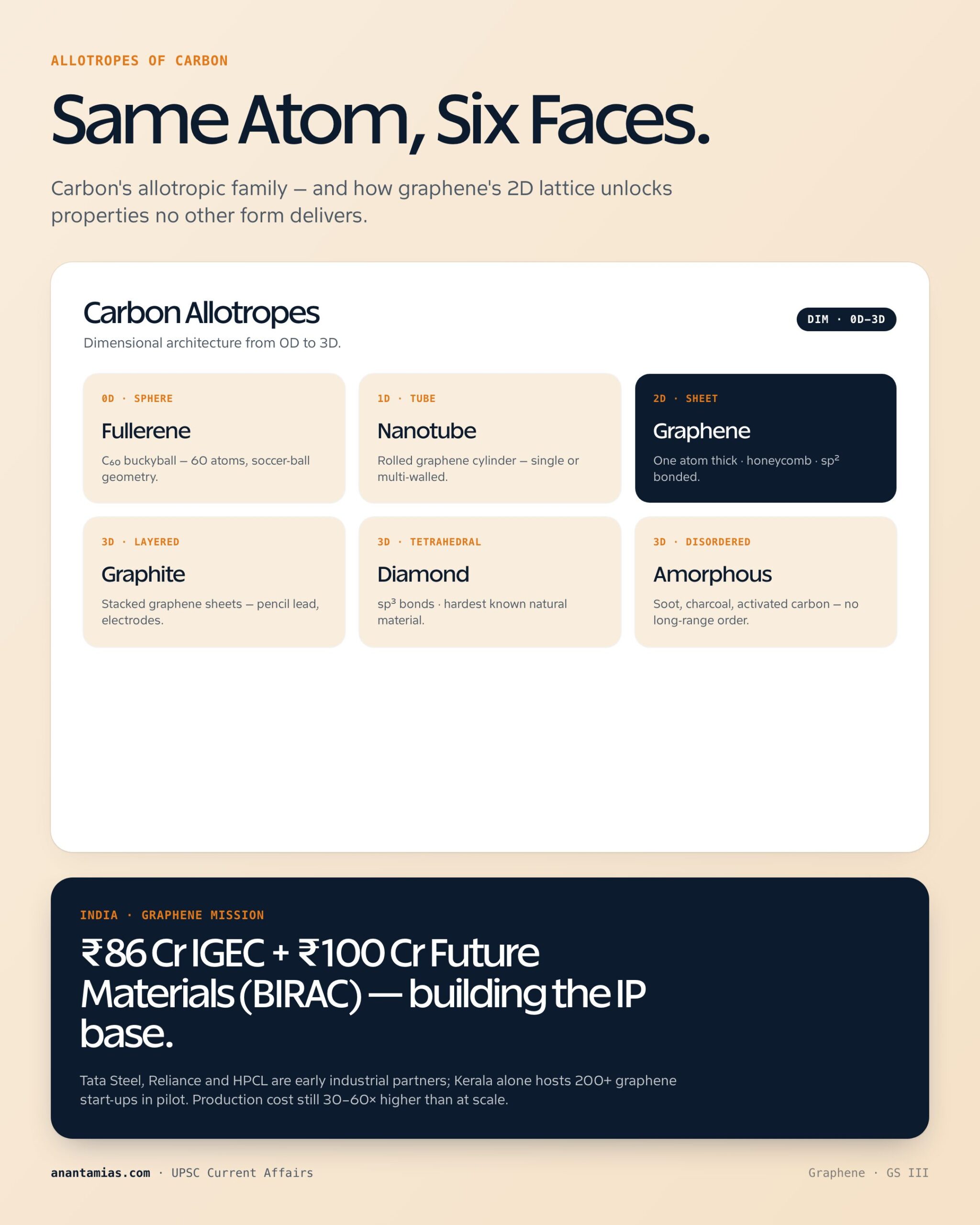
Allotropes of carbon
Graphene is part of a family of pure-carbon forms with very different structures:
| Allotrope | Dimensionality | Structure |
|---|---|---|
| Diamond | 3D | sp³ tetrahedral lattice |
| Graphite | 3D (stacked 2D) | Layers of graphene held by weak forces |
| Graphene | 2D | Single hexagonal carbon sheet |
| Carbon nanotubes | 1D | Rolled-up graphene tube |
| Fullerenes (C60) | 0D | Spherical carbon cage |
| Amorphous carbon | None (disordered) | Charcoal, soot |
Properties of graphene
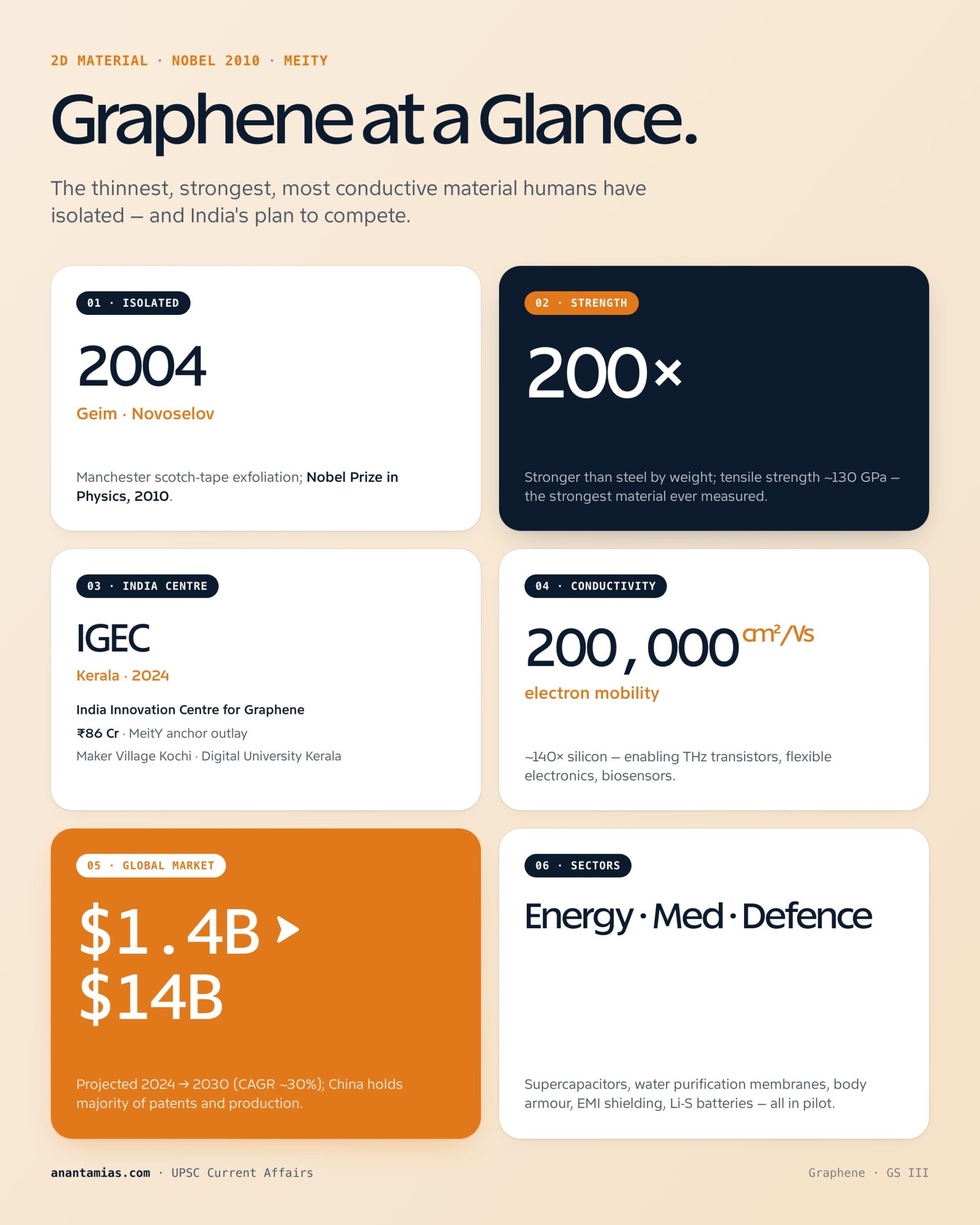
| Property | Value | Significance |
|---|---|---|
| Tensile strength | ~130 GPa | ~200× stronger than structural steel |
| Young's modulus | ~1 TPa | Among stiffest materials known |
| Electrical conductivity | ~10⁸ S/m at room temperature | Better than copper |
| Electron mobility | ~200,000 cm²/Vs | 100× silicon |
| Thermal conductivity | ~5,000 W/mK | Higher than diamond |
| Optical transparency | ~97.7% (single layer) | Almost invisible |
| Surface area | ~2,630 m²/g | Massive for a solid; ideal for batteries, sensors |
| Impermeability | Blocks even helium | Excellent barrier material |
These properties stem directly from its sp² lattice: the carbon-carbon bond is one of the strongest in chemistry, and the Dirac cone band structure lets electrons behave like massless particles, accelerating to high speeds without resistance.
How graphene is made
Several methods coexist, each with its own cost-quality trade-off:
- Mechanical exfoliation — the original "scotch-tape" method. Best quality but tiny flakes.
- Chemical vapour deposition (CVD) — methane decomposes on a hot copper foil, depositing a graphene layer. Workhorse for high-quality films used in electronics.
- Liquid-phase exfoliation — graphite is sonicated in solvents to peel off layers; produces graphene ink.
- Reduction of graphene oxide (rGO) — graphite is oxidised, exfoliated, then chemically or thermally reduced; cheapest, lower quality, used in composites and energy storage.
- Epitaxial growth on SiC — silicon carbide is heated; silicon evaporates, leaving a graphene layer.
- Plasma-arc and flash-graphene — emerging routes that turn waste plastics into graphene.
Applications of graphene
Graphene's versatility is unusual in materials science.
Energy
- Supercapacitors — high surface area enables ultra-fast charging.
- Lithium-ion battery anodes/cathodes — graphene-coated electrodes improve conductivity, cycle life and charge speed.
- Solar cells — transparent conductive electrodes; perovskite-graphene hybrids.
- Hydrogen storage — high surface area for adsorption.
- Fuel cells — catalyst supports.
Electronics
- Flexible and foldable displays — replaces brittle indium tin oxide (ITO).
- Transistors and logic — high-frequency RF transistors for 6G and beyond.
- Photodetectors — broadband, ultrafast.
- Memory devices — graphene-based RRAM and floating-gate memories.
- Wearable sensors — strain, temperature, biochemical.
Composites
- Aerospace and automotive — graphene-reinforced polymers and metals.
- Sports equipment — tennis rackets, helmets, cycling tyres.
- Construction — graphene-cement, graphene-bitumen for stronger roads.
- Defence textiles — body armour, ballistic plates.
Medicine and water
- Drug delivery — functionalised graphene oxide carries drugs to target tissues.
- Biosensors — DNA, glucose, virus detection.
- Antibacterial coatings — graphene oxide damages bacterial membranes.
- Water filtration — graphene oxide membranes for desalination and heavy-metal removal.
Pandemic-era surge
Graphene-coated face masks and antiviral coatings for hospital surfaces saw a major push during COVID-19; graphene is reusable, antibacterial, and effective against viral particles when properly engineered.
India's graphene story
India holds the world's fifth largest graphite reserves (around 8 million tonnes) and is among the top global producers. Translating that mineral advantage into downstream graphene manufacturing has been a stated policy priority.
Key institutional pushes
| Initiative | Agency | Detail |
|---|---|---|
| India Innovation Centre for Graphene (IICG) | MeitY + Kerala govt + Tata Steel | At Maker Village, Kochi; aims to be Asia's first graphene innovation hub |
| National Centre of Excellence on Graphene | MeitY-Karnataka discussions | Proposed advanced research and pilot lines |
| National Mission on Interdisciplinary Cyber-Physical Systems (NM-ICPS) | DST | Funds graphene labs at IITs |
| Materials on Demand programme | DST | Scale-up of advanced 2D materials |
| Graphene Aurora Programme | MeitY (announced 2023) | Roadmap for graphene-based products and start-ups |
| CSIR labs (NCL, CSIR-CECRI, NPL) | CSIR | Graphene synthesis, supercapacitors, sensors |
| Indian Graphene Engineering and Innovation Centre | Karnataka (announced 2024) | Pilot manufacturing in Bengaluru |
Indian start-ups (e.g., Log9 Materials, Tata Steel's graphene division, Ad-Nano Technologies, GrapheneIndia) are exporting graphene-enhanced batteries, lubricants and inks. Tata Steel is among the largest producers of bulk graphene globally.
Global landscape
- EU Graphene Flagship — EUR 1 billion programme (2013-2023); follow-on under Horizon Europe.
- China — world's largest graphene producer by volume; embedded in 14th Five-Year Plan.
- UK — National Graphene Institute, Manchester; commercial production through First Graphene, Versarien and others.
- South Korea — Samsung, LG investments in graphene displays and batteries.
- United States — DOE-funded graphene research; Rice University's "flash graphene" pioneered turning plastic waste into graphene.
Challenges
| Challenge | Detail |
|---|---|
| High-quality bulk production | Most commercial "graphene" is actually multi-layer or graphene oxide; true monolayer is hard to scale |
| Cost | Pristine CVD graphene remains expensive; rGO is cheaper but lower performance |
| Standards & quality control | ISO 80004-13 standardised vocabulary in 2017; testing methods still maturing |
| Toxicity & EHS | Inhalation of graphene nanosheets is being studied for health risk |
| Integration into existing industry | Reformulating composites, electronics processes is non-trivial |
| IP landscape | Heavy patenting by China (~70% of patents) raises freedom-to-operate concerns |
Recent developments (2024-26)
- India Innovation Centre for Graphene (IICG) moved towards full-scale operations at Kochi with a Rs 86 crore Phase-I outlay.
- Tata Steel scaled up graphene production at Jamshedpur and announced graphene-bitumen roads in pilot.
- Karnataka announced an Indian Graphene Engineering and Innovation Centre (2024) anchored at Bengaluru.
- CSIR-NPL and IIT Kanpur demonstrated graphene-based supercapacitors and quantum-grade Hall-effect sensors.
- DRDO-graphene composite armour developed for body protection (DRDO press releases 2024).
- Critical and Strategic Minerals list (2023) — graphite included; auctions opened.
- National Quantum Mission (2023) — leverages graphene and 2D materials for qubits, sensors.
- Bharat 6G Vision (2023) — graphene RF transistors flagged for terahertz devices.
- EU Graphene Flagship 2.0 under Horizon Europe (2024-) reoriented to applications and industrialisation.
- Flash-graphene from waste plastics scaled at Rice University; Indian start-ups exploring tech-transfer routes.
Way forward
- Move from research to manufacturing — pilot lines in Kochi and Bengaluru must transition to commercial-scale production.
- Vertical integration — link graphite mining, graphene production, and downstream battery/electronics manufacturing.
- Standards and certification — BIS to publish graphene quality standards and test protocols aligned with ISO/IEC.
- Export-oriented graphene products — supercapacitor cells, graphene-enhanced lubricants, inks, masks.
- Health and environmental safety — set occupational exposure limits; nano-EHS framework under DST.
- PLI for advanced materials — extend production-linked incentives to graphene and 2D materials.
- Skilling — dedicated MTech specialisations and ITI courses for nano-materials production technicians.
- International partnerships — bilateral graphene R&D with EU Flagship, UK NGI, Korea.
- Procurement push — defence, railways and aerospace as anchor customers for graphene-enhanced steel, polymers, lubricants.
Mains hook
"India has the carbon, the chemistry and the coders; what it lacks is the courage to commercialise." In light of this, examine the prospects for graphene as a strategic advanced material in India. (GS III, 250 words, 15 marks)
Prelims pointers
- Graphene — single 2D layer of sp² hybridised carbon atoms; isolated 2004 by Andre Geim and Konstantin Novoselov (Nobel Physics 2010).
- Allotropes of carbon — diamond, graphite, graphene, fullerene (C60), carbon nanotubes, amorphous carbon.
- Properties — strongest known material; best room-temperature conductor of heat and electricity; ~97.7% transparent; impermeable to gases.
- Production — mechanical exfoliation, CVD, liquid-phase exfoliation, reduction of graphene oxide, epitaxial growth on SiC.
- India Innovation Centre for Graphene (IICG) — at Maker Village, Kochi; supported by MeitY, Kerala govt, Tata Steel.
- India — world's 5th largest graphite reserves; included in 2023 Critical Minerals list.
- Graphene Aurora Programme — MeitY's roadmap for graphene-based products and start-ups.
- EU Graphene Flagship — EUR 1 billion programme launched 2013.
- Applications — supercapacitors, flexible electronics, water filtration, body armour, biosensors, antibacterial coatings.
- National Science Day (28 February) — celebrates Raman effect; National Technology Day (11 May).
Graphene vs other 2D materials
Graphene started a revolution, but it is no longer alone. The "2D-materials family" now includes a long list of single-layer crystals each with its own properties. UPSC aspirants should know the major players.
| 2D material | Composition | Key property |
|---|---|---|
| Graphene | Carbon | Best conductor of heat and electricity |
| Hexagonal boron nitride (h-BN) | Boron, nitrogen | Insulator; "white graphene"; substrate for graphene devices |
| Molybdenum disulphide (MoS₂) | Mo, S | Direct-bandgap semiconductor; useful for transistors |
| Black phosphorus (phosphorene) | Phosphorus | Tunable bandgap, high mobility |
| MXenes | Transition-metal carbides/nitrides | Excellent electrochemical capacitance |
| Borophene, Silicene, Germanene | B, Si, Ge | Predicted to rival graphene in electronic properties |
Mixing and stacking these materials in van der Waals heterostructures is one of the hottest areas in materials physics, and India's NM-ICPS labs are active participants.
For the UPSC aspirant, graphene is a textbook study in how a fundamental discovery in basic science can, within two decades, define a strategic advanced-materials race spanning batteries, defence, electronics and water security. India's challenge is no longer to discover graphene — it is to manufacture it at scale and weave it into the industrial fabric of the 21st century.
Tell Google you want more of this.
Add Anantam IAS as a preferred sourceOne tap, and this site shows up more often in your own Top Stories, AI Overviews and AI Mode. Remove it any time.