Anglo-Mysore Wars (1767–99): Hyder Ali, Tipu Sultan & British Expansion
UPSC guide to the four Anglo-Mysore Wars — Hyder Ali, Tipu Sultan, Srirangapatna, Treaty of Mangalore, Subsidiary Alliance, and the fall of Mysore in 1799.
The Anglo-Mysore Wars were a series of four armed conflicts fought between the Kingdom of Mysore and the English East India Company (with its allies the Nizam of Hyderabad and the Marathas) from 1767 to 1799. They marked the most sustained military resistance the British faced in 18th-century India, and ended with the death of Tipu Sultan — the “Tiger of Mysore” — at the Battle of Srirangapatna on 4 May 1799.
The wars are a core topic in UPSC Modern History because they trace the rise of Mysore under Hyder Ali and Tipu Sultan, the evolution of Company military strategy, and the working of Lord Wellesley’s Subsidiary Alliance, which ultimately reshaped the political map of South India.
Rise of Mysore Before the Wars
Mysore, a Wodeyar principality since 1399, weakened after the death of Chikka Krishnaraja Wodeyar II in 1734. Hyder Ali, a soldier of Arab-Persian descent, rose through the ranks of the Mysore army, displaced the Wodeyar authority in 1761, and became the de facto ruler. He modernised the army with European-style infantry, employed French officers, built a navy at Mangalore, and tripled state revenue through land reform.
By 1766, Mysore controlled much of Karnataka, parts of Tamil Nadu, Malabar, and southern Andhra — enough to alarm the Madras Presidency and trigger a chain of four wars.
First Anglo-Mysore War (1767–69)
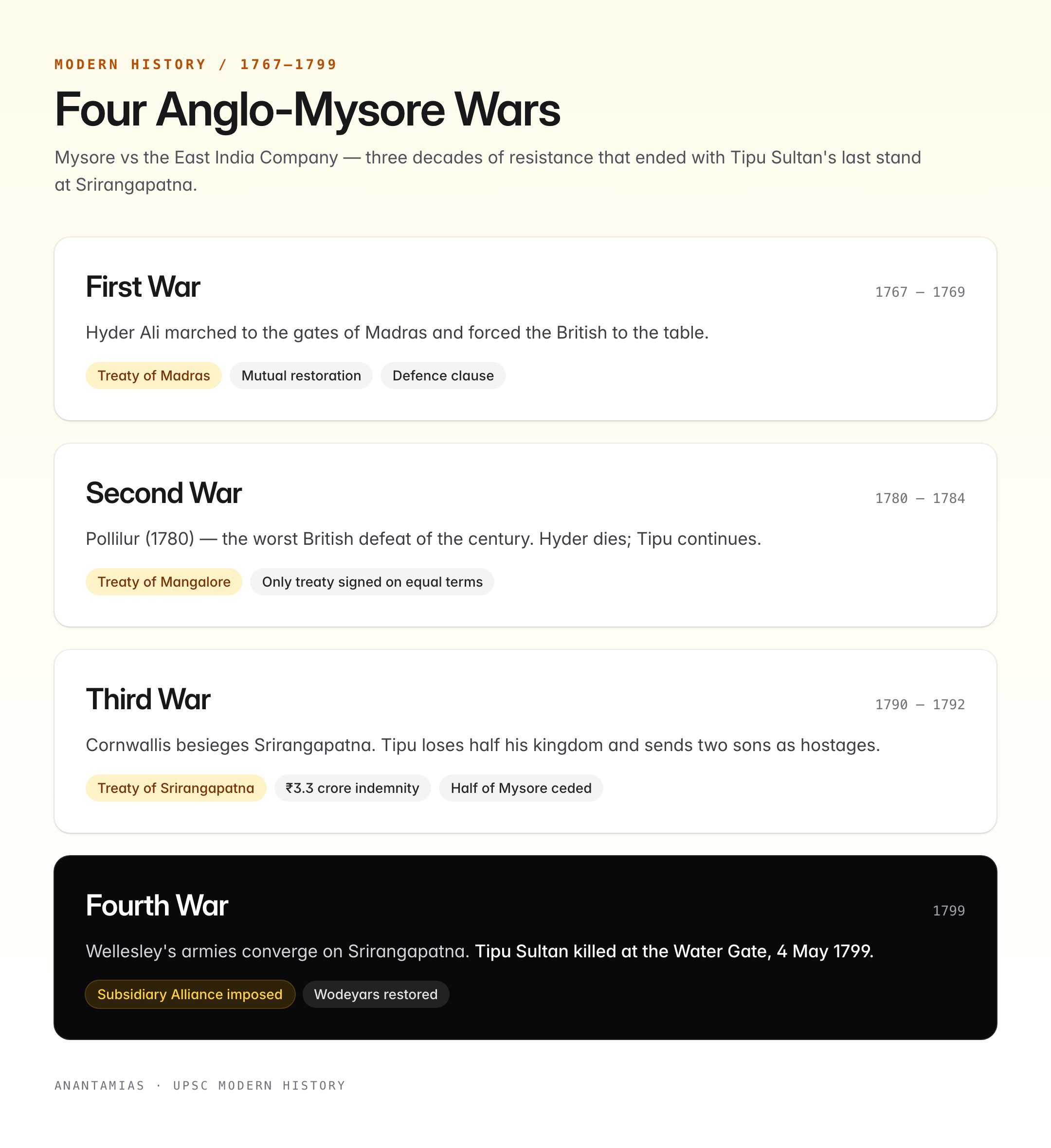
Cause: The British signed a treaty with the Nizam of Hyderabad (1766) promising military help against Hyder Ali in exchange for the Northern Circars. Hyder responded by attacking the allied armies.
| Feature | Detail |
|---|---|
| Duration | 1767–1769 |
| Parties | Mysore vs British + Nizam + Marathas |
| Key event | Hyder marched to the gates of Madras (March 1769) |
| Treaty | Treaty of Madras, 4 April 1769 |
Terms of the Treaty of Madras:
- Mutual restoration of conquered territories.
- Mutual defence clause — the British promised to help Hyder Ali if attacked by a third party.
The British violated this defence clause when the Marathas attacked Hyder in 1771, a breach that directly caused the second war.
Second Anglo-Mysore War (1780–84)
Cause: British capture of Mahé (a French port on the Malabar Coast from which Hyder drew arms) in 1779, combined with the broken 1769 defence clause.
- Hyder Ali forged an alliance with the Nizam and the Marathas — the "Triple Alliance" against the Company.
- Battle of Pollilur (10 September 1780): Hyder's forces, led by his son Tipu, routed Colonel Baillie's army — the worst British defeat in 18th-century India.
- Eyre Coote recovered the situation for the Company at Porto Novo (1 July 1781).
- Hyder Ali died of cancer on 7 December 1782; Tipu Sultan continued the war.
- French forces under Admiral Suffren supported Tipu at sea until the end of the American War of Independence (Peace of Versailles, 1783) cut off French aid.
Treaty of Mangalore, 11 March 1784 — negotiated by Tipu and the British:
| Clause | Effect |
|---|---|
| Mutual restoration of territories | Status quo ante bellum |
| Release of prisoners | Thousands of British captives freed |
| No alliance with third parties against each other | Binding on both sides |
The Treaty of Mangalore is the only treaty the Company signed with an Indian ruler on equal terms — and the last one. Warren Hastings privately condemned it as "humiliating."
Third Anglo-Mysore War (1790–92)
Cause: Tipu Sultan's invasion of Travancore in December 1789. Travancore was an ally of the Company, making its territory Company-protected under the Act of 1781.
- Lord Cornwallis personally led British forces.
- A triple alliance was re-forged with the Nizam and the Marathas — this time against Mysore.
- Siege of Srirangapatna (February 1792): Cornwallis surrounded Tipu's capital; Tipu sued for peace.
Treaty of Srirangapatna, 18 March 1792:
| Term | Detail |
|---|---|
| Cession of territory | Half of Mysore ceded — Baramahal, Dindigul, Malabar to British; territory also to the Nizam and Marathas |
| War indemnity | ₹3.3 crore paid to the allies |
| Hostages | Tipu's two sons sent to Madras as hostages until indemnity paid |
The treaty marked the end of Mysore's primacy in the South. Tipu recovered his sons by 1794 but the kingdom was now surrounded and financially drained.
Fourth Anglo-Mysore War (1799)
Cause: Lord Wellesley (Governor-General 1798–1805), alarmed by Tipu's outreach to Napoleonic France, Zaman Shah of Afghanistan, the Ottoman Sultan and Revolutionary France's Jacobin Club at Srirangapatna, demanded Tipu accept the Subsidiary Alliance. Tipu refused.
- British armies advanced from Madras (under George Harris), Bombay (Stuart), and Hyderabad (Arthur Wellesley — the future Duke of Wellington).
- Siege of Srirangapatna began on 5 April 1799.
- 4 May 1799: British breached the fort; Tipu Sultan was killed near the Water Gate, sword in hand.
Post-war settlement:
| Action | Detail |
|---|---|
| Mysore reduced | Large tracts given to British, Nizam, Marathas |
| Wodeyar restoration | Krishnaraja Wodeyar III (5 years old) placed on throne |
| Subsidiary Alliance | Mysore became a subsidiary state — first major South Indian state under Wellesley's system |
| Tipu's family | Interned at Vellore Fort (source of the 1806 Vellore Mutiny) |
| Tipu's treasury | Looted — the gold Tipu's Tiger mechanical toy now sits in the V&A Museum, London |
Why Tipu Sultan Matters
Tipu was far more than a battlefield commander:
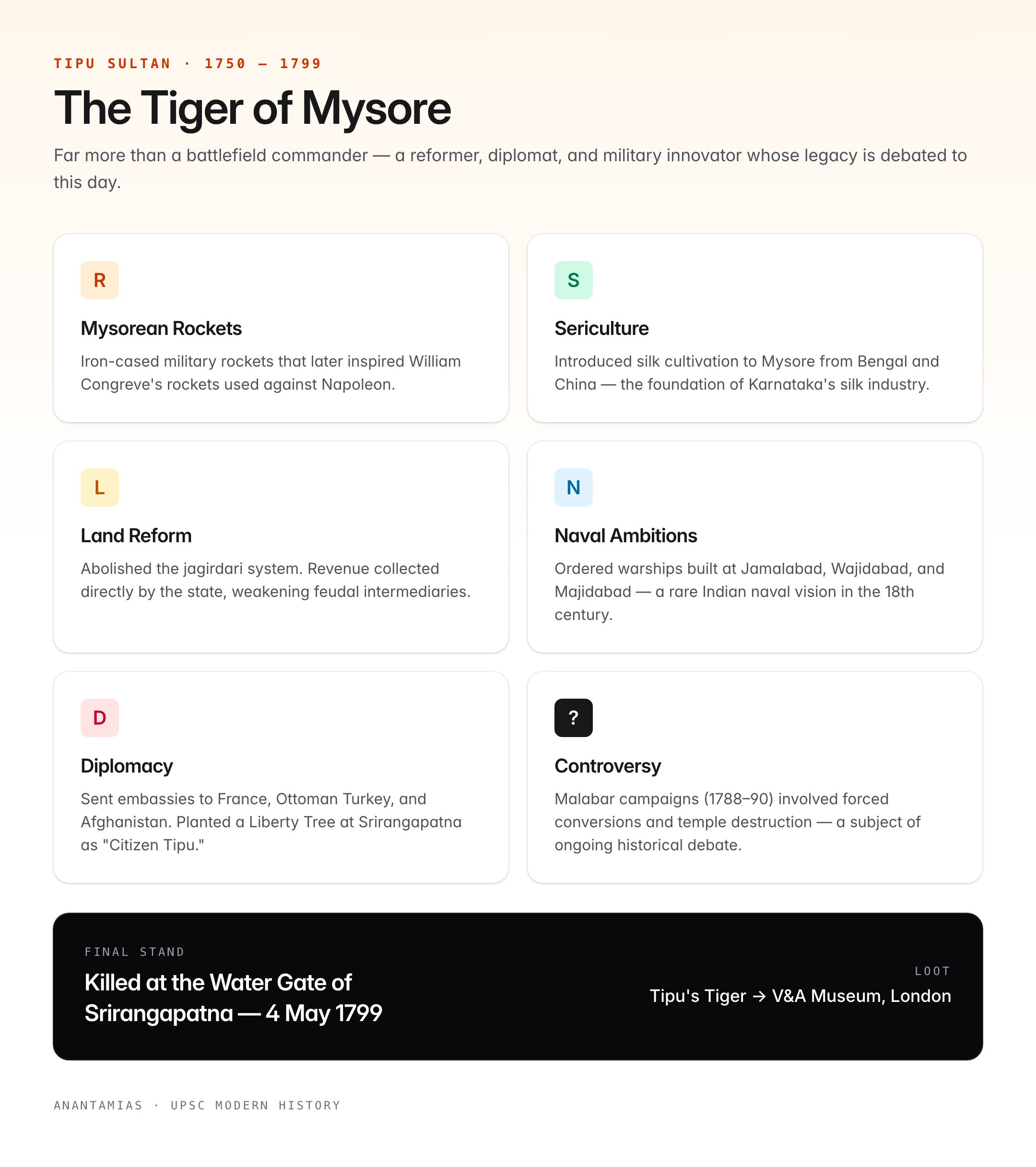
- Mysorean rockets — iron-cased military rockets that later inspired William Congreve's rockets used against Napoleon.
- Sericulture — introduced silk cultivation to Mysore from Bengal and China.
- Land revenue reform — abolished the jagirdari system; direct state collection.
- Naval ambitions — ordered warships built at Jamalabad, Wajidabad, Majidabad.
- Diplomacy — sent embassies to France, Ottoman Turkey, and Afghanistan; planted a Liberty Tree at Srirangapatna and called himself "Citizen Tipu."
- Controversy — his Malabar campaigns (1788–90) involved forced conversions and temple destruction, a subject of modern historical debate.
Strategic Consequences
- End of the last major threat to the Company in South India before the 1857 Revolt.
- Accelerated Wellesley's Subsidiary Alliance — Hyderabad (1798), Mysore (1799), Tanjore (1799), Awadh (1801), Peshwa (1802).
- Transfer of Canara and Malabar brought the Western coast's pepper and sandalwood trade under the Company.
- Mysorean rocket technology was reverse-engineered at Woolwich Arsenal, influencing modern artillery.
- Cemented the Company's financial-military fiscal state — the template for colonial rule until 1857.
Timeline at a Glance
| Year | Event |
|---|---|
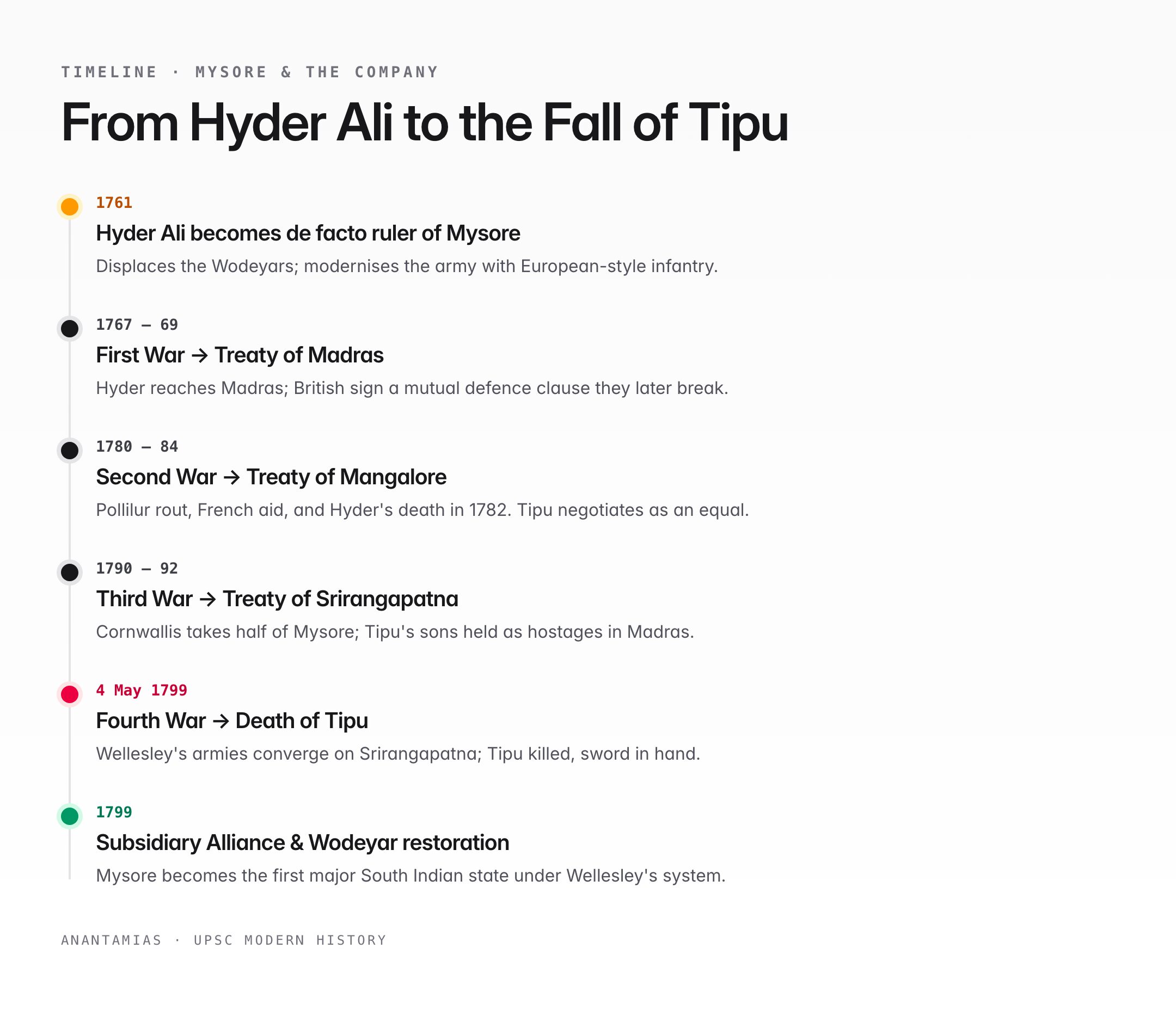
| 1761 | Hyder Ali becomes de facto ruler of Mysore |
| 1767–69 | First War → Treaty of Madras |
| 1780–84 | Second War → Treaty of Mangalore |
| 1782 | Death of Hyder Ali; Tipu Sultan ascends |
| 1790–92 | Third War → Treaty of Srirangapatna |
| 1799 | Fourth War → Death of Tipu at Srirangapatna |
| 1799 | Wodeyar dynasty restored under Subsidiary Alliance |
UPSC Relevance
Prelims: Direct factual questions — dates of the four wars, terms of the Treaty of Mangalore, Treaty of Srirangapatna, and the role of Tipu Sultan's rockets have all featured in past papers.
Mains (GS Paper I — Modern History):
- Evaluate Tipu Sultan's role as a moderniser and a military innovator.
- Discuss the evolution of the Subsidiary Alliance system, with Mysore as a case study.
- Compare the resistance offered by Mysore with that of the Marathas and the Sikhs against British expansion.
Essay: Themes of regional resistance to colonial power, military modernisation in 18th-century India, and the limits of Indian diplomacy map directly onto this topic.
Optional (History): The Anglo-Mysore Wars connect to the rise of the Company state, Carnatic Wars, Treaty of Salbai (1782), and the Vellore Mutiny (1806). Understanding this chain is essential for 18th-century history questions.