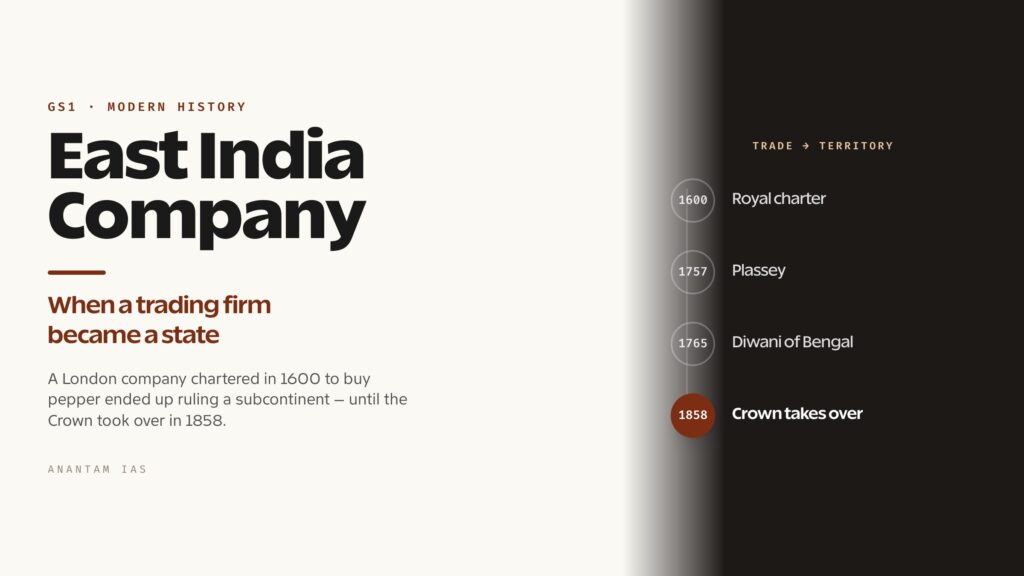
A single London company once governed the lives of more than a hundred million people, raised an army of roughly 260,000 soldiers — about twice the size of Britain’s own standing army, by the count of the National Army Museum — collected taxes, minted coins and ran courts across the Indian subcontinent. It was not a kingdom or a government. It was a joint-stock corporation answerable to shareholders, the East India Company, and for the better part of a century it ruled India as a business.
That is the fact worth holding onto before any dates or battles. The story of British India does not begin with a king or a conquest; it begins with a balance sheet. A firm chartered to buy pepper ended up owning a subcontinent, and it left behind a question that still feels modern: what happens when a company grows so large that it becomes a state? For a UPSC aspirant, the Company is the backbone of Modern Indian History — Plassey and Buxar, the Diwani and the drain, the Charter Acts and 1857 all hang off this one thread.
Origins and the Long Road to India
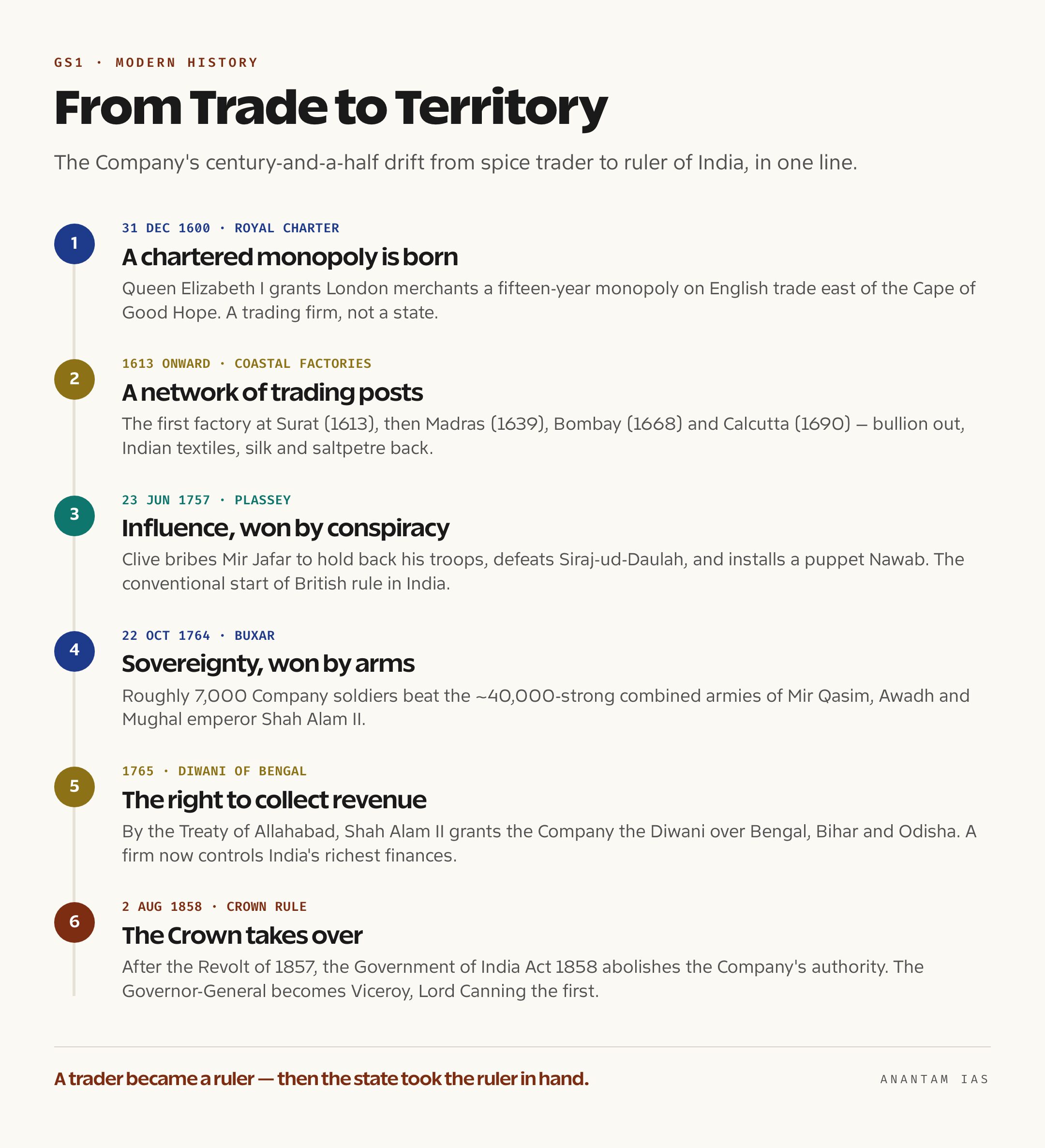
The Company was born on the last day of 1600. On 31 December 1600, Queen Elizabeth I granted a royal charter to a group of London merchants — the History channel’s account names the Earl of Cumberland and 215 knights, aldermen and burgesses — incorporated as the “Governor and Company of Merchants of London trading into the East Indies.” The charter handed them a fifteen-year monopoly over English trade everywhere east of the Cape of Good Hope and west of the Straits of Magellan. No other English subject could legally trade in that vast arc of ocean. The Crown, perpetually short of money, took its cut.
The original target was not India at all. It was the Spice Islands of present-day Indonesia, where nutmeg, cloves and pepper fetched enormous margins in Europe. But the Dutch East India Company, founded in 1602, fought the English hard there, and after a bloody falling-out the English turned west toward the Indian mainland almost by default. India became the consolation prize that turned out to be the real prize.
Getting a foothold meant dealing with the Mughals, then near the height of their power. Captain William Hawkins reached the court of Emperor Jahangir around 1609 but failed to win a permanent post, blocked by Portuguese influence. The breakthrough came after Captain Thomas Best beat the Portuguese in a naval skirmish off Surat in 1612; an impressed Jahangir allowed the English to set up their first factory — a fortified trading warehouse, not a manufacturing plant — at Surat in 1613. Sir Thomas Roe, sent as ambassador by James I, secured a wider farman for trade across the empire in 1615. From these beginnings the coastal network grew: Madras and Fort St. George on the Coromandel coast in 1639, Bombay handed over by Charles II in 1668, and Calcutta with Fort William in Bengal by 1690. The Company shipped out bullion and brought back Indian cotton textiles, silk, saltpetre, indigo and spices — and, increasingly, the goods it traded made it one of the richest commercial powers on earth.
From Trade to Territory
For a century and a half the Company was a merchant, not a ruler. What changed everything was Bengal, the wealthiest province of the Mughal empire, and a single battle that barely deserves the name.
On 23 June 1757, Robert Clive’s force met the much larger army of Nawab Siraj-ud-Daulah at Plassey. The outcome had been fixed in advance. Clive had conspired with the Nawab’s own commander-in-chief, Mir Jafar, and with the powerful Jagat Seth bankers; when the fighting began, Mir Jafar simply held his troops back. The Company won, installed Mir Jafar as a puppet Nawab, and began draining Bengal’s revenues into its own coffers. Britannica and the National Army Museum both treat Plassey as the conventional starting point of British rule in India — less a conquest than a corporate takeover by bribery.
Plassey gave the Company influence; Buxar gave it sovereignty. On 22 October 1764, an outnumbered Company force defeated the combined armies of the deposed Mir Qasim, Shuja-ud-Daulah of Awadh and the Mughal emperor Shah Alam II — by most accounts around 40,000 allied troops against roughly 7,000 Company soldiers. The 1765 Treaty of Allahabad then made it formal: Shah Alam II granted the Company the Diwani — the right to collect revenue — over Bengal, Bihar and Odisha. A trading firm now legally controlled the public finances of India’s richest region.
Clive turned this into the so-called dual system. The Company held the Diwani (revenue) while the Nawab kept the Nizamat (the nominal duties of policing and justice). It was a clever, cynical arrangement: the Company took the money and the power but dodged the cost and blame of actually governing. The result was paralysis at the top and plunder at the bottom — a model that would soon end in catastrophe. Over the following decades the Anglo-Mysore, Anglo-Maratha and Anglo-Sikh wars finished the job, the annexation of Punjab in 1849 completing the Company’s grip on the subcontinent.
How It Ruled — and Misruled
The dual system’s first great failure was also its most damning. In 1770, after a failed monsoon, Bengal was struck by famine. The Company’s response was to keep extracting revenue and, by several accounts, to raise demands rather than lower them — its directors estimated that about a third of Bengal’s population, on the order of ten million people, had died. Historians still argue over the exact toll, with some revising it sharply downward, but no one disputes that Company policy turned a drought into a demographic disaster. A firm that owed nothing to the people it taxed had no reason to feed them, and didn’t.
Underneath the famine lay a deeper machinery: the drain of wealth. The economist and early nationalist Dadabhai Naoroji would later give it a name and a number, arguing that a steady stream of India’s resources was being siphoned to Britain with no return. Indian revenue paid for Indian conquests; Indian taxes bought British goods; and India’s own famous handicraft industries — its hand-woven textiles above all — were undercut and hollowed out, a process nationalist historians call deindustrialisation. To fix revenue, the Company imposed land settlements that reshaped rural India for over a century: Cornwallis’s Permanent Settlement in Bengal (1793), which created a class of zamindar landlords; Munro’s Ryotwari system in Madras and Bombay; and the Mahalwari system in the north. Each squeezed the cultivator differently, and each left scars.
What made all this possible was force. The Company was, in the literal sense, a state in corporate clothing. It maintained three presidency armies that together reached around 260,000 men — soldiers who swore allegiance not to the British Crown but to the Company itself. It collected taxes, ran courts, and issued its own currency. By the mid-eighteenth century it accounted for a huge share of world trade in cotton, silk, indigo, saltpetre, tea and, infamously, the opium it forced into China. This was the world’s first true multinational corporation, and it had quietly become a sovereign power that happened to pay dividends.
The Road to Crown Rule
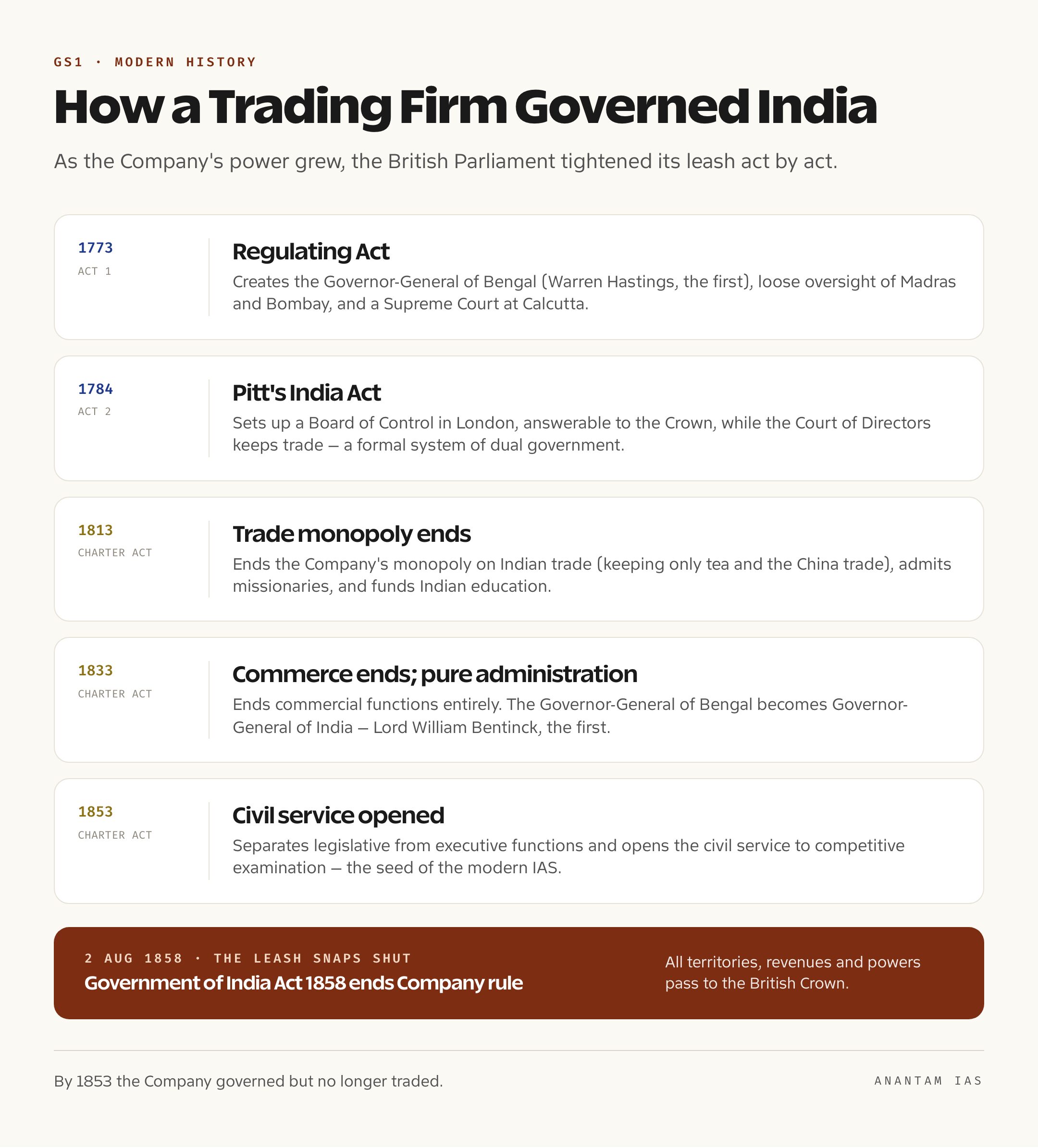
A company with an army the size of a nation’s, governing a subcontinent, was bound to alarm the British state. As scandal and corruption stories drifted home — Clive’s own fortune became a byword for plunder — Parliament began pulling the Company onto a tighter leash, act by act.
The Regulating Act of 1773 was the first intervention: it created the post of Governor-General of Bengal, with Warren Hastings as the first holder, gave him loose supervision over Madras and Bombay, and set up a Supreme Court at Calcutta. Pitt’s India Act of 1784 went further, establishing a Board of Control in London answerable to the Crown while the Company’s Court of Directors kept its commercial business — a formal system of dual government over India. Then the Charter Acts steadily stripped the Company of the very thing it was founded for. The Charter Act of 1813 ended its monopoly on Indian trade (keeping only tea and the China trade), opened the door to Christian missionaries, and set aside a small annual sum for Indian education. The Charter Act of 1833 ended the Company’s commercial functions altogether and turned it into a purely administrative body; the Governor-General of Bengal became the Governor-General of India, Lord William Bentinck the first. The Charter Act of 1853 separated legislative from executive functions and opened the civil service to competitive examination — the seed of the modern IAS.
By now the Company governed but no longer traded. Reform and resentment grew together. Bentinck abolished sati in 1829; Macaulay’s 1835 Minute pushed English education; Dalhousie’s Doctrine of Lapse annexed Satara, Jhansi, Nagpur and Awadh, stoking deep anger among displaced rulers. The pressure broke in the Revolt of 1857, which began at Meerut on 10 May 1857 and spread across northern India. The uprising was crushed, but it exposed the absurdity of a private firm ruling an empire. The Government of India Act 1858, passed on 2 August, abolished the Company’s authority and transferred all its territories, revenues and powers to the British Crown. A single Secretary of State for India replaced the old Board of Control and Court of Directors; the Governor-General gained the new title of Viceroy, Lord Canning being the first; and Queen Victoria’s Proclamation of 1 November 1858 promised religious non-interference and equal treatment. The Company itself lingered on paper until it was formally dissolved in 1874, but its rule was over.
Legacy and Why It Still Matters
The Company left India with an apparatus that long outlived it. A centralised revenue state, a salaried bureaucracy, a unified legal and court system, English-medium higher education, the railway and telegraph lines laid in its final decades, and the competitive civil service — these were Company inheritances that the Crown took over wholesale and that independent India, in part, still runs on. The downside ledger is just as long: a drained economy, deindustrialised crafts, recurring famines, a peasantry locked into exploitative land settlements, and a political order built to extract rather than serve.
What makes the Company genuinely contemporary, though, is the bigger lesson historians like William Dalrymple have drawn from it: this was history’s first great corporate-state, a private company that grew powerful enough to swallow a government. It is the original cautionary tale about unaccountable corporate power — an institution answerable to shareholders, not citizens, raising armies and writing law. In an age of trillion-dollar firms and debates over how to regulate them, the question the Company first posed has not gone away. For India, the deeper relevance is that the freedom struggle was, at its root, a long answer to the East India Company: a demand that India be governed by Indians, for Indians, and not run as anyone’s business.
For Your Mains Answer
The East India Company is core to GS Paper 1 (Modern Indian History — “the Freedom Struggle, its various stages and important contributors”) and feeds directly into Indian polity in GS Paper 2, since the Charter Acts and the 1858 Act form the constitutional pre-history of India. It also offers rich material for the Essay paper on themes of power, accountability and the relationship between commerce and the state. Treat the Company not as a list of battles but as a single argument: how a trader became a ruler, and how Britain then took the ruler in hand.
How to Build the Answer
Move in four clean phases — trade, transition, rule, takeover. Open with the Company as a chartered monopoly (1600), show the turn to territory through Plassey (1757) and the Diwani (1765), explain how it ruled and misruled through the dual system, the drain and the famine of 1770, then close with Parliament reining it in through the Regulating Act, Pitt’s Act and the Charter Acts before 1857 forced the 1858 transfer. That arc answers almost any Company question.
Common Mistakes to Avoid
Don’t confuse the two Bengal battles — Plassey (1757) was won by conspiracy and gave influence; Buxar (1764) was a real military victory and gave the Diwani. Don’t muddle the acts: the Charter Act of 1813 ended the trade monopoly, the 1833 Act ended commercial functions, the 1858 Act ended the Company itself. And don’t present Company rule as wholly modernising or wholly destructive — examiners reward a balanced ledger.
A Compact Answer Spine
Chartered monopoly (1600, Elizabeth I) → coastal factories (Surat 1613 onward) → Plassey 1757 and Buxar 1764 → Diwani of Bengal 1765 and the dual system → drain of wealth and the 1770 famine → parliamentary control (Regulating Act 1773, Pitt’s Act 1784, Charter Acts 1813/1833/1853) → Revolt of 1857 → Government of India Act 1858 transfers power to the Crown → legacy: India’s first corporate-state.
Diagram or Flowchart Idea
Draw a single timeline arrow from 1600 to 1858, with four labelled nodes — “Trader” (1600), “Turn to power” (1757-65), “Ruler under watch” (1773-1853) and “Crown takes over” (1858). Above the arrow write “company”; below it write “state.” The visual makes the whole transformation legible in seconds.
A Balanced-Conclusion Line
“The East India Company’s two and a half centuries built the scaffolding of the modern Indian state while draining the society it governed — its real legacy is the lesson that power without accountability, even corporate power, ends in misrule.”
How to Use Data Without Cramming
Anchor the answer with a handful of memorable figures rather than a flood: the 1600 charter, Plassey 1757 and Buxar 1764, the Diwani in 1765, the roughly ten-million death toll of the 1770 famine, an army of about 260,000, and the 1858 transfer. Six anchors, confidently placed, read as mastery; thirty dates read as panic.
FAQ
When and by whom was the East India Company established? The East India Company was chartered on 31 December 1600 by Queen Elizabeth I, as the “Governor and Company of Merchants of London trading into the East Indies.” The charter gave a group of London merchants a fifteen-year monopoly on English trade east of the Cape of Good Hope.
How did the East India Company become a ruler rather than just a trader? The turning point was Bengal. The Battle of Plassey in 1757 let Robert Clive install a puppet Nawab and tap Bengal’s revenue, and the Battle of Buxar in 1764 made the Company dominant militarily. The 1765 Treaty of Allahabad then granted it the Diwani — the right to collect revenue — over Bengal, Bihar and Odisha, turning a trading firm into a territorial power.
What was the dual system of government in Bengal? After winning the Diwani in 1765, Clive let the Company control revenue while the Nawab kept nominal responsibility for policing and justice. The Company took the money and the power without the cost or accountability of governing — an arrangement widely blamed for worsening the catastrophic Bengal famine of 1770.
Why and when did Company rule end? The Revolt of 1857 exposed the dangers of a private company governing an empire. The Government of India Act 1858, passed on 2 August, abolished the Company’s authority and transferred all its powers, territories and revenues to the British Crown. The Governor-General became the Viceroy, Lord Canning the first, and Queen Victoria’s Proclamation promised religious non-interference and equal treatment.
Practice Questions
Prelims MCQs
- Who granted the royal charter that established the East India Company, and in which year?
(a) James I in 1615
(b) Queen Elizabeth I in 1600
(c) Charles II in 1668
(d) Queen Victoria in 1858
Answer: (b) — Queen Elizabeth I granted the charter on 31 December 1600, giving London merchants a fifteen-year monopoly on English trade east of the Cape of Good Hope. - By the Treaty of Allahabad of 1765, the East India Company obtained the Diwani over which regions?
(a) Madras, Bombay and Surat
(b) Punjab, Sindh and Awadh
(c) Bengal, Bihar and Odisha
(d) Mysore, Hyderabad and the Carnatic
Answer: (c) — Shah Alam II granted the Company the right to collect revenue over Bengal, Bihar and Odisha, turning a trading firm into a territorial power. - Which battle is conventionally treated as the starting point of British rule in India, won largely through conspiracy with Mir Jafar?
(a) Battle of Buxar, 1764
(b) Battle of Plassey, 1757
(c) Battle of Wandiwash, 1760
(d) Battle of Wadgaon, 1779
Answer: (b) — At Plassey on 23 June 1757, Robert Clive defeated Siraj-ud-Daulah after Mir Jafar held back his troops, giving the Company influence over Bengal. - Which Charter Act ended the East India Company’s commercial functions altogether and turned it into a purely administrative body?
(a) Charter Act of 1813
(b) Charter Act of 1833
(c) Charter Act of 1853
(d) Pitt’s India Act of 1784
Answer: (b) — The 1833 Act ended the Company’s commercial role and made the Governor-General of Bengal the Governor-General of India, with Lord William Bentinck the first. - The Government of India Act 1858 introduced which of the following changes?
(a) It created the post of Governor-General of Bengal
(b) It established the Board of Control in London
(c) It transferred power to the Crown and retitled the Governor-General as Viceroy
(d) It opened the civil service to competitive examination
Answer: (c) — The 1858 Act abolished Company authority, transferred its territories and revenues to the Crown, and made the Governor-General the Viceroy, with Lord Canning the first.
Mains Practice Questions
- “The story of British India begins not with a conquest but with a balance sheet.” Critically examine how the East India Company transformed from a chartered trading monopoly into a territorial sovereign. (15 marks, 250 words)
- Explain the dual system of government introduced by Robert Clive in Bengal after 1765, and assess its role in the catastrophic Bengal famine of 1770. (10 marks, 150 words)
- Trace the progressive parliamentary control over the East India Company from the Regulating Act of 1773 to the Charter Act of 1853, and explain how these acts shaped the constitutional pre-history of modern India. (15 marks, 250 words)
- Discuss the concept of the “drain of wealth” and the deindustrialisation of Indian handicrafts under Company rule, with reference to the land-revenue settlements it imposed. (15 marks, 250 words)
- “The East India Company was history’s first great corporate-state — answerable to shareholders, not citizens.” Analyse the contemporary relevance of this assessment of unaccountable corporate power. (10 marks, 150 words)
Tell Google you want more of this.
Add Anantam IAS as a preferred sourceOne tap, and this site shows up more often in your own Top Stories, AI Overviews and AI Mode. Remove it any time.