ASEAN Full Form: Association of Southeast Asian Nations
ASEAN full form is Association of Southeast Asian Nations. Learn about ASEAN's 1967 founding, 10 member countries, India-ASEAN relations, Act East Policy, RCEP, ASEAN centrality, and trade data for UPSC.
ASEAN Full Form: Association of Southeast Asian Nations
ASEAN stands for Association of Southeast Asian Nations. It’s the political, economic, and security grouping of ten nations in Southeast Asia — one of the world’s most dynamic regions, sitting at the crossroads of the Pacific and Indian Oceans.
For India, ASEAN is not just a neighbouring bloc — it’s the anchor of India’s Act East Policy, a $3 trillion-plus market, and a region where India’s strategic interests intersect with China’s expanding influence.
ASEAN Full Form and Founding
ASEAN was established on 8 August 1967 through the Bangkok Declaration, signed by the foreign ministers of five founding countries.
| Particulars | Details |
|---|---|
| Full form | Association of Southeast Asian Nations |
| Founded | 8 August 1967 |
| Founding document | Bangkok Declaration |
| Secretariat | Jakarta, Indonesia |
| Secretary-General | Kao Kim Hourn (Cambodia, since 2023) |
| Official language | English |
| Founding members | Indonesia, Malaysia, Philippines, Singapore, Thailand |
Why Was ASEAN Founded?
The 1960s was a turbulent decade for Southeast Asia. The Vietnam War was escalating. Communist insurgencies were active in several countries. Indonesia under Sukarno had just ended its confrontation with Malaysia (Konfrontasi). Tensions were high.
The five founders came together with a shared interest: regional stability through cooperation. The Bangkok Declaration emphasised non-interference in internal affairs, sovereignty, and peaceful dispute resolution. These “ASEAN norms” have defined the organisation’s culture ever since.
The Cold War context is important. ASEAN was seen in the West as a non-communist grouping — though its founders were careful to keep it formally neutral and not explicitly anti-communist.
ASEAN’s 10 Member Countries
ASEAN has expanded from 5 to 10 members over decades:
| Country | Year Joined | Capital | Population (approx.) |
|---|---|---|---|
| Indonesia | 1967 (founder) | Jakarta | 280 million |
| Malaysia | 1967 (founder) | Kuala Lumpur | 33 million |
| Philippines | 1967 (founder) | Manila | 115 million |
| Singapore | 1967 (founder) | Singapore | 6 million |
| Thailand | 1967 (founder) | Bangkok | 72 million |
| Brunei | 1984 | Bandar Seri Begawan | 0.5 million |
| Vietnam | 1995 | Hanoi | 98 million |
| Laos | 1997 | Vientiane | 7 million |
| Myanmar | 1997 | Naypyidaw | 54 million |
| Cambodia | 1999 | Phnom Penh | 17 million |
Timor-Leste (East Timor) was granted observer status and its accession is in process — it is expected to become the 11th member.
Combined ASEAN Stats
ASEAN collectively is a major global player:
- Population: ~680 million
- Combined GDP: ~$3.6 trillion (2023)
- Fifth-largest economy by GDP (if treated as one)
- Fourth-largest trading bloc globally
ASEAN Structure and Key Bodies
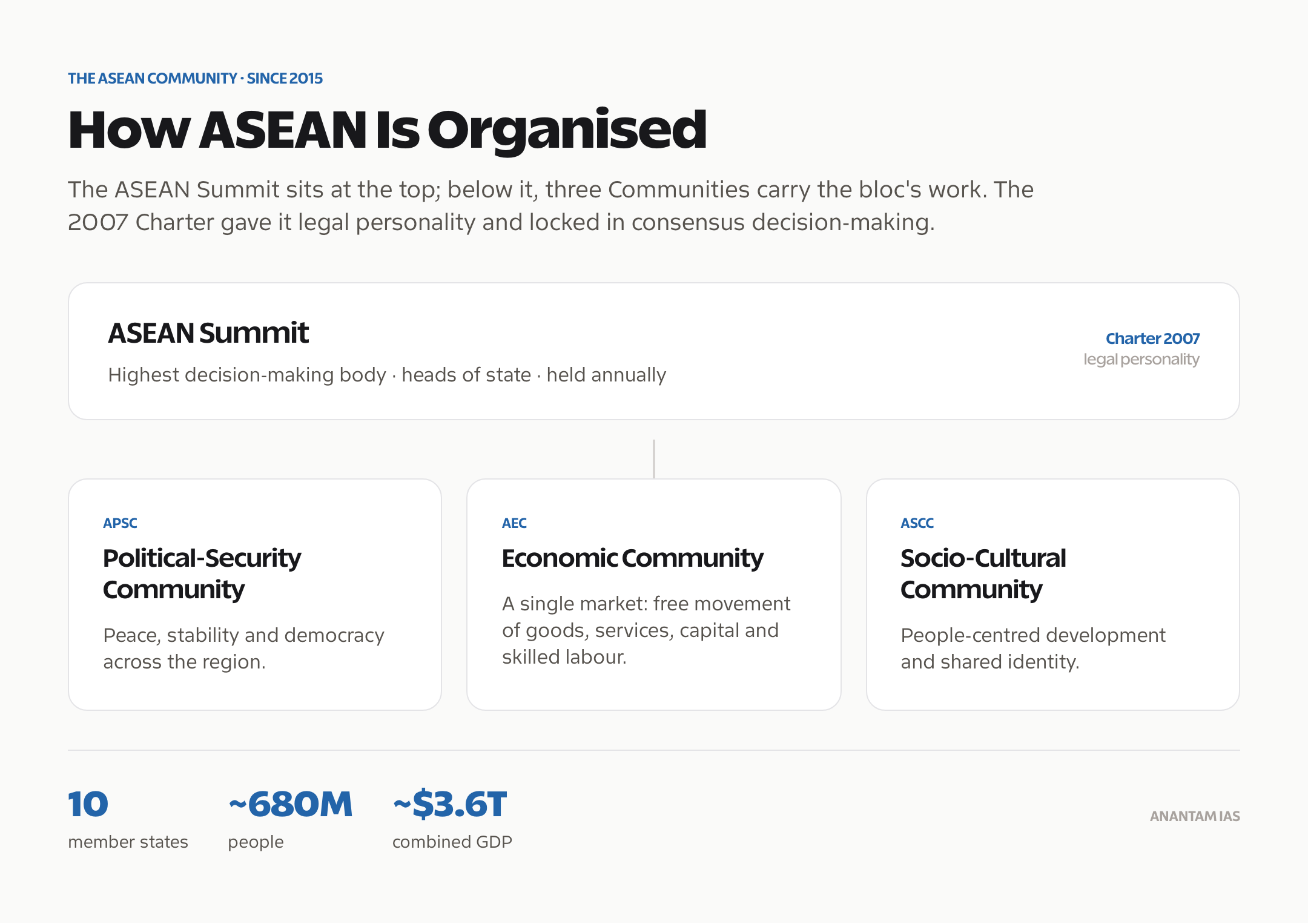
ASEAN Summit: The highest decision-making body, held annually (sometimes twice). Attended by heads of state/government. ASEAN Summit is rotated among member states.
ASEAN Ministerial Meeting (AMM): Foreign ministers meet annually.
ASEAN Coordinating Council (ACC): Foreign ministers coordinate implementation of Summit decisions.
Three Communities (ASEAN Community, since 2015):
- ASEAN Political-Security Community (APSC) — peace, stability, democracy
- ASEAN Economic Community (AEC) — single market, free movement of goods, services, capital, skilled labour
- ASEAN Socio-Cultural Community (ASCC) — people-centred development
ASEAN Charter (2007)
The ASEAN Charter, signed in 2007 and entered into force in 2008, gave ASEAN legal personality and a formal institutional structure for the first time. It codified ASEAN principles: sovereignty, non-interference, consensus decision-making, and peaceful dispute settlement.
The consensus requirement is both ASEAN’s strength and weakness — it prevents ASEAN from being dominated by any single member, but it also makes binding decisions near-impossible on contentious issues.
India-ASEAN Relations
India’s relationship with ASEAN is one of its most important external partnerships — and one that has deepened dramatically since the 1990s.
Look East to Act East: The Policy Evolution
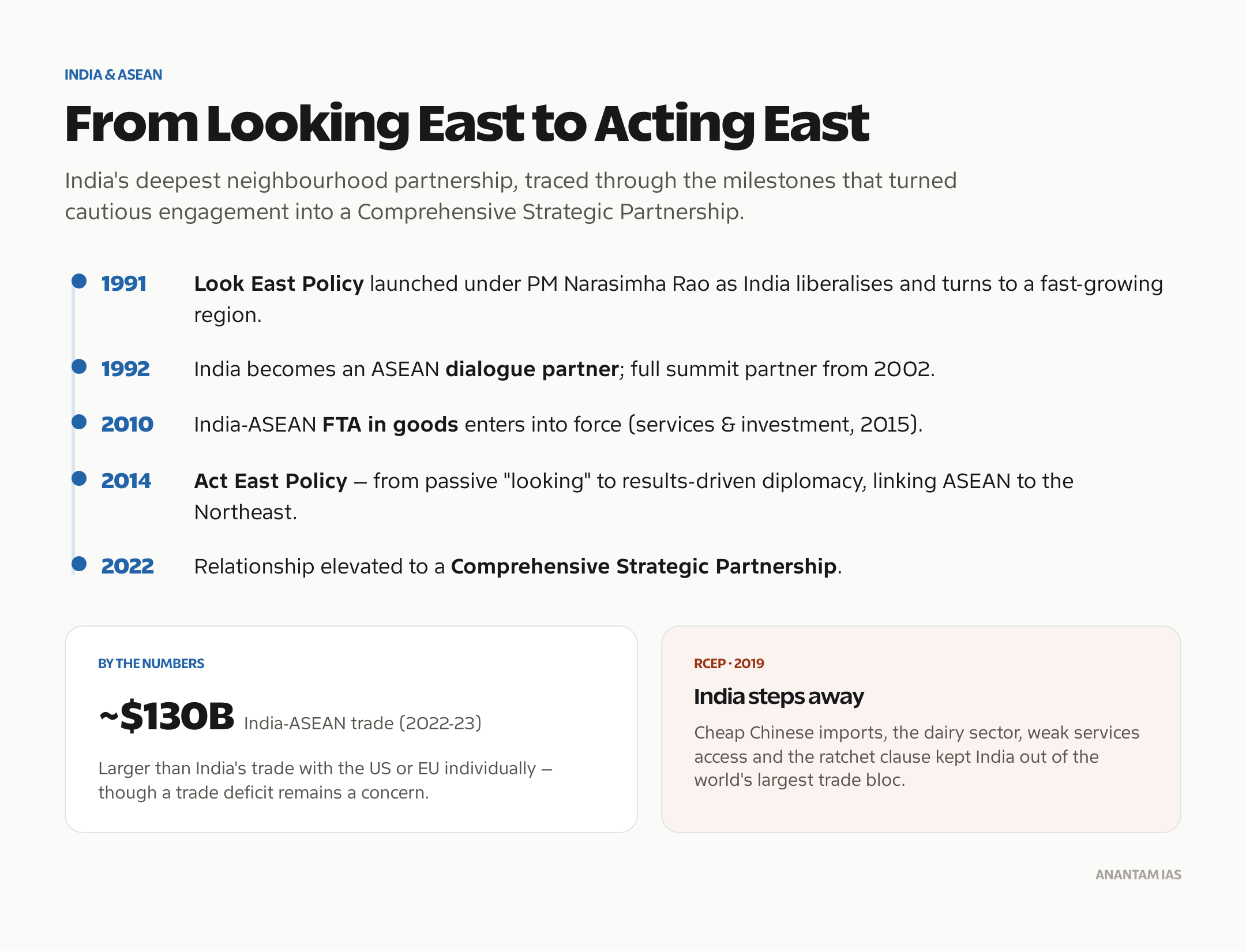
Look East Policy: Launched in 1991 by PM Narasimha Rao and architected by Foreign Minister P.V. Narasimha Rao’s MEA team. The context: India’s economy was liberalising, and Southeast Asia’s rapid growth made it a natural trade partner. India sought to integrate economically and strategically with the region.
Act East Policy: PM Modi renamed and upgraded the Look East Policy to Act East Policy in 2014. The word change was deliberate — from passive engagement (“looking”) to active, results-driven diplomacy (“acting”). Act East has a broader geographic scope (including East Asia) and explicitly links ASEAN to India’s northeast development.
India-ASEAN: Key Facts
| Metric | Data |
|---|---|
| India-ASEAN trade (2022-23) | ~$130 billion |
| India as ASEAN dialogue partner | Since 1992 |
| India as ASEAN Summit partner | Since 2002 |
| India-ASEAN FTA (goods) | In force since 2010 |
| India-ASEAN FTA (services and investment) | In force since 2015 |
| ASEAN-India Comprehensive Strategic Partnership | Declared 2022 |
India’s trade with ASEAN (~$130 billion) exceeds its trade with the US or EU individually. But the trade deficit is a concern — India imports more from ASEAN (especially from Vietnam and Malaysia) than it exports.
ASEAN Connectivity and India’s Northeast
A key dimension of Act East is connecting India’s landlocked northeastern states to Southeast Asia. Projects include:
India-Myanmar-Thailand Trilateral Highway: A 1,360 km road from Moreh (Manipur) to Mae Sot (Thailand) via Myanmar. Facing delays due to Myanmar’s political instability after the 2021 military coup.
Kaladan Multi-Modal Transit Transport Project: Sea-river-road route connecting Kolkata to Mizoram via Sittwe port and Kaladan river in Myanmar.
ASEAN and RCEP: India’s Decision to Step Away
The Regional Comprehensive Economic Partnership (RCEP) is a free trade agreement involving ASEAN’s 10 members plus China, Japan, South Korea, Australia, and New Zealand. It was signed in November 2020 and is the world’s largest trading bloc by population and GDP.
India was part of RCEP negotiations for years. But in November 2019, PM Modi announced India would not join. The reasons:
- China concern: RCEP would have flooded India with cheap Chinese goods, widening an already large trade deficit
- Dairy sector: New Zealand’s dairy exports threatened India’s dairy farmers
- Services: India wanted greater liberalisation of services (Mode 4 — movement of professionals) which RCEP didn’t offer adequately
- Ratchet clause: Once India reduced tariffs under RCEP, it couldn’t raise them again — seen as a sovereignty concern
India’s exit was significant but not final — the door remains open, and RCEP members continue to invite India.
ASEAN Centrality
“ASEAN Centrality” is a core concept in Indo-Pacific diplomacy. It means ASEAN should be at the centre of the regional architecture — not dominated by any great power (explicitly: China or the US).
ASEAN-led forums that embody this centrality:
- ASEAN Regional Forum (ARF) — security dialogue (27 members including India, China, USA)
- East Asia Summit (EAS) — strategic forum (18 members including India)
- ASEAN Defence Ministers’ Meeting Plus (ADMM+) — defence cooperation
India is a member of all three. For India, supporting ASEAN centrality is a way to ensure the Indo-Pacific order is multipolar rather than Sino-centric.
South China Sea: The ASEAN Fault Line
The South China Sea dispute is ASEAN’s most divisive issue. China claims most of the South China Sea (nine-dash line), conflicting with the claims of Vietnam, Philippines, Malaysia, and Brunei. The 2016 Permanent Court of Arbitration ruling (Philippines v. China) rejected China’s claims — but China ignored it.
ASEAN cannot issue strong collective statements on the South China Sea because some members (Cambodia, Laos) are close to China and block consensus. This is a live demonstration of ASEAN’s consensus constraint.
India supports freedom of navigation in the South China Sea — diplomatically backing ASEAN claimants without directly confronting China.
SCO: Shanghai Cooperation Organisation and India
SAARC Full Form and Member Countries
Frequently Asked Questions
What is the full form of ASEAN?
ASEAN stands for Association of Southeast Asian Nations. It’s a regional grouping of ten Southeast Asian countries, founded in 1967 through the Bangkok Declaration.
How many members does ASEAN have?
ASEAN has 10 member countries: Indonesia, Malaysia, Philippines, Singapore, Thailand (founding members, 1967), Brunei (1984), Vietnam (1995), Laos, Myanmar (1997), and Cambodia (1999). Timor-Leste’s accession is in process.
What is the difference between Look East Policy and Act East Policy?
Look East Policy (1991) was India’s strategy to economically and diplomatically engage Southeast Asia. Act East Policy (2014), launched by PM Modi, upgraded this to active, results-driven engagement with a broader scope covering East Asia and explicitly linking the northeast to ASEAN connectivity.
Why did India not join RCEP?
India withdrew from RCEP negotiations in November 2019 over concerns about a potential surge of cheap Chinese imports widening India’s trade deficit, inadequate commitments on services liberalisation, and the lack of a safeguard mechanism to protect domestic industries.
What is ASEAN centrality?
ASEAN centrality is the principle that ASEAN should be the hub of regional multilateral architecture in Asia — not dominated by any single great power. India supports ASEAN centrality as a way to ensure a multipolar Indo-Pacific order.