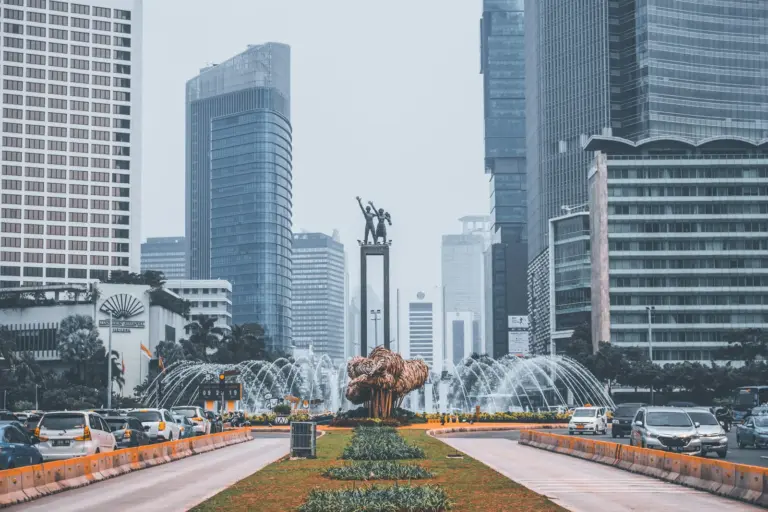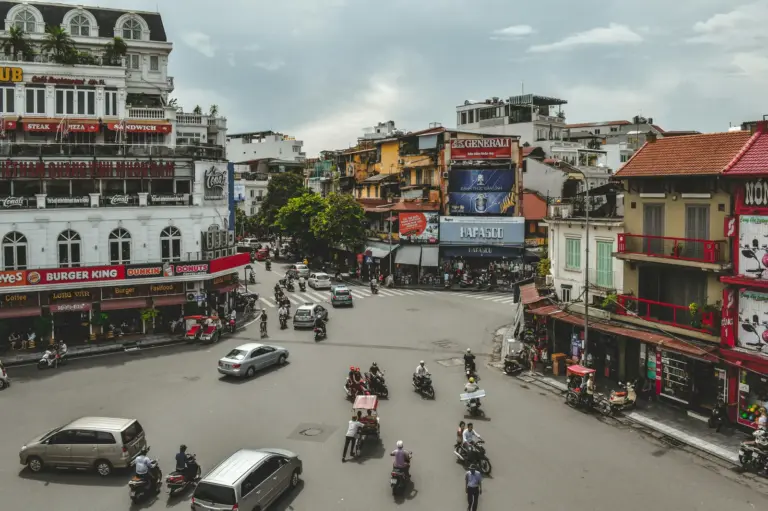
The ASEAN Summit is the supreme policy-making body of the Association of Southeast Asian Nations (ASEAN), convening the heads of state or government of its 10 member states to set the strategic direction of the grouping. ASEAN, founded in 1967 through the Bangkok Declaration, has evolved from a Cold War-era anti-communist alliance into the most successful regional organisation in Asia, with a combined GDP exceeding $3.6 trillion and a population of over 680 million. The Summit meets twice a year — once at mid-year and once at the year-end — and is complemented by related summits such as the East Asia Summit (EAS), the ASEAN Regional Forum (ARF), and the ASEAN Plus Three framework.
For UPSC, ASEAN and its summit mechanisms are high-value topics in International Relations (GS2), appearing in questions on India’s Act East Policy, regional architecture, free trade agreements, and Indo-Pacific geopolitics.
ASEAN at a Glance
| Feature | Detail |
|---|---|
| Full form | Association of Southeast Asian Nations |
| Founded | August 8, 1967 (Bangkok Declaration) |
| Founding members | Indonesia, Malaysia, Philippines, Singapore, Thailand |
| Current members | 10 (see table below) |
| Secretariat | Jakarta, Indonesia |
| Secretary-General | Elected for a 5-year term (rotational, alphabetical) |
| Official language | English |
| Motto | "One Vision, One Identity, One Community" |
| Charter | ASEAN Charter, 2008 |
Member States
| Country | Capital | Year of Joining |
|---|---|---|
| Indonesia | Jakarta | 1967 (founding) |
| Malaysia | Kuala Lumpur | 1967 (founding) |
| Philippines | Manila | 1967 (founding) |
| Singapore | Singapore | 1967 (founding) |
| Thailand | Bangkok | 1967 (founding) |
| Brunei | Bandar Seri Begawan | 1984 |
| Vietnam | Hanoi | 1995 |
| Laos | Vientiane | 1997 |
| Myanmar | Naypyidaw | 1997 |
| Cambodia | Phnom Penh | 1999 |
Timor-Leste was granted observer status in 2002 and approved in-principle for membership in 2022, with a roadmap for full accession.
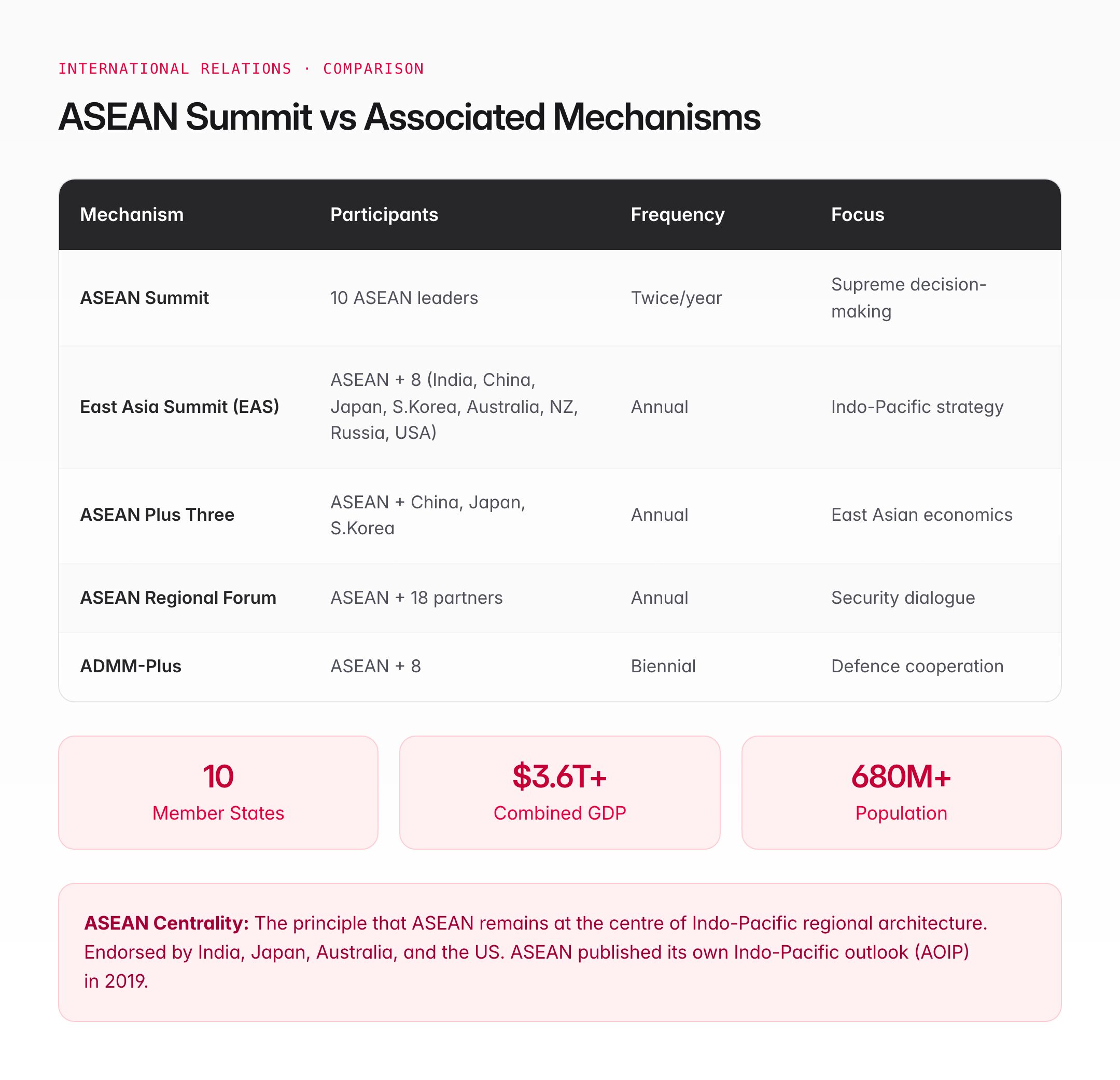
The ASEAN Summit — How It Works
Structure
- The ASEAN Summit meets twice annually: a formal summit and a retreat
- The ASEAN Chairmanship rotates annually among member states (alphabetical order)
- Decisions are made by consensus — no formal voting mechanism
- The Chair hosts and sets the agenda, giving the host country significant diplomatic influence
Associated Summit Mechanisms
| Meeting | Participants | Frequency | Purpose |
|---|---|---|---|
| ASEAN Summit | 10 ASEAN leaders | Twice/year | Supreme decision-making body |
| East Asia Summit (EAS) | ASEAN + 8 (Australia, China, India, Japan, South Korea, New Zealand, Russia, USA) | Annual | Strategic dialogue on Indo-Pacific security, economy |
| ASEAN Plus Three (APT) | ASEAN + China, Japan, South Korea | Annual | East Asian economic cooperation |
| ASEAN Regional Forum (ARF) | ASEAN + 18 dialogue partners | Annual | Security dialogue; confidence-building |
| ASEAN Defence Ministers' Meeting Plus (ADMM-Plus) | ASEAN + 8 | Biennial | Defence and military cooperation |
The ASEAN Charter (2008)
The ASEAN Charter, adopted in 2007 and entered into force in December 2008, transformed ASEAN from a loose association into a rules-based, legally binding organisation:
- Gave ASEAN legal personality under international law
- Established the ASEAN Community, comprising three pillars:
- ASEAN Political-Security Community (APSC)
- ASEAN Economic Community (AEC) — launched in 2015
- ASEAN Socio-Cultural Community (ASCC)
- Codified the principle of non-interference in internal affairs
- Reaffirmed consensus-based decision-making
- Created the Committee of Permanent Representatives (ambassadorial level) in Jakarta
- Established the ASEAN Human Rights Body (AICHR) — though with limited enforcement powers
ASEAN Centrality
ASEAN Centrality is the principle that ASEAN should be at the centre of the Indo-Pacific regional architecture, driving agendas rather than being sidelined by great-power competition:
- ASEAN insists that frameworks like the EAS, ARF, and ADMM-Plus operate under ASEAN leadership
- The concept is under pressure from US-China strategic rivalry, with both powers seeking to pull ASEAN member states into their orbit
- ASEAN published the ASEAN Outlook on the Indo-Pacific (AOIP) in 2019, articulating its own vision for the Indo-Pacific that emphasises dialogue, inclusion, and development over military alliances
- India, Japan, Australia, and the US have all endorsed ASEAN centrality as a principle of their respective Indo-Pacific strategies
India and ASEAN
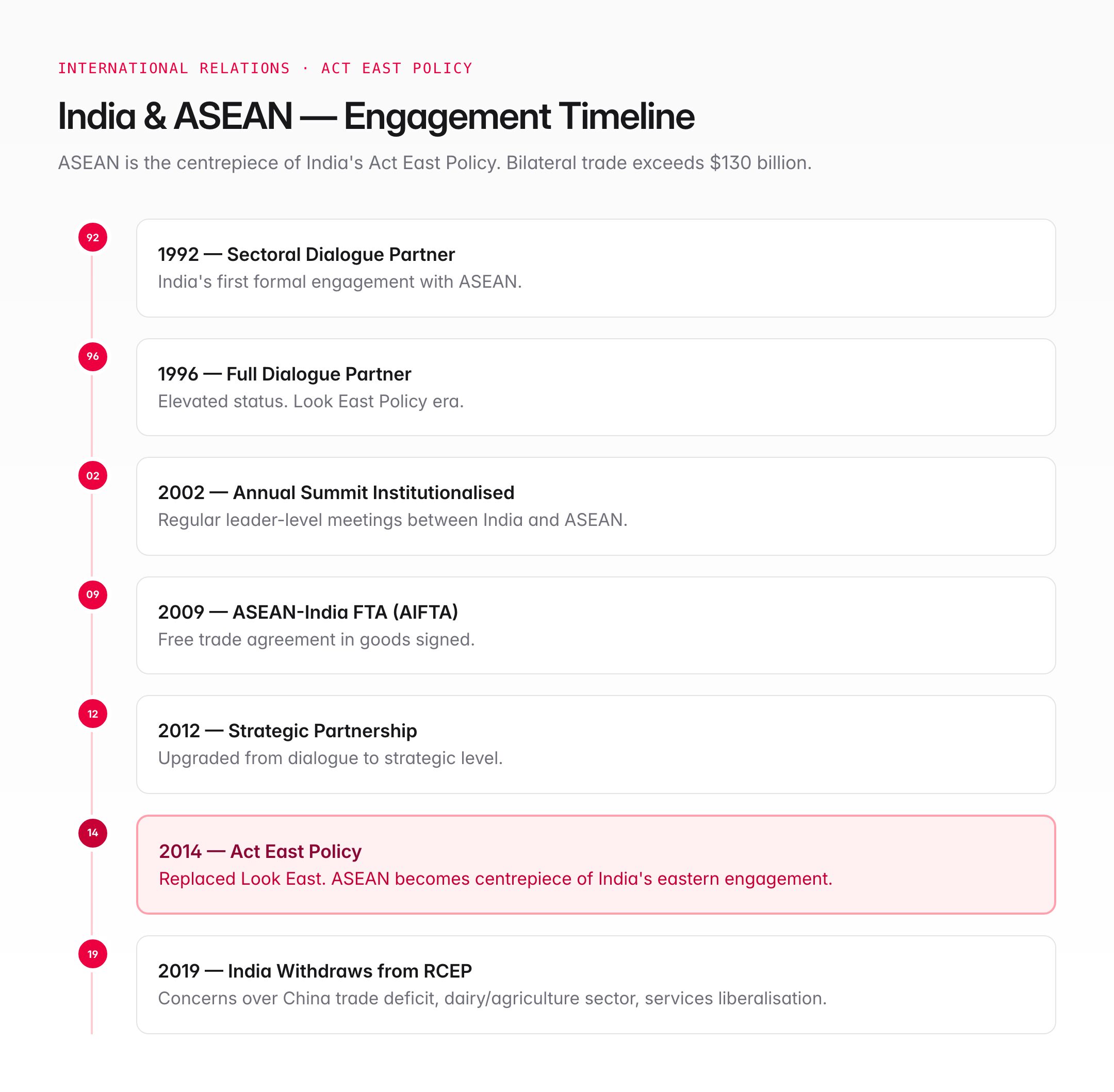
Timeline of Engagement
| Year | Milestone |
|---|---|
| 1992 | India became a Sectoral Dialogue Partner of ASEAN |
| 1996 | Elevated to Full Dialogue Partner |
| 2002 | Annual ASEAN-India Summit institutionalised |
| 2012 | Upgraded to Strategic Partnership |
| 2014 | India's Act East Policy replaced the earlier Look East Policy, deepening engagement |
| 2022 | 30th anniversary of ASEAN-India relations; commemorative summit held |
India's Key Interests in ASEAN
- Act East Policy: ASEAN is the centrepiece of India's engagement with Southeast and East Asia
- Trade: ASEAN-India FTA (AIFTA) signed in 2009; bilateral trade exceeded $130 billion in recent years
- Connectivity: India-Myanmar-Thailand Trilateral Highway, Kaladan Multi-Modal Transit, India-ASEAN maritime cooperation
- Strategic balance: India uses ASEAN platforms (EAS, ARF) to counterbalance China's influence in the Indo-Pacific
- Cultural ties: Shared Buddhist and Hindu heritage with mainland Southeast Asia (Cambodia's Angkor Wat, Thailand's Rama tradition, Vietnam's Cham civilisation)
RCEP and India
The Regional Comprehensive Economic Partnership (RCEP) — a mega free trade agreement — was signed in November 2020 by 15 countries (10 ASEAN + China, Japan, South Korea, Australia, New Zealand). India withdrew from RCEP negotiations in November 2019, citing concerns over:
- Trade deficit with China: Feared that zero-tariff imports from China would flood Indian markets
- Dairy and agriculture sector: Pressure from New Zealand and Australia
- Services liberalisation: RCEP lacked reciprocal opening for Indian services (IT, professionals)
- Rules of origin: Concerns that Chinese goods could enter India via ASEAN backdoors
India remains a potential future participant; the RCEP agreement contains a provision for India's accession.
Key Recent Summits and Declarations
| Summit | Year | Host | Key Outcomes |
|---|---|---|---|
| 42nd ASEAN Summit | 2023 | Indonesia (Jakarta) | Focus on ASEAN centrality, Myanmar crisis, digital economy |
| 43rd ASEAN Summit | 2023 | Indonesia | Adopted the ASEAN Leaders' Declaration on developing ASEAN as an epicentrum of growth |
| 44th-45th ASEAN Summits | 2024 | Laos (Vientiane) | Emphasis on sustainability, connectivity, digital transformation |
UPSC Relevance
GS Paper II: International Relations — ASEAN structure, India’s Act East Policy, EAS, RCEP, Indo-Pacific architecture, ASEAN centrality.
GS Paper III: Economy — ASEAN-India FTA, trade relations, regional economic integration.
Key Points for Prelims
- ASEAN was founded in 1967 through the Bangkok Declaration by 5 founding members
- Current membership: 10 countries; secretariat in Jakarta, Indonesia
- Decisions are made by consensus (no voting)
- The ASEAN Charter (2008) gave ASEAN legal personality and established three community pillars
- ASEAN Centrality = ASEAN at the centre of Indo-Pacific regional architecture
- East Asia Summit (EAS) includes ASEAN + 8 (India, China, Japan, South Korea, Australia, New Zealand, Russia, USA)
- India became a Full Dialogue Partner in 1996 and a Strategic Partner in 2012
- India's Act East Policy (2014) replaced Look East Policy; ASEAN is its centrepiece
- India withdrew from RCEP in 2019; the agreement was signed by 15 countries in 2020 without India
- The ASEAN Outlook on the Indo-Pacific (AOIP) was adopted in 2019
Tell Google you want more of this.
Add Anantam IAS as a preferred sourceOne tap, and this site shows up more often in your own Top Stories, AI Overviews and AI Mode. Remove it any time.