Balance of Payments: Current Account & Capital Account
Understand India's balance of payments — current account deficit, capital account, trade deficit, forex reserves, and BOP crisis for UPSC Economy.
Balance of Payments: Current Account & Capital Account
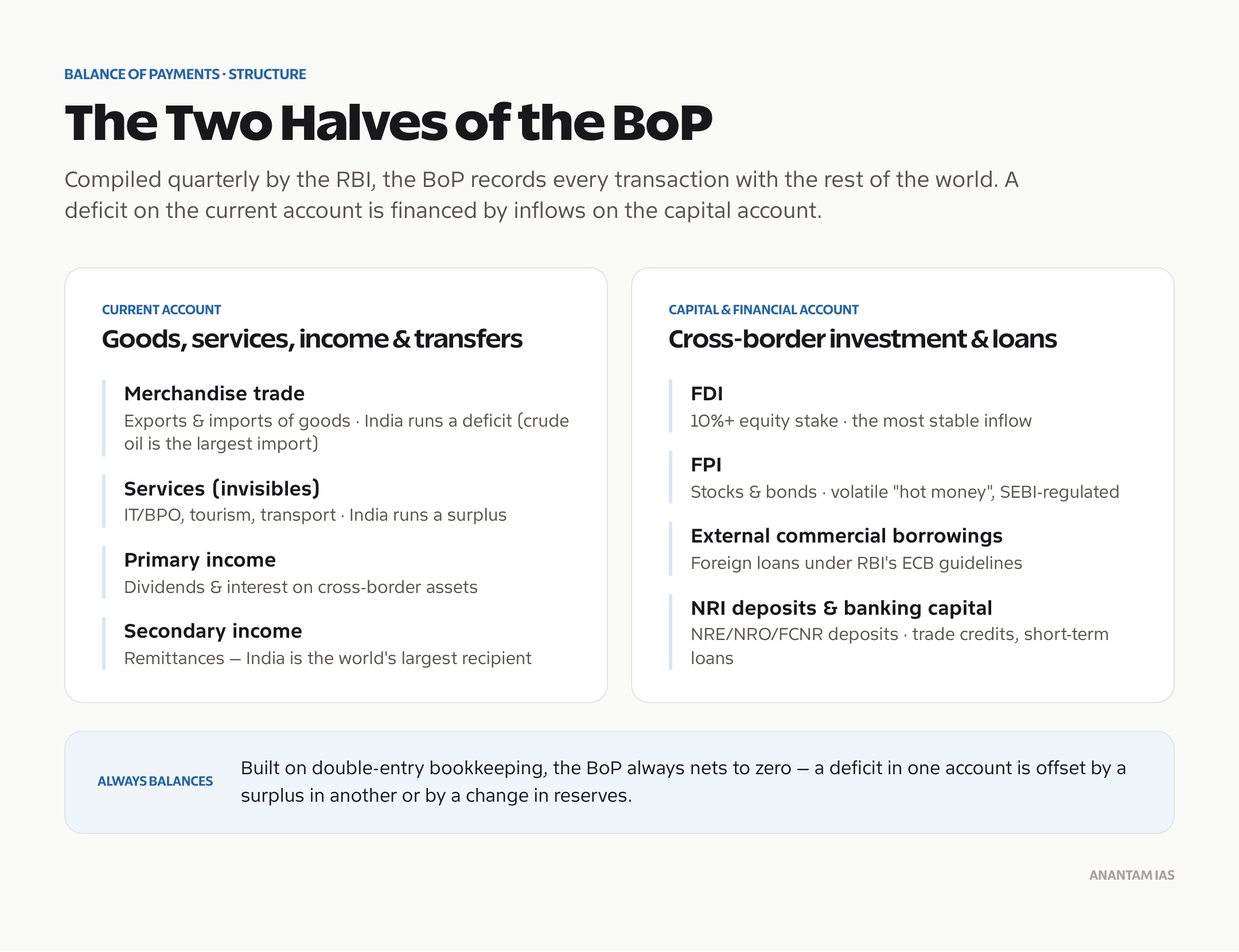
The Balance of Payments (BOP) is a systematic record of all economic transactions between residents of a country and the rest of the world during a given period. India’s BOP statement, published quarterly by the RBI, captures trade in goods, services, income flows, transfers, and capital movements. For UPSC, BOP is a recurring topic that connects international trade, exchange rates, foreign investment, and macroeconomic stability.
What Is Balance of Payments?
The BOP is based on double-entry bookkeeping — every transaction has a credit (inflow) and a debit (outflow). The BOP always balances in an accounting sense because any deficit in one account is offset by a surplus in another or by changes in reserves.
The BOP has three main components:
- Current Account: Trade in goods and services, income, and transfers
- Capital Account: Capital transfers and acquisition/disposal of non-financial assets
- Financial Account: Foreign investment, loans, and reserve assets
In India’s BOP classification (following the IMF’s BPM6 standard), what is commonly called the “capital account” includes both the capital and financial accounts.
The Reserve Bank of India (RBI) compiles India’s BOP data. The IMF’s Balance of Payments Manual (BPM6) provides the international standard.
Current Account
The current account records transactions in goods, services, primary income, and secondary income. A current account deficit (CAD) means the country is spending more foreign currency than it earns — requiring capital inflows to finance the gap.
Components of Current Account
Trade in Goods (Merchandise Trade)
- Exports and imports of physical goods
- India typically runs a merchandise trade deficit — imports exceed exports
- Crude oil is the single largest import item
- Key exports: petroleum products, gems & jewellery, IT services, pharmaceuticals, textiles
Trade in Services (Invisibles)
- IT and business services, tourism, transportation, financial services
- India runs a significant services surplus, driven by IT/BPO exports
- This surplus partially offsets the merchandise trade deficit
Primary Income
- Investment income (dividends, interest) earned by residents on foreign assets and paid to foreigners on their Indian investments
- Compensation of employees working abroad (short-term)
- India typically has a deficit — foreign investors earn more from India than Indian investors earn abroad
Secondary Income (Transfers)
- Remittances from Indians working abroad — India is the world’s largest recipient of remittances
- Grants, donations, and other one-way transfers
- A major positive contributor to India’s current account
Current Account Balance
| Component | Typical Direction for India |
|---|---|
| Merchandise trade | Deficit (imports > exports) |
| Services trade | Surplus (IT/BPO exports) |
| Primary income | Deficit |
| Secondary income (remittances) | Surplus |
| Overall Current Account | Usually deficit (CAD) |
India’s CAD has ranged from under 1% to over 4% of GDP in recent decades. A CAD of 2.5% of GDP is generally considered manageable for India.
Capital Account (Financial Account)
The capital account records cross-border investment flows, loans, and banking capital. A capital account surplus means more foreign money is flowing into the country than flowing out — financing the current account deficit.
Components
Foreign Direct Investment (FDI)
- Long-term investment where a foreign entity acquires 10% or more equity in an Indian enterprise
- Considered the most stable form of capital inflow
- Governed by FDI policy (automatic route and government approval route)
Foreign Portfolio Investment (FPI)
- Investment in stocks, bonds, and other financial instruments
- More volatile than FDI — can reverse quickly (“hot money”)
- Regulated by SEBI through the FPI framework
External Commercial Borrowings (ECBs)
- Loans from foreign commercial banks and institutions
- Regulated by the RBI through ECB guidelines (end-use restrictions, maturity, cost ceilings)
NRI Deposits
- Deposits by Non-Resident Indians in Indian bank accounts (NRE, NRO, FCNR)
- A significant source of stable capital inflow
Banking Capital
- Net foreign assets and liabilities of the banking sector
Other Capital
- Trade credits, short-term loans, advances
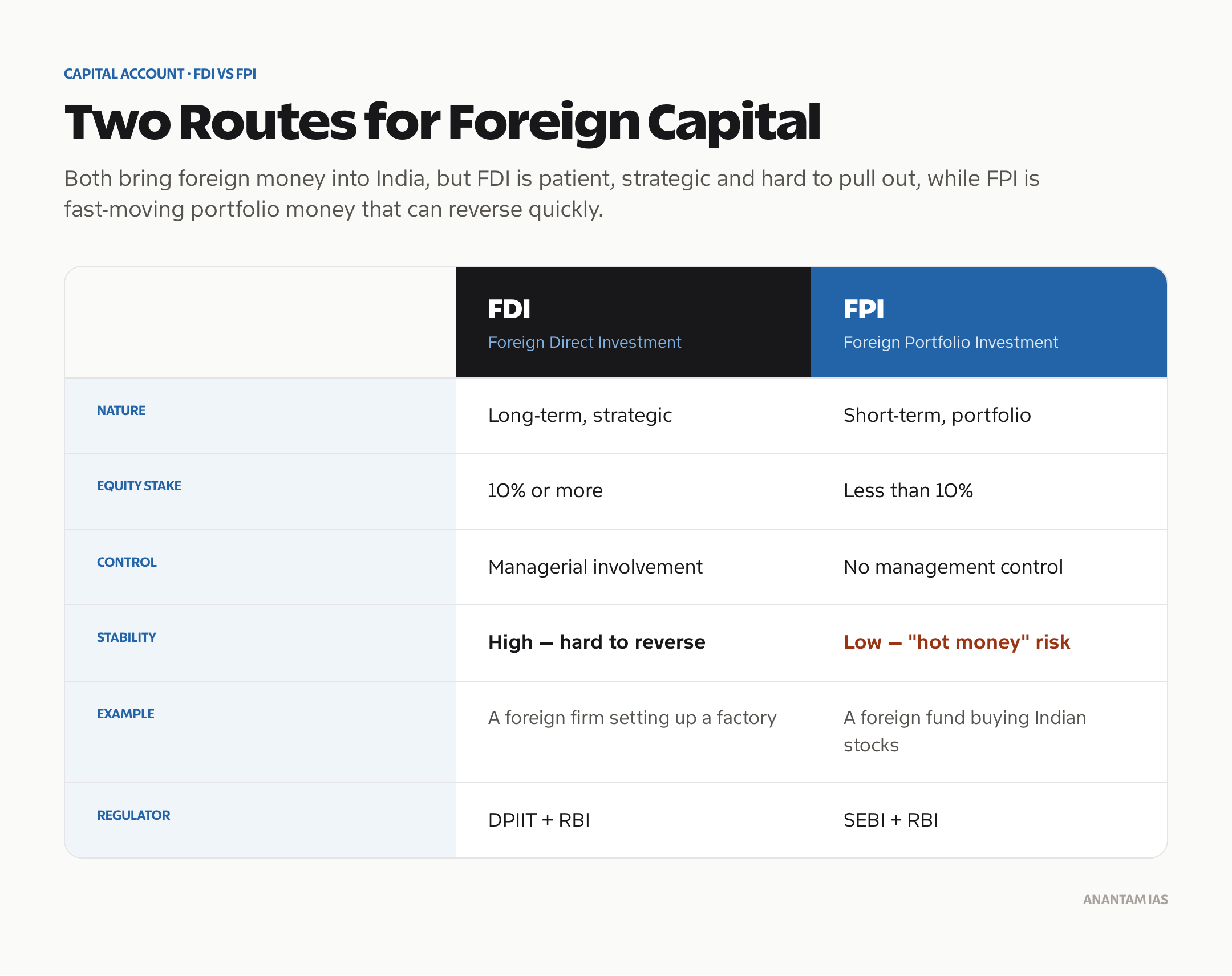
FDI vs FPI Comparison
| Parameter | FDI | FPI |
|---|---|---|
| Nature | Long-term, strategic | Short-term, portfolio |
| Equity stake | 10% or more | Less than 10% |
| Control | Managerial involvement | No management control |
| Stability | High — difficult to reverse quickly | Low — “hot money” risk |
| Example | A foreign company setting up a factory | Foreign fund buying Indian stocks |
| Regulator | DPIIT + RBI | SEBI + RBI |
Foreign Exchange Reserves
Foreign exchange reserves (forex reserves) are assets held by the RBI to manage the BOP and exchange rate. India’s forex reserves include:
- Foreign Currency Assets (FCA): The largest component — held in major currencies (USD, EUR, GBP, JPY)
- Gold reserves: Physical gold held by RBI
- Special Drawing Rights (SDRs): Allocated by the IMF
- Reserve Tranche Position: India’s quota contribution to the IMF
India’s forex reserves have grown significantly — from barely $1 billion during the 1991 crisis to over $600 billion. Adequate reserves provide:
- Import cover (months of imports that reserves can finance)
- Buffer against external shocks
- Confidence for foreign investors
- Exchange rate stability
The RBI uses forex reserves for intervention in the foreign exchange market — buying or selling dollars to prevent excessive rupee appreciation or depreciation.
India’s BOP Crisis of 1991
The 1991 BOP crisis was a watershed moment in Indian economic history. Key factors:
- Fiscal profligacy through the 1980s increased government borrowing
- Gulf War (1990) spiked oil prices and disrupted remittances
- Political instability reduced investor confidence
- Foreign exchange reserves fell to barely two weeks of imports
- India pledged gold to the Bank of England and IMF to avoid default
The crisis led to liberalisation reforms under PM Narasimha Rao and Finance Minister Manmohan Singh — dismantling the License Raj, opening the economy to foreign investment, and reforming trade policy.
Another stress episode occurred during the Taper Tantrum of 2013 when the US Federal Reserve’s announcement of reducing quantitative easing triggered FPI outflows from emerging markets. The rupee depreciated sharply, and India’s CAD touched 4.8% of GDP. The RBI under Governor Raghuram Rajan responded with measures like FCNR(B) dollar swap windows to attract NRI deposits.
Monetary Policy of RBI: Tools & Objectives
Exchange Rate and BOP
India follows a managed floating exchange rate system. The rupee’s value is determined by market forces (demand and supply of foreign exchange) but the RBI intervenes to prevent excessive volatility.
Key exchange rate concepts:
- Real Effective Exchange Rate (REER): Trade-weighted exchange rate adjusted for inflation differentials — indicates competitiveness
- Nominal Effective Exchange Rate (NEER): Trade-weighted exchange rate without inflation adjustment
- Marshall-Lerner Condition: Devaluation improves trade balance only if the sum of export and import demand elasticities exceeds one
- J-Curve Effect: Trade balance initially worsens after depreciation before improving
Key Policy Measures to Manage BOP
The government and RBI use multiple tools:
- Trade policy: Export promotion schemes (RoDTEP, PLI), import substitution (Aatmanirbhar Bharat)
- Capital flow management: Limits on ECBs, FPI investment caps, NRI deposit incentives
- Exchange rate management: RBI intervention using forex reserves
- Current account management: Oil import diversification, services export promotion
- Bilateral swap arrangements: Currency swap agreements with countries like Japan, UAE to reduce dollar dependence
Frequently Asked Questions
What is Current Account Deficit (CAD)?
CAD occurs when a country’s total imports of goods, services, and transfers exceed total exports. For India, the merchandise trade deficit (especially oil imports) is the primary driver. CAD isn’t always negative — it can reflect productive investment financed by foreign savings. However, a persistently large CAD (above 3% of GDP) creates vulnerability to external shocks.
Why does India usually have a trade deficit?
India imports more goods than it exports — crude oil alone accounts for roughly 25% of import value. Other major imports include gold, electronics, and machinery. While India has a services surplus (IT exports, remittances), it isn’t large enough to offset the merchandise deficit. Structural dependence on oil imports and limited manufacturing export base are the core reasons.
What are forex reserves used for?
Forex reserves serve multiple purposes: financing imports during crisis periods, defending the exchange rate against speculative attacks, providing confidence to foreign investors, and meeting external debt obligations. The RBI also uses reserves for open market operations in the forex market to prevent excessive rupee volatility.
How did the 1991 BOP crisis change India?
The 1991 crisis forced India to liberalise its economy. Reforms included abolishing industrial licensing, reducing trade barriers, welcoming FDI, devaluing the rupee, and reforming the financial sector. The crisis demonstrated that a closed, regulated economy with large fiscal deficits was unsustainable. It marked India’s transition from a planned economy to a market-oriented one.