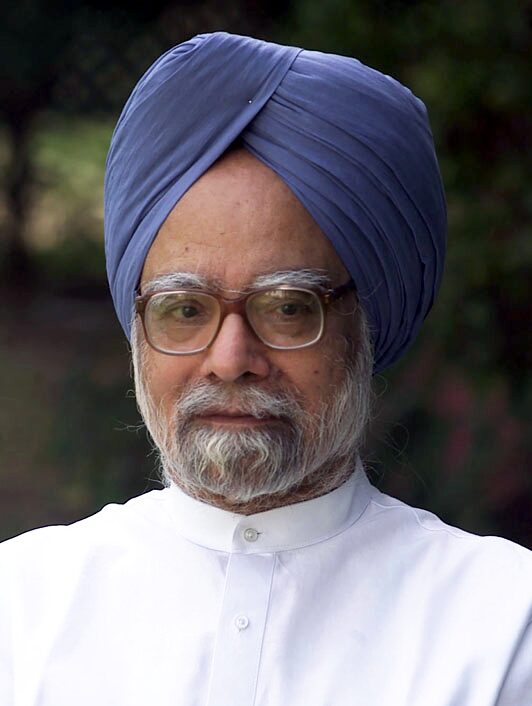
Manmohan Singh served as India’s 13th Prime Minister from 22 May 2004 to 26 May 2014, leading the United Progressive Alliance through two consecutive terms — the only non-Nehru/Gandhi Congress leader since Jawaharlal Nehru to win a second mandate. Trained at Punjab University, Cambridge and Oxford, Manmohan Singh entered office already carrying the legacy of being the Finance Minister who unlocked the 1991 reforms under P.V. Narasimha Rao. His decade as Prime Minister produced the Right to Information Act, MGNREGA, the Forest Rights Act, the Food Security Act, the Aadhaar foundation, and the Indo-US Civil Nuclear Deal.
Critics argue that the second term — UPA-II from 2009 to 2014 — was paralysed by coalition pulls, the 2G spectrum and coal-block allocation controversies, and a perception of weak political authority against a stronger Sonia Gandhi-led party. Manmohan Singh’s quiet, professorial style made him a target of caricature, but his death on 26 December 2024 prompted a rare bipartisan recognition that India’s transition from a USD 700 billion economy in 2004 to over USD 2 trillion by 2014 owed much to him.
Education, RBI, and the technocrat’s road to politics
Manmohan Singh was born on 26 September 1932 in Gah, Punjab (now in Pakistan). Partition uprooted the family to Amritsar. He completed his BA and MA in Economics from Punjab University, took the Economics Tripos at St John’s College Cambridge, and earned a DPhil at Nuffield College Oxford in 1962 with a thesis on India’s export performance. He taught at the Delhi School of Economics and Panjab University, then moved into government as Chief Economic Adviser in 1972.
He served as Secretary in the Department of Economic Affairs, Governor of the Reserve Bank of India from 1982 to 1985, Deputy Chairman of the Planning Commission, and Secretary-General of the South Commission in Geneva. The trajectory built a CV almost impossible to question on competence — the precise quality the moment demanded in June 1991.
Finance Minister, 1991-96
When P.V. Narasimha Rao inducted him into the cabinet, Manmohan Singh was heading the University Grants Commission. His 24 July 1991 Budget speech — quoting Victor Hugo’s line that “no power on earth can stop an idea whose time has come” — devalued the rupee, slashed import tariffs, opened FDI, and dismantled industrial licensing in one package. The deeper architecture of that moment is set out in the Anantamias explainer on the 1991 LPG reforms, which sits beside the political record of P.V. Narasimha Rao as the founding event of the post-Nehruvian economy.
UPA-I: 2004-09, the rights-based welfare state
The 2004 verdict surprised most pollsters. Sonia Gandhi declined the prime ministership and nominated Manmohan Singh, who took oath on 22 May 2004. UPA-I governed with Left party outside support until 2008. The legislative output of those five years was the densest welfare-state expansion since the 1970s.
Landmark laws
- Right to Information Act 2005 — operationalised Article 19(1)(a) by giving citizens a statutory right to access information held by public authorities.
- MGNREGA 2005 — guaranteed 100 days of unskilled wage employment per rural household per year, the world’s largest employment-guarantee programme.
- Forest Rights Act 2006 — recognised the rights of forest-dwelling Scheduled Tribes and Other Traditional Forest Dwellers over forest land and produce.
- Right of Children to Free and Compulsory Education Act 2009 — gave statutory effect to Article 21A.
- National Food Security Act 2013 — extended subsidised foodgrains to roughly two-thirds of the population.
- Lokpal and Lokayuktas Act 2013 — created an anti-corruption ombudsman after the Anna Hazare movement.
UPA-I also launched the National Rural Health Mission (2005), the Jawaharlal Nehru National Urban Renewal Mission (2005), and the Bharat Nirman programme for rural infrastructure.
Indo-US Civil Nuclear Deal
The 123 Agreement signed with the United States in October 2008 ended three decades of nuclear isolation imposed after Pokhran-I. Manmohan Singh staked his government on it. The Left withdrew support in July 2008, and his government survived a trust vote 275-256 after weeks of political drama. The deal won India a Nuclear Suppliers Group waiver, opened civilian nuclear cooperation, and reset US-India relations strategically.
UPA-II: 2009-14, governance under strain
Manmohan Singh returned with a stronger Congress tally in 2009. UPA-II was, in retrospect, an inflection. Growth accelerated initially — GDP touched 8.5 percent in 2010-11 — but the global financial crisis aftermath, persistent inflation, the rupee slide of 2013, and a sequence of audit controversies eroded political capital.
Scams and the policy paralysis charge
- 2G spectrum allocation (2008-10) — the CAG estimated a presumptive loss of up to Rs 1.76 lakh crore from first-come-first-served licence allotments. The Supreme Court cancelled 122 licences in 2012. Most accused were acquitted in 2017, though political damage was done.
- Coal block allocations (Coalgate, 2012) — CAG estimated a presumptive loss of Rs 1.86 lakh crore from non-auction allocations between 2004 and 2009. The Supreme Court cancelled 214 blocks in 2014.
- Commonwealth Games 2010, Adarsh Society, Devas-Antrix — added to a perception of governance drift.
Manmohan Singh was personally never charged in any case. The Vinod Rai CAG reports later attracted scrutiny over the “presumptive loss” methodology. But the cumulative public mood produced the 2014 mandate for the BJP.
Aadhaar and digital infrastructure
UPA-II established the Unique Identification Authority of India in 2009 and rolled out Aadhaar enrolment that today underpins India’s Digital Public Infrastructure stack. The Direct Benefit Transfer architecture was seeded in this period, although operationalised at scale after 2014.
Foreign policy, federal reform, and the planning shift
Manmohan Singh deepened the India-US strategic embrace, normalised relations with ASEAN through the Comprehensive Economic Cooperation Agreement, advanced the Look East policy initiated by P.V. Narasimha Rao, and managed a stable if cautious China policy. The 26/11 Mumbai attacks of November 2008 strained ties with Pakistan; he chose not to retaliate militarily.
On federalism, UPA created the Goods and Services Tax Empowered Committee (GST itself was passed under NDA in 2017), strengthened the Finance Commission framework, and operated the last full five-year plan cycle. The Planning Commission was wound down in 2015 and replaced by Niti Aayog.
Post-PM years and the demonetisation critique
After 2014 Manmohan Singh returned to the Rajya Sabha. His 24 November 2016 speech on the 8 November 2016 demonetisation called it “organised loot and legalised plunder” and predicted a GDP hit of around 2 percentage points — a forecast subsequent data largely vindicated. He remained a measured but consistent critic of policy missteps until his death on 26 December 2024.
For comparative analysis of his decade against the NDA-I years under Atal Bihari Vajpayee, see our companion article, and for the Mandal-era prelude that reshaped Indian politics before the UPA era, see V.P. Singh.
The Manmohan style: doctrine, restraint, and the long view
Manmohan Singh’s prime ministership was defined by an unusual combination — technocratic clarity, public reticence, and political durability through coalition turbulence. He did not own a personal political base, contested only Rajya Sabha elections, and depended on Sonia Gandhi for party authority. Yet he ran two terms without a single Cabinet resignation forced by a personal disagreement with him, presided over the National Development Council with patience, and kept the Reserve Bank of India operationally independent through the 2008 global crisis under Governors Y.V. Reddy and D. Subbarao.
His decade also saw poverty headcount decline sharply — Tendulkar Committee estimates show poverty falling from 37.2 percent in 2004-05 to 21.9 percent in 2011-12 — and absolute numbers of poor falling by over 137 million. Whether the credit belongs to global commodity tailwinds, the 1991 reform vintage, or UPA welfare laws is the question UPSC essay papers still ask. Manmohan Singh himself attributed the gains to “the silent revolution of inclusive growth” — a phrase that captures his understated rhetorical register.
Frequently Asked Questions
Who was Manmohan Singh and what made him unique as Prime Minister?
Manmohan Singh was India’s 13th Prime Minister (2004-14) and the first Sikh to hold the office. He was uniquely a trained economist — Cambridge and Oxford educated, former RBI Governor — who entered electoral politics through the Rajya Sabha rather than the Lok Sabha. He never won a direct Lok Sabha election, an unusual record for a two-term PM.
What were Manmohan Singh’s major achievements as Finance Minister in 1991?
As Finance Minister under P.V. Narasimha Rao, Manmohan Singh authored the July 1991 Budget that devalued the rupee, cut customs duties, opened FDI, ended industrial licensing for most sectors, and triggered the LPG reforms. He served as FM through 1996, anchoring India’s transition from a closed to an open economy.
What landmark laws were passed under Manmohan Singh’s UPA government?
UPA-I and UPA-II passed the RTI Act 2005, MGNREGA 2005, Forest Rights Act 2006, Right to Education Act 2009, National Food Security Act 2013, and Lokpal Act 2013. The Aadhaar enrolment architecture was also set up under Manmohan Singh through the UIDAI in 2009.
What was the Indo-US Civil Nuclear Deal?
The 123 Agreement, finalised in October 2008, ended India’s nuclear isolation after Pokhran. Manmohan Singh staked his government on it — surviving a trust vote 275-256 after the Left withdrew support. The deal won India a Nuclear Suppliers Group waiver and opened civil nuclear cooperation with the US, France, Russia and Australia.
What were the main controversies during Manmohan Singh’s second term?
UPA-II faced CAG findings on the 2G spectrum allocation (presumptive loss up to Rs 1.76 lakh crore) and coal block allocations (Rs 1.86 lakh crore presumptive loss). The Supreme Court cancelled 122 telecom licences in 2012 and 214 coal blocks in 2014. Manmohan Singh personally faced no charge, but governance perception suffered.
Why did Manmohan Singh criticise demonetisation?
In his 24 November 2016 Rajya Sabha speech, Manmohan Singh called the 8 November 2016 demonetisation u0022organised loot and legalised plunderu0022 and forecast a GDP hit of around 2 percentage points. He argued that 86 percent of currency in circulation could not be withdrawn overnight without disrupting the cash-intensive informal economy.
How is Manmohan Singh viewed historically?
Manmohan Singh is recognised across the political spectrum as the technocratic architect of liberalised India and as the welfare-rights-state Prime Minister. His critics fault UPA-II’s governance drift; his admirers point to the doubling of GDP, falling poverty headcount, and the legal infrastructure of rights-based welfare. His death on 26 December 2024 prompted a rare cross-party tribute.
What was Manmohan Singh’s relationship with Sonia Gandhi and the Congress?
Sonia Gandhi nominated Manmohan Singh as Prime Minister in 2004 after she declined the post. The dual-power arrangement — Sonia chaired the UPA and the National Advisory Council, Manmohan Singh ran the government — produced both the rights-based welfare laws and friction over policy authority. He served two full terms without ever challenging her party leadership.
Watch on YouTube
Related video from the Anantam IAS YouTube channel.
Manmohan Singh and India's Foreign Policy

Tell Google you want more of this.
Add Anantam IAS as a preferred sourceOne tap, and this site shows up more often in your own Top Stories, AI Overviews and AI Mode. Remove it any time.