
Foreign Direct Investment (FDI) in India: Complete Guide
Foreign Direct Investment is cross-border capital that comes with a long-term ownership interest and management control. India has been one of the world’s largest FDI destinations for over two decades — and the policy framework around it has transformed dramatically since 1991. For UPSC, FDI is a core GS-III topic. You need to understand the entry routes, sector-level caps, the reform trajectory, and India’s position in the global FDI landscape.
What Is FDI? Definition and Features
FDI stands for Foreign Direct Investment — investment by a foreign entity in an Indian company where the investor acquires a lasting interest and a degree of influence or control over management. The IMF and OECD define a lasting interest as owning 10% or more of the voting power (equity) of the enterprise.
Characteristics of FDI
- Long-term horizon: Unlike portfolio flows, FDI is not easily reversible
- Management participation: Investor has a say in how the company is run
- Technology and skill transfer: Often accompanies physical capital
- Greenfield vs Brownfield: Greenfield FDI creates new capacity (new factories, offices); Brownfield FDI involves acquiring or expanding existing facilities
- Sector-specific: Subject to India’s FDI policy — some sectors are open, some restricted, some prohibited
Routes of FDI Entry in India
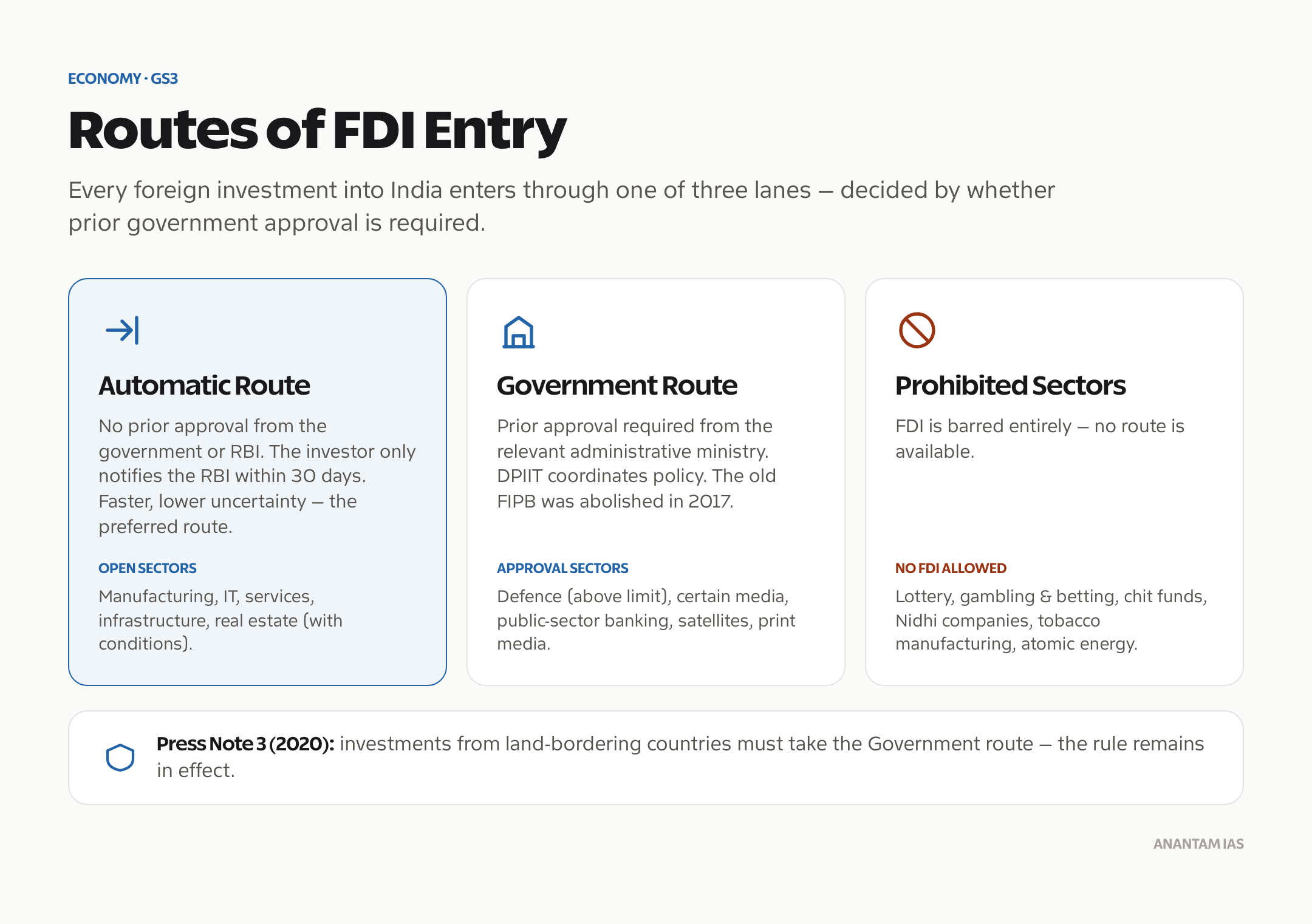
India allows FDI through two routes, determined by whether the investment requires prior government approval.
Automatic Route
Under the automatic route, a foreign investor does not need prior approval from the government or the Reserve Bank of India. The investor simply needs to notify the RBI within 30 days of receiving the investment. This is the preferred route — it’s faster and reduces regulatory uncertainty.
Most sectors fall under the automatic route, including manufacturing, IT, services, infrastructure, and real estate (with conditions).
Government (Approval) Route
Under the government route (previously called FIPB route — Foreign Investment Promotion Board, which was abolished in 2017), the investor must obtain prior approval. The relevant administrative ministry handles the approval. The DPIIT (Department for Promotion of Industry and Internal Trade) coordinates policy.
Sectors requiring government approval include: defence (beyond the automatic limit), media (certain segments), banking (public sector), satellites, print media, and sectors with sensitive national interest considerations.
Prohibited Sectors
FDI is prohibited entirely in:
- Lottery business (including online lotteries)
- Gambling and betting
- Chit fund business
- Nidhi companies
- Trading in Transferable Development Rights
- Manufacturing of tobacco products
- Real estate business (other than developed townships/housing projects)
- Activities reserved for Micro, Small and Medium Enterprises (MSME)
- Atomic energy (under the Atomic Energy Act)
Sector-Wise FDI Caps: Key Table
| Sector | FDI Cap | Route |
|---|---|---|
| Agriculture & Animal Husbandry | 100% | Automatic |
| Manufacturing | 100% | Automatic |
| IT & Business Process Outsourcing | 100% | Automatic |
| E-commerce (marketplace model) | 100% | Automatic |
| Private Sector Banking | 74% | Automatic up to 49%; Government above 49% |
| Public Sector Banking | 20% | Government |
| Insurance | 74% | Automatic up to 49%; Government above 49% |
| Defence | 74% (100% with Government route for modern tech) | Automatic up to 74% |
| Telecom | 100% | Automatic up to 49%; Government above 49% |
| Print Media (news) | 26% | Government |
| Digital News Media | 26% | Government |
| Broadcasting (FM Radio) | 49% | Government |
| Multi-Brand Retail | 51% | Government |
| Single-Brand Retail | 100% | Automatic up to 49%; Government above 49% |
| Civil Aviation (domestic airlines) | 100% (49% for foreign airlines) | Automatic |
| Petroleum & Natural Gas | 49% (PSU exploration) to 100% (private refining) | Varies |
| Pharmaceuticals (Brownfield) | 74% Automatic; 100% Government | Both |
Recent FDI Policy Reforms
India has progressively liberalised its FDI policy since 1991. Key recent reforms:
2020 — Press Note 3: After COVID-19, India made it mandatory for investments from countries sharing a land border with India (China, Pakistan, Bangladesh, Nepal, Myanmar, Bhutan) to go through the government route. This was a direct response to concerns about opportunistic Chinese takeovers of undervalued Indian companies during the pandemic. This rule remains in effect.
Insurance sector (2021): FDI limit in insurance raised from 49% to 74% (with Indian management and control requirements).
Defence sector reforms: The automatic route threshold was raised from 49% to 74% to attract cutting-edge defence technology investment. 100% is allowed under the government route for modern technology.
DPIIT role: The Department for Promotion of Industry and Internal Trade under the Commerce Ministry is the nodal agency for FDI policy. It issues “Press Notes” to amend the Consolidated FDI Policy.
Abolition of FIPB (2017): The Foreign Investment Promotion Board was abolished. Approval functions were transferred to the competent ministries. This streamlined the approval process.
FDI Inflows Data: India’s Performance
India has been among the top global FDI destinations for several years running.
| Year | Total FDI Equity Inflows (USD Billion) |
|---|---|
| 2017-18 | 44.85 |
| 2018-19 | 44.37 |
| 2019-20 | 49.97 |
| 2020-21 | 59.64 (record at the time) |
| 2021-22 | 58.77 |
| 2022-23 | 46.03 |
| 2023-24 | 44.42 |
The drop from the 2020-21 peak reflects global factors — rising interest rates, tighter financial conditions, and geopolitical uncertainty. But India’s structural attractiveness remains intact.
Top Investing Countries in India
| Rank | Country | Share in FDI Equity (approx.) |
|---|---|---|
| 1 | Mauritius | ~25-27% |
| 2 | Singapore | ~20-23% |
| 3 | USA | ~9-10% |
| 4 | Netherlands | ~7-8% |
| 5 | Japan | ~6-7% |
| 6 | UAE | ~3-4% |
| 7 | Cayman Islands | ~3-4% |
Mauritius and Singapore top the list partly because of treaty shopping — investors routing funds through these jurisdictions to avail of Double Taxation Avoidance Agreement (DTAA) benefits. India has renegotiated its DTAA with Mauritius (2016) and Singapore to plug this loophole.
Top Recipient Sectors
Services sector (financial, banking, insurance, non-financial) historically receives the largest FDI. Computer software and hardware, telecommunications, trading, construction, and automobile industries are other major recipients.
FDI vs FPI: Critical Distinction for UPSC
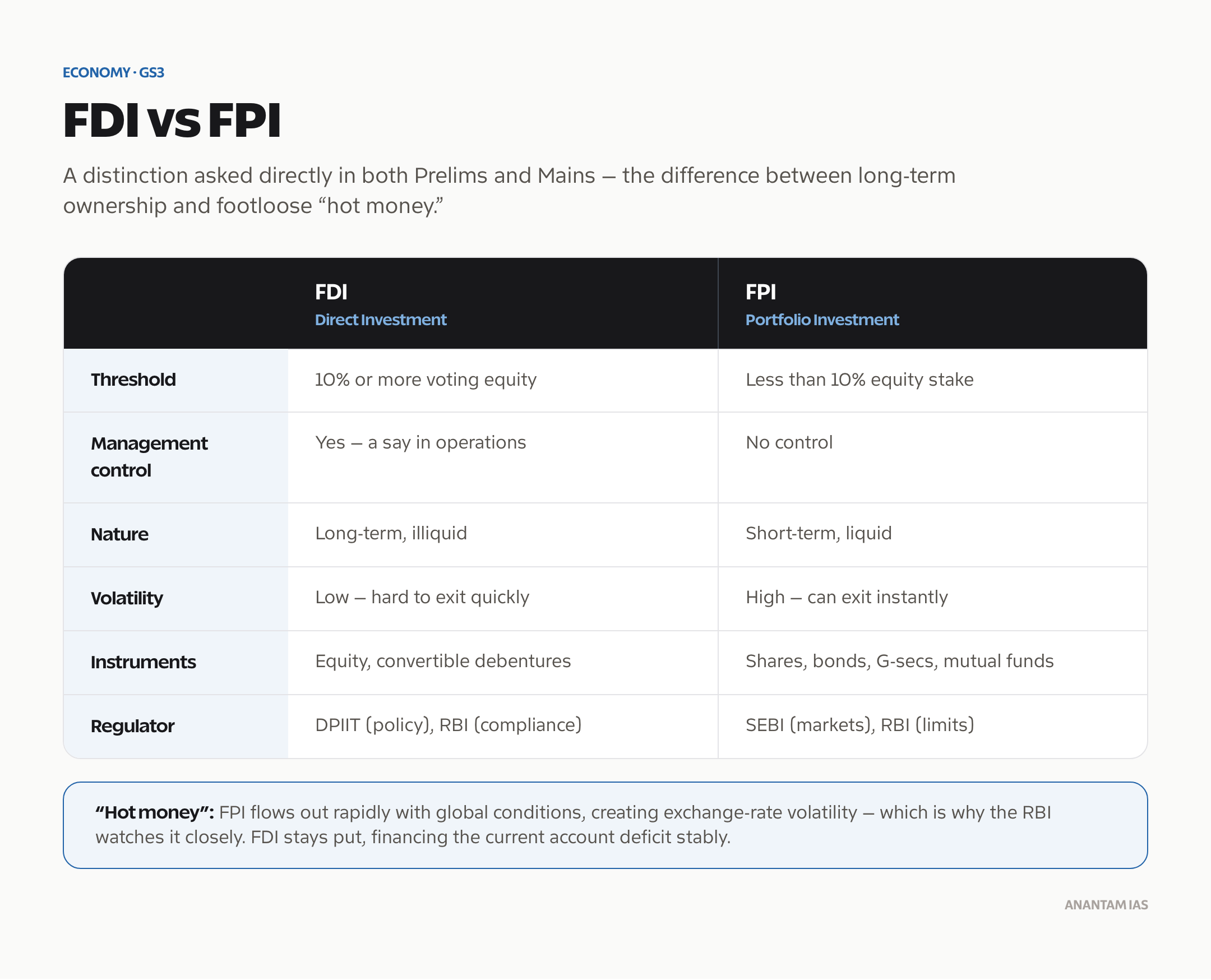
This comparison is asked directly in both Prelims and Mains.
| Parameter | FDI (Foreign Direct Investment) | FPI (Foreign Portfolio Investment) |
|---|---|---|
| Definition | Investment with management control | Investment in financial instruments only |
| Threshold | 10% or more voting equity | Less than 10% equity stake |
| Nature | Long-term, illiquid | Short-term, liquid |
| Management control | Yes | No |
| Instruments | Equity, partly paid instruments, compulsorily convertible debentures | Shares, bonds, government securities, mutual funds |
| Volatility | Low — hard to exit quickly | High — can exit instantly (called “hot money”) |
| Impact on BoP | Stable capital account contribution | Can cause sudden outflows and currency pressure |
| Regulatory authority | DPIIT (policy), RBI (compliance) | SEBI (for markets), RBI (for limits) |
| Motive | Business operations, market access | Returns from financial markets |
Hot Money: FPI is often called “hot money” because it can flow out rapidly in response to global conditions, creating exchange rate volatility. The RBI monitors FPI flows closely precisely because of this risk.
Why FDI Matters for India’s Economy
Capital formation: FDI supplements domestic savings for investment, especially in capital-intensive sectors like infrastructure, manufacturing, and technology.
Technology transfer: Multinational companies bring proprietary technologies, management practices, and global supply chain linkages. This is especially important in defence, pharmaceuticals, and advanced manufacturing.
Employment generation: Both direct employment in FDI enterprises and indirect employment through supply chains.
Export competitiveness: FDI in export-oriented sectors (IT, garments, auto components) has strengthened India’s export capacity.
Current account deficit financing: FDI is the most stable form of external financing for India’s persistent current account deficit.
Concerns About FDI
- Crowding out domestic firms: Large multinationals can use pricing power to eliminate local competition
- Profit repatriation: Dividends, royalties, and management fees flow out as FDI income in the current account
- Treaty shopping and tax avoidance: Routing through Mauritius/Singapore eroded India’s tax base until DTAA renegotiations
- Policy sovereignty: Strategic sectors with high FDI may face conflicts between investor interests and national policy goals
- Land border rule tension: The 2020 press note creates friction with regional economic integration goals
India’s FDI Policy Architecture: Institutions
DPIIT (Department for Promotion of Industry and Internal Trade): Frames FDI policy, issues Consolidated FDI Policy document (updated periodically), handles policy-level approvals.
RBI: Under the Foreign Exchange Management Act (FEMA), 1999, the RBI regulates the actual flow — pricing guidelines, reporting requirements, sectoral caps compliance. FEMA replaced the old FERA (Foreign Exchange Regulation Act, 1973), which had a penal rather than civil framework.
SEBI: Regulates FPI flows into capital markets.
Competition Commission of India (CCI): Scrutinises mergers and acquisitions involving FDI for anti-competitive effects.
Frequently Asked Questions
1. What is the difference between FDI automatic route and government route?
Under the automatic route, no prior approval is needed — the investor just informs the RBI post-investment. Under the government route, prior approval from the relevant ministry is required. Most sectors allow 100% FDI under the automatic route; sensitive sectors need government approval.
2. Why does Mauritius top India’s FDI source list?
Historically, Mauritius offered capital gains tax exemptions under its DTAA with India, making it a preferred routing destination. India renegotiated the treaty in 2016 to tax capital gains at source (India), reducing but not eliminating the advantage. Some investments are genuinely Mauritius-based.
3. What is Press Note 3 of 2020?
Press Note 3 (2020) requires all FDI from countries sharing a land border with India (China, Pakistan, Bangladesh, Nepal, Myanmar, Bhutan) to go through the government approval route. It was introduced during COVID-19 to prevent opportunistic acquisitions of Indian companies at depressed valuations.
4. What is the FDI limit in insurance in India?
The FDI limit in insurance was raised from 49% to 74% by the Insurance Amendment Act, 2021. The automatic route applies up to 74%, subject to conditions of majority of directors and management being Indian residents.
5. What is the difference between Greenfield and Brownfield FDI?
Greenfield FDI creates entirely new production capacity — building new factories or facilities from scratch. Brownfield FDI involves acquiring or expanding existing facilities. India tracks both. Greenfield FDI is generally more beneficial for employment and industrial capacity creation.
Tell Google you want more of this.
Add Anantam IAS as a preferred sourceOne tap, and this site shows up more often in your own Top Stories, AI Overviews and AI Mode. Remove it any time.