Banking System in India: Types & Structure
Complete study notes on India's banking system — RBI, commercial banks, cooperative banks, payment banks, NPAs, and banking reforms for UPSC.
Banking System in India: Types & Structure
India’s banking system is a multi-layered structure with the Reserve Bank of India at the apex, followed by commercial banks, cooperative banks, and specialised institutions. The sector has undergone massive transformation — from nationalisation in 1969 to liberalisation in the 1990s to the digital banking revolution today. Understanding bank classification, RBI regulation, NPA challenges, and recent reforms is essential for UPSC Economy preparation.
Structure of the Indian Banking System
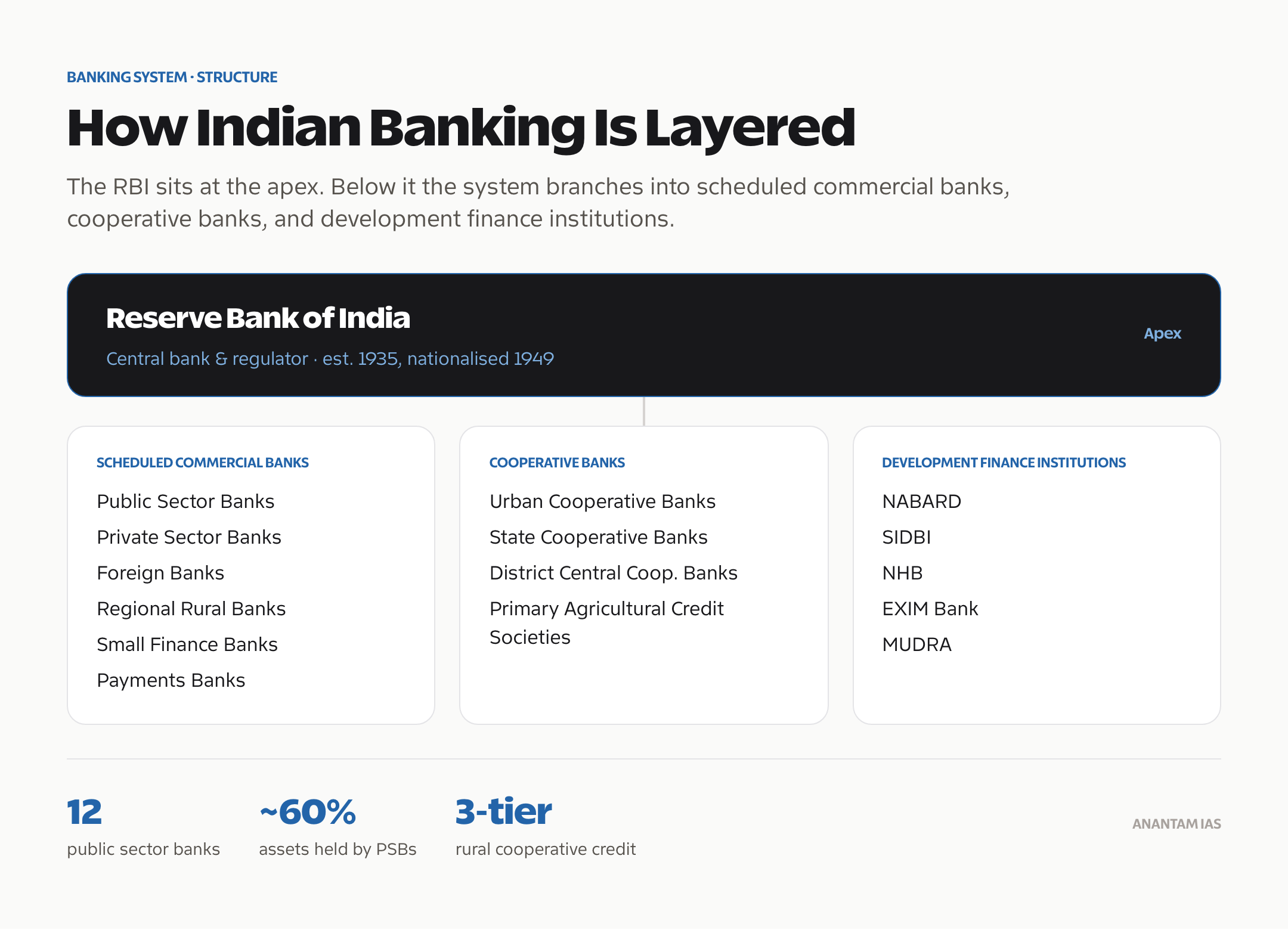
The Indian banking system operates under the regulatory oversight of the Reserve Bank of India (RBI), established in 1935 and nationalised in 1949. The structure can be visualised as a pyramid.
Banking System Hierarchy
At the top sits the RBI as the central bank. Below it, the system branches into:
- Scheduled Commercial Banks (SCBs)
– Public Sector Banks (PSBs) – Private Sector Banks – Foreign Banks – Regional Rural Banks (RRBs) – Small Finance Banks – Payments Banks
- Cooperative Banks
– Urban Cooperative Banks (UCBs) – State Cooperative Banks – District Central Cooperative Banks – Primary Agricultural Credit Societies (PACS)
- Development Finance Institutions
– NABARD, SIDBI, NHB, EXIM Bank, MUDRA
Reserve Bank of India: The Central Bank
The RBI was established under the Reserve Bank of India Act, 1934. It serves as the banker to the government, lender of last resort, regulator of banks, and manager of the country’s monetary policy.
Key Functions of RBI
- Monetary policy: Setting interest rates through the MPC
- Currency management: Sole authority to issue banknotes (Section 22, RBI Act)
- Banking regulation: Licensing, supervision, and inspection of banks
- Foreign exchange management: Under FEMA, 1999
- Developmental role: Financial inclusion, priority sector lending, payment systems
- Banker to government: Managing government accounts and public debt
The RBI is governed by a Central Board of Directors appointed by the government. The Governor is the chief executive. Historically significant governors include CD Deshmukh (first Indian Governor), Manmohan Singh, Raghuram Rajan, and Urjit Patel.
Monetary Policy of RBI: Tools & Objectives
Commercial Banks
Public Sector Banks (PSBs)
Banks where the government holds more than 50% equity. After the bank nationalisation of 1969 (14 banks) and 1980 (6 more banks), PSBs dominated Indian banking. The merger exercise of 2019–20 consolidated PSBs from 27 to 12.
Major PSBs: State Bank of India (largest bank), Punjab National Bank, Bank of Baroda, Canara Bank, Union Bank of India, Indian Bank.
PSBs account for roughly 60% of banking assets but have faced challenges with NPAs, governance issues, and competition from private banks.
Private Sector Banks
Private sector banks include old private banks (pre-independence, like Federal Bank, South Indian Bank) and new private banks (post-1993 liberalisation, like HDFC Bank, ICICI Bank, Axis Bank, Kotak Mahindra Bank).
New private banks have been more efficient, technology-driven, and profitable. HDFC Bank merged with its parent HDFC Ltd in 2023 — creating India’s largest private sector bank and one of the world’s most valuable banks.
Foreign Banks
Banks incorporated abroad but operating in India through branches or wholly-owned subsidiaries. Examples: Citibank, Standard Chartered, HSBC, Deutsche Bank.
Foreign banks must comply with Indian regulations but operate under a different regulatory framework. The RBI’s 2013 guidelines encouraged foreign banks to convert into wholly-owned subsidiaries for deeper local integration.
Types of Commercial Banks: Comparison
| Parameter | Public Sector Banks | Private Banks | Foreign Banks |
|---|---|---|---|
| Ownership | Government > 50% | Private shareholders | Foreign parent |
| Number | 12 | ~20+ | ~45 (branches) |
| Market share (assets) | ~60% | ~30% | ~5% |
| Strengths | Branch network, trust, social banking | Technology, efficiency, service | Global expertise, niche services |
| Challenges | NPAs, governance, legacy costs | Limited rural reach | Regulatory restrictions, thin presence |
Differentiated Banks
Small Finance Banks (SFBs)
Licensed to provide basic banking services (deposits and lending) with a focus on unserved and underserved sections — small and marginal farmers, micro enterprises, and informal sector entities.
Key requirements:
- 75% of adjusted net bank credit must be in priority sector lending
- 50% of loans must be up to Rs 25 lakh
- Minimum capital of Rs 200 crore
Examples: AU Small Finance Bank, Equitas Small Finance Bank, Ujjivan Small Finance Bank.
Payments Banks
Licensed to accept deposits (up to Rs 2 lakh per customer), offer remittance services, and issue debit cards — but cannot lend. Designed for financial inclusion and digital payments.
Examples: Paytm Payments Bank, India Post Payments Bank, Airtel Payments Bank, Fino Payments Bank, Jio Payments Bank.
The Payments Bank model was recommended by the Nachiket Mor Committee (2013) on financial inclusion.
Cooperative Banks
Cooperative banks operate under the dual regulation of the RBI (banking operations) and the Registrar of Cooperative Societies (registration, management). The 97th Constitutional Amendment (2011) provided constitutional status to cooperative societies.
Structure
Urban Cooperative Banks (UCBs): Operate in urban and semi-urban areas. Multi-state UCBs are now regulated entirely by the RBI following the Banking Regulation (Amendment) Act, 2020 — a reform triggered by the PMC Bank crisis of 2019.
Rural Cooperative Credit Structure (Three-tier):
- State Cooperative Banks (apex level)
- District Central Cooperative Banks (district level)
- Primary Agricultural Credit Societies (PACS) (village level)
PACS are the grassroots institutions providing crop loans to farmers. India has over 1 lakh PACS. The Vaidyanathan Committee recommended reforms for the cooperative credit structure.
Cooperative Movement in India: History & Reforms
Non-Performing Assets (NPAs): India’s Banking Challenge
NPAs — loans where borrowers have stopped repaying — have been the most significant challenge for Indian banking in the past decade.
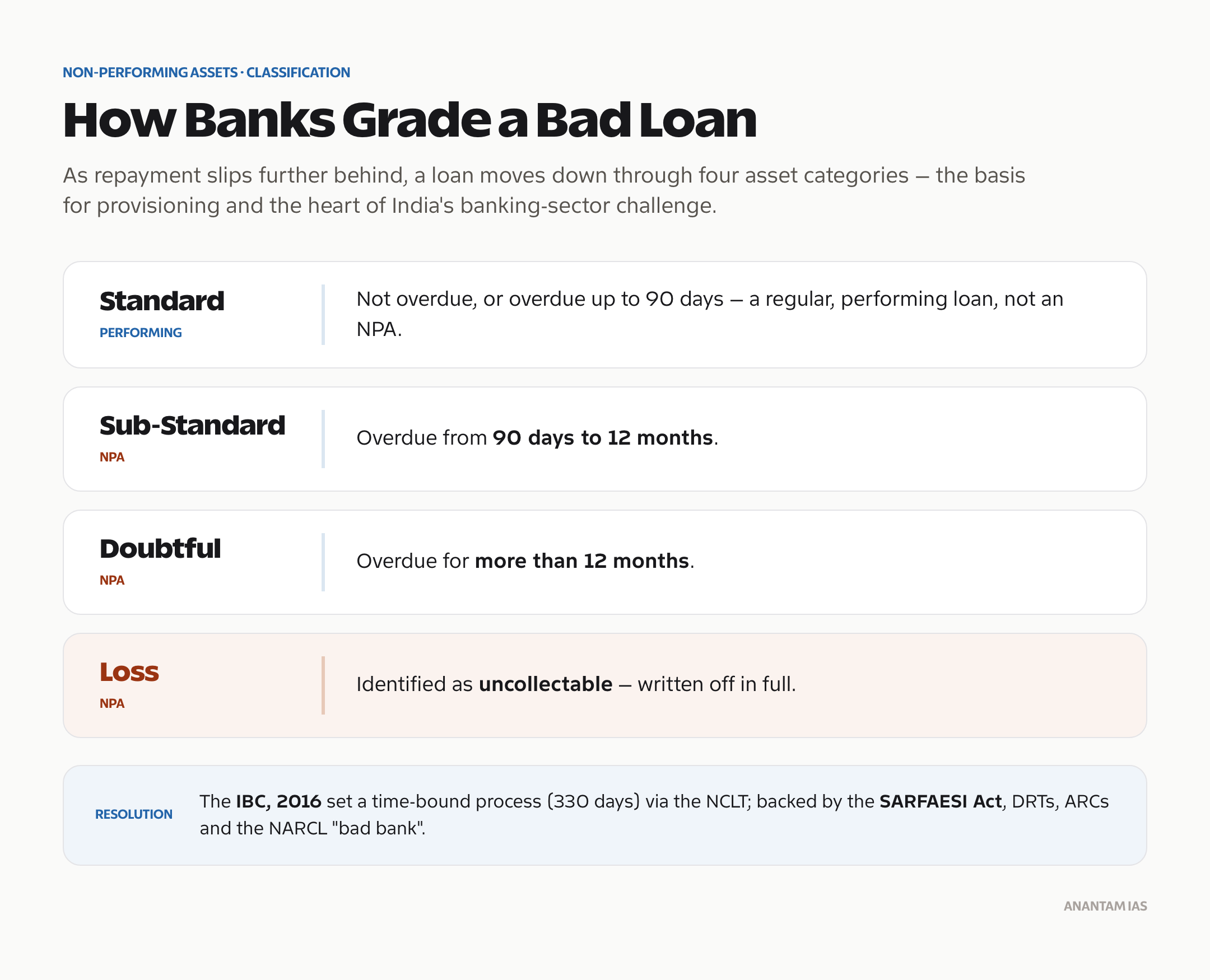
NPA Classification
| Category | Overdue Period |
|---|---|
| Standard Asset | Not overdue or overdue < 90 days |
| Sub-Standard | Overdue 90 days to 12 months |
| Doubtful | Overdue > 12 months |
| Loss Asset | Identified as uncollectable |
NPA Resolution Framework
The Insolvency and Bankruptcy Code (IBC), 2016 was a landmark reform. It established a time-bound process (330 days) for resolving corporate insolvency through the National Company Law Tribunal (NCLT). The IBC shifted power from debtors to creditors, fundamentally changing India’s credit culture.
Other resolution mechanisms:
- SARFAESI Act, 2002: Allows banks to seize and sell assets of defaulting borrowers without court intervention
- Debt Recovery Tribunals (DRTs): Specialised tribunals for debt recovery
- Asset Reconstruction Companies (ARCs): Buy NPAs from banks at a discount
- NARCL (National Asset Reconstruction Company): “Bad bank” set up in 2021 to consolidate and resolve large NPAs
Twin Balance Sheet Problem
India faced a “twin balance sheet” crisis — over-leveraged corporates (high debt) and stressed banks (high NPAs). This was identified by the Economic Survey 2016–17 as the central challenge to economic recovery. The 4R strategy — Recognition, Resolution, Recapitalisation, and Reform — guided the government’s response.
Major Banking Reforms
Bank Nationalisation (1969, 1980)
The nationalisation of 14 major banks in 1969 under PM Indira Gandhi was driven by the need for social banking — directing credit to agriculture, small industry, and neglected sectors. A second round in 1980 nationalised 6 more banks. Nationalisation dramatically expanded branch networks (especially in rural areas) and deposit mobilisation.
Narasimham Committee Reforms (1991, 1998)
The Narasimham Committee-I (1991) recommended:
- Reducing CRR and SLR
- Deregulating interest rates
- Strengthening capital adequacy (CAR)
- Allowing private and foreign bank entry
- Moving to asset classification and provisioning norms
The Narasimham Committee-II (1998) focused on:
- Strengthening bank governance
- Consolidation of banks
- Higher capital adequacy standards
- Technology adoption
Recent Reforms
- Bank consolidation (2019–20): 10 PSBs merged into 4, reducing total PSBs to 12
- Banking Regulation Amendment (2020): Brought cooperative banks under stricter RBI oversight
- Digital banking push: UPI, BHIM, Aadhaar-enabled payments
- Account Aggregator framework: Consent-based financial data sharing
- Central Bank Digital Currency (CBDC): e-Rupee pilot launched
Financial Inclusion
India has made significant strides in financial inclusion:
Pradhan Mantri Jan Dhan Yojana (PMJDY)
Launched in 2014, it became the world’s largest financial inclusion programme. Over 50 crore accounts opened with zero-balance facility, RuPay debit card, and insurance coverage. PMJDY accounts serve as the foundation for Direct Benefit Transfer (DBT).
India’s Digital Payments Revolution
The Unified Payments Interface (UPI), developed by NPCI (National Payments Corporation of India), has transformed payments. UPI processes billions of transactions monthly, making India a global leader in real-time digital payments. This infrastructure enables financial inclusion by reaching populations without traditional banking access.
Key Banking Legislation
| Law | Year | Purpose |
|---|---|---|
| RBI Act | 1934 | Establishes and governs RBI |
| Banking Regulation Act | 1949 | Regulates banking companies |
| SBI Act | 1955 | Establishes State Bank of India |
| Bank Nationalisation Act | 1969, 1970 | Nationalises commercial banks |
| NABARD Act | 1981 | Establishes NABARD |
| SARFAESI Act | 2002 | NPA recovery without court |
| FEMA | 1999 | Foreign exchange management |
| IBC | 2016 | Insolvency resolution |
| Payment and Settlement Systems Act | 2007 | Regulates payment systems |
Insurance Sector in India: Types & Regulation
Frequently Asked Questions
What are the types of banks in India?
India has commercial banks (public sector, private sector, foreign, and regional rural banks), differentiated banks (small finance banks and payments banks), cooperative banks (urban and rural), and development finance institutions (NABARD, SIDBI, NHB). The RBI regulates all these institutions, though cooperative banks have dual regulation with state registrars.
What is an NPA in banking?
A Non-Performing Asset is a loan where the borrower has failed to make interest or principal payments for 90 days or more. NPAs are classified as sub-standard (90 days–1 year overdue), doubtful (over 1 year), or loss assets. High NPAs reduce bank profitability, restrict lending capacity, and can threaten financial stability. The IBC and SARFAESI Act are key resolution tools.
What is the difference between a payments bank and a small finance bank?
Payments banks can accept deposits up to Rs 2 lakh but cannot lend money. Small finance banks can accept deposits without limits and provide loans, especially to underserved segments. Payments banks focus on remittances, digital payments, and basic banking. Small finance banks function more like traditional banks but with a financial inclusion mandate.
Why were banks nationalised in 1969?
Bank nationalisation aimed to redirect credit from large industrial houses to agriculture, small industry, and weaker sections. Before 1969, private banks focused lending on urban commercial interests. Nationalisation expanded branch networks to rural areas, increased deposit mobilisation, and made banking accessible to the masses. It was a key step in India’s social banking agenda.
What is the Insolvency and Bankruptcy Code (IBC)?
The IBC (2016) provides a time-bound process for resolving insolvency of companies and individuals. Corporate debtors can be resolved within 330 days through the NCLT. The IBC shifted power to creditors, introduced the concept of resolution professionals, and created a structured framework for either revival or liquidation of stressed companies. It has been India’s most significant banking reform of the decade.