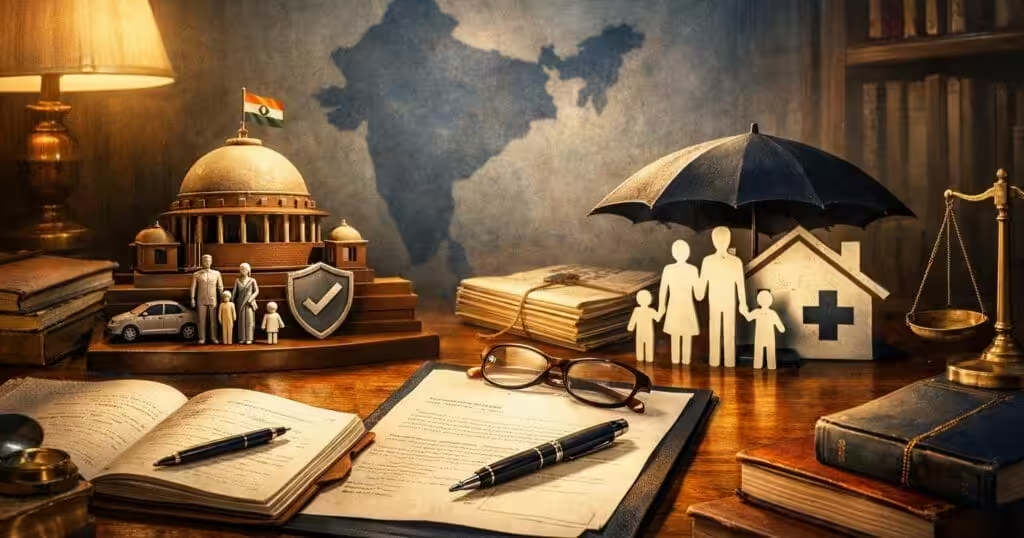
The insurance sector in India has transformed from a government monopoly into a competitive market with public and private players. Regulated by the Insurance Regulatory and Development Authority of India (IRDAI), the sector covers life insurance, general insurance, and health insurance. Despite rapid growth, India's insurance penetration remains below the global average — making it both a development challenge and an opportunity. For UPSC, insurance connects to financial inclusion, social security, and economic development themes.
Evolution of Insurance in India
Historical Timeline
- 1818: First insurance company in India (Oriental Life Insurance Company, Kolkata)
- 1912: Indian Life Assurance Companies Act — first regulation
- 1938: Insurance Act — comprehensive regulatory framework
- 1956: Nationalisation of life insurance — 245 companies merged to form Life Insurance Corporation of India (LIC)
- 1972: Nationalisation of general insurance — 107 companies merged into 4 subsidiaries under General Insurance Corporation of India (GIC)
- 1993: Malhotra Committee recommends opening insurance to private sector
- 1999: IRDA Act — creates the regulatory body; private entry allowed
- 2000: IRDAI established; first private insurance licences issued
- 2015: FDI limit raised to 49%
- 2021: FDI limit raised to 74%
- 2022: LIC IPO — largest in Indian history at the time
IRDAI: The Regulator
The Insurance Regulatory and Development Authority of India was established under the IRDA Act, 1999. Headquartered in Hyderabad, it regulates and promotes the insurance industry.
Key Functions
- Granting, renewing, and revoking licences to insurance companies and intermediaries
- Protecting policyholder interests
- Regulating premium rates and terms of policies
- Promoting insurance education and awareness
- Monitoring solvency margins of insurance companies
- Regulating investment of insurance funds
- Adjudicating disputes through Insurance Ombudsman
Recent IRDAI Reforms (2023–24)
IRDAI has pursued a series of deregulatory reforms under the "Insurance for All by 2047" vision:
- Simplified licensing: Composite licence allowing single entity to offer life, general, and health insurance
- Use-and-file approach for product approvals — companies can launch products and file later
- BIMA Sugam: A unified digital platform — the "UPI of insurance" — for policy purchase, claims, and portability
- Reduced compliance burden: Simplified reporting and registration requirements
- BIMA Vistaar: Affordable bundled insurance product for underserved populations
- Cashless treatment in health insurance: Mandated across all network hospitals
Types of Insurance
Life Insurance
Life insurance provides financial protection to the policyholder's family in the event of death or disability. It also serves as a long-term savings and investment vehicle.
Key players:
- LIC (Life Insurance Corporation of India): Public sector; largest with ~60% market share
- Private players: SBI Life, HDFC Life, ICICI Prudential, Max Life, Bajaj Allianz Life
Types of life insurance:
- Term insurance: Pure protection — pays sum assured only on death during the term
- Endowment: Protection + savings — pays on maturity or death
- ULIP (Unit Linked Insurance Plan): Insurance + market-linked investment
- Whole life: Coverage for entire lifetime
- Annuity/Pension: Regular income after retirement
General Insurance
General insurance covers non-life risks — property, vehicle, travel, and liability.
Key players:
- Public sector: New India Assurance, United India, National Insurance, Oriental Insurance (all GIC subsidiaries)
- Private sector: ICICI Lombard, HDFC Ergo, Bajaj Allianz General, Tata AIG
- Specialised: Agriculture Insurance Company of India, ECGC (export credit)
Types of general insurance:
- Motor insurance: Third-party liability (compulsory) + own damage
- Fire insurance: Property protection against fire and allied perils
- Marine insurance: Cargo and hull protection
- Crop insurance: PMFBY — government-subsidised crop protection
- Liability insurance: Professional indemnity, directors' liability
Health Insurance
Health insurance covers medical expenses. It has been the fastest-growing insurance segment in India, especially post-COVID.
Key features of India's health insurance market:
- Ayushman Bharat – PM-JAY: World's largest health insurance scheme — covers 50 crore people for Rs 5 lakh per family per year for hospitalisation
- Stand-alone health insurers: Star Health, Care Health, Niva Bupa
- Group health insurance: Employer-provided coverage — fastest-growing segment
- Insurance Ombudsman: Resolves policyholder grievances
| Insurance Type | Coverage | Key Product | Regulator |
|---|---|---|---|
| Life | Death/disability/savings | Term plan, endowment, ULIP | IRDAI |
| General | Property/vehicle/travel | Motor, fire, marine | IRDAI |
| Health | Medical expenses | Hospitalisation, critical illness | IRDAI |
| Crop | Agricultural risk | PMFBY | IRDAI + Agriculture Ministry |
| Reinsurance | Insurance of insurers | Catastrophe cover | GIC Re (national reinsurer) |
Insurance Penetration and Density
Insurance penetration = Total premium / GDP (percentage) Insurance density = Total premium / Population (per capita in USD)
India's insurance penetration is approximately 4% (life ~3%, non-life ~1%) — below the global average of ~7%. Insurance density is approximately $90 — far below the global average of $850+.
Why Low Penetration?
- Low awareness and financial literacy, especially in rural areas
- Trust deficit — complex products, poor claim settlement experience
- Low income levels — affordability constraint
- Preference for physical savings (gold, real estate)
- Limited distribution in rural and semi-urban areas
- Regulatory complexity for micro-insurance products
Government Initiatives to Increase Penetration
- PM-JAY (Ayushman Bharat): Universal health coverage for bottom 40%
- PMJJBY (Pradhan Mantri Jeevan Jyoti Bima Yojana): Life insurance at Rs 436/year for Rs 2 lakh cover
- PMSBY (Pradhan Mantri Suraksha Bima Yojana): Accident insurance at Rs 20/year for Rs 2 lakh cover
- PMFBY: Subsidised crop insurance
- Atal Pension Yojana: Guaranteed pension for unorganised sector workers
| Scheme | Type | Annual Premium | Coverage |
|---|---|---|---|
| PMJJBY | Life | Rs 436 | Rs 2 lakh (death) |
| PMSBY | Accident | Rs 20 | Rs 2 lakh (death/disability) |
| PM-JAY | Health | Government-funded | Rs 5 lakh hospitalisation |
| PMFBY | Crop | 1.5–5% of sum insured | Full sum insured |
| APY | Pension | Variable | Rs 1,000–5,000/month pension |
FDI in Insurance
The FDI limit in insurance has been progressively raised:
- 2000: 26% (when sector opened to private players)
- 2015: 49% (Insurance Laws Amendment Act)
- 2021: 74% (Union Budget announcement)
- Proposed: 100% in certain conditions for new licences
Higher FDI limits aim to bring in more capital, technology, and global expertise. However, concerns remain about foreign control over a sector that manages long-term savings of millions of Indians.
LIC: India's Insurance Giant
The Life Insurance Corporation of India, established in 1956, is the world's largest insurer by number of policies. Key facts:
- Market share: ~60% of life insurance premiums
- Agent network: Over 13 lakh agents — the largest distribution network in India
- AUM (Assets Under Management): Over Rs 40 lakh crore — one of the largest institutional investors globally
- LIC is a significant investor in Indian stock markets and government securities
- LIC IPO (May 2022): Government sold 3.5% stake, raising Rs 21,000 crore
LIC's investment decisions influence capital markets significantly — making it a systemically important financial institution.
Related: Banking System in India: Types & Structure
Key Challenges
Mis-selling and Consumer Trust
Insurance products are often mis-sold — consumers don't fully understand policy terms, exclusions, and claim processes. IRDAI has strengthened disclosure requirements and introduced a "cooling-off" period for policy cancellation.
Claim Settlement
Low claim settlement ratios (especially in general and health insurance) erode consumer trust. IRDAI monitors and publishes claim settlement data to improve accountability.
Distribution Gap
Insurance availability in rural India and for lower-income groups remains inadequate. Technology (insurtech), partnerships with microfinance institutions, and government-mandated products aim to bridge this gap.
Related: Cooperative Movement in India: History & Reforms
Frequently Asked Questions
What is IRDAI and what does it do?
IRDAI (Insurance Regulatory and Development Authority of India) is the statutory body regulating the insurance sector in India. Established under the IRDA Act, 1999 and headquartered in Hyderabad, it grants licences to insurance companies, protects policyholder interests, regulates premium rates, monitors solvency margins, and promotes insurance awareness. It also appoints Insurance Ombudsmen for grievance redressal.
What is the difference between life insurance and general insurance?
Life insurance covers the risk of death or disability, providing financial protection to the policyholder's family. Policies are typically long-term (10–30 years). General insurance covers non-life risks — property damage, vehicle accidents, travel disruption, and liability claims. General policies are usually annual. Health insurance, while technically part of general insurance, has emerged as a separate specialised segment.
What is Ayushman Bharat (PM-JAY)?
Ayushman Bharat – Pradhan Mantri Jan Arogya Yojana is the world's largest government-funded health insurance scheme. It provides hospitalisation coverage of Rs 5 lakh per family per year to approximately 50 crore beneficiaries from economically vulnerable households. Cashless treatment is available at empanelled hospitals. The scheme targets the bottom 40% of the population identified through SECC data.
Why is India's insurance penetration low?
India's insurance penetration (~4%) is below the global average (~7%) due to low financial literacy, inadequate rural distribution, affordability constraints among lower-income groups, complex product structures, trust deficits from mis-selling and poor claim settlement, and cultural preference for physical savings. Government schemes like PMJJBY, PMSBY, and PM-JAY are addressing the gap.
Tell Google you want more of this.
Add Anantam IAS as a preferred sourceOne tap, and this site shows up more often in your own Top Stories, AI Overviews and AI Mode. Remove it any time.