Battles of Panipat: The Three Wars That Shaped Medieval India (1526, 1556, 1761)
The three Battles of Panipat decided the fate of the Delhi Sultanate, restored the Mughal Empire, and broke Maratha power in North India. UPSC notes on commanders, tactics, outcomes and the long shadow of Panipat on Indian history.
Panipat is a small market town about ninety kilometres north of Delhi on the Grand Trunk Road. The land around it is flat, dry, and historically grain-rich. Three times in two and a half centuries, the future of northern India was decided on this stretch of plain. In 1526 a Central Asian adventurer named Babur defeated the Sultan of Delhi here and founded the Mughal Empire. In 1556 the boy-king Akbar, advised by his regent Bairam Khan, defeated the Hindu general Hemu and restored Mughal power after a fifteen-year Sur interregnum. In 1761 the Marathas, led by Sadashivrao Bhau, were broken by Ahmad Shah Abdali’s Afghan army, opening the door for British dominance in the next sixty years.
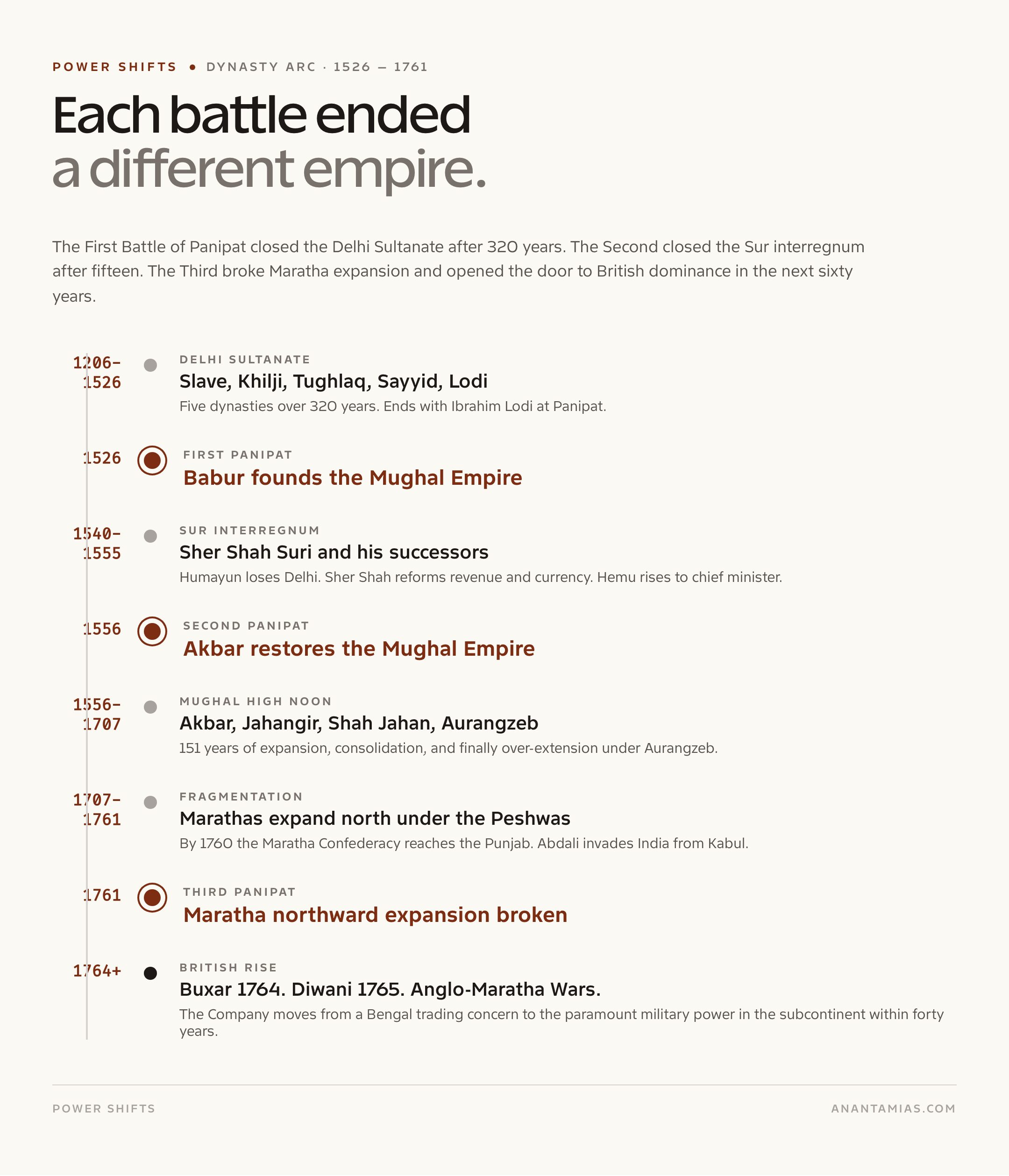
Each battle changed the political map of India. Each one is a separate set piece in Indian history. Read together, the three Battles of Panipat trace the long arc from late medieval Sultanate rule, through the Mughal Empire’s high noon, to the start of the colonial era. They are among the most heavily examined topics in both prelims and mains for the UPSC and most state PSCs.
This article walks through each battle in turn, sets out the commanders, tactics and casualty figures, and ends with a comparative analysis of why Panipat itself became such a recurring choice of battleground.
Quick Facts
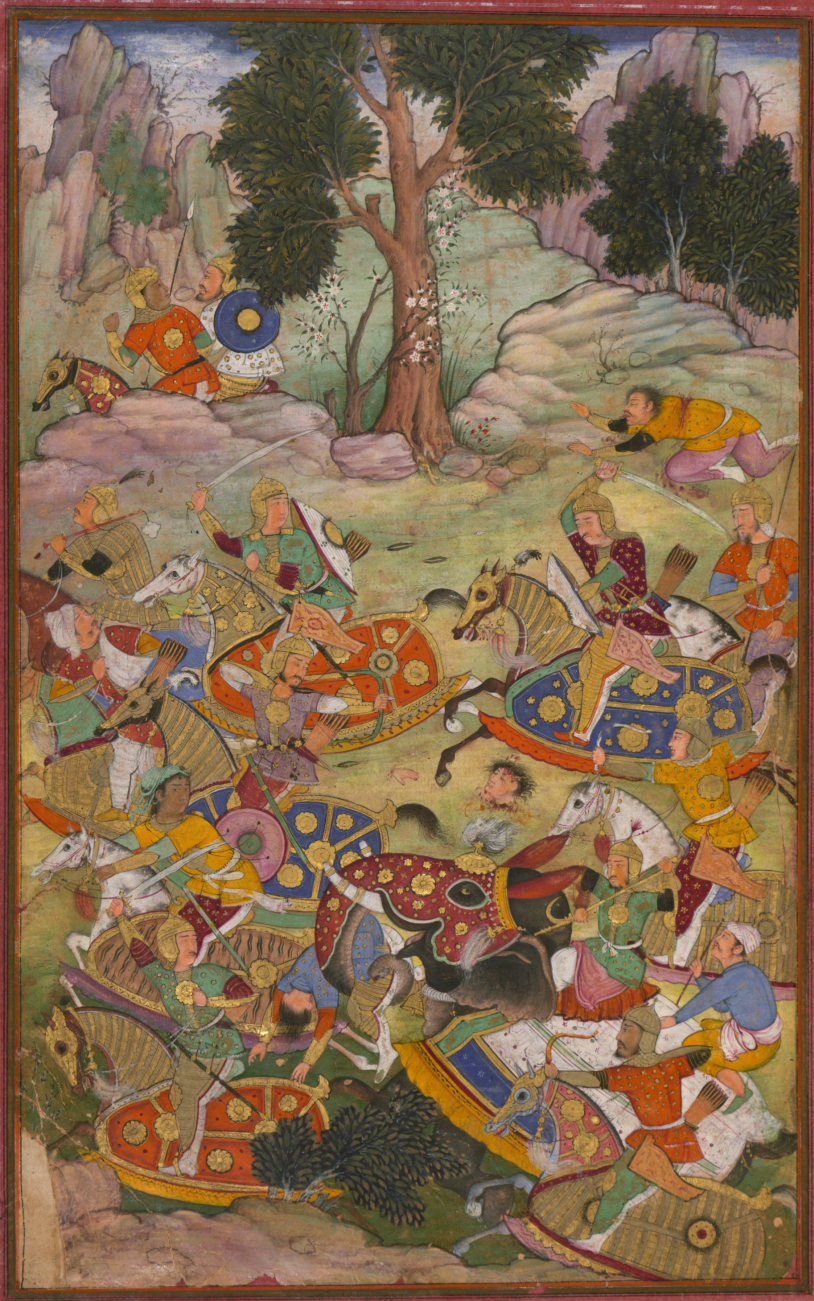
- First Battle of Panipat: 20 or 21 April 1526. Babur defeats Ibrahim Lodi. The Lodi Dynasty ends. The Mughal Empire begins.
- Second Battle of Panipat: 5 November 1556. Akbar, advised by Bairam Khan, defeats Hemu Vikramaditya. The Sur Empire ends. Mughal rule is restored.
- Third Battle of Panipat: 14 January 1761. Ahmad Shah Abdali defeats the Marathas under Sadashivrao Bhau. The Maratha northern expansion stops.
- Location: Panipat, Haryana, about 90 km north of Delhi
- Pattern: All three battles fought between an invading force from the north-west and a defending Indian power
- Combined Estimated Casualties: Around 100,000 to 150,000 across the three battles
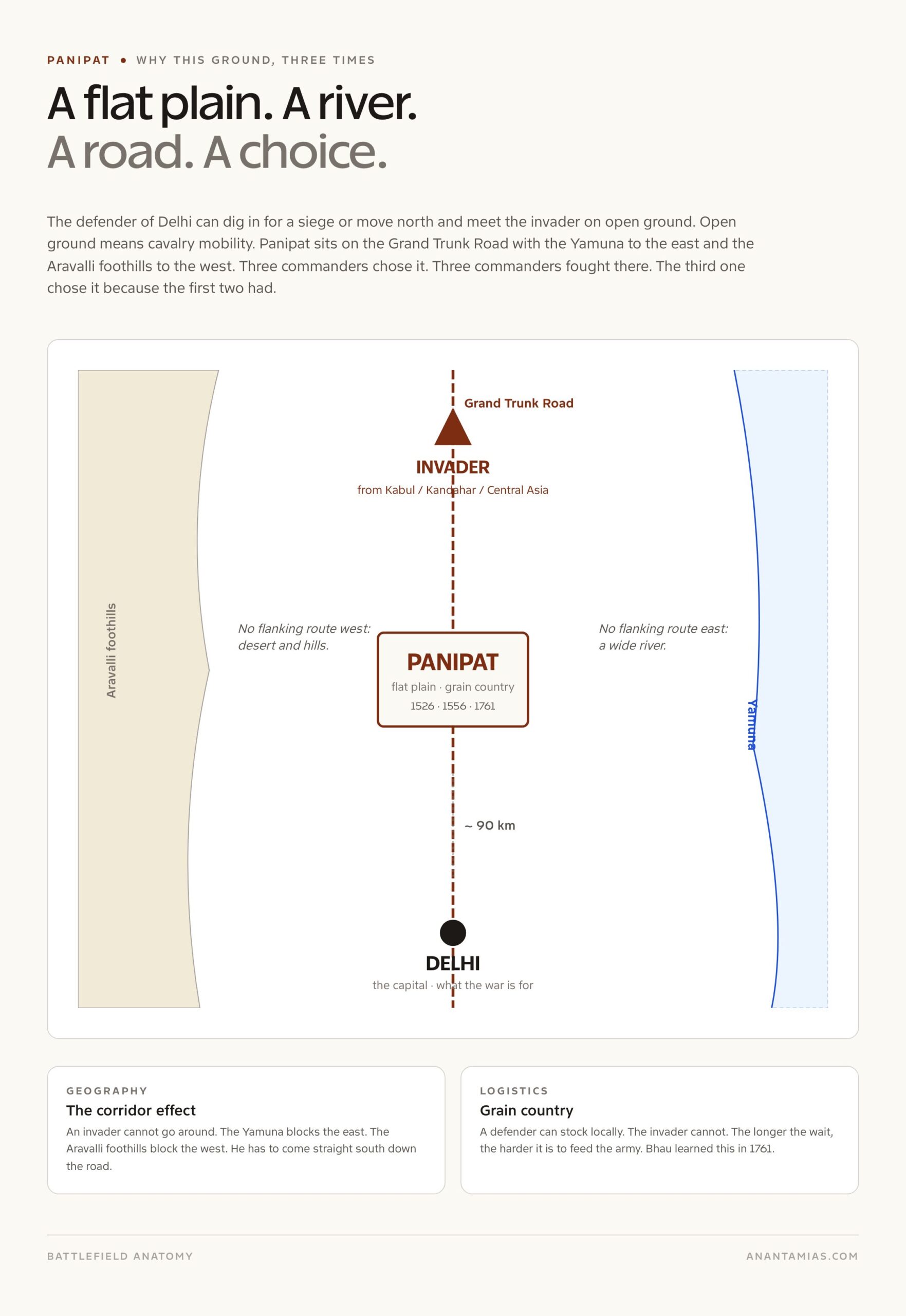
- Strategic Reason: Panipat sits on the Grand Trunk Road, on flat ground, with the Yamuna to the east and the Aravalli foothills to the west
- Modern Site: Three commemorative markers and the Panipat Battles Museum
What Were the Battles of Panipat
The three Battles of Panipat are not a single connected war. They are three separate engagements fought in roughly the same place because that place suits cavalry warfare. The defender of Delhi has the choice. He can either dig in around the capital and face a siege, or move north and meet the invader on open ground. Open ground gives mobility to both sides. From Babur’s time onwards, Indian commanders consistently chose to meet northern invaders at Panipat. The third commander, Sadashivrao Bhau, chose the same ground and lost catastrophically.
Background and Historical Context
By the early sixteenth century, the Delhi Sultanate had weakened. Ibrahim Lodi, the third Lodi sultan, faced internal nobility revolts. His uncle Daulat Khan Lodi, the governor of Punjab, invited Babur to invade. Babur was the ruler of Kabul, a descendant of Timur on his father’s side and of Chinggis Khan on his mother’s. He had already made four exploratory raids into the Punjab before he committed to a full invasion in 1526.
First Battle of Panipat (1526)
The First Battle of Panipat was fought on 20 or 21 April 1526. Babur had about 12,000 to 25,000 troops. Ibrahim Lodi fielded around 100,000 troops and 1,000 war elephants. Babur was outnumbered four to one at the most conservative estimate.
Babur won through three innovations. The first was firearms. He had acquired Ottoman-style matchlock muskets and field artillery, weapons that had never been used in India on a battlefield scale. The Ustad Ali Quli and Mustafa Rumi commanded his Ottoman-trained gunners. The second innovation was the tulughma tactic, a Central Asian envelopment manoeuvre. Babur divided his army into a centre, two flanks, and a reserve. The flanks would wheel around the enemy and attack from the rear. The third was the use of bullock carts chained together to form a defensive line, behind which the matchlockmen could reload without being charged by Lodi cavalry.
Ibrahim Lodi’s army was structured for the older style of war. War elephants, heavy cavalry and large infantry blocks were effective against fellow Indian forces. Against artillery and tulughma envelopment they were nearly useless. The elephants panicked at the noise of the cannon. The cavalry could not break the cart line. By midday Ibrahim Lodi was dead on the field. The Lodi army disintegrated.
Babur entered Delhi a few days later and was proclaimed Padshah. The Mughal Empire dates its formal founding from 1526. The First Battle of Panipat ended the Delhi Sultanate, which had lasted from 1206 to 1526, a span of 320 years.
Second Battle of Panipat (1556)
The Second Battle of Panipat was fought on 5 November 1556 between the Mughal forces of the boy-emperor Akbar, then only thirteen years old, and the army of Hemu Vikramaditya. Hemu was the Hindu chief minister and general of Adil Shah Suri, the last Sur ruler. The Sur dynasty had displaced the Mughals after Humayun’s defeat at Chausa in 1539 and Kanauj in 1540.
Humayun reconquered Delhi in 1555 with Persian military help, then died in an accident in January 1556 after slipping down the stairs of his library. The thirteen-year-old Akbar was proclaimed emperor at Kalanaur in February 1556. The Mughal grip on Delhi was very thin. Hemu, a brilliant Hindu commander of Vaisya origin from Rewari, took advantage. He marched on Delhi, defeated the Mughal governor Tardi Beg Khan in October 1556, and crowned himself Vikramaditya in Delhi. This was the only Hindu coronation in Delhi during the medieval period after the Tughlaq age.
Akbar’s regent, Bairam Khan, made the daring decision to confront Hemu directly. The Mughal army marched south from Punjab. The two forces met at Panipat. Hemu had a numerical advantage and over 1,500 war elephants. The Mughal cavalry, commanded by Bairam Khan, had no clear plan beyond holding the centre.
The battle was almost won by Hemu. Then a stray Mughal arrow found the slit of Hemu’s eye armour and struck him in the eye. He fell unconscious from his elephant. The Mughal flanks pressed the advantage. The Hindu force, leaderless, broke and fled. Bairam Khan brought the wounded Hemu to Akbar and asked the boy emperor to strike the first blow as a token of victory. Akbar, according to the Akbarnama, refused. Bairam Khan then beheaded Hemu himself.
The Second Battle of Panipat restored Mughal rule for a second time and effectively ended the Sur interregnum. Akbar’s long reign of forty-nine years dates from this victory.
Third Battle of Panipat (1761)
The Third Battle of Panipat was fought on 14 January 1761. It is the largest and most costly of the three battles. The combatants were the Maratha Confederacy under Sadashivrao Bhau and the Afghan army of Ahmad Shah Durrani, also called Abdali, who had repeatedly invaded northern India since 1747.
The setting is complex. After Aurangzeb’s death in 1707, the Mughal Empire fragmented. The Marathas, originally a regional power in the western Deccan under Shivaji and his successors, expanded north under the Peshwas in the 1730s and 1740s. By 1760 they controlled territory from Pune to the Punjab. Ahmad Shah Abdali, the founder of the Durrani Afghan state, treated northern India as his tributary zone. The two powers were on a collision course.
The Peshwa Balaji Bajirao sent his cousin Sadashivrao Bhau north in early 1760 with a Maratha army of around 45,000 troops, plus camp followers, women, children, pilgrims and merchants that brought the total camp to perhaps 100,000 people. Bhau captured Delhi in August 1760. Then he marched north to meet Abdali. The two armies camped opposite each other near Panipat from late October 1760 to mid-January 1761. The standoff lasted nearly three months. Maratha supplies ran out. The civilian camp died of starvation in large numbers.
On 14 January 1761, Bhau opened the battle. The Marathas had French-pattern artillery under Ibrahim Khan Gardi and a strong centre. The Afghans had heavier cavalry, more supplies, and the alliance of the Rohillas and the Nawab of Awadh. The battle lasted from dawn to early afternoon. The Maratha centre held initially. Then the Afghan reserve cavalry punched through the Maratha left flank. Vishwasrao, the Peshwa’s son, was killed by a musket shot. Bhau dismounted to die fighting beside the body. The Maratha line collapsed.
Estimates of Maratha casualties range from 40,000 to 70,000 dead in the battle itself. Another 20,000 to 30,000 were killed in the rout. Perhaps as many of the civilian camp followers died in the days that followed. The total Maratha loss was the largest single-day military catastrophe in Indian history before the World Wars.
Detailed Analysis: Why Panipat Three Times
Three battles in two and a half centuries on the same ground is not a coincidence. Three structural reasons explain it.
The first is geography. Panipat sits on the flat alluvial plain north of Delhi. The Yamuna is to the east. The Aravalli foothills are to the west. The Grand Trunk Road runs through it. An invader coming from the north-west, whether from Kabul, Kandahar or Central Asia, has to come down this corridor. A defender from Delhi can intercept at Panipat with a day’s march. The terrain is open enough for cavalry envelopment but narrow enough to prevent the invader from going around.
The second is logistics. Panipat is grain country. A defending army can stock itself locally. The invader cannot. The longer the standoff, the harder it gets for the invader to feed his troops. This worked against Babur, who chose to attack quickly. It worked against Abdali, who would have lost if Bhau had held out another week. Bhau lost partly because his own supplies failed first.
The third is precedent. After 1526 and 1556, Panipat became the obvious place. Indian commanders chose it because two predecessors had chosen it. Bhau picked it in 1761 for exactly that reason. The choice became self-reinforcing.
Comparative: Tactics Across the Three Battles
The First Battle of Panipat is a textbook case of gunpowder defeating cavalry. Babur’s matchlocks and cannon, used behind the cart wall, broke the Lodi elephant charge. The tulughma envelopment finished the job.
The Second Battle of Panipat is a case of a single freak event. Hemu was winning. A stray arrow ended the battle. Without that arrow, Mughal history might have ended in 1556. The lesson is the fragility of command in pre-modern warfare. The death or wounding of the commanding general routinely ended battles in this period.
The Third Battle of Panipat is a case of logistics and strategic isolation. The Marathas had the better artillery and a comparable cavalry. They lost because they were 1,500 kilometres from base, with no friendly population in the surrounding country, while Abdali had the Rohillas and the Nawab of Awadh as allies and could draw on the Punjab grain supply. Battles are not won only on the battlefield.
Challenges and Aftermath
The First Battle of Panipat opened a new dynasty. The Mughal Empire lasted formally until 1857 and culturally much longer. The Battle of Khanwa in 1527 and the Battle of Ghaghra in 1529 secured Babur’s holdings. His son Humayun lost the empire to Sher Shah Suri in 1540 but his grandson Akbar restored it after Panipat 1556.
The Second Battle of Panipat is the foundation date for Akbar’s reign in the conventional sense. The fifty-year project of Mughal consolidation begins here. The institutions associated with Akbar, including the mansabdari system, the Din-i-Ilahi, and the Akbarnama itself, all develop in the decades after 1556.
The Third Battle of Panipat is the disaster from which the Maratha Confederacy never recovered politically, even though it recovered militarily within a decade. The British East India Company, which had won at Plassey in 1757 and was about to win at Buxar in 1764, became the only credible power in northern India by the 1770s. The road from Panipat 1761 to Plassey 1757, viewed forward, leads to the Anglo-Maratha wars and finally to the Doctrine of Lapse era.
Prelims Pointers
- First Battle of Panipat: 20 or 21 April 1526. Babur defeats Ibrahim Lodi.
- Second Battle of Panipat: 5 November 1556. Akbar and Bairam Khan defeat Hemu.
- Third Battle of Panipat: 14 January 1761. Ahmad Shah Abdali defeats Sadashivrao Bhau.
- Babur used the tulughma tactic and field artillery for the first time in India.
- Babur’s artillery was commanded by Ottoman gunners Ustad Ali Quli and Mustafa Rumi.
- Hemu was the chief minister and general of Adil Shah Suri.
- Hemu was crowned Vikramaditya at Delhi in October 1556 before the Second Panipat.
- Bairam Khan was the regent of the thirteen-year-old Akbar in 1556.
- The Maratha army at the Third Battle was led by Sadashivrao Bhau, cousin of Peshwa Balaji Bajirao.
- Ibrahim Khan Gardi commanded the Maratha artillery in 1761.
- Vishwasrao, the Peshwa’s son, was killed in the Third Battle.
- Ahmad Shah Abdali’s allies in 1761 included Najib-ud-Daula and Shuja-ud-Daula.
Mains Questions
- “The three Battles of Panipat decided the fate of three different Indian polities.” Discuss with reference to the Delhi Sultanate, the Sur Empire and the Maratha Confederacy. (GS Paper I, 15 marks)
- Compare the tactics used by Babur in the First Battle of Panipat with those used by Sadashivrao Bhau in the Third. What does the comparison reveal about military change in early modern India? (GS Paper I, 15 marks)
- The Third Battle of Panipat is often described as the moment that opened the door to British dominance in India. Critically examine this claim. (GS Paper I, 10 marks)
- “Battles are not won only on the battlefield.” Examine this statement with reference to the logistics, alliances and supply lines of the Third Battle of Panipat. (Essay / GS Paper I, 10 marks)
Legacy and Way Forward
The Government of Haryana has built the Panipat Battles Museum near the historical site. The state observes Panipat Diwas annually on 14 January to mark the Third Battle. Maratha and Sikh diaspora groups visit the site each January in significant numbers. The Archaeological Survey of India maintains the Kalandar Shah Wali tomb, near which much of the 1526 fighting took place, as a protected monument.
The deeper task is the historiographical one. Indian school textbooks tend to treat the three battles as set pieces and lose the wider story. The pre-Panipat decline of the Lodi sultanate, the post-Panipat consolidation of the Mughal Empire, and the long Maratha recovery after 1761 are all parts of the same narrative. Reading them together is what produces a coherent answer in the mains, especially when the question asks about transitions between dynasties.
Comparing the Panipat series with the older battles of the Maurya Empire and the Vijayanagara Empire helps set the long arc of Indian dynastic warfare in perspective. Each empire faced a moment of military decision. Panipat happens to host three such moments in a row, which is why the name has become almost a synonym for decisive battle in the Indian historical imagination.
Frequently Asked Questions
When were the three Battles of Panipat fought?
The First Battle of Panipat was fought on 20 or 21 April 1526. The Second Battle of Panipat was fought on 5 November 1556. The Third Battle of Panipat was fought on 14 January 1761. The three battles span 235 years and cover the transition from the Delhi Sultanate to the late Mughal era.
Who won the First Battle of Panipat and why is it important?
Babur, the ruler of Kabul, won the First Battle of Panipat by defeating Ibrahim Lodi, the Sultan of Delhi. The battle ended the Lodi Dynasty and the Delhi Sultanate and founded the Mughal Empire in India. Babur’s use of field artillery and the tulughma envelopment tactic was the first appearance of gunpowder warfare on this scale in India.
Who was Hemu and why is the Second Battle of Panipat significant?
Hemu Vikramaditya was the Hindu chief minister and general of Adil Shah Suri. He had captured Delhi in October 1556 and crowned himself Vikramaditya. The Second Battle of Panipat saw the boy emperor Akbar, advised by his regent Bairam Khan, defeat Hemu. A stray arrow struck Hemu in the eye and ended the battle. The Mughal Empire was restored after the fifteen-year Sur interregnum.
Who led the Marathas at the Third Battle of Panipat?
Sadashivrao Bhau, cousin of Peshwa Balaji Bajirao, led the Maratha army at the Third Battle of Panipat. He was supported by Vishwasrao, the Peshwa’s son, who was killed in the battle, and by the artillery commander Ibrahim Khan Gardi, who was captured and later executed. Bhau himself died on the field.
Why did the Marathas lose the Third Battle of Panipat?
The Marathas lost for three main reasons. They were operating 1,500 kilometres from their base in the western Deccan, with no friendly population in the surrounding country. Their supplies failed during the three-month standoff before the battle. Ahmad Shah Abdali had alliances with the Rohillas and the Nawab of Awadh, while the Marathas had no major Indian ally on the field. The Maratha artillery and the cavalry were comparable to the Afghan force, but the strategic isolation was decisive.
How many people died in the Third Battle of Panipat?
Estimates vary. Maratha military deaths in the battle and the rout are usually placed between 40,000 and 70,000. Civilian camp followers killed in the days after the battle may have totalled another 50,000 or more. The total Maratha loss is one of the largest single-day military catastrophes in Indian history before the twentieth century.
Why was Panipat chosen as the battleground three times?
Panipat sits on the flat alluvial plain about ninety kilometres north of Delhi, on the Grand Trunk Road, with the Yamuna to the east and the Aravalli foothills to the west. The terrain suits cavalry warfare and forces an invader from the north-west to come down a narrow corridor. The defender of Delhi can intercept at Panipat with a day’s march. The choice became self-reinforcing after 1526 and 1556.
What is the long-term significance of the Third Battle of Panipat?
The Third Battle of Panipat stopped Maratha expansion in northern India and weakened the Confederacy politically for at least a decade. The British East India Company, which had won at Plassey in 1757, became the only credible major power in northern India through the 1770s. The road from Panipat 1761 leads directly to the Anglo-Maratha wars and to British dominance in the early nineteenth century.
Are the Battles of Panipat important for UPSC?
Yes. The Battles of Panipat are among the most heavily examined topics in medieval and modern Indian history. Prelims questions on the dates, commanders, tactics and outcomes appear in almost every cycle. Mains questions on the political consequences and the comparative tactics appear regularly in GS Paper I.