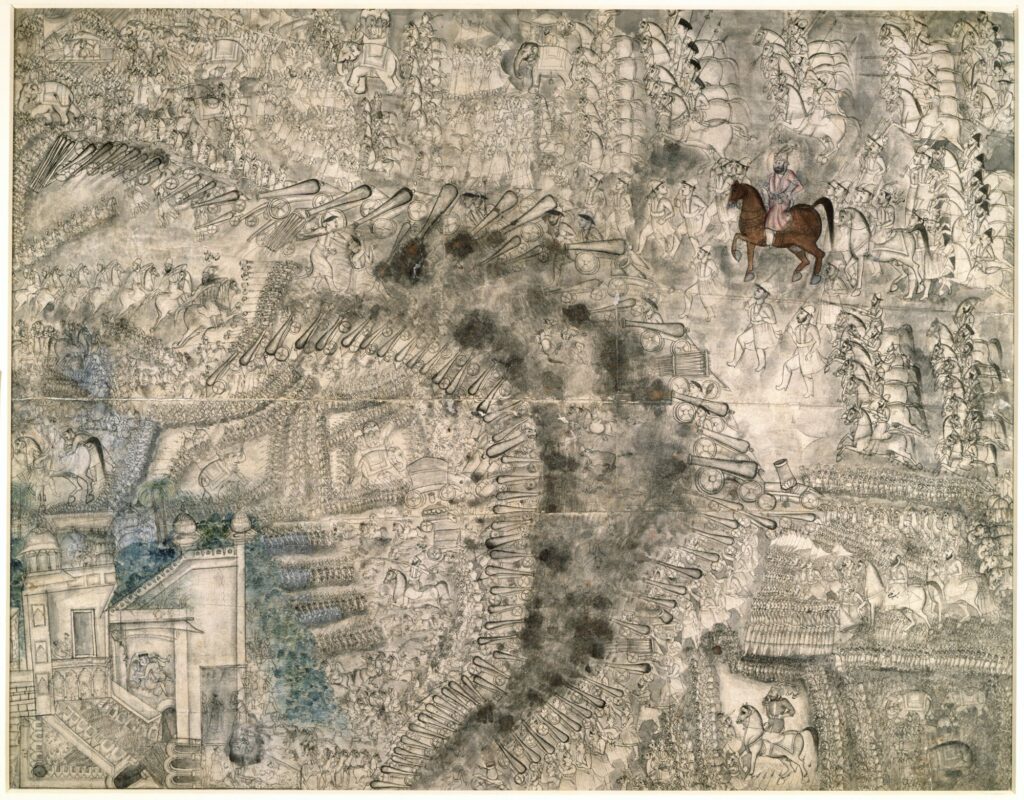
The Third Battle of Panipat 1761, fought on 14 January 1761 on the dusty plains 90 km north of Delhi where the Yamuna meets the road to Lahore, was by some measures the bloodiest single day of fighting in the entire eighteenth century anywhere in the world. Between sunrise and sunset, an estimated 60,000 to 70,000 combatants and another 40,000 non-combatant camp-followers died on the battlefield or in the immediate massacre that followed. The Maratha army under Sadashivrao Bhau, nephew of Peshwa Balaji Bajirao, confronted Ahmad Shah Abdali, the founder of the Durrani Empire of Afghanistan, supported by Najib-ud-Daula the Rohilla chief and Shuja-ud-Daula the Nawab Wazir of Awadh. The Maratha army was annihilated; the Peshwa’s son Vishwasrao was killed early in the action, Sadashivrao Bhau died with sword in hand, the great Maratha commander Jankoji Scindia was captured and executed, and only Mahadji Scindia escaped permanently lamed. The military catastrophe ended Maratha pretensions to North Indian paramountcy for at least a decade and ensured that when the East India Company moved north from Bengal after the Battle of Buxar 1764, it would find no consolidated Indian counterpoise. The Marathi expression _Panipat zala_ — “Panipat has happened” — entered the language as shorthand for catastrophic, civilisation-defining defeat. UPSC aspirants must read the Third Battle of Panipat 1761 alongside the other two Battles of Panipat to grasp the full trajectory of medieval North Indian politics.
Quick Facts About the Third Battle of Panipat 1761
- Date: 14 January 1761
- Location: Panipat, modern Haryana, 90 km north of Delhi, on the historic Delhi-Lahore route
- Belligerents: Maratha Confederacy vs Durrani Afghan Empire and its Indian Muslim allies (Rohillas and Awadh)
- Commanders: Sadashivrao Bhau, with the young Vishwasrao as nominal heir, Ibrahim Khan Gardi commanding artillery, Jankoji and Mahadji Scindia, Malharrao Holkar; vs Ahmad Shah Abdali, Najib-ud-Daula, Shuja-ud-Daula, and Hafiz Rahmat Khan Rohilla
- Strength: Marathas: approximately 45,000 to 55,000 combatants plus 200,000 non-combatant pilgrims; Abdali coalition: approximately 60,000 combatants
- Outcome: Decisive Abdali victory; Maratha army destroyed; Bhau, Vishwasrao, and Jankoji Scindia killed; Mahadji Scindia escaped wounded
- Casualties: 60,000 to 70,000 combatants killed in battle; perhaps 40,000 non-combatants massacred or sold into slavery on subsequent days
- Long-term consequence: Maratha decline in North India for a decade; Mughal Emperor Shah Alam II forced to court Awadh and Company; eventual British expansion into the Maratha vacuum
Background: The Maratha High-Water Mark
By 1758 the Maratha Confederacy under Peshwa Balaji Bajirao stood at its territorial maximum. Raghunathrao had captured Lahore, Multan, and Attock in 1758-1759, planting the Maratha flag on the Indus and reducing the Mughal Emperor Shah Alam II to ceremonial dependence. The chauth-and-sardeshmukhi system extracted revenue from a belt stretching from Tanjore to Peshawar. Maratha vakils sat in the courts of every Indian power. The Battle of Plassey four years earlier had been a distant Bengal event the Marathas largely ignored.
This sprawl was unstable. The Marathas had displaced the Rohilla Afghans from Doab and lower Punjab, alienating both Najib-ud-Daula the Rohilla chief of Saharanpur and Hafiz Rahmat Khan of Bareilly. They had antagonised Shuja-ud-Daula of Awadh by intervening in Doab. Most importantly, the Maratha capture of Punjab in 1758 threatened the eastern frontier of the new Durrani Empire that Ahmad Shah Abdali had built at Kandahar from the wreckage of Nadir Shah’s empire. Abdali had already raided India four times between 1748 and 1757, the last time sacking Mathura and Delhi. The Maratha occupation of Punjab in 1758 was a direct provocation.
Najib-ud-Daula, the most consequential single Indian agent of the disaster, travelled to Kandahar and personally invited Abdali to lead a fifth invasion against the Marathas. Religious appeals to defend Islam against the Hindu Marathas, combined with promises of unpaid armies of Rohillas and Awadhis, persuaded Abdali. He crossed the Indus in October 1759, swept aside the Maratha garrisons of Punjab under Sabaji Patil, and entered the Doab in early 1760.
The Maratha Response
The Peshwa Balaji Bajirao, ailing with tuberculosis, despatched a large army under his cousin Sadashivrao Bhau to confront Abdali. Bhau was the victor of the 1760 Battle of Udgir against Nizam-ul-Mulk and a respected administrator, but he was unfamiliar with northern terrain and politics. With him went the young Vishwasrao, son of the Peshwa, both as heir and as living symbol of Maratha legitimacy. Critically the Peshwa also sent Ibrahim Khan Gardi, a French-trained Muslim artillerist commanding the most modern force in India: 9,000 disciplined sepoys armed with bayonets and 100 European-style guns.
Bhau’s army marched north through summer 1760, occupied Delhi on 1 August, and crowned Shah Alam II’s son Shah Jahan III as nominal emperor in place of Abdali’s puppet. From Delhi, Bhau then made a fateful diplomatic decision: he refused to conciliate Shuja-ud-Daula of Awadh, who had hesitated about joining either side. Shuja-ud-Daula’s mother Sadr-i-Jahan Begum counselled him to join Abdali, citing Maratha arrogance and the religious solidarity of Sunni Muslims. Shuja-ud-Daula joined the Afghan coalition in October 1760, bringing his Persian-style cavalry and abundant supplies. Najib-ud-Daula and Hafiz Rahmat Khan provided Rohilla infantry.
Bhau advanced from Delhi to Kunjpura on the Yamuna, captured the town in late October 1760, and slaughtered its Afghan garrison. Abdali, who had been on the wrong bank of the Yamuna, crossed at Bagput in early November in a remarkable feat of cavalry engineering, and cut off Bhau’s line of retreat to Delhi. The Marathas withdrew to Panipat and constructed an entrenched camp.
The Siege of Panipat
For more than two months, from 1 November 1760 to 13 January 1761, the two armies faced each other across Panipat. Neither could afford to attack a strong entrenched position; both depended on foraging in already devastated countryside.
The siege turned on supply. Abdali’s foragers controlled the open country and the routes to the Doab and Rohilkhand. The Maratha army, encumbered by an enormous pilgrim train estimated at 200,000 non-combatants (women, children, Brahmin priests, traders, all wanting a wartime pilgrimage to the Ganga), exhausted its supplies. By December 1760 the Marathas were eating their own horses. Forage parties under the cavalry generals Govind Pant Bundele and Balwantrao were defeated and killed. By early January, men and beasts were dying of starvation inside the entrenchments.
Bhau’s options narrowed. A negotiated surrender was politically impossible. A break-out south toward Delhi was Abdali’s expected move and would be intercepted. On 13 January 1761 Bhau took the decision to attack Abdali’s army at dawn the next day. The pilgrim train would form a hollow square at the centre of the army, behind which the women, children, and treasure would advance. If victorious, the Marathas could resupply at Delhi.
Course of the Battle
The battle commenced around 9 am on 14 January 1761 on a frosty winter morning. The Maratha line of about 8 km, from east to west, deployed in the conventional left-centre-right formation. Ibrahim Khan Gardi’s artillery and disciplined sepoy infantry held the left wing; Bhau and Vishwasrao with their Huzurati Pagas and the bulk of the heavy cavalry held the centre; Jankoji Scindia and the Holkar contingents held the right. The Afghan line opposite had Shuja-ud-Daula’s Awadh contingent on the centre-right, Abdali’s own elite Qizilbash cavalry behind in reserve, Najib-ud-Daula’s Rohillas on the left, and Pashtun cavalry on the wings.
The early phases went well for the Marathas. Ibrahim Gardi’s artillery, firing canister at point-blank range, tore the Rohilla advance to pieces. The Maratha cavalry charge in the centre under Bhau personally drove deep into the Afghan line, killing Abdali’s vizier Shah Wali Khan’s brother and threatening Abdali’s tent. By around 2 pm, the Marathas appeared to have won the battle.
The catastrophe began with a single event. Vishwasrao, the Peshwa’s son, was hit in the head by a stray musket ball and killed. Bhau, seeing his nephew fall, dismounted from his elephant, mounted a horse, and personally led a desperate charge to recover the body. The Maratha rank-and-file, who had been navigating by the heir-apparent’s elephant howdah, suddenly saw the empty howdah and assumed the worst. Panic spread.
Abdali, watching from his command position, recognised the moment and committed his uncommitted Qizilbash reserve — 10,000 to 15,000 elite cavalry he had deliberately held back through the morning. The reserve smashed into the disordered Maratha centre. Bhau was killed (his body was never definitively identified; his fate became a folk mystery). The Maratha line collapsed.
The right wing under Malharrao Holkar saw the centre dissolve and withdrew from the field — an action for which Holkar would be criticised, though some Maratha sources defend it as a tactical decision to preserve at least one functional army. Ibrahim Khan Gardi’s left wing fought on until overwhelmed; Gardi himself was captured, tortured, and executed. Jankoji Scindia was captured and beheaded the next day. Mahadji Scindia escaped with serious leg wounds that lamed him for life.
The massacre that followed was systematic. Najib-ud-Daula’s Rohillas, Shuja-ud-Daula’s Awadhis, and Abdali’s Pashtuns killed every Maratha soldier and male civilian they could find for three days. Women and children were taken as slaves and dispatched to the Afghan camp; many were later ransomed by Shuja-ud-Daula, who behaved with relative chivalry toward female captives. Estimates of total dead vary widely, but the figure of 60,000-70,000 combatants killed in the battle proper plus 40,000 non-combatants massacred over the following days is reasonable.
Why the Marathas Lost
Maratha defeat has been analysed by every serious historian of the period. Five interlocking factors recur:
- Logistical disaster. The 200,000-strong pilgrim train consumed supplies, slowed movement, and tied Bhau to a fixed defensive position. Maratha military culture had historically thrived on mobility and the absence of impedimenta; at Panipat, the army was unable to move.
- Diplomatic failure with Awadh. Bhau’s refusal to conciliate Shuja-ud-Daula handed Abdali an additional 30,000 troops and reliable supply lines through the Doab.
- Cavalry tradition vs siege warfare. Marathas had won their empire through guerrilla raids and rapid cavalry strikes. The two-month static siege at Panipat played to Afghan strengths.
- Tactical reserve. Abdali deliberately held his Qizilbash reserve back until the decisive moment. Bhau committed his entire army to the initial assault and had no reserve when Vishwasrao fell.
- Death of leadership. The successive deaths of Vishwasrao and Bhau within a few hours collapsed Maratha command structure. Indian armies of the period depended heavily on visible princely command for cohesion.
Govind Sakharam Sardesai’s New History of the Marathas, Surendra Nath Sen’s writings, T.S. Shejwalkar’s monumental Panipat 1761 in Marathi, and more recently Uday Kulkarni’s Solstice at Panipat all return to these factors with varying emphasis.
Immediate Consequences
Ahmad Shah Abdali did not exploit his victory politically. His army was exhausted, his Indian allies fractious, and a mutiny over arrears of pay was building. Within weeks of Panipat he wrote to the Peshwa proposing peace and recognising Maratha suzerainty south of the Yamuna. He left India in March 1761 and never returned. The Durrani Empire began declining within a decade.
The Peshwa Balaji Bajirao received the news of Panipat at Pune by a famous message: “Two pearls have been dissolved, twenty-seven gold mohurs lost, and of the silver and copper the total cannot be cast up.” He died of grief and tuberculosis on 23 June 1761, exactly four years after the Battle of Plassey. His son Madhavrao I assumed the Peshwaship aged 16.
The Maratha recovery was remarkably fast. Madhavrao I, with Mahadji Scindia and Tukoji Holkar, reasserted Maratha power in North India by 1772, defeated the Rohillas, restored Shah Alam II to Delhi, and pushed back the boundaries to the Sutlej. But the recovery was always shadowed by Panipat. Maratha confidence was permanently impaired, and the steady displacement of authority to regional chiefs — Scindia, Holkar, Bhonsle, Gaikwad — meant the confederacy could no longer act as a single empire.
Significance for UPSC Preparation
The Third Battle of Panipat 1761 is one of the most testable single events in UPSC modern Indian history. Connect it to:
- The triple Panipat sequence (1526, 1556, 1761): all three battles were fought on the same plain, all three saw a Central Asian invader (Babur, Akbar through Bairam Khan, Abdali) defeat an Indian power. The pattern matters.
- The vacuum thesis. With Marathas crippled, Mughals reduced to pensioners, and the southern kingdoms post-Talikota fragmented, the East India Company’s expansion after Plassey-Buxar met no consolidated Indian opposition. The connection between Panipat 1761 and Buxar 1764 deserves explicit treatment in mains answers.
- Religious and ethnic politics. Najib-ud-Daula’s appeal to Abdali on grounds of Muslim solidarity, contrasted with the presence of Muslim commanders like Ibrahim Khan Gardi on the Maratha side and Hindu accountants in the Afghan camp, complicates simple religious framings.
Mains-Style Questions
- “The Third Battle of Panipat 1761 was lost on the road from Delhi, not on the battlefield.” Discuss the strategic and diplomatic failures of the Maratha campaign.
- Examine the long-term political consequences of the Third Battle of Panipat 1761 for North India and for British expansion.
- Compare the three Battles of Panipat (1526, 1556, 1761) in terms of belligerents, tactics, and historical consequences.
Frequently Asked Questions
When and where was the Third Battle of Panipat fought?
The Third Battle of Panipat 1761 was fought on 14 January 1761 at Panipat in modern Haryana, about 90 km north of Delhi, on the historic Delhi-Lahore road. The battlefield is now within Panipat city; the site of Kala Amb where Sadashivrao Bhau is believed to have died is marked by a memorial.
Who fought the Third Battle of Panipat 1761?
The Third Battle of Panipat 1761 was fought between the Maratha Confederacy under Sadashivrao Bhau and a coalition led by Ahmad Shah Abdali of Afghanistan, supported by Najib-ud-Daula the Rohilla chief, Shuja-ud-Daula the Nawab Wazir of Awadh, and Hafiz Rahmat Khan of Bareilly. The Mughal Emperor Shah Alam II remained absent in Bihar.
Why did the Marathas lose at Panipat in 1761?
The Marathas lost at the Third Battle of Panipat 1761 due to a combination of logistical disaster from the 200,000-strong pilgrim train, the diplomatic failure to win Shuja-ud-Daula of Awadh, dependence on a defensive siege that played to Afghan strengths, absence of a tactical reserve, and the morale-shattering deaths of Vishwasrao and Bhau within hours of each other on the battlefield.
What happened to Sadashivrao Bhau?
Sadashivrao Bhau dismounted from his elephant after his nephew Vishwasrao was killed, mounted a horse, and led a desperate charge to recover the body. He was killed in the melee, but his body was never definitively identified. The mystery led to several pretenders claiming to be Bhau in the years after 1761, all of whom were eventually exposed.
How many people died at the Third Battle of Panipat 1761?
Estimates of total dead at the Third Battle of Panipat 1761 vary widely. The most commonly cited figures are 60,000 to 70,000 combatants killed in the battle proper, with another 30,000 to 40,000 non-combatants — women, children, pilgrims, traders — massacred over the following three days. Several thousand more were enslaved and taken to Afghanistan.
What is the meaning of the expression u0022Panipat zalau0022?
u0022Panipat zalau0022 is a Marathi expression meaning literally u0022Panipat has happenedu0022 and idiomatically signifying a catastrophic, civilisation-defining defeat or disaster. It entered the language after 1761 and remains in use to describe any total loss, particularly one where families lose multiple members at once, since few Maratha households were untouched by the casualties.
Did Ahmad Shah Abdali gain anything from his victory at Panipat?
Ahmad Shah Abdali gained surprisingly little from his victory at the Third Battle of Panipat 1761. His army was exhausted, his Indian allies fractious, and his troops mutinous over unpaid arrears. He left India in March 1761, never returned, and his Durrani Empire began declining within a decade. The main long-term beneficiary of Panipat was the British East India Company, which encountered no consolidated Indian power blocking its expansion from Bengal.
How did the Maratha Confederacy recover from Panipat?
The Maratha Confederacy recovered remarkably fast under Peshwa Madhavrao I, who assumed office aged 16 after his father Balaji Bajirao died of grief in June 1761. With Mahadji Scindia and Tukoji Holkar, Madhavrao defeated the Rohillas, restored Shah Alam II to Delhi by 1772, and reasserted Maratha influence to the Sutlej. But the confederacy never regained its pre-1761 cohesion; power devolved permanently to Scindia, Holkar, Bhonsle, and Gaikwad as effectively independent princes.
Tell Google you want more of this.
Add Anantam IAS as a preferred sourceOne tap, and this site shows up more often in your own Top Stories, AI Overviews and AI Mode. Remove it any time.