Batukeshwar Dutt: Revolutionary & Assembly Bombing — UPSC Guide
Complete UPSC guide to Batukeshwar Dutt — 1929 Central Assembly bombing with Bhagat Singh, trial, Cellular Jail, HSRA role and revolutionary legacy.
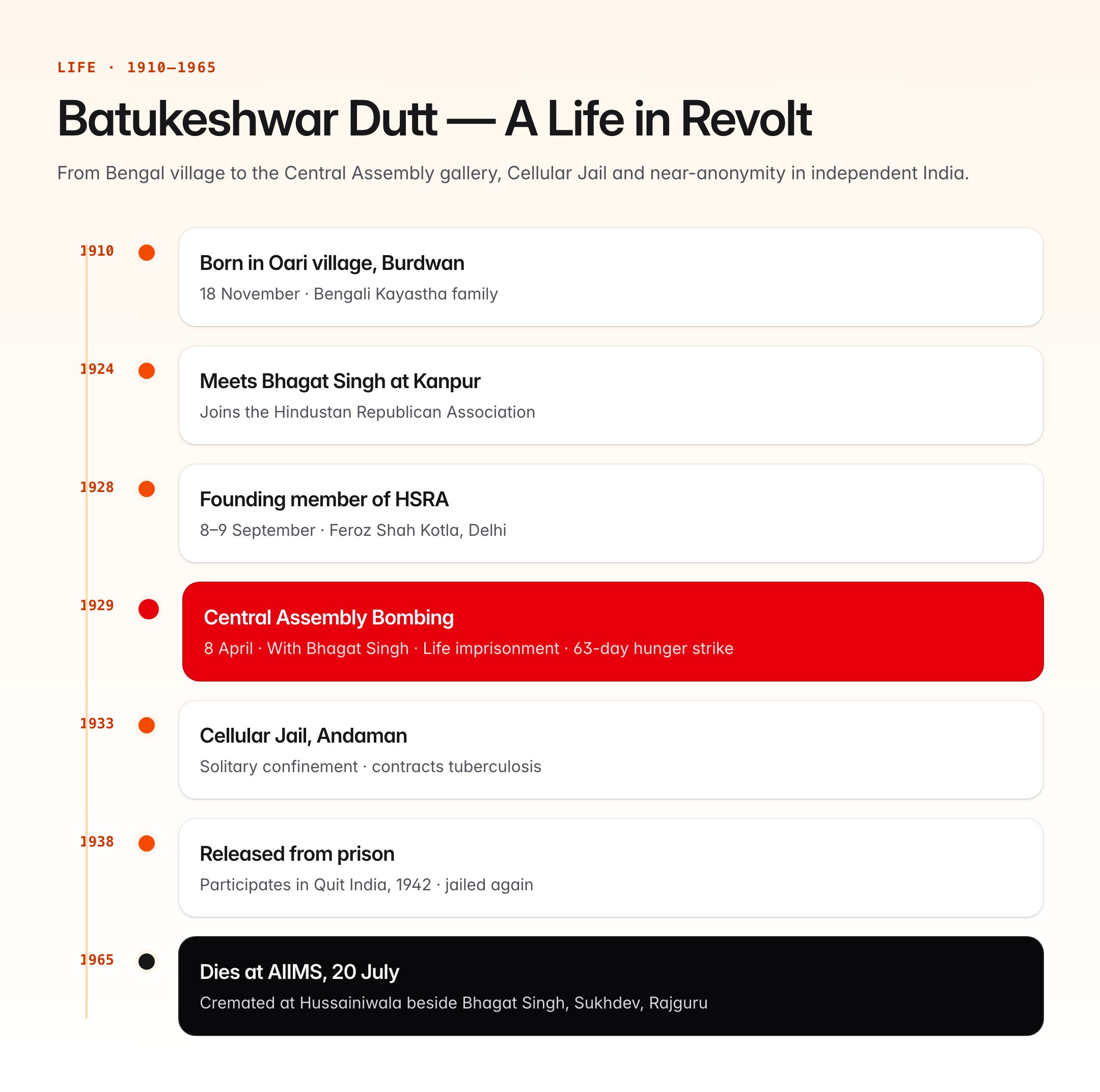
Batukeshwar Dutt (18 November 1910 – 20 July 1965) was an Indian revolutionary, a close associate of Bhagat Singh, and a founding member of the Hindustan Socialist Republican Association (HSRA). He is best known for throwing two non-lethal bombs inside the Central Legislative Assembly in Delhi on 8 April 1929, along with Bhagat Singh, as a protest against two repressive bills. Choosing not to escape, the duo courted arrest to turn their trial into a platform to publicise the cause of Indian independence.
For UPSC, Dutt is a Modern Indian History (GS1) figure often overshadowed by Bhagat Singh but essential to understanding the revolutionary phase of the freedom struggle.
Early Life and Background
| Aspect | Detail |
|---|---|
| Born | 18 November 1910, Oari village, Burdwan district, Bengal Presidency |
| Also known as | B. K. Dutt; "Battu" |
| Education | PPN High School, Kanpur |
| Family | Middle-class Bengali Kayastha family |
| Mother tongue | Bengali |
| Political turn | Met Bhagat Singh at Kanpur in 1924 |
Dutt's family later moved to Kanpur, where he met young revolutionaries in the aftermath of the Non-Cooperation Movement's suspension (1922). He joined the Hindustan Republican Association (HRA), later reorganised as the HSRA.
Revolutionary Context
| Event | Year | Significance |
|---|---|---|
| Non-Cooperation withdrawal | 1922 | Chauri Chaura incident disillusioned youth; many turned to revolutionary path |
| HRA founded | 1924 | By Sachindra Nath Sanyal, Ram Prasad Bismil, others |
| Kakori Conspiracy | 1925 | HRA train robbery; Ashfaqullah Khan, Bismil executed (1927) |
| HSRA founded | 8–9 September 1928 | HRA reorganised at Feroz Shah Kotla, Delhi; added "Socialist" |
| Saunders killing | 17 December 1928 | Bhagat Singh, Rajguru, Chandrashekhar Azad shot J.P. Saunders in Lahore |
| Assembly Bombing | 8 April 1929 | Bhagat Singh and Batukeshwar Dutt |
The HSRA and the "Socialist" Shift
The Hindustan Socialist Republican Association (HSRA) was formed on 8–9 September 1928 at the Feroz Shah Kotla ruins in Delhi. Dutt was among its founding members. The HSRA aimed at:
- Complete political independence
- Establishment of a socialist republic
- Use of armed struggle against British rule
- Ideological move from pure nationalism to socialism
Key HSRA figures: Chandrashekhar Azad (Commander-in-Chief), Bhagat Singh, Sukhdev, Rajguru, Shiv Verma, B. K. Dutt, Jaidev Kapoor, Bhagwati Charan Vohra.
The Central Assembly Bombing — 8 April 1929
The HSRA leadership needed a high-profile act that would make the deaf hear. Two bills in the Central Legislative Assembly provided the trigger.
| Bill | Purpose |
|---|---|
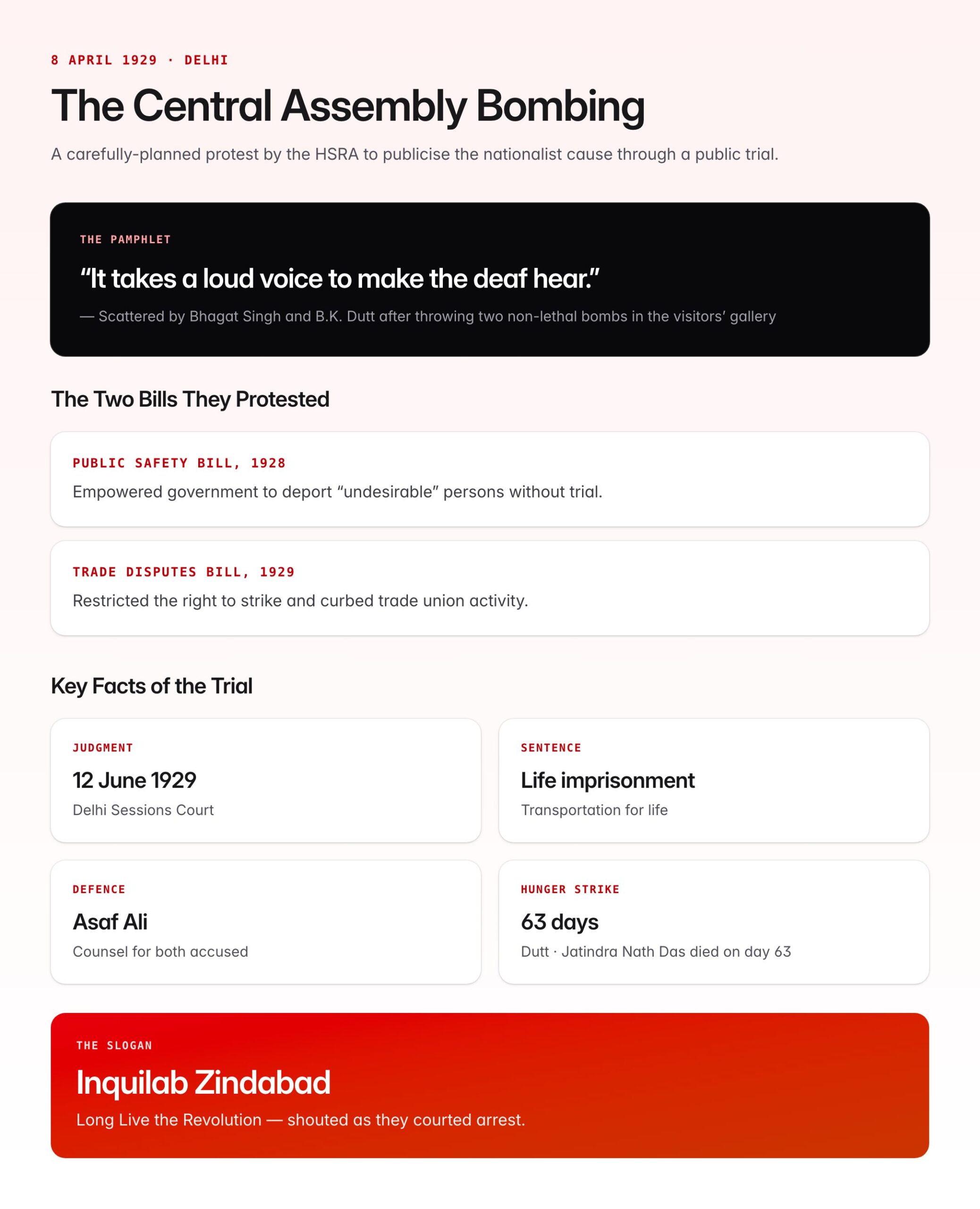
| Public Safety Bill, 1928 | Empower government to deport "undesirable" persons |
| Trade Disputes Bill, 1929 | Restrict the right to strike and curb trade union activity |
The plan: throw low-intensity bombs in the Assembly to disrupt proceedings, scatter pamphlets, court arrest, and use the trial as a platform for nationalist propaganda.
The Act
On 8 April 1929 at around 12:30 PM, during the Assembly session of the Council House (now Sansad Bhavan), Bhagat Singh and Batukeshwar Dutt threw two bombs from the visitors' gallery onto the vacant benches — deliberately avoiding members.
They then:
- Shouted "Inquilab Zindabad" (Long Live the Revolution) and "Samrajyawad ka naash ho"
- Scattered red pamphlets explaining their motives
- Made no attempt to escape
- Were peacefully arrested
The Pamphlet
The pamphlet famously declared:
"It takes a loud voice to make the deaf hear."
It was signed on behalf of the HSRA and explained that the goal was not to kill but to protest unjust legislation.
Assembly Bomb Case
| Aspect | Detail |
|---|---|
| Charge | Attempt to murder; Explosive Substances Act, 1908 |
| Trial court | Delhi Sessions Court |
| Judgment date | 12 June 1929 |
| Sentence | Life imprisonment (transportation for life) for both |
| Defence counsel | Asaf Ali |
Both refused to plead for mercy. Bhagat Singh and Dutt used their court statements to articulate their revolutionary ideology.
The Hunger Strike in Jail
After conviction, Bhagat Singh and Dutt were imprisoned in Mianwali Jail and later moved to Lahore Central Jail (for Bhagat Singh, owing to the Lahore Conspiracy Case). On 15 June 1929, they launched a historic hunger strike for prisoners' rights.
Demands
| # | Demand |
|---|---|
| 1 | European prisoners' diet for Indian political prisoners |
| 2 | Books, newspapers, and writing materials |
| 3 | Better clothing and sanitary conditions |
| 4 | Designation as political prisoners, not ordinary criminals |
| 5 | No forced labour |
The strike lasted 63 days for Dutt and 116 days for Bhagat Singh. Jatindra Nath Das, a fellow HSRA revolutionary on hunger strike, died after 63 days on 13 September 1929 — becoming a national martyr. The hunger strike electrified Indian public opinion.
Transportation to Cellular Jail, Andaman
Dutt was transported to the notorious Cellular Jail (Kala Pani) in Port Blair, Andaman and Nicobar Islands.
| Aspect | Detail |
|---|---|
| Period | 1933 onwards |
| Conditions | Solitary confinement, forced oil-mill labour, starvation diet |
| Health impact | Dutt contracted tuberculosis in Cellular Jail |
| Fellow inmates | Many HSRA, Anushilan, Jugantar prisoners |
Dutt participated in another hunger strike at Cellular Jail demanding better conditions. His health collapsed, and he was eventually shifted to Bankipore Jail (Patna) and later released in 1937.
While Dutt Was in Prison
Events in the outside world moved fast.
| Date | Event |
|---|---|
| 23 March 1931 | Bhagat Singh, Sukhdev, Rajguru hanged in Lahore Jail (Lahore Conspiracy Case) |
| 27 February 1931 | Chandrashekhar Azad killed at Alfred Park, Allahabad |
| 1942 | Quit India Movement |
| 1947 | India's independence |
Post-Release and Post-Independence Life
Dutt was released in 1938. He later participated in the Quit India Movement (1942) and was jailed again.
After independence, Dutt's life was marked by poverty, illness and neglect.
| Year | Development |
|---|---|
| 1947 | India becomes independent |
| 1947–65 | Dutt struggles financially; runs a bakery and a small transport business |
| Late 1950s | Chronic TB forces repeated hospitalisation |
| July 1965 | Admitted to AIIMS, New Delhi, in critical condition |
| 20 July 1965 | Dies at AIIMS |
| 22 July 1965 | Cremated at Hussainiwala, Punjab, beside Bhagat Singh, Sukhdev and Rajguru |
At his request, Dutt was cremated at the same site as his three comrades at Hussainiwala — reuniting the martyrs of the Assembly Bombing and Lahore Conspiracy Case.
Legacy and Recognition
| Recognition | Detail |
|---|---|
| Hussainiwala memorial | Samadhi alongside Bhagat Singh, Sukhdev, Rajguru |
| Postage stamp | Issued by India Post in 2010 |
| Kanpur memorial | Statue and park named in his honour |
| B. K. Dutt Colony | Locality in New Delhi named after him |
| Films | Portrayed in The Legend of Bhagat Singh (2002), Rang De Basanti (2006) references |
Dutt vs Bhagat Singh — Different Fates
| Feature | Bhagat Singh | Batukeshwar Dutt |
|---|---|---|
| Assembly Bombing charge | Convicted; life imprisonment | Convicted; life imprisonment |
| Lahore Conspiracy Case | Convicted; hanged in 1931 | Not implicated |
| Post-sentence | Executed | Transported to Cellular Jail |
| Post-independence | Posthumous icon | Lived in near-anonymity till 1965 |
Dutt's survival was a kind of accident of history — had he been present when Saunders was shot, he might have shared Bhagat Singh's fate.
Revolutionary Ideology
Dutt embraced the full HSRA ideology, which differed from mainstream Congress politics.
| Principle | Congress (mainstream) | HSRA / Dutt |
|---|---|---|
| Goal | Dominion status (till 1929), then Purna Swaraj | Complete independence and socialist republic |
| Method | Non-violence, satyagraha | Armed struggle, sabotage |
| Theory | Liberal-nationalist | Marxist-influenced; anti-imperialist, anti-capitalist |
| International inspiration | British liberalism | Russian Revolution, Irish Republicans |
UPSC Relevance
GS1 (Modern History): Revolutionary movement, HSRA, Bhagat Singh, repressive legislation, phases of freedom struggle.
Key Prelims facts:
- Born: 18 November 1910, Burdwan (Bengal)
- Died: 20 July 1965, AIIMS, New Delhi; cremated at Hussainiwala
- Founding member of HSRA (8–9 September 1928, Feroz Shah Kotla, Delhi)
- Central Assembly Bombing: 8 April 1929, along with Bhagat Singh
- Protest against: Public Safety Bill and Trade Disputes Bill
- Trial: Convicted on 12 June 1929; sentenced to life imprisonment
- Slogan: "Inquilab Zindabad"; "It takes a loud voice to make the deaf hear"
- Hunger strike in jail (1929) with Bhagat Singh and Jatindra Nath Das; JN Das died after 63 days
- Imprisoned in Cellular Jail, Andaman
- Not implicated in Lahore Conspiracy Case (Saunders murder)
- Released: 1937–38; also participated in Quit India Movement 1942