Bhagat Singh: Life, Legacy & Freedom Struggle
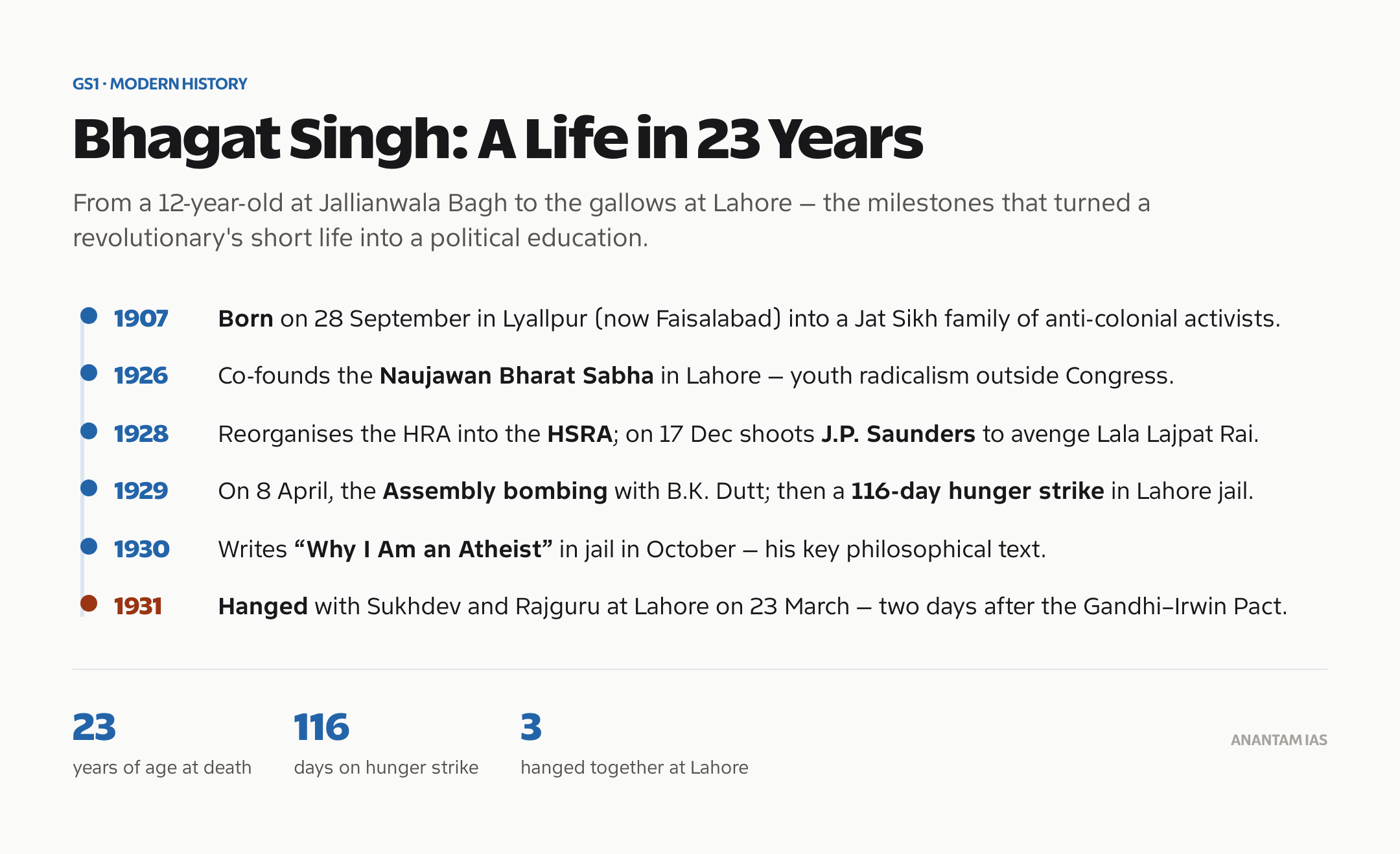
Bhagat Singh was hanged on March 23, 1931. He was 23 years old. In those 23 years, he built a revolutionary organization, killed a British police officer, bombed the Central Legislative Assembly, endured a hunger strike lasting 116 days, conducted a landmark trial that he turned into a political platform, and wrote philosophy that still challenges readers today.
He didn’t want to die quietly. He used his arrest, trial, and execution as instruments of political education. And it worked — his death shook the independence movement and hardened public sentiment against British rule more than most military victories could have.
For UPSC, Bhagat Singh appears in Modern History, Indian Freedom Struggle, and questions about revolutionary nationalism as distinct from Gandhian non-violence.
Early Life and Radicalization
Bhagat Singh was born on September 28, 1907 in Lyallpur district (now Faisalabad, Pakistan) in a Jat Sikh family with a deep tradition of political resistance. His father Kishan Singh and his uncles Ajit Singh and Swaran Singh were already involved in anti-colonial activism. His aunt reportedly welcomed his birth as auspicious because his father had just been released from prison that day.
Jallianwala Bagh and the 13-Year-Old
When the Jallianwala Bagh massacre happened on April 13, 1919, Bhagat Singh was 12 years old. He reportedly walked to Jallianwala Bagh from Lahore — 12 miles — after hearing what had happened. He collected soil from the site and kept it in a bottle. Whether perfectly historical or slightly embellished by later accounts, this story reflects the formative impact the massacre had on his generation.
The massacre didn’t just anger him — it politicized him. It showed him that British rule rested on violence, and that colonial administration would kill hundreds to maintain order.
Early Education and Leaving Home
Bhagat Singh studied at the DAV High School in Lahore. When Gandhi launched the Non-Cooperation Movement in 1920, Bhagat Singh — then 13 — abandoned government-affiliated education in response to Gandhi’s call. He studied instead at National College, Lahore, where nationalist ideas were actively discussed.
He was also influenced by the Russian Revolution (1917), the writings of Marx and Lenin, and the actions of Irish revolutionaries. His intellectual formation was genuinely eclectic — he read widely, in Punjabi, Urdu, Hindi, and English.
His family wanted him to marry. He refused and left home, writing a letter saying he was dedicating his life to the nation. He was 17.
Naujawan Bharat Sabha (1926)
In 1926, Bhagat Singh co-founded the Naujawan Bharat Sabha (Young India Association) in Lahore. This was a youth organization focused on nationalist politics outside the Congress framework. It organized students, workers, and young professionals and pushed a more radical anti-colonial line than Congress was willing to take.
Hindustan Socialist Republican Association (HSRA)
The organization most associated with Bhagat Singh is the Hindustan Socialist Republican Association (HSRA) — and its predecessor, the Hindustan Republican Association (HRA).
HRA to HSRA: Adding “Socialist”
The Hindustan Republican Association was founded in 1924 by Ram Prasad Bismil and others, primarily active in UP and Punjab. Their goal was armed revolution to overthrow British rule. The Kakori Train Robbery (1925) — where HRA members looted a train to fund revolutionary activities — led to the arrest and execution of Bismil, Ashfaqullah Khan, and others in 1927.
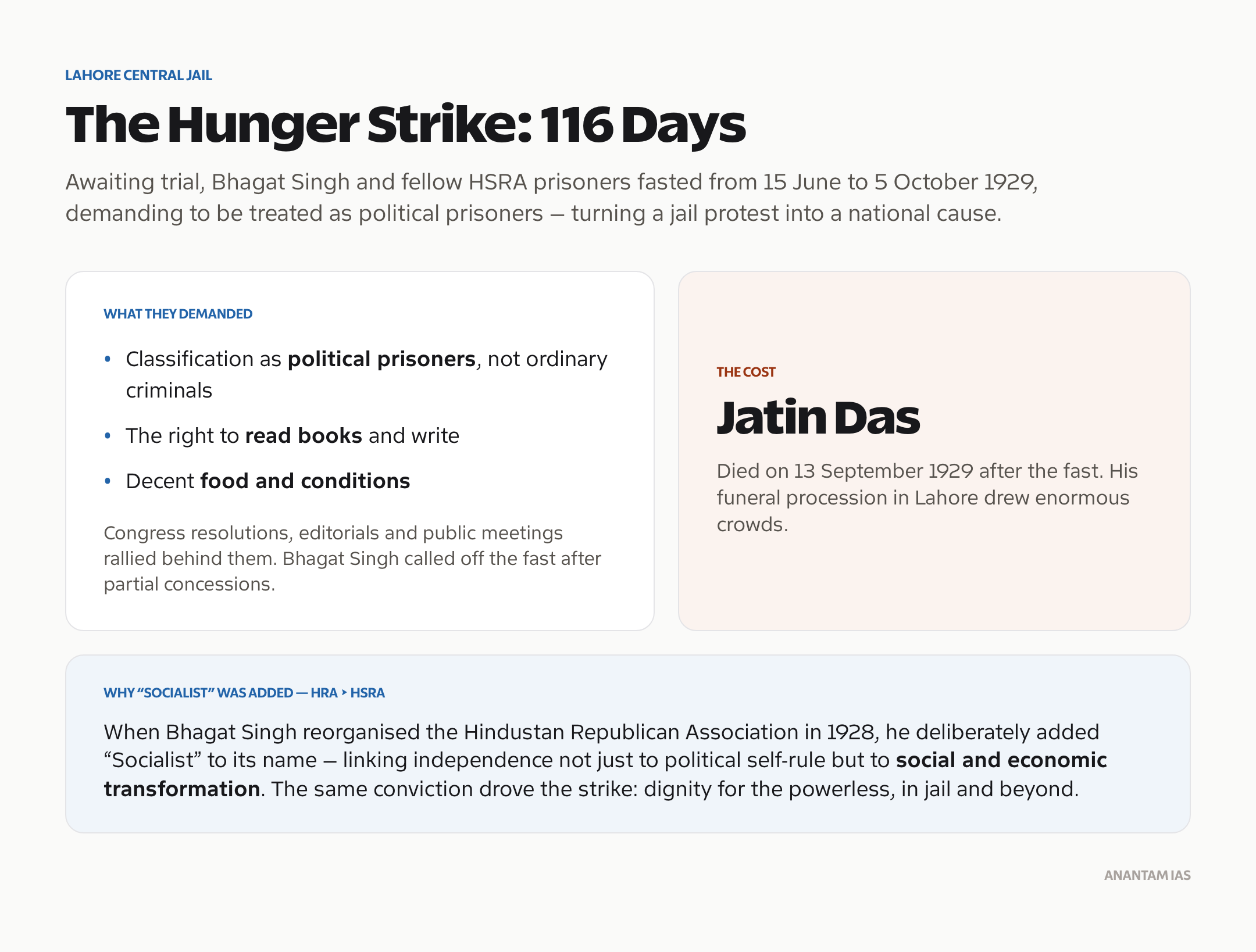
Bhagat Singh joined and reorganized the HRA in 1928, adding “Socialist” to its name to make it the HSRA. The addition was deliberate — he wanted to link Indian independence with social and economic transformation, not just political self-rule. The HSRA’s document, “The Philosophy of the Bomb” (though primarily Bhagwati Charan Vohra’s writing), laid out the case for revolutionary violence.
Key HSRA members alongside Bhagat Singh:
- Chandrashekhar Azad — the “untouchable” commander who vowed never to be captured alive
- Sukhdev Thapar — Bhagat Singh’s closest associate, hanged on the same day
- Rajguru — also hanged on March 23, 1931
- Bhagwati Charan Vohra — ideologue and writer
The Murder of Saunders: The Lajpat Rai Connection
On October 30, 1928, Lala Lajpat Rai led a protest march against the Simon Commission in Lahore. British police, under Superintendent James Scott, lathi-charged the protesters. Lajpat Rai was struck on the chest. He died on November 17, 1928.
Bhagat Singh, Rajguru, and Azad decided to avenge this. Their target was James Scott. But on December 17, 1928, they mistakenly shot and killed John P. Saunders — the Assistant Superintendent of Police — outside the Lahore police headquarters. Saunders was confused with Scott in the identification.
They escaped from Lahore. Bhagat Singh disguised himself and fled. The British launched a massive manhunt.
This killing set off the chain of events that would lead to Bhagat Singh’s arrest, trial, and execution.
The Central Legislative Assembly Bombing: April 8, 1929
On April 8, 1929, Bhagat Singh and Batukeshwar Dutt threw two bombs in the Central Legislative Assembly (now Lok Sabha) in Delhi during a session. The bombs were designed to make noise and create smoke — not to kill. They deliberately threw them at empty benches.
Why They Did It
The bombing was timed to protest the Public Safety Bill and the Trade Disputes Bill, which the HSRA considered anti-worker and instruments of oppression. The British government was trying to pass these bills despite opposition from Indian members.
After throwing the bombs, Bhagat Singh and Dutt didn’t run. They threw pamphlets reading “It takes a loud voice to make the deaf hear” — a statement that the bombing was political theatre, not assassination.
They waited. Shouted “Inquilab Zindabad” (Long Live Revolution). And surrendered to the police.
This was deliberate. Bhagat Singh wanted a trial. He wanted a platform to articulate revolutionary ideology in a British courtroom, watched by the Indian public and press.
Impact of “Inquilab Zindabad”
The slogan “Inquilab Zindabad” entered Indian political consciousness through Bhagat Singh. It wasn’t his invention — Hasrat Mohani had used similar language earlier — but Bhagat Singh’s use of it, from a British court, gave it new power. It remains a rallying cry in Indian political life today.
The Lahore Conspiracy Case
The Lahore Conspiracy Case tried Bhagat Singh for the murder of Saunders. It became the most politically charged trial of the independence era.
The Hunger Strike: 116 Days
While awaiting trial in Lahore Central Jail, Bhagat Singh and other HSRA prisoners launched a hunger strike demanding better treatment for political prisoners — the right to read books, better food, and classification as political prisoners rather than ordinary criminals.
The hunger strike lasted 116 days (June 15 to October 5, 1929). It became a national cause. Congress resolutions, newspaper editorials, and public meetings demanded the demands be met. Jatin Das, one of the hunger strikers, died on September 13, 1929 — his funeral procession in Lahore drew enormous crowds.
Bhagat Singh eventually called off the hunger strike after partial concessions.
The Trial and Bhagat Singh’s Defence
The trial under the Lahore Conspiracy Case was specifically designed by the British as a Special Tribunal — not a standard court — to avoid the normal delays and procedural protections. The Viceroy Lord Irwin amended the existing law through ordinance to enable this tribunal.
Bhagat Singh used the trial as a political platform. He cross-examined witnesses aggressively, made statements about the nature of British colonialism, and turned proceedings into debates about imperialism and revolution. The court was packed. The press covered every session.
The tribunal found Bhagat Singh, Sukhdev, and Rajguru guilty of the murder of Saunders and sentenced them to death.
Execution: March 23, 1931
Bhagat Singh, Sukhdev, and Rajguru were hanged at Lahore Central Jail on the evening of March 23, 1931 — reportedly a day earlier than scheduled. The British government, worried about public reaction, kept the execution secret until after it was done. The bodies were cremated at Hussainiwala on the banks of the Sutlej River.
The execution came just two days after the Gandhi-Irwin Pact (March 5, 1931), which had suspended the Civil Disobedience Movement. Many in the independence movement were furious that Gandhi had not made Bhagat Singh’s release or commutation a condition of the Pact. Gandhi explained he had tried but that the Viceroy refused.
The public reaction to the execution was intense. There were riots and protests across India. Bhagat Singh’s popularity exceeded Congress leaders in many polls of the time.
Hussainiwala Memorial — at the cremation site on the India-Pakistan border in Punjab — is today a national memorial to Bhagat Singh, Sukhdev, and Rajguru.
Philosophy: Why I Am an Atheist
Bhagat Singh wasn’t just an activist. He was a thinker. His most important philosophical work is the essay “Why I Am an Atheist”, written in jail in October 1930.
The essay addresses the accusation that he had turned to atheism out of vanity or arrogance. His argument is careful and serious:
- He had read and thought about religion and found it intellectually unsatisfying
- A God who allows suffering — particularly the suffering of the poor and oppressed — is either not omnipotent, not omniscient, or not benevolent
- The charge that atheists are “proud” misunderstands the position — atheism requires intellectual courage, not pride
- He welcomed death because it was consistent with his beliefs: he would face the unknown without flinching
The essay shows that Bhagat Singh’s radicalism was philosophical, not merely emotional. He wasn’t angry — he had reasoned positions on God, the state, capitalism, and revolution.
He also wrote extensively in jail — letters, notes on prison conditions, and what would become “Why I Am an Atheist.”
Legacy and UPSC Relevance
Bhagat Singh’s legacy is contested and rich. He’s claimed by socialists, Marxists, nationalists, and revolutionaries across the political spectrum. His portrait hangs in Parliament. But his radical critique of capitalism and his rejection of religion make him uncomfortable for any simple nationalist mythology.
Revolutionary Nationalism vs Gandhian Non-Violence
For UPSC, the key conceptual distinction is between revolutionary nationalism (Bhagat Singh, Chandrashekhar Azad, Subhas Chandra Bose) and Gandhian non-violence. These were not competing failures — both put pressure on British rule in different ways.
Revolutionary violence made the cost of colonialism visible to Britain. Gandhian mass movements mobilized people who would never take up arms. Historians debate which had more impact, but the honest answer is that both mattered.
Key UPSC Points
| Event | Year | Significance |
|---|---|---|
| Naujawan Bharat Sabha founded | 1926 | Youth radicalism outside Congress |
| HRA renamed HSRA | 1928 | Socialist dimension added to revolution |
| Saunders killing | December 17, 1928 | Response to Lajpat Rai death |
| Central Legislative Assembly bombing | April 8, 1929 | Political theatre, not assassination |
| Hunger strike in Lahore jail | June–October 1929 | 116 days, Jatin Das died September 13 |
| Execution at Lahore | March 23, 1931 | Two days after Gandhi-Irwin Pact |
| “Why I Am an Atheist” | October 1930 | Key philosophical text |
Frequently Asked Questions
When was Bhagat Singh born and when was he executed?
Bhagat Singh was born on September 28, 1907 in Lyallpur (now Faisalabad, Pakistan). He was executed by hanging at Lahore Central Jail on March 23, 1931, at the age of 23, along with Sukhdev Thapar and Shivaram Rajguru.
What was the Lahore Conspiracy Case?
The Lahore Conspiracy Case was the trial of Bhagat Singh, Sukhdev, and Rajguru for the murder of British police officer John P. Saunders in December 1928. A Special Tribunal (not a regular court) was constituted through a presidential ordinance to try the case and delivered the death sentence in 1930.
Why did Bhagat Singh bomb the Central Legislative Assembly?
Bhagat Singh and Batukeshwar Dutt threw bombs in the Central Legislative Assembly on April 8, 1929 to protest the Public Safety Bill and Trade Disputes Bill. The bombs were non-lethal — intended as political statement, not mass killing. They deliberately surrendered after throwing the bombs to use the trial as a public platform.
What is HSRA?
HSRA stands for Hindustan Socialist Republican Association. It was reorganized and renamed (from Hindustan Republican Association) by Bhagat Singh in 1928 to include a socialist dimension. The organization advocated armed revolution combined with social transformation, not just political independence.
What did Bhagat Singh write in jail?
Bhagat Singh’s most significant writing from jail is the essay u0022Why I Am an Atheistu0022 (October 1930). He also wrote letters to his father and comrades, notes on Marxist theory, and testimony related to his trial. His writings show an intellectually sophisticated thinker, not just an impulsive revolutionary.
Tell Google you want more of this.
Add Anantam IAS as a preferred sourceOne tap, and this site shows up more often in your own Top Stories, AI Overviews and AI Mode. Remove it any time.