Beekeeping & Sweet Revolution in India: NBHM, Honey Mission UPSC Notes
Beekeeping (apiculture) drives India's Sweet Revolution. NBHM, Honey Mission, KVIC, exports. Boosts crop yield 20-30% via pollination. UPSC GS-III complete guide.
Beekeeping (apiculture) is the scientific practice of rearing honeybees in artificial hives for honey, beeswax, royal jelly, propolis, bee pollen, bee venom, and — most valuable of all — pollination services that boost yields of fruits, vegetables, oilseeds and pulses by 20-30%. India's policy push for apiculture is branded the Sweet Revolution, conceived as the apiculture analogue to the White Revolution (milk) and Yellow Revolution (oilseeds). The flagship schemes — National Beekeeping and Honey Mission (NBHM) and the Honey Mission of KVIC — together aim to make India a major global honey exporter while strengthening rural livelihoods, especially for small and marginal farmers, landless labourers, women and tribal communities.
For UPSC, beekeeping is a high-yield GS-III topic that bridges agriculture, allied sectors, MSME, rural livelihood, biodiversity, food security, and exports. Prelims has tested NBHM components, KVIC's Honey Mission, India's honey export rank, and species like Apis mellifera and Apis cerana indica. Mains questions probe the Sweet Revolution's role in doubling farmers' income and agricultural diversification.
What is the Sweet Revolution?
The Sweet Revolution is a 2016-onward policy push to scale up scientific beekeeping and honey production. The rationale: just as the Green Revolution transformed grain output, the White Revolution revolutionised milk, and the Yellow Revolution boosted oilseeds, the Sweet Revolution can transform rural household incomes through the low-capital, high-return apiculture sector.
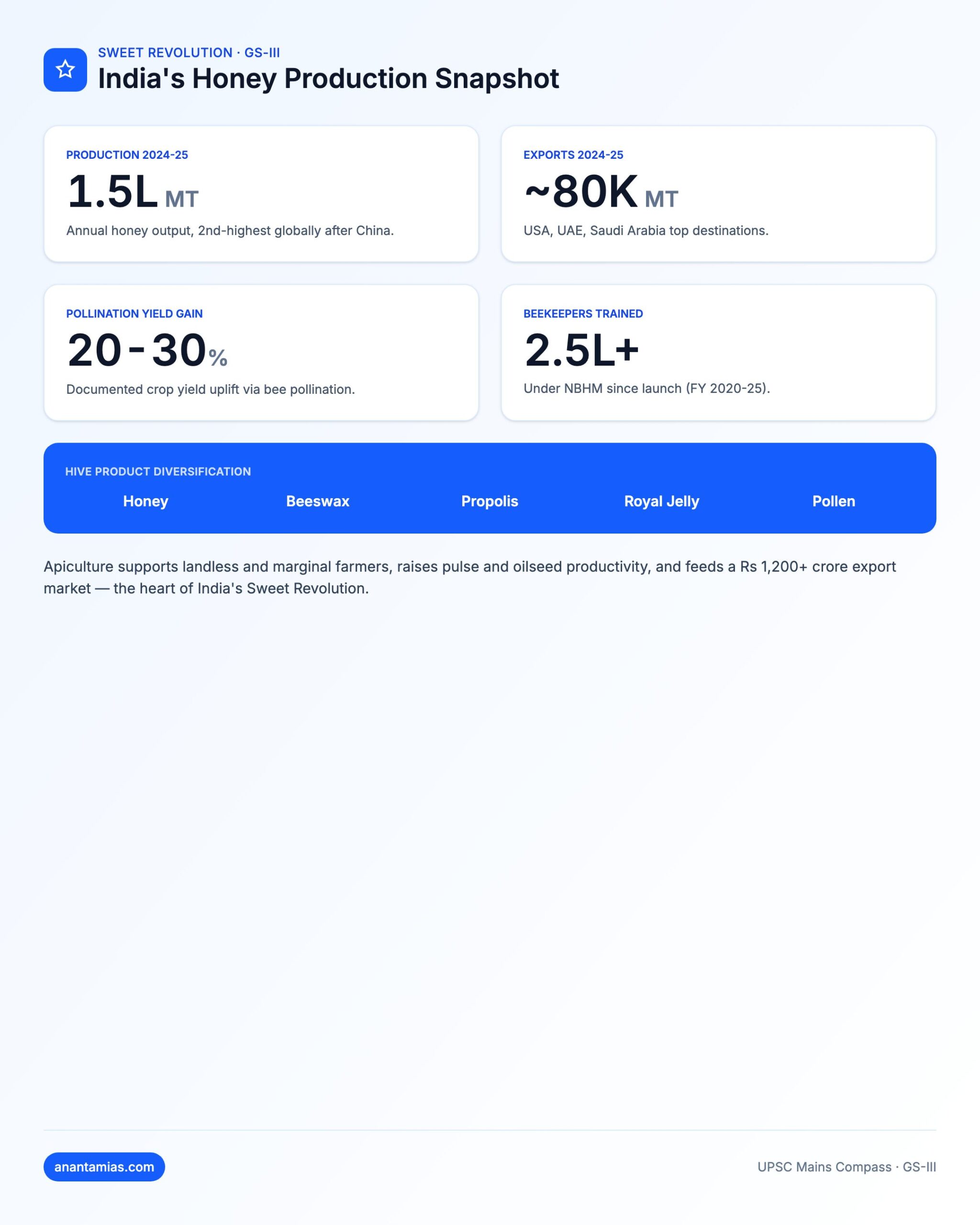
India's Honey Production Snapshot (2024-25)
- Annual production: ~1,33,000 tonnes (10th largest globally).
- Exports: ~80,000+ tonnes worth USD 180+ million; major buyers — USA, Saudi Arabia, UAE, Bangladesh, Morocco.
- Per-capita consumption: ~70 grams/year (vs 1.5 kg in Germany, 1 kg in USA) — huge domestic upside.
- Number of beekeepers: ~5 lakh.
- Number of honeybee colonies: ~50 lakh.
- Honey-producing states: Punjab, UP, West Bengal, MP, Bihar, Haryana, Rajasthan, Maharashtra, J&K, Tamil Nadu, Karnataka.
Background: Why Beekeeping Matters
Pollination Value
Honeybees pollinate 30-40% of global food crops. In India, bee pollination raises yield of mustard, sunflower, coriander, cotton, fruits and vegetables by 20-30%. The economic value of pollination services in India is estimated at USD 22-25 billion annually — vastly exceeding direct hive product value.
Livelihood for Marginal Groups
Beekeeping is uniquely suited to rural households because it requires:
- Low capital — Rs 25,000-50,000 for a starter unit of 10 hives.
- No land — bees forage from neighbouring fields and forests.
- Minimal labour — 2-3 hours per week per 10 hives.
- Compatibility with other livelihoods — works alongside farming, livestock, MGNREGA work.
This makes apiculture ideal for landless labourers, small/marginal farmers, women's SHGs, and tribal communities in forest-fringe districts.
Honey Bee Species in India
| Species | Scientific Name | Characteristics |
|---|---|---|
| Indian honey bee | Apis cerana indica | Native; suited to box hives; moderate yield |
| Rock bee | Apis dorsata | Wild, large colonies; high yield but cannot be domesticated |
| Little bee | Apis florea | Wild; small colonies; low yield |
| European honey bee | Apis mellifera | Introduced from Europe; high yield (40 kg/colony/year); commercially dominant |
| Stingless bee | Trigona / Tetragonula | Native; medicinal honey; emerging commercial value |
Other Hive Products
Honey is just one output. Beeswax, royal jelly, propolis, bee pollen, bee venom, bee bread are all commercially valuable — bee venom and royal jelly often costlier per gram than honey because of pharmaceutical applications.
Components: Government Beekeeping Architecture
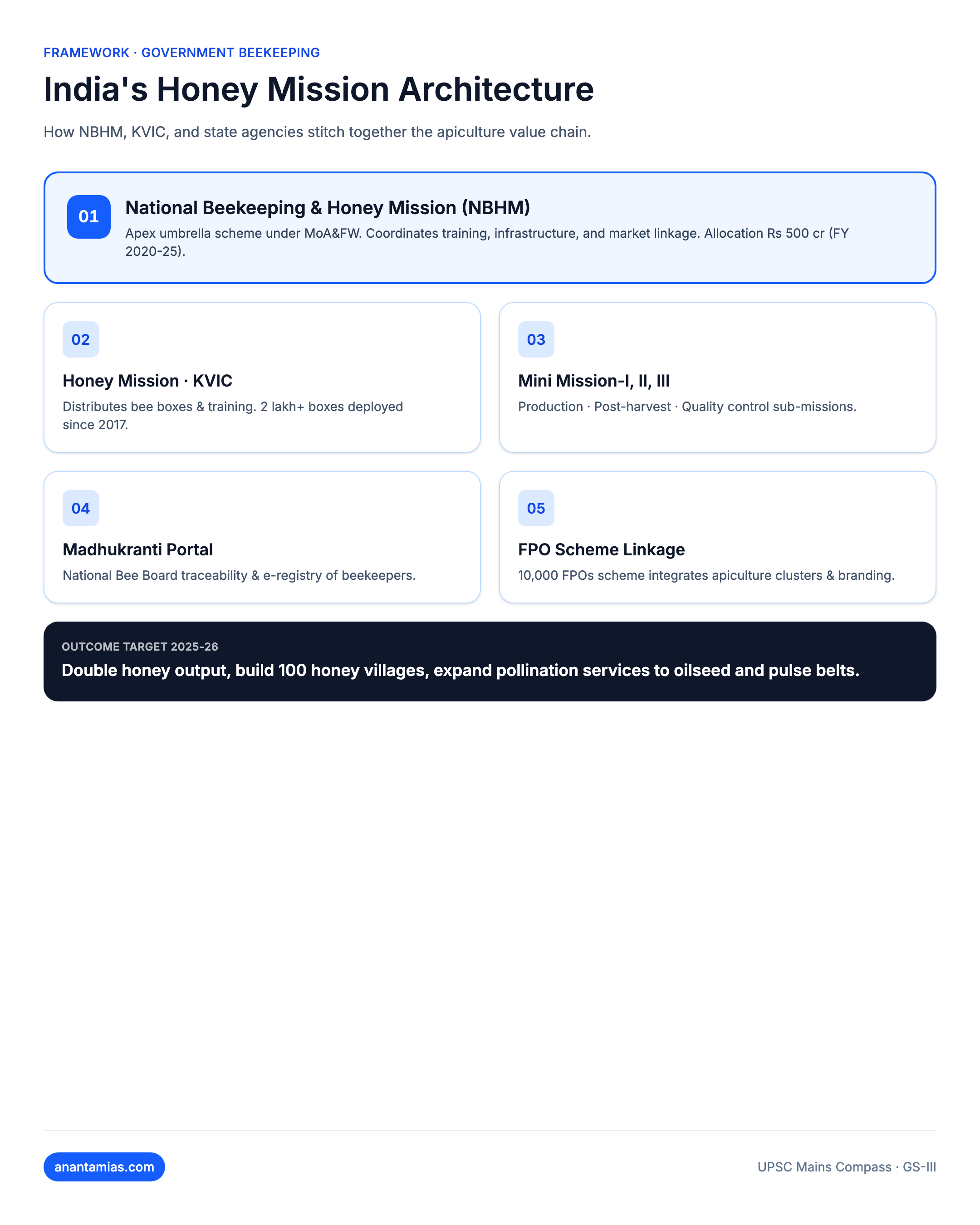
National Beekeeping and Honey Mission (NBHM)
Launched in 2020 under the Ministry of Agriculture and Farmers Welfare, NBHM has three components:
| Mini Mission | Focus |
|---|---|
| MM-I | Production support — training, equipment, hives, scientific bee colonies |
| MM-II | Post-harvest support — honey processing, value addition, marketing, branding |
| MM-III | R&D — disease management, queen bee rearing, varietal development, IT integration |
NBHM works through National Bee Board (NBB), State Beekeeping Development Boards, Krishi Vigyan Kendras (KVKs), and FPOs. Outlay: Rs 500 crore for 2020-21 to 2023-24, with extensions in subsequent budgets.
KVIC's Honey Mission
Launched in 2017 by Khadi and Village Industries Commission, the Honey Mission distributes:
- Bee boxes to beneficiaries (each box ~Rs 4,500).
- Training (5-7 days).
- Toolkits (smoker, gloves, hive tool).
By 2025, KVIC had distributed 2+ lakh bee boxes generating an estimated Rs 600+ crore in additional rural income.
Apiary Honey Houses and FPOs
NBHM supports Mini Honey Mission/Honey Houses, FPO-led aggregation, and Honey Corner shops for direct retail.
Madhukranti Portal and Honey Lab
The Madhukranti Portal (launched 2021) is a digital traceability platform — every batch of honey gets a QR code-linked source mapping to combat adulteration. The National Honey Quality Testing Lab in Anand (Gujarat) and several regional labs do NMR (Nuclear Magnetic Resonance) testing to detect adulteration with sugar syrup.
Benefits of Beekeeping for Indian Agriculture
- Increased crop yields by 20-30% through cross-pollination — a free yield bonus for fruit and oilseed farmers.
- Additional source of income — paid pollination contracts, with bee colonies migrating to crop fields during flowering.
- Less capital intensive — 10 hives can be started under Rs 50,000.
- Requires no land — ideal for landless labourers and tenant farmers.
- High-value secondary products — beeswax, royal jelly, propolis, bee venom often costlier than honey itself.
- Nutritional security — over a third of the global food basket depends on bee-pollinated crops.
- Growing export demand — USA, Saudi Arabia, UAE driving exports; India among the top 5 honey exporters globally.
- Forest and biodiversity conservation — beekeeping in forest-fringe areas creates economic stake in habitat preservation.
- Women empowerment — SHGs nationwide running successful apiary units (e.g., NRLM bee SHGs in Bihar, Jharkhand, Odisha).
- Tribal livelihoods — TRIFED's Van Dhan Yojana integrates honey collection with minor forest produce.
- Climate resilience — bee colonies are mobile and resilient to monsoon variability.
- Aligned with doubling farmers' income — Dalwai Committee identified apiculture as a top secondary income source.
Challenges and Criticism
Adulteration
The Centre for Science and Environment (CSE) 2020 study found 77% of branded honey samples in India failed NMR tests for adulteration with sugar syrup imported as "rice syrup" or "fructose syrup". The Madhukranti Portal and NMR labs are responses, but enforcement is patchy.
Pesticide Mortality
Excessive use of neonicotinoid insecticides in cotton, rice, and vegetable crops causes colony collapse disorder (CCD). India's pesticide regulation needs strengthening.
Climate Change and Habitat Loss
- Erratic monsoons disrupt nectar flow.
- Deforestation reduces wild bee populations.
- Apis dorsata colonies declining in many states.
Lack of Quality Inputs
- Limited supply of disease-free queen bees.
- Few professional bee breeders.
- Imported Apis mellifera queens vulnerable to varroa mites.
Marketing and Branding
- Co-operative branding (e.g., Dabur, Patanjali) dominates; small beekeepers struggle for visibility.
- Limited direct-to-consumer channels for ethical, single-origin honey.
- Geographical Indication (GI) tags for niche honeys (e.g., Sundarbans Mangrove Honey) emerging slowly.
Skill and Extension Gaps
- Insufficient trainers and extension officers.
- Many beekeepers operate without scientific knowledge of disease management.
Disease Burden
- Varroa mite, American foulbrood, Thai sac brood virus decimate colonies.
- Limited domestic vaccine and biocontrol options.
Recent Developments (2024-2026)
| Year | Update |
|---|---|
| 2020 | NBHM launched with Rs 500 crore initial outlay |
| 2021 | Madhukranti Portal launched for honey traceability |
| 2024 | NBHM Phase II approved with Rs 1,000+ crore through FY27 |
| 2024 | Honey exports cross 80,000 tonnes worth USD 180+ million |
| Budget 2024-25 | Rs 200 crore for honey processing and quality testing infrastructure |
| 2025 | 5 mega honey-testing labs operationalised; NMR coverage expanded |
| Budget 2025-26 | NBHM extended; Rs 250 crore for value addition and exports |
| 2025-26 | Sundarbans Honey, Kashmir Acacia Honey, Lalitpur Honey under GI evaluation |
| 2026 | One District One Product (ODOP) for honey in 80+ districts |
Reforms and Way Forward
- Treat beekeeping as an agricultural input — cross-pollination is part of crop production, not a separate sector.
- Mandatory pollination training for fruit and oilseed farmers under KVKs.
- Bee-pasture programmes — plant nectar-rich trees (eucalyptus, neem, sunflower, mustard) along roadsides and in wastelands.
- Pesticide regulation — phase out neonicotinoids; align with EU best practice.
- Strengthen NMR testing — every bottle of branded honey to carry NMR-tested certification by 2027.
- Promote stingless bee (Trigona) farming for medicinal honey premium.
- Cluster Development Programme — 100+ honey clusters under MIDH and PMFME.
- Direct-to-consumer e-commerce — FPO-led ethical brands.
- GI tagging push — Sundarbans, Kashmir, Himalayan, Konkan, Western Ghats honeys.
- Insurance for bee colonies under PMFBY-style scheme.
- Bee research institutions — strengthen ICAR-IIBR (Pune) and state agricultural universities.
- Export incentives — APEDA-led promotion of Indian honey in EU, Japan, Korea.
Government Schemes and Budget Allocations (2025-26)
- National Beekeeping and Honey Mission (NBHM): Rs 250 crore (2025-26); 1,000+ crore total Phase II.
- KVIC Honey Mission: continued bee-box distribution.
- Madhukranti Portal: traceability and quality assurance.
- MIDH: cluster development for high-value horticulture including beekeeping.
- PMFME: One District One Product — honey selected in 80+ districts.
- NRLM: SHG-led beekeeping units.
- Van Dhan Yojana: tribal honey collectives under TRIFED.
- APEDA: export promotion.
Mains Answer Hook
A high-scoring GS-III answer should: (a) frame beekeeping as the most cost-effective rural livelihood multiplier, with crop pollination yield gain of 20-30% being a free agricultural input; (b) cite the Sweet Revolution analogy to White, Yellow, Green; (c) describe the NBHM-KVIC-Madhukranti policy stack; (d) flag adulteration (CSE 77% failure rate) and CCD from neonicotinoids as the binding constraints; (e) propose reforms — bee-pasture, GI tags, pesticide regulation, exports.
Use: "Beekeeping is agriculture's silent multiplier — it raises grain yields, employs the landless, and earns export dollars on a capital base smaller than a smartphone."
Prelims Pointers
- Sweet Revolution: apiculture analogue of White/Yellow/Green Revolutions.
- NBHM: National Beekeeping and Honey Mission, launched 2020.
- KVIC Honey Mission: launched 2017; 2+ lakh bee boxes distributed.
- Madhukranti Portal: 2021; honey traceability via QR codes.
- Pollination yield gain: 20-30% in fruits, vegetables, oilseeds.
- Indian honey species: Apis cerana indica, Apis dorsata (rock), Apis florea (little), Apis mellifera (European), Trigona (stingless).
- India's honey exports: ~80,000 tonnes; USD 180+ million.
- Top buyer: USA.
- Implementing ministry: Ministry of Agriculture & Farmers Welfare; National Bee Board.
- NMR testing: Nuclear Magnetic Resonance test for honey adulteration.
FAQ on Beekeeping and Sweet Revolution
What is the Sweet Revolution?
A national push to scale up scientific beekeeping in India to boost honey production, exports, and rural incomes — analogous to the White, Yellow, and Green Revolutions.
Which scheme governs beekeeping in India?
National Beekeeping and Honey Mission (NBHM), launched 2020 under the Ministry of Agriculture & Farmers Welfare, with three Mini Missions for production, post-harvest, and R&D.
What is the Madhukranti Portal?
A digital traceability platform launched in 2021 that assigns QR codes to honey batches to prevent adulteration.
Why does beekeeping suit small/marginal farmers?
Low capital (Rs 25-50K for 10 hives), no land requirement, minimal labour, complementary to other livelihoods.
What is colony collapse disorder?
Mass bee mortality caused by pesticides (especially neonicotinoids), pathogens, and climate stress; threatens beekeeping globally.
How does beekeeping help non-beekeeping farmers?
Through pollination services — honeybees boost yields of fruits, oilseeds, vegetables, and pulses by 20-30%.
Beekeeping is an under-rated rural multiplier — every Rs 1 invested generates Rs 5-10 in farm-system returns through pollination plus hive products. For UPSC, anchor your answers in NBHM, KVIC Honey Mission, Madhukranti Portal, the bee species list, and the 20-30% pollination yield gain. Pair with the CSE adulteration finding and CCD challenge for a Mains-grade answer.