The Yellow Revolution refers to the rapid growth in India's oilseeds production triggered by the Technology Mission on Oilseeds (TMO), launched in 1986 under the leadership of Sam Pitroda. Within five years, domestic oilseed output rose from 11 million tonnes to nearly 19 million tonnes, and India moved from being one of the world's largest importers of edible oils in the mid-1980s to near self-sufficiency by the early 1990s.
Though the gains were partly reversed after trade liberalisation in 1994, the Yellow Revolution remains a textbook case of mission-mode agricultural planning in India, and it is directly relevant to current policy efforts like the National Mission on Edible Oils – Oilseeds (NMEO-Oilseeds) and NMEO-Oil Palm.
Background: The Oilseed Crisis of the 1980s
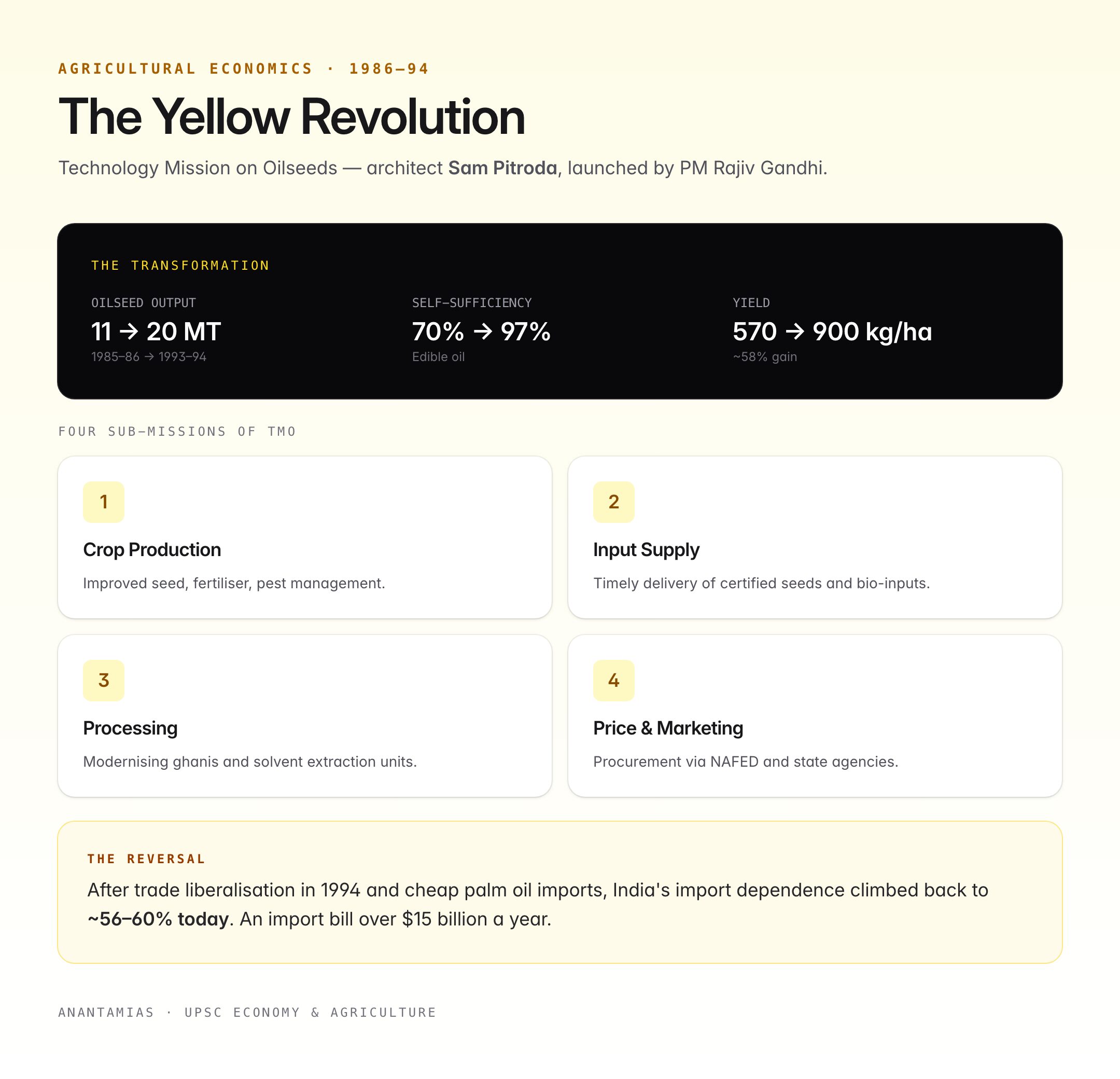
| Indicator (1985–86) | Value |
|---|---|
| Oilseed production | ~11 million tonnes |
| Edible oil imports | ~1.5 million tonnes (≈30% of demand) |
| Import bill | Among India's top imports after crude oil |
| Yield | ~570 kg/hectare — among the lowest globally |
| Farmers involved | Small and marginal, mostly rainfed |
Most oilseeds (groundnut, mustard, sesame, safflower, soybean, sunflower) were grown in rainfed, low-input conditions. Yields stagnated while population and per capita oil consumption rose. The import bill for palm, soybean and sunflower oil was a drag on the balance of payments.
Launch of the Technology Mission on Oilseeds (TMO)
- Year: 1986.
- Initiated by: Prime Minister Rajiv Gandhi.
- Architect: Sam Pitroda, then Adviser to the PM.
- Institutional design: Modelled on the telecom and dairy missions — an inter-ministerial, target-driven "mission-mode" approach.
- Implementing agency: Department of Oilseeds Research (later merged into the Ministry of Agriculture); Indian Council of Agricultural Research (ICAR) institutions; NAFED for price support.
Four Sub-Missions of TMO
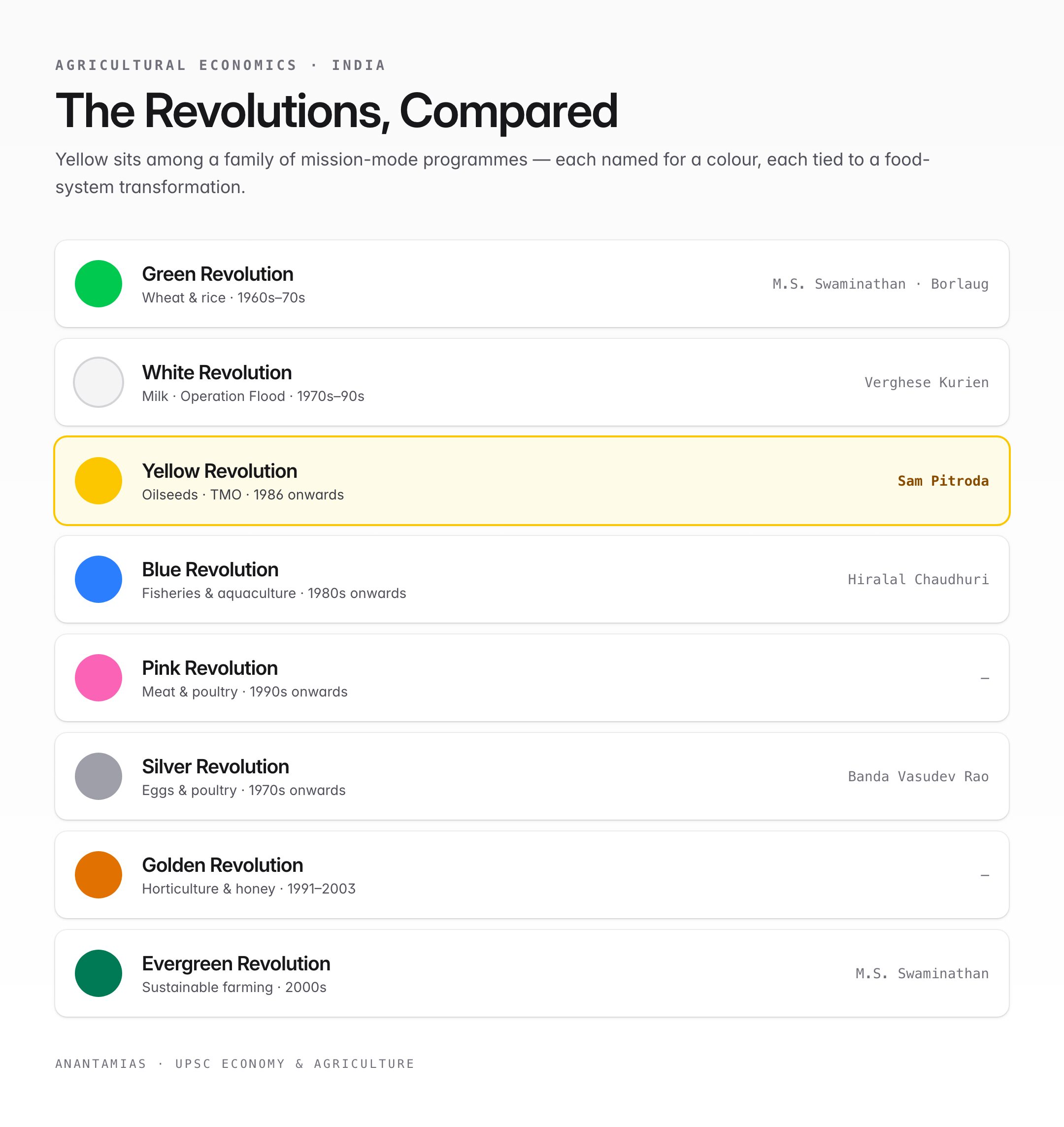
- Crop Production — improved seed, fertiliser, pest management.
- Input Supply — timely delivery of certified seeds and bio-inputs.
- Processing & Post-Harvest — modernising ghanis and solvent extraction units.
- Price Support & Marketing — assured procurement through NAFED and state agencies.
Results of the Yellow Revolution (1986–1994)
| Indicator | 1985–86 | 1993–94 |
|---|---|---|
| Oilseed production | 11 MT | ~20 MT |
| Edible oil output | 3 MT | ~6 MT |
| Self-sufficiency in oil | ~70% | ~97% |
| Imports of edible oil | ~1.5 MT | ~0.1 MT |
| Yield | 570 kg/ha | ~900 kg/ha |
| Area under oilseeds | 19 million ha | 26 million ha |
- Soybean emerged as a major crop in Madhya Pradesh, Maharashtra, and Rajasthan — often called India's "Golden Bean".
- Mustard and rapeseed expansion in Rajasthan, UP, Haryana, Punjab.
- Groundnut gains in Gujarat, Andhra Pradesh, Karnataka, Tamil Nadu.
- Yellow Revolution also drove growth in oilseed crushing and refining capacity, private-sector solvent extraction plants, and marketing infrastructure.
Key Crops of the Yellow Revolution
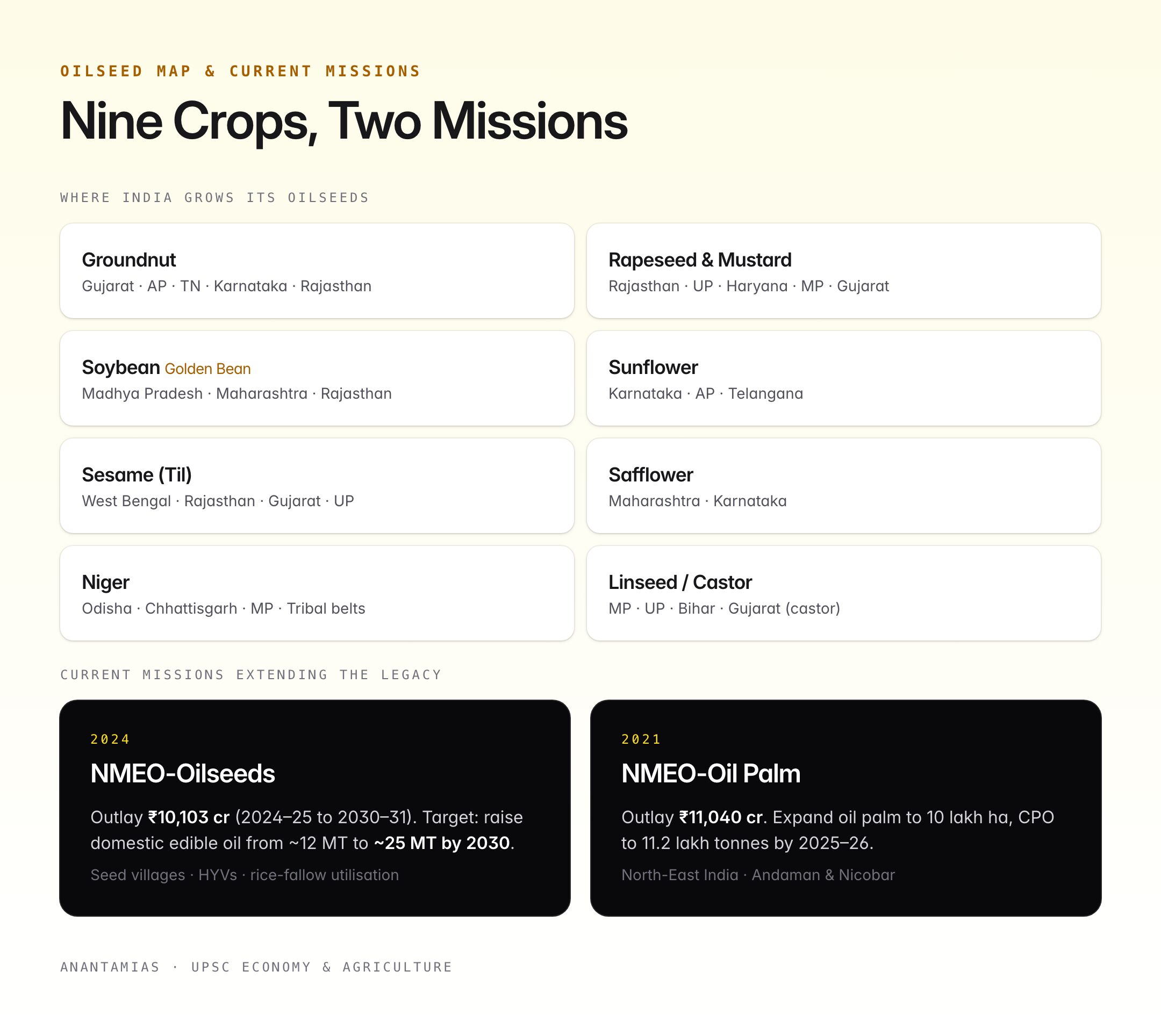
| Crop | Major States |
|---|---|
| Groundnut | Gujarat, Andhra Pradesh, Tamil Nadu, Karnataka, Rajasthan |
| Rapeseed & Mustard | Rajasthan, UP, Haryana, MP, Gujarat |
| Soybean | Madhya Pradesh, Maharashtra, Rajasthan |
| Sunflower | Karnataka, Andhra Pradesh, Telangana |
| Sesame (til) | West Bengal, Rajasthan, Gujarat, UP |
| Safflower | Maharashtra, Karnataka |
| Niger | Odisha, Chhattisgarh, MP (tribal belts) |
| Linseed | MP, UP, Bihar |
| Castor (non-edible) | Gujarat, Rajasthan |
India also counts coconut, cottonseed, rice bran as secondary edible oil sources.
Institutional Backbone
- ICAR–Indian Institute of Oilseeds Research (IIOR), Hyderabad — coordinates varietal research.
- Directorate of Rapeseed–Mustard Research (DRMR), Bharatpur.
- Directorate of Soybean Research, Indore.
- Directorate of Groundnut Research, Junagadh.
- National Oilseeds and Vegetable Oils Development (NOVOD) Board.
- Solvent Extractors' Association (SEA) — industry body.
Why the Gains Slowed After 1994
- Trade liberalisation (1994) — India opened edible oil imports under the Open General Licence (OGL), tariff rates dropped.
- Cheap palm oil imports from Malaysia and Indonesia undercut domestic prices.
- Yield stagnation — research on oilseeds slowed compared to wheat and rice.
- Rainfed cultivation risk — 70% of oilseed area still depends on monsoon.
- Minimum Support Price (MSP) procurement for oilseeds remained weak relative to wheat and paddy.
By the early 2010s, imports again crossed 60% of domestic edible oil consumption — making India the world's largest importer of vegetable oils.
Current Status (Latest Data)
| Metric | Approximate value |
|---|---|
| Oilseed production (2023–24) | ~39 million tonnes |
| Domestic edible oil output | ~11–12 million tonnes |
| Edible oil consumption | ~25 million tonnes |
| Import dependence | ~56–60% |
| Major imports | Palm oil (Indonesia, Malaysia), soybean oil (Argentina, Brazil), sunflower oil (Ukraine, Russia) |
| Import bill | Over $15 billion annually |
Current Missions Extending the Legacy
National Mission on Edible Oils — Oilseeds (NMEO-Oilseeds, 2024)
- Outlay: ₹10,103 crore over 2024–25 to 2030–31.
- Goal: Raise domestic edible oil production from ~12 MT to ~25 MT by 2030.
- Strategies: Seed villages, high-yielding varieties, cluster-based cultivation, rice-fallow utilisation.
National Mission on Edible Oils — Oil Palm (NMEO-OP, 2021)
- Outlay: ₹11,040 crore.
- Goal: Expand oil palm area to 10 lakh ha and CPO production to 11.2 lakh tonnes by 2025–26.
- Focus: North-East India and the Andaman & Nicobar Islands.
Minimum Support Price (MSP)
- All 9 oilseeds have an announced MSP.
- Procurement under the Price Support Scheme (PSS) through NAFED.
Comparison with Other Revolutions
| Revolution | Focus | Period | Key leader |
|---|---|---|---|
| Green Revolution | Wheat, rice | 1960s–70s | M. S. Swaminathan, Norman Borlaug |
| White Revolution | Milk | 1970s–90s (Operation Flood) | Verghese Kurien |
| Blue Revolution | Fisheries, aquaculture | 1980s onwards | Hiralal Chaudhuri |
| Yellow Revolution | Oilseeds | 1986 onwards | Sam Pitroda |
| Pink Revolution | Meat, poultry | 1990s onwards | — |
| Silver Revolution | Egg, poultry production | 1970s onwards | Banda Vasudev Rao |
| Golden Revolution | Horticulture, honey | 1991–2003 | — |
| Grey Revolution | Fertilisers | 1960s–70s | — |
| Evergreen Revolution | Sustainable farming | 2000s | M. S. Swaminathan |
Strengths and Shortcomings of the Yellow Revolution
Strengths
- Technology + policy + institutions aligned in mission mode.
- Built a solvent extraction industry and downstream processing capacity.
- Raised oilseed farmers' incomes in the late 1980s.
- Introduced soybean as a new major cash crop.
Shortcomings
- Not sustained — trade policy shifts undid the self-sufficiency gains.
- Yield gap remains wide — Indian oilseed yields still ~50–60% of global average.
- Price volatility between MSP and market prices discouraged investment.
- Climate risk underweighted — rainfed dependence remains the core vulnerability.
Way Forward
- Closing the yield gap via improved varieties, precision agriculture, and irrigation.
- Diversifying sources — oil palm, rice-bran oil, cottonseed oil, secondary oilseeds.
- Balanced tariff policy — calibrated import duties to protect farmers without hurting consumers.
- Cluster-based missions in rainfed districts.
- Decentralised oilseed processing to retain value within farming regions.
- Climate-resilient oilseed varieties with drought tolerance.
Quick Revision
- Yellow Revolution = boost in oilseed production.
- Started: 1986 with the Technology Mission on Oilseeds.
- Architect: Sam Pitroda under PM Rajiv Gandhi.
- Key achievement: Near self-sufficiency in edible oils by 1993–94.
- Reversal: Post-1994 liberalisation and surge in palm oil imports.
- Current push: NMEO-Oilseeds (2024) + NMEO-Oil Palm (2021).
UPSC Relevance
Prelims (GS Paper III): Questions on the Technology Mission on Oilseeds, major oilseed-producing states, and links between different "revolutions" (Green, White, Yellow, Blue) recur frequently.
Mains (GS Paper III — Economy / Agriculture):
- Critically examine India's attempt at achieving self-sufficiency in edible oils since the Yellow Revolution.
- Discuss the rationale and expected impact of NMEO-Oilseeds (2024).
- Evaluate why gains from mission-mode programmes often reverse with a change in trade policy.
Mains (GS Paper II — Governance): Institutional design of mission-mode programmes, and the use of inter-ministerial coordination as a governance template.
Essay: Themes like "agriculture and the external sector," "self-reliance in essentials," and "missions that changed Indian farming" fit the Yellow Revolution story.
Tell Google you want more of this.
Add Anantam IAS as a preferred sourceOne tap, and this site shows up more often in your own Top Stories, AI Overviews and AI Mode. Remove it any time.