Bioethics and Gene-Editing Ethics: The Designer-Baby Debate (UPSC Ethics)
When a scientist edited the genes of twin babies in 2018, he forced the world to confront a question older than CRISPR: just because we can rewrite human DNA, should we? Here is bioethics and the gene-editing debate — the four principles, somatic vs germline editing, designer babies, India's germline ban, and a usable GS4 ethical framework.
In November 2018, a Chinese scientist named He Jiankui stood at a genome-editing summit in Hong Kong and announced that twin girls had been born from embryos whose DNA he had rewritten with CRISPR. He had switched off a gene called CCR5, he said, to make the babies resistant to HIV. The room did not applaud. Within days the scientific world had turned on him, his university cut him loose, and a Chinese court later sent him to prison for three years for practising medicine without a licence and forging ethics documents. He had crossed a line almost everyone in his field treated as sacred — and in doing so he turned an abstract argument into a living one, with two children at the centre of it.
That moment is where bioethics stops being a seminar topic and becomes a public reckoning. Bioethics is the branch of ethics that asks how we should act when biology and medicine hand us new power over life — over birth, illness, death, and now over the human genetic code itself. Gene editing, and CRISPR in particular, has made that power cheap, fast and precise enough that the old “what if” questions are suddenly real engineering choices. For a UPSC aspirant, this sits squarely in the GS Paper 4 world of applied ethics: it forces you to weigh autonomy against harm, individual freedom against collective risk, and the rights of people alive today against the interests of generations not yet born. The designer-baby debate is, in the end, a stress test of every ethical principle you have learned.
What Bioethics Is and Its Four Guiding Principles
Start with the discipline before the controversy. Bioethics emerged in the second half of the twentieth century, driven by hard cases — the Nuremberg trials that exposed Nazi medical experiments, the Tuskegee study in which American researchers let Black men go untreated for syphilis for decades, and the new ability of machines to keep bodies alive long after the brain had stopped. Each scandal taught the same lesson: scientific capability is not the same as moral permission. Out of that reckoning came a working language for thinking through medical dilemmas, and its most durable contribution is a simple, four-part framework set out by the American philosophers Tom Beauchamp and James Childress in their 1979 book Principles of Biomedical Ethics. Almost every gene-editing argument you will read maps onto these four ideas.
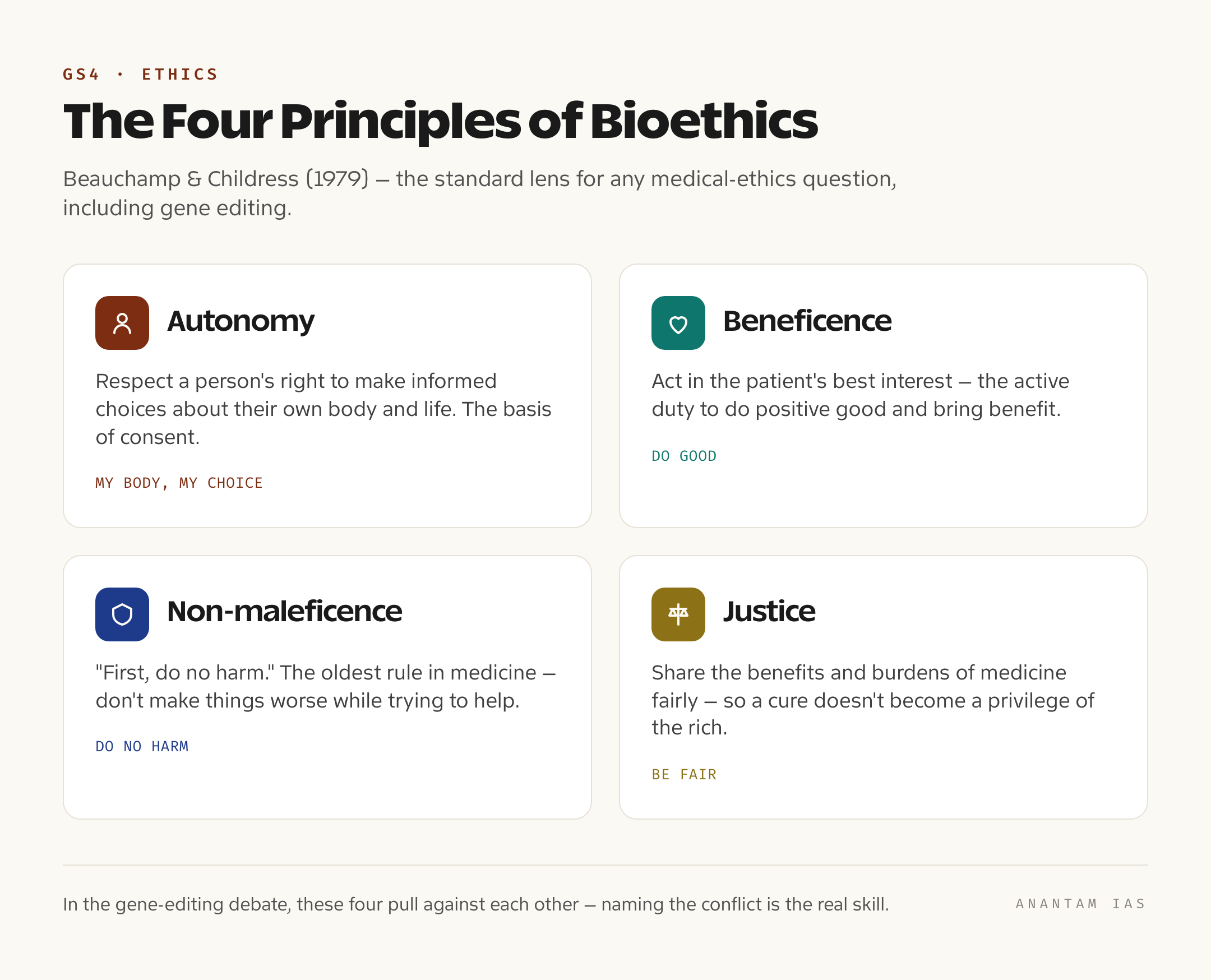
The first is autonomy — respect for a person’s right to make informed choices about their own body and life. It is why consent matters, why a patient can refuse treatment, and why a doctor cannot decide for you. The second is beneficence — the duty to act in the patient’s best interest, to do positive good. The third is non-maleficence, the oldest rule in medicine, captured in the Hippocratic phrase “first, do no harm.” Beneficence pushes us to help; non-maleficence reminds us not to make things worse while trying. And the fourth is justice — fairness in how the benefits and burdens of medicine are shared, so that a treatment does not become a privilege of the rich while its risks fall on the poor. Beauchamp and Childress argued these four are part of a “common morality” most people already accept, which is what makes them such a useful neutral ground for debate.
The power of the framework is that it forces you to look at a dilemma from four angles at once, and gene editing breaks in interesting ways across all of them. Take the He Jiankui case. Autonomy is the first thing that collapses — the twins could not consent to having their genome rewritten, and neither could the generations who would inherit the change. Non-maleficence was violated because CRISPR can cut DNA in the wrong place (“off-target” edits) or unevenly across cells (“mosaicism”), exposing healthy embryos to unknown lifelong risk for a disease they were never going to get anyway. Beneficence was thin to nonexistent — there are safe, established ways to prevent a father from passing HIV to a child, so the edit solved a problem that already had a solution. And justice looms over the whole field: if genetic upgrades ever work, who gets them? The four principles do not always agree, and learning to name the conflict between them is the real skill bioethics teaches.
The Two Distinctions That Decide Everything: Somatic vs Germline, Therapy vs Enhancement
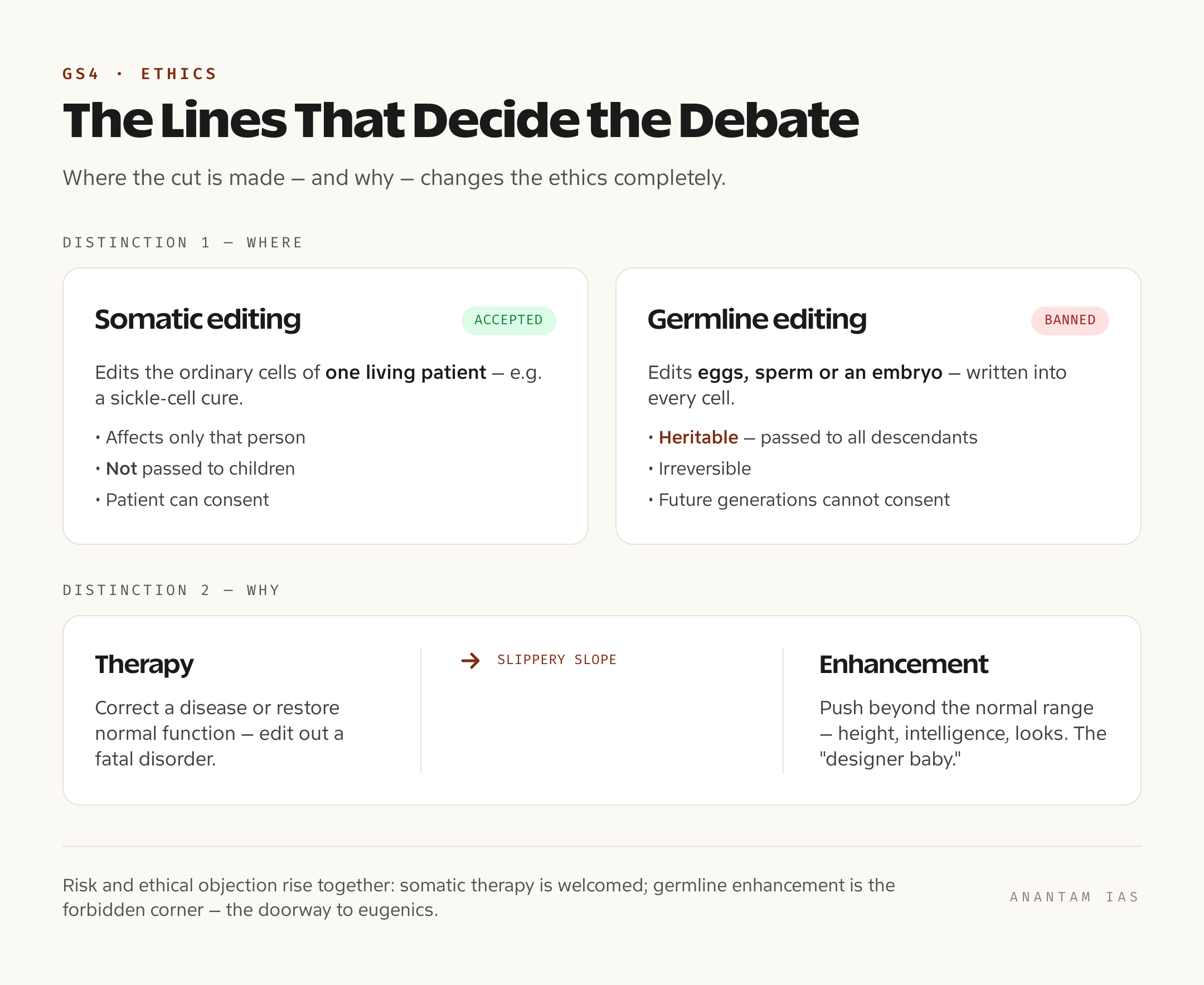
Before you can take a position, you have to know which kind of editing is on the table, because the ethics changes completely depending on where the cut is made. The first distinction is somatic versus germline. Somatic editing changes the DNA in the ordinary cells of one living person — say, the blood cells of someone with sickle-cell disease. It affects only that patient, dies with them, and is not passed on to their children. Germline editing changes the DNA in eggs, sperm or a very early embryo, which means the change is written into every cell of the resulting person and, crucially, into the eggs or sperm they will one day make. It is heritable — it ripples forward into descendants who never had a say. He Jiankui’s edit was germline, which is precisely why it caused such alarm.
This is why a near-global consensus has settled into a clean split. Somatic gene therapy is broadly accepted and is already curing people — India approved its first home-grown CAR-T cancer therapy, NexCAR19, and several countries have approved a CRISPR-based treatment for sickle-cell disease. These are celebrated, not condemned, because they treat a consenting patient and stop there. Heritable germline editing of babies, by contrast, is banned or effectively prohibited in dozens of countries and is the subject of repeated calls for a worldwide moratorium. The reason is the consent problem stacked on top of the irreversibility problem: a mistake in a somatic patient harms one informed adult, while a mistake in the germline could be propagated through a family tree forever, with no one downstream having agreed to the experiment.
The second distinction is therapy versus enhancement, and it is where the “designer baby” fear actually lives. Therapy aims to correct a disease or restore normal function — editing out a fatal genetic disorder. Enhancement aims to push a person beyond the normal range — greater height, muscle, intelligence, chosen eye colour. Most ethicists draw the brightest line here: even those open to germline therapy for terrible inherited diseases recoil at enhancement, because that is the doorway to a consumer market in “better” humans. And this is exactly where the slippery slope argument bites — the worry that once we accept editing to prevent suffering, the boundary will quietly slide toward editing for advantage. The history that haunts this debate is eugenics: the early-twentieth-century movement, embraced from the United States to Nazi Germany, that tried to “improve” the human stock through forced sterilisation and worse. Critics argue that a market in designer babies would be eugenics with a credit card — voluntary, individual, but pointed at the same goal of ranking and engineering human worth.
The Designer-Baby Debate: Playing God, Dignity, and the Consent of the Unborn
So why does heritable enhancement provoke such deep unease, beyond the practical risk of botched edits? The objections cluster around a few powerful ideas, and a good GS4 answer can name them. The first is the “playing God” concern — the sense that there are limits humans should not cross in remaking themselves, that some humility before the unknown is itself a virtue. You do not have to be religious to feel its force; many secular thinkers frame it as respect for the “given-ness” of human life, the idea that not everything about us should be a product of choice and design. The second is human dignity: the worry that a child made to a parent’s genetic specification is being treated as a manufactured object — a means to someone else’s ends — rather than a person valued for their own sake. The philosopher Jürgen Habermas argued that being “designed” by another could corrode a child’s sense of being the free, equal author of their own life.
Then there is the problem at the heart of every germline case: consent. The whole edifice of medical ethics rests on autonomy and informed consent, yet the one person most affected by a germline edit — the future child, and every descendant after them — can never be asked. Defenders reply that parents make momentous, irreversible choices for children all the time, from religion to where they grow up, so consent on behalf of the unborn is nothing new. Critics counter that those choices can be revisited or rejected later in life, whereas a rewritten genome cannot be handed back. There is also the unsettling philosophical wrinkle that without the specific edit, that particular child would never have existed at all — so it is hard to claim the editing “harmed” them in the ordinary sense. These puzzles are not academic dead-ends; they are exactly the kind of tension an examiner wants to see you hold and reason through rather than resolve too neatly.
Finally, and most concretely, there is justice and equity. Suppose germline enhancement one day works and is safe. It will be expensive. The first families to buy genetic advantages for their children will be the wealthy, and over generations those advantages could compound into a biological aristocracy — a world where inequality is not just social but written into the genome and inherited like an estate. Disability-rights advocates add a sharper point: a society racing to edit out every “defect” sends a chilling message to people already living full lives with those conditions, implying they should never have been born. The justice principle, in other words, asks us to look past the lucky individual on the operating table to the kind of society a technology would build if it spread. That is the difference between a clever answer and a wise one.
How the World Is Governing Gene Editing — and Where India Stands
Faced with all this, the world’s response has been to draw firm lines around germline editing while keeping somatic research open. The most important global voice is the World Health Organization, which after the He Jiankui scandal convened an Expert Advisory Committee on human genome editing. In July 2021 that committee delivered two landmark documents — a governance framework and a set of recommendations — and the WHO Director-General urged regulators worldwide to refrain from approving any clinical germline editing for now. The WHO also created a global registry so that all human genome-editing research is tracked transparently, an attempt to stop another secret experiment before it happens. Alongside it, the world’s three national science academies and many professional bodies have repeatedly stated that heritable editing should not proceed until it is proven safe and there is broad societal agreement that it should — a high bar that, in practice, functions as a moratorium.
India’s framework sits comfortably inside this consensus and is worth knowing precisely. The Indian Council of Medical Research (ICMR) lays down the rules through its National Ethical Guidelines for Biomedical and Health Research Involving Human Participants, last revised in 2017, which require every study on human participants to clear an institutional ethics committee and to honour informed consent. On gene editing specifically, India’s National Guidelines for Stem Cell Research are blunt: human germline editing and reproductive cloning are prohibited, full stop. Research that modifies an early human embryo in the lab is allowed only within strict limits — such embryos cannot be cultured beyond 14 days and cannot be implanted to start a pregnancy. The Department of Biotechnology (DBT) and its biosafety machinery, including the Genetic Engineering Appraisal Committee, oversee the wider field, while somatic gene therapy is regulated as a medical product so that genuine cures like NexCAR19 can move forward. The gap critics point to is that much of this rests on guidelines rather than a single binding statute, which leaves room for ambiguity — a fair point to flag in any answer on India’s regulatory readiness.
The debate refuses to stay settled, which is what keeps it current. He Jiankui was released from prison in 2022 and has been trying to stage a comeback, pivoting to less controversial work on diseases like Duchenne muscular dystrophy and Alzheimer’s, while insisting embryo editing will one day be accepted — a reminder that the person who broke the taboo has not gone away. Meanwhile the line that once seemed solid is blurring: as somatic CRISPR therapies become routine, some researchers note that edited cells could in rare cases drift into the germline, and the old neat wall between “one patient” and “future generations” looks less absolute than it did. If you want to connect this to related ground, see Anantam IAS on gene therapy versus gene editing for the science, on neuroethics and cognitive liberty for the parallel debate over editing the mind, and on synthetic biology for the wider effort to engineer life. The governance question is the same across all of them: how do we keep the brakes on a technology whose accelerator gets easier to press every year?
For Your Mains Answer
This topic is built for GS Paper 4 (Ethics, Integrity and Aptitude), where it can anchor questions on applied ethics, the ethics of science and technology, ethical dilemmas, and the relationship between law and morality. It is also a ready-made case study for a GS Paper 4 case study on a scientist tempted to cross a line, and it doubles up in GS Paper 3 (biotechnology, science-and-tech developments) and the Essay paper on themes of science versus conscience. The skill examiners reward here is not picking a side but reasoning openly — naming the principles in tension, weighing both ethical traditions, and landing on a measured judgement.
How to Build the Answer
Open by defining bioethics and the four principles, then introduce the two distinctions that frame everything — somatic versus germline, therapy versus enhancement. Use the He Jiankui case as your live anchor. Then work the dilemma through both major ethical lenses: a consequentialist (utilitarian) view weighs outcomes — does the editing reduce suffering more than it risks harm? — while a deontological view asks about duties and rights regardless of outcome — was consent possible, is human dignity respected? Layer in the precautionary principle (when potential harm is irreversible and uncertain, the burden of proof falls on the actor to show safety). Close with India’s position and a balanced verdict.
Common Mistakes to Avoid
Don’t treat all gene editing as one thing — the entire argument turns on somatic versus germline, so collapsing them loses the marks. Don’t lapse into pure science and forget the ethics; in GS4 the technology is only the setting. Don’t moralise without a framework — invoke autonomy, beneficence, non-maleficence and justice by name. Don’t present “playing God” as your only objection; pair it with the concrete points on consent, irreversibility and equity. And don’t conclude with a flat ban-it-or-allow-it; show why a calibrated line (permit somatic therapy, restrain heritable editing) is the defensible position.
A Compact Answer Spine
Bioethics = ethics of biology and medicine → four principles: autonomy, beneficence, non-maleficence, justice → CRISPR makes editing cheap and precise → somatic (one person, not inherited, broadly accepted) vs germline (heritable, affects descendants, banned) → therapy vs enhancement, the designer-baby and slippery-slope/eugenics fear → He Jiankui 2018: violated consent, non-maleficence and beneficence → objections: playing God, human dignity, consent of the unborn, justice/equity → governance: WHO framework + registry + moratorium calls; India bans germline editing and reproductive cloning (ICMR, stem-cell guidelines, DBT) → verdict: precautionary restraint on heritable editing, open door to consenting somatic therapy.
Diagram or Flowchart Idea
Sketch a 2×2 grid: one axis somatic-to-germline, the other therapy-to-enhancement. Mark “somatic therapy” (sickle-cell cure) as the accepted corner and “germline enhancement” (designer baby) as the forbidden corner, with the diagonal showing how risk and ethical objection rise together. Beside it, a small four-box panel of the four principles. This single visual communicates the whole landscape at a glance.
A Balanced-Conclusion Line
A line that lands the marks: “The question is no longer whether we can edit the human genome but whether we have the wisdom to choose what not to edit — keeping the door open to cures that heal a consenting patient while holding firm against rewriting the inheritance of generations who cannot consent.”
How to Use Data Without Cramming
You need only a handful of anchors, not a dossier: the He Jiankui case (2018, twin girls, CCR5 gene, three-year sentence), the WHO’s 2021 governance framework and global registry, India’s outright ban on germline editing and reproductive cloning, and the 14-day limit on embryo research. Attribute them plainly — “as the WHO’s 2021 framework recommended”, “under India’s ICMR guidelines” — rather than scattering facts loose.
Frequently Asked Questions
What is the difference between somatic and germline gene editing?
Somatic editing changes the DNA in the ordinary cells of one living person — for example, treating sickle-cell disease — so the change affects only that patient and is not passed to their children. Germline editing changes the DNA in eggs, sperm or an early embryo, which means it is written into every cell of the resulting person and inherited by all their descendants. Somatic therapy is widely accepted because it treats a consenting patient; heritable germline editing of babies is banned or effectively prohibited in most countries because it is irreversible and the future generations affected cannot consent.
What was the He Jiankui “CRISPR babies” scandal?
In November 2018, the Chinese scientist He Jiankui announced he had used CRISPR to edit the embryos of twin girls, switching off the CCR5 gene to try to make them resistant to HIV. The scientific world condemned it as reckless and unethical: the babies could not consent, the edit risked off-target damage, and safe alternatives to prevent HIV transmission already existed. A Chinese court sentenced him to three years in prison. The episode triggered worldwide calls for a moratorium on heritable human genome editing.
What are the four principles of bioethics?
They are autonomy (respecting a person’s right to make informed choices about their own body), beneficence (acting in the patient’s best interest), non-maleficence (above all, doing no harm), and justice (sharing the benefits and burdens of medicine fairly). Set out by Beauchamp and Childress in 1979, they form the standard lens for analysing any medical-ethics dilemma, including gene editing.
Is gene editing legal in India?
Somatic gene therapy is legal and regulated as a medical treatment — India approved its own CAR-T cancer therapy, NexCAR19. But heritable germline editing and reproductive cloning are prohibited under India’s National Guidelines for Stem Cell Research, and the ICMR’s 2017 ethical guidelines govern all research on human participants. Lab research on early embryos is allowed only within strict limits, including a ban on culturing them beyond 14 days or implanting them to start a pregnancy.
Practice Questions
Prelims MCQs
- With reference to the four principles of biomedical ethics proposed by Beauchamp and Childress, which of the following is the principle of “above all, do no harm”?
(a) Autonomy
(b) Beneficence
(c) Non-maleficence
(d) Justice
Answer: (c) Non-maleficence is the duty to avoid causing harm; beneficence is the separate duty to do positive good. - Which of the following correctly describes germline gene editing?
(a) It edits the cells of one patient and is not inherited
(b) It edits eggs, sperm or early embryos and is passed to future generations
(c) It is only used to treat cancer in adults
(d) It is fully permitted for clinical use in India
Answer: (b) Germline editing alters heritable cells, so the change is inherited by all descendants — which is why it is banned in India and most countries. - The He Jiankui affair of 2018 involved editing which gene in human embryos?
(a) BRCA1
(b) CCR5
(c) FOXP3
(d) TP53
Answer: (b) He Jiankui edited the CCR5 gene, claiming it would make the twin girls resistant to HIV infection. - The World Health Organization’s response to heritable human genome editing after 2018 included which of the following?
(a) Approval of clinical germline editing worldwide
(b) A governance framework and a global registry of genome-editing research
(c) A ban on all somatic gene therapy
(d) A mandate to commercialise designer babies
Answer: (b) In 2021 the WHO issued a governance framework and recommendations and set up a global registry, while urging regulators not to approve clinical germline editing. - Under India’s regulatory framework, which of the following is correct?
(a) Germline editing and reproductive cloning are prohibited, while somatic therapy is permitted
(b) All forms of human gene editing are fully legal
(c) Only germline editing is allowed
(d) Embryo research has no time limit
Answer: (a) India bans germline editing and reproductive cloning under its stem-cell guidelines, permits regulated somatic therapy, and caps lab embryo research at 14 days.
Mains Practice Questions
- “Scientific capability is not the same as moral permission.” Examine this statement in the context of human gene editing, using the four principles of bioethics. (15 marks, 250 words)
- Distinguish between somatic and germline gene editing, and between therapy and enhancement. Why does the ethical objection to heritable enhancement run deepest? (15 marks, 250 words)
- A brilliant young scientist in your research institute confides that she has perfected a safe technique to edit embryos to prevent a fatal inherited disease, and intends to proceed quietly with a willing couple before regulators can object. As the institute’s ethics-committee head, what are the ethical issues involved, and what course of action would you take? (20 marks, 250 words)
- “The designer-baby debate is a contest between the autonomy of parents and the rights of future generations.” Critically analyse, drawing on both consequentialist and deontological reasoning. (15 marks, 250 words)
- Discuss the global and Indian governance response to gene editing. To what extent does the precautionary principle justify a moratorium on heritable human genome editing? (15 marks, 250 words)