For most of human history, the inside of your head was the one place no one else could reach. You could be watched, recorded, searched and tracked, but the thoughts you didn’t speak stayed yours. That assumption is quietly coming apart. In November 2025, UNESCO’s General Conference adopted the world’s first global standard on the ethics of neurotechnology — a recognition by 194 countries that devices able to read, and increasingly to alter, brain activity now need rules of their own. The same year, a man with ALS who could no longer speak edited a video using only his thoughts, through a chip in his motor cortex. The brain has stopped being a sealed room.
This is the territory of neuroethics, and it has moved from seminar rooms to statute books with surprising speed. The promise is genuine and humane — restoring movement to the paralysed and speech to the silenced. But the same tools that decode a paralysed person’s intention to move a cursor can, in principle, decode a healthy person’s mood, attention or honesty, and a growing consumer industry is already collecting brain signals from ordinary headbands and earbuds. For a UPSC aspirant, this sits squarely in GS Paper 4, where ethics meets emerging technology, and spills into GS3 science and tech. It forces the oldest question in ethics — what do we owe one another — onto the newest frontier: the human mind itself.
What Neuroethics Actually Is
Start with the word, because it carries more than one idea. Neuroethics is usually split into two halves, a division the philosopher Adina Roskies set out in 2002 and that the field still uses. The first half is the ethics of neuroscience — the moral questions raised by what we can now do to the brain, from deep-brain stimulation and memory drugs to brain-computer interfaces that read neural signals. The second half is the neuroscience of ethics — what brain research tells us about how moral judgement itself works, about free will, responsibility and the biological roots of right and wrong. One asks how we should use the science; the other asks how the science changes our picture of the moral agent. A good answer keeps both in view, because the deepest unease about neurotech is that it touches not just our data but the organ that does our deciding.
For the exam, the first half is where the action is, and it has a clear engine: neurotechnology. This is any device that interfaces with the nervous system to record or change its activity. At the clinical end sit invasive brain-computer interfaces — a BCI is a system that translates brain signals into commands for a computer or a machine. Elon Musk’s Neuralink, which by mid-2025 had implanted its chip in several paralysed patients who can now move cursors and robotic arms by thought, is the famous example; Synchron’s Stentrode, which reaches the brain through a blood vessel rather than open-skull surgery and is heading for a pivotal US trial, is the quieter one. At the consumer end sit non-invasive EEG wearables — headbands like Muse and Emotiv’s Insight that read electrical activity through the scalp and sell wellness, focus or meditation feedback. And in between sits neuromarketing, the use of brain and biometric signals to test how consumers really respond to an advertisement or a product, beneath what they say.
What ties these together, and what makes neuroethics urgent rather than academic, is a single technical fact: the same signal that helps one person can expose another. Decoding brain activity to let a locked-in patient spell words is, mechanically, the same act as decoding brain activity to infer a shopper’s desire or a citizen’s allegiance. The technology does not know the difference. The ethics has to supply it.
Why the Mind Is the Last Frontier of Privacy
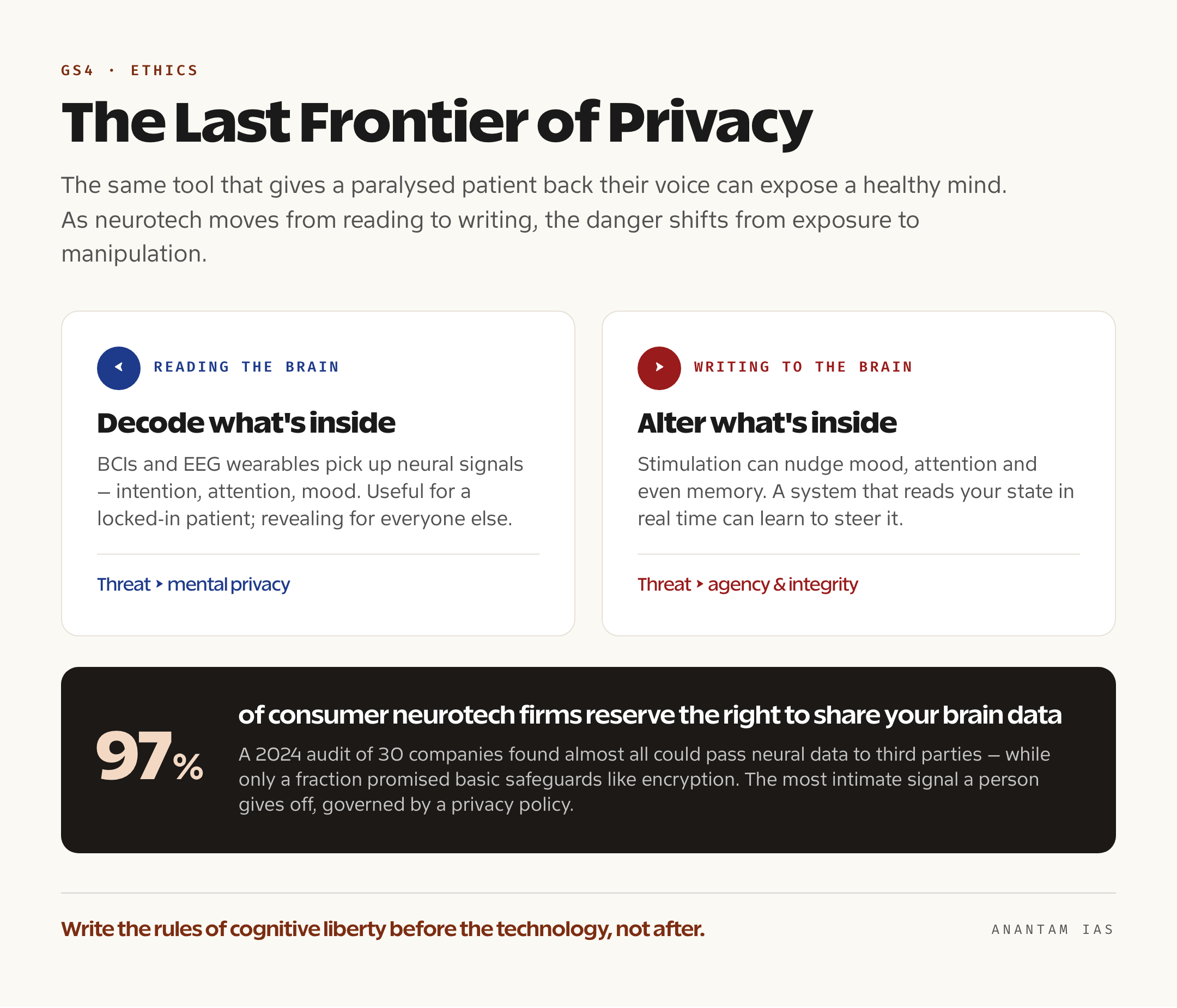
Here is the shift that changes everything. For years, neurotech could only read the brain — pick up signals and try to interpret them. Increasingly it can also write to the brain — use stimulation to nudge mood, attention or even, in early experiments, the formation of memories. The Duke law scholar Nita Farahany, whose book The Battle for Your Brain did much to popularise the debate, frames the danger as two-sided: tracking and decoding the brain on one hand, and hacking and manipulating it on the other. Reading threatens your privacy. Writing threatens your agency. Together they reach the one space law has always treated as untouchable — the forum internum, the inner forum of thought that freedom-of-thought guarantees were written to protect.
This is why so many call mental privacy the last frontier of privacy. You can refuse to hand over a password; you cannot easily refuse to think. Brain data is also uniquely revealing and impossible to change — you can reissue a stolen card number, but you cannot reissue your neural patterns. And it is being gathered with startlingly little protection. A 2024 audit by the NeuroRights Foundation of thirty consumer neurotechnology companies found that almost all of them — about 97 per cent — reserved the right to share users’ brain data with third parties, while only a tiny fraction committed to basic safeguards like encryption or breach notification. People are clipping on focus-tracking headbands and streaming raw signals from their cortex to servers governed by little more than a vague privacy policy.
The subtler risk is manipulation. A system that can read your attention in real time can also learn to capture it, and a recommendation engine fed brain signals could exploit emotional states with a precision no advertiser has ever had. That is where the harm stops being about leaked data and becomes about a loss of self-determination — the worry that your choices are being shaped from inside, below the level you can notice or resist. This is the practical meaning of cognitive liberty: the right to govern your own mind. It connects directly to India’s own constitutional story, since the right to privacy that the Supreme Court recognised as a fundamental right rests on exactly this idea of self-determination over one’s inner life. You can read more in our explainer on the right to privacy.
The Proposed Neurorights — and the Laws Catching Up
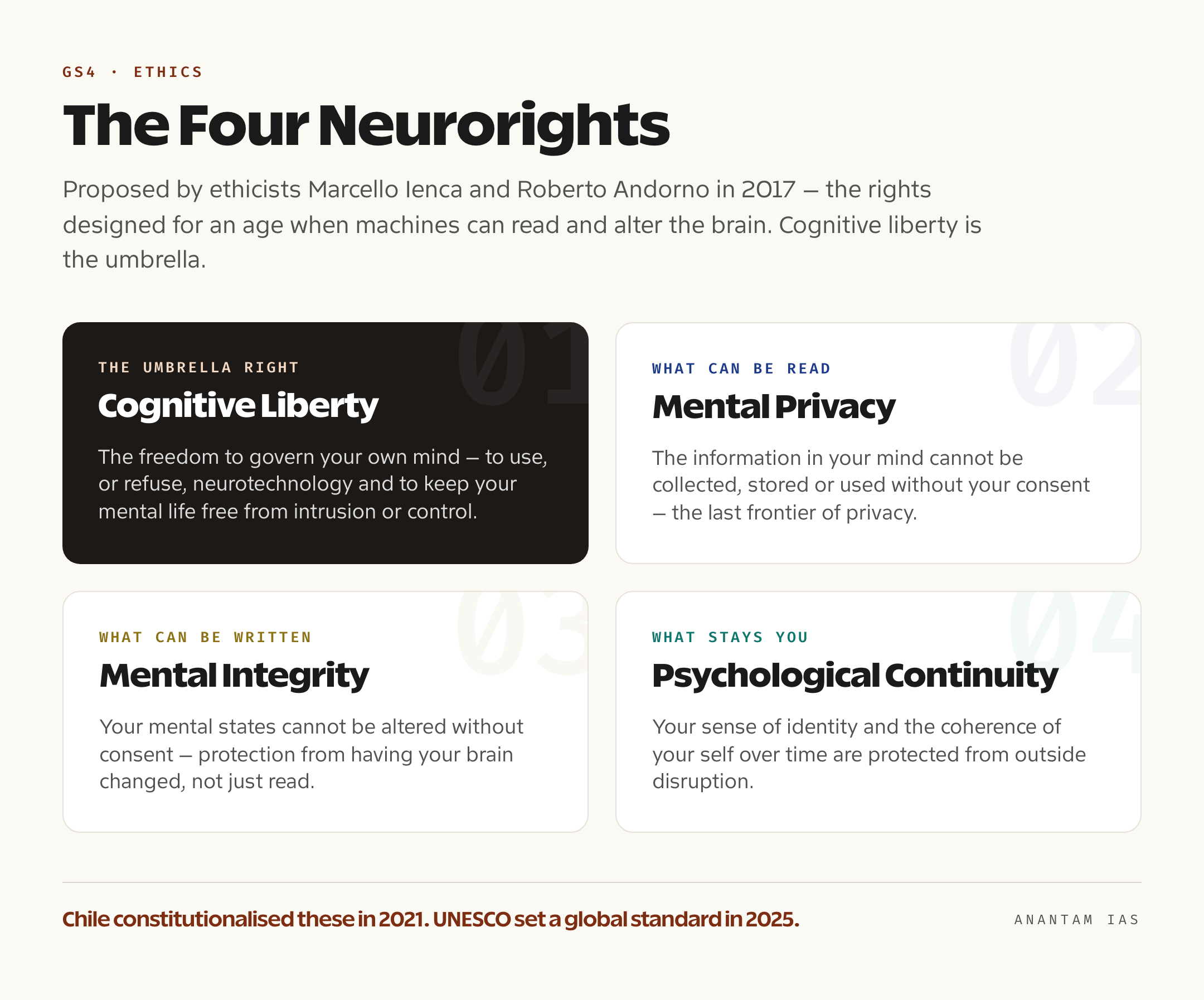
Because existing human rights were written before any of this was possible, two ethicists, Marcello Ienca and Roberto Andorno, proposed in 2017 a set of new neurorights — rights designed specifically for the age of brain-reading machines. Their framework names four. The right to cognitive liberty is the umbrella: the freedom to use, or refuse, neurotechnology and to keep control over your own mental life. The right to mental privacy protects the information in your mind from being collected, stored or used without consent. The right to mental integrity guards against the unauthorised altering of your mental states — protection from having your brain changed, not just read. And the right to psychological continuity protects your sense of identity and the coherence of your self over time from being disrupted by outside intervention. Whether these need to be brand-new rights or can be read into existing ones is a live debate, but the four labels have become the common vocabulary of the field.
What turned this from philosophy into law was Chile. In 2021 it became the first country in the world to write neurorights into its constitution, amending the charter to protect brain activity and the information drawn from it, and following up with legislation that treats neural data with special care — one proposal compared protecting brain data to protecting a human organ that cannot be bought, sold or trafficked. The principle was tested almost at once: in a 2023 ruling, Chile’s Supreme Court ordered the US neurotech firm Emotiv to delete the brain-activity data it had gathered from a Chilean user through a consumer EEG headset, holding that storing it had violated his rights to mental privacy and integrity. A consumer wellness gadget had collided with a constitutional right, and the right won.
The wider system is now catching up. Back in 2019 the OECD issued the first international standard in the area, its Recommendation on Responsible Innovation in Neurotechnology, asking governments and companies to build in safeguards — privacy, cognitive liberty and oversight — across the whole life of a product, from lab to market. Then in November 2025 came the landmark: UNESCO’s Recommendation on the Ethics of Neurotechnology, the first global instrument of its kind, adopted by member states and built on a rights-based frame that centres human dignity, freedom of thought, mental privacy and autonomy. Like UNESCO’s earlier standard on the ethics of artificial intelligence, it is not legally binding — but it sets a benchmark that national laws are expected to grow toward, and it signals that protecting the mind is now a settled item on the global agenda rather than a fringe concern.
The Dual-Use Dilemma: Healing Versus Harvesting
Run through the ethics and one tension keeps surfacing — the same tool can heal or harvest, and the line between the two is drawn by intent, consent and oversight, not by the technology. This is the classic dual-use problem, and neurotech is a sharp case of it. A BCI that lets a paralysed patient operate a wheelchair is an unambiguous good; the medical benefit is real, urgent and hard to overstate for someone who has lost the ability to move or speak. The very same decoding ability, pointed at a healthy consumer to read attention for an advertiser or at an employee to monitor focus on the job, becomes surveillance. Neither the chip nor the algorithm changes. Only the purpose does.
The commercial pull is strong because brain data is extraordinarily valuable — it is the most intimate signal a person can give off, and an industry built on attention has every incentive to capture it. So the practical ethical work is about drawing bright lines: insisting on genuine, informed consent rather than a buried clause; demanding that medical-grade protections follow brain data even when it is gathered by a wellness gadget rather than a hospital; and refusing to let inferred mental states — what a system guesses you feel — escape regulation just because you never typed them in. The familiar precautionary principle applies with extra force here, because some harms to identity or autonomy may not be reversible once done. This is also where data-protection law meets its limits; you can see how India’s existing framework is built in our explainer on the Digital Personal Data Protection Act, which does not yet single out neural data for special treatment.
For India specifically, the gap is the story. The country is not a bystander in the science — institutions like IIT Delhi, IIT Madras, IISc Bengaluru and AIIMS run active BCI and neurotech research, an indigenous BCI-based speech device was trialled for ALS patients in 2023, and bodies like the DST and ICMR are funding indigenous work, with DRDO exploring cognitive-load monitoring for soldiers and pilots. But India has no neuro-specific law, and its main data-protection statute, the Digital Personal Data Protection Act of 2023, does not classify neural data as a special, sensitive category deserving heightened safeguards. Scholars have begun arguing that cognitive liberty should be read into the right to life and personal liberty under Article 21, and that brain data should be treated as sensitive personal data. The lesson from Chile and UNESCO is that the wise time to write these rules is before the technology is everywhere — to anticipate, not to react. India still has that window open.
For Your Mains Answer
This topic is tailor-made for GS Paper 4 (Ethics, Integrity and Aptitude), where it lets you apply ethical theory to a cutting-edge technology — exactly the kind of contemporary case examiners reward. It also serves GS Paper 3 (developments in science and technology, and their applications) and the Essay paper, on themes of technology and human values, privacy, or the limits of progress. The skill being tested is the ability to weigh a real benefit against a real risk and propose a principled balance, not to cheerlead or to panic.
How to Build the Answer
Open by defining neuroethics and the technology in a line each, then state the core tension fast: neurotech can read and increasingly write the brain, which makes the mind the new frontier of privacy. Move in a chain — what the tech does (BCIs, EEG wearables, neuromarketing), the new harms (mental privacy, manipulation, loss of cognitive liberty), the proposed response (the four neurorights), the laws catching up (Chile 2021, OECD 2019, UNESCO 2025), the dual-use dilemma (healing versus harvesting), and India’s gap. Close with a balanced position. That arc — define, threaten, propose, regulate, evaluate — fits almost any neurotech-and-ethics prompt.
Relevant Thinkers and an Ethical Frame
Anchor the answer in named ideas. Use Adina Roskies for the two halves of neuroethics; Ienca and Andorno for the four neurorights; Nita Farahany for cognitive liberty and the reading-versus-writing danger. For ethical theory, a rights-based (deontological) lens treats mental privacy and integrity as near-absolute, things that should not be traded away even for benefit — close to Kant’s insistence on treating persons as ends, never merely as means, which is exactly what harvesting brain data for profit fails to do. A consequentialist lens weighs the immense good of restoring speech and movement against the aggregate harm of mass mental surveillance. The mature answer holds both: protect the inner forum as a matter of right, while using cost-benefit reasoning to decide how, not whether, to deploy the medical good.
The Rights-Versus-Innovation Balance
The conclusion examiners want is not “ban it” or “embrace it” but a calibrated line. Frame it as proportionality: the more a technology touches the inner self, the higher the bar of consent, oversight and reversibility it must clear. Restorative medical use, with strong consent and clinical oversight, sits on one side; non-consensual reading of healthy minds for commercial or state ends sits firmly on the other. Anticipatory regulation — rules written before harm is widespread — is the way to keep innovation and dignity on the same side.
A Compact Answer Spine
Neuroethics = ethics of neuroscience + neuroscience of ethics → neurotech can read and now write the brain (BCIs like Neuralink/Synchron, EEG wearables, neuromarketing) → new harms: mental privacy, manipulation, loss of cognitive liberty → 2024 audit, 97% of neurotech firms reserve the right to share brain data → response: four neurorights (cognitive liberty, mental privacy, mental integrity, psychological continuity; Ienca & Andorno, 2017) → law catching up: Chile (first to constitutionalise, 2021; Emotiv ruling 2023), OECD (2019), UNESCO standard (Nov 2025) → dual-use: healing vs harvesting → India: active BCI research but no neuro-specific law, DPDP Act 2023 silent on neural data, argue for cognitive liberty under Article 21 → verdict: anticipatory, rights-based regulation.
Diagram or Flowchart Idea
Draw the brain in the centre with two arrows: one out (reading → mental-privacy risk) and one in (writing → manipulation risk), then a ring of the four neurorights around it as the protective shield, and a small timeline beneath — Chile 2021, OECD 2019, UNESCO 2025. The read/write split plus the four-rights ring captures the whole argument in one frame.
A Balanced-Conclusion Line
A line that lands the marks: “Neurotechnology offers to give voice to the voiceless and movement to the still — but the same power to decode the mind can erode the freedom that makes us persons; the task is not to choose between healing and freedom, but to write the rules of cognitive liberty before the technology, not after.”
Frequently Asked Questions
What is neuroethics, in simple terms?
Neuroethics is the study of the moral questions raised by brain science and brain technology. It has two halves: the ethics of neuroscience — what we should and shouldn’t do to the brain with tools like brain-computer interfaces and stimulation — and the neuroscience of ethics — what brain research tells us about free will, responsibility and how moral judgement works. The urgent, exam-relevant half is the first.
What are neurorights and the four that are usually listed?
Neurorights are proposed new human rights for the age of brain-reading technology, set out by Marcello Ienca and Roberto Andorno in 2017. The four are: cognitive liberty (the right to control your own mind and to use or refuse neurotech), mental privacy (your brain data cannot be collected or used without consent), mental integrity (your mental states cannot be altered without consent), and psychological continuity (your identity over time is protected from outside disruption).
Which country has acted on neurorights, and what has the world done?
Chile became the first country to write neurorights into its constitution in 2021, and in 2023 its Supreme Court ordered a consumer neurotech firm to delete a user’s brain data. Internationally, the OECD issued a responsible-innovation standard in 2019, and in November 2025 UNESCO adopted the first global Recommendation on the Ethics of Neurotechnology — a non-binding but agenda-setting standard centred on dignity, freedom of thought and mental privacy.
Does India have a law protecting brain data?
No specific one. India has active brain-computer interface research at institutions like the IITs, IISc and AIIMS, but no neuro-specific legislation, and the Digital Personal Data Protection Act of 2023 does not single out neural data as a sensitive category. Scholars argue that cognitive liberty should be recognised under the right to life and liberty in Article 21 and that brain data should be treated as sensitive personal data — a gap India can still close before the technology becomes widespread.
Practice Questions
Prelims MCQs
- The field of “neuroethics” is commonly divided into which two branches?
(a) The ethics of neuroscience and the neuroscience of ethics
(b) Medical ethics and research ethics
(c) Bioethics and data ethics
(d) The philosophy of mind and the philosophy of law
Answer: (a) Following Adina Roskies, neuroethics covers the ethics of neuroscience (moral issues of what we do to the brain) and the neuroscience of ethics (what brain science reveals about moral thought). - The four “neurorights” proposed by Ienca and Andorno include which of the following?
(a) Cognitive liberty, mental privacy, mental integrity and psychological continuity
(b) Right to health, right to information, right to dignity and right to equality
(c) Freedom of speech, freedom of thought, freedom of assembly and freedom of religion
(d) Data portability, data minimisation, consent and purpose limitation
Answer: (a) The framework names cognitive liberty, mental privacy, mental integrity and psychological continuity as the four neuro-specific rights. - Which country became the first in the world to incorporate neurorights into its constitution?
(a) United States
(b) Chile
(c) France
(d) India
Answer: (b) Chile amended its constitution in 2021 to protect brain activity and neural data, and its Supreme Court enforced this in a 2023 ruling against a consumer neurotech company. - With reference to the regulation of neurotechnology, consider the following:
1. The OECD issued a Recommendation on Responsible Innovation in Neurotechnology in 2019.
2. UNESCO adopted a Recommendation on the Ethics of Neurotechnology in 2025.
3. India’s Digital Personal Data Protection Act, 2023 classifies neural data as a special sensitive category. Which are correct?
(a) 1 and 2 only
(b) 2 and 3 only
(c) 1 and 3 only
(d) 1, 2 and 3
Answer: (a) The OECD (2019) and UNESCO (2025) standards exist; the DPDP Act, 2023 does not specifically classify neural data as sensitive. - In the context of neuroethics, the term “cognitive liberty” most nearly means:
(a) The right to free primary education
(b) The right of individuals to self-determination over their own minds and mental experiences
(c) The freedom to access the internet
(d) The right to intellectual property over one’s ideas
Answer: (b) Cognitive liberty is the umbrella right to control one’s own mind — to use or refuse neurotechnology and to keep one’s mental life free from unwanted intrusion or manipulation.
Mains Practice Questions
- “The same neurotechnology that restores speech to the silenced can also expose the private contents of a healthy mind.” Discuss the dual-use dilemma of neurotechnology and the ethical principles that should govern its deployment. (15 marks, 250 words)
- What do you understand by “neurorights”? Examine the four neurorights proposed by ethicists and evaluate whether existing human-rights frameworks are adequate to protect mental privacy and cognitive liberty. (15 marks, 250 words)
- Mental privacy has been called “the last frontier of privacy.” In light of advances in brain-computer interfaces and consumer neurotechnology, critically analyse the new risks to individual autonomy and the right to self-determination over one’s mind. (15 marks, 250 words)
- India has growing brain-computer interface research but no neuro-specific law, and its Digital Personal Data Protection Act, 2023 is silent on neural data. Suggest a framework for anticipatory, rights-based regulation of neurotechnology in India. (15 marks, 250 words)
- Examine how a rights-based (deontological) approach and a consequentialist approach would each evaluate the commercial use of brain data, and argue for a balanced ethical position. (10 marks, 150 words)
Tell Google you want more of this.
Add Anantam IAS as a preferred sourceOne tap, and this site shows up more often in your own Top Stories, AI Overviews and AI Mode. Remove it any time.