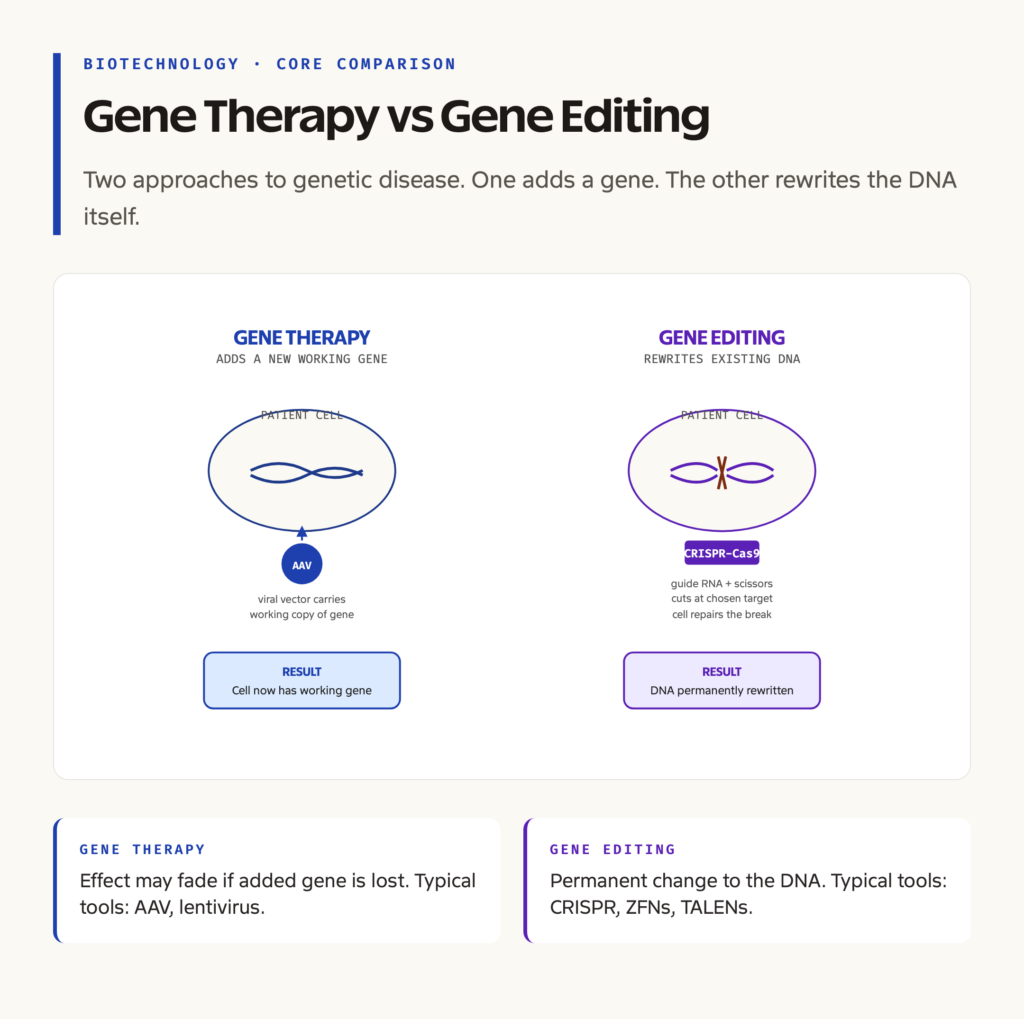
For most of medical history, the genetic component of a disease was something doctors could observe but not change. Cystic fibrosis was caused by a faulty CFTR gene. Sickle cell disease came from a single base-pair mutation in the haemoglobin gene. The Duchenne muscular dystrophy came from a deletion in the dystrophin gene. The diagnosis was clear, and the treatment was indirect, addressing symptoms rather than the underlying genetic cause. Two technologies have begun to change this. Gene therapy adds a working copy of a missing or broken gene to the patient’s cells. Gene editing rewrites the patient’s DNA at the precise location of the fault. Both are now in clinical use, and both have moved into India’s regulatory mainstream over the last few years.
The two are often spoken of together, but they are technically distinct. Gene therapy is older, conceptually simpler, and depends on viral or non-viral vectors that carry a corrective gene into the patient’s cells. Gene editing is newer, far more precise, and uses molecular scissors that cut DNA at a chosen location, allowing the cell’s repair machinery to either disable, correct, or insert a sequence at that site. The two approaches can be combined: a gene-edited cell can also receive a gene-therapy payload, which is the basis of the most sophisticated CAR-T cancer therapies now in service.
For UPSC purposes, the topic sits at the centre of the biotechnology curriculum and the broader debate about access to advanced therapy. India has moved from being a passive observer of these technologies to an active developer, with two indigenous CAR-T therapies approved between 2023 and 2025. The article walks through the science, the tools, the Indian milestones, and the regulatory and ethical questions that follow.
Quick Facts on Gene Therapy and Gene Editing
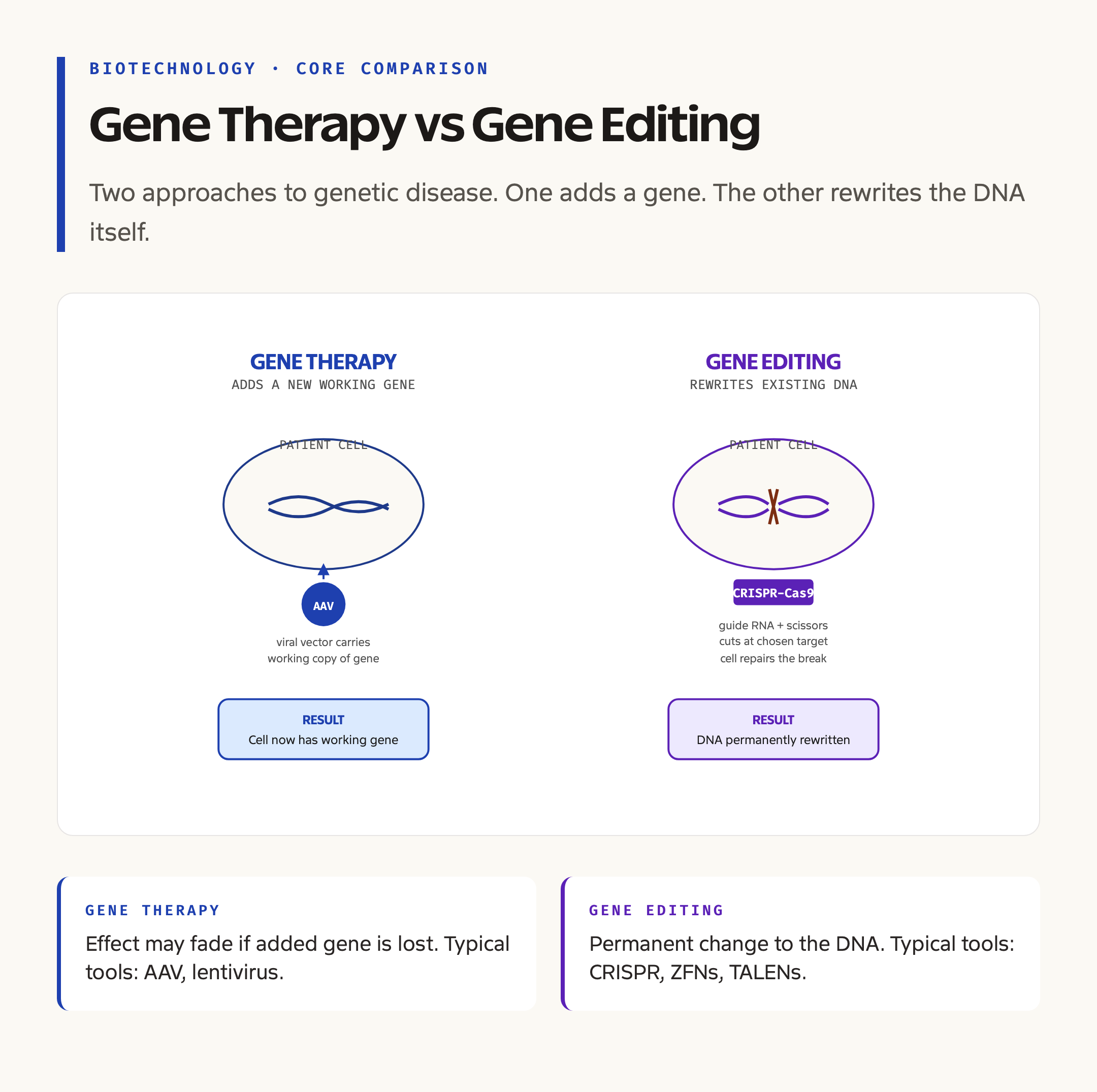
Gene therapy adds a functional copy of a gene to the patient’s cells. The added gene either replaces a missing function or augments an existing one. The delivery vehicle is usually a virus that has been engineered to carry the therapeutic gene without causing disease. Common vectors are adeno-associated virus, abbreviated AAV, and lentivirus. The added gene may persist for years but can fade if the cell does not retain it.
Gene editing changes the DNA at a specific location. The most widely used tool is CRISPR-Cas9, originally a bacterial defence system that has been adapted to cut DNA in a chosen sequence. Other tools are zinc finger nucleases, abbreviated ZFNs, and transcription activator-like effector nucleases, abbreviated TALENs. The change made by editing is, in principle, permanent, because it modifies the DNA sequence directly.
Both technologies have moved from laboratory curiosity to clinical reality. Luxturna, a gene therapy for a hereditary form of blindness, was approved by the US Food and Drug Administration in 2017. Zolgensma, a gene therapy for spinal muscular atrophy, was approved in 2019. Casgevy, the first CRISPR-based gene-editing therapy for sickle cell disease, was approved in 2023. India’s first indigenous CAR-T therapy, NexCAR19, was approved in late 2023. The second, Qartemi, was approved in 2025 for B-cell lymphoma.
What Gene Therapy Actually Does
Gene therapy works by introducing a working copy of a gene into cells that lack one. The therapy can be delivered in two main ways. In vivo gene therapy injects the vector directly into the patient, where it travels to the target tissue and delivers the gene. Luxturna, for example, is injected into the retina to deliver a working copy of the RPE65 gene to retinal cells. In ex vivo gene therapy, cells are taken from the patient, treated in the laboratory, and then reinfused. CAR-T therapies use this route.
Background and Historical Context
The first gene-therapy clinical trial took place in 1990 at the US National Institutes of Health, on a four-year-old patient with adenosine deaminase deficiency, a rare immune disorder. The trial was modestly successful but the field then suffered a major setback in 1999, when an eighteen-year-old patient named Jesse Gelsinger died in a gene-therapy trial at the University of Pennsylvania, due to a severe immune reaction against the viral vector. Several other early trials produced leukaemia in patients because of where the vector inserted in the genome.
The field recovered slowly through the 2000s, as safer vectors and better targeting were developed. The breakthrough came with adeno-associated virus, which integrates into the genome at very low frequency and provokes a milder immune response. Luxturna, approved in 2017, was the first gene therapy to receive a full marketing authorization in the United States.
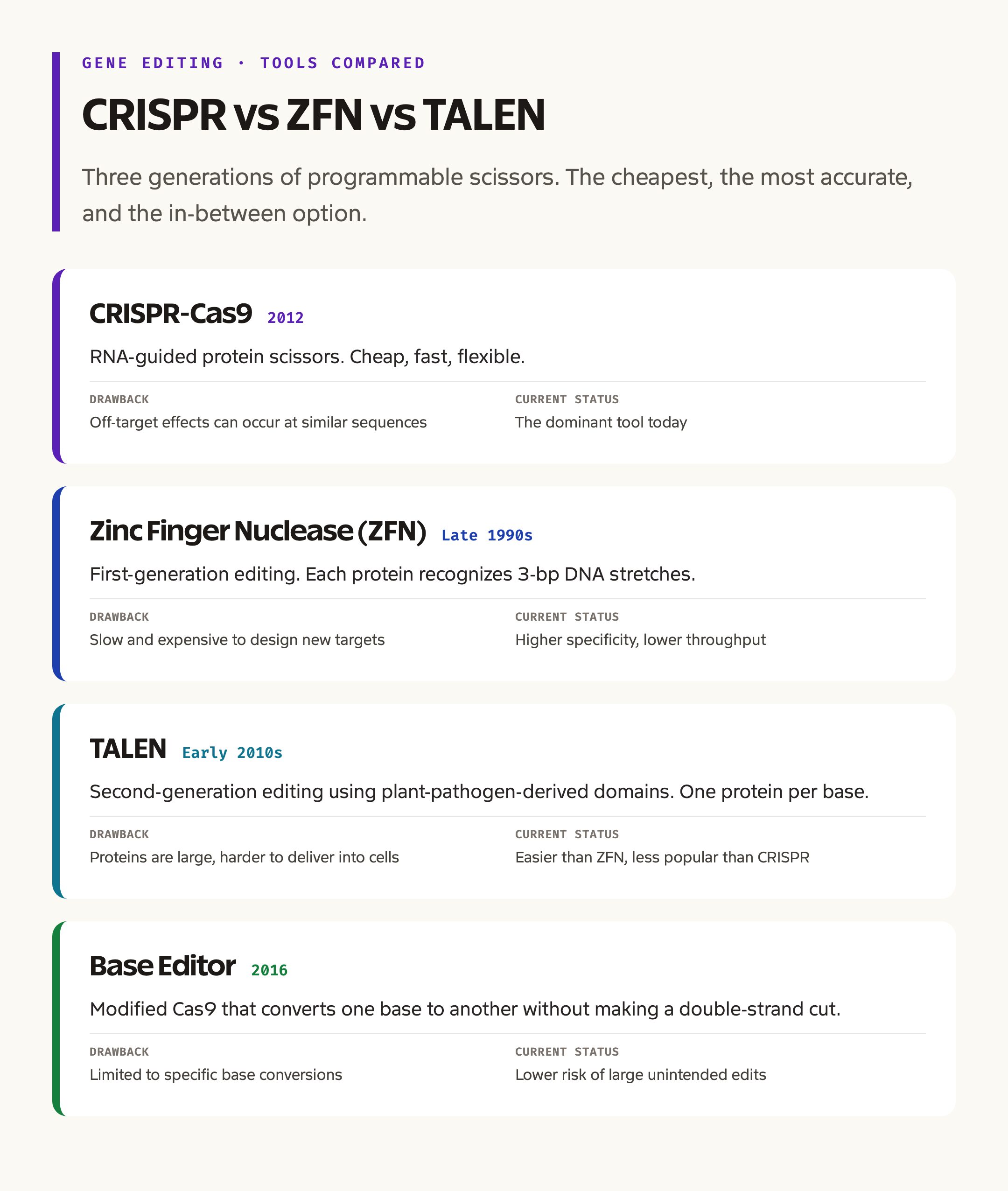
Gene editing has a shorter history. Zinc finger nucleases were the first generation, developed in the late 1990s and 2000s. They are accurate but each new ZFN must be designed and synthesized for each new target, which is slow and expensive. TALENs, the second generation, came in the early 2010s. They are easier to design but the proteins are physically large, which makes delivery into cells harder.
The third generation, CRISPR-Cas9, came from a 2012 publication by Jennifer Doudna, Emmanuelle Charpentier, and colleagues. The system is based on a bacterial defence mechanism in which short RNA sequences guide a protein, Cas9, to cut foreign DNA. The same system can be redirected to cut any target by simply designing a new guide RNA. The simplicity and low cost of CRISPR transformed the field. Doudna and Charpentier were awarded the Nobel Prize in Chemistry in 2020 for the work.
Casgevy, the first CRISPR-based therapy in clinical use, was approved by the United Kingdom’s Medicines and Healthcare products Regulatory Agency in November 2023 and by the US FDA in December 2023. It treats sickle cell disease by editing a regulatory region that turns off foetal haemoglobin production after birth, allowing patients to produce a fetal-style haemoglobin that compensates for the defective adult haemoglobin.
The Three Major Gene-Editing Tools in Detail
Three nuclease-based tools dominate the field. Each is a pair of molecular scissors plus a targeting mechanism that brings the scissors to the right location.
CRISPR-Cas9 uses a guide RNA of about twenty nucleotides to direct the Cas9 protein to a matching DNA sequence. The Cas9 protein cuts both strands of the DNA at that location. The cell’s natural repair machinery then takes over, either rejoining the cut ends imperfectly to disable the gene, or using a supplied template to make a precise correction. CRISPR is the cheapest, fastest, and most flexible tool. The main risk is off-target editing, where the Cas9 cuts a similar but unintended sequence elsewhere in the genome.
Zinc finger nucleases use a series of zinc finger protein domains, each of which recognizes a specific three-nucleotide DNA sequence. The protein is fused to a non-specific cutting domain. ZFNs are accurate and have lower off-target rates than early CRISPR systems, but each new target requires a new protein design, and the process is slow and expensive. ZFNs were the first gene-editing tool to enter clinical trials.
TALENs use a different DNA-binding architecture borrowed from a plant pathogen. Each repeat unit recognizes a single DNA base. TALENs are easier to design than ZFNs but the proteins are physically large, which complicates delivery into cells. TALENs are still used for specific applications where high specificity matters more than ease of use.
Newer techniques have emerged from the CRISPR family. Base editors can convert one DNA base to another without making a double-strand cut, which reduces the risk of large unintended edits. Prime editors can rewrite stretches of DNA with a single tool. These newer techniques are not yet in widespread clinical use but are advancing fast.
Detailed Analysis: Gene Therapy Versus Gene Editing
The two approaches have different strengths and different limitations. Knowing the contrast is essential for prelims and for any mains question on advanced therapy.
| Feature | Gene Therapy | Gene Editing |
|---|---|---|
| Action on the genome | Adds a new gene to the cell | Rewrites or cuts existing DNA |
| Permanence | May fade if added gene is lost | Permanent change to DNA sequence |
| Tools | Viral vectors such as AAV and lentivirus | CRISPR-Cas9, ZFNs, TALENs, base editors |
| Typical use cases | Replacing missing or broken genes | Disabling, correcting, or rewriting genes |
| Approved examples | Luxturna (blindness), Zolgensma (SMA) | Casgevy (sickle cell disease) |
| Off-target risk | Insertion at random or unintended sites | Editing at similar sequences elsewhere |
| Cost per patient | Several hundred thousand to over two million US dollars | Comparable, dropping over time |
The two approaches are not always alternatives. CAR-T therapy is a hybrid: a patient’s T cells are taken out, modified using a viral vector (gene therapy) or a gene-editing tool, and reinfused to attack cancer cells.
Indigenous Success: NexCAR19 and Qartemi
India’s most consequential entry into this space is its CAR-T therapy programme. NexCAR19 was developed jointly by the Indian Institute of Technology Bombay, the Tata Memorial Centre, and the spin-off company ImmunoACT. It was approved by the Central Drugs Standard Control Organisation in late 2023 and made commercially available in 2024.
The therapy works by taking T cells from a patient with relapsed B-cell leukaemia or B-cell lymphoma, engineering them with a chimeric antigen receptor that recognizes the CD19 protein on B-cell cancers, and reinfusing them. The engineered T cells then hunt and destroy the cancer cells. The clinical results have been comparable to the best international CAR-T therapies. The price point, however, has been the major Indian achievement: NexCAR19 costs a fraction of comparable Western CAR-T therapies, bringing the technology within reach of upper-middle-class Indian patients and several public-funded health schemes.
The second indigenous CAR-T therapy, Qartemi, was approved in 2025 for B-cell lymphoma. A growing pipeline of further targets, including multiple myeloma and solid tumours, is in clinical trials.
These approvals matter beyond their immediate clinical impact. They demonstrate that India can develop, manufacture, and clinically validate cell therapies of the most advanced type, in line with the priorities set out in the National Biotechnology Development Strategy. They also set a regulatory precedent for future cell-based therapies in the Indian system.
Why Gene Therapy and Editing Matter
The first reason is scope of disease. Several thousand human diseases have a single-gene cause and are, in principle, addressable by either gene therapy or gene editing. The list includes haemophilia, sickle cell disease, beta-thalassaemia, severe combined immunodeficiency, Duchenne muscular dystrophy, spinal muscular atrophy, and several inherited eye disorders. For these conditions, traditional medicine offers symptomatic relief at best.
The second is one-time treatment. Many gene therapies are designed to be administered once, with the corrective effect lasting for years or for life. The economic logic is different from chronic medication, which has to be paid for monthly across decades.
The third is the cancer link. CAR-T cell therapy and tumour-infiltrating lymphocyte therapy are advanced cell therapies that overlap with gene therapy and gene editing. India’s NexCAR19 sits in this overlap.
The fourth is the broader genome project ambition of mapping Indian genetic diversity. Gene therapy and editing become more powerful as Indian-population genetic data grows, since therapies can then be designed for the variants common in Indian populations.
Comparative Snapshot: India and Global Regulators
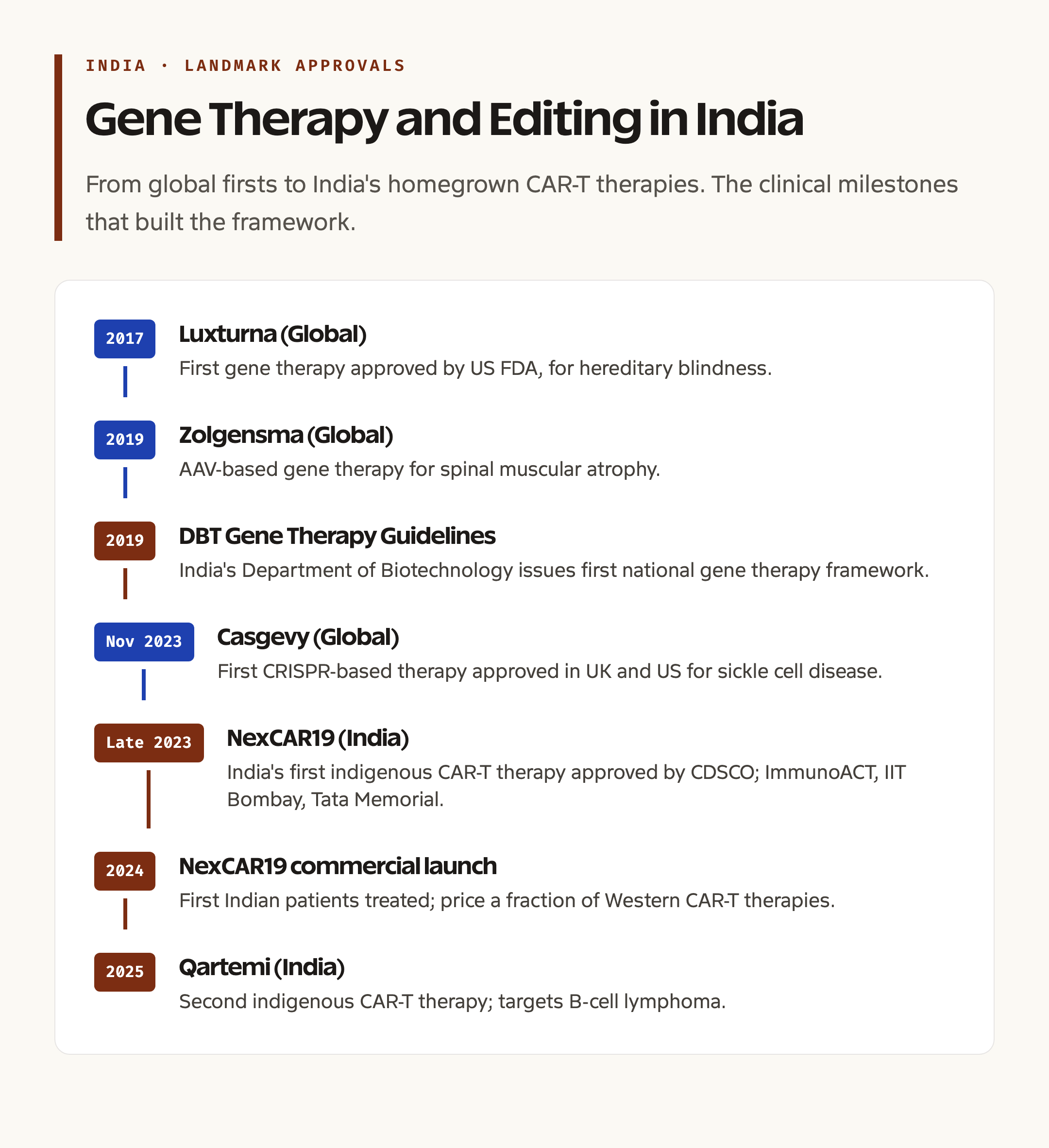
The US Food and Drug Administration has approved several gene therapies and one gene-editing therapy as of the writing of this primer. The European Medicines Agency has approved a similar list, with some divergence on price negotiation. The United Kingdom’s MHRA was the first regulator globally to approve Casgevy.
India’s CDSCO has built up its capacity for cell-and-gene-therapy approvals through the NexCAR19 process. Indian guidelines for gene therapy products were issued by the Department of Biotechnology, with the Indian Council of Medical Research, in 2019 and revised since. The framework requires a phased clinical evaluation similar to the Western model.
China has approved several gene therapies and is moving aggressively in CAR-T therapy. Some Chinese approvals have used clinical data from earlier phases than would be acceptable in the West, which has provoked debate in the international community.
Challenges and Ethical Questions
The first challenge is cost. International gene therapies have been priced at over two million US dollars per patient. Even Indian therapies, although significantly cheaper, are out of reach for the bulk of the Indian population without insurance support.
The second is access infrastructure. Cell-based therapies require specialised hospital infrastructure, including good-manufacturing-practice cell-processing facilities. India has only a handful of such facilities, concentrated in major metropolitan centres.
The third is the germline question. Most current therapies are somatic, meaning they affect only the patient’s body cells, not the eggs or sperm. Germline editing, which would affect future generations, remains globally controversial. The 2018 case of a Chinese researcher who edited the genomes of two human embryos prompted condemnation worldwide and a moratorium on clinical germline editing.
The fourth is off-target safety. Editing tools are improving rapidly, but the risk of unintended changes to the genome remains a concern, particularly for therapies that cannot be reversed.
Prelims Pointers
- Gene therapy adds a new gene to a patient’s cells; gene editing rewrites or cuts existing DNA.
- Common gene-therapy vectors are adeno-associated virus, abbreviated AAV, and lentivirus.
- The major gene-editing tools are CRISPR-Cas9, ZFNs, TALENs, and newer derivatives such as base editors and prime editors.
- CRISPR-Cas9 was reported as a programmable gene-editing tool by Jennifer Doudna and Emmanuelle Charpentier in 2012; they shared the Nobel Prize in Chemistry in 2020.
- Luxturna, a gene therapy for hereditary blindness, was approved in the United States in 2017.
- Zolgensma, a gene therapy for spinal muscular atrophy, was approved in the United States in 2019.
- Casgevy, the first CRISPR-based therapy, was approved in the UK and the US in late 2023 for sickle cell disease.
- NexCAR19 is India’s first indigenous CAR-T therapy, developed by ImmunoACT, IIT Bombay, and Tata Memorial Centre, approved in late 2023.
- Qartemi is the second Indian CAR-T therapy, approved in 2025, targeting B-cell lymphoma.
- The 2018 case of human embryo gene editing in China prompted a global moratorium on clinical germline editing.
Mains Practice Questions
- Distinguish between gene therapy and gene editing as therapeutic strategies. Discuss the role of indigenous CAR-T therapies, including NexCAR19, in expanding India’s biotechnology capability.
- Examine the regulatory and ethical challenges in the clinical use of gene-editing technologies, including the germline editing question. What should India’s policy approach be?
- The cost of gene therapies is a major barrier to access. Discuss the economic, regulatory, and infrastructural reforms needed to make these therapies available at scale in India.
Way Forward
India’s path in this field needs four moves. First, sustained public investment in cell-and-gene-therapy manufacturing infrastructure, including good-manufacturing-practice facilities in tier-2 cities, so that production capacity is not concentrated in a few metropolitan hubs. Second, integration of approved cell therapies into the Ayushman Bharat insurance and other public schemes, so that cost is not the gatekeeper between Indian patients and the technology. Third, an updated regulatory framework that handles gene editing and base editing distinctly from older gene therapy, with clear guidance on the off-target evaluation expected for clinical approval. Fourth, sustained engagement on the global ethical debate, particularly on the germline question, so that India’s voice contributes to whatever consensus eventually emerges. The science is moving fast. India’s policy and infrastructure must keep pace if the country is to convert its current scientific success into widespread patient benefit.
Frequently Asked Questions
What is the difference between gene therapy and gene editing?
Gene therapy adds a new working copy of a gene to a patient’s cells, usually using a viral vector. The therapy compensates for a missing or broken gene. Gene editing rewrites or cuts the patient’s existing DNA at a specific location, using molecular scissors such as CRISPR-Cas9, ZFNs, or TALENs. The change made by editing is, in principle, permanent.
What is CRISPR-Cas9?
CRISPR-Cas9 is a gene-editing tool adapted from a bacterial immune system. It uses a short guide RNA to direct the Cas9 protein to a specific DNA sequence, where Cas9 makes a double-strand cut. The cell then repairs the cut, either disabling the gene or, with a supplied template, making a precise correction. CRISPR is cheap, fast, and flexible, and is now the dominant gene-editing tool worldwide.
What is NexCAR19?
NexCAR19 is India’s first indigenous CAR-T cell therapy. It was developed by ImmunoACT, the Indian Institute of Technology Bombay, and the Tata Memorial Centre, and approved by the Central Drugs Standard Control Organisation in late 2023. It treats relapsed B-cell leukaemia and lymphoma and is priced at a fraction of comparable Western CAR-T therapies.
What is Casgevy?
Casgevy is the first CRISPR-based gene-editing therapy approved for clinical use. It treats sickle cell disease by editing a regulatory region that turns off foetal haemoglobin production after birth. With this regulatory region disabled, patients can produce a fetal-style haemoglobin that compensates for the defective adult haemoglobin. Casgevy was approved in the United Kingdom and the United States in late 2023.
What are Luxturna and Zolgensma?
Luxturna and Zolgensma are gene therapies. Luxturna treats a hereditary form of blindness by injecting a viral vector carrying the working copy of the RPE65 gene into the retina. It was approved in the United States in 2017. Zolgensma treats spinal muscular atrophy in young children by delivering a working copy of the SMN1 gene through an intravenous infusion. It was approved in the United States in 2019.
What is CAR-T therapy?
CAR-T therapy is a cancer treatment that uses the patient’s own T cells, genetically modified to attack cancer cells. T cells are taken out of the patient, engineered in the laboratory to express a chimeric antigen receptor that recognizes a target on cancer cells, and then reinfused. The therapy is most established for B-cell cancers, where the target is the CD19 protein on the cancer cells.
What is Qartemi?
Qartemi is India’s second indigenous CAR-T therapy, approved in 2025 for B-cell lymphoma. It is the next major step after NexCAR19 in India’s growing pipeline of cell-based cancer therapies.
What are the risks of gene therapy and gene editing?
The main risks are off-target effects, where the therapy modifies a gene other than the one intended; immune reactions to the vector or the editing protein; and, rarely, insertional mutagenesis, where the added gene disrupts an important gene at its insertion site. Modern vectors and editing tools have reduced these risks substantially, but they have not been eliminated, and patients are followed up for years to monitor late effects.
What is the difference between somatic and germline editing?
Somatic editing affects only the body cells of the patient and is not passed on to children. Germline editing affects the eggs or sperm or the early embryo and is passed on to future generations. Germline editing remains globally controversial. The 2018 case of human embryo editing in China prompted a global moratorium on clinical germline editing, although the moratorium is informal rather than legally binding.
Are gene therapies expensive?
Yes, gene therapies have been among the most expensive medicines ever developed. International gene therapies have been priced at several hundred thousand to over two million US dollars per patient. Indian indigenous therapies such as NexCAR19 are significantly cheaper, but cost remains a major barrier to widespread access, and integration with insurance and public health schemes is a continuing policy priority.
Tell Google you want more of this.
Add Anantam IAS as a preferred sourceOne tap, and this site shows up more often in your own Top Stories, AI Overviews and AI Mode. Remove it any time.