Cabinet Ministers of India: Structure, Roles, and Council
Cabinet ministers of India: Union Council of Ministers structure, the three categories of ministers, Articles 74 and 75, collective responsibility and how the council is formed. UPSC Polity notes.
The cabinet ministers of India form the political core of the Union executive under the Narendra Modi-led NDA government that took office after the 18th Lok Sabha elections in June 2024 and continues in office. The Union Council of Ministers is structured into Cabinet Ministers, Ministers of State (Independent Charge) and Ministers of State, all appointed by the President on the advice of the Prime Minister under Article 75 of the Constitution. For UPSC aspirants, understanding the composition, constitutional framework, ranks and functions of the Council is as important as remembering who currently heads which ministry. This guide focuses on the architecture rather than chasing every reshuffle.
Constitutional Basis
The Union executive is governed by Articles 52-78 of the Constitution. Key provisions on the Council of Ministers:
- Article 74 – there shall be a Council of Ministers with the Prime Minister at the head to aid and advise the President, who shall act according to such advice. The advice is binding (42nd and 44th Amendments clarified this).
- Article 75 – the PM is appointed by the President; other ministers are appointed by the President on the PM's advice. Ministers hold office during the pleasure of the President and are collectively responsible to the Lok Sabha.
- Article 75(1A) – total number of ministers, including PM, shall not exceed 15% of the total strength of the Lok Sabha (inserted by the 91st Amendment, 2003).
- Article 75(5) – a minister who is not a member of either House must become one within six consecutive months.
- Article 77 – conduct of business of the Government of India in the name of the President.
The Cabinet itself is not defined in the original Constitution; the word was inserted into Article 352 by the 44th Amendment. The cabinet is a subset of the Council of Ministers, comprising only Cabinet-rank ministers.
Structure of the Council
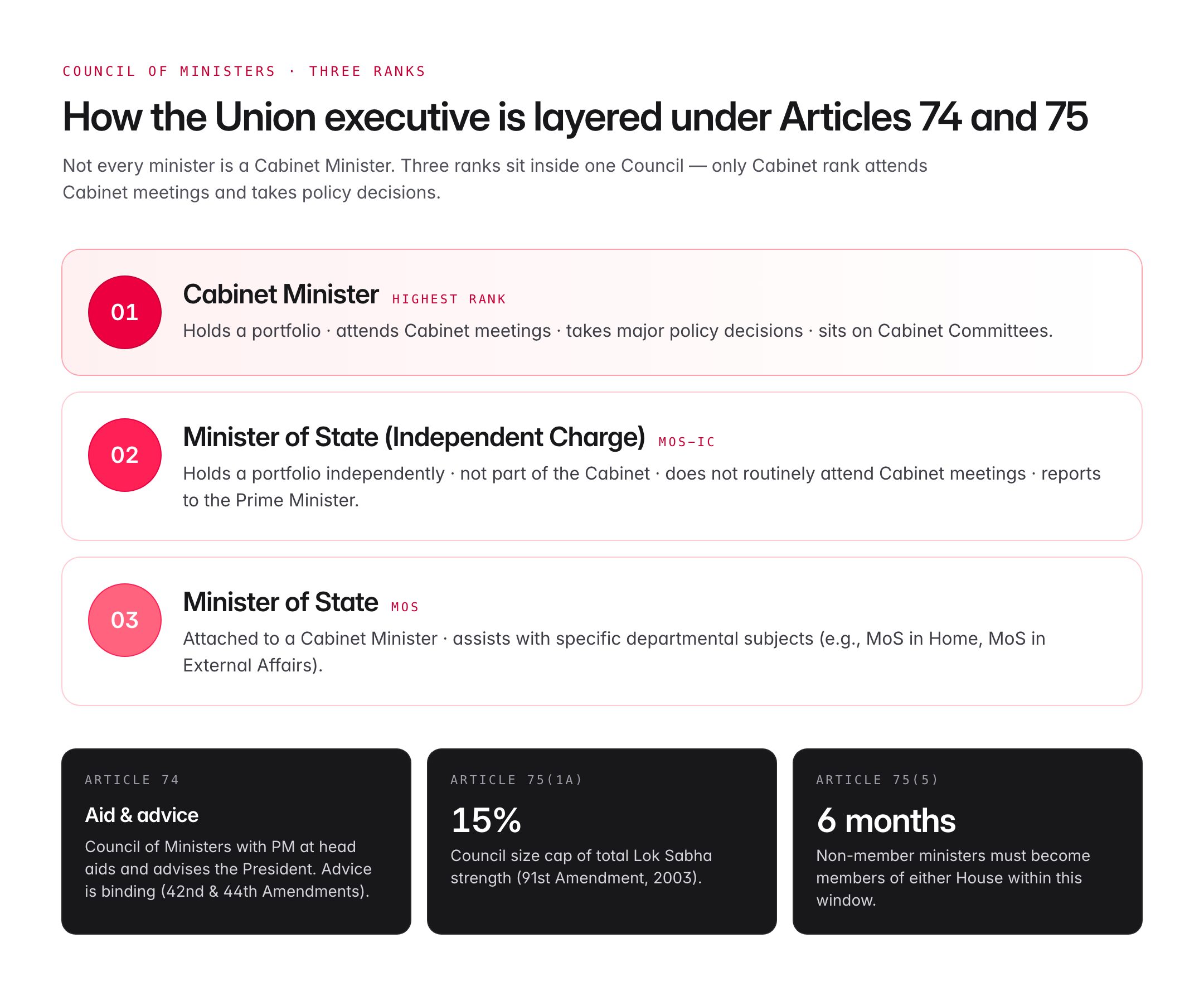
The Union Council of Ministers has three ranks:
| Rank | Role |
|---|---|
| Cabinet Minister | Holds a portfolio; attends Cabinet meetings; takes major policy decisions |
| Minister of State (Independent Charge) | Holds a portfolio but is not part of the Cabinet; reports to the PM |
| Minister of State | Attached to a Cabinet Minister; assists with departmental work |
The Prime Minister's Office (PMO), Cabinet Secretariat and the Cabinet Committees (such as Cabinet Committee on Security, Cabinet Committee on Economic Affairs, Appointments Committee of the Cabinet) support Cabinet decision-making.
The Modi 3.0 Cabinet (2024 onwards)
Prime Minister Narendra Modi was sworn in for his third term on 9 June 2024, heading the NDA coalition. The initial Council of Ministers included over 70 members, with the BJP holding the majority of Cabinet posts and allies such as TDP, JD(U), LJP (Ram Vilas), JD(S), HAM, RLD and others securing ministerial representation.
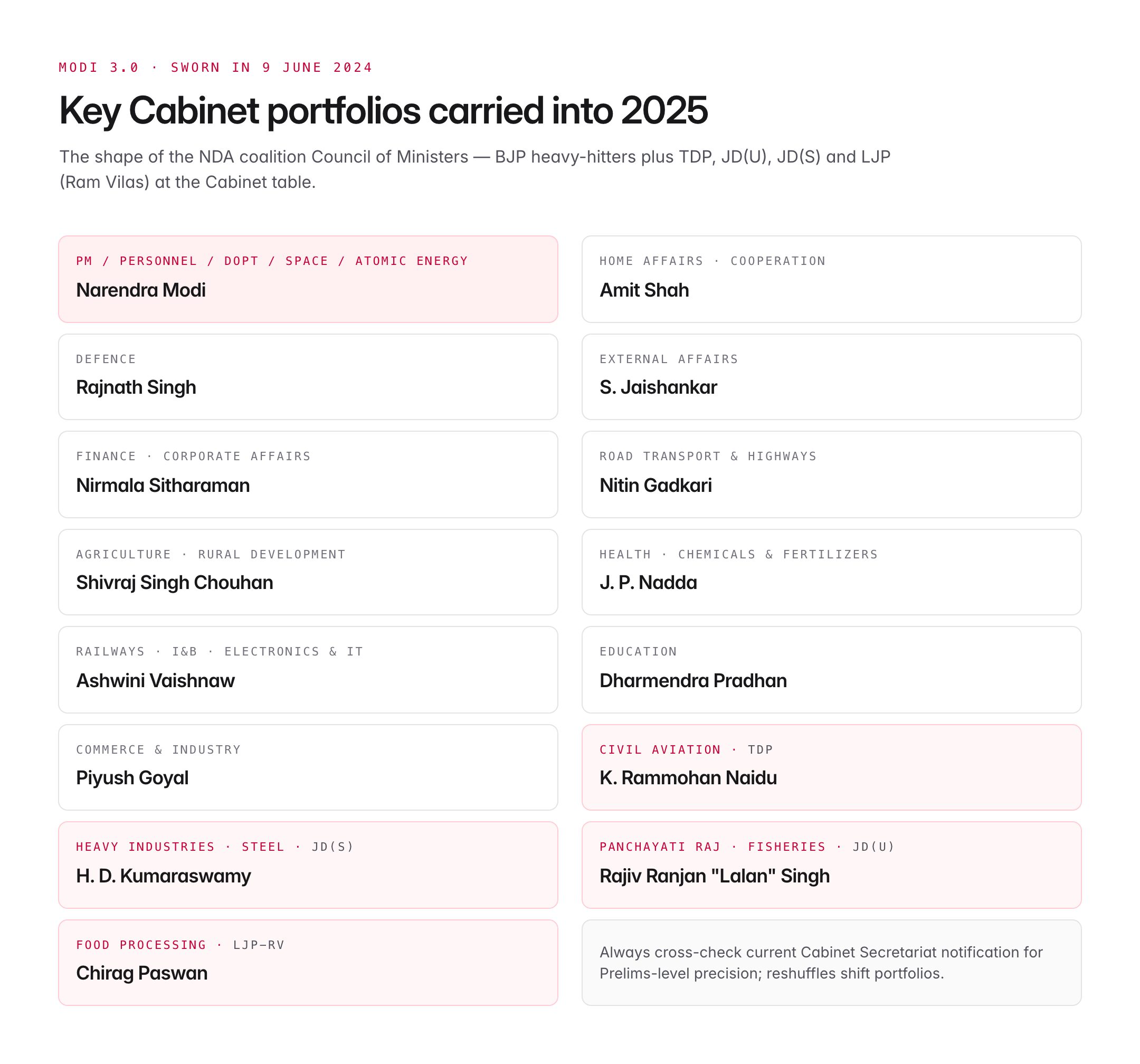
Key Cabinet portfolios in 2025 include:
| Portfolio | Minister (illustrative) |
|---|---|
| Prime Minister / Personnel, Public Grievances, Pensions; DoPT; Atomic Energy; Space | Narendra Modi |
| Home Affairs; Cooperation | Amit Shah |
| Defence | Rajnath Singh |
| External Affairs | S. Jaishankar |
| Finance; Corporate Affairs | Nirmala Sitharaman |
| Road Transport and Highways | Nitin Gadkari |
| Agriculture & Farmers' Welfare; Rural Development | Shivraj Singh Chouhan |
| Health and Family Welfare; Chemicals & Fertilizers | J. P. Nadda |
| Railways; Information & Broadcasting; Electronics and IT | Ashwini Vaishnaw |
| Education | Dharmendra Pradhan |
| Commerce and Industry | Piyush Goyal |
| Civil Aviation | K. Rammohan Naidu (TDP) |
| Heavy Industries; Steel | H. D. Kumaraswamy (JD-S) |
| Panchayati Raj; Fisheries, Animal Husbandry | Rajiv Ranjan "Lalan" Singh (JD-U) |
| Food Processing Industries | Chirag Paswan (LJP-RV) |
Portfolios shift with occasional reshuffles; aspirants should always cross-check the latest Cabinet Secretariat notification for Prelims-level precision. The table above reflects the broad shape of the Council carried into 2025.
Minister of State (Independent Charge)
A Minister of State with Independent Charge (MoS-IC) heads a ministry or department independently, without a Cabinet Minister above them, but does not routinely attend Cabinet meetings. Examples in Modi 3.0 include ministers handling portfolios such as Statistics and Programme Implementation, Planning, Culture and Tourism, depending on the latest allocation.
Ministers of State (MoS) are attached to Cabinet Ministers and assist with specific departmental subjects (e.g., MoS in Home, MoS in External Affairs).
Appointment, Oath and Responsibility
Ministers take two oaths administered by the President under the Third Schedule:
- Oath of office (to faithfully discharge duties).
- Oath of secrecy (not to disclose matters of state).
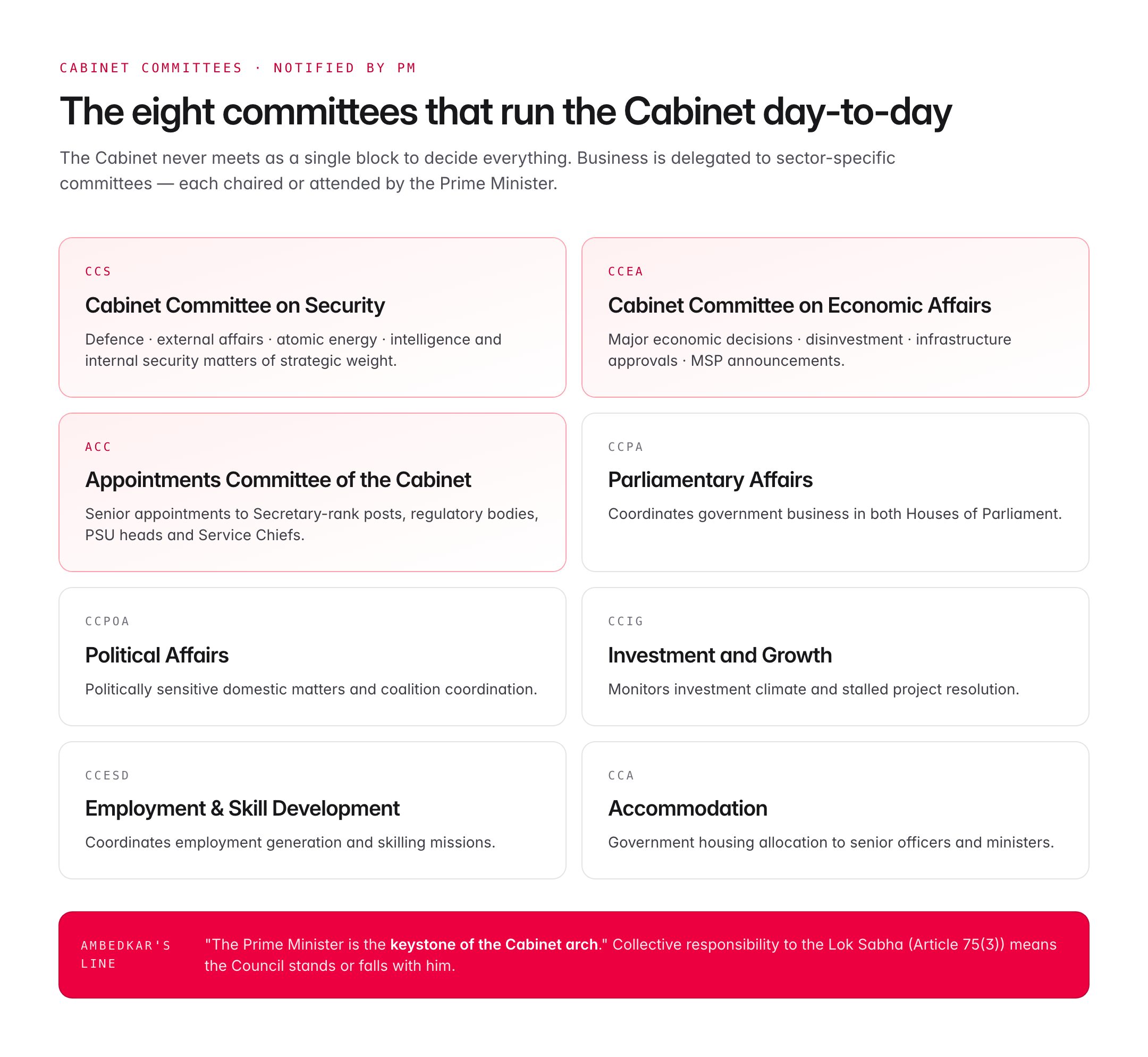
Collective responsibility (Article 75(3)) means the Council stands or falls with the Lok Sabha's confidence. Individual responsibility means a minister holds office at the PM's pleasure. The PM is described by Dr. B. R. Ambedkar as the "keystone of the Cabinet arch".
Cabinet Committees – notified by the PM – handle sector-specific decisions:
- Cabinet Committee on Security (CCS) – defence, external affairs, atomic energy.
- Cabinet Committee on Economic Affairs (CCEA) – major economic decisions.
- Appointments Committee of the Cabinet (ACC) – senior appointments.
- Cabinet Committee on Parliamentary Affairs, Political Affairs, Investment and Growth, Employment and Skill Development, and others.
Powers and Functions of the Cabinet
The Cabinet is the highest decision-making body of the Union executive. Its functions include:
- Policy formulation on domestic and foreign affairs.
- Legislative proposals – approving bills before they go to Parliament.
- Budget finalisation – approval of the Union Budget before it is tabled.
- Administrative control over all ministries through Cabinet Committees.
- Coordination of ministries via the Cabinet Secretariat.
- Crisis management – decisions on security, emergencies, disasters.
UPSC Relevance
Prelims focus
- Article 74 vs Article 75 – aid and advice vs appointment and tenure.
- 91st Amendment – 15% cap on Council size.
- Three categories of ministers; nature of MoS-IC.
- Composition of key Cabinet Committees – especially CCS and ACC.
- Oaths under the Third Schedule.
Mains GS-II angle
Questions regularly probe: role of the PM vis-a-vis Cabinet, coalition government dynamics, collective responsibility, and the shift from cabinet government to prime-ministerial or even presidential-style government. Use Modi 3.0 as a live case: coalition partners, allocation of key ministries, and the working of Cabinet Committees.
Sample PYQ angle – "'The Prime Minister is the keystone of the Cabinet arch.' Discuss." A structured answer would trace constitutional provisions (Articles 74, 75, 78), conventions (primus inter pares vs. primus), and contemporary practice under coalition and majoritarian governments.
Rather than memorising every portfolio name, focus on the structure, constitutional provisions and rank-wise functions – that is what yields marks across Prelims and Mains on the cabinet ministers of India 2025.