Cabinet Mission 1946: Plan, Members & UPSC Notes
Complete guide to the Cabinet Mission 1946 — members, three-tier plan, grouping of provinces, Congress-League response, and UPSC Prelims & Mains relevance.
Introduction
The Cabinet Mission of 1946 was a high-powered British delegation sent by Prime Minister Clement Attlee to negotiate a constitutional settlement that would transfer power from the British Raj to Indian hands. Its proposals shaped the Constituent Assembly, became the last serious attempt to preserve a united India, and ultimately unravelled into Partition. For UPSC, the Cabinet Mission is a pivotal topic in modern Indian history and polity.
This guide explains the background, members, plan, Indian response, and UPSC relevance.
Background: Why the Cabinet Mission
By 1946, the British Raj faced converging pressures:
- Post-war Britain was economically exhausted and politically keen to leave India.
- Labour Party victory (July 1945) under Clement Attlee brought a government sympathetic to Indian independence.
- INA trials (1945–46) and the Royal Indian Navy Mutiny (February 1946) showed that the armed forces could no longer be relied upon.
- The Shimla Conference (1945) had collapsed over Congress–League disagreements on Muslim representation.
Against this backdrop, Attlee announced on 19 February 1946 that a special mission of three Cabinet ministers would be sent to India.
Members of the Cabinet Mission
The mission arrived in Delhi on 24 March 1946 and comprised:
| Member | Designation |
|---|---|
| Lord Pethick-Lawrence | Secretary of State for India (Chairman) |
| Sir Stafford Cripps | President of the Board of Trade |
| A.V. Alexander | First Lord of the Admiralty |
Viceroy Lord Wavell participated in many meetings but was not a formal member.
Objectives
The mission's terms of reference, as announced by Attlee, were:
- To arrange for constitution-making by Indians.
- To set up an interim government with Indian leaders.
- To negotiate the transfer of power from Britain to India.
- To safeguard minority interests while preventing partition if possible.
The Cabinet Mission Plan (16 May 1946)
After two months of negotiations with the Congress, Muslim League, Sikhs, Scheduled Castes, and princely states, the mission released its plan on 16 May 1946. It rejected the League's demand for a sovereign Pakistan but proposed a compromise that retained some communal federalism.
Three-Tier Structure
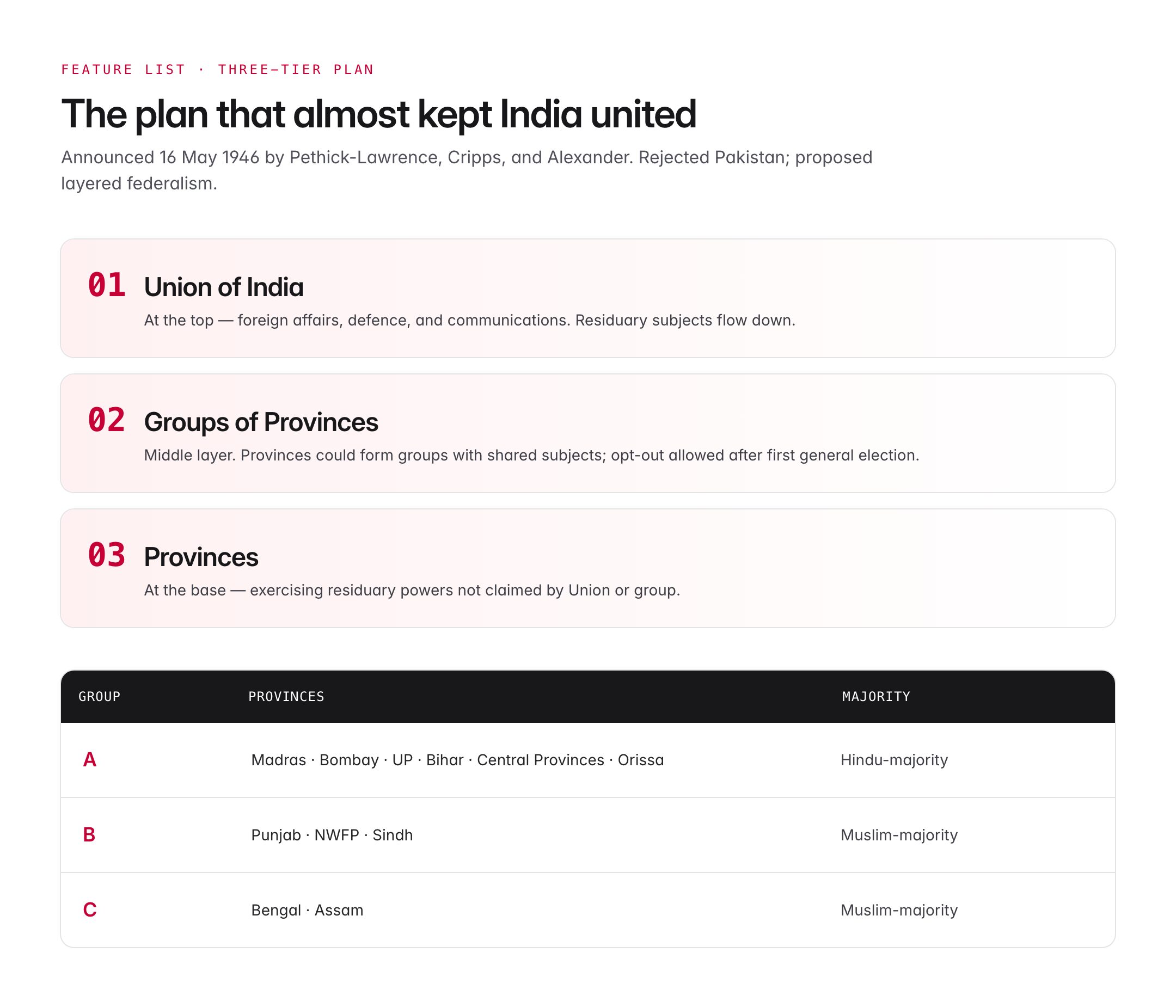
- Union of India at the top — covering foreign affairs, defence, and communications; all other subjects to the provinces.
- Groups of Provinces in the middle — provinces could form groups with common subjects.
- Provinces at the base — exercising residuary powers.
Grouping of Provinces
| Group | Provinces |
|---|---|
| Group A | Madras, Bombay, UP, Bihar, Central Provinces, Orissa |
| Group B | Punjab, North-West Frontier Province, Sindh |
| Group C | Bengal, Assam |
- Group A was Hindu-majority; Groups B and C were Muslim-majority.
- Any province could opt out of its group after the first general election under the new constitution.
- Groups could frame group-level constitutions for their provinces.
Constituent Assembly
- A Constituent Assembly of approximately 389 members was to be indirectly elected by provincial legislatures through a single transferable vote.
- Seat allocation was roughly 1 per million population, with seats divided among Muslims, Sikhs, and General communities.
- The Assembly would meet in three sections, one per group, to frame group and provincial constitutions before reconvening as a whole.
- Princely states were to send 93 representatives via negotiation.
Interim Government
- An interim government to be formed at the Centre with 14 members (6 Hindus including 1 Scheduled Caste, 5 Muslims, 1 Sikh, 1 Indian Christian, 1 Parsi).
- Led by the Viceroy but with Indian members running most portfolios.
Response of Indian Parties
Indian National Congress
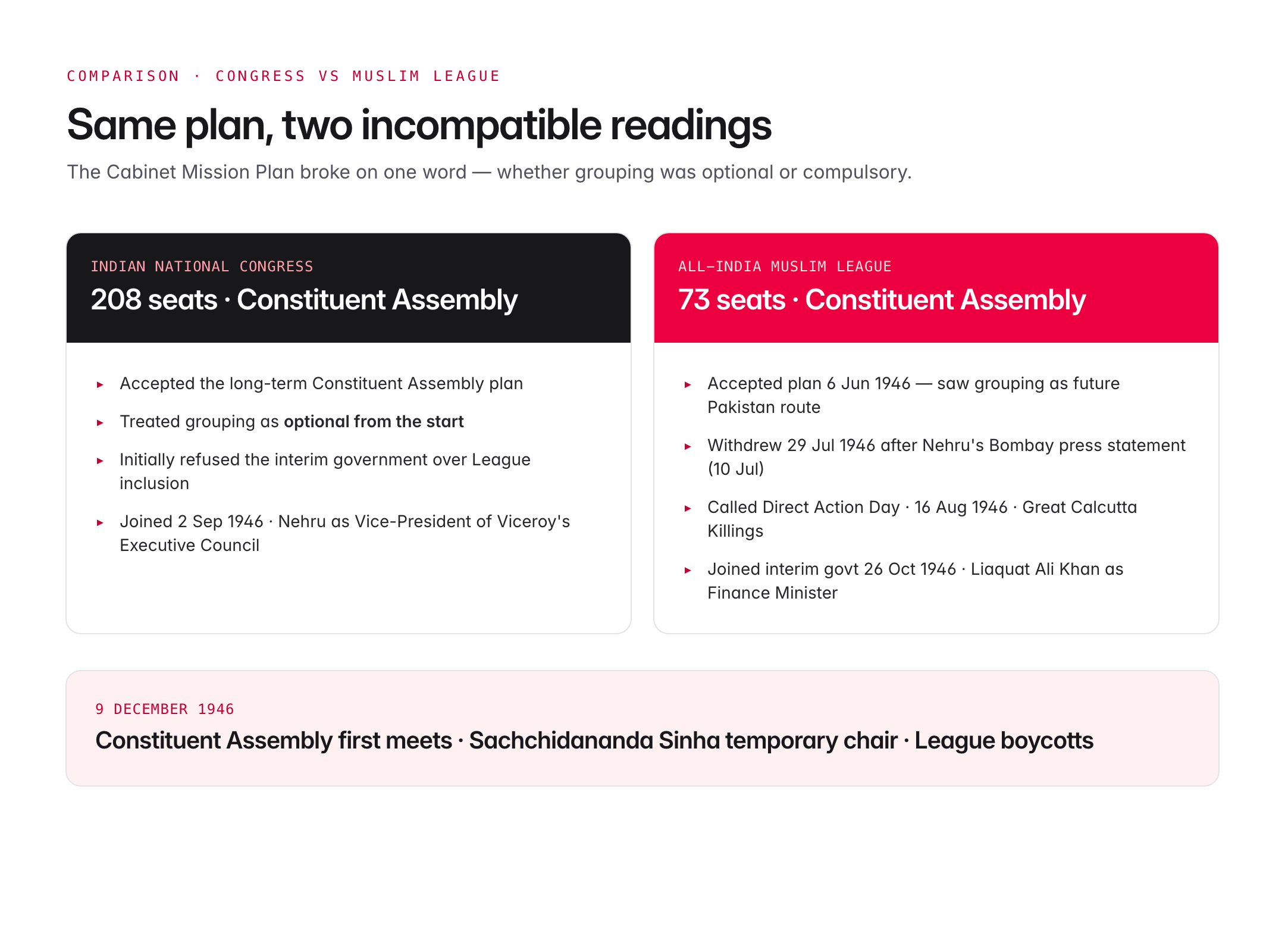
- Accepted the long-term plan for the Constituent Assembly but with reservations on compulsory grouping.
- Interpreted grouping as optional from the start — a province could refuse to join its group.
- Refused to join the interim government initially due to the League's inclusion.
- Later joined the interim government on 2 September 1946 with Jawaharlal Nehru as Vice-President of the Viceroy's Executive Council.
Muslim League
- Initially accepted the plan on 6 June 1946, viewing grouping as a basis for a future Pakistan through Groups B and C.
- Withdrew acceptance on 29 July 1946 after Nehru's controversial Bombay press statement (10 July 1946) implying that the Constituent Assembly could modify the grouping.
- Called for "Direct Action Day" on 16 August 1946, triggering the Great Calcutta Killings.
- Joined the interim government on 26 October 1946 with Liaquat Ali Khan as Finance Minister.
Elections and the Constituent Assembly
- Elections to the Constituent Assembly were held in July 1946.
- Congress won 208 seats, Muslim League won 73, Unionist Party and independents won the remainder.
- The Assembly first met on 9 December 1946 in the Constitution Hall, New Delhi.
- The Muslim League boycotted the first session.
- Dr Sachchidananda Sinha was the first temporary chairman; Dr Rajendra Prasad became the permanent President.
Why the Cabinet Mission Plan Failed
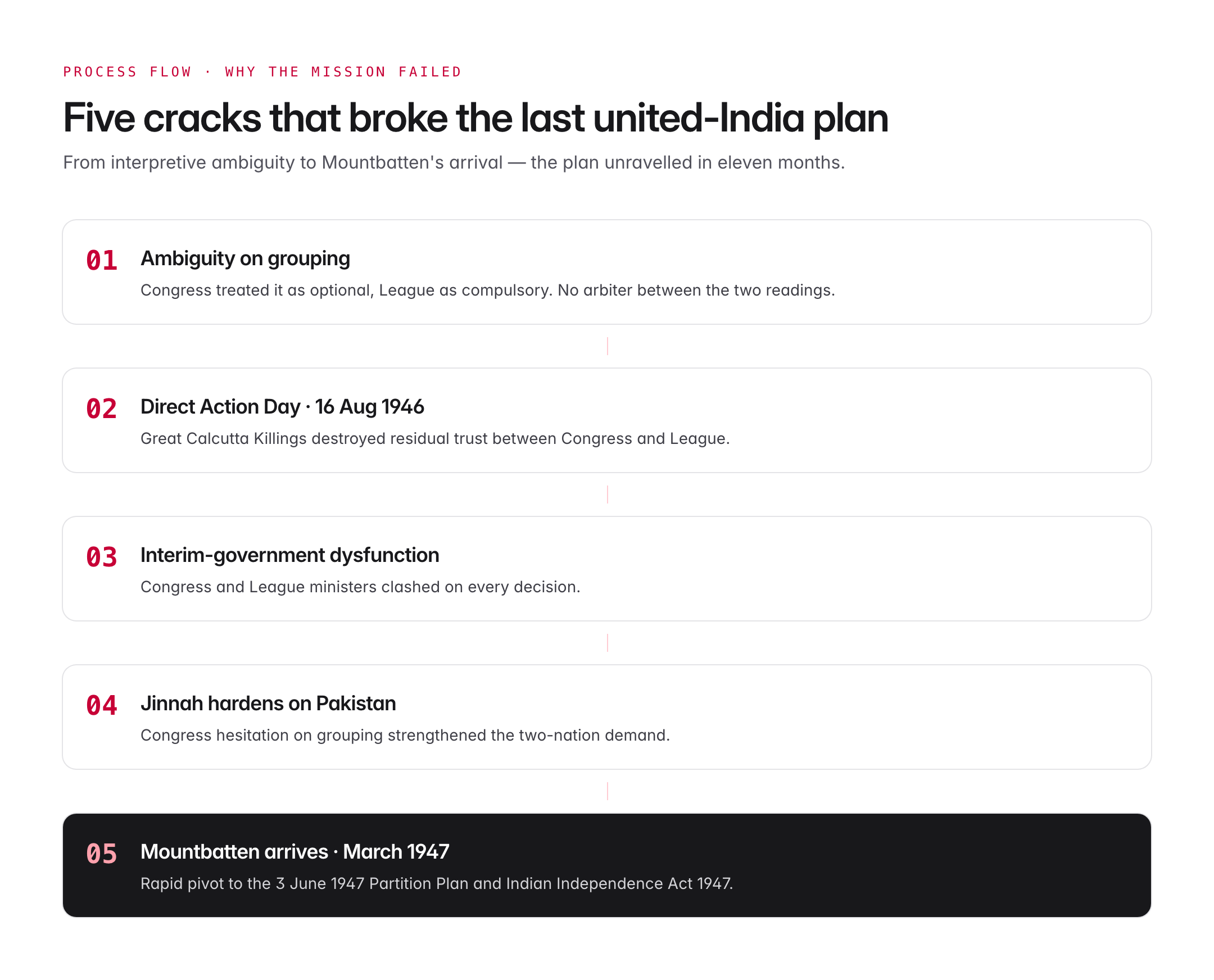
- Ambiguity on grouping — Congress treated it as optional, League as compulsory; no clear arbiter.
- Direct Action Day violence destroyed residual trust between the two parties.
- Interim government dysfunction — Congress and League ministers clashed on every decision.
- Jinnah's insistence on Pakistan hardened after Congress hesitation.
- Mountbatten's arrival (March 1947) quickly moved toward the Partition Plan of 3 June 1947.
Legacy
- Constituent Assembly of India, born from the plan, drafted the Constitution.
- The three-tier model influenced discussions on federalism and states' rights.
- The plan remains a "what if" moment — a possible but ultimately unrealised path to a federal, united India.
UPSC Relevance
Prelims angle: Remember the three members (Pethick-Lawrence, Cripps, Alexander), the date of arrival (24 March 1946), the plan announcement (16 May 1946), and the three groups of provinces. Know that the Cabinet Mission rejected a sovereign Pakistan but proposed compulsory grouping. Direct MCQs often pair the mission with the Constituent Assembly elections and Direct Action Day.
Mains GS I angle: Use the Cabinet Mission in answers on the road to Partition, federalism debates, Congress–League relations, and constitutional history. Connect to the Mountbatten Plan, 3 June 1947 Plan, and the Indian Independence Act 1947.
PYQ angle:
- "Many voices had strengthened and enriched the nationalist movement during the Gandhian phase. Elaborate." (Mains 2019) — applicable.
- "Bring out the socio-economic effects of the introduction of railways in different countries on the basis of your reading of the 'History of Science, Technology and Medicine'." — broader modern history.
- Prelims 2017: MCQ on Constituent Assembly composition.
The Cabinet Mission is essential for understanding the birth of India's constitutional republic.