Direct Action Day, observed on August 16, 1946, was a day called by the All-India Muslim League under Muhammad Ali Jinnah to demonstrate the strength of Muslim demand for a separate homeland — Pakistan. What was intended as a hartal (general strike) and protest escalated into one of the worst episodes of communal violence in Indian history, known as the Great Calcutta Killings. Over the course of 72 hours, an estimated 4,000 to 10,000 people were killed and over 100,000 were left homeless in Calcutta (now Kolkata).
For UPSC, Direct Action Day is a critical event under Modern Indian History (GS Paper I) — it marked the point of no return in the trajectory towards the Partition of India in 1947.
Background: The Cabinet Mission Plan
To understand Direct Action Day, one must first understand the Cabinet Mission Plan of 1946.
The Cabinet Mission (March-June 1946)
In early 1946, the British government sent a three-member Cabinet Mission (Lord Pethick-Lawrence, Sir Stafford Cripps, and A.V. Alexander) to India to negotiate a constitutional framework for the transfer of power. The Mission proposed:
| Proposal | Detail |
|---|---|
| United India | Rejection of the demand for a separate Pakistan; India to remain united |
| Three-tier structure | A weak central government (defence, foreign affairs, communications) with provinces grouped into three sections |
| Section A | Hindu-majority provinces (Madras, Bombay, UP, Bihar, CP, Orissa) |
| Section B | Muslim-majority provinces of the northwest (Punjab, NWFP, Sindh, Baluchistan) |
| Section C | Muslim-majority provinces of the northeast (Bengal, Assam) |
| Constituent Assembly | To draft India's constitution within this framework |
The Muslim League's Response
Initially, both the Indian National Congress and the Muslim League accepted the Cabinet Mission Plan, though with different interpretations:
- The Muslim League saw the grouping clauses (Sections B and C) as a stepping stone to eventual Pakistan, interpreting them as mandatory groupings
- The Congress accepted the plan but interpreted the grouping as optional, with individual provinces free to opt out
- Jawaharlal Nehru, as Congress president, made statements in July 1946 suggesting that the Constituent Assembly would be free to modify the plan — which the League saw as a betrayal of the agreement
Jinnah's Decision
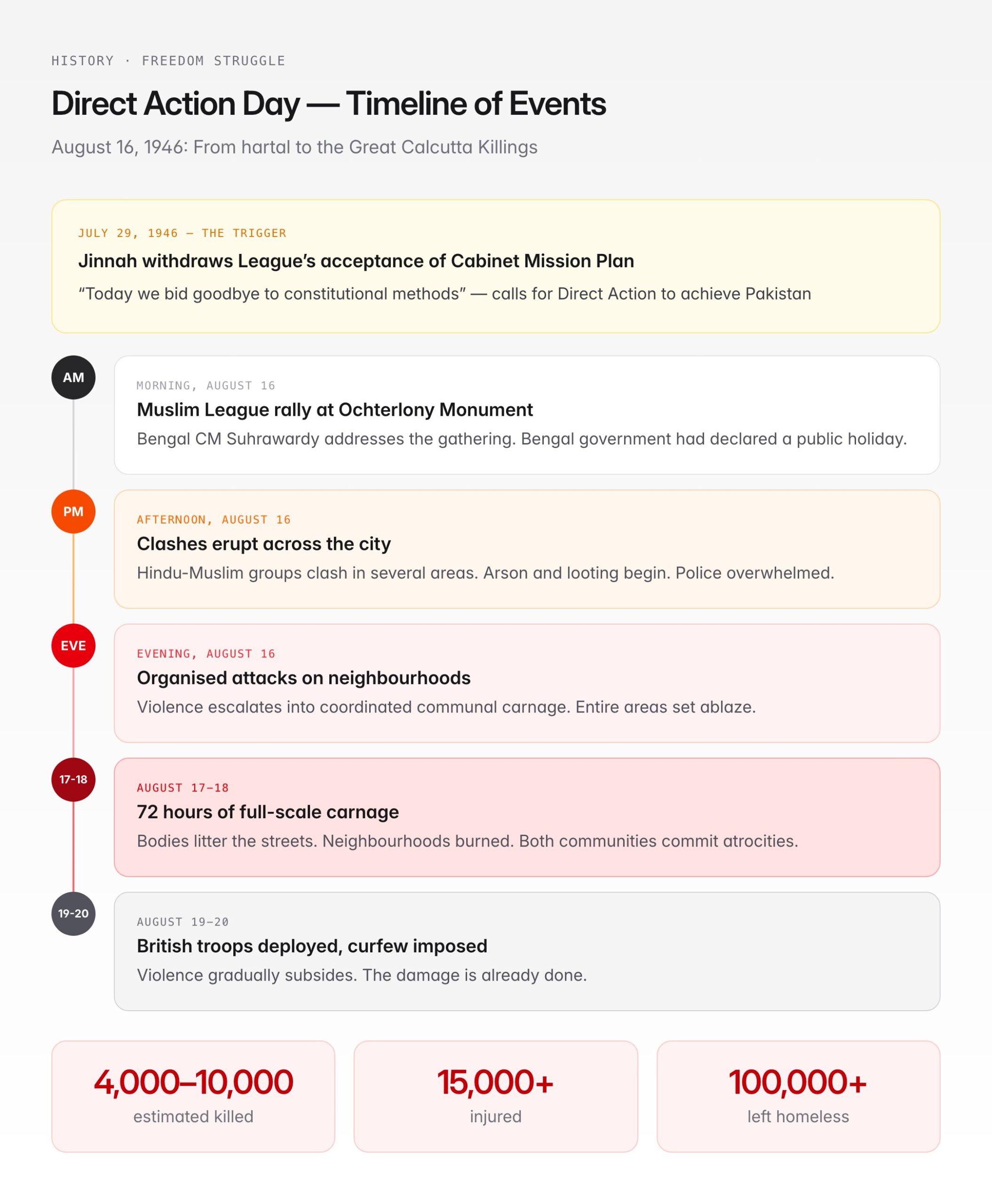
Angered by what he perceived as Congress's bad faith and alarmed that the British might transfer power to a Congress-dominated interim government, Jinnah withdrew the Muslim League's acceptance of the Cabinet Mission Plan on July 29, 1946, and called for "Direct Action" to achieve Pakistan.
Jinnah declared: "Today we bid goodbye to constitutional methods" and "Today we have also forged a pistol and are in a position to use it."
The Events of August 16, 1946
Preparations in Calcutta
Bengal was at that time governed by a Muslim League ministry under Chief Minister Huseyn Shaheed Suhrawardy. The Bengal government declared August 16 a public holiday, which meant government offices, courts, and many businesses were closed — but also meant that crowds were free to gather.
Timeline of Violence
| Time | Event |
|---|---|
| Morning, Aug 16 | Muslim League rally at the Ochterlony Monument (now Shahid Minar) in central Calcutta; Suhrawardy addressed the gathering |
| Afternoon, Aug 16 | Clashes broke out between Hindu and Muslim groups in several parts of the city; arson and looting began |
| Evening, Aug 16 | Violence escalated into organised attacks on neighbourhoods; police were overwhelmed |
| August 17-18 | Full-scale communal carnage across Calcutta; entire neighbourhoods burned; bodies littered the streets |
| August 19-20 | British troops deployed; curfew imposed; violence gradually subsided in Calcutta |
H.S. Suhrawardy's Role
Huseyn Shaheed Suhrawardy, the Chief Minister of Bengal, has been criticised by historians for:
- Declaring a public holiday on Direct Action Day, facilitating mass mobilisation
- Being present at the police control room during the violence, allegedly restraining police from acting against rioters
- Allowing the Muslim League's provocative rhetoric to go unchecked in the days leading up to August 16
However, some historians note that the violence was not one-sided — once retaliatory attacks began, both Hindu and Muslim communities committed atrocities. The scale of violence overwhelmed all administrative machinery.
The Role of the British
The British administration in Calcutta was caught unprepared. Governor Sir Frederick Burrows was criticised for:
- Not ordering military intervention quickly enough
- Failing to override the Bengal ministry's decisions
- Underestimating the potential for violence
The British Indian Army was finally deployed on August 19, by which time the worst damage had been done.
Casualties and Impact
| Parameter | Estimate |
|---|---|
| Deaths | 4,000 to 10,000 (estimates vary widely) |
| Injured | Over 15,000 |
| Displaced | Over 100,000 left homeless |
| Property destroyed | Thousands of houses and shops burned or looted |
Consequences of Direct Action Day
Immediate: Chain Reaction of Violence
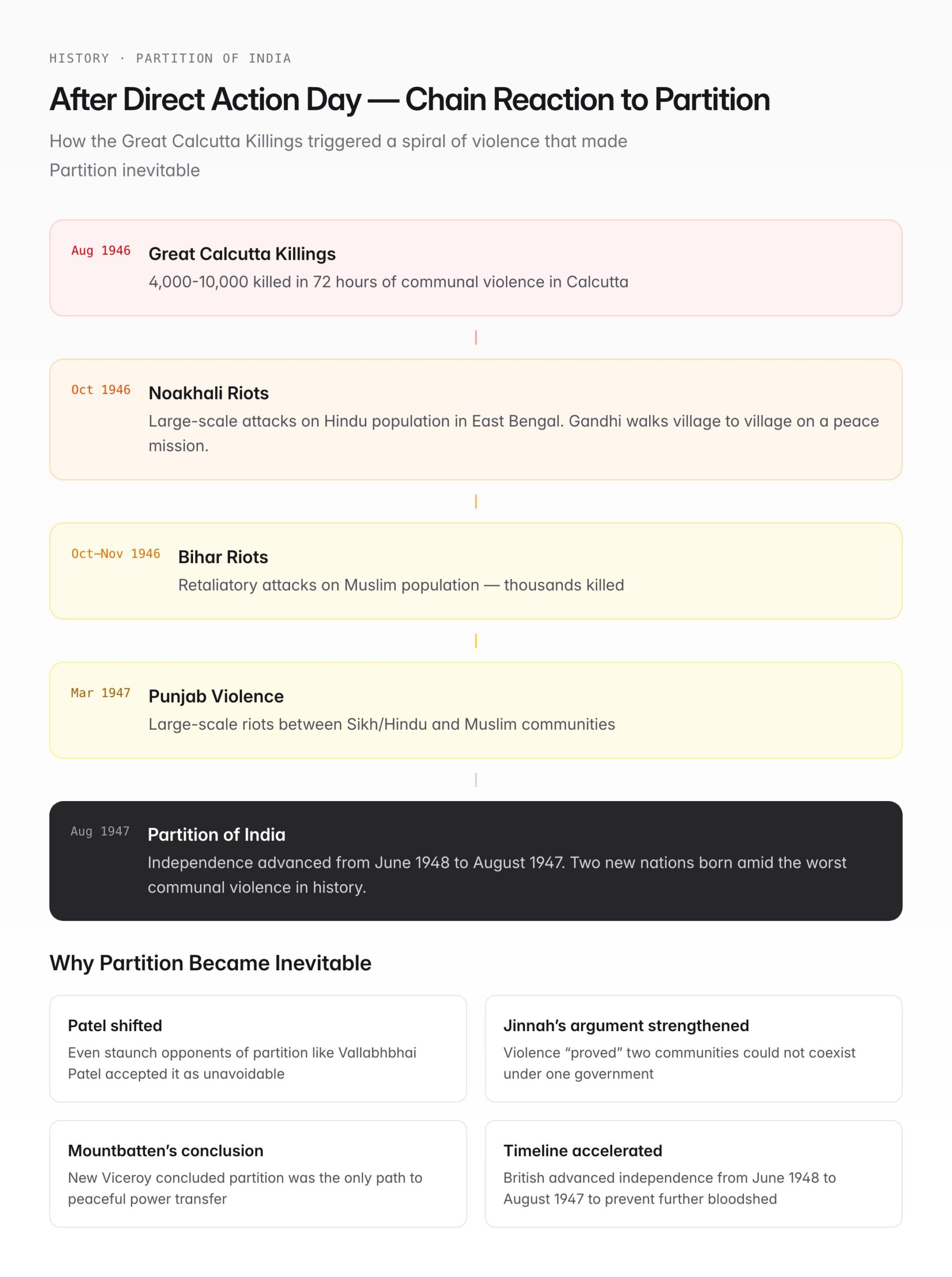
The Calcutta killings triggered a chain reaction of communal violence across India:
| Event | Date | Location |
|---|---|---|
| Noakhali Riots | October 1946 | Noakhali district, East Bengal — large-scale attacks on Hindu population; Mahatma Gandhi walked through Noakhali villages in a peace mission |
| Bihar Riots | October-November 1946 | Bihar — retaliatory attacks on Muslim population; thousands killed |
| Garmukteshwar Riots | November 1946 | UP — communal violence during a religious fair |
| Punjab Violence | March 1947 | Punjab — large-scale riots between Sikh/Hindu and Muslim communities |
Long-Term: Path to Partition
Direct Action Day and its aftermath fundamentally altered the political landscape:
- Demonstrated the impossibility of Hindu-Muslim coexistence in the minds of many political leaders — both Congress and League
- Strengthened the case for Pakistan — Jinnah argued that communal violence proved the two communities could not live together under one government
- Shook Congress leaders — even leaders like Vallabhbhai Patel, who had been staunchly opposed to partition, began to accept it as unavoidable
- Influenced Lord Mountbatten's decision — the new Viceroy (arriving March 1947) concluded that partition was the only way to achieve a peaceful transfer of power
- Hastened the timeline — the British advanced the date of independence from June 1948 to August 1947, partly to prevent further bloodshed
Gandhi's Response
Mahatma Gandhi was deeply affected by the communal violence. He travelled to Noakhali in October 1946 on a solo peace mission, walking from village to village to calm tensions and restore communal harmony. He famously said: “I am not going to leave Bengal until the last embers of the trouble are stamped out.”
Historiographical Perspectives
| Perspective | View |
|---|---|
| Nationalist | Direct Action Day was the direct result of the Muslim League's communal politics and Jinnah's brinkmanship |
| League's position | Congress's bad faith in interpreting the Cabinet Mission Plan left the League no choice but extra-constitutional pressure |
| British responsibility | The colonial state's failure to maintain law and order, and its "divide and rule" legacy, made such violence possible |
| Subaltern | The violence reflected deeper socio-economic tensions (class, labour, housing) that were expressed through communal identities |
Direct Action Day in Context
Direct Action Day was not an isolated event but part of a larger pattern of communal mobilisation and violence that characterised the final years of British rule. It must be understood alongside:
- The Lahore Resolution (1940) demanding separate Muslim homelands
- The Quit India Movement (1942) and the Muslim League's refusal to participate
- The INA trials (1945-46) and the Royal Indian Navy Mutiny (1946) which demonstrated the waning of British control
- The elections of 1945-46 which polarised Hindu and Muslim votes along communal lines
UPSC Relevance
GS Paper Mapping
| Paper | Topic | Connection |
|---|---|---|
| GS Paper I | Modern India — Freedom Struggle | Cabinet Mission, partition politics, communal violence |
| GS Paper I | Modern India — Post-War Phase | Transfer of power, Muslim League's strategy |
| GS Paper I | Modern India — Gandhi | Gandhi's Noakhali peace mission |
| GS Paper II | Governance | Failure of law and order, role of provincial governments |
Key Points for Prelims
- Direct Action Day was August 16, 1946, called by the Muslim League under Jinnah
- It resulted in the Great Calcutta Killings — estimated 4,000-10,000 deaths
- Bengal was under a Muslim League ministry led by Chief Minister H.S. Suhrawardy
- The call came after the League withdrew acceptance of the Cabinet Mission Plan (July 29, 1946)
- Jinnah's rejection was triggered by Nehru's statements suggesting Congress would modify the Cabinet Mission's grouping clauses
- Direct Action Day triggered a chain of communal violence: Noakhali Riots (October 1946), Bihar Riots (October-November 1946)
- Mahatma Gandhi undertook a peace mission in Noakhali in response
- The violence strengthened the case for Partition and influenced the decision to advance independence to August 1947
- The Cabinet Mission consisted of Lord Pethick-Lawrence, Sir Stafford Cripps, and A.V. Alexander
Tell Google you want more of this.
Add Anantam IAS as a preferred sourceOne tap, and this site shows up more often in your own Top Stories, AI Overviews and AI Mode. Remove it any time.