CAG Full Form: Comptroller and Auditor General of India
CAG full form is Comptroller and Auditor General. India's supreme audit institution under Article 148. Learn CAG's role, powers, reports, and UPSC relevance.
CAG Full Form: Comptroller and Auditor General of India
CAG stands for Comptroller and Auditor General. The Comptroller and Auditor General of India is the country’s supreme audit authority — a constitutional office under Article 148 that ensures the Union and state governments spend public money exactly as Parliament and state legislatures authorised.
If you’re preparing for UPSC, CAG shows up in Polity, Economy, and current affairs. Understanding what CAG does — and doesn’t do — is essential for both Prelims and Mains.
CAG Full Form and Constitutional Status
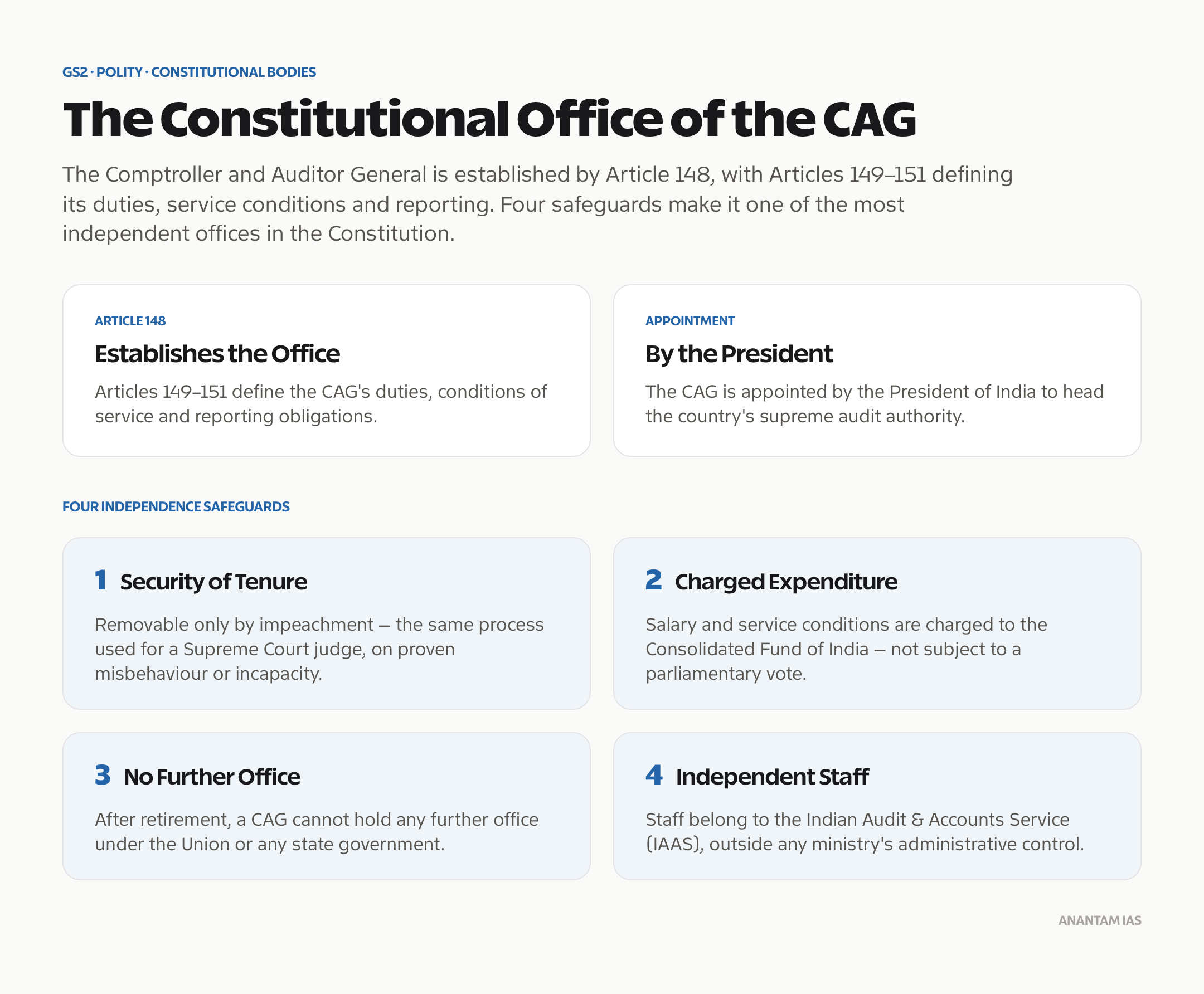
The Comptroller and Auditor General of India holds one of the most independent offices in the Constitution. Article 148 establishes the office; Articles 149–151 define the duties, conditions of service, and reporting obligations.
The CAG is appointed by the President of India. Once appointed, the CAG can only be removed through a process identical to the removal of a Supreme Court judge — impeachment by Parliament on grounds of proven misbehaviour or incapacity. This near-irremovability is the foundation of the office’s independence.
Key Constitutional Provisions
| Article | Subject |
|---|---|
| Article 148 | Establishment of CAG, appointment, removal, salary |
| Article 149 | Duties and powers of CAG (governed by Parliament by law) |
| Article 150 | Form of accounts of the Union and states |
| Article 151 | Audit reports — submission to President (Union) and Governors (states) |
The CAG’s salary and service conditions are charged to the Consolidated Fund of India — meaning Parliament cannot reduce them as a pressure tactic.
CAG vs Comptroller General
In most countries, a “Comptroller” actually controls expenditure (gives sanction before money is spent). In India, the CAG is not a comptroller in the true sense — the office audits after the fact. The name is historical, inherited from British India, and the actual expenditure control functions were separated in 1976.
Fundamental Rights vs Directive Principles
Functions and Duties of CAG
The CAG’s functions are defined by the Comptroller and Auditor General’s (Duties, Powers and Conditions of Service) Act, 1971.
Audit of Government Accounts
The CAG audits the accounts of:
- The Union government
- All state governments
- Union Territories with legislatures (Delhi, Puducherry, J&K)
- Government companies and corporations (where government holds 51%+ equity)
- Bodies receiving substantial government grants or loans
There are three main types of audit the CAG conducts:
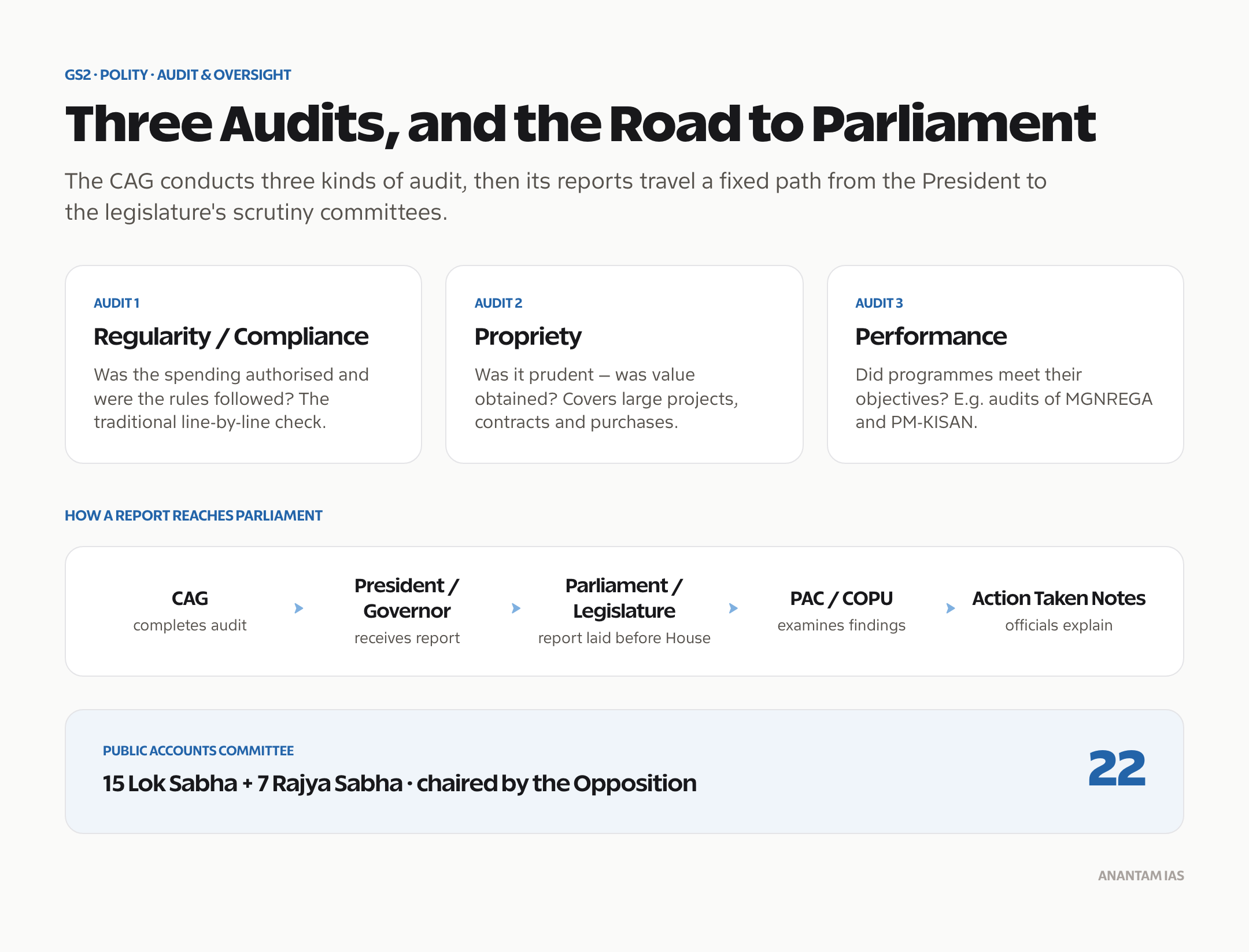
1. Regularity Audit (Compliance Audit) Checks whether expenditure was authorised, whether rules were followed, whether money was spent for the purpose it was granted. This is the traditional, line-by-line audit.
2. Propriety Audit Goes beyond legality into prudence — whether the expenditure was wise, whether value was obtained. This is more discretionary and covers large capital projects, purchase contracts, and policy implementation.
3. Performance Audit Assesses whether government programmes achieved their stated objectives economically, efficiently, and effectively. CAG’s reports on MGNREGA, PM-KISAN, and Smart Cities Mission are examples of performance audits.
Compilation of Accounts
The CAG also compiles the accounts of the Union and states (though states have their own Accountants General under the CAG). This dual role — accounting and auditing — is unusual globally but gives the CAG comprehensive insight into government finances.
CAG Reports: How They Reach Parliament
Once the CAG completes an audit, the process is:
- CAG submits audit reports to the President (Union) or Governor (state)
- President/Governor lays them before Parliament/state legislature
- Public Accounts Committee (PAC) or Committee on Public Undertakings (COPU) examines the reports
- These committees call secretaries and officials to explain audit findings
- Government issues action taken notes (ATRs) on committee recommendations
The CAG typically submits multiple reports each year — on civil, defence, commercial undertakings, and revenue receipts. High-profile CAG reports (like the 2G spectrum report, coal block allocation report) have triggered major parliamentary debates and investigations.
Public Accounts Committee
The PAC is the parliamentary committee that acts on CAG reports. Key facts:
- Has 22 members: 15 from Lok Sabha, 7 from Rajya Sabha
- Chaired by a member of the Opposition (by convention since 1967)
- Examines CAG reports and calls officials to explain irregularities
- Cannot vote money or reverse executive decisions — it recommends and reports
The PAC-CAG combination is India’s primary mechanism for legislative oversight of executive spending.
UPSC Full Form: Union Public Service Commission Guide
CAG and State Finances
The CAG’s jurisdiction extends to state governments. The Accountant General (AG) of each state is an officer of the Indian Audit and Accounts Service (IAAS) — a Group A Central Service — working under the CAG’s authority.
States cannot opt out of CAG audit. The Constitution mandates this. The audit reports for states go to the respective Governors, who lay them before the state legislature. Each state has its own PAC that examines these.
This matters for UPSC because it shows the CAG as a unifying audit authority — a quasi-federal institution that audits both Union and state accounts without being subordinate to either.
Independence of CAG: Why It Matters
The Constitution protects the CAG’s independence through several mechanisms:
- Security of tenure: Cannot be removed except by impeachment process (like a SC judge)
- Charged expenditure: Salary not subject to parliamentary vote
- No eligibility for further office: After retirement, a CAG cannot hold any further office under the Government of India or any state — prevents post-retirement benefits from compromising pre-retirement behaviour
- Staff: CAG’s staff are part of IAAS, not under any ministry’s administrative control
Despite these protections, the CAG’s effectiveness depends on parliamentary and public attention to audit reports. Reports can sit unexamined if PAC meetings don’t happen or if ATRs are delayed for years.
UPSC Relevance: What Gets Asked
UPSC Prelims asks factual questions about CAG’s constitutional basis, removal process, types of audit, and reporting mechanism. Mains (GS-II) can ask about the CAG’s role in legislative oversight, comparison with similar institutions globally, or reform suggestions.
Common Prelims Questions
- Under which article is the CAG established? (Article 148)
- CAG reports for states are submitted to whom? (Governor)
- Is CAG’s salary charged or voted? (Charged to Consolidated Fund)
- Can a retired CAG hold government office? (No)
- Which committee primarily examines CAG reports? (Public Accounts Committee)
Mains Angles
- How does the CAG strengthen legislative control over the executive?
- What are the limitations of CAG’s audit process?
- Compare India’s CAG with the US Government Accountability Office (GAO)
- Should CAG audits be expanded to cover PPP projects more comprehensively?
Notable CAG Reports and Their Impact
Some CAG reports have had significant policy consequences:
2G Spectrum Allocation (2010): CAG estimated a presumptive loss of ₹1.76 lakh crore from spectrum allocation policy. Triggered Supreme Court intervention, cancellation of 122 licences, and a shift to auction-based spectrum allocation.
Coal Block Allocation (2012): CAG estimated ₹1.86 lakh crore in presumptive losses. Led to Supreme Court cancellation of coal block allocations and the Coal Mines Special Provisions Act, 2015.
PM-KISAN (2022): CAG found that ineligible beneficiaries received transfers — including persons with income tax filing history. Led to beneficiary database cleansing.
These reports illustrate both the power and the limits of CAG: it reveals, documents, and quantifies — but cannot recover money or punish officials directly.
Frequently Asked Questions
What is the full form of CAG?
CAG stands for Comptroller and Auditor General. The full designation is Comptroller and Auditor General of India (CAG of India), the supreme audit institution established under Article 148 of the Constitution.
Who appoints the CAG of India?
The President of India appoints the CAG. The appointment is made by a warrant under the President’s hand and seal. There’s no confirmation hearing before Parliament, unlike some other countries.
How is the CAG removed from office?
The CAG can be removed only through an address by each House of Parliament — the same process as removing a Supreme Court judge. The ground must be proven misbehaviour or incapacity. This makes the office extremely secure.
What is the term of the CAG?
The CAG holds office until the age of 65 years or for 6 years, whichever comes earlier. There’s no re-appointment — once a CAG retires, the office must be filled by a new appointee.
Can the CAG audit private companies?
The CAG audits government companies (where the government holds 51%+ share) and bodies substantially funded by the government. Purely private companies are outside the CAG’s audit jurisdiction.