Fundamental Rights vs Directive Principles: Key Differences
The distinction between Fundamental Rights and Directive Principles of State Policy (DPSP) is one of the most important topics in Indian Polity — for UPSC Prelims, Mains, and any exam testing Constitutional knowledge.
They’re both in the Constitution, both describe rights and duties, and both relate to governance. But they work completely differently, and understanding why is as important as knowing what they are.
The Core Distinction in One Line
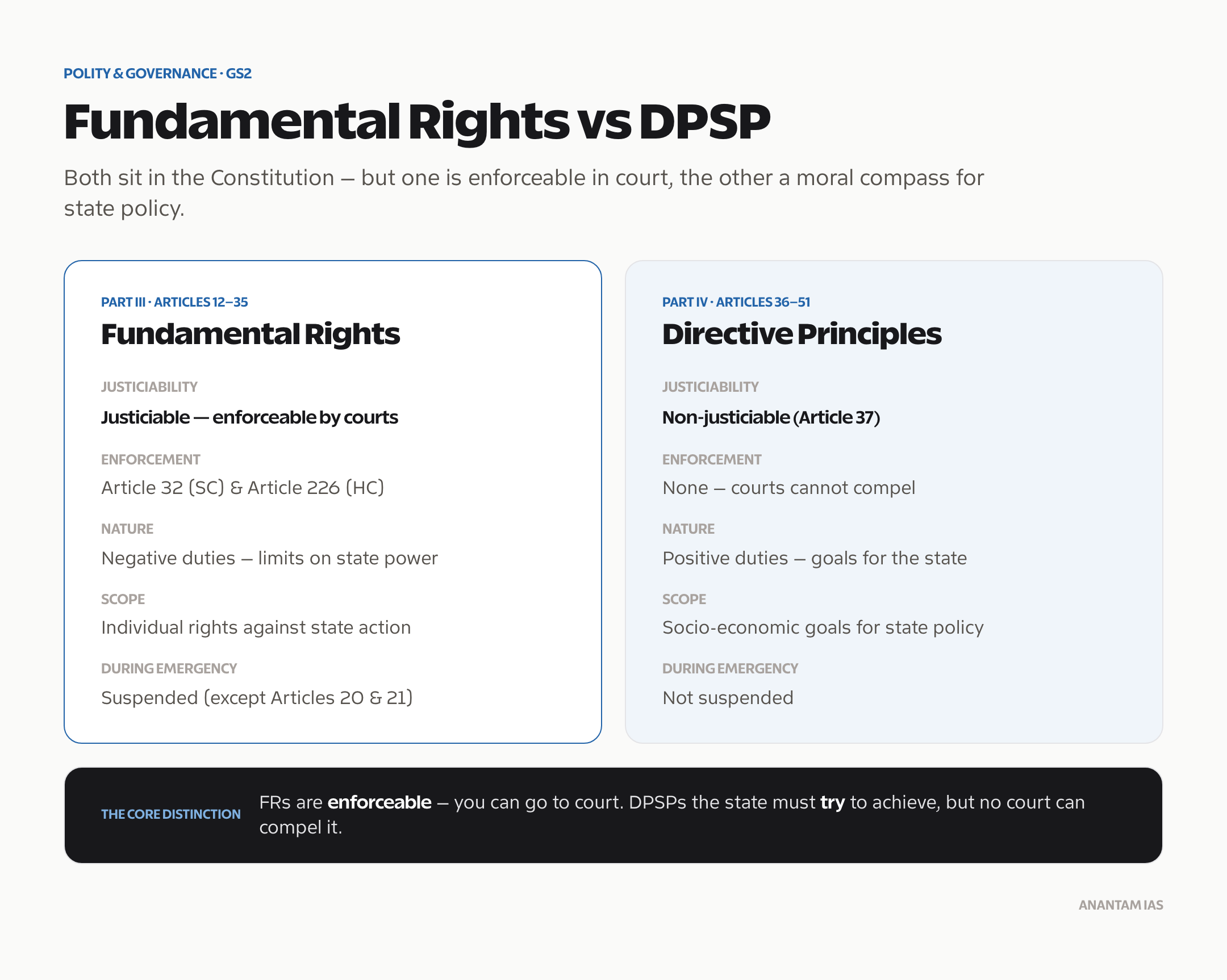
Fundamental Rights are enforceable — you can go to court if they’re violated. DPSPs are non-enforceable — the state must try to achieve them, but no court can compel the state to do so.
That single difference — justiciability — flows from the Constitution itself and generates most other differences between the two.
Where They Live in the Constitution
| Feature | Fundamental Rights | Directive Principles (DPSP) |
|---|---|---|
| Part | Part III (Articles 12–35) | Part IV (Articles 36–51) |
| Articles | 12–35 | 36–51 |
| Inspired by | US Bill of Rights, Irish Constitution | Irish Constitution (Directive Principles) |
| Nature | Negative duties on the state (mostly) | Positive duties on the state |
| Justiciability | Justiciable (enforceable by courts) | Non-justiciable (not directly enforceable) |
| Enforcement | Article 32 (SC) and Article 226 (HC) | None — courts cannot compel |
| Scope | Individual rights against state action | Socio-economic goals for state policy |
| Suspended during Emergency | Yes (most; except Articles 20, 21) | No |
Fundamental Rights: What They Are
Part III guarantees six categories of Fundamental Rights (originally seven — the right to property was removed as a Fundamental Right by the 44th Amendment, 1978, and moved to Article 300A as a legal/constitutional right):
- Right to Equality (Articles 14–18): Equality before law, prohibition of discrimination, equality of opportunity, abolition of untouchability, abolition of titles.
- Right to Freedom (Articles 19–22): Freedom of speech and expression, assembly, association, movement, residence, and profession. Protection against arbitrary arrest. Protection against double jeopardy and self-incrimination.
- Right Against Exploitation (Articles 23–24): Prohibition of trafficking and forced labour. Prohibition of child labour in hazardous occupations.
- Right to Freedom of Religion (Articles 25–28): Freedom of conscience, practice and propagation of religion. Freedom to manage religious affairs. No compulsion to pay taxes for a specific religion’s promotion.
- Cultural and Educational Rights (Articles 29–30): Right of minorities to conserve their language/culture. Right of minorities to establish and administer educational institutions.
- Right to Constitutional Remedies (Article 32): Dr Ambedkar called this “the heart and soul of the Constitution.” It gives every person the right to move the Supreme Court directly for enforcement of Fundamental Rights. The five writs — habeas corpus, mandamus, prohibition, certiorari, quo warranto — are the instruments.
Why Fundamental Rights Are Enforceable
The Constitution grants rights in Part III as limitations on state power. The state cannot do certain things (unreasonable restrictions on speech, arbitrary arrest, discrimination based on religion/race/caste/sex/place of birth). Since these are prohibitions, courts can review whether a state action violated them and grant relief.
Article 13 is the enforcer: any law that contravenes Fundamental Rights is void to the extent of the contravention. Courts have struck down hundreds of laws under this provision.
Fundamental Duties: Article 51A Complete Guide Directive Principles of State Policy: Complete Guide
Directive Principles: What They Are
Part IV instructs the state on the direction of policy — economic and social goals that the Constitution wants India to pursue. They cannot be made justiciable (Article 37 explicitly says so) because they involve resource allocation, and courts cannot micro-manage the state’s policy choices or budget.
DPSPs are grouped into three broad categories:
Socialistic DPSPs (Social and Economic Justice)
- Article 38: Promote welfare state, minimise inequalities
- Article 39: Equal pay, right to livelihood, no concentration of wealth, protection of childhood
- Article 39A: Equal justice and free legal aid
- Article 41: Right to work, education, and public assistance in unemployment/disability
- Article 42: Maternity relief and just/humane conditions of work
- Article 43: Living wage for workers
- Article 43A: Workers’ participation in management of industries
- Article 47: Raise nutrition level and standard of living; prohibit liquor
Gandhian DPSPs (Village-Level Self-Sufficiency)
- Article 40: Organise village panchayats
- Article 43: Cottage industries in rural areas
- Article 46: Promote educational and economic interests of SCs, STs, and weaker sections
- Article 47: Prohibition of liquor and intoxicating drinks (as a duty of the state)
- Article 48: Prohibit cow slaughter; improve breeds
Liberal-Intellectual DPSPs (Modernist Vision)
- Article 44: Uniform Civil Code for all citizens
- Article 45: Early childhood care and education for children up to 6 years (pre-RTE)
- Article 48A: Protection of environment, forests, and wildlife
- Article 49: Protect monuments of national importance
- Article 50: Separation of judiciary from executive
- Article 51: Promote international peace; respect international law
Why DPSPs Are Non-Justiciable
The Constituent Assembly debated this extensively. The argument for non-justiciability was pragmatic: India in 1947 was a newly independent, largely agrarian economy with limited resources. Constitutionalising socio-economic rights as enforceable would either bankrupt the state (if courts demanded universal implementation) or bring the judiciary into every budget decision.
Making DPSPs non-enforceable was a strategic choice — the Constitution expresses aspirations while leaving the state flexibility on timing and method.
The Conflict: When Fundamental Rights Clash With DPSPs
The most important constitutional question for decades: when a law implements a DPSP but violates a Fundamental Right, which prevails?
Early Supreme Court Position: Fundamental Rights Win
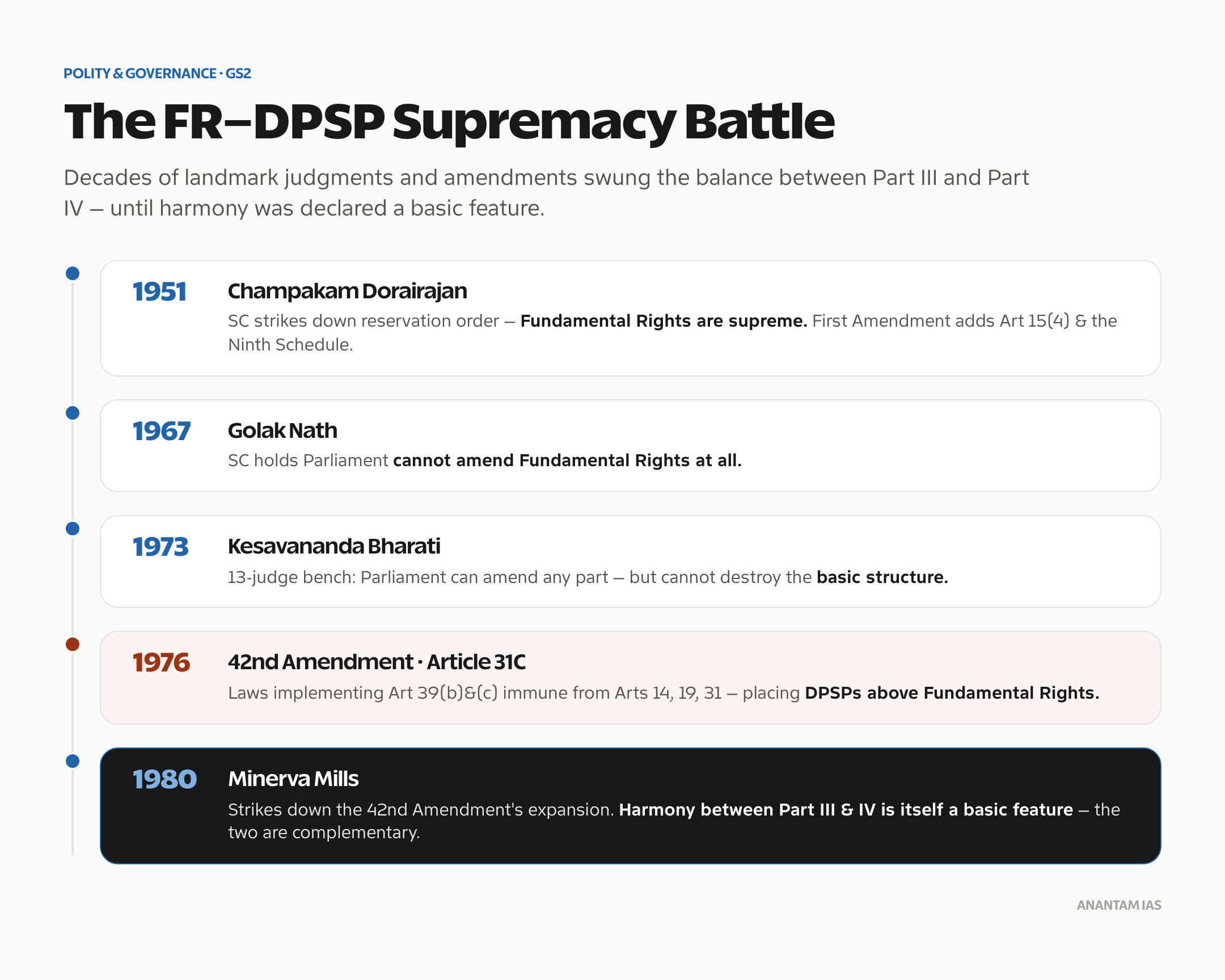
In State of Madras v. Champakam Dorairajan (1951), the Supreme Court struck down a state order reserving seats in educational institutions (implementing social justice goals — DPSP) because it violated Article 15(1) (no discrimination based on religion/race/caste). The court held that Fundamental Rights are supreme.
The government responded with the First Constitutional Amendment (1951) — adding Article 15(4) (special provisions for SC/ST/backward classes) to protect reservation laws.
Parliament’s Response: The Ninth Schedule
The First Amendment also introduced the Ninth Schedule — a list of laws immune from Fundamental Rights challenge. Parliament could add laws to the Ninth Schedule to protect them from judicial review.
This was the beginning of the constitutional tension: Parliament trying to implement DPSPs even if they conflicted with Fundamental Rights; courts trying to protect Fundamental Rights.
The Property Rights Controversy
The most bitter battles were over the right to property (Article 31, now repealed). Zamindari abolition laws, nationalisation of banks, and land reform laws were challenged as violations of the right to property. Parliament amended the Constitution repeatedly to overrule Supreme Court decisions.
Golak Nath case (1967): Supreme Court held that Parliament cannot amend Fundamental Rights at all. Massive controversy.
Kesavananda Bharati case (1973): 13-judge bench held Parliament can amend any part of the Constitution (including Fundamental Rights) but cannot destroy the basic structure. The “basic structure doctrine” was born.
The Emergency Amendments: Supremacy of DPSPs
42nd Constitutional Amendment (1976) — passed during Emergency — added Article 31C: any law implementing DPSPs in Articles 39(b) and 39(c) (distribution of wealth, prevention of concentration) would be immune from challenge under Articles 14, 19, and 31 (equality, freedoms, property). Parliament also added that courts couldn’t examine whether laws actually implemented these DPSPs.
This effectively placed DPSPs above Fundamental Rights for a large category of laws — a near-reversal of the original hierarchy.
Minerva Mills Case (1980): The Definitive Answer
Minerva Mills Ltd. v. Union of India (1980) is the landmark judgment that resolved the hierarchy question. The Supreme Court (5-judge bench) struck down the provisions of the 42nd Amendment that placed DPSPs above Fundamental Rights.
Key holdings of Minerva Mills:
- The balance between Fundamental Rights and Directive Principles is a basic feature of the Constitution — Parliament cannot destroy it
- Article 31C (as expanded by the 42nd Amendment) violated the basic structure by giving absolute supremacy to DPSPs
- Courts can examine whether a law actually implements a DPSP (overruling the ousted judicial review)
- Fundamental Rights and DPSPs are complementary, not contradictory — together they form the conscience of the Constitution
The court’s formulation: “The Indian Constitution is founded on a bedrock of balance between Part III and Part IV… harmony and balance between fundamental rights and directive principles is an essential feature of the basic structure.”
The result: Parliament can restrict Fundamental Rights to implement DPSPs — but cannot abrogate or destroy Fundamental Rights in the process. Courts will examine whether the restriction is reasonable and genuinely furthers DPSP goals.
Post-Minerva Mills: The Current Position
After Minerva Mills, Article 31C continues in its original (pre-42nd Amendment) form — laws implementing Articles 39(b) and (c) are protected from challenge under Articles 14 and 19, but not Article 21. Courts can still check if laws actually implement these DPSPs.
The current principle: Fundamental Rights and DPSPs must be read harmoniously. Reasonable restrictions on Fundamental Rights to achieve DPSP goals are valid. Total destruction of a Fundamental Right for any reason — including DPSP implementation — is unconstitutional.
Amendments That Implemented DPSPs
Parliament has consistently amended Fundamental Rights provisions to enable DPSP implementation:
| Amendment | Year | What It Did |
|---|---|---|
| 1st Amendment | 1951 | Added Article 15(4) — reservation for SC/ST/backward classes |
| 25th Amendment | 1971 | Reduced compensation for property acquisition |
| 42nd Amendment | 1976 | Expanded Article 31C (struck down in Minerva Mills) |
| 44th Amendment | 1978 | Removed right to property from Part III (Article 19(f), 31) |
| 86th Amendment | 2002 | Added Article 21A — Right to Education (converted DPSP to FR) |
The 86th Amendment is particularly notable: it converted what was Article 45 DPSP (free elementary education) into Article 21A Fundamental Right — directly enforceable. The Right to Education Act (2009) operationalised it.
UPSC Questions on Fundamental Rights vs DPSP
This topic generates predictable exam questions at both Prelims and Mains levels.
Frequent Prelims Points
- Articles covering Fundamental Rights: 12–35 (Part III)
- Articles covering DPSP: 36–51 (Part IV)
- DPSPs are non-justiciable under which article? (Article 37)
- Right to Constitutional Remedies: Article 32 (Dr Ambedkar called it “heart and soul”)
- Minerva Mills case year and outcome
- Which amendment removed right to property from Fundamental Rights? (44th Amendment, 1978)
- Which amendment converted the elementary education DPSP into a Fundamental Right? (86th Amendment, 2002)
Mains GS-II Angles
- Discuss the relationship between Fundamental Rights and Directive Principles in light of Minerva Mills
- The 44th Amendment shifted right to property from Part III to Article 300A. Examine the implications.
- How has the Supreme Court balanced individual rights with societal goals through its interpretation of Part III and Part IV?
- Critically analyse the basic structure doctrine with reference to the conflict between Fundamental Rights and DPSPs.
Frequently Asked Questions
What is the main difference between Fundamental Rights and DPSP?
Fundamental Rights (Part III, Articles 12–35) are justiciable — enforceable by courts. If violated, you can approach the Supreme Court under Article 32 or a High Court under Article 226. DPSPs (Part IV, Articles 36–51) are non-justiciable — they’re guidelines for the state that no court can directly enforce. The state must *try* to achieve them but cannot be legally compelled to do so.
Which prevails when Fundamental Rights and DPSP conflict?
After the Minerva Mills case (1980), the Supreme Court held that neither absolutely prevails. Both must be harmoniously read. Parliament can restrict Fundamental Rights to implement DPSPs but cannot destroy or abrogate them. The balance between Part III and Part IV is itself a basic feature of the Constitution.
What is the significance of the Minerva Mills case?
Minerva Mills v. Union of India (1980) is the landmark judgment that established the harmonious relationship between Fundamental Rights and DPSPs. It struck down the 42nd Amendment’s expansion of Article 31C, which had given absolute supremacy to certain DPSPs over Fundamental Rights. The judgment held that this balance is part of the Constitution’s basic structure and Parliament cannot destroy it.
Are DPSPs legally binding?
DPSPs are not legally enforceable in courts — Article 37 explicitly says they u0022shall not be enforceable by any court.u0022 But they are fundamental in governance — the state must consider them in legislation and policy. Parliament has repeatedly amended Fundamental Rights provisions to implement DPSPs, showing their practical constitutional weight.
Which DPSP became a Fundamental Right?
Article 45 (DPSP) originally directed the state to provide free and compulsory education for children up to 14 years. The 86th Constitutional Amendment (2002) converted this into Article 21A — a Fundamental Right to free and compulsory education for children aged 6–14 years. This was operationalised by the Right to Education Act, 2009.
Tell Google you want more of this.
Add Anantam IAS as a preferred sourceOne tap, and this site shows up more often in your own Top Stories, AI Overviews and AI Mode. Remove it any time.