Case Study Approach for UPSC Ethics Paper (GS IV)
Master the UPSC GS 4 case study format with a step-by-step framework, real examples, common themes, and scoring tips for ethics paper case studies.
Case Study Approach for UPSC Ethics Paper (GS IV)
Case studies in the UPSC GS Paper 4 present real-world administrative dilemmas and ask candidates to demonstrate ethical reasoning, stakeholder sensitivity, and practical decision-making. Carrying approximately 120–125 marks (roughly half the paper), case studies are the highest-scoring opportunity in GS 4 — if approached with a structured framework. The examiner evaluates not just what the candidate decides, but how the reasoning unfolds.
Unlike theory questions where textbook knowledge suffices, case studies test the application of ethical principles to messy, ambiguous situations where values conflict and perfect solutions don’t exist.
Understanding UPSC Ethics Case Studies
Case Study Format
Typical UPSC ethics case studies follow this pattern:
- A scenario is described (150–250 words) involving an administrative situation
- The candidate is placed in a specific role (District Collector, SDM, department head)
- Multiple stakeholders with competing interests are involved
- An ethical dilemma is embedded — two or more values conflict
- The question asks: “What would you do?” or “Examine the ethical issues involved”
Marks Distribution
| Type | Approximate Marks | Questions |
|---|---|---|
| Short case studies | 20 marks each | 3–4 questions |
| Long case studies | 25 marks each | 2–3 questions |
| Total case study marks | 120–125 | 5–6 questions |
What the Examiner Looks For
| Evaluation Criteria | Weight |
|---|---|
| Identification of ethical issues | High |
| Stakeholder analysis | High |
| Options considered (not just the chosen one) | Medium-High |
| Quality of reasoning | Very High |
| Practical feasibility of the solution | Medium |
| Sensitivity to vulnerable groups | High |
| Reference to ethical frameworks or thinkers | Medium |
| Balance between idealism and pragmatism | High |
UPSC Mains GS 4 Strategy: Ethics, Integrity & Aptitude
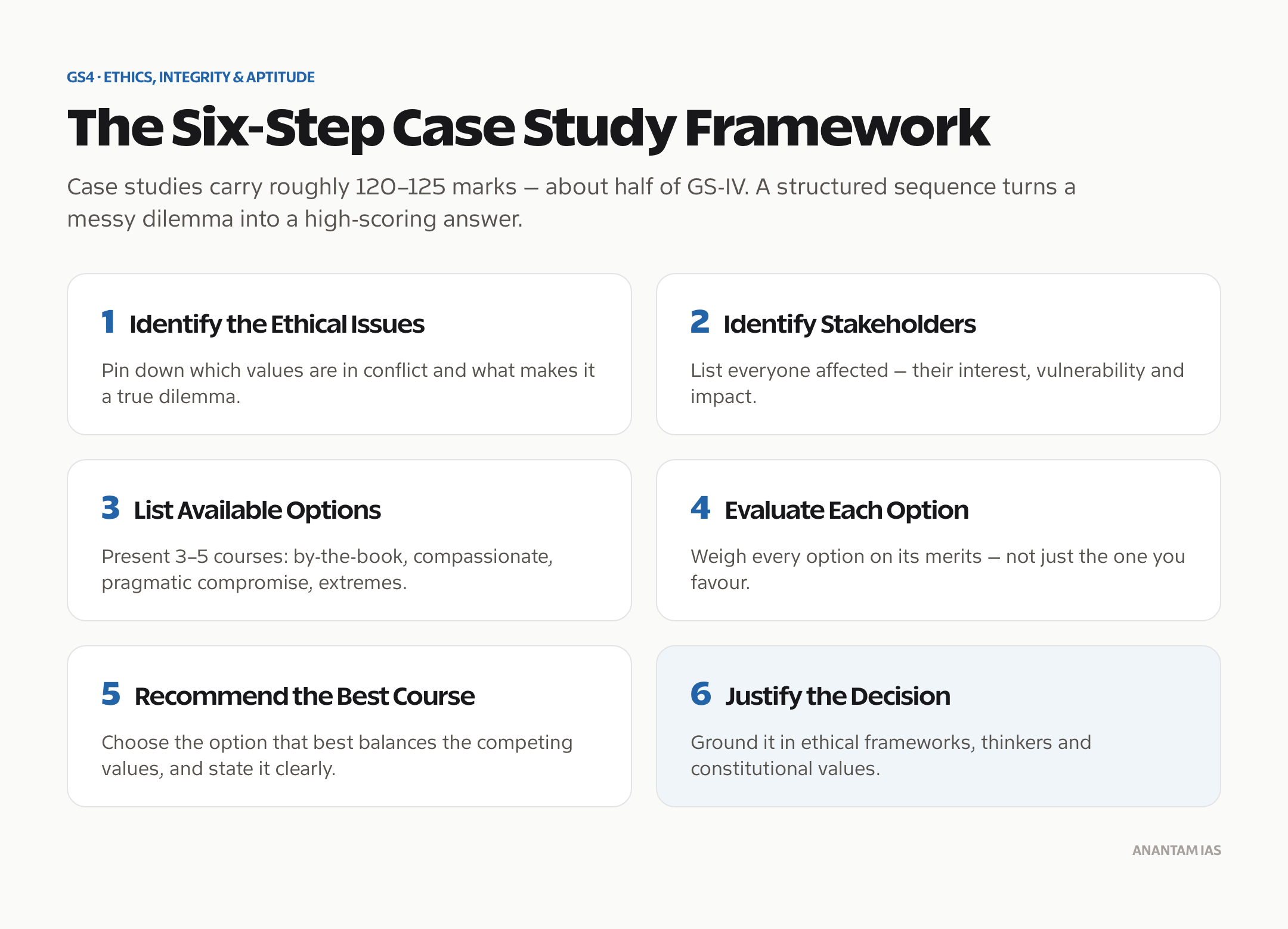
The 6-Step Case Study Framework
Step 1: Identify the Ethical Issues
Read the case study twice. On the second reading, explicitly identify:
- Which values are in conflict?
- What makes this a dilemma (not a simple right-vs-wrong)?
- Are there legal, moral, and practical dimensions?
Write this section first. Start the answer with: “The case involves a conflict between [value A] and [value B]…” or “The ethical issues in this scenario include…”
Common value conflicts in UPSC case studies:
| Conflict Type | Example |
|---|---|
| Duty vs Compassion | Following rules vs helping a desperate citizen |
| Loyalty vs Integrity | Protecting a colleague vs reporting corruption |
| Efficiency vs Equity | Quick development vs environmental protection |
| Individual Rights vs Collective Good | Privacy vs national security |
| Short-term vs Long-term | Immediate relief vs sustainable solution |
| Personal Ethics vs Professional Duty | Personal beliefs vs official responsibilities |
Step 2: Identify Stakeholders
List every person or group affected by the decision. For each stakeholder, note:
- Their interest or concern
- Their vulnerability level
- How they’re affected by different courses of action
Example format:
- Villagers: Directly affected by the industrial project; risk losing agricultural land
- Industrial Company: Has legitimate permits; employment generation
- District Administration: Responsible for both development and welfare
- Environmental NGO: Concerns about ecological damage
- State Government: Political interest in investment inflows
Step 3: List Available Options
Present 3–5 courses of action, including:
- The “by-the-book” option (strict rule-following)
- The “compassionate” option (prioritizing human welfare)
- The “pragmatic compromise” option
- Extreme options (to show you’ve considered the full spectrum)
Don’t dismiss any option immediately. Present each seriously before evaluating.
Step 4: Evaluate Each Option
For each option, analyze:
| Criterion | Questions |
|---|---|
| Legality | Does it comply with existing laws and rules? |
| Ethics | Does it align with moral principles (fairness, justice, honesty)? |
| Practicality | Can it actually be implemented? |
| Consequences | Who benefits? Who suffers? Short-term vs long-term impact? |
| Precedent | What signal does this decision send for future situations? |
| Stakeholder Impact | How does each stakeholder fare under this option? |
Step 5: Recommend the Best Course of Action
Choose the option that best balances competing values. State clearly: “The most appropriate course of action would be…”
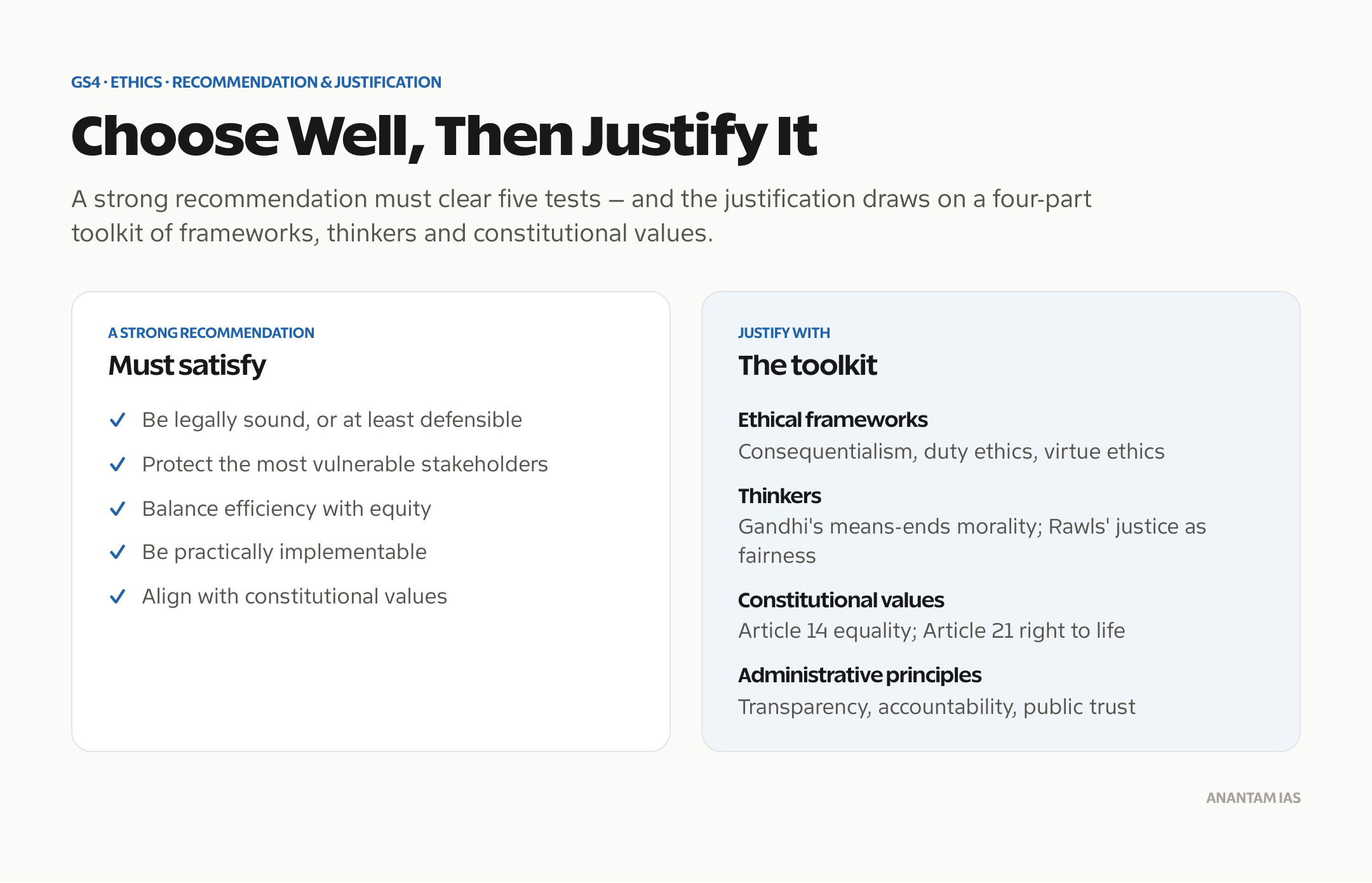
The recommended option should:
- Be legally sound (or at least defensible)
- Protect the most vulnerable stakeholders
- Balance efficiency with equity
- Be practically implementable
- Align with constitutional values
Step 6: Justify the Decision
Explain why this option is superior to the alternatives. Reference:
- Ethical frameworks (consequentialism, duty ethics, virtue ethics)
- Thinkers (Gandhi’s means-ends morality, Rawls’ justice as fairness)
- Constitutional values (Article 14 equality, Article 21 right to life)
- Administrative principles (transparency, accountability, public trust)
Close with implementation steps — briefly outline how the decision would be executed.
Case Study Example with Model Answer
Scenario
“You are a newly posted Sub-Divisional Magistrate. A major road construction project has been approved by the State Government. However, it requires the demolition of 50 houses in a tribal hamlet. The tribals have been offered compensation as per the Right to Fair Compensation Act, but many are unwilling to relocate as the area holds cultural and spiritual significance. Your superior has asked you to expedite the demolition to meet the project deadline. Local political leaders are pressuring for the project, while an NGO has filed a petition claiming inadequate consultation.”
Model Answer Framework
Ethical Issues (3–4 lines): The case involves a conflict between development objectives and the cultural rights of tribal communities. Issues include: inadequacy of consultation (violating the spirit of PESA and Forest Rights Act), tension between government orders and ground realities, and the personal dilemma of following superior’s orders versus protecting vulnerable citizens.
Stakeholders (4–5 lines): Tribal families (cultural displacement, vulnerability), State Government (development mandate, political commitment), superior officer (project deadline pressure), NGO (advocacy for tribal rights), local political leaders (development narrative), and future beneficiaries of the road.
Options:
- Expedite demolition as directed by superior
- Halt the project entirely pending judicial review
- Seek a modified alignment that reduces displacement
- Conduct fresh consultations with tribal gram sabha before proceeding
- Report the inadequate consultation to higher authorities and request time extension
Evaluation (key points per option):
- Option 1 is legally risky (potential violation of PESA and FRA) and ethically problematic
- Option 2 may be seen as overstepping authority
- Option 3 requires technical feasibility assessment but balances both interests
- Option 4 respects the law and tribal rights while not abandoning the project
- Option 5 maintains institutional integrity
Recommendation: Pursue Option 4 (fresh consultations) combined with Option 3 (exploring modified alignment). Communicate to the superior that proper consultation isn’t just legally mandated — it builds project legitimacy and prevents future legal challenges.
Justification: This approach aligns with the Rawlsian principle of protecting the most vulnerable, respects the constitutional right to cultural identity (Article 29), and ensures long-term project sustainability by building community consent.
Ethics in Governance: Key Concepts for UPSC GS IV
Common Case Study Themes in UPSC (2013–2025)
| Theme | Frequency | Key Values Tested |
|---|---|---|
| Corruption/Irregularity | Very High | Integrity, courage, whistleblowing |
| Political Pressure | High | Impartiality, non-partisanship |
| Conflicting Loyalties | High | Duty, institutional integrity |
| Resource Allocation | Medium | Equity, fairness, prioritization |
| Environmental Dilemma | Medium | Sustainability, development balance |
| Social Discrimination | Medium | Empathy, constitutional morality |
| Technology/Privacy | Growing | Rights, transparency, accountability |
| Disaster/Emergency | Low-Medium | Compassion, quick decision-making |
Practising Case Studies
Building Practice Habit
| Week | Activity |
|---|---|
| Weeks 1–4 | Read and analyze 2 case studies daily (don’t write; just outline) |
| Weeks 5–8 | Write 1 case study answer daily (untimed) |
| Weeks 9–12 | Write 1 case study daily (timed: 15–20 minutes per case) |
| Weeks 13–16 | Full GS 4 paper simulation weekly |
Sources for Case Study Practice
- UPSC PYQs (2013–2025) — the most authentic source
- Test series case studies from reputed institutes
- Real administrative scenarios from news (convert them into case study format)
- Ethics textbook exercises (Lexicon, Subba Rao)
Self-Evaluation Checklist
After writing each case study, check:
- Did the answer identify all ethical issues?
- Were all stakeholders mentioned?
- Were at least 3 options listed?
- Was each option evaluated (not just the chosen one)?
- Is the recommendation practically feasible?
- Is the justification grounded in ethical principles?
- Was the answer within the word limit?
Frequently Asked Questions
Is there a fixed word limit for case study answers?
Case studies worth 20 marks should be answered in approximately 250–300 words; 25-mark case studies in 300–350 words. The 6-step framework naturally produces answers in this range. Going significantly over wastes time; going under suggests inadequate analysis. Practise until the framework produces the right length naturally.
Should case study answers use first person (u0022I would…u0022)?
Yes. UPSC explicitly asks u0022What would you do?u0022 — making first-person responses appropriate and expected. Phrases like u0022As the SDM, the first step would be…u0022 or u0022The recommended course of action involves…u0022 work well. Avoid overly formal third-person constructions that create distance from the decision.
How to handle case studies where all options seem bad?
Real dilemmas have no perfect solutions — that’s what makes them dilemmas. Acknowledge the imperfection of the chosen option explicitly. Write: u0022While this option has limitations (mention them), it best balances the competing values because…u0022 This honesty demonstrates ethical maturity.
Is it necessary to reference specific thinkers in case study answers?
Not mandatory, but it adds significant value. A brief reference — u0022Consistent with Gandhi’s principle that means must be as pure as the endsu0022 or u0022Rawls’ veil of ignorance suggests prioritizing the most vulnerable groupu0022 — elevates the answer. Limit to 1–2 references per case study; more feels forced.
Can case study answers include diagrams or flowcharts?
A decision tree or stakeholder map can be highly effective in case study answers. A simple flowchart showing u0022If Option A → consequences; If Option B → consequencesu0022 demonstrates structured thinking visually. Use this selectively — for complex case studies with many stakeholders or options.