Disclosure: this guide contains Amazon affiliate links. As an Amazon Associate, Anantam IAS earns from qualifying purchases — at no extra cost to you.
UPSC Mains GS 4 Strategy: Ethics, Integrity & Aptitude
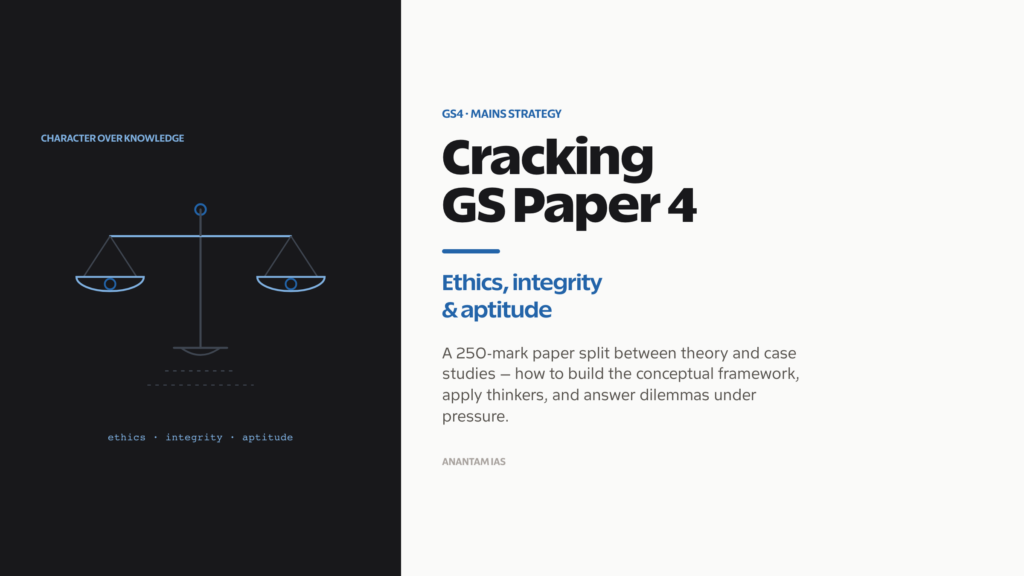
GS Paper 4 is the most unique paper in the UPSC Mains — it tests character, moral reasoning, and decision-making rather than factual knowledge. Carrying 250 marks, the paper is split between theory (approximately 125 marks) and case studies (approximately 125 marks). Scoring above 110 is considered good; crossing 120 separates strong candidates from average ones.
This paper can’t be prepared through rote learning. It demands internalization of ethical concepts, consistent practice with case studies, and the ability to articulate moral reasoning under exam pressure.
GS 4 Syllabus Breakdown
Two Halves of the Paper
| Section | Content | Marks (Approx.) |
|---|---|---|
| Theory/Concepts | Ethics, attitude, aptitude, emotional intelligence, thinkers, public service values | 125 |
| Case Studies | Administrative/ethical dilemmas requiring decision-making | 125 |
Detailed Syllabus Topics
- Essence, determinants, consequences of ethics in human actions
- Ethics in private and public relationships
- Human values — role of family, society, educational institutions
- Attitude: content, structure, function; moral and political attitudes; social influence
Aptitude and Foundational Values:
- Integrity, impartiality, non-partisanship, objectivity
- Dedication to public service, empathy, tolerance, compassion
- Emotional intelligence — concepts and utilities in administration
Public/Civil Service Values:
- Public service ethics, accountability, ethical governance
- Status and problems of ethics in public service
- Ethical concerns and dilemmas in government and private institutions
- Laws, rules, regulations, and conscience as sources of ethical guidance
Probity in Governance:
- Concept of public service, philosophical basis of governance
- Information sharing and transparency in government
- RTI, codes of ethics, codes of conduct, citizen’s charters
- Work culture, quality of service delivery
- Utilization of public funds, challenges of corruption
Case Studies:
- Real-life administrative scenarios
- Ethical dilemmas involving conflicting values
- Questions on what the candidate would do in specific situations
Theory Preparation Strategy
Building the Conceptual Framework
| Topic | Key Concepts | Resources |
|---|---|---|
| Ethics Basics | Consequentialism, deontology, virtue ethics, ethical relativism | Lexicon Ethics |
| Attitude | Cognitive, affective, behavioral components; attitude change models | Subba Rao‘s Ethics |
| Emotional Intelligence | Goleman’s model, self-awareness, empathy, social skills | IGNOU material |
| Thinkers | Gandhi, Ambedkar, Kautilya, Aristotle, Kant, Rawls, Confucius | Compilations |
| Public Administration Ethics | Nolan Principles, foundational values, conflict of interest | 2nd ARC (4th Report) |
| Corporate Governance | Board accountability, CSR, business ethics | News coverage |
The Thinkers Section
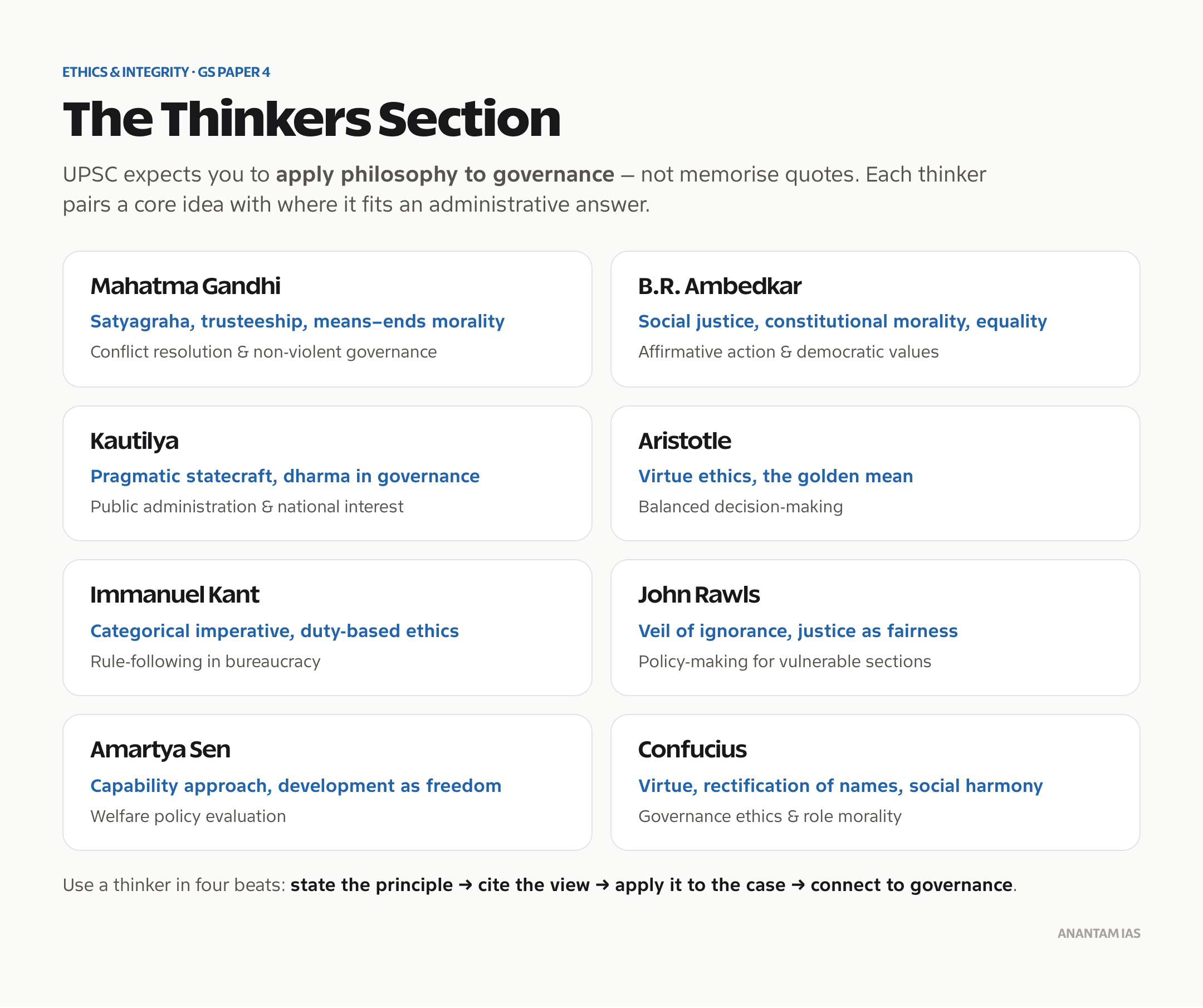
UPSC expects candidates to apply philosophical ideas to governance situations. Don’t just memorize quotes — understand the thinker’s core philosophy.
Essential Thinkers and Their Key Ideas:
| Thinker | Core Philosophy | Application |
|---|---|---|
| Mahatma Gandhi | Satyagraha, trusteeship, means-ends morality | Conflict resolution, non-violent governance |
| B.R. Ambedkar | Social justice, constitutional morality, equality | Affirmative action, democratic values |
| Kautilya | Pragmatic statecraft, dharma in governance | Public administration, national interest |
| Aristotle | Virtue ethics, golden mean | Balanced decision-making |
| Immanuel Kant | Categorical imperative, duty-based ethics | Rule-following in bureaucracy |
| John Rawls | Veil of ignorance, justice as fairness | Policy-making for vulnerable sections |
| Amartya Sen | Capability approach, development as freedom | Welfare policy evaluation |
| Confucius | Virtue, rectification of names, social harmony | Governance ethics, role morality |
How to Use Thinker Quotes in Answers
Don’t drop quotes randomly. Follow this pattern:
- State the ethical principle
- Introduce the relevant thinker’s view (1 line quote + 1 line explanation)
- Apply it to the specific context of the question
- Connect to governance or administrative implications
Example: “Kant’s categorical imperative — ‘Act only according to that maxim which you can will to become a universal law’ — suggests that an administrator facing a bribery dilemma must consider whether accepting the bribe could be universalized as an acceptable norm. Clearly, it cannot.”
Ethics in Governance: Key Concepts for UPSC GS IV
Case Study Strategy
Understanding What UPSC Wants
Case studies present realistic administrative scenarios where multiple values conflict. There’s rarely one “correct” answer. The examiner evaluates:
- Identification of stakeholders and their interests
- Recognition of ethical issues embedded in the scenario
- Options considered (not just the chosen action)
- Reasoning quality behind the final decision
- Practical feasibility of the proposed solution
The Case Study Answer Framework
Follow this 6-step structure for every case study:
Step 1: Identify the Ethical Issues (2–3 lines) What values are in conflict? What makes this situation a dilemma?
Step 2: Identify the Stakeholders (3–4 lines) Who is affected? What are their interests and vulnerabilities?
Step 3: List Available Options (4–5 options) Present at least 3–4 courses of action, including extreme ones.
Step 4: Evaluate Each Option Assess merits and demerits of each option using ethical principles.
Step 5: Recommend the Best Course of Action Choose the option that best balances competing values.
Step 6: Justify the Decision Explain why this course of action is ethically superior, citing principles, thinkers, or legal frameworks.
Common Case Study Themes
| Theme | Scenario Type |
|---|---|
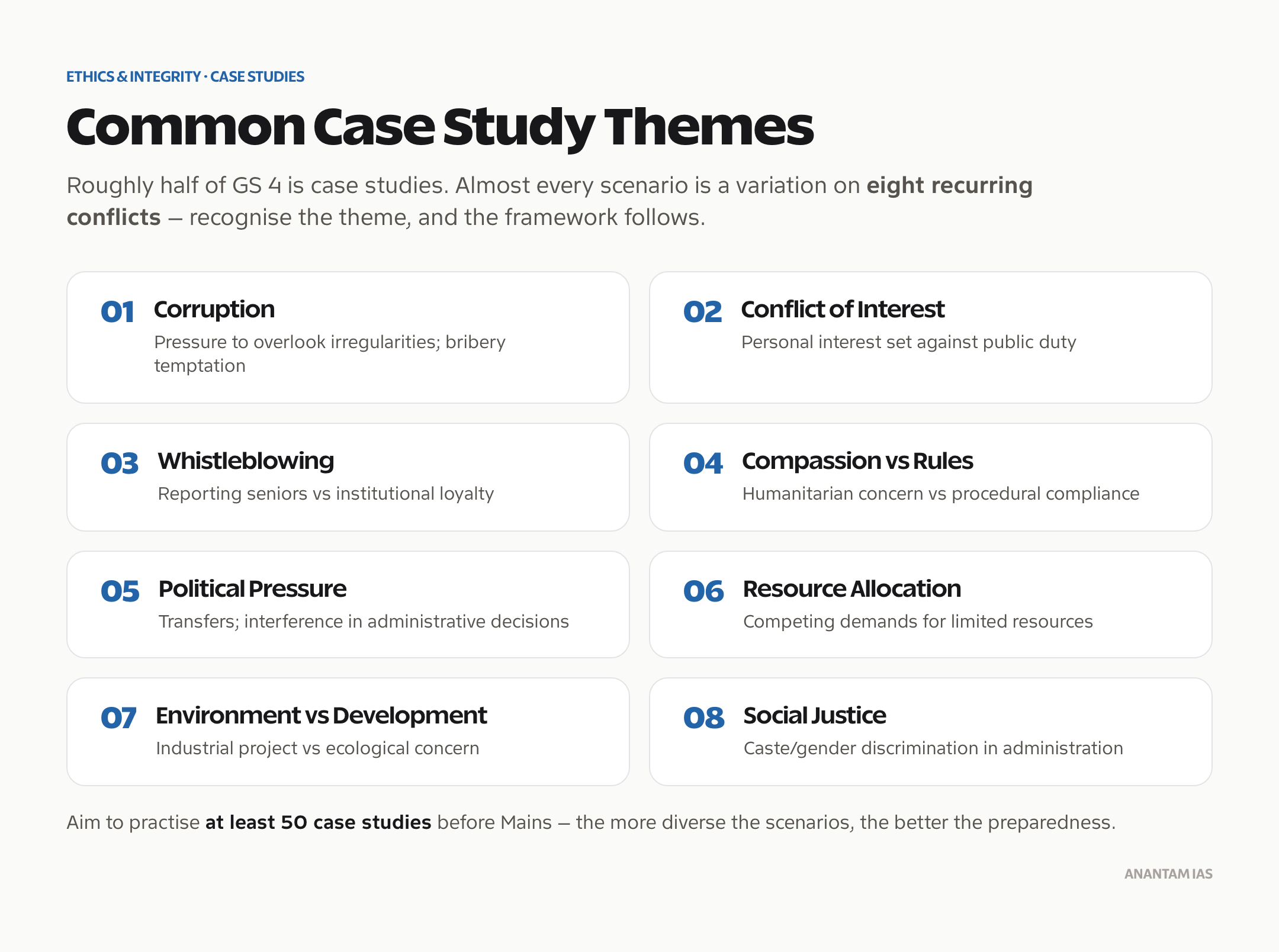
| Corruption | Pressure to overlook irregularities, bribery temptation |
| Conflict of Interest | Personal interest vs public duty |
| Whistleblowing | Reporting seniors vs institutional loyalty |
| Compassion vs Rules | Humanitarian concern vs procedural compliance |
| Political Pressure | Transfers, interference in administrative decisions |
| Resource Allocation | Competing demands for limited resources |
| Environmental vs Development | Industrial project vs ecological concern |
| Social Justice | Caste/gender discrimination in administrative context |
Case Study Approach for UPSC Ethics Paper (GS IV)
Answer Writing for GS 4
Theory Questions: Format
For definition-type questions (10 marks):
- Define the concept clearly
- Explain its significance in public life
- Give 2–3 real-world examples
- Connect to governance implications
- Include a relevant quote from a thinker
For analytical questions (15 marks):
- Define and contextualize
- Present multiple dimensions
- Use examples from Indian governance
- Reference relevant thinkers or reports
- Conclude with a balanced synthesis
What Makes GS 4 Answers Score High
| Element | Impact |
|---|---|
| Personal touch | Authentic reasoning, not textbook answers |
| Real examples | Specific incidents from governance, not generic |
| Balanced perspective | Acknowledging complexity of ethical dilemmas |
| Thinker references | Used contextually, not decoratively |
| Practical solutions | Actionable recommendations, not idealistic statements |
| Empathy | Sensitivity to vulnerable stakeholders |
Common Mistakes
- Being too idealistic — “I will sacrifice everything for duty” sounds hollow. Show realistic decision-making.
- Ignoring stakeholders — Every case study has multiple affected parties. Acknowledge all of them.
- No ethical framework — Using terms like “consequentialism” or “duty ethics” shows structured thinking.
- Copy-paste quotes — Quotes without application are filler.
- One-sided answers — Even when taking a position, acknowledge the other side.
Preparation Resources
Primary Resources
| Resource | What It Covers |
|---|---|
| Lexicon Ethics (Chronicle Publications) | Comprehensive theory + examples |
| G. Subba Rao & P.N. Roy Chowdhury | Ethics, integrity, aptitude — covers full syllabus |
| 2nd ARC 4th Report (Ethics in Governance) | Probity, codes of conduct, transparency |
| IGNOU Ethics Material | Foundational concepts |
| Previous Year Papers (2013–2025) | Pattern and depth understanding |
Supplementary Sources
- Newspaper editorials on governance ethics
- Real administrative case studies (available in civil services journals)
- Biographies of civil servants (for real-world ethical examples)
- TED talks on leadership, decision-making, and moral psychology (for concept building)
Practice Schedule for GS 4
| Activity | Frequency |
|---|---|
| Read one chapter of ethics book | Daily (during preparation phase) |
| Solve 1 case study | Daily (3 months before Mains) |
| Write 2 theory answers | Daily (last 2 months) |
| Review topper answers for GS 4 | Weekly |
| Compile real-world ethical examples from news | Weekly |
| Full-length GS 4 mock test | Monthly (last 3 months) |
Building a Case Study Practice Bank
Collect case studies from:
- Previous year GS 4 papers (2013–2025)
- Test series question papers
- Real administrative scenarios from news
- Ethics textbook exercises
Practise at least 50 case studies before Mains. The more diverse the scenarios, the better the preparedness.
Frequently Asked Questions
Is GS 4 a high-scoring paper compared to other GS papers?
GS 4 has the potential to be high-scoring because there are no u0022wrongu0022 answers in the traditional sense — the quality of reasoning matters more than specific content. Candidates who internalize ethical frameworks and practise case studies consistently often score 110–130, which is above average. The paper rewards original thinking over memorization.
How to prepare thinkers and their philosophies for GS 4?
Don’t try to study every philosopher in depth. Focus on 8–10 thinkers whose ideas are most applicable to governance: Gandhi, Ambedkar, Kautilya, Aristotle, Kant, Rawls, Amartya Sen, and Confucius. For each, know the core philosophy, 2–3 key quotes, and 2–3 governance applications. Quality of understanding beats breadth of coverage.
Should GS 4 answers be personal or academic?
Both. Theory questions benefit from academic vocabulary (ethical frameworks, principles) while case studies should include personal reasoning (u0022In this situation, the most ethical course would be…u0022). UPSC explicitly asks what u0022youu0022 would do in case studies — first-person responses are appropriate and expected in that section.
How much time should case study answers take in the exam?
Case studies are typically 20-mark or 25-mark questions. Allocate 15–20 minutes per case study. The detailed framework (issues, stakeholders, options, evaluation, recommendation) takes time, so don’t rush. A well-structured case study answer of 300–350 words can score 15–20 marks.
Can GS 4 be prepared in the last 2 months?
Theory concepts can be covered in 2 months, but case study fluency develops over time. Starting case study practice at least 4–5 months before Mains is recommended. The theory part draws heavily from GS 2 knowledge (governance, constitutional values), so candidates already deep into preparation will find many concepts familiar.
Tell Google you want more of this.
Add Anantam IAS as a preferred sourceOne tap, and this site shows up more often in your own Top Stories, AI Overviews and AI Mode. Remove it any time.