Central vs State Government: Powers & Division
Complete comparison of Central and State Government powers in India — Union List, State List, Concurrent List, Seventh Schedule, and federal dynamics for UPSC.
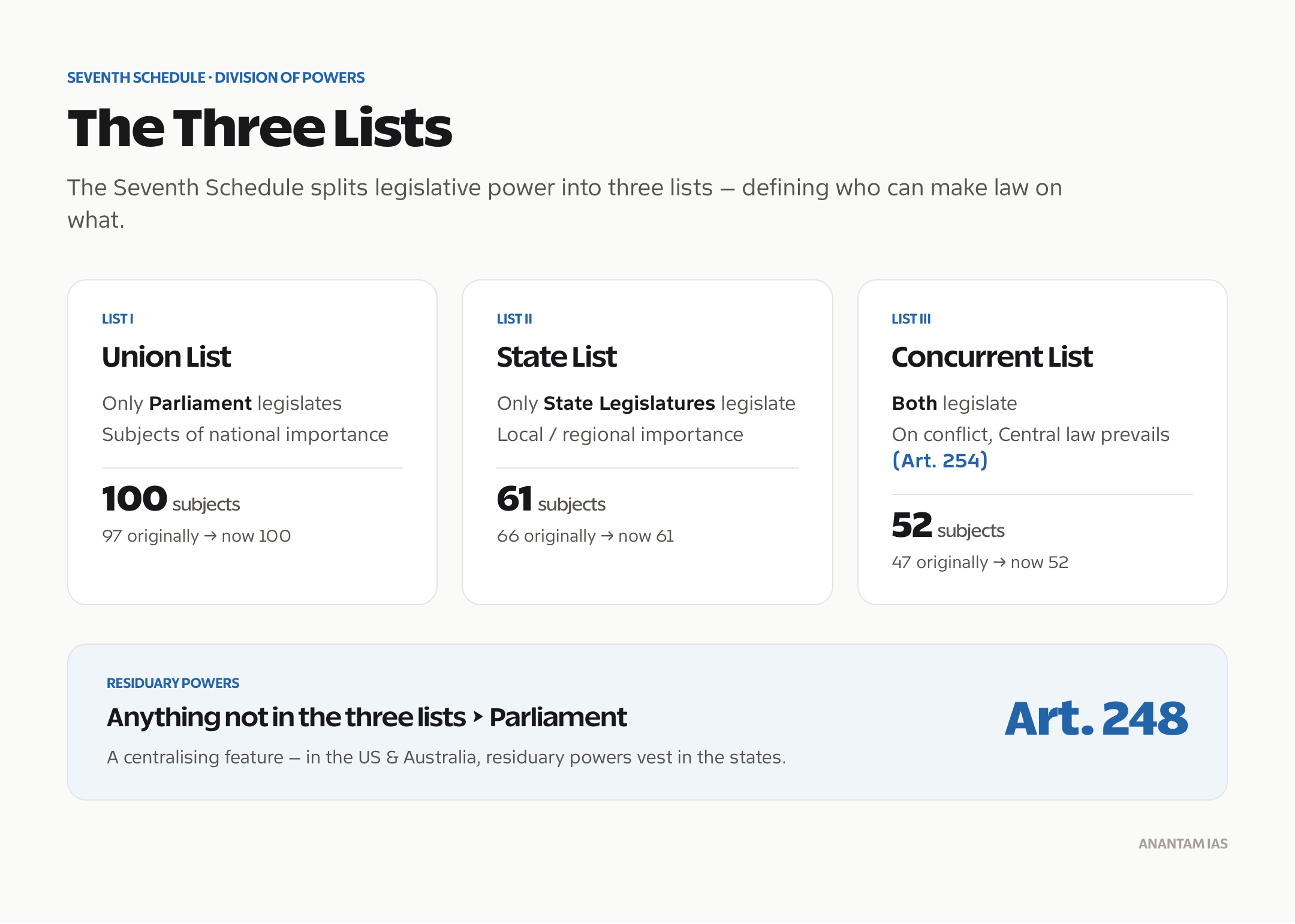
The Central (Union) Government and the State Governments share power through the Seventh Schedule of the Constitution, which sorts every subject into three lists: the Union List (100 subjects, on which only Parliament legislates), the State List (61 subjects, only the State legislatures) and the Concurrent List (52 subjects, both — with the Central law prevailing in a conflict under Article 254). Residuary powers rest with the Centre (Article 248), which is why India is described as a federation with a strong unitary bias, or “quasi-federal.”
Central vs State Government: Powers & Division
India is a federal country with a strong unitary bias — often described as “quasi-federal” by constitutional scholars like K.C. Wheare. The division of powers between the Central (Union) Government and State Governments is defined primarily in the Seventh Schedule of the Constitution, which contains three lists: Union List, State List, and Concurrent List. For UPSC, understanding this power division, the mechanisms of Centre-State relations, and the tensions in Indian federalism is fundamental to Polity preparation.
Constitutional Framework for Power Division
The framers of the Indian Constitution, having witnessed the challenges of partition and provincial autonomy under the Government of India Act, 1935, deliberately created a federation with a powerful Centre. The key provisions governing Centre-State relations are found in Parts XI and XII of the Constitution.
Key Constitutional Provisions
| Article | Subject |
|---|---|
| Article 245 | Extent of laws made by Parliament (entire India) and State Legislatures (within the state) |
| Article 246 | Distribution of legislative powers — Union, State, and Concurrent Lists |
| Article 248 | Residuary powers vest in Parliament (not states) |
| Article 249 | Parliament can legislate on State List matters if Rajya Sabha passes a resolution by 2/3 majority in national interest |
| Article 250 | Parliament can legislate on State List matters during a national emergency |
| Article 252 | Parliament can legislate for two or more states if their legislatures consent |
| Article 253 | Parliament can legislate on any subject to implement international treaties |
| Article 254 | Central law prevails in case of conflict on Concurrent List subjects |
| Article 256-263 | Administrative relations between Centre and States |
| Article 268-281 | Financial relations — distribution of taxes, grants-in-aid |
The Seventh Schedule: Three Lists
Union List (List I)
The Union List contains subjects on which only Parliament can legislate. These are matters of national importance requiring uniform policy.
Number of subjects: 97 (originally), now 100
Key subjects:
| Category | Examples |
|---|---|
| Defence and Security | Defence, armed forces, war and peace, atomic energy, CBI |
| Foreign Affairs | Foreign affairs, diplomacy, treaties, UN, citizenship |
| Communication | Railways, national highways, posts and telegraphs, broadcasting |
| Financial | Currency, banking, RBI, foreign exchange, insurance, income tax, customs |
| Trade | Inter-state trade, foreign trade, industries (declared by Parliament) |
| Others | Census, audit (CAG), elections, Supreme Court, all-India services |
State List (List II)
The State List contains subjects on which only State Legislatures can legislate (under normal circumstances). These are matters of local or regional importance.
Number of subjects: 66 (originally), now 61
Key subjects:
| Category | Examples |
|---|---|
| Law and Order | Police, prisons, public order (but not defence) |
| Local Government | Municipalities, panchayats, local governance |
| Agriculture | Agriculture, land revenue, irrigation, animal husbandry |
| Health | Public health, hospitals, sanitation (state subjects) |
| Education | Not in State List after 42nd Amendment (moved to Concurrent) |
| Revenue | Land revenue, state taxes (sales tax was here before GST) |
| Others | Fisheries, markets, fairs, money lending, theatres, betting |
Concurrent List (List III)
The Concurrent List contains subjects on which both Parliament and State Legislatures can legislate. In case of conflict, the Central law prevails (Article 254).
Number of subjects: 47 (originally), now 52
Key subjects:
| Category | Examples |
|---|---|
| Legal | Criminal law (IPC), criminal procedure (CrPC), civil procedure, marriage, divorce, adoption |
| Social | Education (added by 42nd Amendment), forests, wildlife, population control |
| Economic | Trade unions, industrial disputes, bankruptcy, economic and social planning |
| Others | Stamp duties, drugs, newspapers, electricity, trusts |
Comparison of the Three Lists
| Feature | Union List | State List | Concurrent List |
|---|---|---|---|
| Legislature | Parliament only | State Legislature only | Both (Centre prevails in conflict) |
| Subjects | 100 | 61 | 52 |
| Scope | National importance | Local/regional importance | Shared interest |
| Residuary Power | Yes (Article 248) | No | No |
| During Emergency | Expanded (can cover State List) | Contracted | Parliament prevails |
| Examples | Defence, railways, banking | Police, land, agriculture | Education, forests, criminal law |
Residuary Powers
Under Article 248, subjects not mentioned in any of the three lists fall under Parliament’s jurisdiction. This is a significant centralising feature — in the US and Australia, residuary powers vest in the states. The 97th entry of the Union List explicitly covers “any other matter not enumerated in List II or List III.”
Examples of residuary power exercise: taxation of services (before GST), cyber crimes (before specific legislation).
Centre’s Override Powers Over State Subjects
The Constitution provides several mechanisms through which the Centre can legislate on State List subjects:
| Mechanism | Article | Condition |
|---|---|---|
| National Emergency | 250 | During proclamation of national emergency under Article 352 |
| Rajya Sabha Resolution | 249 | If Rajya Sabha passes resolution by 2/3 majority that it’s in national interest |
| State Request | 252 | If two or more state legislatures request Parliament to legislate |
| International Treaties | 253 | To implement international agreements/treaties |
| President’s Rule | 356 | Parliament can legislate for a state under President’s Rule |
Administrative Relations
Distribution of Executive Power
| Level | Scope of Executive Power |
|---|---|
| Union Government | Coextensive with Union List + Concurrent List + treaties |
| State Government | Coextensive with State List + Concurrent List (subject to Central law) |
Centre’s Directions to States (Articles 256-257)
The Centre can direct state governments to:
- Ensure compliance with Central laws (Article 256)
- Not impede Central government functions (Article 257)
- Construct and maintain communication means of military importance (Article 257(2))
- Protect railways within the state (Article 257(3))
Failure to comply can lead to President’s Rule under Article 356.
Inter-State Councils and Disputes
| Body | Article | Function |
|---|---|---|
| Inter-State Council | 263 | Advisory body for Centre-State coordination; recommended by Sarkaria Commission |
| Zonal Councils | States Reorganisation Act, 1956 | 5 zonal councils for inter-state cooperation |
| Inter-State Water Disputes Tribunal | 262 | Adjudicates river water disputes |
Financial Relations
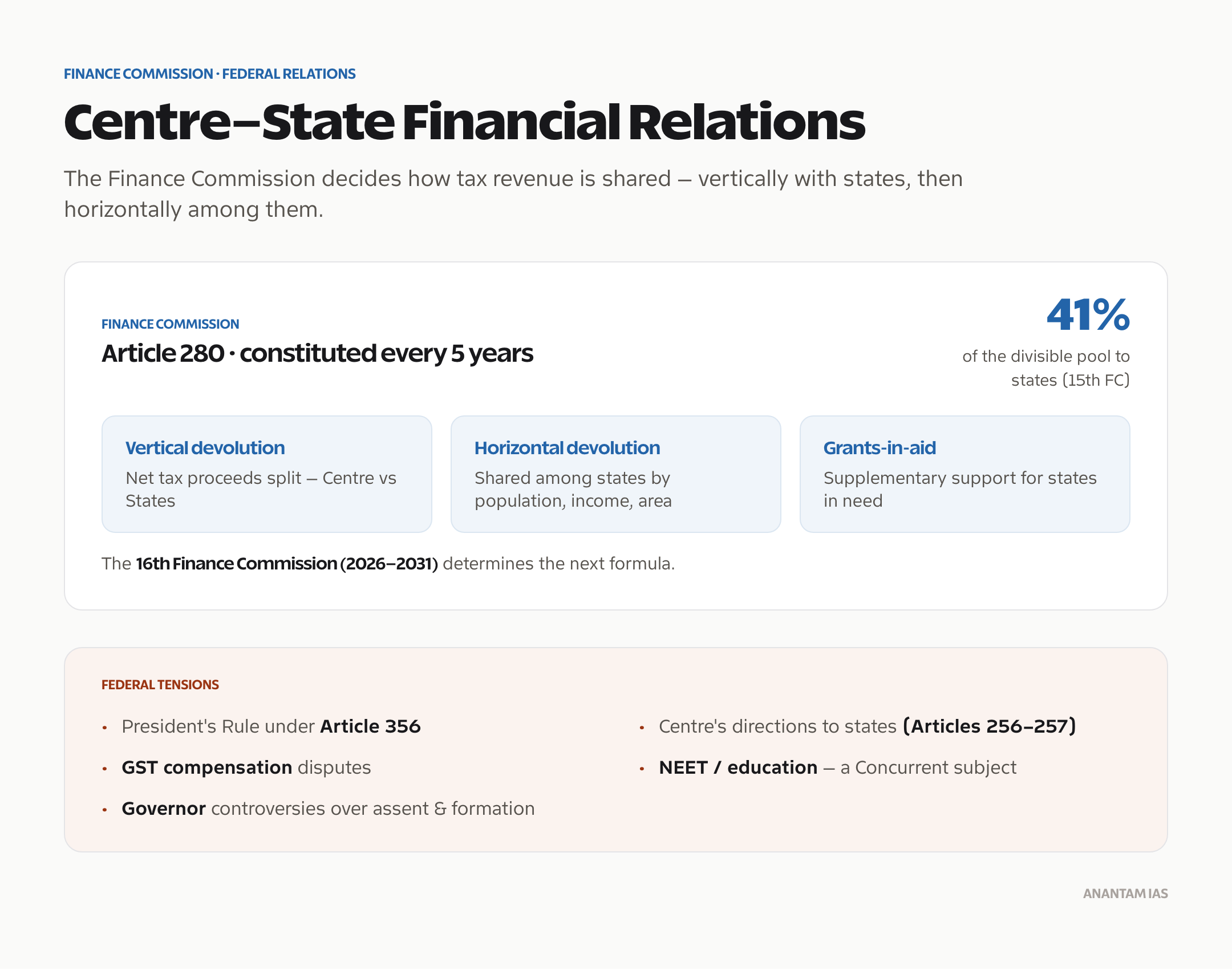
Financial relations between the Centre and States are governed by Articles 268-281 and the recommendations of the Finance Commission (Article 280).
Tax Distribution Framework
| Category | Example | Collection | Revenue Sharing |
|---|---|---|---|
| Taxes levied and collected by Centre, shared with States | Income Tax, Corporation Tax, GST | Centre | Shared per Finance Commission recommendation |
| Taxes levied by Centre but collected and retained by States | Stamp duty on financial documents | States | Retained by states |
| Taxes levied and collected by Centre but assigned to States | Central Sales Tax (being phased out) | Centre | Assigned to states |
| Surcharges and Cesses | Health cess, education cess | Centre | NOT shared with states (retained by Centre) |
Finance Commission Recommendations
The Finance Commission (constituted every 5 years under Article 280) recommends:
- Division of net tax proceeds between Centre and States (vertical devolution)
- Distribution among states (horizontal devolution) based on criteria like population, income, area
- Grants-in-aid for states
The 16th Finance Commission (2026-2031) will determine the latest formula. The 15th FC recommended 41% of divisible pool to states.
Grants-in-Aid
| Type | Article | Nature |
|---|---|---|
| Statutory Grants | 275 | Recommended by Finance Commission; for states in need |
| Discretionary Grants | 282 | Centre can make grants for any public purpose |
| Grants for Scheduled Tribes | 275(1) | For welfare of STs and upgradation of tribal areas |
| GST Compensation | GST Act | Compensation for revenue loss from GST implementation (expired 2022) |
Tensions in Indian Federalism
Centre’s Dominance
| Issue | Description |
|---|---|
| Governor’s Role | Appointed by Centre; often seen as agent of ruling party; discretion in government formation |
| President’s Rule | Article 356 — used/misused over 100 times; S.R. Bommai case (1994) imposed limits |
| Fiscal Dependence | States depend on Central transfers; cesses/surcharges not shared |
| All-India Services | IAS, IPS, IFoS officers serve states but are recruited/controlled by Centre |
| NITI Aayog vs Planning Commission | Planning Commission (abolished 2014) had centralising tendencies; NITI Aayog is advisory |
| GST Council | Decisions on tax rates affect state revenue autonomy |
Key Commissions on Centre-State Relations
| Commission | Year | Key Recommendations |
|---|---|---|
| Sarkaria Commission | 1988 | Stronger Inter-State Council; restrain Article 356 use; consultation before deploying central forces |
| M.M. Punchhi Commission | 2010 | Governor appointment reform; Article 356 amendment; concurrent list review |
| Administrative Reforms Commission | Various | Decentralisation; strengthening local government |
Recent Federal Disputes
- GST Compensation: States demanded extension beyond 2022; Centre resisted
- NEET/Education: States opposing centralised medical entrance (education is Concurrent)
- CAA/Farm Laws: States challenging Central legislation on grounds of overreach
- Governor Controversies: Multiple states alleged partisan behaviour by governors in government formation and bill assent
Cooperative Federalism vs Competitive Federalism
| Concept | Description | Examples |
|---|---|---|
| Cooperative Federalism | Centre and States work together on shared goals | NITI Aayog, GST Council, National Development Council |
| Competitive Federalism | States compete to attract investment, improve governance | Ease of Doing Business rankings, investment summits |
The current government’s approach emphasises both — cooperative federalism through institutions like NITI Aayog and GST Council, and competitive federalism through ranking states on various governance parameters.
Centre vs State: Quick Comparison
| Parameter | Central Government | State Government |
|---|---|---|
| Legislative Power | Union List (100 subjects) + Residuary | State List (61 subjects) |
| Head of State | President | Governor |
| Head of Government | Prime Minister | Chief Minister |
| Legislature | Parliament (Lok Sabha + Rajya Sabha) | State Legislature (Vidhan Sabha ± Vidhan Parishad) |
| Judiciary | Supreme Court | High Court |
| Key Subjects | Defence, foreign affairs, currency, railways | Police, land, agriculture, local government |
| Tax Powers | Income tax, customs, GST (Centre’s share) | State GST, stamp duty, land revenue, excise on alcohol |
| Emergency Powers | Can assume state powers during emergency | No equivalent power over Centre |
| Civil Services | All-India Services (IAS, IPS, IFoS) | State Civil Services |
Frequently Asked Questions
What is the Seventh Schedule of the Indian Constitution?
The Seventh Schedule divides legislative powers between the Centre and States through three lists: Union List (100 subjects for Parliament), State List (61 subjects for State Legislatures), and Concurrent List (52 subjects for both). In case of conflict on Concurrent List subjects, Central law prevails under Article 254. Residuary powers rest with Parliament.
What happens when Central and State laws conflict on a Concurrent List subject?
Under Article 254, if a State law conflicts with a Central law on a Concurrent List subject, the Central law prevails and the State law becomes void to the extent of the inconsistency. However, if the State law received Presidential assent, it can prevail in that state — though Parliament can still override it later.
Why is India called quasi-federal?
Constitutional scholar K.C. Wheare described India as u0022quasi-federalu0022 because it has both federal features (written constitution, dual polity, independent judiciary) and unitary features (single citizenship, single constitution, residuary powers with Centre, emergency provisions that suspend federalism, all-India services, and Centre’s override powers on State List subjects).
What is Article 356 and why is it controversial?
Article 356 allows the President to impose President’s Rule in a state if the constitutional machinery has broken down. It’s controversial because it has been misused over 100 times — often to dismiss opposition-led state governments for political reasons. The Supreme Court in S.R. Bommai v. Union of India (1994) imposed judicial review and strict conditions on its use.
How does the GST Council work in the federal framework?
The GST Council (Article 279A) is a joint body of the Centre and all States that decides GST tax rates, exemptions, and administrative issues. The Centre has 1/3 voting weight and States collectively have 2/3. Decisions require 3/4 majority. While designed for cooperative federalism, disputes have arisen over compensation, rate changes, and whether Council recommendations are binding.