President’s Rule was inserted into the Constitution as a last-resort tool for situations where a state government cannot be carried on in accordance with the Constitution. In Manipur in February 2025, the Centre invoked Article 356 for the eleventh time in the state’s history, after Chief Minister N. Biren Singh resigned amid ongoing ethnic violence between the Meitei and Kuki-Zo communities and a brewing no-confidence motion. The proclamation has reopened the long-running debate over what counts as a failure of constitutional machinery, how Bommai guidelines apply in practice, and whether the present design of Article 356 still serves the federal vision of the Constitution.
The numbers are revealing. Article 356 has been invoked over 130 times since 1950. Most were imposed in the first three decades of the Constitution, often controversially. The post-Bommai period has seen far fewer, but Manipur’s record demonstrates that frequent, short impositions remain a feature of the federal landscape, especially in the northeast. Punjab and Jammu and Kashmir hold the records for the longest continuous President’s Rule, but Manipur now leads in frequency, with the 2025 imposition pushing it past Uttar Pradesh.
This guide walks through the constitutional design of Article 356, the procedural safeguards built in over time, the S.R. Bommai judgment that anchors current practice, the specific factual matrix in Manipur in 2025, and the comparative position of related provisions like Article 355 and Article 365.
Quick Facts on President’s Rule in Manipur
President’s Rule was imposed in Manipur on 13 February 2025 under Article 356 of the Constitution. The trigger was the resignation of Chief Minister N. Biren Singh, the inability to form an alternative government within the BJP-led legislature party, and the continuation of ethnic violence in the state since May 2023. The Legislative Assembly was placed under suspended animation rather than dissolved. This is the eleventh imposition of President’s Rule in Manipur, the highest frequency of any Indian state. The first imposition was in 1967, and the previous one was in 2001-02. The S.R. Bommai v. Union of India judgment of 1994 governs the constitutional framework. Parliamentary approval is required within two months by simple majority in both houses. Initial validity is six months, extendable in six-monthly slabs up to three years.
What President’s Rule Actually Is
President’s Rule is the popular term for a proclamation under Article 356, technically described in the Constitution as the imposition of state emergency or emergency due to failure of constitutional machinery in a state. The proclamation has three operative effects. First, the President assumes to himself all or any of the functions of the state government and the powers vested in or exercisable by the Governor or any other authority other than the state legislature. Second, the President may declare that the powers of the state legislature shall be exercisable by Parliament, which usually delegates the work to the Centre. Third, the President may make incidental and consequential provisions necessary for the administration of the state.
In practice, the day-to-day administration is run by the Governor, advised by central officers. The state cabinet is dismissed. The state assembly is either dissolved or, more commonly in recent practice, kept under suspended animation pending political revival.
Background and Historical Context
Article 356 traces its lineage to Section 93 of the Government of India Act, 1935, which empowered the Governor of a province, acting on the directions of the Governor-General, to assume charge if the constitutional machinery in the province broke down. The framers of the Indian Constitution adapted this colonial provision while debating it intensely. B.R. Ambedkar, while introducing the provision, expressed the hope that it would remain a dead letter and that the conditions justifying its use would never arise.
The hope did not survive contact with politics. The first invocation came in 1951 in Punjab under unusual circumstances. By the late 1950s, the dismissal of the EMS Namboodiripad government in Kerala in 1959 had set the political pattern: Article 356 became a tool not just for genuine constitutional breakdowns but for the dismissal of state governments at odds with the Centre. The 42nd Amendment in 1976 extended the maximum period of President’s Rule, and the 42nd amendment of Indian constitution emergency-era widening of executive power was partially rolled back by the 44th amendment of Indian constitution in 1978.
The Sarkaria Commission, in 1988, examined Article 356 in detail and recommended that the provision should be invoked only in extreme cases of breakdown of constitutional machinery and as a last resort. The S.R. Bommai judgment of 1994 absorbed many Sarkaria recommendations into binding constitutional law, transforming Article 356 from a near-political tool into a justiciable provision with judicial review and procedural discipline.
The Constitutional Design: Articles 355, 356 and 365
Article 355 imposes a duty on the Union to protect every state against external aggression and internal disturbance and to ensure that the government of every state is carried on in accordance with the provisions of the Constitution. Article 355 is not by itself a power to take over a state; it is a duty that justifies the use of other powers, including but not limited to Article 356.
Article 356 is the operative power. The President may, on receipt of a report from the Governor or otherwise, issue a proclamation if he is satisfied that the government of the state cannot be carried on in accordance with the provisions of the Constitution. The phrase “or otherwise” was added in 1955 and was reaffirmed by the Supreme Court in Bommai. The President’s satisfaction is not subjective in the absolute sense; it is justiciable and must rest on relevant material.
Article 365 provides a complementary route. Where any state has failed to comply with or to give effect to any direction given in the exercise of the executive power of the Union, it shall be lawful for the President to hold that a situation has arisen in which the government of the state cannot be carried on in accordance with the provisions of the Constitution. Article 365 effectively converts non-compliance with central directions into a Article 356 trigger.
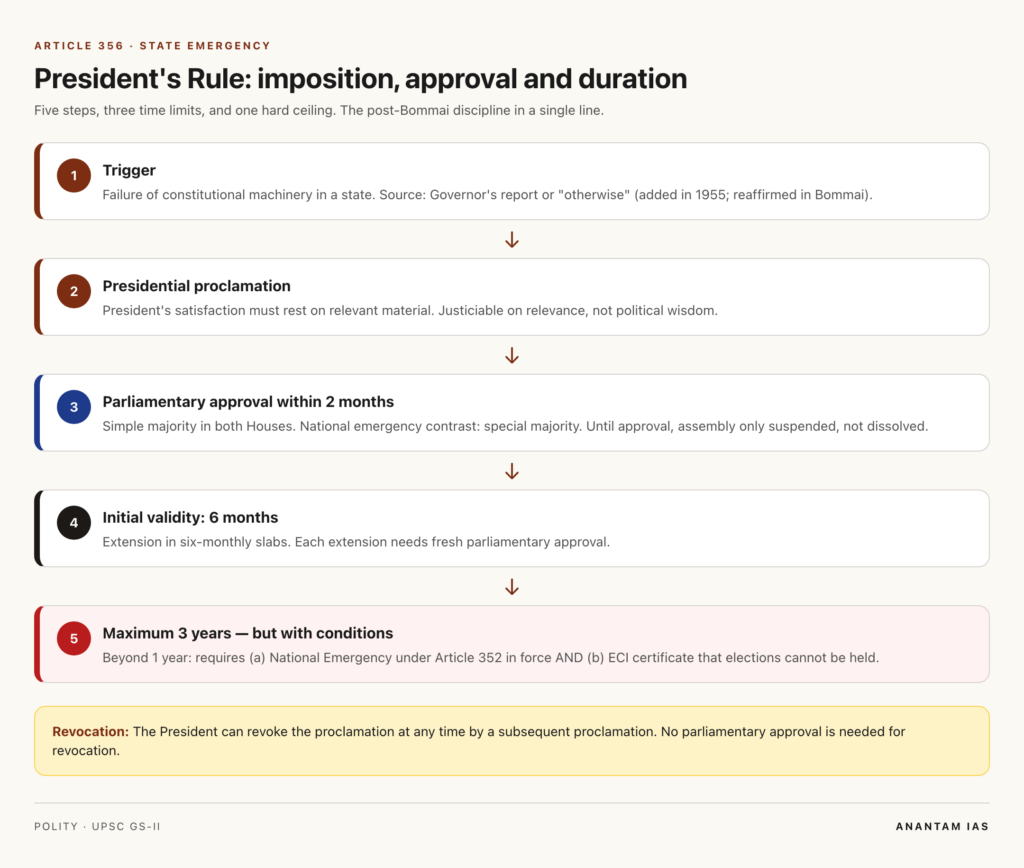
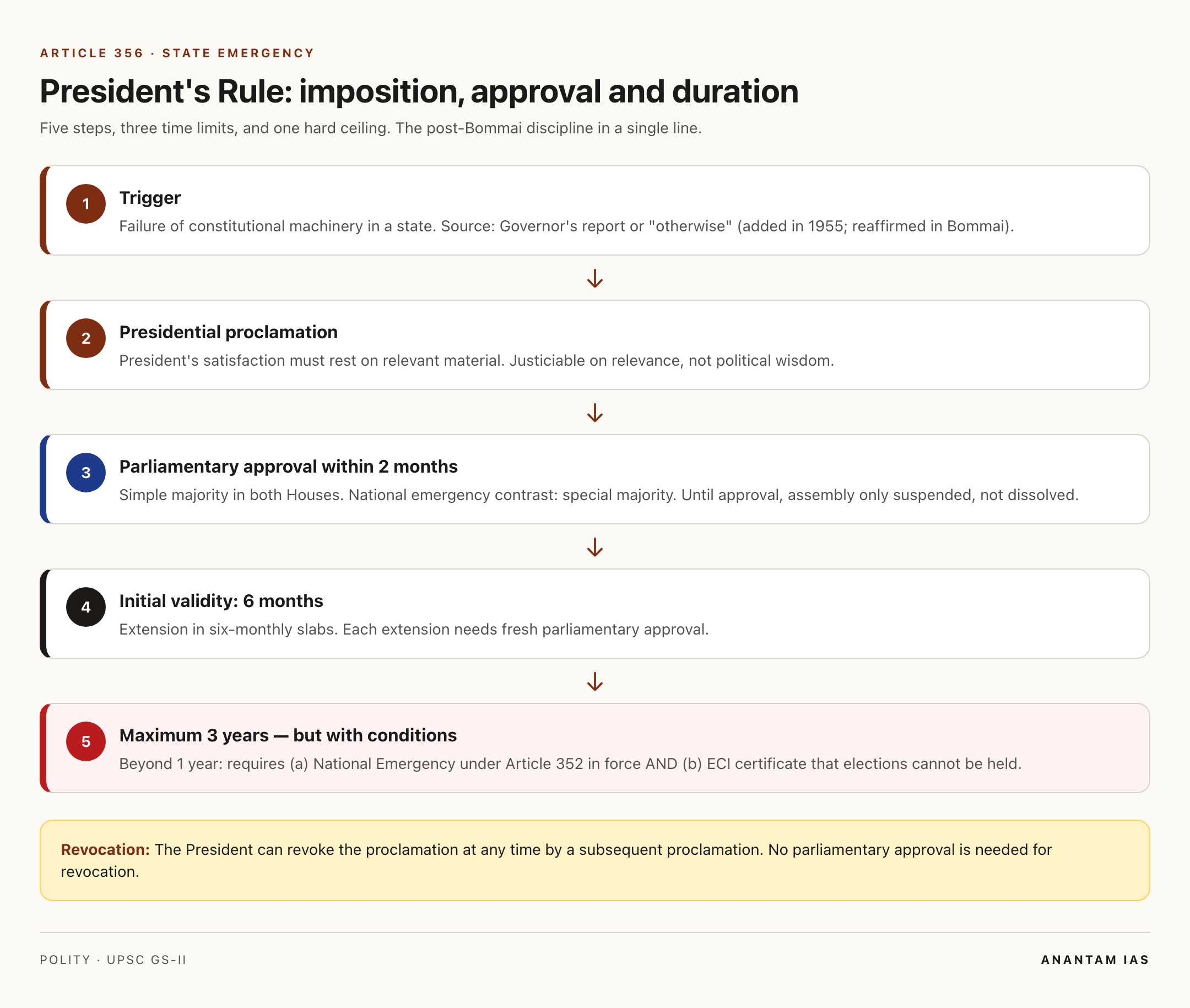
A proclamation under Article 356 must be approved by both Houses of Parliament within two months. The approval is by simple majority. This stands in contrast with a national emergency under Article 352, which requires special majority. Once approved, the proclamation is valid for six months. It can be extended by another six months at a time, up to a maximum of three years. Beyond one year, extension requires two specific conditions to coexist: a national emergency in operation in the whole or any part of the state, and a certificate from the Election Commission that elections to the state assembly cannot be held.
Manipur 2025: The Trigger and the Sequence
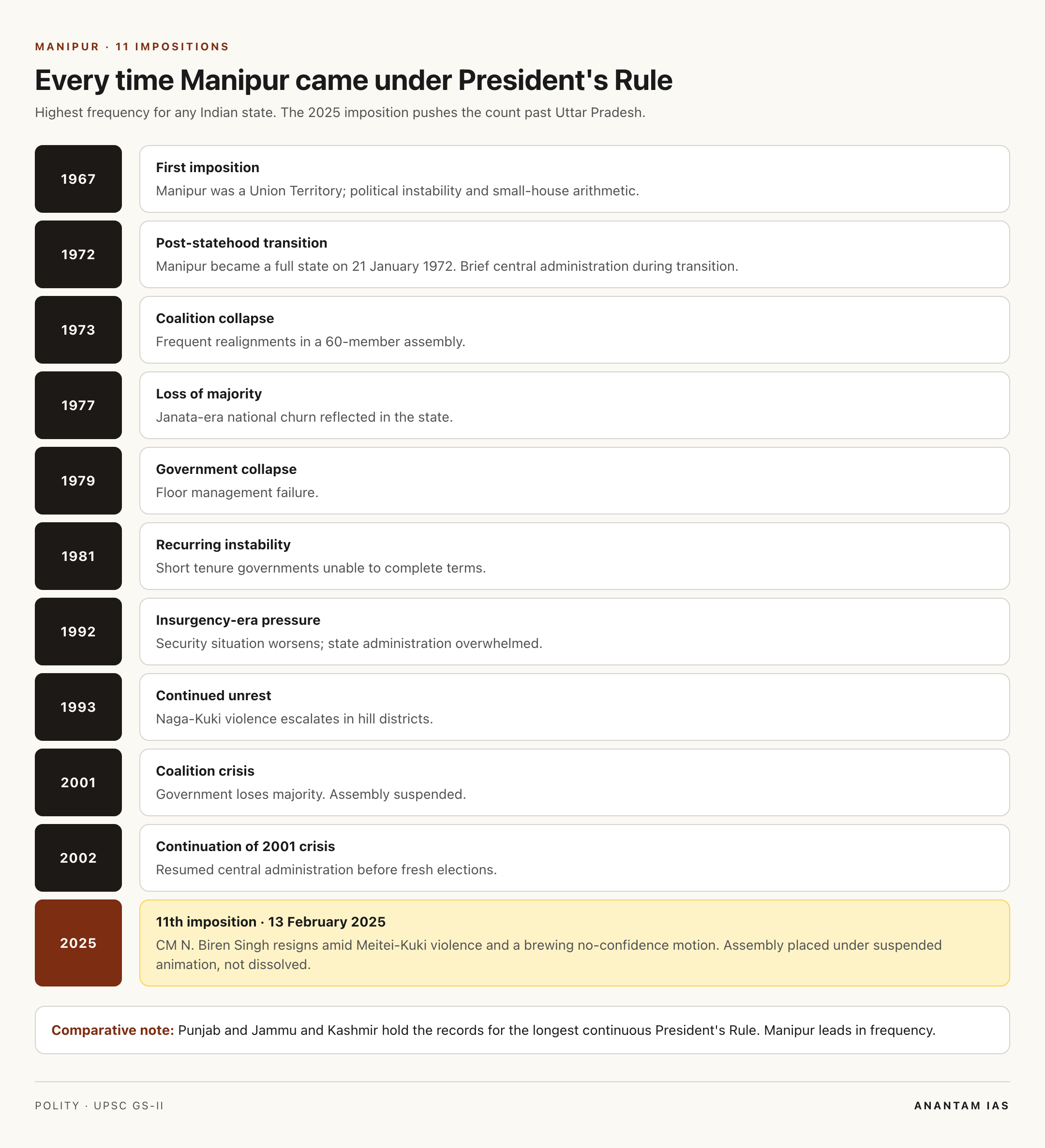
The Manipur situation arose from a complex tangle of ethnic, political and security factors. The Meitei community in the Imphal valley and the Kuki-Zo and Naga communities in the hills had clashed in May 2023 after a tribal solidarity march sparked widespread violence. The Manipur High Court’s order recommending Scheduled Tribe status for the Meitei community had earlier triggered the unrest. Over the next twenty months, more than two hundred people died, tens of thousands were displaced, and an effective territorial divide between valley and hill districts hardened.
The political crisis followed in early 2025. Chief Minister N. Biren Singh’s leadership came under sustained pressure from within the BJP legislature party. A no-confidence motion was building in the assembly. On 9 February 2025 the Chief Minister resigned. The BJP leadership in Delhi could not assemble an alternative leadership commanding majority support, the assembly session was prorogued, and on 13 February 2025 the President issued a proclamation under Article 356 placing the state under President’s Rule. The assembly was placed under suspended animation, not dissolved, leaving open the possibility of revival or fresh elections.
This is the eleventh imposition of President’s Rule in Manipur, the highest tally for any Indian state. Earlier impositions came in 1967, 1972, 1973, 1977, 1979, 1981, 1992, 1993, 2001 and 2002. The frequency reflects Manipur’s chronic political instability, the ongoing kuki naga conflict rages in manipur ethnic tensions, and the difficulty of forming durable coalitions in a small assembly with strong ethnic bloc voting.
S.R. Bommai v. Union of India (1994): The Gold Standard
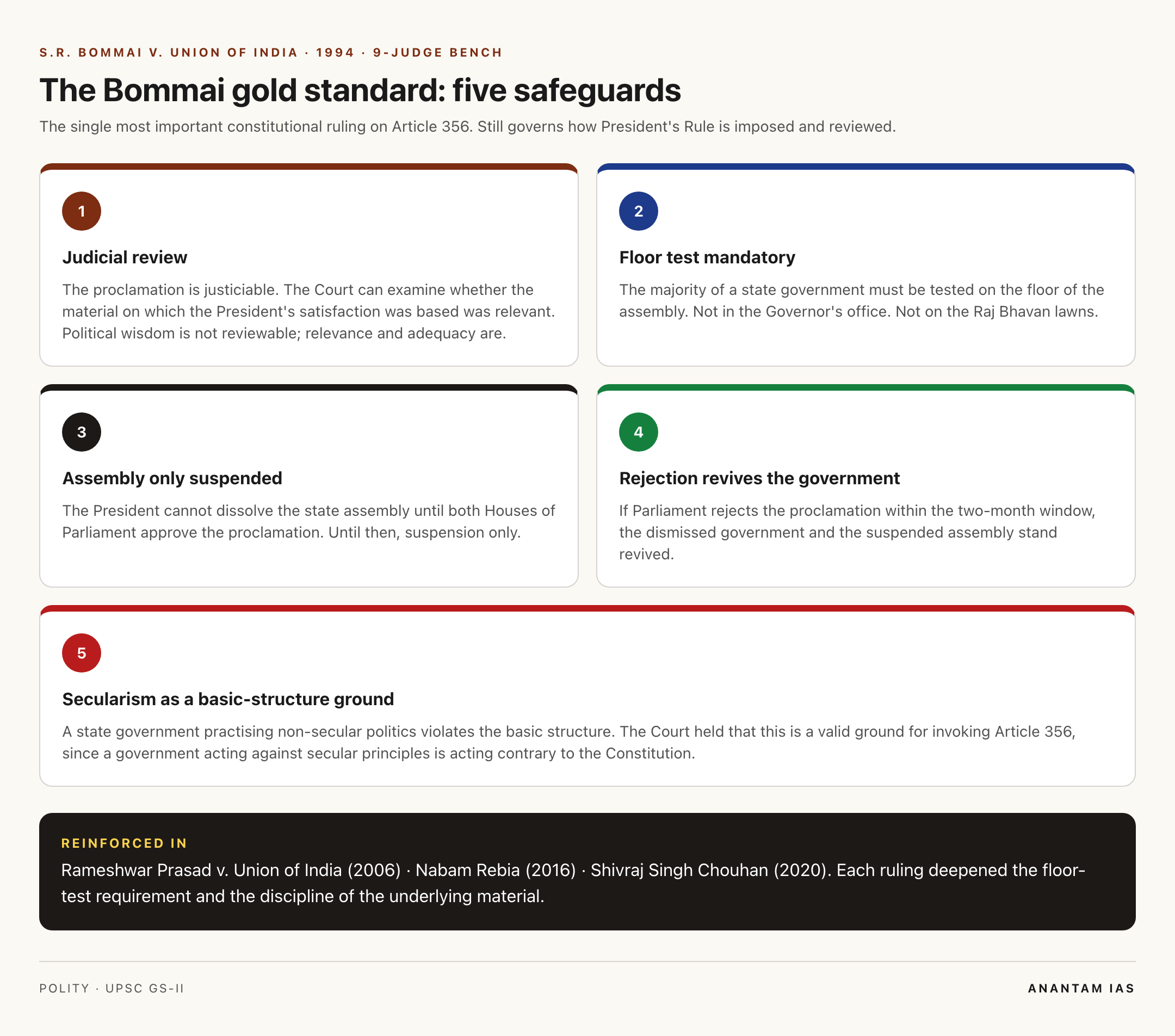
The S.R. Bommai judgment is the single most important constitutional ruling on Article 356. A nine-judge bench of the Supreme Court, dealing with the dismissal of the Karnataka government and several other state governments, laid down a comprehensive framework that still governs.
The judgment held five things that anchor the present law. First, the President’s proclamation under Article 356 is subject to judicial review. The Court can examine whether the material on which the President’s satisfaction was based was relevant. The political wisdom of the decision is not reviewable, but the relevance and adequacy of the material is. Second, the floor test is the only constitutionally appropriate way to determine whether a state government enjoys majority support. The majority must be tested on the floor of the assembly, not in the Governor’s office or by counting heads on the lawns of Raj Bhavan. Third, the President cannot dissolve the assembly until both Houses of Parliament approve the proclamation. Until then, the assembly is only suspended. Fourth, if Parliament rejects the proclamation, the dismissed government and the suspended assembly stand revived. Fifth, anti-secular conduct by a state government can be a ground for Article 356, on the reasoning that any government that practises non-secular politics violates the basic structure of the Constitution.
The Bommai framework continues to evolve. The basic structure doctrine has been deepened in subsequent rulings, and the floor test as the constitutionally mandated mechanism has been reiterated in Rameshwar Prasad (2006), Nabam Rebia (2016) and Shivraj Singh Chouhan (2020).
Why the 2025 Imposition Matters
The Manipur 2025 proclamation is unusual in three ways. First, it follows a CM’s resignation rather than a constitutional dispute over majority. The breakdown is political rather than legal: the BJP holds the majority on paper but could not produce a leader. Second, the law and order dimension is salient. Article 355 has been continuously operative since the violence began in May 2023, with central forces deployed in significant numbers. The Article 356 imposition is presented as the next step in that escalation rather than a sudden shift. Third, the assembly was kept under suspended animation rather than dissolved, leaving the BJP legislature party the option to revive an in-state government later.
Each of these features will shape any judicial review of the proclamation. The Bommai framework allows the Court to examine whether the underlying material was relevant. A resignation that follows a brewing no-confidence motion can be argued either way: the government had effectively lost the will to face the assembly, or the assembly should have been allowed to test confidence on the floor. The choice not to dissolve the assembly preserves political flexibility but raises questions about whether the requirement that the state could not be governed in accordance with the Constitution is genuinely met. The discussion runs through broader emergency provisions jurisprudence on how exceptional powers should be calibrated.
Detailed Analysis: Procedural Safeguards in Practice
The procedural safeguards around Article 356 work in three layers. The first layer is parliamentary control. A proclamation must be approved within two months. This is short by emergency standards and forces a national debate within a defined window. The simple majority requirement makes approval easy when the ruling party has a Lok Sabha majority, which is why parliamentary control alone has rarely been a binding constraint.
The second layer is judicial review. After Bommai, the Court has been willing to set aside Article 356 proclamations and order revival of dismissed governments. The most striking application was in Rameshwar Prasad v. Union of India (2006), where the dissolution of the Bihar Assembly in 2005 was held unconstitutional because it had been based on the Governor’s perception of horse-trading rather than any objective material. The Court could not restore the assembly because elections had been held in the meantime, but the principle was reinforced.
The third layer is the time discipline. Initial validity is six months. Extension requires fresh parliamentary approval each time. Extension beyond one year requires the conjunction of a national emergency and an ECI certificate. This third condition has been strict enough that recent impositions have rarely crossed the one-year line.
Comparative Frame: Article 356, Article 352 and Article 360
Indian emergency provisions come in three varieties. Article 352 is the national emergency, invokable on grounds of war, external aggression or armed rebellion (the original phrase was internal disturbance, replaced by armed rebellion through the 44th Amendment in 1978). Approval requires special majority. The President can suspend most fundamental rights, except Articles 20 and 21 which were ring-fenced after the 50 years of national emergency 1975-2025 reckoning that produced the 44th Amendment.
Article 356 is the state emergency, invokable on the failure of constitutional machinery in a state. Approval requires simple majority. Fundamental rights are not affected. The state government is dismissed and the assembly is suspended or dissolved.
Article 360 is the financial emergency, invokable on threat to financial stability or credit of India. Approval requires simple majority. The President can give directions on financial matters, including reduction of salaries of all central and state employees. Article 360 has never been invoked.
Challenges and Open Questions
Article 356 has matured into a more disciplined provision but still raises four problems. The first is the politicisation of Governors’ reports. Despite repeated commission recommendations, Governors continue to be appointed and removed at the pleasure of the President, and the political alignment of the Governor with the Centre influences the timing and content of reports. The second is the use of Article 356 in coalition flux situations, where the underlying question is which alliance commands majority rather than whether the constitutional machinery has failed. The third is the increasing recourse to suspended animation rather than dissolution, which keeps political options open but stretches the constitutional logic of the provision. The fourth is the federal asymmetry: states with smaller assemblies, especially in the northeast, are far more frequently subjected to President’s Rule than larger states with stable polities.
Prelims Pointers
President’s Rule is imposed under Article 356 of the Constitution. The grounds are failure of constitutional machinery in a state, on the President’s satisfaction based on the Governor’s report or otherwise. Article 365 makes failure to comply with central directions a separate ground. Article 355 imposes a duty on the Union to protect states and to ensure constitutional governance, but is not itself a power to take over a state. Parliamentary approval is required within two months by simple majority. Initial validity is six months, extendable in six-monthly slabs up to three years. Extension beyond one year requires a national emergency to be in operation and an ECI certificate that elections cannot be held. President can revoke the proclamation at any time without parliamentary approval. The S.R. Bommai case (1994) made the proclamation justiciable, mandated floor tests, and held that the assembly can only be suspended until Parliament approves. Manipur’s 2025 imposition is the eleventh, the highest frequency for any state. Punjab and J&K hold the records for longest continuous President’s Rule.
Mains Practice Questions
Critically examine the imposition of President’s Rule in Manipur in February 2025 in light of the Bommai guidelines and the federal vision of the Constitution.
Discuss the role of the Governor in the imposition of President’s Rule under Article 356 and evaluate the Sarkaria Commission’s recommendations on this question.
Analyse the evolution of Article 356 jurisprudence from State of Rajasthan v. Union of India (1977) to S.R. Bommai (1994) to Rameshwar Prasad (2006).
Examine the difference between Article 356 and Article 365 and assess whether Article 365 is being used as a parallel route to bypass the safeguards built around Article 356.
Way Forward
The Sarkaria Commission’s recommendations remain the most balanced reform menu. Article 356 should be used as a last resort, only where all other alternatives have been exhausted. The Governor’s report should be made public, with reasons recorded. The Centre should issue a warning to the state government before imposing President’s Rule, except in cases of extreme urgency. The dismissal should be preceded by a floor test wherever feasible.
Three further reforms could deepen the post-Bommai discipline. First, a statutory time-limit within which the Centre must move for fresh elections after imposing President’s Rule, except where security conditions make elections impossible. Second, an objective procedural template for what constitutes a failure of constitutional machinery, codified through a parliamentary statute under Article 356(5). Third, a parliamentary committee tasked with reviewing every Article 356 proclamation in advance of the two-month approval deadline. Together, these would prevent the present pattern of repeated short impositions in vulnerable states like Manipur and would re-ground Article 356 in its original last-resort logic, supported by the broader internal security architecture of the Indian state.
Frequently Asked Questions
Under which article was President’s Rule imposed in Manipur in February 2025?
President’s Rule in Manipur was imposed under Article 356 of the Constitution on 13 February 2025, following the resignation of Chief Minister N. Biren Singh and the inability of the BJP legislature party to produce an alternative leadership commanding majority support.
How many times has Manipur been under President’s Rule?
The 2025 imposition is the eleventh in Manipur’s history. The previous impositions came in 1967, 1972, 1973, 1977, 1979, 1981, 1992, 1993, 2001 and 2002. Manipur now has the highest frequency of President’s Rule among Indian states, ahead of Uttar Pradesh.
What is the duration of President’s Rule under Article 356?
The initial validity is six months from the date of the proclamation, subject to parliamentary approval within two months. It can be extended in six-monthly slabs up to a maximum of three years. Extension beyond one year requires both a national emergency under Article 352 to be in operation and a certificate from the Election Commission that elections to the state assembly cannot be held.
What majority is needed to approve a proclamation under Article 356?
Approval requires a simple majority, that is a majority of members present and voting, in each House of Parliament. This is in contrast with a national emergency under Article 352, which requires a special majority. The simple majority requirement allows ruling-party majorities to approve proclamations relatively easily.
What did the S.R. Bommai case decide?
The nine-judge bench in S.R. Bommai v. Union of India (1994) held that proclamations under Article 356 are subject to judicial review on the relevance of the underlying material; that the floor test is the only proper way to test the majority of a state government; that the assembly can only be suspended until Parliament approves the proclamation, not dissolved; that if Parliament rejects the proclamation, the dismissed government and suspended assembly stand revived; and that anti-secular conduct can be a ground for invoking Article 356.
What is the difference between Article 356 and Article 365?
Article 356 is the substantive power to impose President’s Rule on the failure of constitutional machinery in a state. Article 365 is a complementary provision that converts non-compliance by a state with central directions into a deemed failure of constitutional machinery, supplying a separate route into Article 356.
Can the President dissolve a state assembly when imposing President’s Rule?
Under Bommai, the President cannot dissolve the assembly until both Houses of Parliament approve the proclamation. Until then, the assembly may only be suspended. If Parliament rejects the proclamation, the suspended assembly is revived; if Parliament approves it, the President may then dissolve the assembly.
Does parliamentary approval need both Houses?
Yes. A proclamation under Article 356 must be approved by both the Lok Sabha and the Rajya Sabha within two months. Failure to obtain approval from either House within the two-month window causes the proclamation to lapse.
Is the President’s satisfaction under Article 356 absolute?
No. The Supreme Court in Bommai held that the President’s satisfaction must rest on relevant material and is subject to judicial review on that ground. The political wisdom of the decision is not reviewable, but the existence and relevance of the material is.
What is Article 355 and how is it different from Article 356?
Article 355 imposes a duty on the Union to protect every state against external aggression and internal disturbance and to ensure that the government of every state is carried on in accordance with the Constitution. It is a duty, not a power. Article 356 provides the actual power to take over the administration of a state when the constitutional machinery fails.
Tell Google you want more of this.
Add Anantam IAS as a preferred sourceOne tap, and this site shows up more often in your own Top Stories, AI Overviews and AI Mode. Remove it any time.