Centre-State Clashes on Vice-Chancellor Appointments: UGC 2025 Draft, Governor as Chancellor and the Federalism Question
Vice-Chancellor appointments in India explained: UGC Draft Regulations 2025, Governor as Chancellor, Concurrent List Entry 25, Article 254, Gambhirdan K Gadhvi case and Sarkaria-Punchhi recommendations.
The post of Vice-Chancellor was meant to be the academic head of a self-governing university, far removed from the daily push and pull of party politics. In practice, the appointment has become one of the sharpest fault lines in India’s centre-state relationship. Kerala, Tamil Nadu, West Bengal, Telangana and Punjab have all clashed with their Governors, and through them with the Union government, over who should choose the head of a state university. The UGC’s Draft Regulations of 2025, currently under consultation, have widened the dispute by tightening the Centre’s grip over the search and selection process.
The constitutional architecture is clear in outline but contested in detail. Education sits in the Concurrent List under Entry 25 of the Seventh Schedule. The University Grants Commission Act, 1956 gives the UGC the power to set minimum standards for universities and prescribe rules for the appointment of teachers. State legislatures, in turn, set up state universities under their own statutes and usually make the Governor the Chancellor by operation of state law. When the two pieces of law collide, Article 254 says the central law prevails, but state governments argue that the central law has been pushed beyond its legitimate scope.
This guide walks through the mechanics of VC appointments in central and state universities, the new 2025 UGC draft, the Gambhirdan K Gadhvi judgment of 2022, the Sarkaria and Punchhi Commission recommendations on the Governor’s role, and the larger federalism question that runs through every clash.
Quick Facts on Vice-Chancellor Appointments
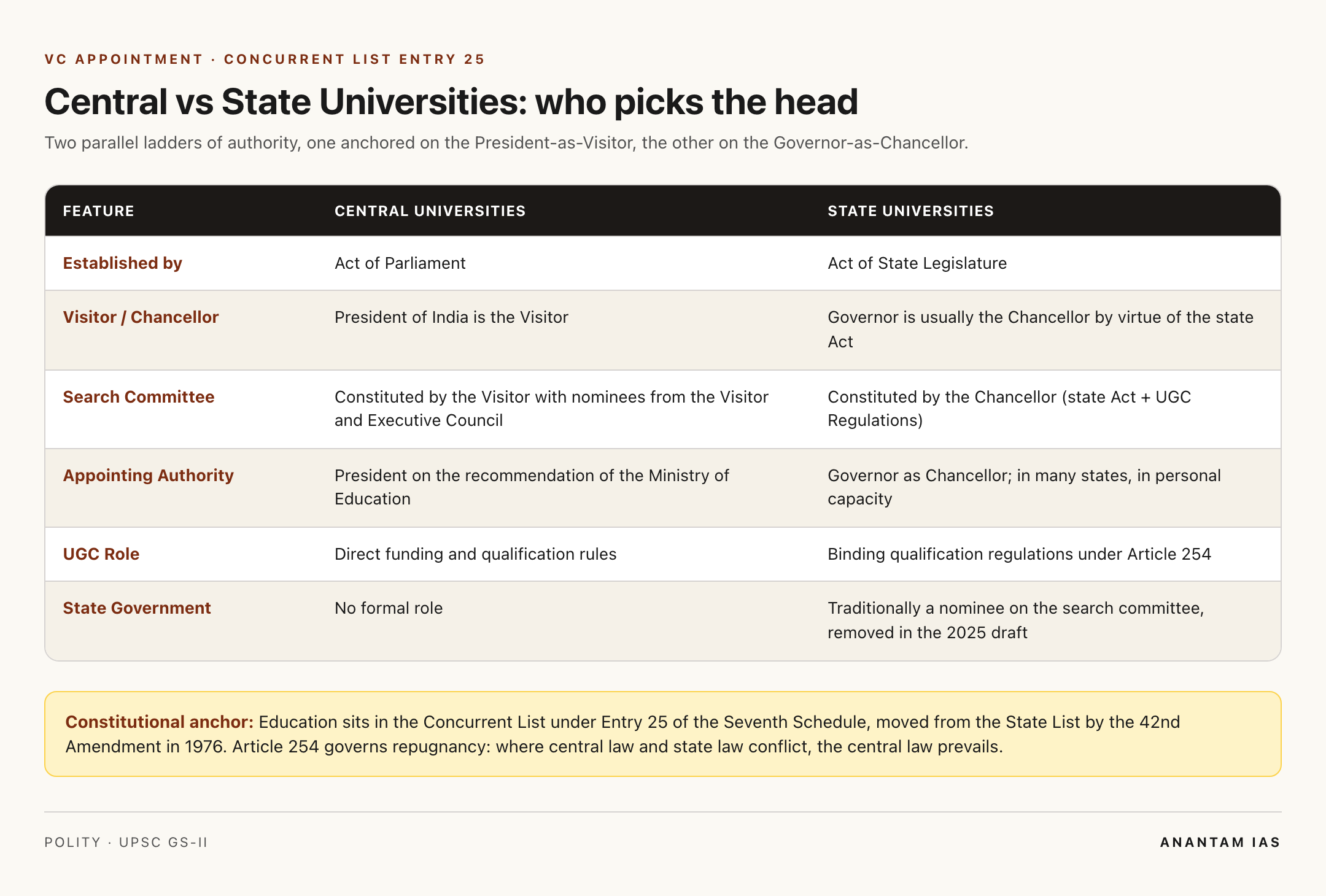
A Vice-Chancellor is the executive head of an Indian university. Central universities are established by an Act of Parliament; the President of India is the Visitor and appoints the VC on the recommendation of the Ministry of Education. State universities are established by an Act of the state legislature, and the Governor ordinarily acts as the Chancellor by virtue of that state Act. The UGC, a statutory body under the UGC Act, 1956, prescribes minimum qualifications for VCs through periodically revised UGC Regulations. The Supreme Court in Gambhirdan K Gadhvi v. State of Gujarat (2022) ruled that any VC appointment in violation of UGC Regulations is void ab initio. The Sarkaria Commission held that the Governor as Chancellor must act in his personal capacity, while the Punchhi Commission recommended removing the Governor from the Chancellor’s role altogether.
What the VC Appointment Question Actually Is
The question is deceptively simple: who picks the Vice-Chancellor of a state university, and on what terms. The longer answer pulls in three pieces of law and three constitutional actors. The first piece is the state university Act, which usually defines the search committee, names the Chancellor, and lists the appointing authority. The second is the UGC Regulations on Minimum Qualifications for Appointment of Teachers and Other Academic Staff, most recently revised in 2018 with a 2025 draft awaiting notification. The third is the Constitution itself, which assigns higher education to the Concurrent List and gives the Centre the upper hand under Article 254.
The three actors are the state government, the Governor as Chancellor, and the UGC representing the Centre. Until 2014, the working compromise allowed each to nominate one member to the search committee. The 2025 draft replaces that arrangement with a Chancellor-led committee in which the state government has no automatic seat.
Background and Historical Context
The Indian university system inherited a colonial template in which the Vice-Chancellor was an academic appointment ratified by political authority. The University of Calcutta Act of 1857 set the pattern. After independence, the question of who should appoint the VC was answered piecemeal in each state university statute, but a common practice emerged: the Chancellor was the constitutional head, the search committee did the shortlisting, and the appointment was issued in the name of the Chancellor on the advice of the council of ministers.
The UGC Act of 1956 added a layer. The UGC was empowered to prescribe minimum standards for teaching staff and Vice-Chancellors. Over the years, successive UGC Regulations on Minimum Qualifications for Appointment of Teachers, especially the 2010 and 2018 versions, gradually tightened the qualification bar and prescribed the broad outline of search-cum-selection committees.
Until 2010, the working understanding was that state universities largely set their own search procedures and followed UGC qualifications as guidance. The 2018 Regulations made the search-cum-selection committee model mandatory and required at least one UGC nominee. State governments, especially in states where the Governor and the Centre were politically aligned against the state ruling party, started to feel the squeeze. The 2025 Draft Regulations, by reducing the committee to three members and removing the state government’s automatic seat, has converted a low-grade tension into a full-blown federalism dispute.
VC Appointment Process: Central vs State Universities
In central universities the line of authority is uncomplicated. The university is established by an Act of Parliament. The Act names the President of India as the Visitor. The Visitor constitutes the search committee, which usually comprises nominees of the Visitor and the Executive Council. The committee submits a panel of three to five names. The Visitor, on the recommendation of the Ministry of Education, appoints one of them as VC. There is no role for the state government.
State universities work differently. The university is established by a state Act. The state Act typically names the Governor as the Chancellor in his ex officio capacity. The Chancellor constitutes the search committee, but the state Act usually obliges him to do so on the advice of the council of ministers or in consultation with the state government. The committee shortlists candidates, the Chancellor makes the final pick, and the appointment is issued in his name. In practice, the appointing power has come to be exercised by the Chancellor in personal capacity in many states, especially where the state has stripped the formal advisory role from the council of ministers through amendment.
The UGC 2025 Draft Regulations: What Changes
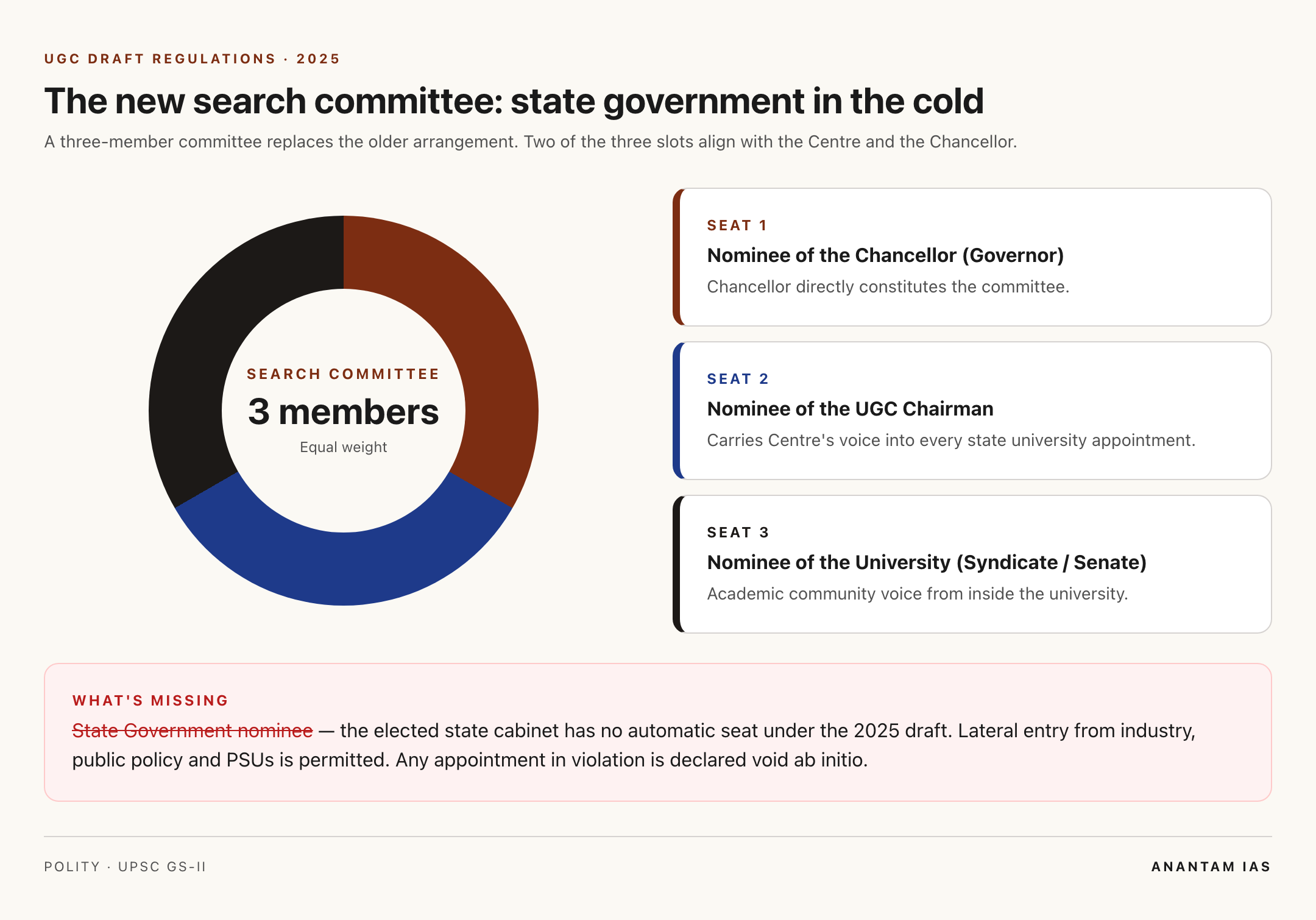
The 2025 Draft Regulations on Minimum Qualifications for Appointment of Teachers and Other Academic Staff and Measures for Maintenance of Standards in Higher Education make four changes that matter for VC appointments. First, the search-cum-selection committee shrinks to three members: one nominee of the Chancellor, one nominee of the UGC Chairman, and one nominee of the university’s apex body, the Syndicate or Senate. The state government no longer has a guaranteed seat on the committee. Second, the Chancellor directly constitutes the committee, replacing the older practice of state government-led notifications. Third, lateral entry is allowed: candidates from industry, public administration, public policy and PSUs with a distinguished record can be considered for the VC post even without the traditional ten years of academic teaching experience. Fourth, the disqualification clause makes any appointment in violation of the regulations void from inception.
Each of these is contested. State governments argue that the first two changes effectively transfer appointment power from elected state cabinets to the Centre and the Governor, against the cooperative spirit of Entry 25. Lateral entry is welcomed by industry groups but criticised by academic associations as opening the door to political appointments. The void ab initio clause is a direct echo of Gambhirdan K Gadhvi and is meant to head off the practice of states issuing appointments and litigating later.
Why the VC Question Matters for Federalism
A Vice-Chancellor decides everything from the academic calendar and faculty hiring to the disciplinary policy and the political climate of the campus. State governments have argued that since they fund a substantial portion of state university budgets, set the language of instruction, and shape the curriculum within UGC norms, the VC choice is integral to the constitutional space reserved for states under Entry 25. The Centre’s reply rests on minimum standards and recognition: a degree from a university that does not follow UGC rules cannot be recognised for higher studies or for central government employment, so UGC norms protect the student rather than centralise power.
The fault lines have hardened in three states. Kerala has passed legislation removing the Governor as Chancellor of state universities and replacing him with appointed academics. The bills have been held up by gubernatorial assent. Tamil Nadu has passed an amendment that vests the VC appointment power in the state government, which the Governor has reserved for the President’s consideration. West Bengal has a long-running dispute over the Chancellor’s powers and has separately passed a law making the Chief Minister the Chancellor, again caught in gubernatorial assent. Each of these disputes ties into the larger governor of india discretionary powers debate and the boundaries of governor discretionary powers on bills passed by state legislatures.
Detailed Analysis: Concurrent List, Article 254 and the Gambhirdan Verdict
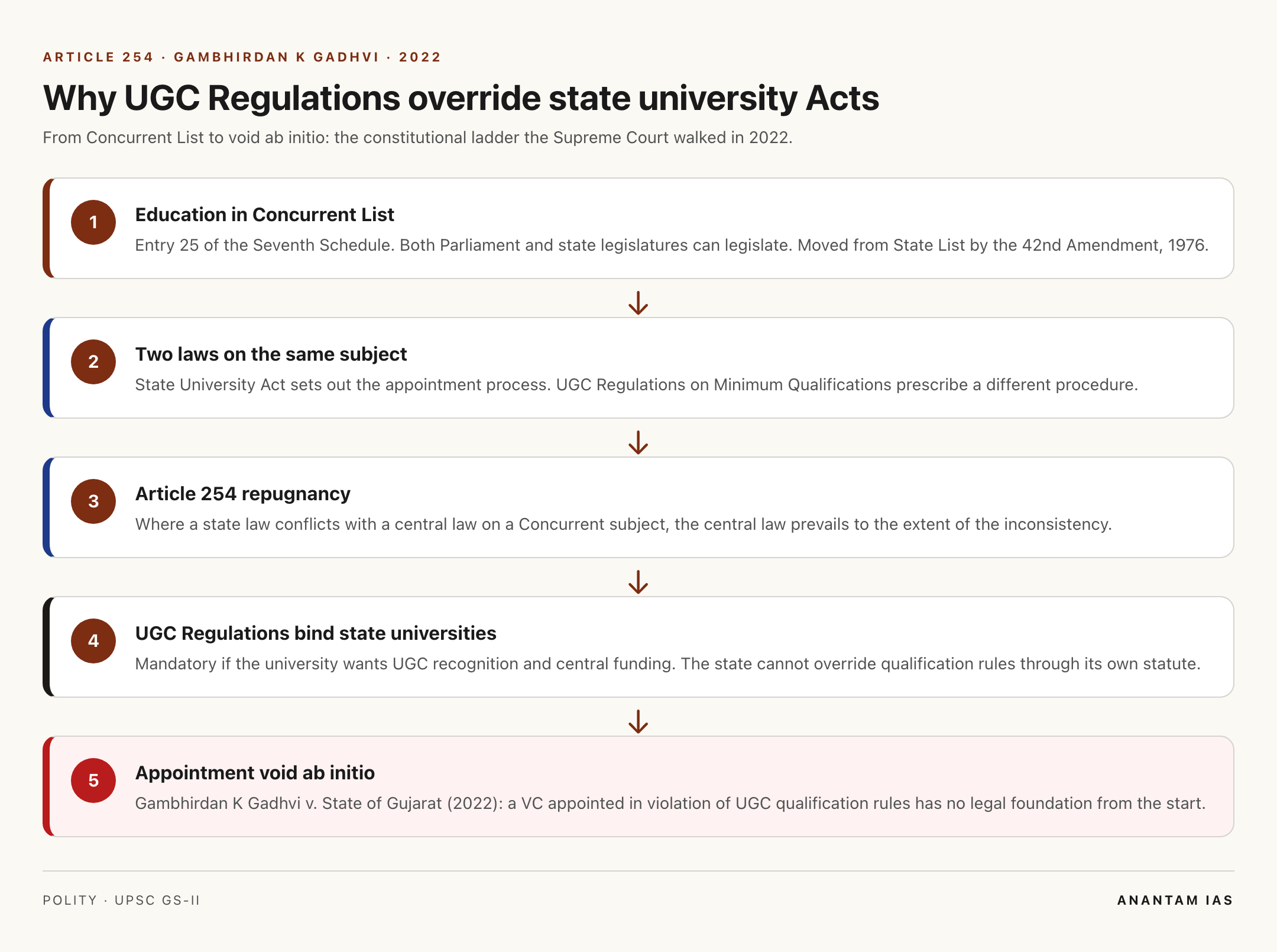
The constitutional law of VC appointments turns on three doors. The first is Entry 25 of the Concurrent List, which puts education, including universities, technical and medical education, in the area where both Parliament and state legislatures can legislate. The original Entry 11 of the State List was moved to the Concurrent List by the 42nd Constitutional Amendment in 1976, a centralising move that has been preserved despite the 44th amendment of Indian constitution rollback of other emergency-era changes. The shift gave Parliament a clear basis to legislate on universities through the UGC Act and to issue binding regulations through the UGC.
The second door is Article 254, the repugnancy clause. Where a central law and a state law deal with a Concurrent List subject and the two are inconsistent, the central law prevails to the extent of the inconsistency. Article 254(2) carves out an exception: a state law repugnant to a central law can prevail in the state if it has received presidential assent, but even then Parliament can override the state law later.
The third door is the Supreme Court’s reading of these provisions in higher education. In Gambhirdan K Gadhvi v. State of Gujarat in 2022, the Court considered the appointment of a VC at Sardar Patel University. The state’s nominee did not satisfy the UGC’s qualification requirement, but the appointment had been made under the state university Act. The Court held that UGC Regulations on minimum qualifications were binding on state universities by virtue of Entry 25 read with Article 254. The state law could not override the UGC Regulations on qualifications. Any appointment made in violation was void ab initio. The judgment has since been applied in dozens of writ petitions, including disputes over appointments in Kerala universities and the West Bengal-Visva Bharati appointment.
Sarkaria and Punchhi Commissions: The Governor as Chancellor
The role of the Governor as Chancellor has been examined by every commission on centre-state relations. The Sarkaria Commission, which submitted its report in 1988, took a moderate view. It held that the Governor as Chancellor should act in his personal capacity, not as a representative of the Centre, and should rise above the political fray. The Commission did not recommend removing the Governor from the Chancellor’s role.
The Punchhi Commission, which reported in 2010, went further. It explicitly recommended that the Governor should not be the ex officio Chancellor of state universities. The Commission noted that the Chancellor’s role frequently brought the Governor into political conflict with the elected state government, and that this was inconsistent with the constitutional design of the Governor as a non-political head of the state. The recommendation has not been implemented and is at the heart of the current Kerala and Tamil Nadu legislation.
Comparative Frame: Other Federal Systems
A short comparative scan helps frame the Indian dispute. In the United States, public universities are creatures of state law, and the choice of president is overwhelmingly a state-level decision through boards of regents appointed by the governor or the state legislature. The federal government’s leverage runs through accreditation and federal research funding, not through direct involvement in appointments.
In Germany, university heads are usually elected by the academic senate from within or sometimes outside the university, and federal-state coordination runs through the Hochschulrektorenkonferenz and the Standing Conference of Education Ministers, not through a federal regulator with binding qualification rules.
In Australia, university appointments are entirely a matter for the university’s governing council, with the federal government’s role limited to regulation through the Tertiary Education Quality and Standards Agency. Australia has nothing comparable to the UGC’s binding regulation of search committees.
These comparisons are not direct precedents, but they highlight that India’s UGC-led model of binding qualification rules and prescribed search committees is unusually centralised by global standards.
Challenges and Open Questions
The 2025 draft amplifies four challenges. The first is the legitimacy of the UGC Chairman’s nominee. The UGC is an autonomous statutory body, but the Chairman is appointed by the central government, and most members are central appointees. Giving the Chairman’s nominee a third of the search committee in every state university effectively centralises political and administrative influence over state university appointments.
The second is the silent demotion of the state government. Under the older 2018 regime, the state government was usually represented either through its own nominee or through the Chancellor-as-state-actor template. The new draft removes both routes. The Chancellor acts in his capacity as a constitutional figure, the UGC Chairman represents the Centre, and the university body represents the academic community. The elected state cabinet is left out.
The third is judicial review. After Gambhirdan, courts have grown comfortable striking down VC appointments in violation of UGC norms, but they remain reluctant to police the political wisdom of who is chosen from the panel. This means the search and selection process can be tilted in advance even if the end appointment looks formally compliant.
The fourth is the cumulative impact on state autonomy. State governments argue that VC appointments are merely the loudest example of a broader trend of using statutory regulators and constitutional functionaries to centralise effective power without amending the Constitution itself. The argument resonates with the seventh schedule of indian constitution debate over how Concurrent List subjects are increasingly being managed in the centre’s favour.
Prelims Pointers
Education is in the Concurrent List under Entry 25 of the Seventh Schedule, moved there from the State List by the 42nd Amendment in 1976. The President is the Visitor of central universities. The Governor is usually the Chancellor of state universities by virtue of the state Act, not the Constitution. The UGC is a statutory body under the UGC Act, 1956, not a constitutional body. UGC Regulations on minimum qualifications are binding on state universities. Article 254 governs repugnancy between central and state laws on Concurrent List subjects. Gambhirdan K Gadhvi v. State of Gujarat was decided by the Supreme Court in 2022. The Sarkaria Commission recommended retaining the Governor as Chancellor in personal capacity; the Punchhi Commission recommended removing the Governor from the Chancellor’s role.
Mains Practice Questions
Examine the federal questions raised by the UGC Draft Regulations of 2025 on the appointment of Vice-Chancellors of state universities.
Discuss the role of the Governor as Chancellor of state universities and evaluate the recommendations of the Sarkaria and Punchhi Commissions in this regard.
Analyse the impact of the Supreme Court’s judgment in Gambhirdan K Gadhvi v. State of Gujarat on the appointment of Vice-Chancellors in state universities.
Critically examine the centralising drift in higher education governance in India and suggest measures to balance national standards with state autonomy.
Way Forward
A balanced reform would preserve UGC’s role in setting minimum qualifications while restoring the state government’s seat on the search-cum-selection committee. A four-member committee with one nominee each from the Chancellor, the UGC, the university body, and the state government would respect both Concurrent List jurisdictions. Lateral entry should be permitted but ring-fenced through stricter eligibility criteria, including a demonstrated record of academic leadership.
The Punchhi Commission’s recommendation to remove the Governor from the Chancellor’s role deserves serious legislative consideration. Replacing the Governor with an academic Chancellor chosen by the state government from a panel proposed by the UGC would lower the political temperature of state university appointments without conceding minimum standards. In the meantime, state laws transferring Chancellor functions, currently held up by gubernatorial assent, should be referred to the President with a clear timeline for decision rather than left in indefinite abeyance.
Frequently Asked Questions
Who appoints the Vice-Chancellor of a central university?
The President of India, in his capacity as the Visitor of central universities, appoints the Vice-Chancellor on the recommendation of the Ministry of Education. The selection is made from a panel of names prepared by a search committee constituted by the Visitor.
Who appoints the Vice-Chancellor of a state university?
The Governor, acting as the Chancellor of the state university by virtue of the state university Act, appoints the Vice-Chancellor. The selection is made from a panel prepared by a search-cum-selection committee constituted under the state Act and UGC Regulations.
What is the role of the UGC in VC appointments?
The UGC issues binding Regulations on Minimum Qualifications for Appointment of Teachers and Other Academic Staff, including Vice-Chancellors. These regulations prescribe qualifications, the structure of the search committee, and the procedure to be followed. State universities must comply if they wish to retain UGC recognition and access central funding.
What did the Gambhirdan K Gadhvi case decide?
In Gambhirdan K Gadhvi v. State of Gujarat (2022), the Supreme Court held that UGC Regulations on minimum qualifications for VCs are binding on state universities and that any appointment made in violation of these regulations is void ab initio. The judgment relied on Article 254 read with Entry 25 of the Concurrent List.
What is the constitutional basis for UGC Regulations binding state universities?
Education, including universities, is in the Concurrent List under Entry 25 of the Seventh Schedule. Both Parliament and state legislatures can legislate on it. Where a central law and regulations under it conflict with a state law, Article 254 says the central law prevails.
What changes does the UGC Draft Regulations of 2025 propose?
The 2025 draft proposes a three-member search-cum-selection committee with nominees from the Chancellor, the UGC Chairman and the university’s apex body. The state government no longer has an automatic seat. The Chancellor directly constitutes the committee. Lateral entry from industry, public policy and PSUs is permitted. Any appointment in violation of these regulations is declared void ab initio.
Why have states like Kerala and Tamil Nadu objected?
State governments argue that the new framework strips elected state cabinets of any meaningful role in choosing the head of a state university, even though states fund and manage these universities. They see the framework as a centralising move that uses Concurrent List jurisdiction to override state autonomy.
What did the Sarkaria and Punchhi Commissions say about the Governor as Chancellor?
The Sarkaria Commission held that the Governor as Chancellor should act in his personal capacity and not as a representative of the Centre, and did not recommend removing the Governor from the Chancellor’s role. The Punchhi Commission went further and recommended that the Governor should not be the Chancellor of state universities.
Can a state law remove the Governor as Chancellor of state universities?
A state legislature can amend its university Act to replace the Governor with another Chancellor, since the Governor’s role as Chancellor is conferred by state law and not by the Constitution itself. Such amendments need gubernatorial assent and may be reserved by the Governor for the President’s consideration, which has slowed implementation in Kerala, Tamil Nadu and West Bengal.
Are decisions of the search-cum-selection committee binding?
The committee submits a panel of names. The appointing authority, the Chancellor in state universities and the President in central universities, picks one name from the panel. The committee’s panel is the universe of choice; the Chancellor or Visitor cannot pick a name outside the panel without restarting the process.