Governor of India: Role, Powers & Appointment
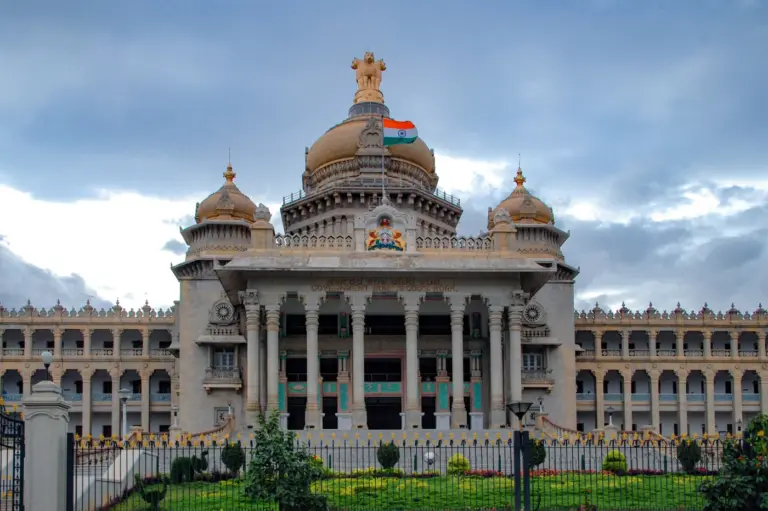
The Governor is the constitutional head of a state — the bridge between the Union government and state administration. Under Articles 153 to 167 of the Indian Constitution, the Governor’s office combines formal constitutional duties with significant discretionary powers that have repeatedly shaped political outcomes. But the Governor is not a sovereign. The position operates within a web of conventions, constitutional provisions, and court-imposed limits that you must understand thoroughly for the UPSC examination.
Constitutional Basis: Articles 153–167
The Governor’s office finds its foundation in Part VI of the Constitution. Article 153 says there shall be a Governor for each state. The same person can act as Governor of two or more states — a practical flexibility introduced to handle smaller states without multiplying constitutional offices.
Key Articles at a Glance
| Article | Subject |
|---|---|
| Article 153 | Governor for each state |
| Article 154 | Executive power of the state vested in Governor |
| Article 155 | Appointment by the President |
| Article 156 | Term of office (5 years, pleasure of President) |
| Article 157 | Qualifications (citizen, 35 years minimum) |
| Article 158 | Conditions of office (no profit-making positions) |
| Article 161 | Power to grant pardons, reprieves |
| Article 163 | Council of Ministers to aid and advise Governor |
| Article 164 | Appointment of Chief Minister by Governor |
| Article 166 | Conduct of business of state government |
| Article 167 | CM’s duty to furnish information to Governor |
So the constitutional architecture is clear: the Governor formally heads the state executive, appoints the Chief Minister, and acts on the aid and advice of the Council of Ministers — except in matters where the Constitution expressly allows discretion.
Appointment, Tenure & Removal
How the Governor Is Appointed
The Governor is appointed by the President of India under Article 155. This is a nominal exercise — in practice, the Union Cabinet recommends the name and the President acts on that advice. The Governor holds office during the pleasure of the President (Article 156), which means the Union government can remove a Governor at any time without giving reasons.
But this pleasure cannot be exercised arbitrarily. The Supreme Court in B.P. Singhal v. Union of India (2010) held that a Governor cannot be removed merely because the political party in power at the Centre has changed, or because the Union government disagrees with the Governor’s actions. The Court said removal must be for “valid reasons” — though it did not require those reasons to be disclosed.
Qualifications
Under Article 157, the Governor must be:
- A citizen of India
- At least 35 years of age
And under Article 158, the Governor:
- Must not be a Member of Parliament or state legislature
- Must not hold any other office of profit
- Is entitled to free official residence, salary, and allowances charged to the Consolidated Fund of the State
Term of Office
Formally, the Governor’s term is five years — but this is subject to the President’s pleasure. In practice, Governors have been removed or transferred mid-term when state governments change or political calculations shift. This is a persistent source of controversy.
Who Should Be Appointed Governor?
The Sarkaria Commission (1988) recommended that Governors should be:
- Eminent figures in public life
- Not from the state where they are posted (to ensure detachment)
- Not recently active in state politics
- Acceptable to the Chief Minister of the state
The Punchhi Commission (2010) went further, recommending that the convention of consulting the Chief Minister before appointing a Governor should be formalised. These recommendations have largely been ignored in practice.
Executive Powers
The Governor is the formal executive head of the state. Under Article 154, all executive actions of the state government are formally taken in the Governor’s name. But real executive power lies with the Council of Ministers headed by the Chief Minister.
Appointment Powers
The Governor appoints:
- The Chief Minister (Article 164)
- Other Ministers on the advice of the Chief Minister
- The Advocate General of the state
- Members of the State Public Service Commission
- The State Election Commissioner
- Vice-Chancellors of state universities (in many states)
The Chief Minister appointment looks simple — the leader of the majority party is appointed. But where no party commands a clear majority (hung assembly), the Governor’s discretion becomes crucial. Who gets first chance to prove majority? How long is the floor test given? These decisions have enormous political consequences.
Legislative Powers
Summoning, Proroguing & Dissolving
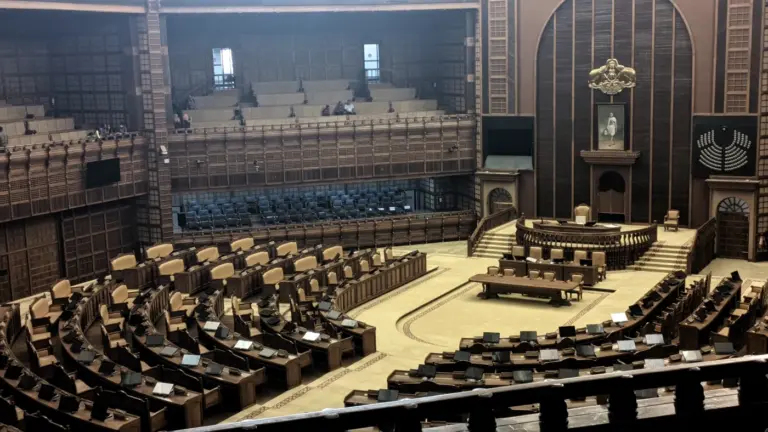
The Governor summons, prorogues, and dissolves the state legislature (Article 174). The Governor addresses the first session after each election and the first session of every year. Bills passed by the state legislature require the Governor’s assent.
What Can the Governor Do with a Bill?
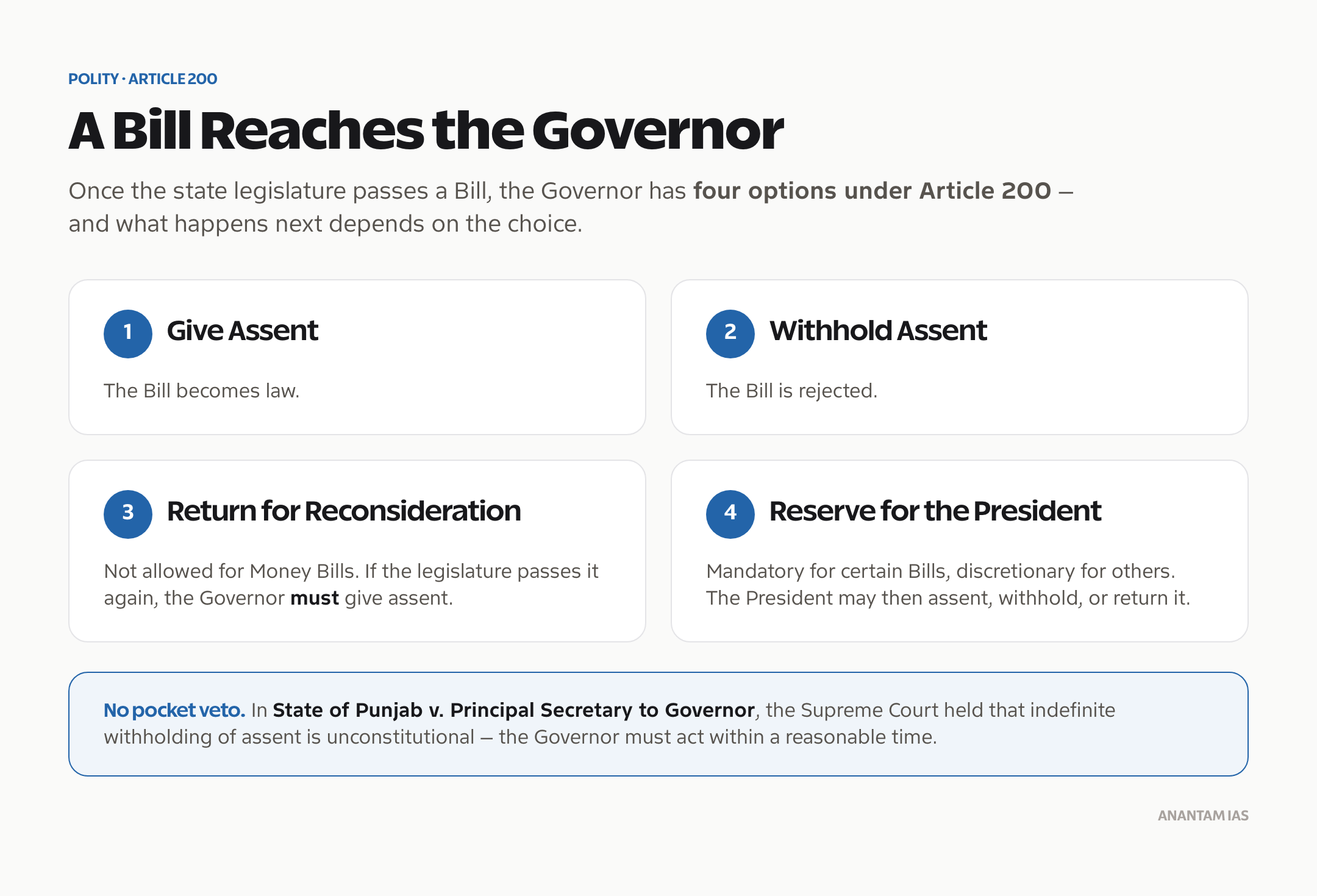
When a bill is presented after passage by the legislature, the Governor has four options under Article 200:
- Give assent — the bill becomes law
- Withhold assent — the bill is rejected
- Return the bill for reconsideration (except for Money Bills) — if the legislature passes it again, the Governor must give assent
- Reserve the bill for the President’s consideration — mandatory for certain bills; discretionary for others
The power to reserve a bill is significant. Governors have reserved bills on financial matters, bills affecting central legislation, and bills deemed unconstitutional. Once reserved, the President can assent, withhold assent, or return for reconsideration.
Ordinance-Making Power
Under Article 213, the Governor can promulgate ordinances when the state legislature is not in session. This is equivalent to the President’s power under Article 123 at the national level.
An ordinance has the same force as a legislative act. It must be laid before the legislature when it reassembles and lapses if not approved within six weeks of the reassembly. An ordinance can also be withdrawn by the Governor at any time.
Key limitations on ordinance power:
- Legislature must not be in session
- Governor must be satisfied that immediate action is necessary
- Cannot make ordinances on subjects where the legislature itself cannot legislate
- A bill containing the same provisions must not have been rejected by the legislature in the same session
The Governor cannot promulgate an ordinance without the aid and advice of the Council of Ministers — unless acting in a personal discretion situation. In states under President’s Rule, the Governor exercises ordinance power independently.
Discretionary Powers
This is the most debated aspect of the Governor’s office. The Constitution explicitly allows the Governor to act in their personal discretion in certain cases — even without or against the advice of the Council of Ministers.
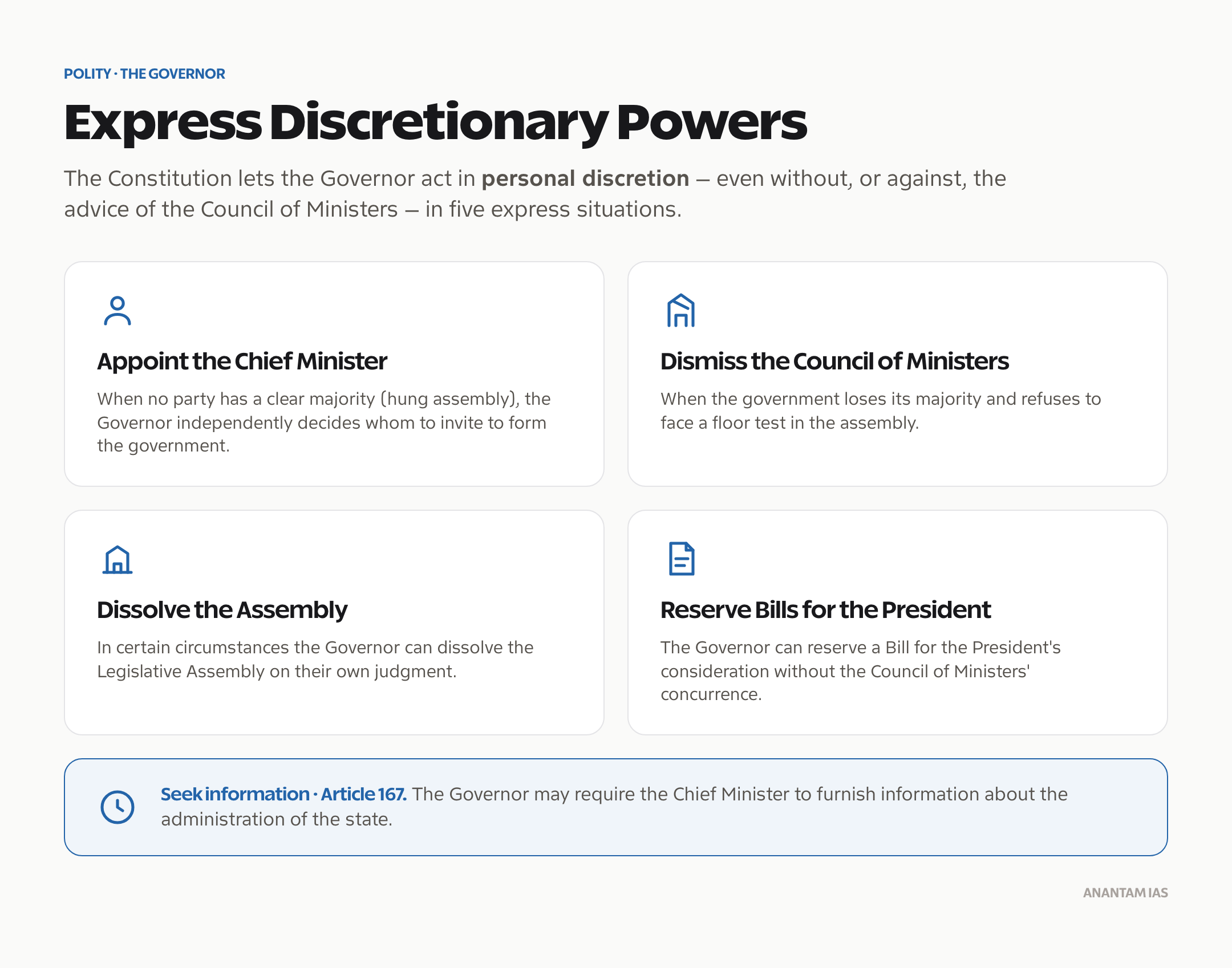
Express Discretionary Powers
- Reservation of bills for the President — the Governor can reserve a bill without the Council of Ministers’ concurrence
- Appointment of Chief Minister — when no clear majority exists, the Governor independently decides who to invite
- Dismissal of the Council of Ministers — when the government loses majority and refuses to face the floor test
- Dissolution of the Legislative Assembly — in certain circumstances, the Governor can dissolve the assembly on their own judgment
- Seeking information from the Chief Minister under Article 167
Situational Discretion
Beyond express discretion, there are grey zones where Governors exercise judgment:
- Deciding how long to delay sending a bill to the President
- Deciding timelines for floor tests in hung assemblies
- Choosing between competing claimants to form government after elections
The Supreme Court in Rameshwar Prasad v. Union of India (2006) — the Bihar dissolution case — held that the Governor’s recommendation for President’s Rule is justiciable. A Governor cannot recommend dissolution of an assembly on a wholly irrelevant or perverse basis.
Role in President’s Rule
Under Article 356, the President can impose President’s Rule on a state if, on the Governor’s report or otherwise, the President is satisfied that governance in the state cannot be carried out in accordance with the Constitution.
The Governor plays a crucial role here — both as the reporter of the constitutional breakdown and as the administrator once President’s Rule is imposed. The S.R. Bommai v. Union of India (1994) judgment imposed important safeguards: the floor test must be used to settle majority questions, not the Governor’s subjective satisfaction.
Sarkaria Commission Recommendations on Governor
The Sarkaria Commission (1983–88), set up to examine Centre-State relations, made several recommendations about the Governor:
- The convention that the Chief Minister is consulted before appointing a Governor should be observed in practice
- Governors should be eminent persons not recently active in state-level politics
- Governors should not be removed arbitrarily — only for compelling reasons
- The Governor should be a detached figure, not an agent of the Centre
- Ordinance power must be exercised only in genuine urgency
- Bills should not be indefinitely kept pending — a time limit should be fixed
Punchhi Commission Recommendations
The Punchhi Commission (2007–2010) revisited Centre-State relations and gave sharper recommendations:
- Term security: Governors should not be removed before completing five years except for misbehaviour or incapacity established through an inquiry
- Consultation formalised: Consultation with the Chief Minister before appointment should be made a constitutional requirement
- Time limit for assent: The Governor should act on bills within six months
- Removal procedure: Governors should be removed only by a resolution of the state legislature — similar to the procedure for removing a judge — to depoliticise the process
These recommendations, if implemented, would substantially reduce the Governor’s role as a political instrument of the Centre.
Governor vs President: Key Differences
| Feature | President | Governor |
|---|---|---|
| Election | Elected by Electoral College | Appointed by President |
| Removal | Impeachment by Parliament | Pleasure of President |
| Veto on bills | Pocket veto available | No pocket veto (must decide) |
| Ordinance power | Article 123 | Article 213 |
| Emergency | Article 352, 356, 360 | No emergency powers |
| Discretion | Virtually none (aid and advice) | Express & situational discretion |
Controversies and Recent Developments
The Governor’s office has been embroiled in recurring controversies:
- Tamil Nadu (2023): The Governor sat on bills passed by the legislature for months, sparking a constitutional standoff. The Supreme Court ruled that indefinite withholding of assent is unconstitutional and that the Governor must act within a reasonable time.
- Kerala and other states: Multiple instances of Governors refusing to summon sessions or delaying appointments prompted court intervention.
- Telangana (2023): The Supreme Court held that the Governor cannot return bills arbitrarily and cannot indefinitely withhold assent — a landmark clarification of Article 200.
The SC’s decision in State of Punjab v. Principal Secretary to Governor (2023) is essential reading. The Court held that Articles 163 and 200 don’t give the Governor a pocket veto. Once a bill is returned and re-passed by the legislature, the Governor must assent.
Frequently Asked Questions
Q1. Can the Governor refuse to appoint the Chief Minister of a party with clear majority?
No. Where a single party commands a clear majority, the Governor has no discretion. The leader of that party must be appointed Chief Minister. Discretion only arises in a hung assembly.
Q2. What happens if the Governor does not act on a bill?
The Supreme Court has ruled that indefinite inaction is unconstitutional. The Governor must either assent, return, or reserve the bill within a reasonable time. The Court can compel action through a writ.
Q3. Can a Governor be impeached like the President?
No. There is no impeachment procedure for the Governor. The Governor serves at the pleasure of the President and can be removed by the President without a formal parliamentary process.
Q4. What is the difference between discretionary and situational powers?
Discretionary powers are expressly given by the Constitution (e.g., reserving bills). Situational powers arise in political grey zones — like deciding who forms the government after a hung assembly. Both are subjects of frequent litigation.
Q5. Are Sarkaria Commission recommendations binding?
No. They are recommendations of an advisory commission, not law. But courts have cited them to interpret constitutional conventions and the spirit of Centre-State relations.
Tell Google you want more of this.
Add Anantam IAS as a preferred sourceOne tap, and this site shows up more often in your own Top Stories, AI Overviews and AI Mode. Remove it any time.