Disclosure: this guide contains Amazon affiliate links. As an Amazon Associate, Anantam IAS earns from qualifying purchases — at no extra cost to you.
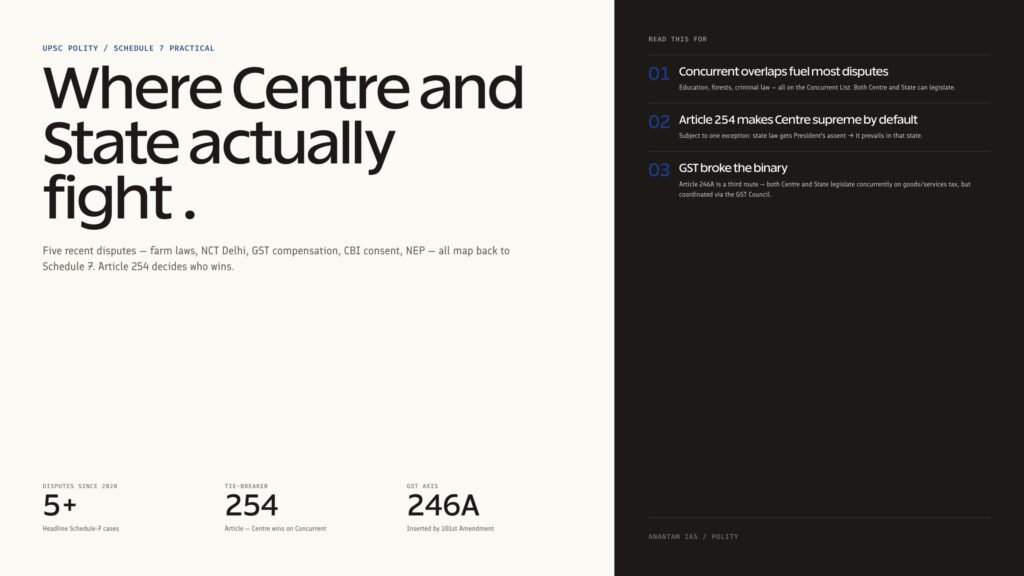
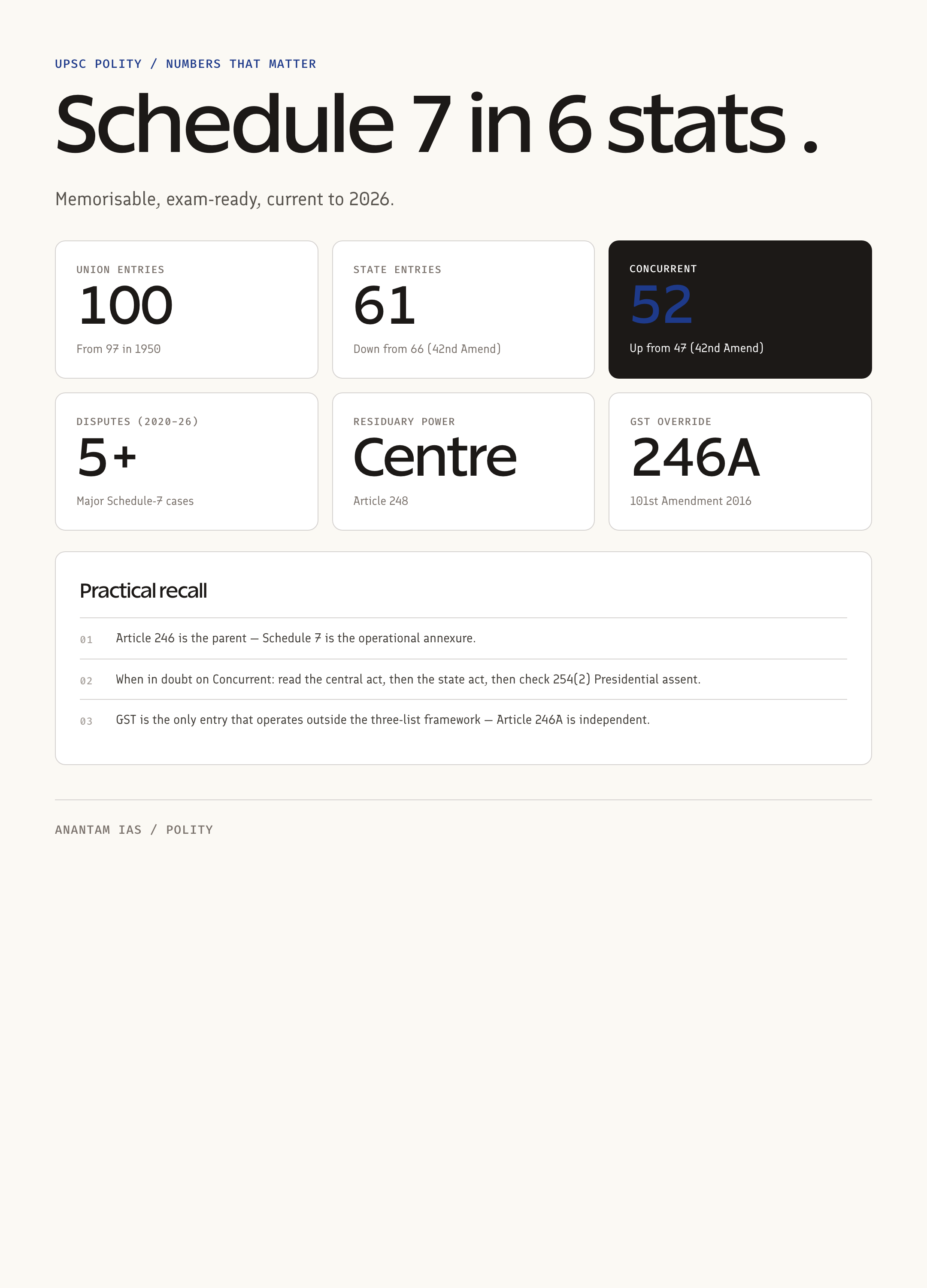
The Seventh Schedule of the Indian Constitution divides all legislative subjects between the Union and the States through three lists — the Union List (100 subjects), the State List (61 subjects), and the Concurrent List (52 subjects) — under Article 246. Parliament alone legislates on Union List subjects, State Legislatures on State List subjects, and both may legislate on Concurrent List subjects, where a central law prevails over a conflicting state law under Article 254. It is the operational core of Indian federalism.
The seventh schedule of indian constitution is the most cited Schedule in centre-state disputes — and the least understood at the operational level. Aspirants memorise the three lists. Then the question paper asks something nobody prepared for — what is Article 254? When does a state law on a Concurrent subject prevail? Why did the Supreme Court in State of West Bengal v. Kesoram Industries (2004) draw fine lines on entry 49 vs entry 52? This is where the Schedule stops being a list and starts being a constitutional battleground. This explainer takes the practical view — notable subjects, conflict mechanics, recent disputes through 2026, and the case law every aspirant must carry into the exam.
What is the Seventh Schedule of the Indian Constitution?
The Seventh Schedule of the Indian Constitution distributes legislative subjects between the Union and the States across three lists — Union List (100 subjects), State List (61 subjects), and Concurrent List (52 subjects) — operating under Article 246. Article 254 governs conflicts on the Concurrent List, with central law prevailing unless a state law has Presidential assent. The Schedule is the textual heart of Indian federalism.
Notable subjects on each list — the ones aspirants must know
You won’t be asked all 213 subjects. You’ll be asked the politically salient ones. Memorise these.
Union List — top 15 to know
- Defence of India (entry 1)
- Atomic energy (entry 6)
- Foreign affairs (entry 10)
- Citizenship (entry 17)
- Railways (entry 22)
- National highways (entry 23)
- Posts and telegraphs (entry 31)
- Currency, coinage, legal tender (entry 36)
- Reserve Bank of India (entry 38)
- Banking (entry 45)
- Insurance (entry 47)
- Stock exchanges, futures markets (entry 48)
- Income tax — non-agricultural (entry 82)
- Customs duties (entry 83)
- All India Services — linked to Article 312 — entry 70
State List — top 12 to know
- Public order (entry 1)
- Police (entry 2)
- Local government (entry 5)
- Public health and sanitation (entry 6)
- Agriculture (entry 14)
- Land — rights, transfer, tenancy (entry 18)
- Fisheries (entry 21)
- Industries — except Union-declared (entry 24)
- Trade and commerce within state (entry 26)
- Markets and fairs (entry 28)
- Taxes on alcohol (entry 51)
- Stamp duties — except those in Union List (entry 63)
Concurrent List — top 12 to know
- Criminal law (entry 1) — IPC/BNS, CrPC/BNSS
- Marriage and divorce (entry 5)
- Contracts (entry 7)
- Bankruptcy and insolvency (entry 9)
- Trusts and trustees (entry 10)
- Administration of justice (entry 11A) — added by 42nd Amendment
- Forests (entry 17A) — added by 42nd Amendment
- Wildlife protection (entry 17B) — added by 42nd Amendment
- Trade unions, industrial disputes (entry 22)
- Social security (entry 23)
- Education (entry 25) — added by 42nd Amendment
- Drugs and poisons (entry 19)
Article 254 — how Concurrent List conflicts work
This is the operational core. Aspirants who don’t get Article 254 lose easy marks.
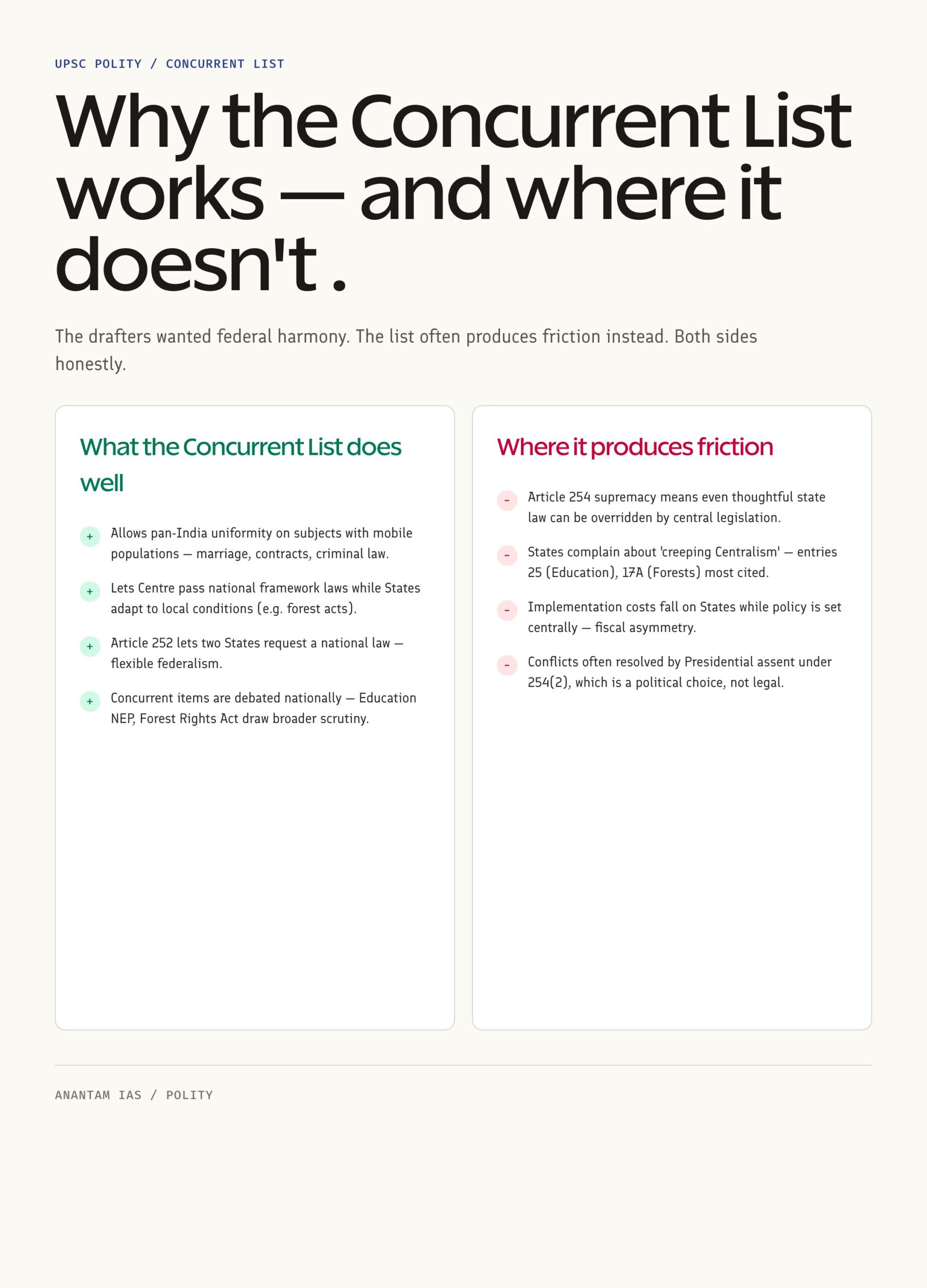
Rule (Article 254(1)): If a state law on a Concurrent List subject conflicts with a central law, the central law prevails. The state law is void to the extent of the inconsistency.
Exception (Article 254(2)): If the state law was reserved for the President’s consideration and received Presidential assent, the state law prevails in that state — but Parliament can subsequently amend, repeal, or override the state law.
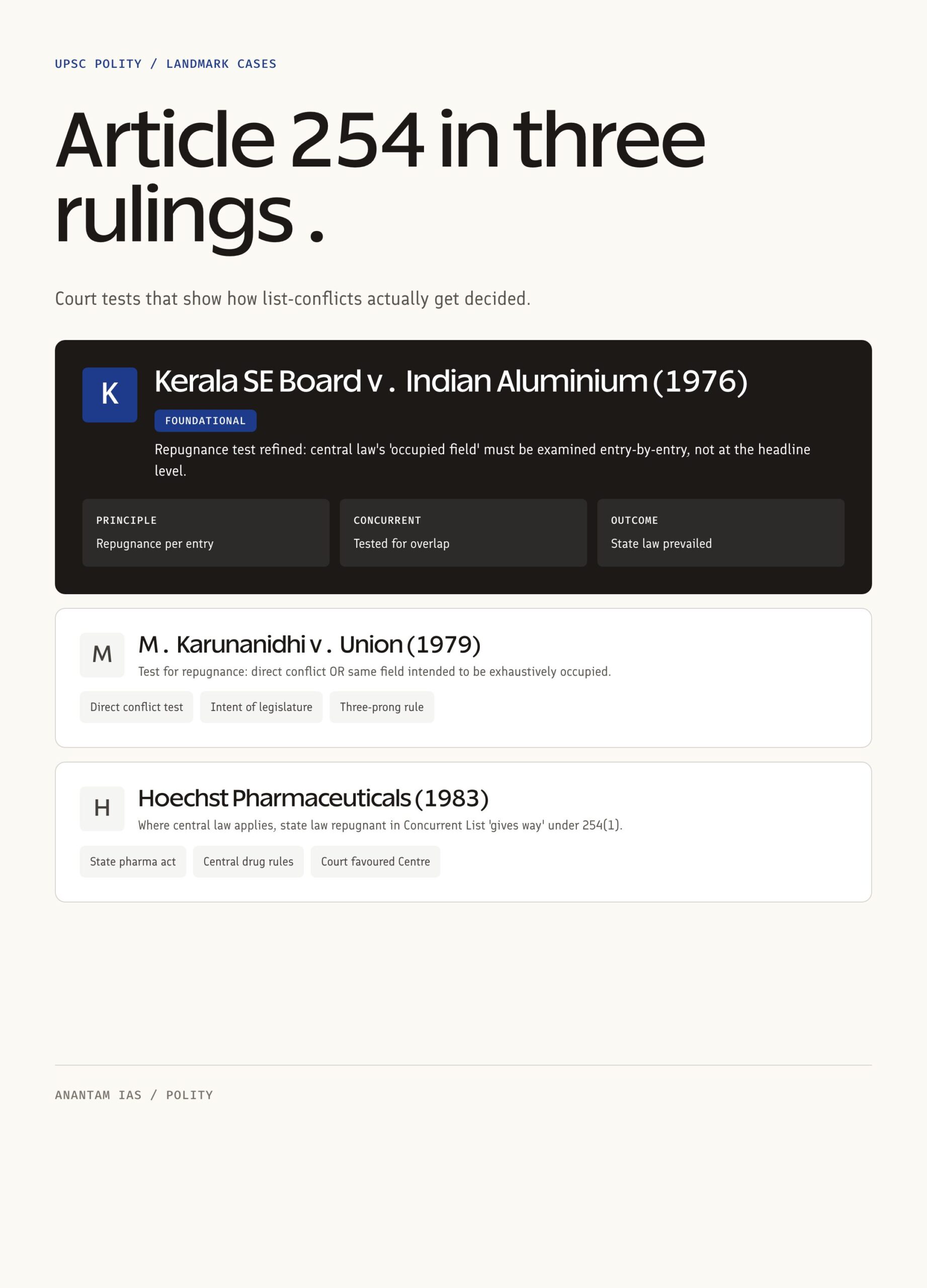
The doctrine of repugnancy. The Supreme Court has elaborated this in cases like Hoechst Pharmaceuticals v. State of Bihar (1983) and M. Karunanidhi v. Union of India (1979). Three tests:
- Is there a direct conflict between the two laws?
- Did Parliament intend to occupy the field?
- Does the central law cover the same subject as the state law?
If yes to any, repugnancy is triggered.
Implication. When a state passes a law on, say, agriculture (which is State List, but several aspects fall on Concurrent List entries 33 and 41), and the centre also passes a law touching the same subject — Article 254 decides who wins. State governments routinely use the Presidential assent route to protect their laws — the three Punjab farm law nullification acts of 2020 took this route, though the original central laws were eventually repealed.
Five recent centre-state disputes anchored in the 7th Schedule
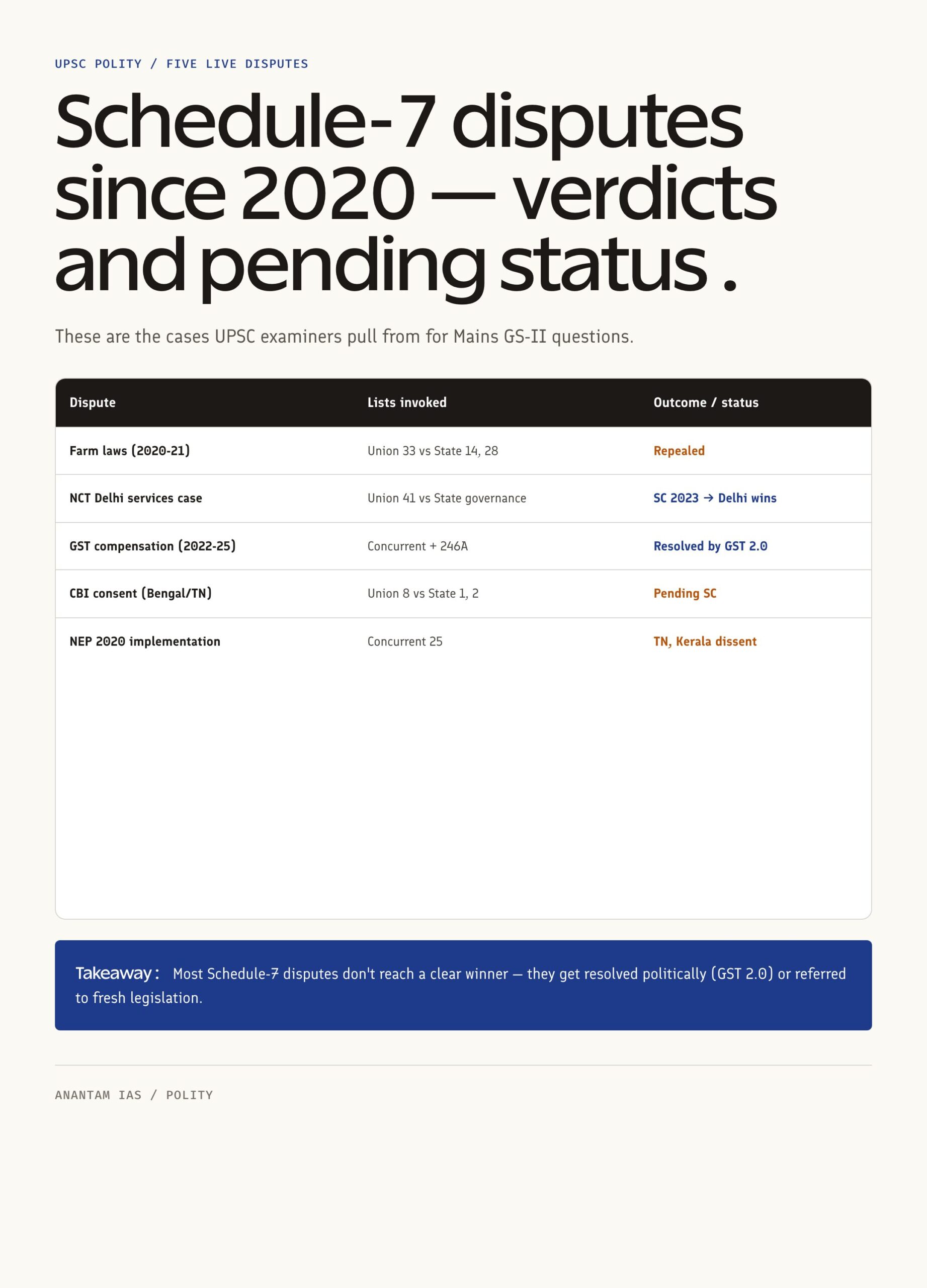
Dispute 1: Farm laws (2020–21). The three central farm laws were challenged on the ground that “agriculture” is entry 14 of the State List. The centre’s defence — they were trade-and-commerce laws (Concurrent entries 33, 41, 42; Union entry 42 for inter-state trade). The laws were repealed in November 2021 before the Supreme Court could rule decisively, but the Standing Committee report and several state assembly resolutions framed the issue around Schedule 7 boundaries.
Dispute 2: NCT Delhi services. Government of NCT of Delhi v. Union of India (2023) — the SC ruled the Delhi government had control over services. Parliament responded with the Government of NCT of Delhi (Amendment) Act, 2023, restoring LG control. Article 239AA is the special provision, but the dispute hinged on which List “services” falls under for a UT with a legislature.
Dispute 3: GST compensation. Article 246A (inserted by 101st Amendment, 2016) creates concurrent GST powers. The 2020-22 dispute on whether the Centre owed states GST compensation when revenues fell short during COVID became a Schedule 7 question — could states have unilaterally imposed certain taxes? The eventual settlement involved RBI borrowing on behalf of states.
Dispute 4: CBI general consent. Police is entry 2 of the State List. The Delhi Special Police Establishment Act, 1946 requires state consent for CBI to operate. West Bengal, Punjab, Tamil Nadu and others have withdrawn general consent. The pending case before the SC is on whether the centre can override this.
Dispute 5: NEP 2020 and education policy. Education is on the Concurrent List (entry 25). The centre’s NEP is a policy framework. States like Tamil Nadu, Kerala, and Karnataka have rejected the three-language formula, citing their concurrent power to legislate in their own way. This is a textbook Article 254 scenario waiting for litigation.
For a deeper take on these dynamics, see Cooperative & Competitive Federalism and Inter-State Council; on how courts decide which list a law truly belongs to, see the doctrine of pith and substance.
Significance — why this Schedule shows up across UPSC
1. Foundation of Indian federalism. Without Schedule 7, “federalism” is just a word in the Preamble. The Schedule operationalises it.
2. The framework for every centre-state dispute. Every time a state government clashes with the centre, the argument lands on which list the subject sits on. This makes Schedule 7 the most-cited Schedule in court.
3. The economic-policy backbone. GST, the 14th and 15th Finance Commission, the goods-and-services architecture all rest on Schedule 7 as amended by Articles 246A, 269A, and 279A. See Fiscal Federalism in India.
4. The institutional foundation for the All India Services. Entry 70 of the Union List, read with Article 312 and Rajya Sabha resolutions, is what allows IAS, IPS, and IFoS to exist as joint cadres.
5. The reform agenda. The Sarkaria Commission (1988), the Punchhi Commission (2010), and the M.M. Punchhi report all recommended specific Schedule 7 adjustments — most ignored. The pending agenda is real.
For the broader frame, anchor with Indian Constitution and Federalism in India.
Significant Supreme Court rulings on Schedule 7 — the case law you must know
State of West Bengal v. Union of India (1963) — Bengal challenged Centre’s power to acquire state land for coal mining. SC upheld Union’s power on the ground that India is not a “true federation” — entry 54 of Union List on regulation of mines and oilfields prevailed.
Kesavananda Bharati v. State of Kerala (1973) — though primarily about basic structure, the case had significant bearing on the federal balance.
S.R. Bommai v. Union of India (1994) — federalism declared part of basic structure. Article 356 limited.
ITC Ltd v. Agricultural Produce Market Committee (2002) — clarified entry 14 (agriculture) State List vs entry 52 (industries declared by Parliament) Union List on tobacco.
State of West Bengal v. Kesoram Industries (2004) — fine line between entry 49 (taxes on lands and buildings) State List and entry 52 Union List.
GST Council case — Union of India v. Mohit Mineral (2022) — recommendations of GST Council under Article 279A are not binding on Parliament/states.
Common misconceptions
Myth 1: Article 246 alone governs the Schedule 7 distribution. Wrong. Article 246 is the gateway, but you also need Article 248 (residuary powers), Article 254 (conflict resolution), and Article 246A (GST) to complete the picture.
Myth 2: A state law on the Concurrent List always loses to a central law. Wrong. Under Article 254(2), a state law that received Presidential assent prevails in that state. Parliament can later override.
Myth 3: All aspects of education are on the Concurrent List. Wrong. Education is entry 25 Concurrent. But entry 64 of the Union List covers institutions of national importance. Entry 65 covers Union institutions for professional education. Entry 66 covers coordination of higher education standards.
Myth 4: GST falls under the Concurrent List. Wrong. GST has its own architecture under Article 246A, which is a special concurrent power outside the three-list scheme. CGST is central; SGST is state; IGST is on inter-state supply.
Myth 5: Police is on the Concurrent List. Wrong. Police is entry 2 of the State List. This is a frequent error. The CBI Act draws on state consent precisely because police is a state subject.
How to revise this in 30 minutes
- Laxmikanth, Indian Polity, Chapter 13 — 12 minutes. Memorise headings, not all entries.
- Three landmark cases — Bommai, NCT Delhi v. Union, Mohit Mineral — 8 minutes.
- Article 254 mechanics — 5 minutes. Drill the repugnancy test.
- PRS analysis on the 101st Amendment and GST — 5 minutes.
Frequently Asked Questions
What does the Seventh Schedule of the Indian Constitution contain?
Three lists distributing legislative subjects — Union List (100), State List (61), Concurrent List (52) — under Article 246.
Which article handles Concurrent List conflicts?
Article 254. Central law prevails unless the state law was reserved for and received Presidential assent.
Why did the 42nd Amendment matter for the Seventh Schedule?
It moved five subjects — Education, Forests, Wildlife, Weights and Measures, Administration of Justice — from State to Concurrent List, expanding central reach.
Where do residuary powers lie?
With Parliament — Article 248 and entry 97 of the Union List.
Which list covers police and public order?
The State List — entries 1 (public order) and 2 (police).
Why is the Concurrent List called u0022concurrentu0022?
Because both Parliament and State Legislatures can make laws on those subjects concurrently. Article 254 governs conflicts.
Is GST on the Concurrent List?
Technically no. GST has its own constitutional treatment under Article 246A inserted by the 101st Amendment, 2016 — outside the three-list scheme.
Has any subject been moved between lists since 1976?
Marginal changes — entries on services tax, GST-related restructuring (101st Amendment, 2016), and minor adjustments. The big shift was the 42nd Amendment in 1976.
Tell Google you want more of this.
Add Anantam IAS as a preferred sourceOne tap, and this site shows up more often in your own Top Stories, AI Overviews and AI Mode. Remove it any time.