Chandrayaan-4: India’s Lunar Sample Return Mission Explained
Chandrayaan-4 for UPSC: ISRO's lunar sample return mission with five modules across two LVM3 launches, Earth-orbit docking, lunar ascent, and re-entry. Covers mission architecture, key technologies, comparison with Apollo and Chang'e, and where it fits in India's space programme.
If you stand at India’s spaceport in Sriharikota and watch a Chandrayaan launch, what you see is one rocket, one fairing, one payload. Chandrayaan-4 will be the first time you watch two. The mission will fly two LVM3 rockets carrying two separate stacks of spacecraft, dock them in Earth orbit, send the assembled spacecraft to the Moon, land near the lunar south pole, scoop and drill samples, lift those samples back off the Moon, dock again in lunar orbit, and finally return a sealed capsule of lunar material to a landing site on Earth. No Indian mission has attempted any one of those steps. Chandrayaan-4 will attempt all of them.
For UPSC aspirants, Chandrayaan-4 is the single best window into where India’s space programme is going in the late 2020s and 2030s. The mission is designed to validate the technologies that will eventually carry an Indian astronaut to the Moon under the Bharatiya Antariksh Station and Gaganyaan extended programme. It is also the first time India will attempt to return material from another celestial body to Earth, joining a club of three countries that have done so before.
This explainer walks through the mission architecture, the five modules, the engineering problems that make sample return so much harder than landing, and how Chandrayaan-4 compares with Apollo, the Soviet Luna programme, and China’s Chang’e missions.
Quick Facts: Chandrayaan-4 at a Glance
- Operator: Indian Space Research Organisation (ISRO)
- Mission type: Lunar Sample Return Mission (LSRM), the first by India
- Landing zone: Near Shiv Shakti Point at the lunar south pole, around 85 degrees south latitude
- Launch vehicle: Two separate LVM3 (Mark-3) launches, designated Stack 1 and Stack 2
- Module count: Five distinct modules across the two stacks
- Sample target: Around 2 to 3 kilograms of lunar surface and sub-surface material
- Drill depth: Up to 2 metres for sub-surface samples
- Critical technology validated: Earth orbit docking (heritage from SPADEX), lunar ascent, lunar orbit rendezvous, atmospheric re-entry from cislunar trajectory
- Significance: Stepping stone for the planned Indian crewed lunar mission and the Bharatiya Antariksh Station programme
What Is Chandrayaan-4?
Chandrayaan-4 is a robotic lunar sample return mission. The phrase has a precise meaning in space exploration. A flyby mission passes a body and observes it. An orbiter goes into orbit and observes from above. A lander touches down. A sample return mission lands, collects material, and brings it back to Earth for laboratory analysis. The last step is the hardest, because it requires the spacecraft to do something almost no robotic mission does: take off again.
The mission’s scientific case is straightforward. The lunar south pole is the most interesting region of the Moon for current science because it harbours water ice in permanently shadowed craters and contains material that has been undisturbed for billions of years. Returning samples allows analysis with instruments that are too large or too sensitive to fly. A mass spectrometer with a precision lab calibration on Earth can extract isotope ratios that no rover instrument can match. A returned sample tells us things a remote-controlled instrument cannot.
The strategic case is about validating capabilities. Each part of Chandrayaan-4, from the docking to the lunar ascent to the re-entry capsule, is a building block for the future. Without these capabilities, an Indian crewed lunar mission cannot happen. Chandrayaan-4 is the rehearsal.
Background and Historical Context
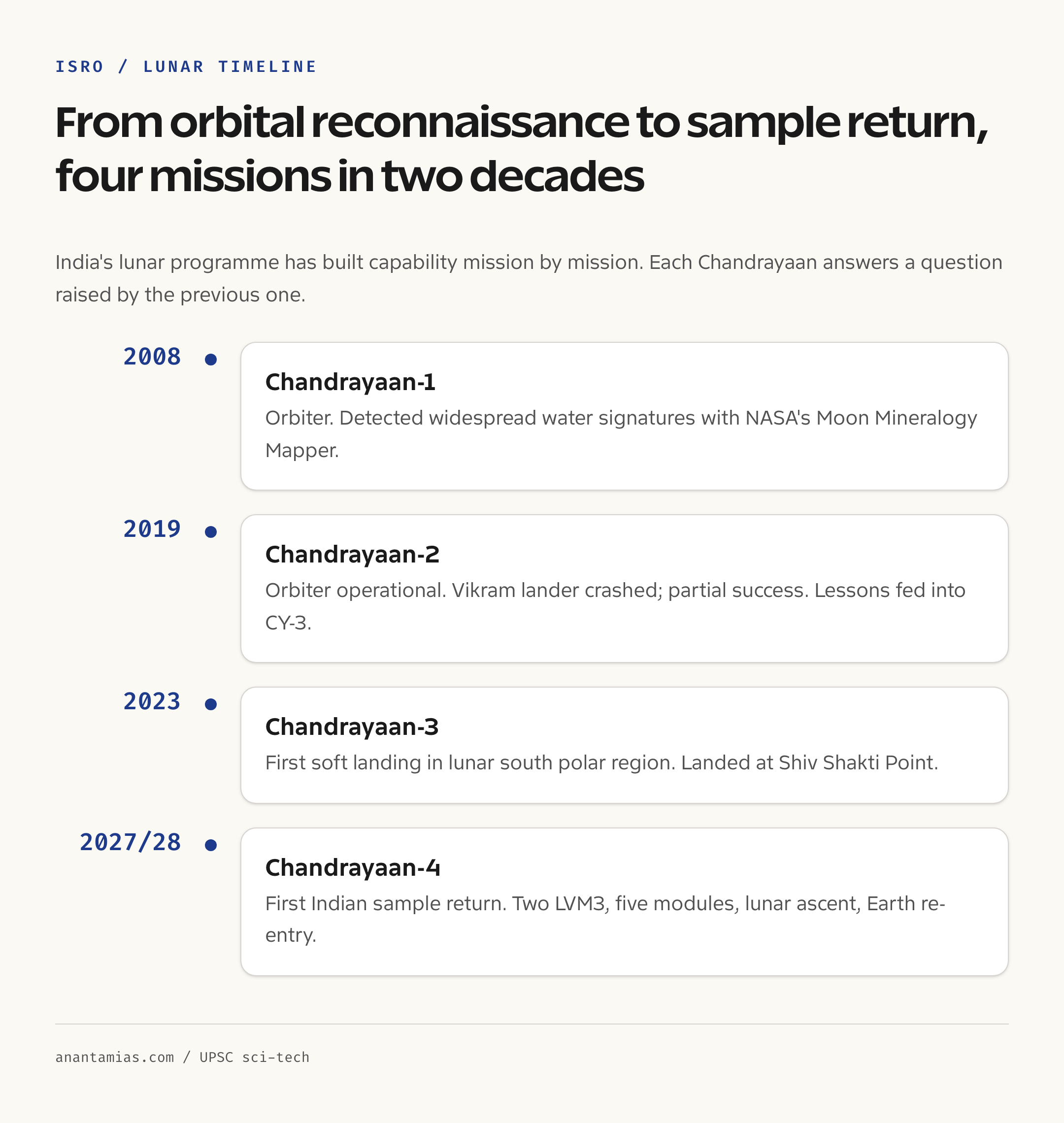
India’s Moon programme began in 2008 with Chandrayaan-1, an orbiter mission that carried a NASA instrument, the Moon Mineralogy Mapper, which detected widespread water signatures across the lunar surface. Chandrayaan-1 lasted less than a year before contact was lost, but it established that ISRO could navigate to the Moon, insert into orbit, and run a useful science programme on a modest budget.
Chandrayaan-2 in 2019 was an ambitious leap. It carried an orbiter, a lander named Vikram, and a rover named Pragyan. The orbiter is still operational and continues to return data. The lander, attempting the first Indian soft landing on the Moon, lost contact in the final descent and crashed. The mission was a partial success rather than a failure, but it taught ISRO hard lessons about the descent guidance and propulsion systems needed for soft landing.
Chandrayaan-3 in 2023 took those lessons and delivered the first soft landing in the lunar south polar region in human history. The Vikram lander touched down at what ISRO named Shiv Shakti Point, and the Pragyan rover operated for the entire lunar day. The mission was deliberately conservative in scope, with no orbiter and no science instruments beyond what the lander and rover carried, precisely because the priority was demonstrating soft landing.
Chandrayaan-4 is the next leap, and it is bigger than any of the previous three combined. The mission is officially approved by the Cabinet, with development underway and a target launch window in 2027 or 2028. The five-module architecture is unique among sample return missions and reflects the constraint of using LVM3, which cannot lift the entire stack in a single launch.
Mission Architecture: Five Modules, Two Launches, Three Phases
The architecture is the most distinctive feature of Chandrayaan-4 and the easiest part to confuse. Take it phase by phase.
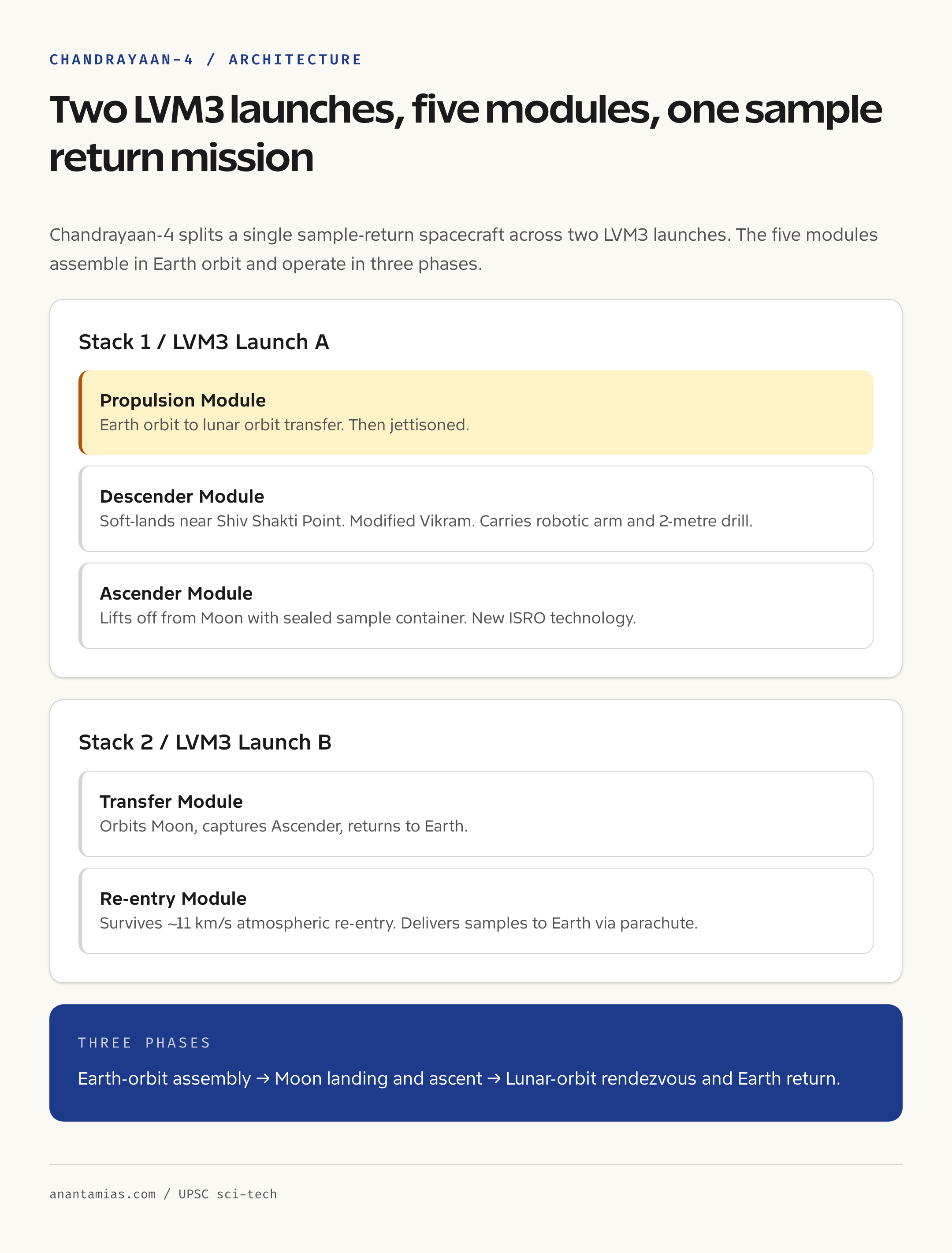
Phase 1 — Earth Orbit Assembly. Two LVM3 rockets launch separately. Stack 1 carries the Propulsion Module and the Descender plus Ascender pair. Stack 2 carries the Transfer Module and the Re-entry Module. The two stacks rendezvous and dock in Earth orbit, forming a single integrated spacecraft. The docking technology was validated in the SPADEX (Space Docking Experiment) mission that ISRO flew in late 2024 and early 2025, which demonstrated autonomous docking between two small satellites in low Earth orbit.
Phase 2 — Translunar and Lunar Operations. The integrated spacecraft uses the Propulsion Module to break out of Earth orbit and enter a translunar trajectory. On reaching the Moon, the Propulsion Module is discarded and the rest enters lunar orbit. The Descender, with the Ascender riding on top, separates and performs a powered descent to the surface near Shiv Shakti Point. The Descender is a modified Vikram, scaled up to carry the Ascender and the sample collection hardware. After landing, a robotic arm and a drill collect surface and sub-surface samples, which are sealed inside the Ascender’s sample container.
Phase 3 — Lunar Ascent and Earth Return. The Ascender lifts off from the Moon. This is one of the most demanding parts of the mission because the Ascender has to fire its engines from the surface in a vacuum, with no launch tower, no human operator, and no second chance. After reaching lunar orbit, the Ascender rendezvouses and docks with the Transfer Module, which has been waiting in lunar orbit. The samples are transferred to the Re-entry Module. The Transfer Module then propels itself back toward Earth on a return trajectory. As it approaches Earth, the Re-entry Module separates and enters the atmosphere. A heat shield protects the samples from the heat of re-entry, and parachutes bring the capsule to a soft landing on Indian soil.
The Five Modules in Detail
| Module | Function | Heritage |
|---|---|---|
| Propulsion Module | Carries the stack from Earth orbit injection to lunar orbit, then is jettisoned | Chandrayaan-3 PM, scaled |
| Descender Module | Lands on the Moon; carries robotic arm and drill | Modified Vikram lander |
| Ascender Module | Lifts off from the Moon with sealed sample container | New, no Indian heritage |
| Transfer Module | Orbits the Moon, captures Ascender, returns to Earth orbit | New for Chandrayaan-4 |
| Re-entry Module | Survives atmospheric re-entry; delivers samples to Earth | Heritage from Gaganyaan capsule |
Each module is a separate engineering project. The Ascender is the most novel because no Indian spacecraft has ever lifted off from another celestial body. The Re-entry Module benefits from Gaganyaan crew capsule development, which has already validated several heat shield and parachute technologies. The Transfer Module is closest to a deep space platform of the kind ISRO will need for future Mars and asteroid missions.
Key Technologies Being Validated
Earth orbit docking. Two spacecraft launched separately must find each other in orbit, rendezvous, and dock with sub-millimetre precision. The SPADEX mission validated the autonomous docking sensors and the docking ring mechanism. Chandrayaan-4 will use a heavier-class version of the same hardware.
Robotic sample collection. The robotic arm scoops surface regolith, while the drill bores up to 2 metres into the lunar surface to extract sub-surface material. Sub-surface samples are scientifically more valuable because they are protected from solar wind weathering and may contain pristine ancient material.
Lunar ascent. Firing rocket engines on a non-Earth surface in a vacuum, with the spacecraft balanced on landing legs, is an unforgiving manoeuvre. The Ascender must clear the Descender by a safe margin, achieve lunar orbital velocity (about 1.6 km/s), and execute the orbital insertion burn autonomously.
Lunar orbit rendezvous and docking. The Ascender and Transfer Module must perform a second autonomous docking, this time around the Moon, where there is no GPS and command latency to Earth is several seconds.
High-velocity Earth re-entry. A capsule returning from lunar distance enters Earth’s atmosphere at around 11 km/s, faster than a low-Earth-orbit re-entry. The heat shield must handle higher peak heating. The trajectory must be precise enough to avoid skipping back into space or burning up.
Why It Matters
Chandrayaan-4 matters at three levels. As science, it gives Indian researchers and the global community a fresh sample of the lunar south polar region, an area not represented in any existing sample collection because Apollo and Luna sampled equatorial sites. As technology validation, it builds every capability India needs for a future crewed lunar mission, where humans must descend, ascend, dock, and return. As strategic positioning, it places India in a small group of countries with sample return capability, alongside the United States, Russia (as USSR), and China.
The mission also matters for the broader ISRO missions portfolio. Chandrayaan-4 will share components and engineering teams with Gaganyaan, the Bharatiya Antariksh Station, and future deep space exploration. Its success or failure will shape what ISRO commits to in the 2030s.
Comparative: Sample Return Missions Across Nations
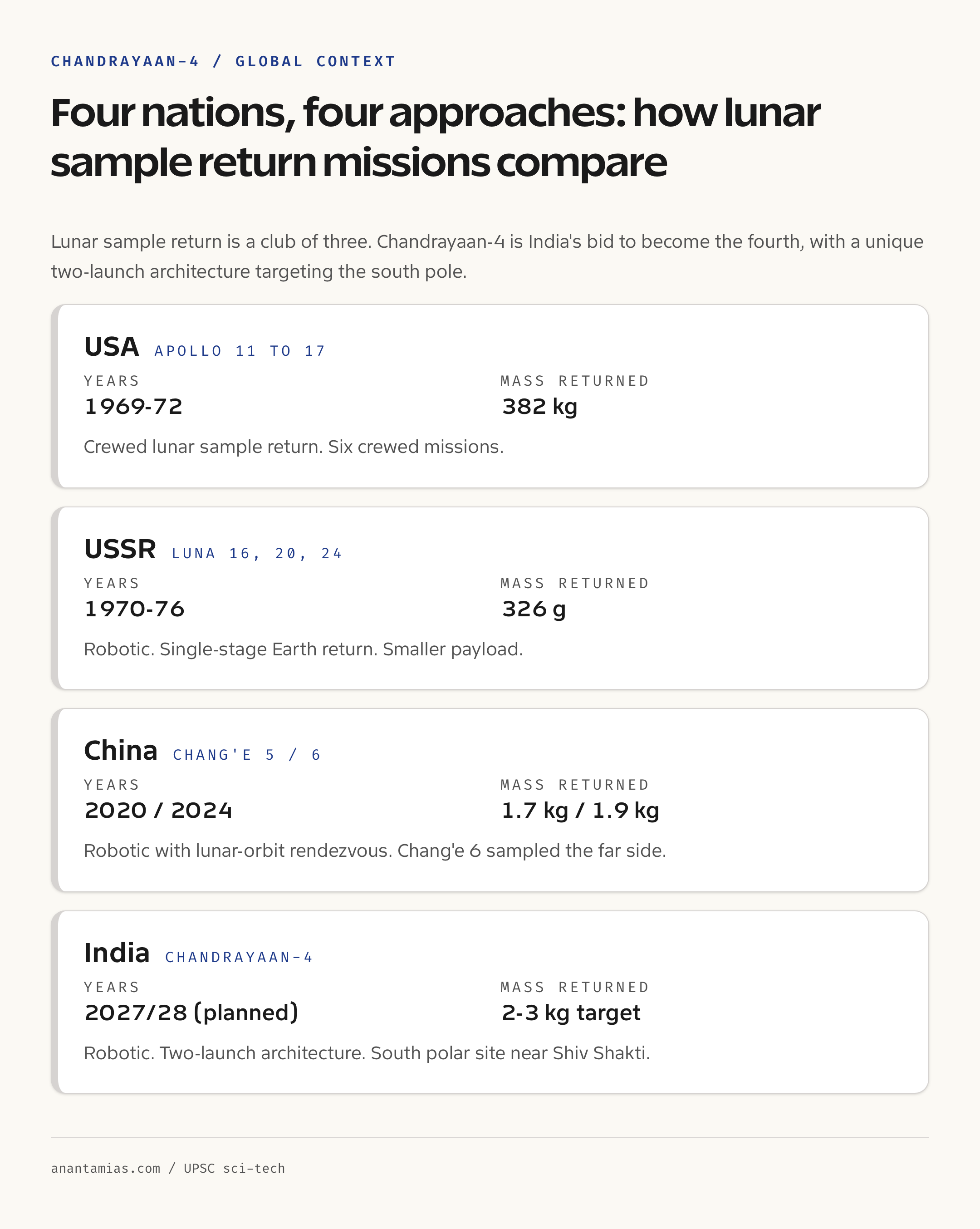
The history of lunar sample return is short. Six missions have brought lunar material back to Earth before Chandrayaan-4.
The American Apollo programme returned 382 kilograms of lunar samples across six crewed missions from Apollo 11 in 1969 to Apollo 17 in 1972. Apollo samples remain the largest body of lunar material on Earth and continue to yield science decades later. The Soviet Luna programme returned roughly 326 grams across three robotic missions, Luna 16, 20, and 24, between 1970 and 1976. The Soviet missions used a single-stage Ascender directly to Earth, which was simpler than the rendezvous architecture of Apollo or Chandrayaan-4 but limited the sample mass.
China’s Chang’e 5 in 2020 returned 1.7 kilograms from a relatively young volcanic region. Chang’e 6 in 2024 became the first mission to return samples from the lunar far side, bringing back nearly 2 kilograms from the South Pole-Aitken basin. Both Chinese missions used the orbital rendezvous architecture, similar in principle to Chandrayaan-4 though without the two-launch Earth orbit docking step.
Chandrayaan-4 is unique in using a two-launch architecture, which reflects the LVM3’s lift capacity rather than a deliberate choice for engineering complexity. It also targets a south polar landing site closer to the pole than any previous sample return, which gives the mission a distinct scientific niche.
Challenges and Risk Profile
Sample return is the highest-risk class of robotic space mission because every phase has to work in sequence. A single failure in any of the five modules ends the mission. Chandrayaan-3 had to land successfully. Chandrayaan-4 has to land, ascend, dock, transit, re-enter, and parachute, in sequence, in a window of weeks.
The two-launch architecture adds a dependency that Apollo and Chang’e did not have. If Stack 2 fails to launch within a reasonable window after Stack 1, Stack 1 will run out of station-keeping propellant and the mission is lost before it has begun.
The Ascender is the single point of failure that most concerns ISRO engineers. Lunar liftoff has only been demonstrated by Apollo, Luna, and Chang’e. Each used different hardware and control logic. ISRO is essentially developing this from scratch.
Re-entry from cislunar trajectories is another untested capability for India. The Gaganyaan capsule is designed for low Earth orbit re-entry at 8 km/s. Chandrayaan-4’s re-entry will be at 11 km/s. The thermal load scales with the cube of velocity, which means peak heating is roughly 2.5 times higher.
Prelims Pointers
- Operator: ISRO; mission classified as a Lunar Sample Return Mission (LSRM)
- Launch vehicles: Two separate LVM3 rockets carrying Stack 1 and Stack 2
- Modules: 5 (Propulsion, Descender, Ascender, Transfer, Re-entry)
- Landing zone: Near Shiv Shakti Point at the lunar south pole
- Sample target: Approximately 2 to 3 kg of lunar material, drilled to 2 m depth
- Earth-orbit docking heritage: SPADEX mission
- Re-entry capsule heritage: Gaganyaan
- Chandrayaan-3 landing site: Shiv Shakti Point at 69 degrees south
- Countries that have returned lunar samples before Chandrayaan-4: USA (Apollo), USSR (Luna), China (Chang’e 5 and 6)
Mains Practice Questions
- “Chandrayaan-4 is less about science and more about technology validation for India’s future crewed lunar programme.” Critically examine. (15 marks, 250 words)
- Discuss the engineering challenges of lunar sample return missions and how Chandrayaan-4’s architecture addresses them. (10 marks, 150 words)
- Compare and contrast Chandrayaan-4 with China’s Chang’e 6 mission in terms of mission profile, scientific objectives, and strategic significance. (15 marks, 250 words)
Way Forward
Chandrayaan-4’s value will be judged twice. The first judgement is on its primary objective, returning lunar samples. The second, slower judgement is on whether the technologies it validates carry forward into India’s crewed lunar programme. The Bharatiya Antariksh Station, planned for completion in 2035, and the Indian crewed lunar mission, planned for 2040, both depend on the Earth orbit docking, the deep space navigation, and the high-velocity re-entry that Chandrayaan-4 is the first to fly.
ISRO’s broader space technology trajectory across the 2020s and 2030s, from Chandrayaan-3 to Chandrayaan-4 to Gaganyaan to BAS, has a rare internal consistency. Each mission’s success unlocks the next. The lunar sample return is the keystone, and it is the mission that will tell ISRO, and the rest of the world, whether India is ready for the next phase of human spaceflight.
Frequently Asked Questions
When will Chandrayaan-4 launch?
The mission is approved by the Indian Cabinet with a target launch window in 2027 or 2028, depending on hardware readiness. Two LVM3 rockets are required, and the launches will be separated by weeks rather than months to keep the Earth-orbit assembly window open.
How is Chandrayaan-4 different from Chandrayaan-3?
Chandrayaan-3 was a soft landing demonstration with a lander and rover. Chandrayaan-4 is a sample return mission with five modules, two launches, in-orbit docking, lunar ascent, and Earth re-entry. The two missions share the lander heritage but Chandrayaan-4 is roughly an order of magnitude more complex.
Why does Chandrayaan-4 need two launches?
The total spacecraft mass exceeds the LVM3’s lift capacity for a translunar trajectory. Splitting the spacecraft across two launches and assembling it in Earth orbit is the workaround. NASA’s Apollo missions used a single Saturn V launch because the Saturn V had vastly more capacity than the LVM3.
Where will the samples land on Earth?
The Re-entry Module will land in Indian territory, with parachutes bringing the capsule to a soft landing. The exact recovery site will be planned closer to the mission to optimise trajectory and recovery logistics.
What can scientists learn from the samples?
Sub-surface lunar samples carry isotope and mineral information that allows scientists to date the surface, study the solar wind history, and search for water ice signatures. South polar samples are particularly valuable because they may contain volatile compounds preserved in permanently shadowed regions.
Will Chandrayaan-4 carry a rover?
The current architecture does not include a separate rover. Sample collection is performed by a robotic arm and drill mounted on the Descender. Adding a rover would increase mass and reduce the sample collection time available.
How does this connect to the Indian human spaceflight programme?
Chandrayaan-4 validates docking, lunar landing, lunar ascent, and high-velocity re-entry. All four capabilities are required for a crewed lunar mission. The Bharatiya Antariksh Station programme will inherit the docking technology directly. The Gaganyaan capsule will share the re-entry heat shield design.
Is there international participation?
Chandrayaan-4 is currently planned as an entirely Indian mission. Earlier reports suggested possible Japanese collaboration on a lunar polar exploration mission (LUPEX), but that has been planned as a separate, later mission rather than as part of Chandrayaan-4.
What is the budget for Chandrayaan-4?
ISRO has indicated a programme budget of around 2,100 crore rupees, comparable in scale to Chandrayaan-2 and significantly less than the cost of comparable Chinese or American missions. The cost reflects ISRO’s tradition of frugal engineering rather than a reduction in technical ambition.
What if the Ascender fails to lift off?
The samples are lost and the mission ends without sample return, even if the rest of the architecture has worked. This is the single highest-risk event in the mission profile and is the part that ISRO is investing the most testing time on, including ground-based vacuum chamber tests of the Ascender propulsion system.