For most of human history, asteroids were specks of light moving against the fixed stars. They had no faces, no maps, no chemistry. The first close-up image of an asteroid was returned only in 1991, when the Galileo spacecraft, on its way to Jupiter, flew past 951 Gaspra and sent home a single grainy frame. Three decades later, robotic spacecraft have orbited asteroids, landed on them, scooped up dust, deliberately crashed into one to nudge its trajectory, and returned with samples now being analyzed in laboratories on three continents. The shift from distant point of light to laboratory specimen is among the cleanest examples in modern science of how robotic exploration converts speculation into evidence.
Asteroid missions matter for three reasons. First, they preserve material from the early solar system that the Earth’s geology has long since destroyed, making them direct probes of how the inner planets formed. Second, they test the technology and the international cooperation needed to defend the planet against the small but real risk of a future impact. Third, they sit at the front edge of the next phase of human spaceflight, where commercial mining of metal-rich asteroids has moved from science fiction to active engineering studies.
For UPSC purposes, the topic intersects space technology, planetary defence, international cooperation, and the broader Indian Space Policy trajectory. This article walks through the landmark missions, the spacecraft on the way, and where India fits.
Quick Facts on Asteroid Missions
Asteroids are rocky and metallic remnants of the early solar system. The vast majority orbit the Sun in the main belt between Mars and Jupiter. A subset called Near-Earth Objects, NEOs, have orbits that bring them close to Earth’s. A further subset called Potentially Hazardous Asteroids, PHAs, are large enough and close enough to be of concern for planetary defence.
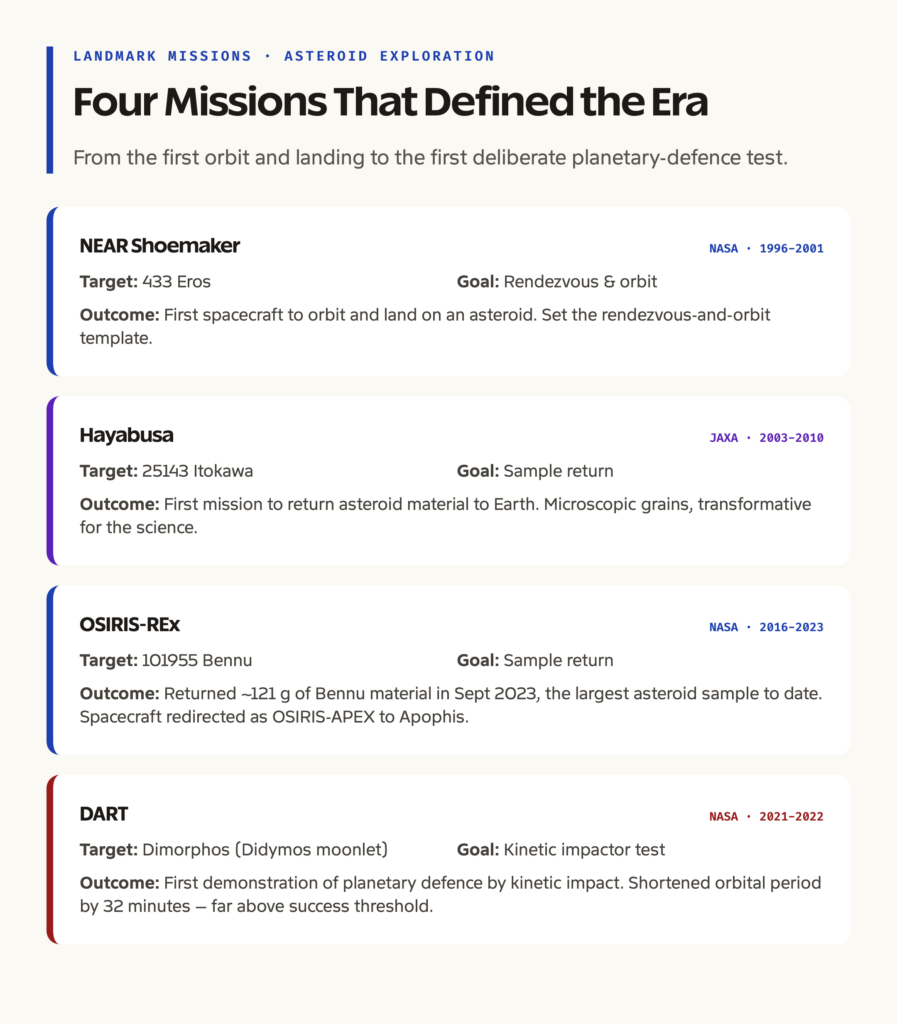
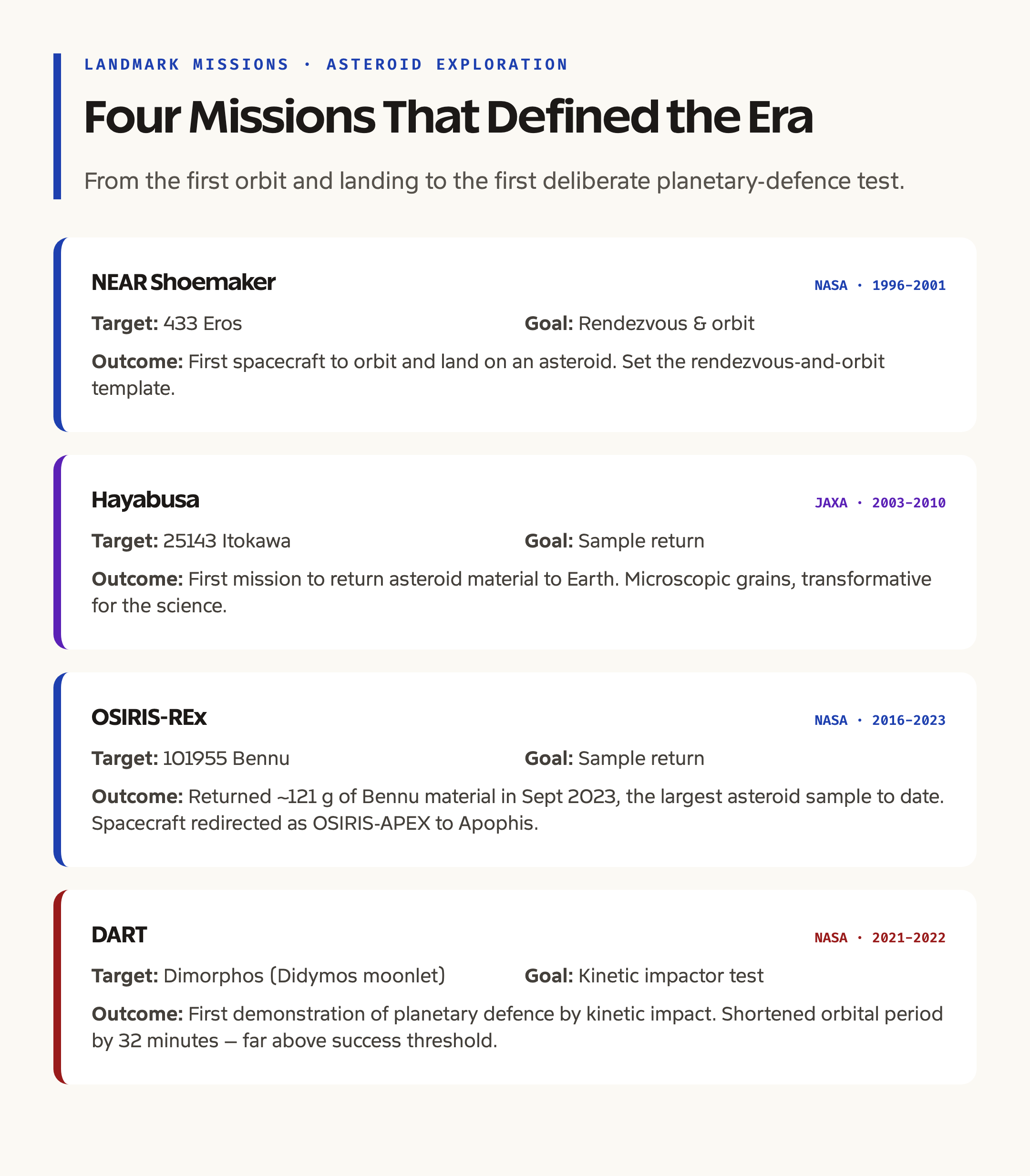
Spacecraft have visited asteroids since 1991. The first dedicated asteroid mission was the Near Earth Asteroid Rendezvous, NEAR Shoemaker, launched by NASA in 1996. It orbited and ultimately landed on 433 Eros in 2001. Japan’s Hayabusa, launched in 2003, was the first mission to return a sample of asteroid material to Earth. NASA’s OSIRIS-REx, launched in 2016, returned samples from asteroid Bennu in 2023. NASA’s Double Asteroid Redirection Test, DART, intentionally collided with the moonlet Dimorphos in 2022, demonstrating that a kinetic impactor can shift an asteroid’s orbit.
Several active and planned missions are currently in flight or scheduled. NASA’s Lucy is touring Jupiter’s Trojan asteroids. NASA’s Psyche is en route to a metal-rich asteroid of the same name. China’s Tianwen-2, launched in May 2025, is heading to the quasi-satellite Kamo’oalewa for a sample return. The European Space Agency’s RAMSES is planned to rendezvous with Apophis ahead of its 2029 close flyby of Earth.
What an Asteroid Mission Actually Does
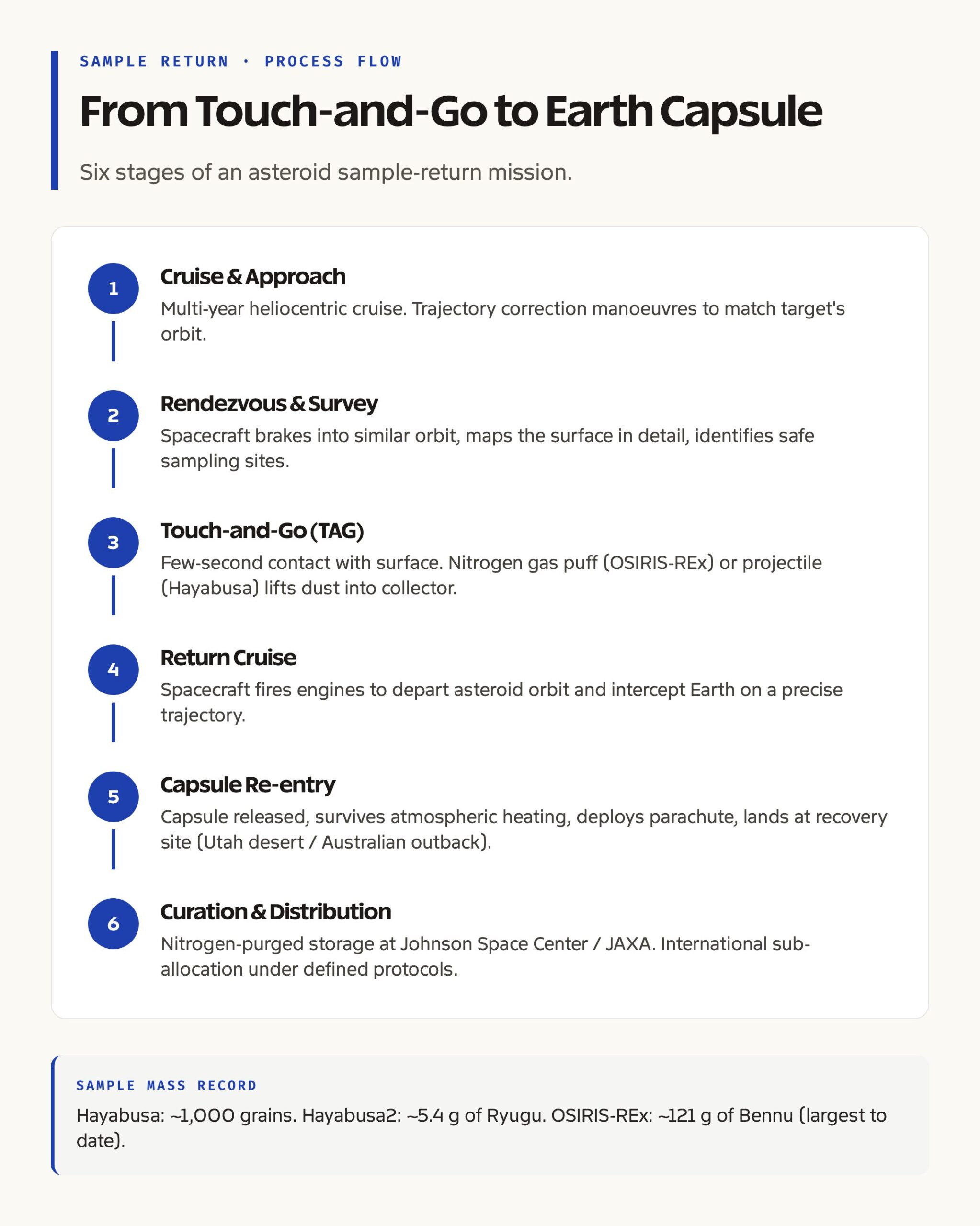
An asteroid mission has up to four phases. Cruise and approach. Rendezvous or flyby. Surface engagement. Return or extended operations. The complexity rises sharply at each phase.
A flyby is the simplest. The spacecraft passes the asteroid at high relative velocity and takes images and spectra during a few hours of close approach. Galileo’s encounter with Gaspra was a flyby. A rendezvous requires matching the asteroid’s orbit, which means the spacecraft must brake into a similar heliocentric orbit and then close in slowly. NEAR Shoemaker rendezvoused with Eros and orbited it for a year before landing.
A surface engagement is harder still. Asteroids have weak gravity, irregular shape, and unpredictable surface mechanics. Hayabusa’s brief touchdown on Itokawa in 2005 fired a small projectile to dislodge surface particles for collection. OSIRIS-REx used a touch-and-go manoeuvre on Bennu in 2020, briefly contacting the surface with a sampling head that puffed nitrogen gas to lift dust into a collection chamber.
A sample return adds an Earth re-entry phase. The capsule containing the sample must be released on a trajectory that intercepts Earth, survive atmospheric entry, deploy a parachute, and land at a designated recovery site. The OSIRIS-REx capsule landed in the Utah desert in September 2023 carrying roughly 121 grams of material from Bennu, more than any previous asteroid sample return.
Background and Historical Context
The scientific case for asteroid exploration grew through the 1970s and 1980s, as planetary scientists realized that the inner planets had been heavily reworked by tectonics, volcanism, and weathering, while small bodies like asteroids and comets preserved the original chemistry of the solar nebula. To understand how the Earth was built, you had to look at things the Earth was built from.
The 1991 Galileo flyby of Gaspra opened the era. The 1993 flyby of Ida revealed the first asteroid moon, Dactyl. NEAR Shoemaker, launched in 1996, was the first dedicated mission. Its orbital tour of Eros and surprise landing in 2001 established that complex orbital and surface operations were possible at small bodies. Hayabusa’s launch in 2003, its troubled but ultimately successful return in 2010, and its delivery of the first asteroid sample to Earth marked the beginning of the sample-return era.
The next decade saw four landmark missions. Dawn, launched in 2007, orbited the asteroids Vesta and the dwarf planet Ceres in turn. Rosetta, an ESA mission, while primarily a comet mission, also flew past asteroids Steins and Lutetia. Hayabusa2, launched in 2014, returned samples from Ryugu in 2020. OSIRIS-REx, launched in 2016, returned the largest asteroid sample to date in 2023.
The DART mission of 2022 added a new dimension. Asteroid missions until then had been about science. DART was about defence. NASA deliberately rammed a half-tonne spacecraft into Dimorphos at over twenty thousand kilometres per hour and shortened the moonlet’s orbital period around Didymos by thirty-two minutes, a far larger effect than the minimum success criterion. ESA’s follow-up mission, Hera, is en route to study the impact site in detail.
Key Features of Landmark Missions
NEAR Shoemaker established the rendezvous-and-orbit template. It demonstrated that a spacecraft could match orbits with a small body, image every square metre of the surface, and end the mission with a controlled touchdown.
Hayabusa, despite repeated equipment failures during the cruise, succeeded in returning a microscopic sample of Itokawa to Earth in 2010. The mission established the value of resilient mission design and of the touch-and-go sampling concept that later missions refined.
OSIRIS-REx executed a more sophisticated touch-and-go on Bennu, returned a much larger sample, and was redirected after capsule release on a new trajectory toward asteroid Apophis. The redirected mission, renamed OSIRIS-APEX, will arrive at Apophis after the 2029 close flyby of Earth and study how the asteroid’s surface and interior are reshaped by tidal forces during the encounter.
DART proved that a kinetic impactor is a viable planetary-defence technology. The measured change in Dimorphos’s orbital period far exceeded the minimum success threshold, supplying the first empirical data point on the efficiency with which an impactor can transfer momentum to an asteroid.
Lucy is touring eight Trojan asteroids in two orbital populations near Jupiter’s Lagrange points, considered the fossils of planet formation.
Psyche is en route to 16 Psyche, a metal-rich main-belt asteroid that may be the exposed core of an early planetesimal, providing direct sampling of the same kind of material that lies hundreds of kilometres beneath the Earth’s surface.
Why Asteroid Missions Matter
The science returns are clear. Bennu samples have already shown organic molecules, hydrated minerals, and isotopic signatures consistent with the idea that water and the building blocks of life were delivered to the early Earth by carbonaceous asteroids. Ryugu samples have produced similar findings. The case for asteroid delivery of prebiotic chemistry to Earth has moved from hypothesis to evidence.
The planetary-defence dimension matters because the risk is real, even if small. The 2013 Chelyabinsk airburst, in which a roughly twenty-metre object exploded over Russia and injured over a thousand people, demonstrated that even small NEOs can cause significant damage. The Tunguska event of 1908, with an estimated impactor in the same size range, devastated a remote Siberian forest. A larger object hitting a populated region remains the worst-case civil-protection scenario for an Earth-based emergency.
The economic dimension is the longer-term. Metal-rich asteroids contain platinum-group metals at concentrations that would dwarf any terrestrial deposit. The cost of bringing such material back to Earth or processing it in orbit remains far higher than the value, but the engineering studies done over the last decade have moved the conversation from impossibility to economics.
Detailed Analysis of Active and Planned Missions
A tabular view of the active and planned missions clarifies who is doing what.
| Mission | Agency | Target | Status and Goal |
|---|---|---|---|
| OSIRIS-APEX | NASA | Apophis | En route after Bennu sample drop, will study Apophis after the 2029 flyby |
| RAMSES | ESA | Apophis | Planned launch around 2028, rendezvous before 2029 flyby |
| NEO Surveyor | NASA | All NEOs | Infrared space telescope, planned launch later in the decade |
| Tianwen-2 | China (CNSA) | Kamo’oalewa | Launched May 2025, sample return targeted for 2027 |
| Psyche | NASA | 16 Psyche | En route, arrival in 2029 |
| Lucy | NASA | Trojan asteroids | En route, multiple flybys through the decade |
| MBR Explorer | UAE | Seven asteroids | Planned 2028 launch, including landing on Justitia |
| Destiny+ | Japan (JAXA) | Phaethon | Planned, flyby of the parent body of the Geminids meteor shower |
| Hera | ESA | Didymos and Dimorphos | En route, will study DART impact aftermath |
Two themes emerge. First, the science programme is widening, from sample return on volatile-rich carbonaceous bodies to in-situ study of metal-rich, quasi-satellite, and Trojan populations. Second, planetary defence is becoming a normal line of mission planning, with RAMSES, NEO Surveyor, and Hera all reflecting the post-DART era.
Comparative Snapshot of Sample-Return Missions
Three sample-return missions define the era. Hayabusa returned roughly a thousand microscopic grains of Itokawa in 2010. Hayabusa2 returned about 5.4 grams of Ryugu material in 2020. OSIRIS-REx returned about 121 grams of Bennu material in 2023. The growth in sample mass over a single decade reflects rapid maturation of the sampling technology. Tianwen-2’s planned return from Kamo’oalewa in 2027 will add a new sample type, that of an Earth quasi-satellite likely composed of lunar-style material, opening a new line of investigation.
India’s Position and Outlook
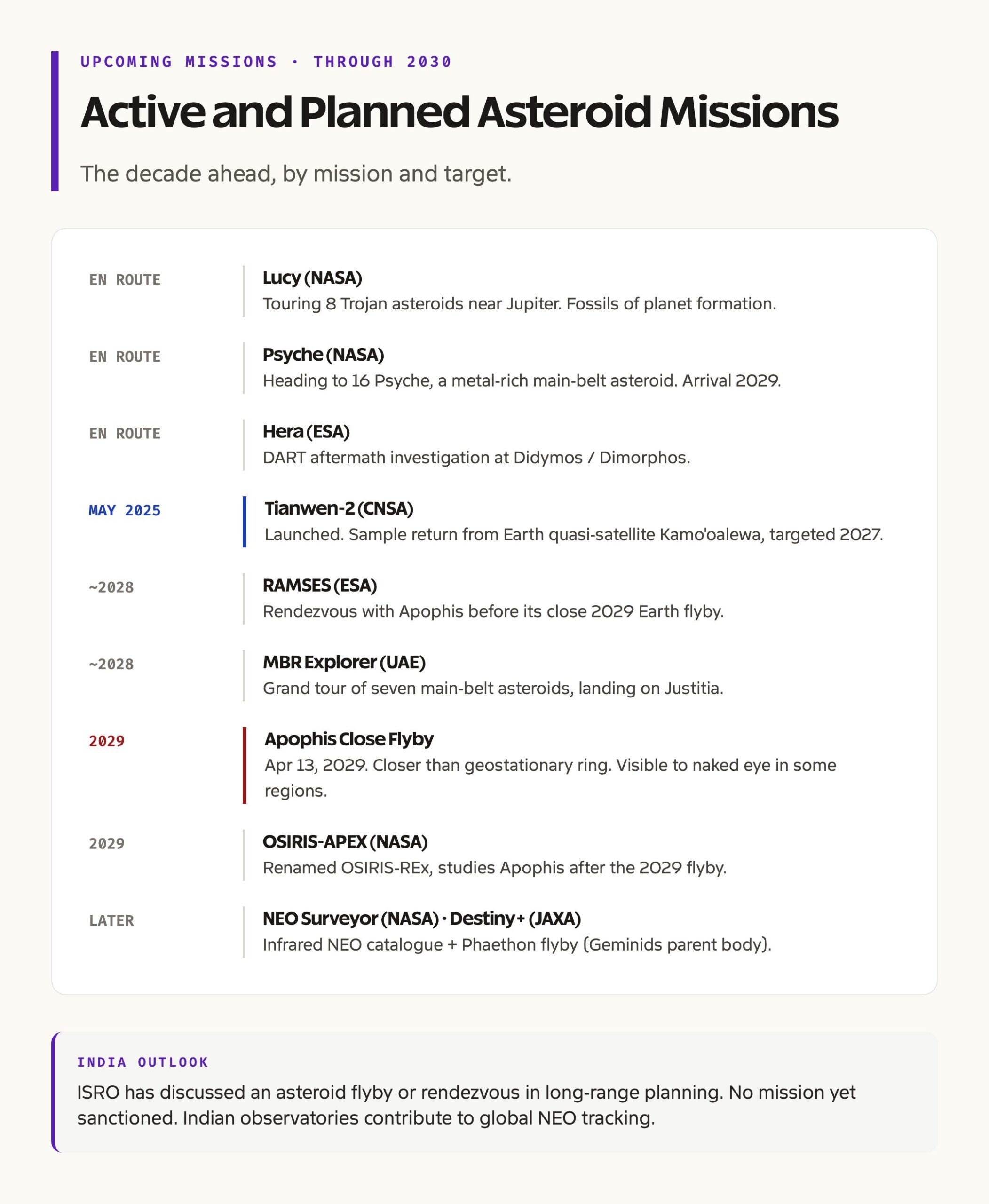
India’s planetary exploration has so far focused on the Moon and Mars, with the Chandrayaan series and the Mangalyaan orbiter establishing capability. The Indian Space Research Organisation has discussed an asteroid mission as a future option, with a flyby or rendezvous of a near-Earth asteroid identified in long-range planning documents. No mission is yet at the formal sanction stage.
India’s contribution to planetary defence has been at the data and observation level. Indian observatories contribute to the network that tracks NEOs and reports orbital refinements. The Physical Research Laboratory and the Indian Institute of Astrophysics have programmes on small-body astronomy. The Indian Space Policy 2023 framework opens space activity to private participation, which could over time enable an Indian commercial role in asteroid characterization or, eventually, prospecting.
The strategic case for an Indian asteroid mission rests on three points. Capability development beyond the cislunar and Mars context. Participation in the global planetary defence framework as a contributor rather than only an observer. And early positioning for an asteroid resource economy that, if it matures, will reward early movers. The decision is one for ISRO and the Department of Space over the second half of the decade.
Challenges Common to All Asteroid Missions
The first challenge is communication latency. Even at the closest, an asteroid is several light-minutes from Earth. Surface operations cannot be commanded in real time. Spacecraft must execute sampling and landing manoeuvres autonomously, with ground supervision lagging by minutes.
The second is microgravity. Asteroids have weak and irregular gravity. Anchoring, landing, and surface operations are all harder than on the Moon or Mars. Sample collection has to be done quickly, often through a single touch-and-go contact lasting only a few seconds.
The third is sample contamination. Asteroid samples must be returned and curated in conditions that preserve their pristine chemistry. The Bennu samples are stored in nitrogen-purged containers at the Johnson Space Center and at curation facilities in Japan and elsewhere, with international sub-allocation under defined protocols.
The fourth is deflection physics. DART has demonstrated that a kinetic impactor works on a small moonlet of a binary system. Whether the same approach scales to a larger threat-class object remains untested. The next generation of planetary-defence studies will need to characterize a wider range of asteroid types and impactor designs.
Prelims Pointers
- The first close-up image of an asteroid was returned by NASA’s Galileo spacecraft from 951 Gaspra in 1991.
- NEAR Shoemaker was the first dedicated asteroid mission and the first to land on an asteroid, 433 Eros, in 2001.
- Hayabusa was the first mission to return a sample of asteroid material to Earth, from Itokawa in 2010.
- Hayabusa2 returned samples from asteroid Ryugu in 2020.
- OSIRIS-REx returned samples from asteroid Bennu in 2023, the largest asteroid sample return to date.
- DART was a planetary-defence mission that intentionally collided with the moonlet Dimorphos in 2022 and shortened its orbital period.
- ESA’s Hera mission is en route to study the DART impact site at Didymos and Dimorphos in detail.
- OSIRIS-APEX is the renamed OSIRIS-REx spacecraft now heading to asteroid Apophis after dropping the Bennu sample capsule.
- Psyche is a NASA mission to a metal-rich main-belt asteroid possibly representing the exposed core of an early planetesimal.
- Lucy is a NASA mission to Jupiter’s Trojan asteroids, considered fossils of solar system formation.
Mains Practice Questions
- Discuss the scientific and strategic significance of asteroid missions. Examine the contributions of NEAR Shoemaker, Hayabusa, OSIRIS-REx, and DART, and outline India’s potential role in this domain.
- Critically evaluate the planetary defence framework that has emerged from the DART mission. Discuss the limits of current technology and the international cooperation required to address the threat of Near-Earth Objects.
- Asteroid sample-return missions have transformed our understanding of the early solar system. Describe the technical challenges of sample-return architecture and discuss the implications of recent findings for theories of how water and prebiotic chemistry reached the early Earth.
Way Forward
A coherent global asteroid programme over the next decade requires four moves. First, completion of the survey of potentially hazardous asteroids through NEO Surveyor and partner observatories, with the goal of cataloguing ninety percent of objects above 140 metres. Second, expansion of the sample-return programme to a wider range of body types, including metal-rich, quasi-satellite, and Trojan populations, building on the Tianwen-2, Psyche, and Lucy data. Third, consolidation of planetary-defence capability through Hera follow-up studies and second-generation kinetic-impactor designs that scale to larger targets. Fourth, an Indian entry through a flyby or rendezvous mission, perhaps coordinated with the Aditya-L1 and Chandrayaan programmes’ established cruise-and-orbit experience, that establishes Indian small-body capability before the resource-economy decade arrives. The window in which the first wave of asteroid science is being written is now. India has the launchers, the deep-space tracking, and the science community. The next step is the mission.
Frequently Asked Questions
What is the difference between an asteroid and a comet?
Asteroids are rocky and metallic bodies, mostly orbiting the Sun in the main belt between Mars and Jupiter. Comets are icy bodies that originate in the outer solar system, develop a coma and tail when they approach the Sun, and have more elongated orbits. Both are remnants of the early solar system, but their composition and dynamics are different.
What was the first asteroid sample-return mission?
Japan’s Hayabusa, launched in 2003 and returned in 2010, was the first mission to return a sample of asteroid material to Earth. The sample, from asteroid Itokawa, was microscopic but transformative for asteroid science.
What did OSIRIS-REx accomplish?
NASA’s OSIRIS-REx, launched in 2016, rendezvoused with asteroid Bennu, mapped its surface, executed a touch-and-go sampling manoeuvre in 2020, and returned a sample capsule to Earth in September 2023. The capsule contained roughly 121 grams of material, the largest asteroid sample return to date.
What was the DART mission?
The Double Asteroid Redirection Test, a NASA mission, was the first demonstration of a kinetic impactor as a planetary-defence technique. In 2022, DART deliberately collided with Dimorphos, a small moonlet of asteroid Didymos, and shortened its orbital period around Didymos by about thirty-two minutes, far more than the minimum success criterion.
What is the significance of asteroid Apophis?
Apophis is a Near-Earth Asteroid that will pass closer to Earth than the geostationary orbital ring on 13 April 2029. The flyby will be visible to the naked eye in some parts of the world. Both NASA’s redirected OSIRIS-APEX and ESA’s planned RAMSES mission are designed to study Apophis around this close approach.
Has India sent a mission to an asteroid?
Not yet. India’s planetary missions have so far focused on the Moon, with the Chandrayaan series, and Mars, with Mangalyaan. ISRO has discussed an asteroid flyby or rendezvous in long-range planning documents, but no mission is yet formally sanctioned.
What are NEOs and PHAs?
Near-Earth Objects, or NEOs, are asteroids and comets whose orbits bring them close to Earth’s. Potentially Hazardous Asteroids, or PHAs, are a subset large enough and close enough to be of concern for planetary defence, typically larger than about 140 metres and with orbits that bring them within 7.5 million kilometres of Earth’s orbit.
What is the Lucy mission?
Lucy is a NASA mission, launched in 2021, that is touring eight Trojan asteroids in two populations near Jupiter’s Lagrange points. The Trojans are considered fossils of planet formation because they have remained in stable gravitational pockets near Jupiter for billions of years.
Why are metal-rich asteroids of interest?
Metal-rich asteroids such as 16 Psyche may represent the exposed cores of early planetesimals whose outer rocky layers were stripped by collisions. They offer direct access to the kind of metal-dominated material that lies hundreds of kilometres beneath the Earth’s surface, and they hold long-term economic interest as potential sources of platinum-group metals.
What is the significance of asteroid sample analysis for theories of life on Earth?
Samples returned by Hayabusa2 from Ryugu and OSIRIS-REx from Bennu have shown organic molecules, hydrated minerals, and isotopic signatures consistent with the idea that water and the building blocks of life were delivered to the early Earth by carbonaceous asteroids. The findings strengthen the case that Earth’s biosphere has roots in extraterrestrial chemistry.
Tell Google you want more of this.
Add Anantam IAS as a preferred sourceOne tap, and this site shows up more often in your own Top Stories, AI Overviews and AI Mode. Remove it any time.