CNR Rao: Bharat Ratna Scientist and Solid State Chemistry Pioneer (UPSC Science & Tech)
Chintamani Nagesa Ramachandra Rao is one of the world's foremost materials chemists and only the third scientist to win the Bharat Ratna. Here is his life, his science, and why his career is a ready-made UPSC answer on India's research story.
When the Bharat Ratna was announced for Chintamani Nagesa Ramachandra Rao in 2014, he became only the third scientist in history to receive India’s highest civilian honour, after the physicist C.V. Raman and the missile-man-turned-President A.P.J. Abdul Kalam. That alone tells you where CNR Rao sits in the country’s scientific memory. But the more interesting fact is what he did with the decades before and after: he turned a single chemist’s curiosity about how atoms arrange themselves in solids into a whole school of Indian materials science.
For a UPSC aspirant, Rao is one of those figures who keeps coming back. He surfaces in Science and Technology questions on the Prelims, in GS Paper 3 answers on research funding and emerging technologies, and in Essay and Ethics papers as a model of curiosity-driven public-sector science. So it pays to know him properly — not as a list of awards, but as a career that maps neatly onto the questions examiners actually ask about India and its labs.
From Bangalore Classrooms to a Global Lab
Rao was born on 30 June 1934 in Bangalore, into a family that valued learning, and he moved through the Indian education system at a pace that still looks astonishing. He took his BSc from Mysore University at seventeen and his MSc in chemistry from Banaras Hindu University at nineteen. He then went to Purdue University in the United States, where he finished his PhD in under three years and returned home a doctor of chemistry at twenty-four. A DSc from Mysore University followed in 1961.
What matters is the choice he made next. Rather than stay abroad — the easy and well-trodden path for a young Indian scientist in the late 1950s — he came back. He joined the Indian Institute of Science in Bangalore as its youngest lecturer, then spent a formative spell at the Indian Institute of Technology Kanpur through the 1960s and into the 1970s, the years when the IITs were still finding their feet. He returned to IISc and went on to direct it from 1984 to 1994. So his career is also a small history of India’s elite scientific institutions, told from the inside.
And the through-line of all of it was one deceptively simple question: why do solids behave the way they do? Rao chose solid-state and structural chemistry — the study of how the arrangement of atoms in a material decides whether it conducts, insulates, magnetises or superconducts — at a time when it was a fringe interest in India. He didn’t just join the field. Over five decades he helped make it a central domain of research, here and worldwide.
The Science That Made His Name
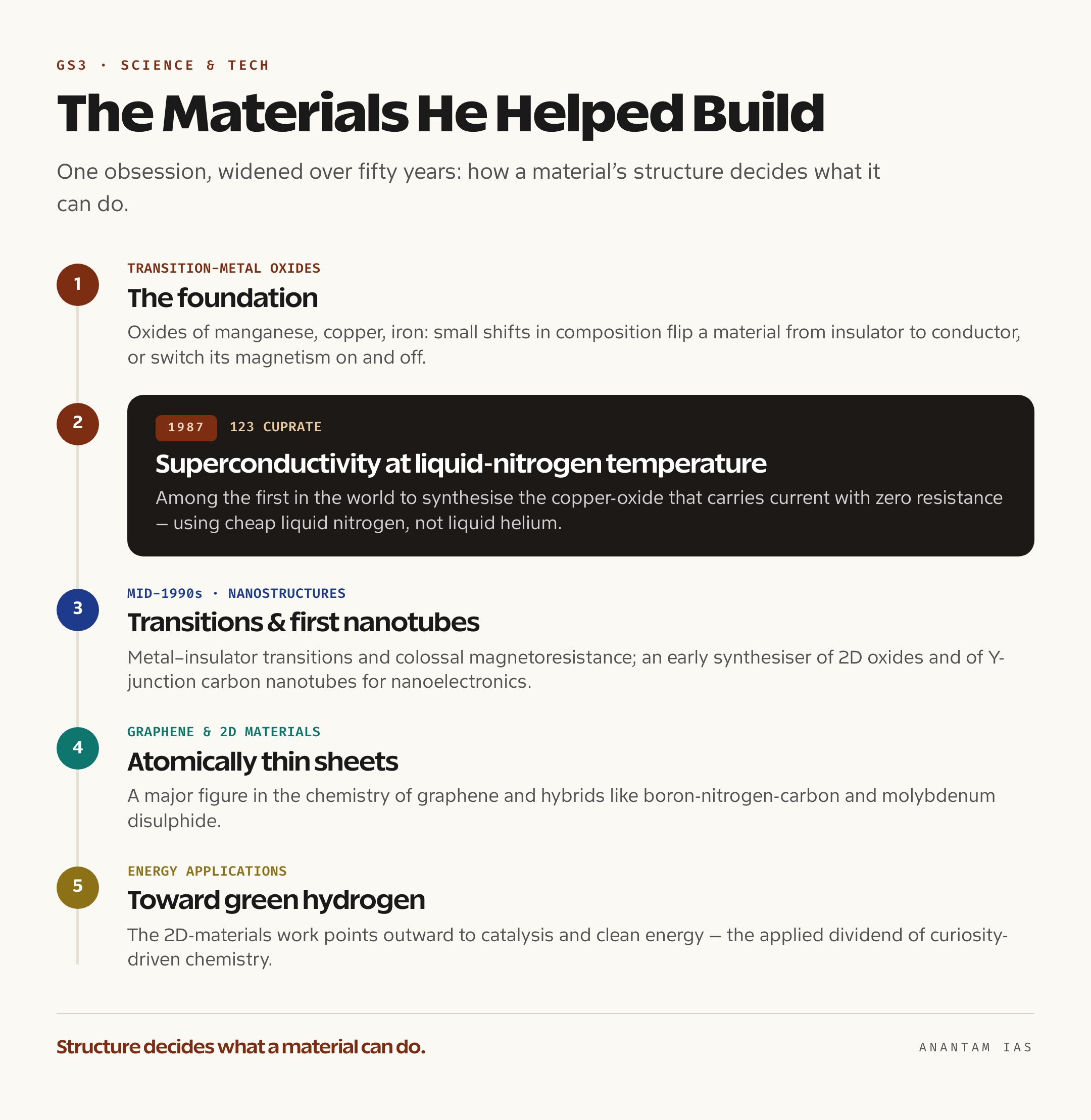
Rao’s research is best understood as a steady widening of one obsession: the link between a material’s structure and what it can do. His earliest and most influential work was on transition-metal oxides — compounds of metals like manganese, copper and iron with oxygen — where small changes in composition flip a material from insulator to conductor, or switch its magnetism on and off. That body of work gave chemists a basic understanding of how and why such transitions happen, and it became the foundation for much of what followed.
The headline achievement came in 1987. Rao and his collaborators were among the first in the world to synthesise the so-called 123 cuprate, a copper-oxide compound that was the first material to superconduct — carry electricity with zero resistance — at the temperature of liquid nitrogen. Because liquid nitrogen is cheap and easy to handle compared with the liquid helium needed earlier, this was a genuine turning point in high-temperature superconductivity, the race that gripped physics and chemistry labs across the globe that year.
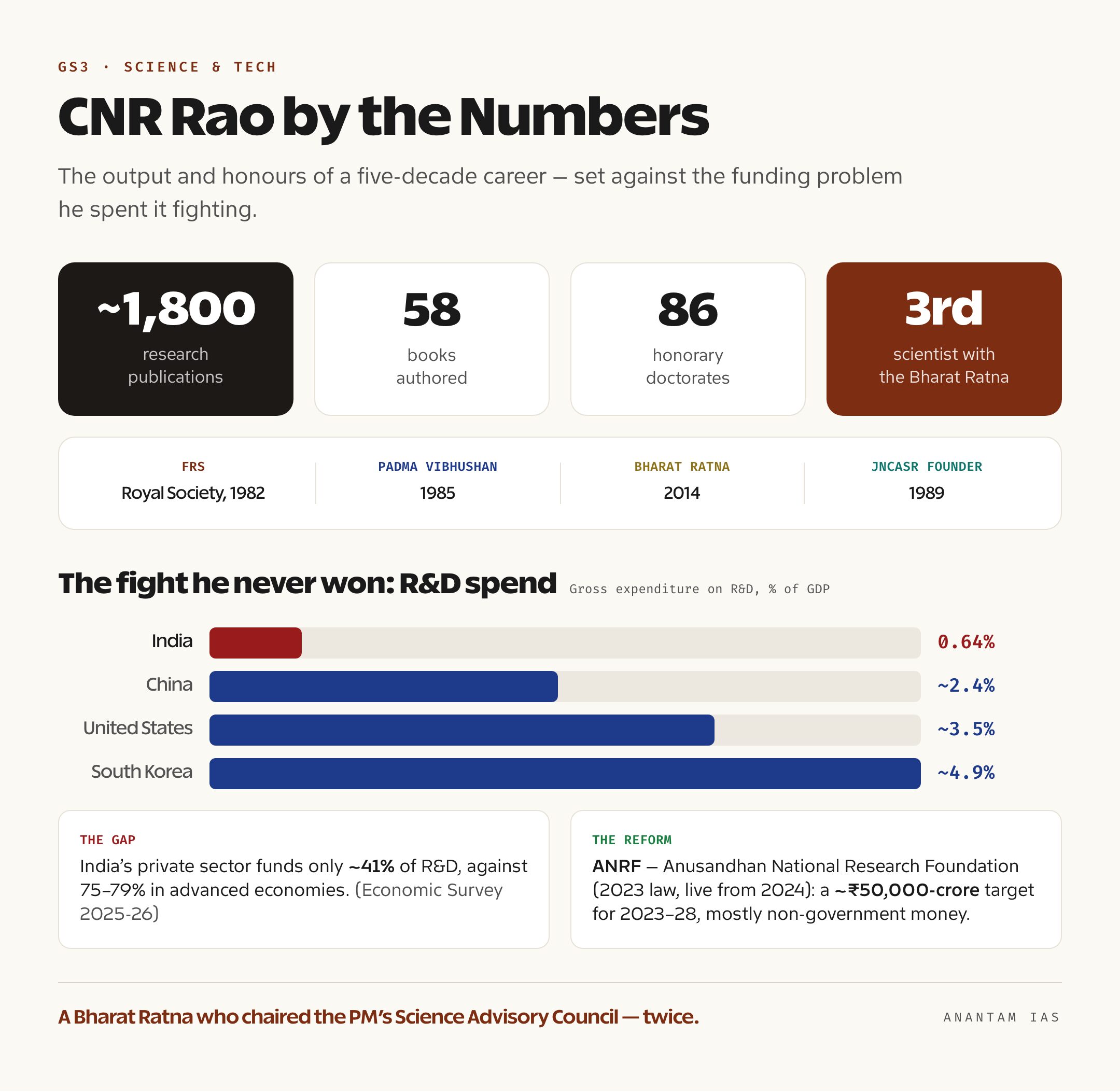
From there his interests kept expanding. He studied metal-insulator transitions and the dramatic phenomenon of colossal magnetoresistance, where a material’s electrical resistance collapses in a magnetic field. He was an early synthesiser of two-dimensional oxide materials and of Y-junction carbon nanotubes in the mid-1990s, important for nanoelectronics. And as the field turned to atomically thin sheets, he became a major figure in the chemistry of graphene and of hybrid materials such as boron-nitrogen-carbon, alongside molybdenum disulphide, all with an eye on energy applications. His output is enormous — around 1,800 research publications and 58 books, which puts him among the most prolific and most-cited chemists India has produced.
Honours, Institutions and the JNCASR Legacy
If you list Rao’s honours, you quickly run out of fingers. At home he holds the Padma Shri (1974), the Padma Vibhushan (1985) and the Bharat Ratna (2014). Abroad, he was elected a Fellow of the Royal Society in 1982 and has since been taken into a remarkable spread of national academies — the United States National Academy of Sciences, the French Academy of Sciences, the Japanese Academy, the Pontifical Academy, and the academies of Brazil, Korea, Poland, Serbia, Spain and Africa, with the Chinese Academy of Sciences electing him an honorary foreign member in 2013. He has won the Royal Society’s Hughes Medal (2000) and Royal Medal (2009), the Dan David Prize (2005), the Einstein Gold Medal of UNESCO (1996) and honorary doctorates from 86 universities. He is, as one colleague put it, a scientist who has collected nearly every prize in his field except the Nobel.
But the honour that arguably matters most for India isn’t a medal — it’s a building full of laboratories. In 1989 Rao founded the Jawaharlal Nehru Centre for Advanced Scientific Research, or JNCASR, in Bangalore, and served as its first president. He went on to set up the International Centre for Materials Science there in 2010. JNCASR has grown into one of the country’s premier research institutions, covering materials, chemistry, biology and the theoretical sciences, and Rao still works there as its Honorary President and Linus Pauling Research Professor. Building an institution that outlives you is a different kind of achievement from publishing a paper, and it’s the one that shaped a generation of Indian researchers.
That, finally, is the point about the medals. Rao’s recognition isn’t just personal glory; it’s a marker of where Indian materials science reached under people like him. When examiners ask about India’s scientific heritage, this is the kind of concrete, verifiable example they want — not Raman in 1930 alone, but a living lineage that runs through to the present.
Shaping India’s Science Policy
Rao never confined himself to the lab bench. He served as chair of the Scientific Advisory Council to the Prime Minister across two long stretches — from 1985 to 1989, and again from 2005 to 2014 — which made him, for much of the last forty years, the most senior scientific voice in the room when India set its research priorities. In that role he was instrumental in shaping the Nano Mission and in pushing sustained public investment into materials science and basic research more broadly.
And he was blunt about what India was getting wrong. Rao has been a long-standing, sometimes scalding, critic of how little the country spends on research. The data backs his frustration. India’s gross expenditure on R&D sits at just 0.64% of GDP, according to the Economic Survey 2025-26 — well below China at roughly 2.4%, the United States at about 3.5% and South Korea near 4.9%. The Survey itself pins much of the gap on the private sector, which funds only about 41% of Indian R&D, against 75-79% in those advanced economies. Rao’s argument for decades has been that a country cannot become a knowledge power on that kind of budget.
So his advocacy reads less like complaint and more like a policy brief. It points directly at reforms now under way: the Anusandhan National Research Foundation, set up under a 2023 law and operational from 2024, is designed to seed research across universities and to pull in non-government money, with a funding target of around 50,000 crore rupees for 2023-28, most of it expected from outside the government. Whether that closes the gap Rao spent a career complaining about is one of the open questions of Indian science policy — and a ready-made debate for a Mains answer.
Why CNR Rao Matters for an Aspirant
Strip away the awards, and what Rao stands for is an argument about how nations build scientific strength. His career says that curiosity-driven basic research — chasing a strange phenomenon in an oxide because it’s interesting, not because it has an obvious use — is the seedbed from which applied technology eventually grows. Superconductors feed MRI machines and maglev transport; nanomaterials feed sensors, catalysts and electronics; the graphene and 2D-materials work feeds next-generation devices and green-hydrogen research. None of that was the goal when the chemistry began. It was the dividend.
His career also makes the case for public-sector institutions and for mentorship as a form of nation-building. Rao didn’t just publish; he built JNCASR, trained students who now run labs of their own, championed science education in Indian languages, and spoke up against research misconduct and brain drain. For an aspirant, that combination — discovery plus institution-building plus public advocacy — is exactly the rounded picture examiners reward. He is the single example you can deploy on India’s research funding, on emerging technologies, and on scientific temper, and have it land in all three.
For Your Mains Answer
CNR Rao is most useful in GS Paper 3, on developments in science and technology and on indigenising technology and developing new tech — but his career also serves GS Paper 4 (Ethics, on scientific temper and integrity) and the Essay paper (on knowledge, research and national capability). The trick is to use him as a concrete anchor for a larger argument about why India underfunds research and what curiosity-driven science returns, rather than reciting his medals.
How to Build the Answer
Open with the policy problem, not the person: India spends only 0.64% of GDP on R&D while competitors spend three to five times more. Then bring Rao in as the human evidence — a Bharat Ratna chemist whose basic work on oxides and superconductors quietly underpins technologies we now call strategic. Move outward in widening circles: the science, the institution he built (JNCASR), the policy roles (Scientific Advisory Council), and the reform his advocacy helped trigger (the Anusandhan National Research Foundation). Close on the open question of whether new funding will change the picture.
Common Mistakes to Avoid
Don’t turn the answer into a fan letter. Listing every award without an argument signals memorisation, not understanding. Don’t overclaim the science — Rao was “one of the first” to synthesise the 123 cuprate superconductor, not its sole discoverer, and precision here reads as competence. Don’t strand his story in the past; tie it to live policy (ANRF, the private-sector funding gap). And don’t ignore the counterpoint — that money alone doesn’t fix research culture.
A Compact Answer Spine
India’s R&D spend is low (0.64% of GDP) → basic research is the seedbed of applied technology → Rao as proof (oxides, 1987 superconductor, graphene, nanomaterials → MRI, sensors, green hydrogen) → he built institutions too (JNCASR, 1989) and shaped policy (Scientific Advisory Council, two terms) → his advocacy points to reform (ANRF, 2023) → the open question: will funding plus culture follow?
Diagram or Flowchart Idea
Draw a simple funnel: a wide mouth labelled “curiosity-driven basic research” narrowing through “materials science / oxides / 2D materials” down to a spout of applications — “MRI, superconducting magnets, sensors, green hydrogen, electronics.” Annotate the funnel with “needs sustained R&D funding” to tie the science to the policy point in one glance.
A Balanced-Conclusion Line
A line that scores: “Rao’s career shows that scientific strength is built slowly, from curiosity upward — but it also shows that without the funding and institutions to sustain that curiosity, a nation’s best minds end up celebrated more than supported.”
How to Use Data Without Cramming
Carry just three numbers and use them with attribution: R&D at 0.64% of GDP (Economic Survey 2025-26), private sector funding only ~41% of that total, and the ANRF’s ~50,000-crore target for 2023-28. Naming the source in the sentence — “the Economic Survey 2025-26 puts it at 0.64% of GDP” — reads as fluency, not recall.
FAQ
Why is CNR Rao famous, and what did he actually discover? CNR Rao is one of the world’s foremost solid-state and materials chemists. His most cited work explains how the structure of transition-metal oxides governs their properties, and in 1987 he was among the first to synthesise the 123 cuprate, the first superconductor to work at liquid-nitrogen temperature. He later did major work on graphene, two-dimensional materials, nanomaterials and green-hydrogen catalysis.
Was CNR Rao the third scientist to receive the Bharat Ratna? Yes. He received the Bharat Ratna in 2014, becoming only the third scientist to be awarded India’s highest civilian honour, after C.V. Raman and A.P.J. Abdul Kalam.
What is JNCASR and what was Rao’s role in it? The Jawaharlal Nehru Centre for Advanced Scientific Research is a leading Indian research institution in Bangalore covering materials, chemistry, biology and the theoretical sciences. Rao founded it in 1989 and was its first president; he continues there as Honorary President and Linus Pauling Research Professor.
Why does CNR Rao matter for UPSC? He is a versatile example. He fits GS Paper 3 answers on science, technology and research funding, GS Paper 4 on scientific temper and integrity, and the Essay paper on knowledge and national capability. His long-running criticism of India’s low R&D spending — about 0.64% of GDP — ties his story directly to current policy debates like the Anusandhan National Research Foundation.
Practice Questions
Prelims MCQs
- CNR Rao was awarded the Bharat Ratna in which year, and he was which scientist to receive it?
(a) 2009, the second
(b) 2014, the third
(c) 2014, the first
(d) 2010, the fourth.
Answer: (b) He received it in 2014, becoming the third scientist after C.V. Raman and A.P.J. Abdul Kalam. - CNR Rao’s research in 1987 is most associated with which breakthrough?
(a) The first organic LED
(b) The first liquid-nitrogen-temperature (123 cuprate) superconductor
(c) The discovery of graphene
(d) The first silicon solar cell.
Answer: (b) He was among the first to synthesise the 123 cuprate, which superconducts at liquid-nitrogen temperature. - With which research institution is CNR Rao most closely associated as its founder?
(a) TIFR, Mumbai
(b) IISER, Pune
(c) JNCASR, Bangalore
(d) IUCAA, Pune.
Answer: (c) He founded the Jawaharlal Nehru Centre for Advanced Scientific Research in 1989. - CNR Rao’s core scientific work lies primarily in which field?
(a) Nuclear physics
(b) Solid-state and materials chemistry
(c) Molecular biology
(d) Theoretical astrophysics.
Answer: (b) He is one of the world’s foremost solid-state and materials chemists, known for work on transition-metal oxides. - According to the Economic Survey 2025-26, India’s gross expenditure on R&D is closest to which share of GDP?
(a) 0.64%
(b) 1.5%
(c) 2.4%
(d) 3.5%.
Answer: (a) India spends about 0.64% of GDP on R&D, far below China, the US and South Korea.
Mains Practice Questions
- “Curiosity-driven basic research is the seedbed of applied technology.” Examine this statement with reference to India’s experience in materials science and the role of leading scientists in building research capacity. (15 marks, 250 words)
- India’s gross expenditure on research and development remains around 0.64% of GDP. Analyse the reasons for this persistently low investment and suggest measures, including the role of the Anusandhan National Research Foundation, to bridge the gap. (15 marks, 250 words)
- Discuss the role of public-sector scientific institutions in India’s development. How can institution-building, rather than individual achievement alone, strengthen the country’s research ecosystem? (15 marks, 250 words)
- Emerging materials such as graphene, two-dimensional materials and advanced catalysts are central to India’s clean-energy and electronics ambitions. Evaluate India’s strengths and weaknesses in translating such basic research into strategic technologies. (10 marks, 150 words)
- “Scientific temper and research integrity are as vital to national progress as funding.” In light of the careers of eminent Indian scientists, critically discuss the ethical foundations of a strong research culture. (10 marks, 150 words)