Coal Sector Reforms in India: Liberalisation, Auctions and 2024-26 Outlook (UPSC)
Coal sector reforms — commercial mining auctions, FDI, Mission Coking Coal. Master Coal India monopoly end, demand-supply gap, and 2024-26 trends for UPSC GS-III.
For half a century after nationalisation in 1973, India's coal sector operated as a near-monopoly under Coal India Limited (CIL). By 2024, it has been transformed into a liberalised, competitive market with commercial coal mining auctions, 100 percent FDI, and a National Coal Index for transparent pricing. The reforms address a chronic structural problem: India is the world's third-largest coal producer but still imports around 175-200 million tonnes annually, draining foreign exchange and stressing thermal power plant economics. Coal accounts for ~55 percent of India's primary energy needs and ~70 percent of electricity generation, making the sector central to growth, NPAs of banks, and the energy transition. This article unpacks the reforms, their rationale, and 2024-26 status for UPSC GS-III on infrastructure, mineral resources, and economy.
The Old Coal Sector: Why Reforms Were Needed
The Nationalised Era (1973-2014)
- Coal Mines (Nationalisation) Act, 1973 consolidated mining under government PSUs.
- Coal India Limited (CIL) — created 1975 — became the world's largest coal producer.
- Captive mining allowed for power, steel, cement companies — but they could not sell to third parties.
- The structure was inefficient, with limited competition, slow technology adoption, and chronic supply shortfalls.
The 2014 Supreme Court Judgment
- The Supreme Court (August 2014) cancelled 204 captive coal block allocations as arbitrary and illegal.
- This triggered the Coal Mines (Special Provisions) Act, 2015 for transparent re-allocation.
- The judgment forced India to rethink coal sector governance comprehensively.
Persistent Structural Problems
- Demand-supply mismatch: domestic production (over 900 MT in FY24) is lower than consumption (~1,150 MT in FY24), forcing imports of 175-200 MT annually.
- CIL monopoly inefficiencies: under-capacity utilisation, slow project execution.
- Captive miners' restriction: They could not sell surplus to power plants in shortage.
- Plant Load Factor (PLF) of thermal plants below capacity (~57-65 percent), raising NPAs of banks lending to power.
The Status of Indian Coal Sector
Reserves and Production
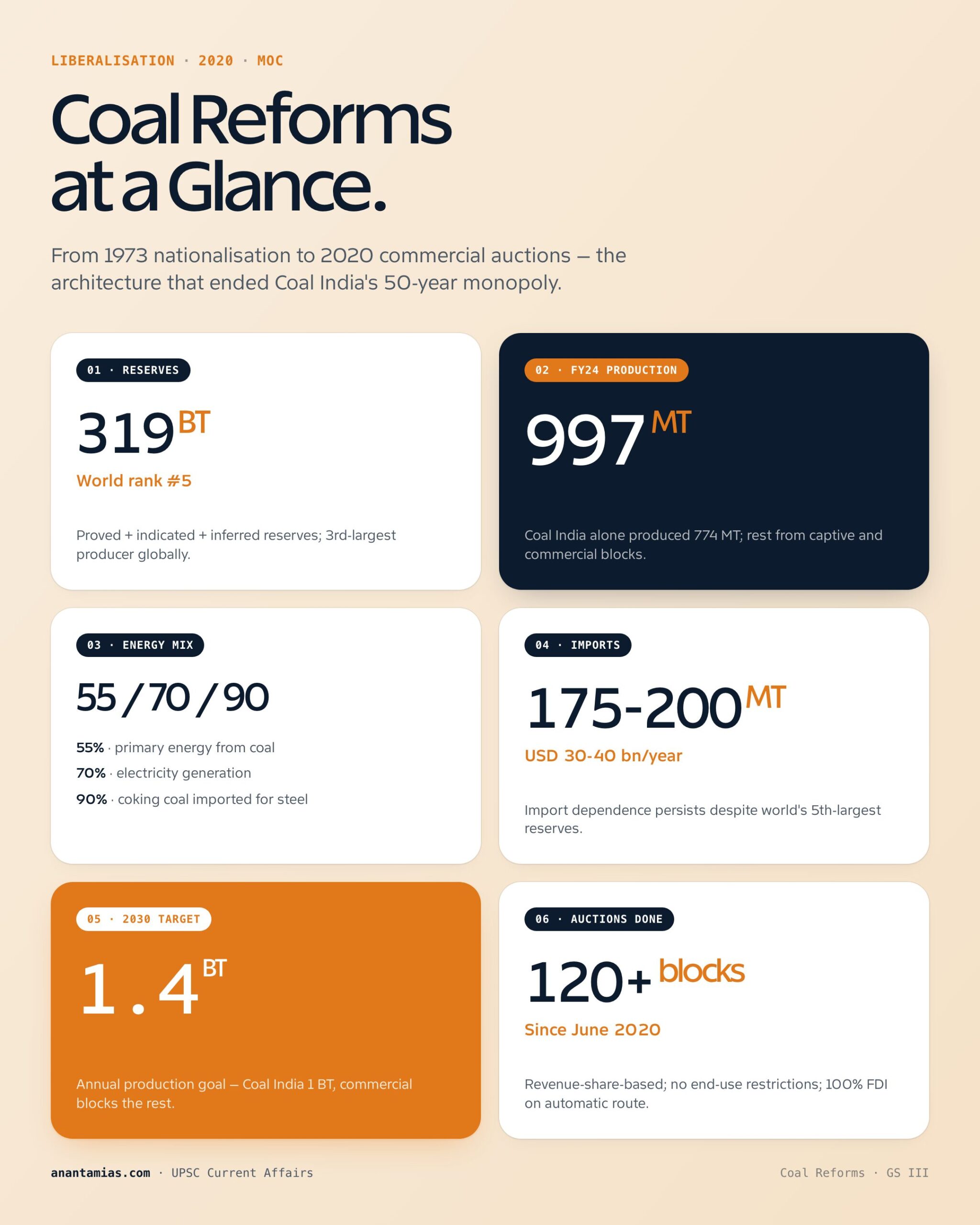
- India has the world's third-largest coal reserves at around 319 billion tonnes (proved + indicated + inferred).
- Production FY24: Coal — 997 MT (Coal India 774 MT, captive/commercial others, SCCL).
- Consumption FY24: ~1,150-1,200 MT.
- Imports FY24: 175-200 MT (coking coal for steel + thermal coal for power).
Coal in the Energy Mix
- ~55 percent of primary energy comes from coal.
- ~70 percent of electricity generation comes from coal-fired plants.
- Steel sector: 90 percent of coking coal needs imported (no high-grade domestic coking coal).
Major Coal Sector Reforms
1. Commercial Coal Mining Auctions (2020)
- Announced under Atmanirbhar Bharat (May 2020).
- Ended the Coal India monopoly on commercial sales.
- First auctions launched June 2020.
- Revenue-share-based auctions (replacing fixed reserve price).
- No end-use restrictions — winners can sell to any buyer.
- By 2024-25, 120+ commercial coal blocks auctioned with peak rated capacity over 300 MT/year.
2. 100% Foreign Direct Investment (Automatic Route, 2019-20)
- 100 percent FDI allowed in coal mining, including commercial sales.
- Earlier, FDI was restricted to captive mining for own consumption.
- This opens India to global mining technology, capital, and best practices.
3. National Coal Index (NCI) and Pricing Reform
- National Coal Index launched 2020 — monthly index reflecting market-determined prices across grades.
- Used for revenue-share calculations in commercial auctions.
- Replaces administered pricing for greater market efficiency.
4. Single Window Clearance
- Project Monitoring Group (PMG) under Cabinet Secretariat tracks coal-sector projects.
- PARIVESH portal for environmental and forest clearances integrated.
- Reduced project gestation time significantly.
5. Mission Coking Coal (2021)
- Domestic coking coal production target: 140 MT by 2030 (from current 51 MT).
- Coal washeries to upgrade lower-grade coking coal.
- Reduces steel-sector import dependence (current: ~90 percent of coking coal imported).
6. Coal India FPO / Disinvestment
- Coal India FPO 2020 — Rs 17,000 crore raised; reduced government stake.
- Partial monetisation under National Monetisation Pipeline.
7. Commercial Logistics and Evacuation
- First Mile Connectivity projects under Ministry of Coal — mechanised coal transport from pithead to railway sidings.
- Dedicated freight corridors improve evacuation.
- PM Gati Shakti integration for last-mile rail-coal connectivity.
8. Coal-Bed Methane (CBM)
- CBM production scaled with companies like Essar, Reliance, ONGC.
- Coal Mine Methane (CMM) captured for power generation — also reduces methane emissions.
9. Underground Mining Push
- Ministry of Coal launched Underground Mining Promotion Policy 2024 — incentives for mechanised underground operations.
- Addresses environmental concerns about open-cast dominance.
Significance of Reforms
1. Boost Coal Production
- CIL alone could not keep pace with demand growth.
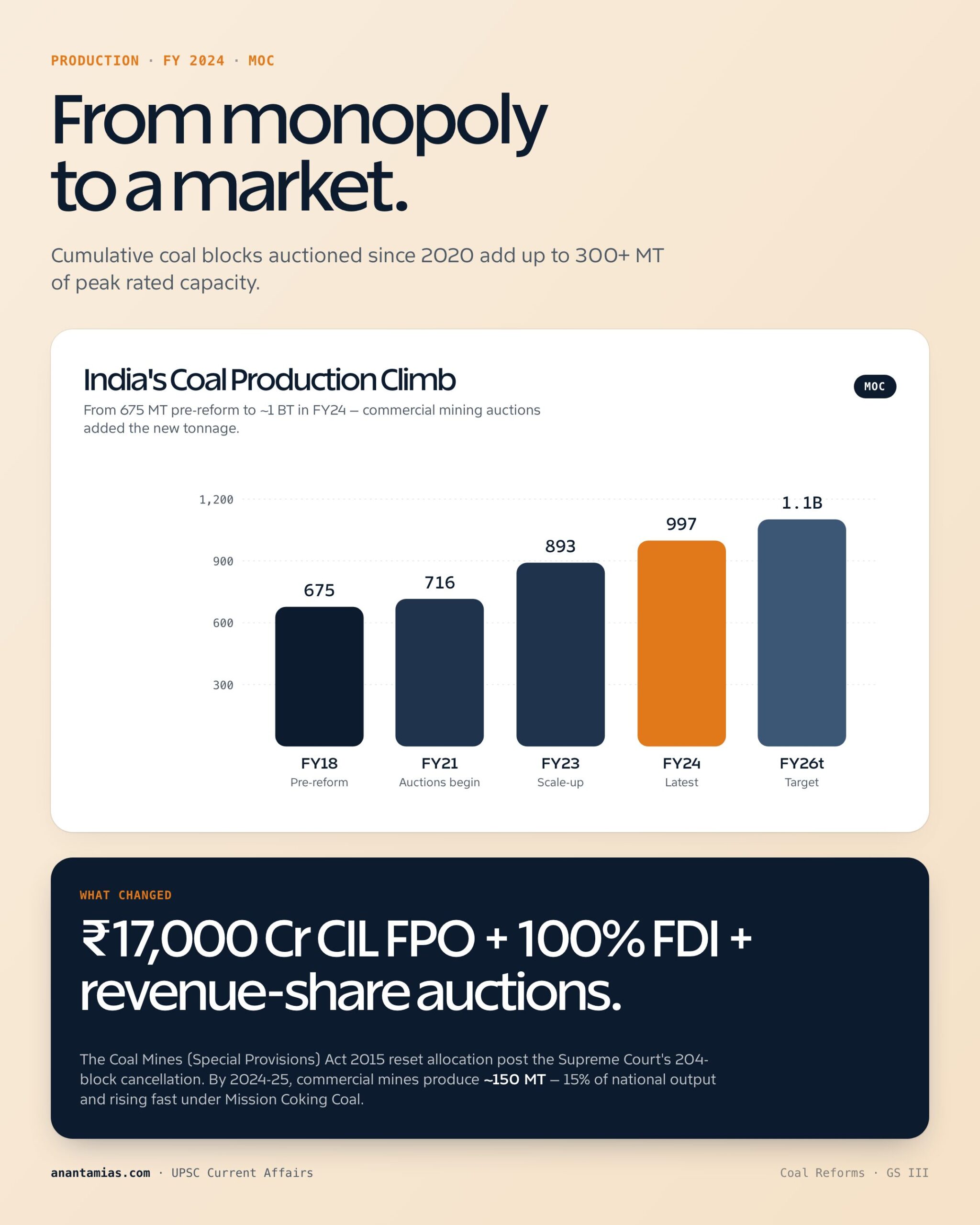
- Commercial auctions add fresh capacity; commercial mines have produced ~150 MT by 2024-25.
- Targets: 1.4 billion tonnes annual coal production by 2030, of which 1 billion tonnes from CIL.
2. Meet Coal Needs of Power Plants
- Power plants operating below installed capacity (PLF ~65-67 percent in FY24).
- New coal supply enables higher PLF, lower per-unit costs, healthier discom-IPP economics.
3. Reduce Current Account Deficit
- Coal imports cost USD 30-40 billion annually — significant CAD pressure.
- Domestic substitution would directly improve external balance.
4. Technological Advancement
- FDI brings longwall mining, continuous miners, automated systems — used by global majors.
- Underground mining technology for high-quality reserves (e.g., Jharia coalfield) protected from open-cast destruction.
5. Promote Competition
- The reforms break the CIL monopoly, opening the industry to competition for the first time since 1973.
- Greater efficiency, lower per-tonne mining costs.
6. Royalty Revenues for States
- Coal-bearing states (Jharkhand, Odisha, Chhattisgarh, Madhya Pradesh, West Bengal) gain higher royalty inflows under auction-based regime.
- Used for development of coal-bearing districts via District Mineral Foundation (DMF).
Recent Developments (2024-26)
- Commercial coal auctions: 12+ rounds completed by 2025; cumulative blocks auctioned 100+ with PRC over 300 MT.
- Mission Coking Coal: Coking coal production rose to ~62 MT in FY25; further growth expected with Bharat Coking Coal Ltd (BCCL) and SAIL captive mines.
- Coal India production: 774 MT in FY24; targeting 1 billion tonnes by FY26.
- Imports: declined slightly in FY24 to ~175 MT but remained high due to coking coal needs.
- Critical Minerals Mission (Budget 2024-25) complements coal sector with lithium, cobalt, REEs.
- Coal India diversification: into solar, critical minerals, lithium-ion battery materials.
- Just Transition: Ministry of Coal working on just transition framework for coal-region rehabilitation as net-zero approaches; Energy Transition Pathway under preparation.
- Carbon Capture, Utilisation and Storage (CCUS) pilots at thermal plants.
- Coal gasification target: 100 MT coal gasification by 2030 to substitute imported chemicals.
- Budget 2025-26: Continued capex outlay for coal evacuation infrastructure, mechanisation.
- Mining Lease Rules: Mineral Concession Rules 2024 amended for longer-term lease security.
- Supreme Court 2024 ruling on royalty being state's tax not central — significant for state finances and inter-governmental relations.
Challenges Remaining
- Land acquisition for new mines remains slow.
- Environmental clearances still face NGT challenges.
- Forest cover in coal-bearing tracts (Hasdeo Aranya, Saranda) faces conservation tension.
- Just transition for coal-dependent districts as net-zero approaches.
- Coal washeries infrastructure inadequate.
- Underground mining still less than 5 percent of production.
- Worker safety — DGMS data shows fatalities persist.
- Air pollution around coalfields.
Way Forward
- Scale commercial auctions with predictable annual calendars.
- Mission Coking Coal acceleration — washeries, beneficiation.
- Underground mining for high-quality reserves with low environmental footprint.
- Coal gasification to substitute imported methanol, ammonia.
- CCUS at thermal plants where economically viable.
- Just transition framework: alternative livelihoods for coal-region communities; reskilling for renewables; District Mineral Foundation funds for development.
- Mine reclamation standards and enforcement.
- Phased transition — coal phase-down (not phase-out) consistent with Glasgow Pact.
International Comparisons
| Country | Coal Production (MT, 2023) | Reserves Rank | Imports/Exports |
|---|---|---|---|
| China | ~4,700 | 4 | Importer |
| India | ~893 | 5 | Importer (175-200 MT) |
| Indonesia | ~775 | 7 | Major exporter |
| USA | ~539 | 1 | Exporter |
| Australia | ~440 | 4 | Major exporter |
| Russia | ~440 | 2 | Exporter |
India's coal reserves rank fifth but imports persist due to mismatch in quality (low ash) and mining cost.
UPSC Relevance
GS-III Mapping
- Infrastructure: Energy, Ports, Roads, Airports, Railways.
- Mineral and energy resources, mining.
- Effects of liberalisation on the economy.
- Indian economy and issues relating to planning, mobilization of resources.
Prelims Pointers
- Coal Mines (Nationalisation) Act, 1973.
- Coal India Limited — established 1975.
- Commercial coal mining auctions — launched June 2020.
- 100% FDI in coal mining — 2019-20 under automatic route.
- National Coal Index — 2020.
- Mission Coking Coal — 2021.
- Coal Mines (Special Provisions) Act, 2015.
- Production target: 1.4 billion tonnes by 2030.
Mains Hooks
- "Examine the rationale and impact of coal sector liberalisation in India." (GS-III)
- "Discuss the role of Coal India Limited in India's energy transition. Should it be partially privatised?"
- "How will commercial coal mining affect Indian power and steel sectors? Examine."
- "Discuss India's pathway for a just transition from coal as it pursues net zero by 2070."
India's coal sector has undergone a paradigm shift from state monopoly to liberalised competition. The reforms — commercial auctions, FDI, NCI, Mission Coking Coal, single-window clearances — have begun to boost domestic production, attract investment, and reduce import dependence. The 2024-26 challenge is to balance production scale-up with the just transition as India moves toward net zero by 2070. For UPSC, master the timeline (1973 → 2014 SC → 2020 auctions → 2024 ongoing), the production data, and the long-term targets to write authoritative answers on India's coal economy.
Major Coalfields of India
| Coalfield | State | Type | Notable Feature |
|---|---|---|---|
| Jharia | Jharkhand | Coking + thermal | India's only major coking coal source; mine fires |
| Raniganj | West Bengal | Thermal + non-coking | Oldest commercial coalfield (since 1774) |
| Talcher | Odisha | Thermal | One of the largest by reserves |
| Korba | Chhattisgarh | Thermal | Major power supply source |
| Singrauli | MP/UP | Thermal | Anchors several large thermal plants |
| Wardha Valley | Maharashtra | Thermal | Vidarbha region |
| North Karanpura | Jharkhand | Thermal | Large reserves |
| Godavari Valley | Telangana | Thermal | SCCL operations |
| Lignite — Neyveli | Tamil Nadu | Lignite | NLC India operations |
| Lignite — Barmer | Rajasthan | Lignite | Thar region |
Coal in India's Steel Sector
- India is the world's second-largest steel producer at ~145 MT in FY24.
- Steel sector consumes ~70 MT of coking coal annually.
- ~90 percent of coking coal is imported, mostly from Australia (60%+), USA, Mozambique, Russia.
- Mission Coking Coal (2021) targets 140 MT domestic production by 2030.
- Coal washeries to upgrade lower-grade Indian coking coal are scaling.
- Bharat Coking Coal Limited (BCCL) and SAIL captive mines are the main domestic sources.
- Reduces steel import dependence, supports National Steel Policy 2017 target of 300 MT capacity by 2030.
Just Transition: The Coming Challenge
As India moves toward net zero by 2070, coal-bearing states face an economic and social transition:
- Coal-bearing districts (Dhanbad, Korba, Singrauli, Bokaro, Asansol, Ramgarh) host millions of livelihoods directly and indirectly tied to coal.
- State revenue dependence: Jharkhand, Odisha, Chhattisgarh derive 15-30 percent of their non-tax revenue from coal royalties.
- District Mineral Foundation (DMF) funds — accumulated over Rs 80,000 crore by 2024 — are critical for transition financing.
- Skill transition programmes are needed for ex-miners to move into renewables, manufacturing, services.
- Mine reclamation and ecological restoration of opencast pits.
- Just Transition Working Group under Power Ministry preparing roadmap (2024-25).
International precedents: Germany's Ruhr region transition (2018-2038) offers lessons in coal phase-down with regional development funds.
Coal Logistics Bottleneck
- 70 percent of coal moves by rail.
- Indian Railways runs over 280 rakes/day for coal.
- Critical chokepoints: Howrah-Mughalsarai-Allahabad corridor; Korba-Bilaspur; Talcher-Paradeep.
- Eastern Dedicated Freight Corridor (EDFC, 1,337 km) commissioned 2024 — relieves coal transport.
- First Mile Connectivity projects mechanise coal evacuation from pithead to railway sidings.
- Sagarmala improves port handling for imported coal.