Disaster Management Act 2005 vs Amendment 2024: What Has Actually Changed
Compare the Disaster Management Act 2005 with the 2024 Amendment: NDMA-SDMA powers, UDMA for cities, statutory SDRF, civil penalties, and UPSC-ready analysis.
The Disaster Management (Amendment) Bill, 2024 was introduced in the Lok Sabha on August 1, 2024 and reshapes the architecture of disaster governance in India for the first time in nearly two decades. The original Disaster Management Act of 2005, drafted in the wake of the 2004 Indian Ocean tsunami, set up the National Disaster Management Authority, State Disaster Management Authorities, and District Disaster Management Authorities. The 2024 amendment shifts the centre of gravity from administrative committees to statutory authorities, creates a new Urban Disaster Management Authority for state capitals and large cities, gives the State Disaster Response Force formal legal status, and adds a national disaster database to plug a long-standing data gap.
For UPSC, the comparison between the 2005 Act and the 2024 amendment is one of the cleanest GS-III topics because every change can be tied to a specific institutional or operational shortcoming exposed by recent disasters. Cyclone Amphan, the COVID pandemic, Joshimath subsidence, the Wayanad landslide, and repeated urban flooding in Bengaluru, Chennai, and Mumbai all fed into the legislative drafting. The amendment also reflects a visible shift in policy doctrine from a relief-and-rescue mindset to a mitigation-and-prevention framework.
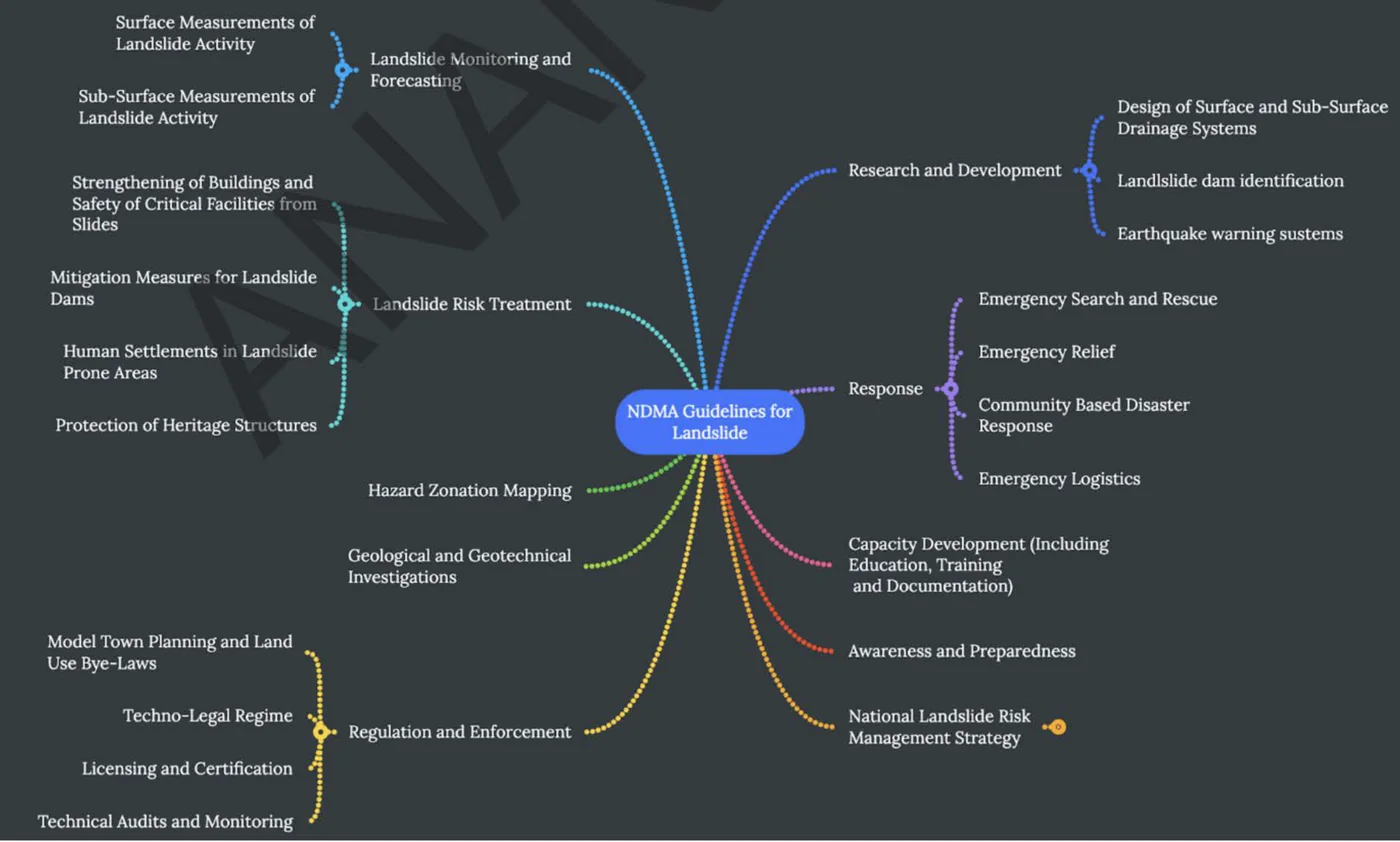
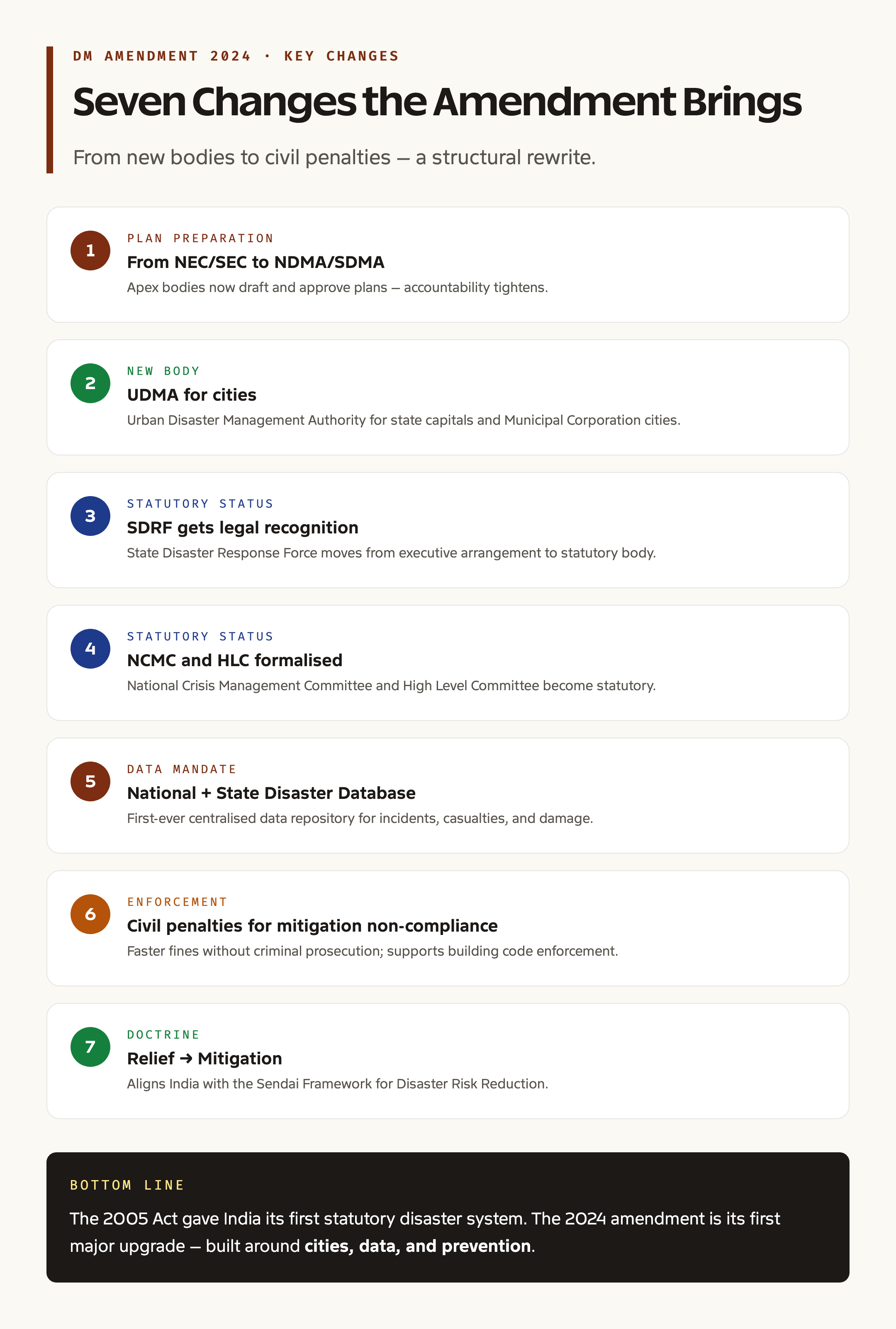
This article walks through the seven specific changes in the 2024 amendment, then sets them against the 2005 baseline, the institutional gaps they aim to fill, and the implications for federalism, urban governance, and public spending.
Quick Facts
- Original law: Disaster Management Act, 2005
- Amendment: Disaster Management (Amendment) Bill, 2024
- Introduced in Lok Sabha: August 1, 2024
- Drafted in response to: 2004 Indian Ocean tsunami; 2024 amendment shaped by Joshimath, Wayanad, COVID, urban floods
- Top body: National Disaster Management Authority (NDMA), chaired by the Prime Minister
- State body: State Disaster Management Authority (SDMA), chaired by the Chief Minister
- District body: District Disaster Management Authority (DDMA), chaired by the District Magistrate
- New body added in 2024: Urban Disaster Management Authority (UDMA) for state capitals and Municipal Corporation cities
- Statutory status granted in 2024: SDRF (State Disaster Response Force), NCMC (National Crisis Management Committee), HLC (High Level Committee)
- New mandate in 2024: National and State Disaster Database
What the Disaster Management Act Is
The Disaster Management Act, 2005 is the parent legislation for disaster governance in India. It defines a disaster, sets up the institutional pyramid (NDMA, SDMA, DDMA), creates the National Disaster Response Force (NDRF), establishes the National Institute of Disaster Management (NIDM), and authorises the National Disaster Response Fund and State Disaster Response Funds. It also contains penalty provisions for obstruction of duty, false warnings, and misappropriation of disaster funds.
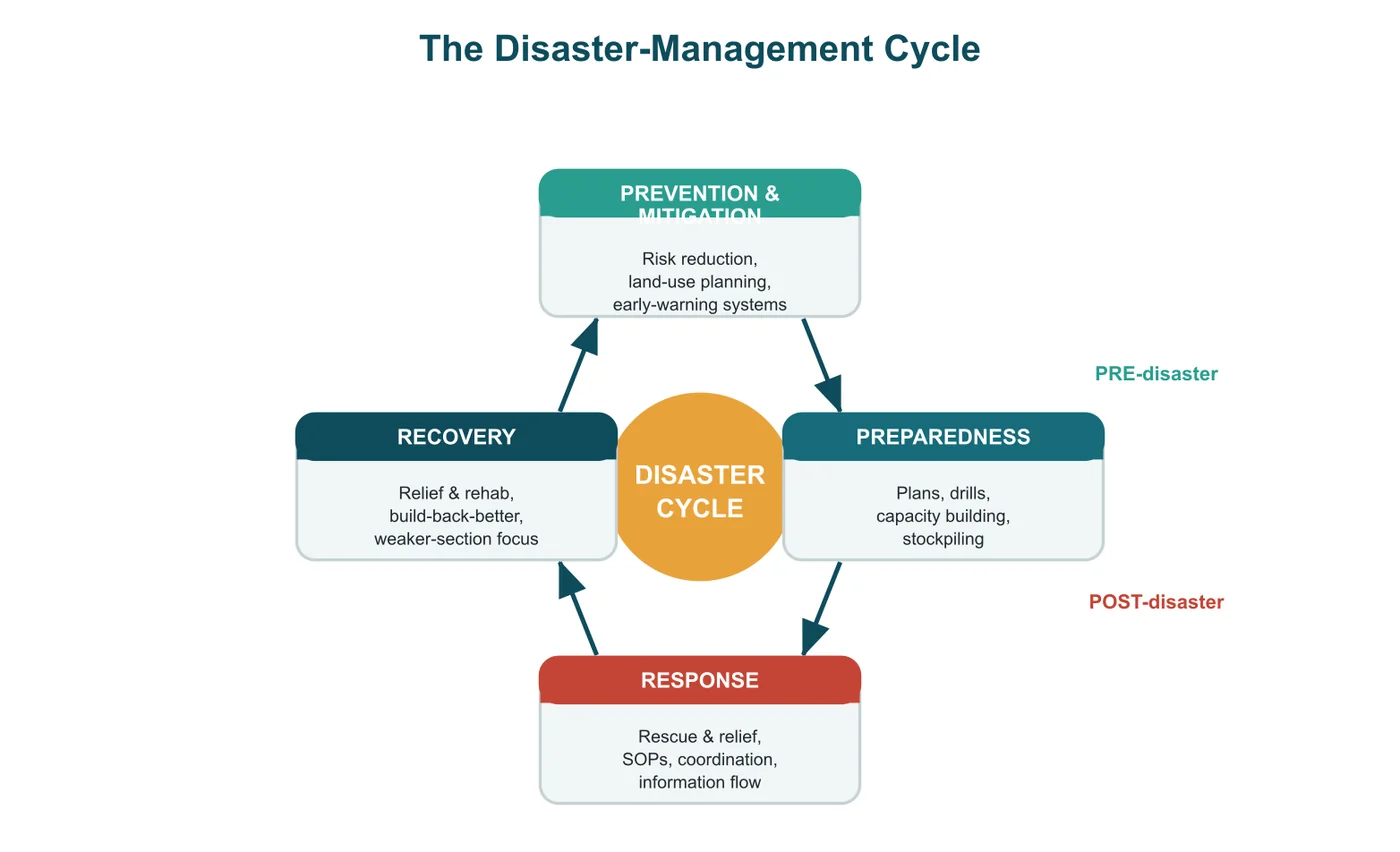
The Act was a direct response to the 26 December 2004 Indian Ocean tsunami, when India had no formal national-level disaster authority and the response depended on the Cabinet Committee on National Calamities and ad hoc state coordination. The 2005 Act gave India a permanent, statutory disaster governance system for the first time. The institutional architecture and powers of each authority are explained in our NDMA-SDMA-DDMA primer.
The 2005 framework worked well for natural disasters with clear physical impact such as cyclones, earthquakes, and floods. It struggled with newer hazards such as urban flooding, pandemic response, climate-induced disasters, and cascading risks where multiple hazards trigger one another. The 2024 amendment attempts to update the law for these new challenges.
Background and Historical Context
India’s disaster management law evolved through four distinct phases.
Pre-2005 phase: Disaster response was treated as a relief problem under the Ministry of Agriculture. Each state had its own Crisis Management Group, and central response depended on the Cabinet Committee on National Calamities. There was no statutory body and no permanent response force.
2005 to 2014 phase: The DM Act, 2005 created the NDMA, SDMA, DDMA pyramid and the NDRF. NDRF battalions were deployed for the 2008 Kosi floods, 2013 Uttarakhand floods, and Cyclone Phailin in 2013. The system worked, though coordination between centre and state remained patchy.
2015 to 2020 phase: The Sendai Framework for Disaster Risk Reduction (2015) shifted global doctrine toward prevention and mitigation. India’s National Disaster Management Plan (2016) was the first comprehensive national plan. The shift from relief-centric to risk-reduction-centric thinking became formal policy.
2020 to 2024 phase: COVID exposed governance gaps. The DM Act, 2005 was invoked for the first time as the legal basis for a nationwide lockdown, raising questions about whether a public health emergency fits under “disaster” as defined in the Act. Joshimath subsidence (2023), Wayanad landslide (2024), and chronic urban flooding strengthened the case for amending the law.
The 2024 amendment is therefore the culmination of nearly a decade of pressure to modernise the framework, reduce ambiguity, and create dedicated authorities for cities and emerging hazards.
Key Provisions: Seven Changes the 2024 Amendment Introduces
1. Plan Preparation Shifts to NDMA and SDMA
In the 2005 Act, the responsibility for preparing the National Plan and the State Plans rested with the National Executive Committee (NEC) and the State Executive Committees (SEC) respectively. These were administrative bodies of senior bureaucrats. Under the 2024 amendment, plan preparation moves directly to the NDMA and SDMA themselves, which are the apex authorities.
This change tightens accountability. The same body that approves a plan now also drafts it, eliminating the buffer of an executive committee. It also gives NDMA and SDMA more direct control over the planning process, plan revisions, and inter-departmental coordination.
2. Urban Disaster Management Authority for Cities
The 2005 Act had no specific body for cities. Urban disasters were managed by the District Disaster Management Authority, which is led by the District Magistrate and is poorly equipped for the complexity of mega-city flooding, fire, and infrastructure failure.
The 2024 amendment establishes a Urban Disaster Management Authority (UDMA) for every state capital and every city with a Municipal Corporation. The UDMA will draw members from the municipal commissioner, fire services, traffic police, water and power utilities, and disaster experts. The aim is to create a city-scale governance unit capable of handling complex urban risk including drainage, encroached water bodies, fires in high-rise buildings, gas leaks, and stampedes.
The change is significant because India’s urban population now exceeds 600 million, and most major cities have outgrown their original drainage and disaster infrastructure.
3. Statutory Status to the State Disaster Response Force
The State Disaster Response Force (SDRF) existed before 2024 only as an executive arrangement. States raised SDRF battalions through orders of the Home Department, often by drawing personnel from state armed police. There was no central legal mandate.
The 2024 amendment grants statutory status to the SDRF, similar to the legal recognition the 2005 Act gave to the NDRF. This means SDRF battalions get a fixed legal framework, defined recruitment and training standards, formal powers, and budgetary protection. It also reduces the discretion a state government has to scale down or restructure its SDRF based on political priorities.
4. Statutory Status to NCMC and HLC
The National Crisis Management Committee (NCMC), chaired by the Cabinet Secretary, and the High Level Committee (HLC), chaired by the Union Home Minister, both functioned for years as administrative bodies. They handled cross-ministry coordination during crises but had no statutory backing.
The 2024 amendment grants statutory status to both. This formalises their roles, authorises their composition, and gives their decisions a clearer legal basis. The change responds to gaps observed during COVID, when crisis-management decisions taken by these committees lacked clear legal grounding.
5. National and State Disaster Database
The 2005 Act had no specific provision for a centralised data repository. Different ministries, states, and agencies maintained their own incident logs, casualty figures, and damage assessments. This made it difficult to compare disasters across regions or to track recurring hazards over time, a gap that the environmental laws in India framework has long faced for hazard reporting.
The 2024 amendment mandates the creation of a National Disaster Database and State Disaster Database. The databases will record disaster incidents, casualties, damage assessments, fund disbursements, and recovery progress. The database is expected to support evidence-based policy, faster compensation, and integration with insurance products.
6. Civil Penalties for Mitigation Non-Compliance
The 2005 Act focused penalties on obstruction of duty, false warnings, and misappropriation of funds. These were primarily criminal in nature.
The 2024 amendment adds civil penalties (fines) for simple non-compliance with mitigation orders. For example, if NDMA or SDMA issues a building code requirement for a flood-prone zone and a developer ignores it, the authority can now levy a financial penalty without needing to prove criminal intent. This makes mitigation enforcement faster and more practical.
7. Shift from Relief-Centric to Mitigation-Centric Approach
The 2005 Act was largely relief-centric, with most provisions focused on post-disaster response, rescue, and rehabilitation. The 2024 amendment shifts the orientation toward mitigation, prevention, and risk reduction, in line with the Sendai Framework and the National Disaster Management Plan, 2016.
This change is partly textual (mitigation language is woven into more sections) and partly structural (the new database, the UDMA, and the civil penalties all serve the mitigation agenda).
Side-by-Side Comparison Table
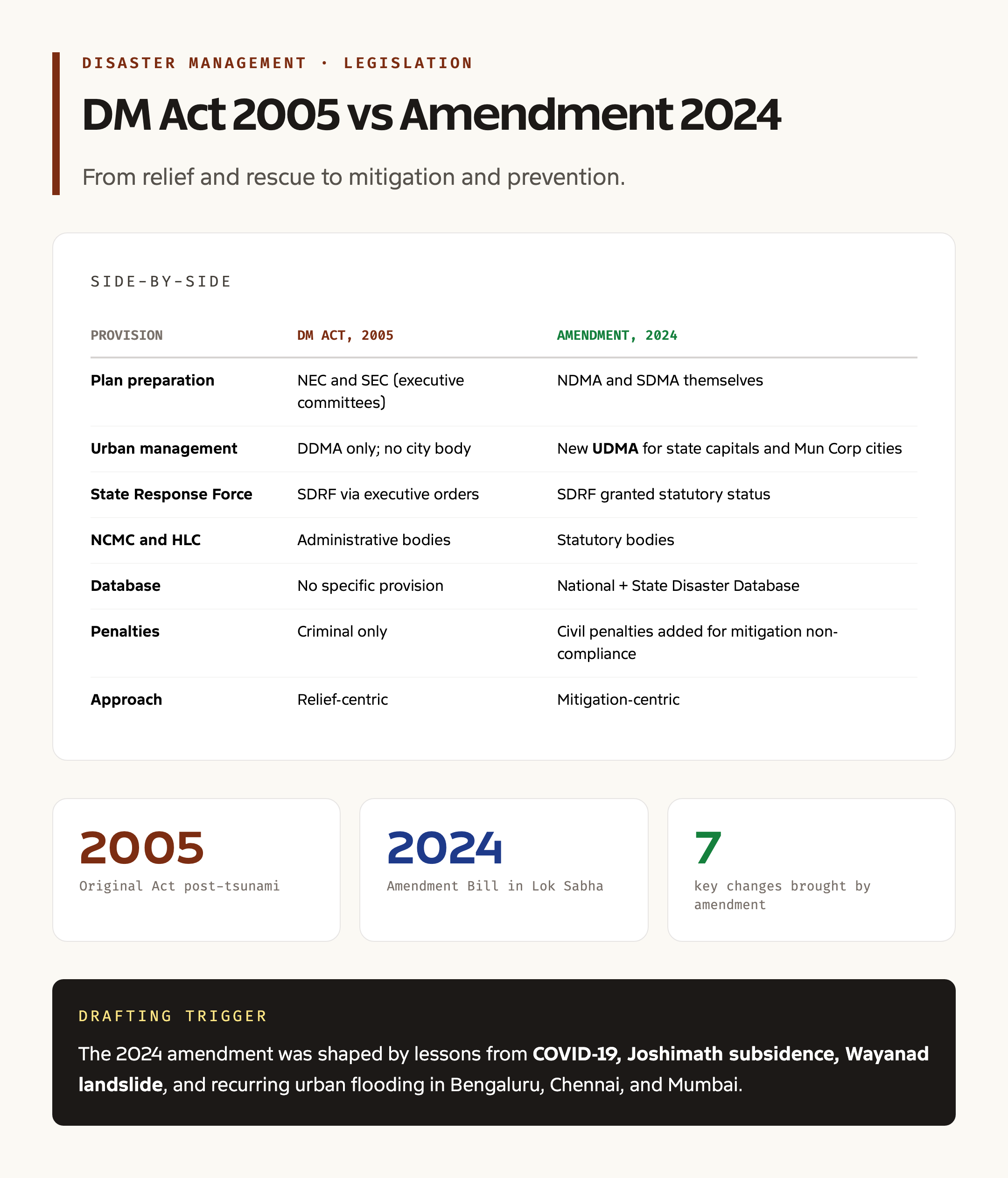
| Feature | DM Act, 2005 | DM Amendment, 2024 |
|---|---|---|
| Plan preparation | NEC and SEC (executive committees) | NDMA and SDMA (apex authorities) |
| Urban management | DDMA only | New UDMA for state capitals and Municipal Corporation cities |
| State Response Force | SDRF via executive orders, no central mandate | Statutory status granted to SDRF |
| NCMC and HLC | Administrative bodies | Statutory bodies |
| Data repository | No specific provision | National and State Disaster Databases mandated |
| Penalties | Criminal: obstruction, false warning, misappropriation | Civil penalties added for mitigation non-compliance |
| Approach | Relief-centric | Mitigation-centric |
Why It Matters
Federal balance: Disaster management is on the Concurrent List by virtue of the DM Act. The amendment strengthens central coordination through statutory NCMC and HLC while also empowering state authorities to plan directly. The net effect is better cooperative federalism if the centre and states actually use the new structures rather than parallel them.
Urban resilience: Indian cities have flooded year after year. Bengaluru in 2022, Chennai in 2015 and 2023, Mumbai in 2005 and almost every monsoon since, Hyderabad in 2020. UDMAs give cities a dedicated governance body that can integrate drainage, fire, traffic, and disaster planning.
Mitigation funding: Civil penalties allow regulators to enforce building codes, hazard zoning, and safety norms without going through criminal prosecution, which is slow and expensive.
Pandemic and climate hazards: The 2005 Act covered “natural and man-made” disasters. The 2024 amendment doesn’t redefine disaster, but the database and mitigation focus position the system better for slow-onset, cascading risks like climate-induced sea level rise, pollution-induced respiratory disasters, and zoonotic disease outbreaks. The framework also draws lessons from the super typhoon Ragasa and recent cyclone responses.
Compensation and insurance: A national disaster database supports evidence-based compensation, parametric insurance products, and faster claims processing.
Detailed Analysis: How the New Architecture Fits Together
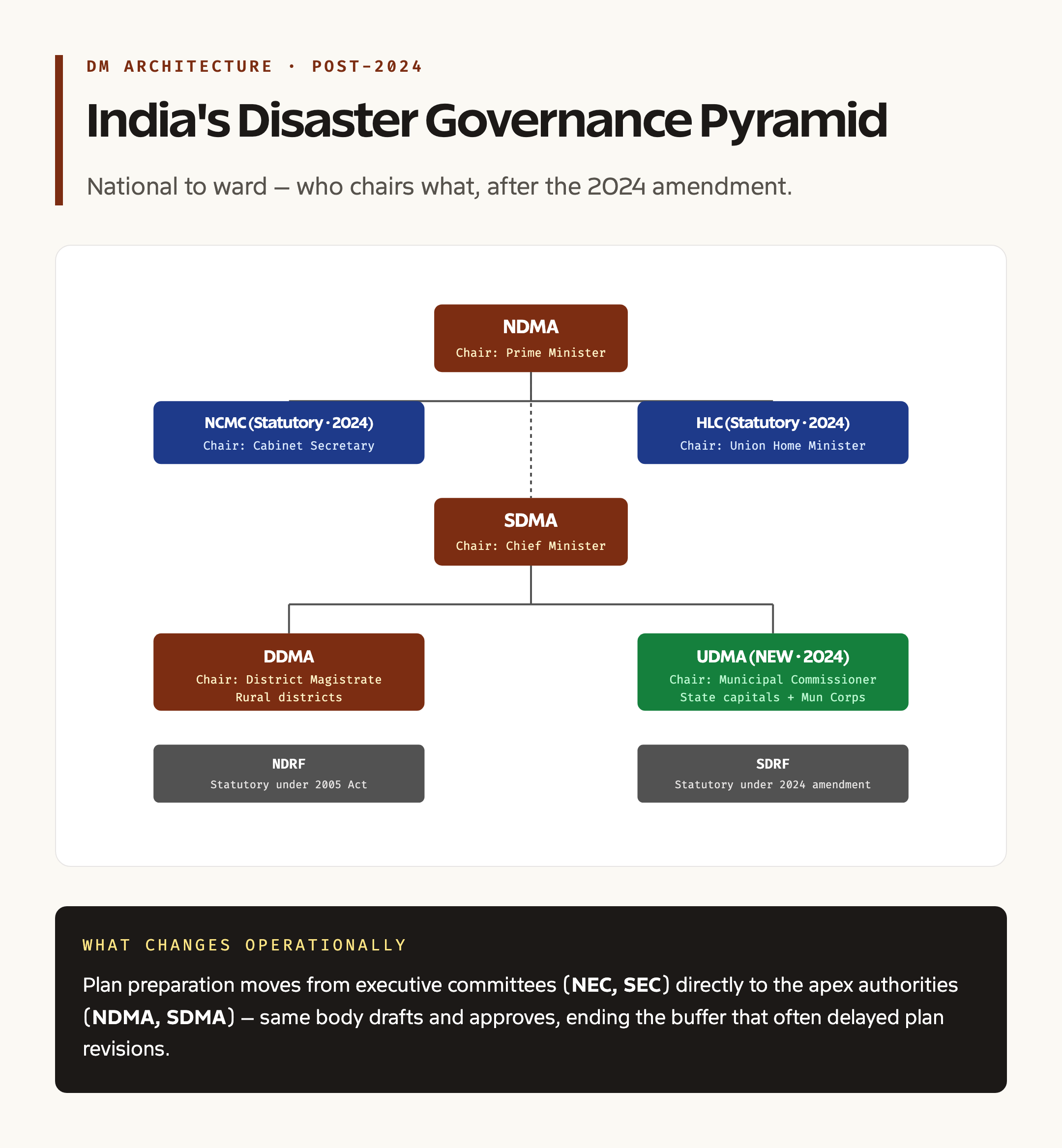
Hierarchy of Authorities (Post-2024)
- National Disaster Management Authority (NDMA): Chaired by the Prime Minister; central body for policy and plans
- National Crisis Management Committee (NCMC): Statutory; chaired by Cabinet Secretary; coordinates response across ministries
- High Level Committee (HLC): Statutory; chaired by the Union Home Minister; clears central financial assistance
- State Disaster Management Authority (SDMA): Chaired by the Chief Minister
- District Disaster Management Authority (DDMA): Chaired by the District Magistrate
- Urban Disaster Management Authority (UDMA): New; for state capitals and large cities
- National Disaster Response Force (NDRF): Statutory under DM Act, 2005
- State Disaster Response Force (SDRF): Now statutory under 2024 amendment
- National Institute of Disaster Management (NIDM): Training, research, capacity building
Funding Architecture
The DM Act funding flows through two main vehicles. The National Disaster Response Fund (NDRF) is supplemented by a National Calamity Contingent Duty levied on certain goods and a budgetary contribution from the centre. The State Disaster Response Fund (SDRF) is funded jointly by the centre and the state in a 75:25 ratio for general states and 90:10 for special category states.
The 2024 amendment retains the funding architecture but adds the National and State Disaster Databases, which will track fund utilisation in much greater detail.
Comparative Lens: International Frameworks
| Country | National Body | Notable Feature |
|---|---|---|
| India (2024) | NDMA | Statutory NCMC, HLC, SDRF; UDMA for cities |
| United States | FEMA | Stafford Act; FEMA reports to DHS; declared-disaster trigger |
| Japan | Cabinet Office (DRR) | Basic Act on Disaster Countermeasures; strong city-level role |
| Bangladesh | Department of Disaster Management | Strong cyclone shelter network; community-based DRR |
| Philippines | NDRRMC | Republic Act 10121; bottom-up DRR architecture |
India’s amended framework is closer to the Japanese model in its emphasis on city-level authorities and to the Philippines model in its push toward mitigation.
Challenges in Implementation
Capacity gaps in cities: Most municipal commissioners are already overloaded. UDMAs will work only if they get dedicated staff, budgets, and decision-making authority.
Coordination overlap: The DDMA and UDMA may overlap in jurisdiction in capital cities. Clear demarcation will need rules.
Database integration: Building a national database with real-time inputs from states, districts, and cities is a major IT and governance challenge. Data quality varies sharply across states.
SDRF training and equipment: Statutory status alone does not deliver capacity. Many SDRF battalions lack diving gear, helicopters, mass-casualty kits, and trained medics.
Climate-induced cascading risks: The amendment does not explicitly redefine “disaster” to include slow-onset climate impacts such as glacial melt, sea-level rise, and ecosystem collapse, which complicates response to events like the Joshimath subsidence.
Prelims Pointers
- The Disaster Management Act was passed in 2005
- The Amendment Bill was introduced in August 2024
- NDMA is chaired by the Prime Minister, SDMA by the Chief Minister, DDMA by the District Magistrate
- The 2024 amendment creates a new Urban Disaster Management Authority (UDMA) for state capitals and Municipal Corporation cities
- The amendment grants statutory status to SDRF, NCMC, and HLC
- A new National Disaster Database and State Disaster Database are mandated
- Civil penalties for non-compliance with mitigation orders are added
- The amendment shifts from relief-centric to mitigation-centric approach
- NDRF was created under the 2005 Act; SDRF gets statutory status only under the 2024 amendment
- The 2005 Act was a response to the 2004 Indian Ocean tsunami
Mains Practice Questions
- The Disaster Management (Amendment) Bill, 2024 marks a doctrinal shift from relief to mitigation. Critically examine how this shift is reflected in the institutional architecture and operational provisions of the amendment. (250 words)
- The creation of Urban Disaster Management Authorities is one of the most significant changes brought by the 2024 amendment. Discuss the rationale and the challenges of operationalising UDMAs in Indian cities. (250 words)
- Examine how the granting of statutory status to the State Disaster Response Force, National Crisis Management Committee, and High Level Committee strengthens India’s disaster governance. (150 words)
Way Forward
To realise the promise of the 2024 amendment, four practical steps matter most. First, the central government should issue model rules for UDMAs within six months of the amendment becoming law, with a default staffing and budget template that states can adapt. Second, the National Disaster Database should be built on an open data architecture with API-level access for researchers, insurers, and state governments, and should be backed by audit standards so that data quality stays consistent. Third, the SDRF statutory framework should specify minimum equipment and training norms, modelled on NDRF battalion standards, with central financial assistance to bridge gaps. Fourth, the centre should integrate climate-induced slow-onset risks (glacial lake outbursts, sea-level rise, urban heatwaves) into the National Plan revision so that the mitigation pivot is not limited to the textbook list of natural disasters. India already has the legal architecture. The challenge now is to convert it into capacity on the ground, in cities, in district control rooms, and in the river valleys where the next disaster is most likely to strike.
Frequently Asked Questions
What is the Disaster Management Act, 2005?
The Disaster Management Act, 2005 is the parent legislation for disaster governance in India. It was enacted in the wake of the 2004 Indian Ocean tsunami and creates the institutional pyramid of NDMA, SDMA, and DDMA, along with the NDRF, NIDM, and the National and State Disaster Response Funds.
What does the 2024 amendment to the Disaster Management Act change?
The 2024 amendment shifts plan preparation to the NDMA and SDMA, creates the Urban Disaster Management Authority (UDMA) for state capitals and Municipal Corporation cities, grants statutory status to the SDRF, NCMC, and HLC, mandates a National and State Disaster Database, and adds civil penalties for mitigation non-compliance.
What is the Urban Disaster Management Authority (UDMA)?
UDMA is a new statutory body introduced by the 2024 amendment. Every state capital and every city with a Municipal Corporation will have one. It is meant to manage city-scale risks such as urban flooding, fires, gas leaks, and stampedes, drawing members from the municipal commissioner, fire services, police, and utilities.
Why was the SDRF given statutory status only in 2024?
Until the 2024 amendment, State Disaster Response Forces were raised through executive orders of state governments. Capacity, training, and funding varied widely. The 2024 amendment grants SDRF a fixed legal framework, defined standards, and budgetary protection, similar to the recognition the 2005 Act gave the NDRF.
Who chairs the NDMA and SDMA?
The NDMA is chaired by the Prime Minister of India. The SDMA is chaired by the Chief Minister of the respective state.
What is the difference between NCMC and HLC?
The National Crisis Management Committee is chaired by the Cabinet Secretary and coordinates the response across ministries. The High Level Committee is chaired by the Union Home Minister and clears central financial assistance for major disasters. Both have been granted statutory status by the 2024 amendment.
Does the 2024 amendment redefine u0022disasteru0022?
The 2024 amendment does not significantly redefine disaster. It retains the broad scope of the 2005 Act (natural and man-made disasters), but the new database, UDMA, and mitigation focus implicitly position the system to handle climate-induced and cascading hazards better.
What is the National Disaster Database?
The National Disaster Database is a centralised data repository mandated by the 2024 amendment. It will record disaster incidents, casualties, damage assessments, fund disbursements, and recovery progress. State Disaster Databases will feed into it. The aim is to enable evidence-based policy and faster compensation.
Are civil penalties under the 2024 amendment new?
Yes. The 2005 Act focused on criminal penalties for obstruction of duty, false warnings, and misappropriation of funds. The 2024 amendment adds civil fines for non-compliance with mitigation orders, which makes enforcement faster and less dependent on criminal prosecution.
How does the 2024 amendment compare with the Sendai Framework?
The Sendai Framework for Disaster Risk Reduction (2015 to 2030) emphasises prevention, mitigation, and risk reduction over relief. The 2024 amendment aligns India’s law with this global doctrine through the new mitigation focus, the disaster database, the UDMA, and the civil penalty regime.