Copyright Act 1957 — Key Provisions, 2012 Amendments & IPR Comparison
UPSC guide to the Copyright Act 1957 in India — key provisions, 2012 amendments, term of protection, fair use, IPRS, and copyright vs patents vs trademarks.
The Copyright Act, 1957 is the principal law governing copyright in India. Enacted shortly after Independence — replacing the Copyright Act of 1914, which was based on the British Copyright Act of 1911 — it protects original literary, dramatic, musical, artistic, cinematographic and sound recording works against unauthorised reproduction, distribution, adaptation and public performance. The Act has been amended six times, most significantly in 2012, which brought Indian copyright law in line with the WIPO Copyright Treaty (WCT) and the WIPO Performances and Phonograms Treaty (WPPT). For UPSC Prelims and GS Paper II (Polity) and GS Paper III (Science & Tech/Economy), copyright is an important intellectual property topic.
Background — Copyright Before and After 1957
Pre-Independence
- Copyright protection in India began with the Indian Copyright Act, 1847
- Replaced by the Copyright Act, 1914 — largely a copy of the British Copyright Act, 1911
- India was a signatory to the Berne Convention (1886) through Britain
Post-Independence Need
After 1947, India needed a statute reflecting:
- The country's sovereign cultural and creative industries
- Obligations under international conventions
- Adaptation to radio, cinema, television
The Copyright Act, 1957 came into force on 21 January 1958.
Subject Matter of Copyright — Section 13
Under Section 13, copyright subsists in the following original works:
| Category | Examples |
|---|---|
| Literary works | Books, articles, speeches, computer programs, databases |
| Dramatic works | Plays, screenplays, choreographic works |
| Musical works | Compositions with or without words (music alone) |
| Artistic works | Paintings, sculptures, drawings, architecture, photographs, maps |
| Cinematograph films | Motion pictures with or without sound |
| Sound recordings | Recorded music/audio on any medium |
Note: Copyright protects the expression, not the idea. Ideas, facts, methods, and procedures are not copyrightable.
Who Owns Copyright — Section 17
The general rule is that the author is the first owner. Exceptions:
| Situation | First Owner |
|---|---|
| Work made for employer (in course of employment) | Employer |
| Work made for publisher (commissioned for magazines, periodicals) | Publisher |
| Government work | Government |
| Work made for public undertaking | Public undertaking |
| Address or speech delivered in public | The person delivering it |
Ownership can be assigned or licensed to others.
Term of Copyright Protection
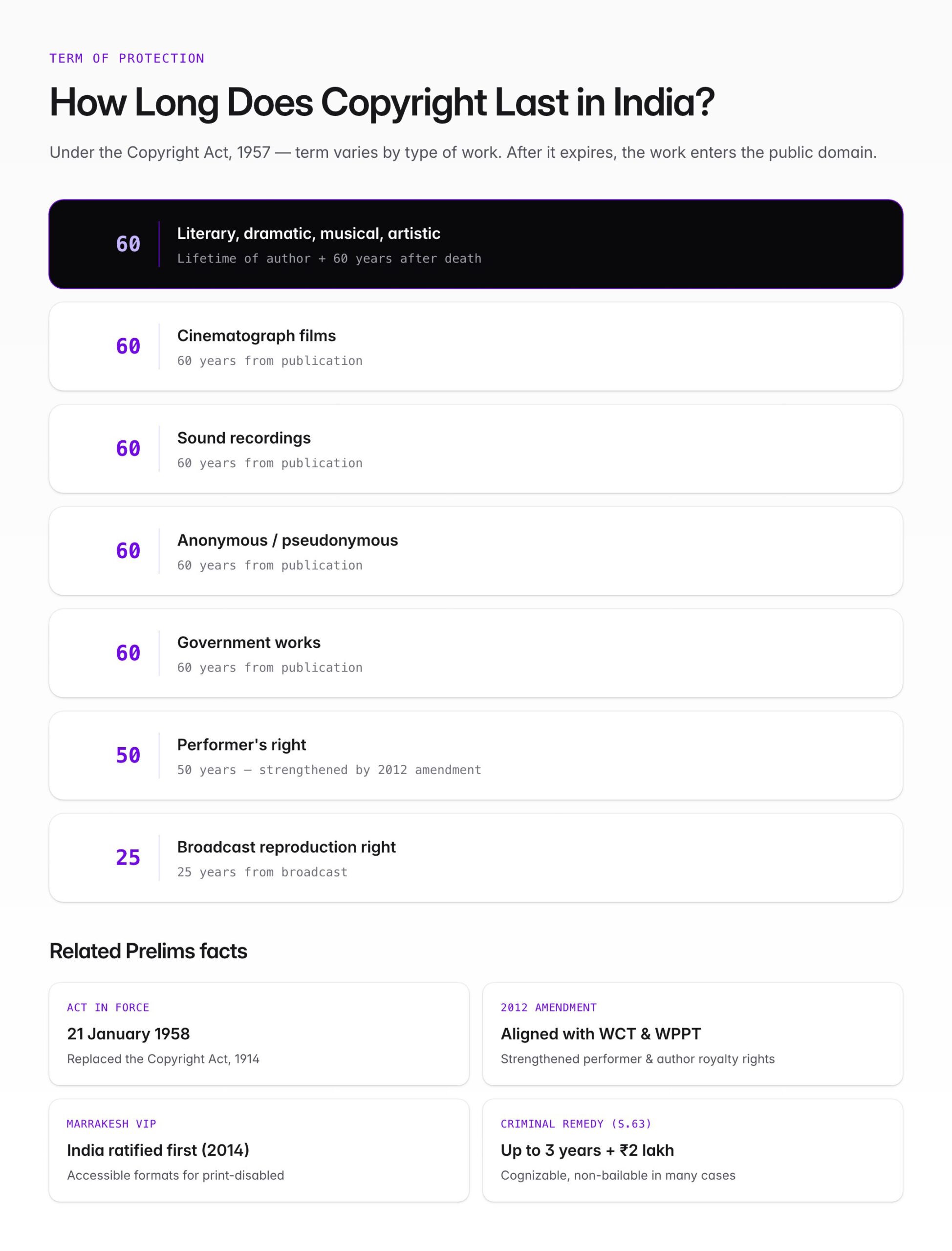
The term of protection varies by type of work.
| Work Type | Term |
|---|---|
| Literary, dramatic, musical, artistic works (author known) | Lifetime of author + 60 years after death |
| Anonymous or pseudonymous works | 60 years from publication |
| Joint authorship | 60 years from death of last surviving author |
| Cinematograph films | 60 years from publication |
| Sound recordings | 60 years from publication |
| Photographs | 60 years from publication (pre-2012 treatment; now life+60 under author rule) |
| Broadcast reproduction right | 25 years |
| Performer's right | 50 years |
| Government works | 60 years from publication |
India's life + 60 for literary works is longer than many countries (e.g., EU/US: life + 70). Works enter the public domain after the term expires.
Rights of the Copyright Holder — Section 14
The author/owner has exclusive rights including:
| Right | Scope |
|---|---|
| Reproduction | Making copies in any form |
| Distribution | Issuing copies to the public |
| Public performance | Stage, concert, broadcast |
| Communication to public | Radio, TV, online streaming |
| Translation | Into other languages |
| Adaptation | Dramatisation, screenplay, abridgement |
Moral Rights — Section 57
Independent of economic rights, the author has moral rights:
- Right of paternity — to be identified as author
- Right of integrity — to prevent distortion, mutilation or derogatory treatment of the work
Moral rights continue even after assignment of economic rights and survive the author's death.
Fair Use / Fair Dealing — Section 52
Indian law uses the term "fair dealing" rather than the US "fair use." Section 52 lists specific acts that do not constitute infringement:
| Permitted Use | Scope |
|---|---|
| Private or personal use, including research | Limited copies |
| Criticism or review of the work or another work | Quotations allowed |
| Reporting of current events and current affairs | In newspapers, broadcasts |
| Judicial proceedings | Copies for court use |
| Performance in educational institutions | To bona fide staff and students |
| Performance in religious ceremonies and official functions | Allowed |
| Reading or recitation of literary works in public | Reasonable extracts |
| Storage by libraries | For preservation |
| Reproduction for blind, dyslexic, disabled persons (Marrakesh Treaty) | 2012 amendment |
India's fair dealing is narrower than US fair use — specific enumerated exceptions rather than a four-factor test.
Copyright (Amendment) Act, 2012 — Major Reforms
The 2012 amendment was the most significant since 1994. It aligned Indian law with:
- WIPO Copyright Treaty (WCT), 1996
- WIPO Performances and Phonograms Treaty (WPPT), 1996
- Marrakesh VIP Treaty (2013) — access for print-disabled
Key Changes in 2012
| Change | Impact |
|---|---|
| Authors' royalty rights | Authors/composers retain royalty for public performance, even after assignment |
| Statutory licensing for radio and TV broadcasting | Prevents private monopolies |
| Extension of moral rights | Strengthened author protections |
| Performer's rights | 50-year term; recognised as primary right holders |
| Digital environment | Protection for technological measures; rights management information; criminalising circumvention |
| Cover versions | Cannot be released within 5 years of original recording |
| Accessibility for disabled | Section 52(1)(zb) — reproduction in accessible formats |
| Copyright Board → Appellate Board | Quasi-judicial oversight |
| Copyright societies | Registration mandatory; one society per class of works |
Copyright Office and Copyright Board
Copyright Office
- Located at New Delhi
- Under Department for Promotion of Industry and Internal Trade (DPIIT), Ministry of Commerce and Industry (since 2016; earlier under HRD)
- Headed by Registrar of Copyrights
- Registration is optional — copyright exists automatically on creation; registration is evidence
Copyright Board (now merged)
- Quasi-judicial body under the Copyright Act
- Hears disputes on licensing, royalties, assignments
- Tribunals Reforms Act, 2021 abolished Copyright Appellate Board (erstwhile IPAB); its functions transferred to the Commercial Courts / High Courts
Indian Performing Right Society (IPRS)
The Indian Performing Right Society Ltd. (IPRS) is a copyright society registered under the Copyright Act.
- Founded in 1969
- Represents authors, composers, and publishers of music
- Collects royalties on behalf of members when music is played in public places (hotels, radio, clubs, events)
- Distributes revenue to rights holders
Other notable copyright societies: Phonographic Performance Limited (PPL), Society for Copyright Regulation of Indian Producers for Films & Television (SCRIPT), Indian Singers' Rights Association (ISRA), Indian Reprographic Rights Organisation (IRRO).
Enforcement and Remedies
Civil Remedies — Section 55
- Injunction — stop the infringement
- Damages — monetary compensation
- Accounts of profits
- Delivery up of infringing copies
Criminal Remedies — Section 63
- Imprisonment up to 3 years and/or
- Fine up to ₹2 lakh
- Second or subsequent offence: imprisonment up to 3 years, fine up to ₹2 lakh
Administrative Remedies
- Customs detention of infringing imports
- Seizure by police (cognizable and non-bailable offence in many cases)
International Dimension
India is a party to:
| Treaty | Year |
|---|---|
| Berne Convention | 1886 (India acceded 1928) |
| Universal Copyright Convention | 1952 |
| Rome Convention (performers, producers, broadcasters) | 1961 |
| TRIPS Agreement (under WTO) | 1995 |
| WIPO Copyright Treaty (WCT) | 1996 (signed; aligned through 2012 amendment) |
| WIPO Performances and Phonograms Treaty (WPPT) | 1996 (aligned through 2012 amendment) |
| Marrakesh VIP Treaty | 2013 (India was the first country to ratify in 2014) |
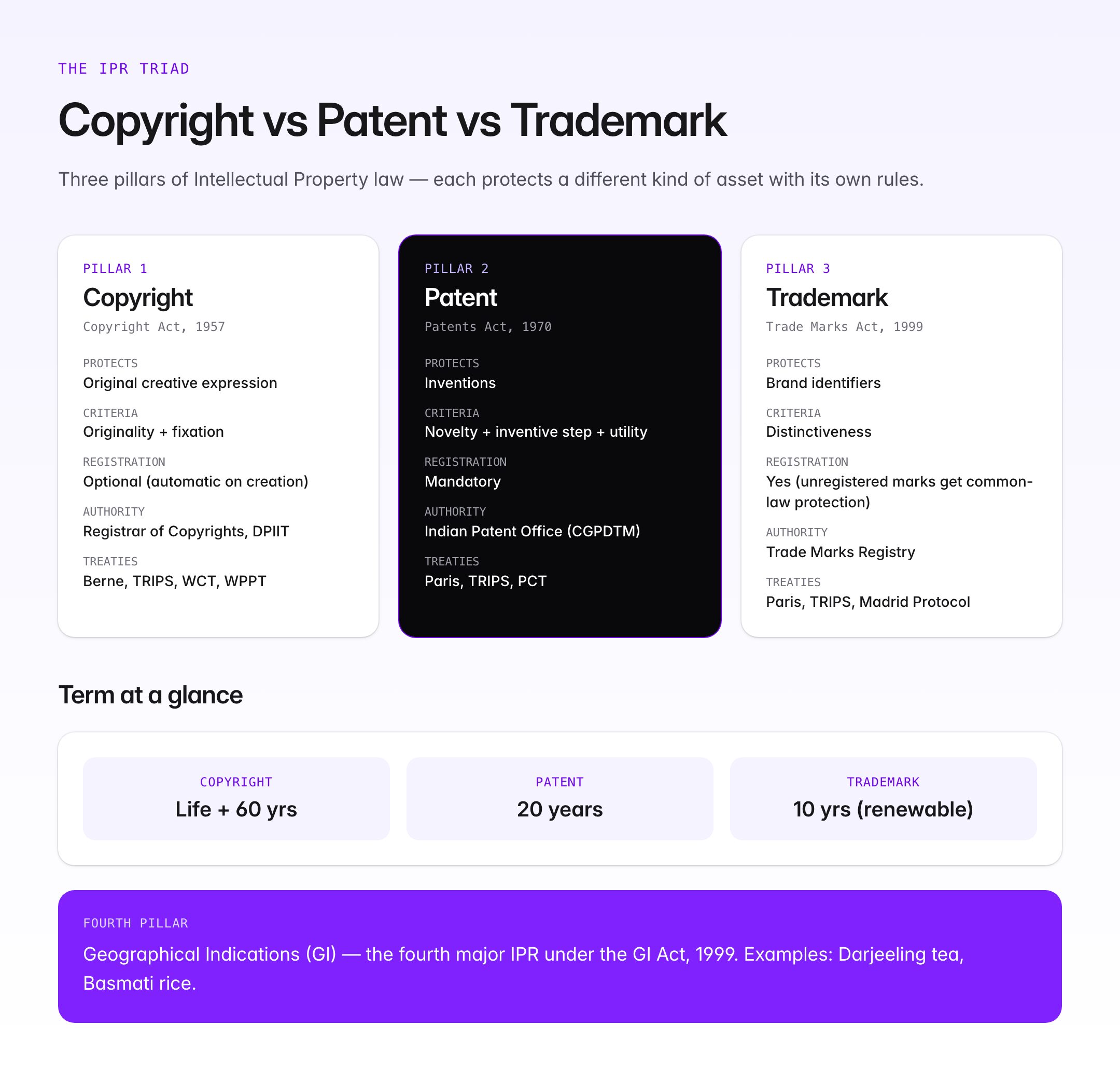
Copyright vs Patent vs Trademark — The IPR Triad
A comparison of the three pillars of Intellectual Property:
| Feature | Copyright | Patent | Trademark |
|---|---|---|---|
| Governing Act | Copyright Act, 1957 | Patents Act, 1970 | Trade Marks Act, 1999 |
| Protects | Original creative expression | Inventions (new, non-obvious, useful) | Brand identifiers (logos, names, symbols) |
| Registration required? | No (automatic on creation); optional registration | Yes (mandatory) | Yes (though unregistered marks get common-law protection) |
| Term | Lifetime of author + 60 years | 20 years from filing date | 10 years (renewable indefinitely) |
| Authority | Registrar of Copyrights, DPIIT | Indian Patent Office, CGPDTM | Trade Marks Registry |
| Geographical scope | India; reciprocal via Berne | India; reciprocal via Paris Convention, PCT | India |
| International treaty | Berne, TRIPS, WCT/WPPT | Paris Convention, TRIPS, PCT | Paris Convention, TRIPS, Madrid Protocol |
| Criteria | Originality + fixation | Novelty + inventive step + utility | Distinctiveness |
| Remedy | Civil + criminal | Civil (infringement); limited criminal | Civil + criminal |
Geographical Indications (GI) is a fourth major IPR — protected under the Geographical Indications of Goods (Registration and Protection) Act, 1999 (e.g., Darjeeling tea, Basmati rice).
Recent Developments
- Tribunals Reforms Act, 2021 — abolished Intellectual Property Appellate Board (IPAB); matters now heard by High Courts' IP Divisions
- Delhi High Court IP Division (2022) and Madras HC IP Division — dedicated IP jurisdiction
- AI-generated works — pending jurisprudence; current law requires human authorship
- National IPR Policy, 2016 — cell under DPIIT for awareness
- Mandatory copyright registration for government tenders, film certification — ongoing discussion
UPSC Relevance
GS Paper Mapping
- GS Paper II — Government policies and interventions; statutory bodies; IPR framework
- GS Paper III — Intellectual Property Rights, Economy, Science & Technology (digital copyright)
- Essay — Knowledge economy; creativity and regulation
Prelims Pointers
- Copyright Act, 1957 — came into force 21 January 1958
- Replaced the Copyright Act, 1914
- Section 13 — subject matter: literary, dramatic, musical, artistic works, cinematograph films, sound recordings
- Section 14 — rights of copyright owner
- Section 52 — fair dealing exceptions
- Section 57 — moral rights
- Section 63 — criminal remedy: up to 3 years imprisonment and ₹2 lakh fine
- Term of copyright for literary work = Lifetime of author + 60 years
- Cinematograph films, sound recordings = 60 years from publication
- Performer's right = 50 years; Broadcast reproduction right = 25 years
- Copyright is automatic — registration is optional but evidentiary
- Copyright Office — New Delhi, under DPIIT (since 2016)
- Copyright (Amendment) Act, 2012 — aligned India with WCT and WPPT; introduced statutory licensing; strengthened performers' rights
- Indian Performing Right Society (IPRS) — founded 1969
- India was first country to ratify Marrakesh VIP Treaty (2014)
- IPAB abolished in 2021 — IP matters now with High Courts
- Copyright = expression (life + 60), Patent = invention (20 years), Trademark = identity (10 years renewable)
The Copyright Act is the legal foundation of India's creative economy — protecting the writer, the composer, the filmmaker, the software developer, and the performer. In a digital age, its continued evolution is inseparable from India's rise as a creative and knowledge power.