
The Central Board of Film Certification, almost universally called the CBFC, sits at the constitutional intersection of free speech, public order, and cultural regulation. Every Indian theatrical release passes through it. Every controversial film of the last decade, from caste-based dramas to political biopics to mythological reinterpretations, has been shaped, cut, delayed or contested at its certification stage. The CBFC is, in plain terms, the gatekeeper between film as creative expression and film as a publicly exhibited cultural product.
The institution’s legal architecture is older than independent India’s first general election. It traces back to the British-era Indian Cinematograph Act of 1918 and is now governed by the Cinematograph Act of 1952, recently overhauled by the Cinematograph (Amendment) Act of 2023. The 2023 amendment changed three big things at once: it introduced age-based UA sub-categories aligned with OTT classifications, made certificates valid in perpetuity, and imposed strict criminal penalties for camcording and film piracy. Just before that, in 2021, the Tribunals Reforms Act abolished the Film Certification Appellate Tribunal and routed appeals directly to the High Court.
This guide walks through the statutory basis of the CBFC, the four certificate categories with their post-2023 sub-categories, the appellate architecture, and the constitutional and free-speech debates that surround the body.
Quick Facts on the CBFC
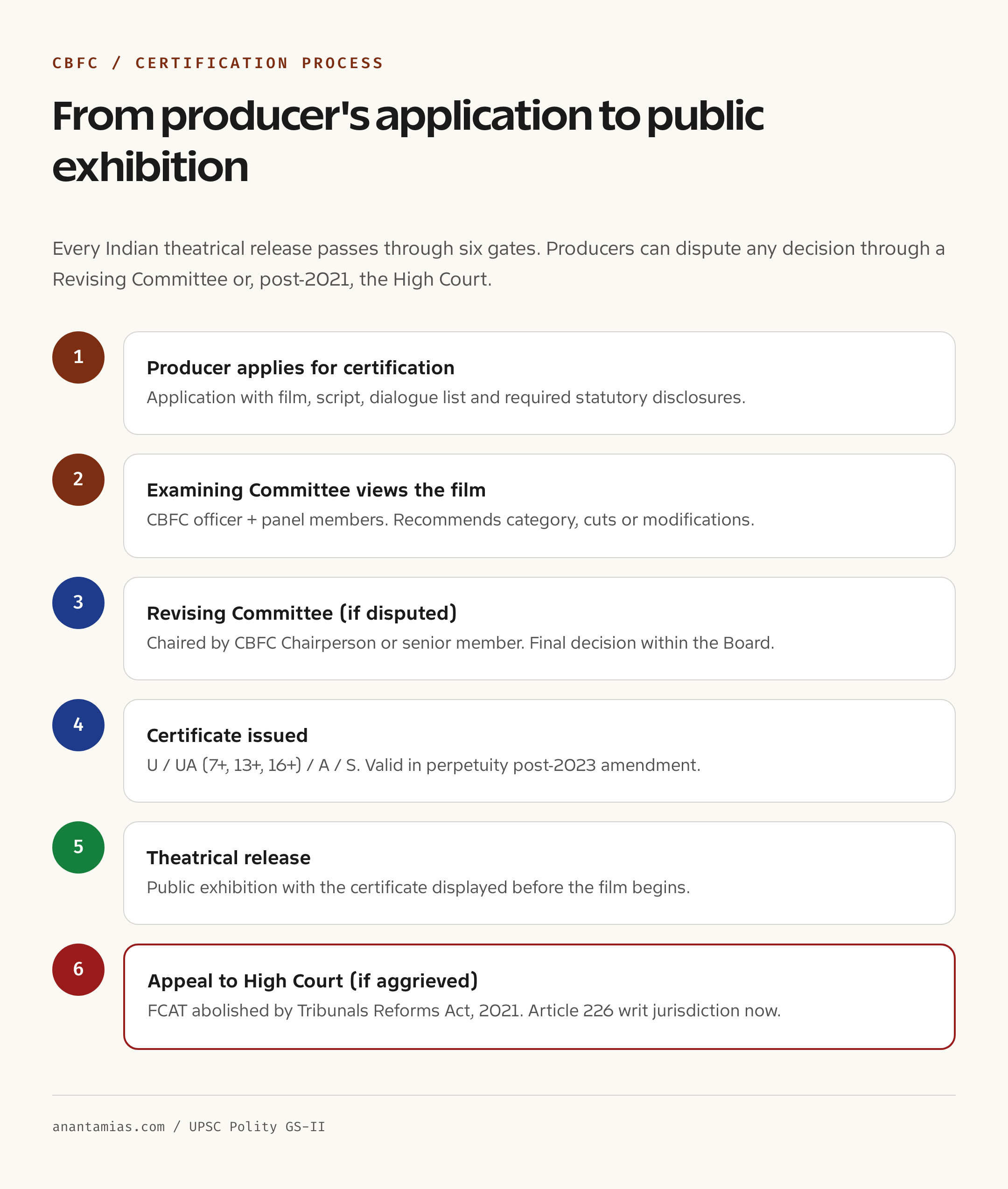
The Central Board of Film Certification is a statutory body under the Cinematograph Act, 1952. It functions under the Ministry of Information and Broadcasting at the Union level. Its headquarters is in Mumbai. It operates through nine regional offices across India. The Chairperson and non-official members are appointed by the Central Government and serve a term of three years or until further orders. The Board issues four categories of certificates: U, UA, A, and S. The UA category is sub-divided into UA 7+, UA 13+ and UA 16+ after the Cinematograph (Amendment) Act, 2023. Certificates are now valid in perpetuity following the 2023 amendment, replacing the earlier ten-year validity. The Film Certification Appellate Tribunal, FCAT, was abolished by the Tribunals Reforms Act, 2021. Appeals against CBFC decisions now go directly to the High Court.
What the CBFC Is
The CBFC is not a constitutional body and not a non-statutory advisory body. It is a statutory body, set up by an Act of Parliament, with a defined mandate, defined powers, and defined procedural rules. The Cinematograph Act of 1952 gives it the authority to examine films intended for public exhibition in India, certify them, refuse certification, or order modifications. The Act covers feature films, documentaries, and short films. It does not currently cover OTT content, which is governed instead by the Information Technology Rules of 2021 and the parallel self-regulatory framework that has emerged around digital streaming services.
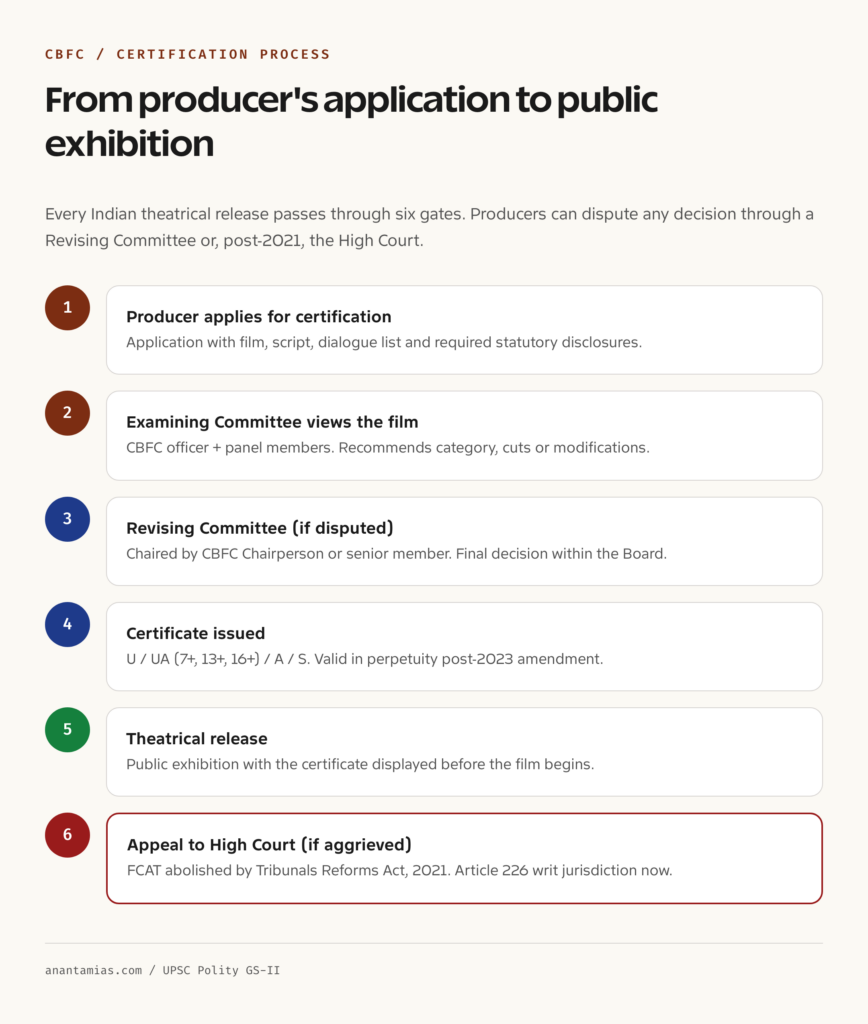
The Board’s day-to-day work is structured through Examining Committees and Revising Committees. An Examining Committee, usually composed of CBFC officers and panel members, views the film and recommends a certificate category along with any cuts or modifications. If the producer disputes the recommendation, the matter goes to a Revising Committee chaired by the CBFC Chairperson or a senior member. Beyond the Revising Committee, the producer’s only remedy is now an appeal to the High Court.
Background and Historical Context
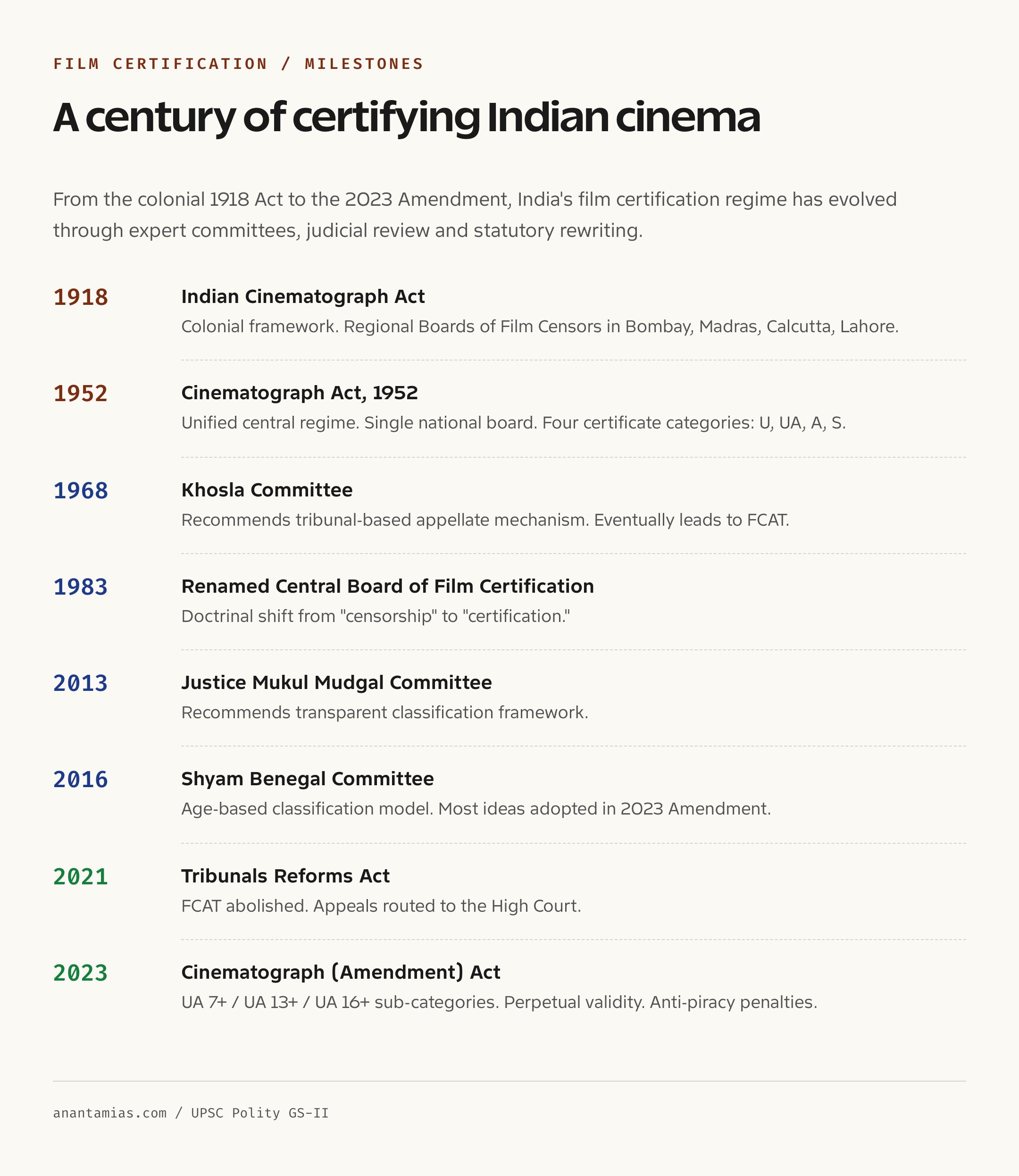
Film certification in India is older than the Republic itself. The Indian Cinematograph Act of 1918, enacted under colonial rule, set up the first formal censorship regime, with regional Boards of Film Censors in Madras, Bombay, Calcutta and Lahore. After independence, the Cinematograph Act of 1952 unified the regime under a single Central Board of Film Censors. The body was renamed the Central Board of Film Certification in 1983, signalling a doctrinal shift from “censorship” to “certification,” although the substantive powers have remained largely unchanged.
The post-1952 history is a series of expert committee recommendations that have shaped the law in stages. The Khosla Committee of 1968 examined the institutional structure and recommended a tribunal-based appellate mechanism, which led to the FCAT. The Justice Mukul Mudgal Committee of 2013 looked at the certification guidelines themselves and recommended a more transparent classification framework. The Shyam Benegal Committee of 2016 went further, recommending an age-based classification that resembled the system used in the United Kingdom and other major film markets. Many of the Benegal Committee’s ideas eventually flowed into the Cinematograph (Amendment) Act of 2023.
In parallel, the courts have shaped the doctrine of artistic freedom under Article 19(1)(a). The K.A. Abbas judgment of 1970 upheld pre-censorship of films as a reasonable restriction under Article 19(2), distinguishing films from other media because of their unique impact on viewers. The Bobby Art International judgment in the Bandit Queen case in 1996 emphasised the artistic and historical context of a film when assessing its certifiability. The SC ruling on artistic freedom vs obscenity in 2025 has since clarified the standards for explicit content. The Bombay High Court, the Madras High Court, and the Supreme Court have all played active roles in narrowing the CBFC’s discretion to demand cuts that overstep the statutory test.
The Four Certificate Categories
The Cinematograph Act, 1952, as amended in 2023, provides for four primary certificate categories. The U certificate is for unrestricted public exhibition; the film is suitable for all audiences, including children, with no age-related caution. The UA certificate is for unrestricted public exhibition with parental guidance for children, and it is the category that received the most significant restructuring in 2023. The A certificate is for restricted public exhibition only to adults aged 18 years and above. The S certificate is for exhibition only to a restricted class of audience defined by profession, such as doctors, scientists, or specialised researchers.
The 2023 amendment subdivided the UA category into three sub-categories based on age sensitivity. UA 7+ flags content suitable for children aged 7 years and above with parental guidance. UA 13+ flags content suitable for those aged 13 years and above. UA 16+ flags content suitable for those aged 16 years and above with parental guidance. The classification aligns broadly with the age-based markers used in OTT content under the IT Rules, allowing parents to make informed choices across theatrical and streaming releases.
A common error in MCQ-style questions is to assume that the S certificate stands for “students” or “special”. It does not. The S certificate stands for “Special Class” and is restricted to professional audiences such as doctors and scientists for medical or scientific films. Films made for general schoolchildren would carry a U certificate, not an S certificate.
The Cinematograph (Amendment) Act, 2023
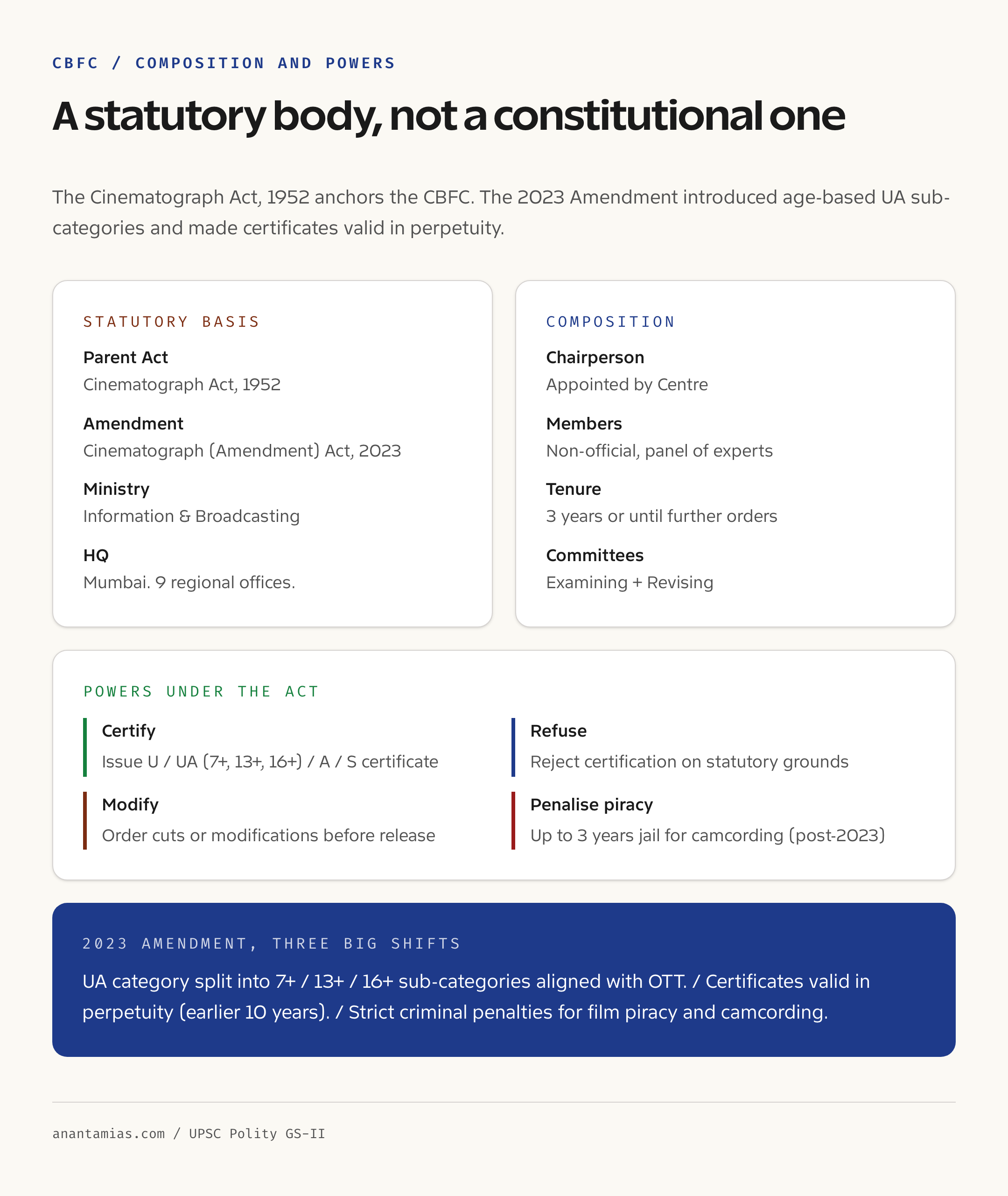
The Cinematograph (Amendment) Act, 2023 made three major changes to the 1952 statute. The first was the introduction of age-based UA sub-categories, as discussed above. The second was the move to perpetual validity for certificates. Until the 2023 amendment, certificates were valid for ten years and had to be renewed; the renewal regime created administrative friction, especially for older films re-released theatrically or on television. Perpetual validity removes that friction.
The third change is the introduction of strict criminal penalties for film piracy and camcording. The Act now prescribes imprisonment of up to three years and substantial fines for the unauthorised recording of films inside theatres, the transmission of such recordings, and the broader piracy economy that has hurt domestic and global box-office revenues. The provision aligns India’s film piracy regime with the World Intellectual Property Organisation framework and the broader intellectual property rights regime in India.
Why the CBFC Matters: Speech, Culture, and Public Order
The CBFC is one of the more visible sites where the constitutional balance between free speech under Article 19(1)(a) and the reasonable restrictions under Article 19(2) is tested in concrete cases. Films involving caste politics, religious mythology, political biographies, or contentious historical events almost invariably reach the CBFC’s most contested decisions. The Board’s decisions affect not only the producer’s commercial interests but also the broader public conversation about what can be said, shown, and discussed in mass media.
The institution also matters for federalism and law-and-order administration. State governments retain the power to suspend the exhibition of a certified film within their jurisdiction under Section 6 of the Cinematograph Act, 1952, on grounds of public order. This has led to repeated tensions when a state suspends a CBFC-certified film, prompting Supreme Court intervention. The Court has consistently held that once a film is certified by the CBFC, state-level bans on the basis of anticipated unrest must meet a high constitutional threshold.
The Appellate Mechanism: From FCAT to High Court
Until 2021, appeals against CBFC decisions went to the Film Certification Appellate Tribunal, FCAT, established under the Cinematograph Act and headed by a retired High Court judge. The FCAT was a specialised forum with expertise in film, free speech and statutory interpretation. The Tribunals Reforms Act, 2021 abolished the FCAT, along with several other tribunals, on the rationale that proliferation of tribunals had not improved access to justice and that High Courts were better placed to handle the appellate work.
After the abolition, producers aggrieved by CBFC decisions must approach the relevant High Court. The change has had two practical consequences. First, the volume of writ petitions in High Courts has grown, with film certification cases competing with the broader docket. Second, the doctrinal evolution of free-speech standards in film certification has shifted from a specialised tribunal to generalist constitutional benches, which has accelerated the integration of film certification with the broader Article 19 jurisprudence.
Detailed Analysis: The 2024 to 2025 Controversies
Recent CBFC controversies have followed three patterns. Films dealing with caste identity, particularly Dalit experiences, have run into long delays at the certification stage, with Examining Committees demanding extensive cuts that producers have argued go beyond the statutory test. Films dealing with mythology, especially reinterpretations of epic characters, have faced opposition from religious organisations and have sometimes been delayed or modified during certification. Films dealing with contemporary political events, including biopics of living political figures, have been caught up in the wider debate on the limits of artistic freedom in a polarised public sphere.
The High Courts, especially the Bombay and Madras High Courts, have intervened in several of these cases to release films from extended pre-release delays and to read down some of the cuts demanded by Examining Committees. The pattern suggests that the post-FCAT appellate architecture is finding its rhythm, although the absence of a specialised tribunal has lengthened the average time between application and final certification.
Comparative Models of Film Certification
Globally, film certification follows three broad models. The age-based classification model, used in the United Kingdom (BBFC) and the United States (MPAA), uses a graduated scale of age recommendations without mandatory cuts in most cases; producers can choose to release a film with a more restrictive rating or recut for a wider audience. The state-licensing model, used historically in many continental European countries, requires state approval for theatrical release with cuts permissible. The hybrid model, which India follows, combines mandatory state certification with age-based markers and a power to demand cuts where the statutory test is satisfied.
The 2023 introduction of UA 7+, UA 13+ and UA 16+ moves India closer to the age-based classification model used internationally, although the CBFC retains the power to refuse certification or demand cuts, which the BBFC for instance does not generally exercise. The integration of these markers with the OTT content classification in the IT Rules, 2021, creates a more consistent age-based regime across theatrical and streaming distribution.
Challenges, Concerns and Reform Pathways
The CBFC faces five enduring challenges. The first is the tension between certification (an objective, age-based exercise) and censorship (a subjective, content-based exercise). The Board’s mandate is the former, but its practice has often slipped into the latter, prompting High Court interventions. The second is the heterogeneity of Examining Committee panels, which has produced inconsistent decisions across regions and over time. The third is the absence of a specialised appellate tribunal post-FCAT, which has lengthened the average certification timeline. The fourth is the gap between theatrical and OTT regulation, which leaves grey zones for films released directly on streaming platforms. The fifth is the transparency deficit; the reasoning behind specific cuts is rarely published, making it hard for producers and the public to predict outcomes.
The Shyam Benegal Committee, 2016, recommended several reforms that remain partly unimplemented: a clearer age-based classification framework (substantially adopted in 2023), a transparent reasons-and-precedent framework for cuts, an independent grievance redress mechanism, and a closer integration with the OTT regulatory architecture. A revival of a specialised appellate body, possibly within the High Court framework as a designated bench, has also been suggested by industry associations.
Prelims Pointers
Anchor the topic on these facts. The CBFC is a statutory body under the Cinematograph Act, 1952. The nodal ministry is the Ministry of Information and Broadcasting, not the Ministry of Culture. The headquarters is in Mumbai with nine regional offices. There are four certificate categories: U, UA, A and S. The S certificate stands for “Special Class,” not “Students.” The UA category was sub-divided into UA 7+, UA 13+ and UA 16+ by the Cinematograph (Amendment) Act, 2023. Certificates are valid in perpetuity post-2023, replacing the earlier ten-year validity. The FCAT was abolished by the Tribunals Reforms Act, 2021. Appeals now go directly to the High Court.
Mains Practice Questions
- “The CBFC sits at the constitutional intersection of artistic freedom under Article 19(1)(a) and reasonable restrictions under Article 19(2).” Critically examine its statutory framework and recent reforms with reference to the Cinematograph (Amendment) Act, 2023. (15 marks, 250 words)
- The Tribunals Reforms Act, 2021 abolished the Film Certification Appellate Tribunal. Discuss the consequences of this abolition for the speed and quality of appellate review in film certification. (10 marks, 150 words)
- “Age-based classification is a more honest framework than blanket censorship.” Examine in the context of the new UA 7+, UA 13+ and UA 16+ sub-categories under the 2023 Amendment. (10 marks, 150 words)
Way Forward
The CBFC’s modernisation runs in three directions. The first is procedural transparency: publishing reasons for cuts, panel composition for each Examining Committee, and a precedent database that producers and the public can consult. The second is appellate efficiency: either by creating a designated CBFC bench within the High Courts of major film hubs or by reviving a specialised tribunal under the post-2021 framework. The third is content regime convergence: integrating the theatrical certification framework with the OTT and digital media classification regime so that producers and audiences face a consistent set of age-based markers across distribution channels. The 2023 Amendment has completed the first leg of this modernisation; the next phase requires institutional and procedural reform rather than fresh legislation.
Frequently Asked Questions
Is the CBFC a constitutional body?
No. The CBFC is a statutory body, established under the Cinematograph Act, 1952. It is not a constitutional body and not a non-statutory advisory body. Its powers, composition, and procedure are entirely defined by the parent Act and the rules made under it.
Which ministry does the CBFC come under?
The CBFC functions under the Ministry of Information and Broadcasting at the Union level. A common error is to place it under the Ministry of Culture; this is incorrect. The Information and Broadcasting ministry is responsible for film policy, including certification, broadcasting, and related areas.
What does the S certificate stand for?
The S certificate stands for u0022Special Classu0022 and is restricted to specific professional audiences such as doctors, scientists, or specialised researchers, typically for medical or scientific films. It does not stand for u0022Studentsu0022 or any general audience marker. Films aimed at general schoolchildren would carry a U certificate.
How long is a CBFC certificate valid?
Following the Cinematograph (Amendment) Act, 2023, CBFC certificates are valid in perpetuity. Until that amendment, certificates were valid for ten years and had to be renewed for re-release. Perpetual validity has removed the renewal cycle and reduced administrative friction for film distributors.
Where do appeals against CBFC decisions go?
Following the Tribunals Reforms Act, 2021, which abolished the Film Certification Appellate Tribunal, FCAT, appeals against CBFC decisions go directly to the High Court of the relevant jurisdiction. The High Court reviews the CBFC’s decision on writ jurisdiction under Article 226, applying the standards of Article 19(1)(a) and Article 19(2).
What are the new UA sub-categories under the 2023 Amendment?
The Cinematograph (Amendment) Act, 2023 sub-divided the UA category into three age-based markers: UA 7+ for content suitable for children aged 7 and above with parental guidance, UA 13+ for those aged 13 and above, and UA 16+ for those aged 16 and above. The classification aligns with the age-based markers used for OTT content under the Information Technology Rules, 2021.
Does the CBFC certify OTT content?
No. The CBFC’s mandate under the Cinematograph Act, 1952 is limited to films intended for theatrical exhibition. OTT content is governed by the Information Technology (Intermediary Guidelines and Digital Media Ethics Code) Rules, 2021, with a self-regulatory framework involving content classification by streaming platforms and oversight by the Ministry of Information and Broadcasting.
Can a state government ban a CBFC-certified film?
A state government can suspend the exhibition of a certified film within its jurisdiction under Section 6 of the Cinematograph Act, 1952 on grounds of public order, but the Supreme Court has held that such suspension must meet a high constitutional threshold. A blanket ban on a CBFC-certified film purely on the basis of anticipated unrest will generally not survive judicial review.
What is the appellate process within the CBFC?
Within the CBFC itself, a producer aggrieved by an Examining Committee decision can request a review by a Revising Committee chaired by the Chairperson or a senior member. Beyond the Revising Committee, the only remedy after the abolition of the FCAT is an appeal to the High Court under Article 226.
Tell Google you want more of this.
Add Anantam IAS as a preferred sourceOne tap, and this site shows up more often in your own Top Stories, AI Overviews and AI Mode. Remove it any time.