Daily Digest
UPSC · Civil Services Examination
Current Affairs · Sunday, 12 July 2026
Current affairs curated and edited by Anantam IAS faculty — pulled from The Hindu, PIB, IDSA, Foreign Affairs and the ministries. Read, annotate, revise.
Old Rajinder Nagar · Delhi 110005 · anantamias.com
Western Ghats landslides: the case for landslide early-warning systems
Why in News?
A fresh spell of monsoon landslides in the Western Ghats has once again pushed the question of predictive early-warning systems to the centre of India’s disaster-management debate. The Ghats – a fragile, steep, high-rainfall belt running down India’s western coast – are among the country’s most landslide-prone terrains, and each monsoon renews the demand for forecasts that can warn communities before a slope fails rather than only counting the dead afterwards.
The trigger is the recurring memory of the 30 July 2024 Wayanad disaster in Kerala, when landslides at Mundakkai and Chooralmala killed more than 200 people – among the deadliest landslide events in India’s history – and exposed how little lead time residents had before the hillsides collapsed in the early hours of the morning.
The Indian Express, in an Explained piece, revisited why India still lacks a dense, last-mile Landslide Early Warning System (LEWS) even as the Geological Survey of India (GSI) scales up its National Landslide Forecasting Centre, framing the recurring Ghat slides as both a scientific-forecasting gap and a slope-governance failure.
- The 2024 Wayanad landslides (Meppadi panchayat, Vythiri taluk) struck around 02:00-04:00 IST after intense overnight rain, sweeping away Mundakkai and Chooralmala villages.
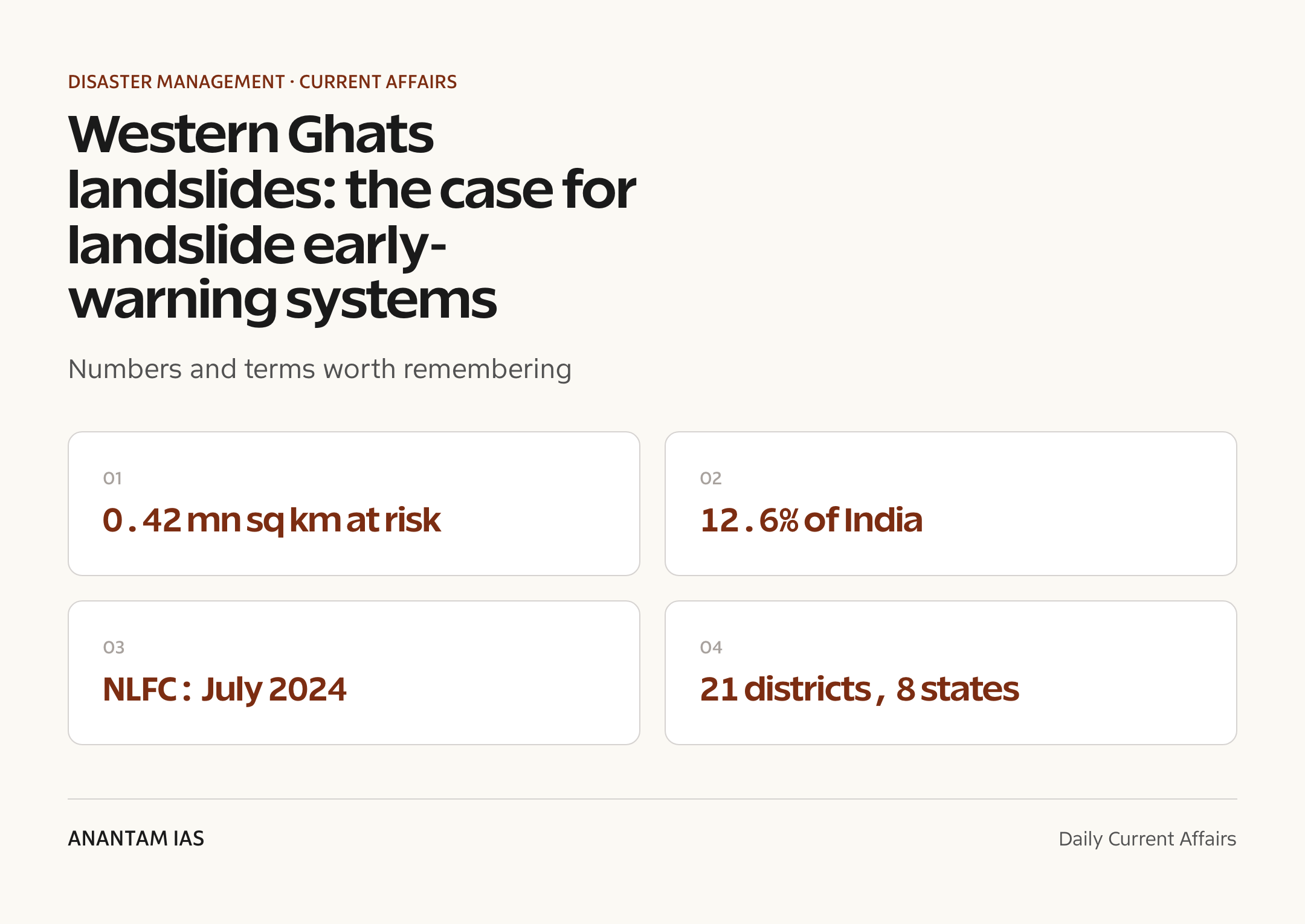
- India’s landslide-prone area is about 0.42 million sq km – roughly 12.6% of the landmass (excluding snow-covered zones), per the Geological Survey of India (GSI).
- The National Landslide Forecasting Centre (NLFC) was launched in July 2024 at GSI’s Kolkata campus, with the Bhusanket web portal and Bhooskhalan mobile app.
- By the 2025 monsoon, GSI was issuing daily landslide forecast bulletins for around 21 districts across 8 states, including Wayanad and Idukki in Kerala.
The development matters in the context of:
- Landslides are a hydro-geological hazard: rainfall is the dominant trigger in the Ghats, making rainfall-threshold forecasting technically feasible.
- The debate links two syllabus strands – GS1 geography (slope, monsoon, physiography) and GS3 disaster management (mitigation, early warning, institutions).

UPSC Relevance
Prelims Relevance
- Geological Survey of India (GSI) – nodal agency for landslide studies, under the Ministry of Mines.
- National Landslide Forecasting Centre (NLFC), Kolkata (2024); Bhusanket portal and Bhooskhalan app.
- LANDSLIP project (2016-2022) – India-UK-Italy R&D on regional landslide early warning; test areas Darjeeling and the Nilgiris.
- Rainfall thresholds – intensity-duration relationships that trigger slope failure.
- Disaster Management Act, 2005; NDMA and its landslide guidelines (2009) and National Landslide Risk Management Strategy (2019).
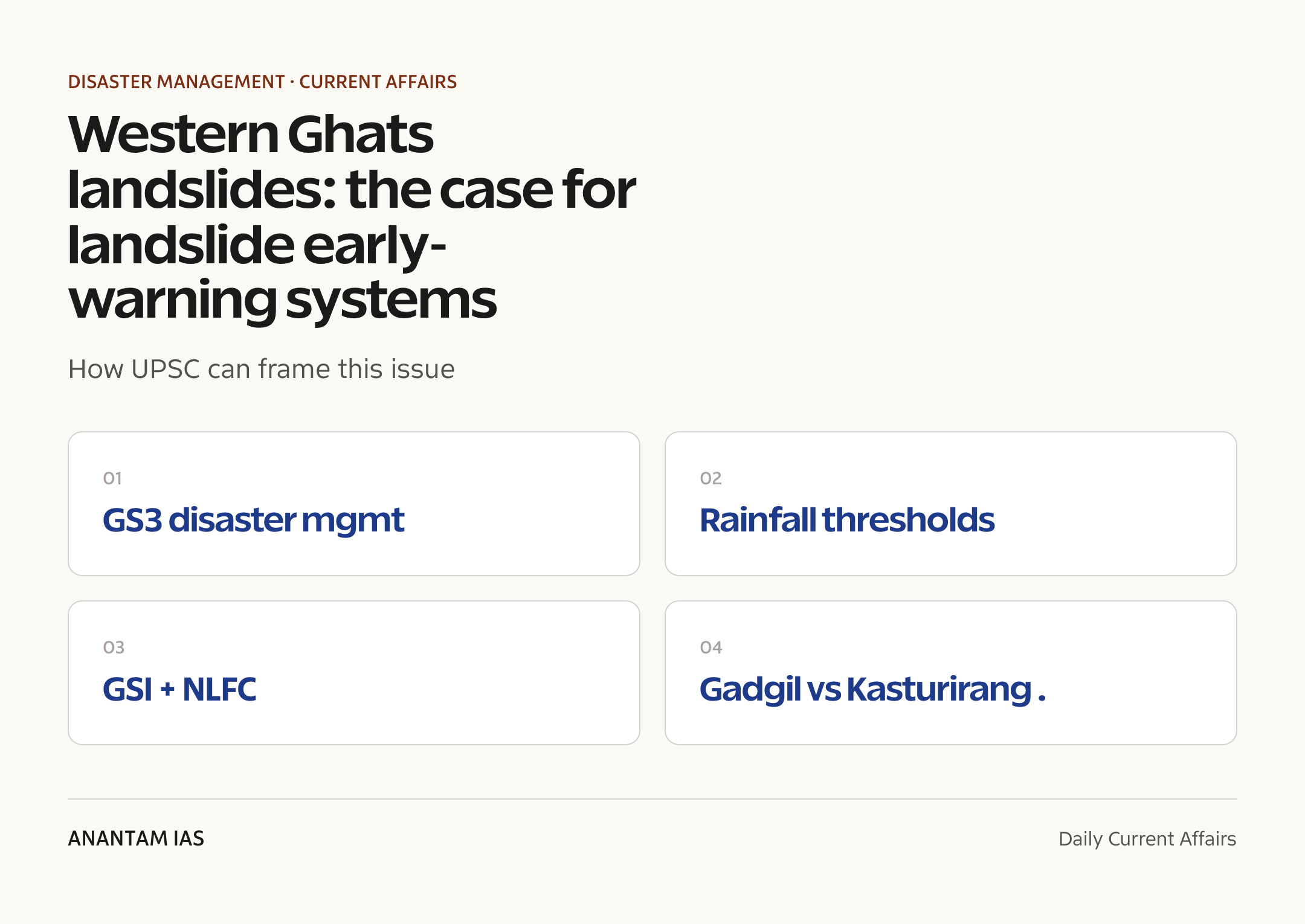
- Gadgil (WGEEP) report – entire ~1,29,037 sq km of the Western Ghats as an Ecologically Sensitive Area.
- Kasturirangan (HLWG) report – about 37% of the Ghats as Ecologically Sensitive Area.
- Partner agencies for forecasting: IMD, NCMRWF, ISRO and state disaster-management authorities.
- Wayanad, Nilgiris, Idukki, Darjeeling, Kalimpong – recurring high-risk landslide districts.
Mains Relevance
GS Paper 3
- Landslide early-warning systems as a non-structural mitigation tool – design, limits and last-mile dissemination.
- Institutional architecture: GSI, NDMA, IMD and state agencies in disaster risk reduction.
GS Paper 1
- Physiography of the Western Ghats and the monsoon-slope interaction that drives landslides.
GS Paper 2
- Ecologically Sensitive Area governance – Gadgil vs Kasturirangan and Centre-State-community friction.
Essay
- Development versus ecology in India’s fragile hill regions.
- Living with disasters: prediction, preparedness and the limits of technology.
Background and Context
Why the Western Ghats slide
The Ghats combine every ingredient that makes slopes fail during the monsoon, which is why forecasting here is technically feasible yet the hazard remains high.
- Steep gradients and thick, weathered soil overburden on hard rock – water saturates the loose top layer and shears it off along the rock interface.
- Extreme, concentrated rainfall: cloudbursts and multi-day spells raise pore-water pressure until the slope loses cohesion and gives way.
- Antecedent rainfall matters too – soil already soaked from earlier spells fails faster when fresh intense rain arrives, a pattern seen repeatedly in Kerala.
- Human pressure amplifies risk – deforestation, quarrying, road-cutting, plantation expansion and unregulated construction on unstable hillsides remove the natural anchoring of slopes.
- The Ghats are a recognised biodiversity hotspot and a UNESCO World Heritage site, so land-use choices carry ecological as well as safety stakes, and the two agendas often collide.
The 2024 Wayanad wake-up call
The disaster that reframed the early-warning debate.
- On 30 July 2024, landslides in Mundakkai-Chooralmala (Meppadi, Wayanad) followed intense overnight rain and killed more than 200 people.
- A first slide near the Punnappuzha river swept two villages; a second diverted a stream and triggered flash floods downstream.
- It ranks among India’s deadliest landslide events, with hundreds injured and many reported missing.
- Investigators flagged heavy antecedent rainfall, weak soil and slope disturbance as compounding causes – the classic profile a warning system aims to anticipate.
How a landslide early-warning system works
The core idea is a rainfall-threshold model, not a crystal ball – it estimates when a slope becomes dangerous, not exactly which one will fail.
- A Landslide Early Warning System (LEWS) links terrain-specific rainfall thresholds – the intensity-and-duration of rain a slope can absorb before failing – to real-time and forecast rainfall.
- Inputs combine rain-gauge and radar data, weather-prediction models, susceptibility maps and past landslide inventories built up over years of field survey.
- When forecast rain crosses the threshold for an area, a colour-coded bulletin (green-yellow-orange-red) is issued for districts, not individual hillsides.
- The bulletin is meant to prompt graded action – readiness, pre-positioning of relief and, at the red stage, evacuation of the most exposed settlements.
- It is a regional, probabilistic forecast – it flags heightened risk over an area and a window, not the exact slope, hour or house, which is both its strength and its practical limit.
India's forecasting architecture
GSI is the nodal agency, building from pilots toward national coverage.
- The LANDSLIP project (2016-2022), an India-UK-Italy effort involving GSI, the British Geological Survey and King’s College London, built a prototype LEWS for Darjeeling and the Nilgiris.
- In July 2024 GSI operationalised the National Landslide Forecasting Centre (NLFC) in Kolkata, with the Bhusanket web portal and Bhooskhalan app for dissemination.
- Forecasting runs in operational mode for Darjeeling, Kalimpong and the Nilgiris and in experimental mode for districts in Kerala, Sikkim, Uttarakhand and Himachal Pradesh.
- By the 2025 monsoon, bulletins covered roughly 21 districts across 8 states; GSI aims to extend the system to all landslide-prone states by 2030.
- Forecasting draws on IMD rainfall inputs, NCMRWF weather models and ISRO satellite data.
The governance backdrop: Gadgil vs Kasturirangan
Warning systems sit atop an unresolved land-use fight over the Ghats.
- The Gadgil report (Western Ghats Ecology Expert Panel, 2011) proposed treating the entire ~1,29,037 sq km as an Ecologically Sensitive Area with graded restrictions.
- The Kasturirangan report (High-Level Working Group, 2013) narrowed protection to about 37% of the Ghats, excluding inhabited and plantation land.
- States and farming communities resisted both; a final ESA notification has stalled for over a decade amid Centre-State friction.
- The core disaster lesson – curb construction, mining and slope disturbance in fragile zones – remains only partly enforced.
Why forecasting alone is not enough
The hardest part is the last mile, not the science.
- Warnings are district-scale; converting them into a house-by-house evacuation call needs dense local rain-gauges and trained local responders.
- Sparse rain-gauge networks in remote Ghat terrain weaken threshold accuracy for small, fast-moving slides.
- Night-time events (as in Wayanad) shrink the response window – dissemination and evacuation must be near-instant.
- Frequent alerts risk warning fatigue; too few risk complacency – calibrating thresholds is a constant trade-off.
- Structural measures – slope stabilisation, drainage, retaining walls, hazard-zonation-based land-use control – must complement the forecast.
Way Forward
Densify the observation network
- Expand automatic rain gauges, soil-moisture sensors and radar coverage across the Ghats so thresholds hold for small catchments.
- Fast-track completion of 1:10,000 landslide hazard zonation maps for high-risk districts.
Strengthen the last mile
- Build community-level warning – sirens, panchayat responders, mock drills – so a bulletin becomes an evacuation.
- Integrate NLFC bulletins directly into state and district disaster-management response chains.
Govern the slope
- Enforce land-use and construction curbs in identified fragile zones, resolving the pending Western Ghats ESA question.
- Fund slope stabilisation and drainage under the National Landslide Risk Management Strategy.
Conclusion
The Western Ghats landslides are a reminder that India’s most fragile terrains are also its most densely lived-in. A rainfall-threshold early-warning system, anchored by GSI’s NLFC and its Bhusanket portal and Bhooskhalan app, is a genuine advance over a purely reactive relief model – but a forecast only saves lives if it reaches a family in time to move.
The Wayanad tragedy showed that the weakest link is rarely the science and almost always the last mile: sparse rain-gauges, night-time events and district-scale bulletins that must somehow trigger house-by-house evacuation. Closing that gap needs denser local sensors, trained panchayat responders and drilled communities as much as better models.
Prediction, preparedness and prudent land-use have to work together. Technology can flag the risk window; only dense local networks, community drills and enforced slope governance – including a resolution of the long-stalled Western Ghats Ecologically Sensitive Area question – can close the gap between a warning and real safety.
UPSC Practice Questions
Prelims MCQ 1
With reference to landslide early-warning in India, consider the following statements:
- The Geological Survey of India is the nodal agency for landslide studies.
- The National Landslide Forecasting Centre issues district-level rainfall-based landslide bulletins.
- Landslide early-warning systems predict the exact hillside and hour of failure.
How many of the above statements are correct?
(a) Only one (b) Only two (c) All three (d) None
Answer: (b) Only two
Explanation:
GSI is the nodal agency and the NLFC issues regional, district-scale bulletins – statements 1 and 2 are correct. Statement 3 is wrong: LEWS gives probabilistic, area-and-window forecasts, not the exact slope or hour.
Prelims MCQ 2
The Western Ghats Ecology Expert Panel, which recommended treating the whole of the Western Ghats as an Ecologically Sensitive Area, was chaired by:
(a) K. Kasturirangan (b) Madhav Gadgil (c) M.S. Swaminathan (d) R.K. Pachauri
Answer: (b) Madhav Gadgil
Explanation:
The 2011 WGEEP (Gadgil panel) proposed the entire ~1,29,037 sq km of the Ghats as an ESA. The later Kasturirangan (HLWG, 2013) report narrowed this to about 37%.
UPSC Mains Questions
- Landslide early-warning systems can flag risk but rarely reach the last mile in time. In the light of the Western Ghats landslides, examine the technical and institutional challenges in operationalising an effective landslide early-warning system in India. (250 words)
- “The Western Ghats crisis is as much a governance failure as a geological one.” Discuss with reference to the Gadgil and Kasturirangan reports and the unresolved Ecologically Sensitive Area question. (250 words)
Sources: The Indian Express (Explained) and PIB, Ministry of Mines / Geological Survey of India.
Frequently Asked Questions
What triggered the renewed early-warning debate?
Fresh monsoon landslides in the Western Ghats, coming after the catastrophic 30 July 2024 Wayanad disaster, revived demands for predictive systems. Rainfall is the dominant trigger in the Ghats, which makes threshold-based forecasting feasible – and makes the absence of dense, last-mile warning networks a recurring and costly gap in India’s disaster preparedness.
What is a landslide early-warning system?
A Landslide Early Warning System (LEWS) links terrain-specific rainfall thresholds – the rain intensity and duration a slope can absorb before failing – to real-time and forecast rainfall. When forecast rain crosses the threshold, a colour-coded bulletin is issued for a district. It flags heightened risk over an area and time window, not an exact hillside or hour.
What is the National Landslide Forecasting Centre?
The NLFC, launched in July 2024 at the Geological Survey of India’s Kolkata campus, issues daily landslide forecast bulletins. It disseminates them through the Bhusanket web portal and the Bhooskhalan mobile app, and draws on IMD rainfall data, NCMRWF weather models and ISRO satellite inputs to forecast risk across India’s landslide-prone districts.
Where does GSI issue landslide forecasts?
GSI runs operational forecasts for Darjeeling, Kalimpong and the Nilgiris, and experimental bulletins for districts in Kerala, Sikkim, Uttarakhand and Himachal Pradesh. By the 2025 monsoon, coverage reached about 21 districts across 8 states, including Wayanad and Idukki. GSI aims to extend the system to all landslide-prone states by 2030.
How do the Gadgil and Kasturirangan reports differ?
The Gadgil report (2011) proposed treating the entire Western Ghats – about 1,29,037 sq km – as an Ecologically Sensitive Area with graded restrictions. The Kasturirangan report (2013) narrowed this to roughly 37%, excluding inhabited and plantation land. States and farmers resisted both, and a final ESA notification has stalled for over a decade.
Why is forecasting alone not enough?
Bulletins are district-scale, but evacuation decisions are house-by-house. Sparse rain-gauge networks weaken accuracy for small, fast slides, and night-time events shrink response time. Forecasts must be paired with dense local sensors, community-level warning and drills, plus structural measures like slope stabilisation and enforced land-use control in fragile zones.
Source: https://anantamias.com/current-affairs/western-ghats-landslides-early-warning-systems/
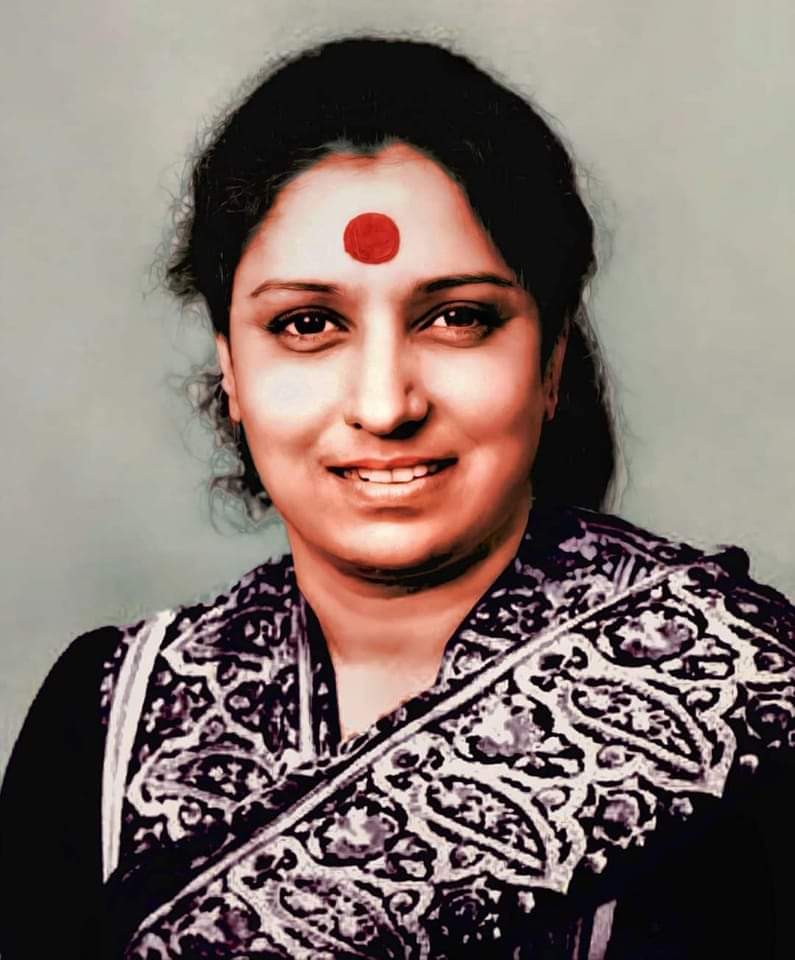
S. Janaki, the ‘Isai Arasi’ of Indian playback, passes away at 88
Why in News?
Veteran playback singer S. Janaki, revered across the south as the Isai Arasi (Tamil for ‘Queen of Music’) and the Nightingale of South India, died on 11 July 2026 in Mysuru, Karnataka, at the age of 88, after a heart attack and age-related illness. The Hindu and The Week reported the passing of one of Indian cinema’s most prolific voices, whose recordings spanned generations of composers and languages.
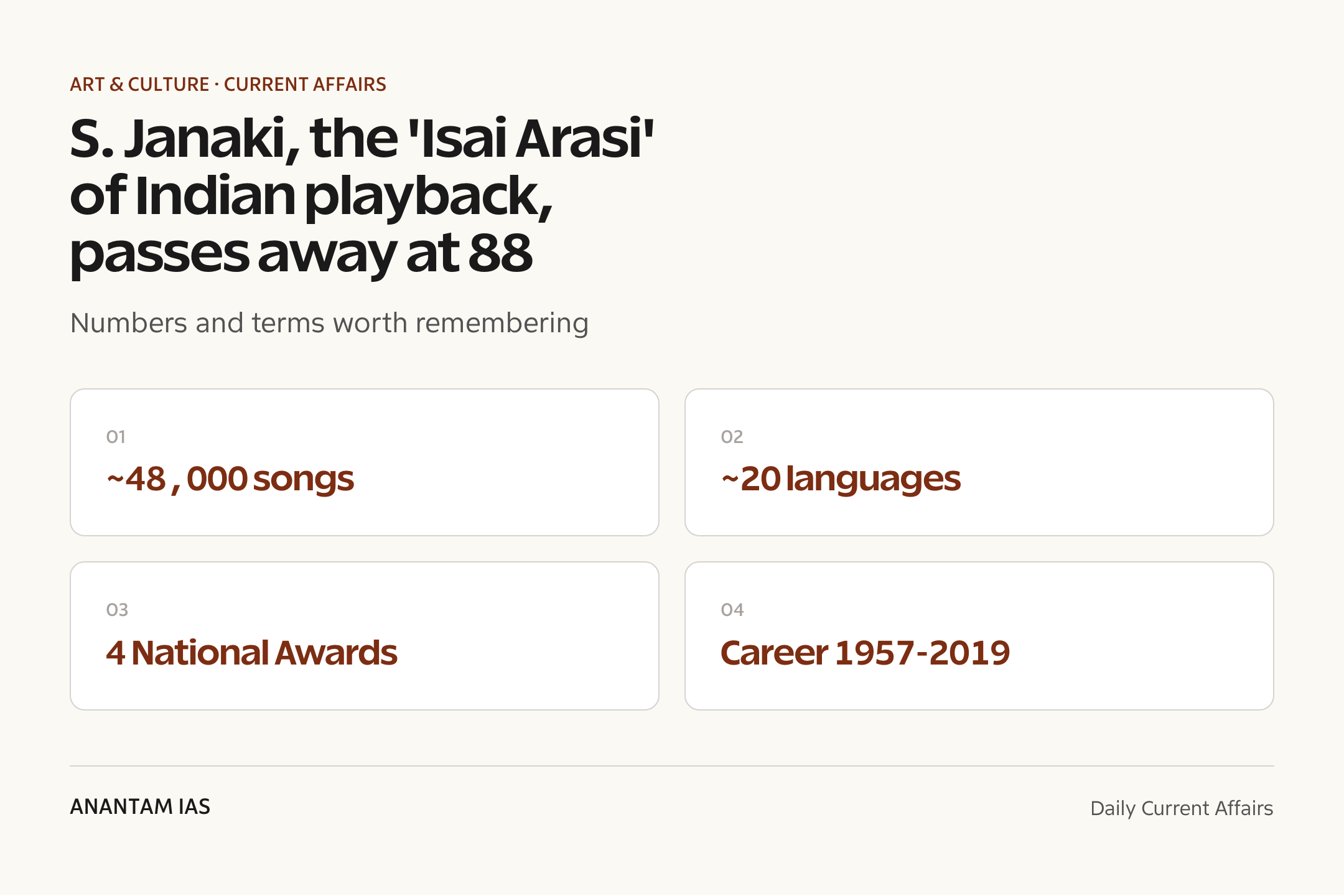
Over a career spanning close to six decades from 1957, Janaki recorded an estimated 48,000 songs across about 20 languages and won four National Film Awards, making her a high-value personality-in-news for UPSC art-and-culture and awards factsheets. Her death draws attention to the golden age of South Indian playback music and to the singers whose voices, more than the on-screen faces, carried the emotional life of regional cinema.
The obituary also revives an old debate she herself sharpened: in 2013 Janaki declined the Padma Bhushan, saying it had come too late and that South Indian artists were under-recognised in national honours — an episode that turns her passing into a case study on the fairness and timeliness of India’s civilian-award system.
- Born 23 April 1938 at Pallapatla (Guntur, then Madras Province, now Andhra Pradesh); spent much of her childhood in Sircilla.
- Playback debut in the Tamil film Vidhiyin Vilayattu (1957) at age 19; sang in six languages in her very first year, followed by the Telugu film M.L.A.
- Won four National Film Awards for Best Female Playback Singer and 33 State Film Awards across Tamil, Telugu, Kannada and Malayalam cinema.
- In 2013 she publicly declined the Padma Bhushan, saying the honour came ‘too late’ and that South Indian artists were under-recognised nationally.
- Announced retirement from film and stage singing in 2016; returned briefly in 2018 for the Tamil film Pannaadi.
The development matters in the context of:
- Personality-in-news is a recurring Prelims and GS1 theme; obituaries of cultural figures feed the ‘Awards and Persons’ factsheet.
- Janaki’s life maps onto the playback singing tradition and the post-Independence growth of South Indian film music as a pillar of India’s cultural economy.
UPSC Relevance
Prelims Relevance
- S. Janaki — titles ‘Isai Arasi’, ‘Gana Kokila’, ‘Nightingale of South India / Deccan’.
- Debut film: Vidhiyin Vilayattu (Tamil, 1957).
- Four National Film Awards for Best Female Playback Singer (1976, 1980, 1984, 1992).
- First National Award: ‘Sindhoora Poove’ from 16 Vayathinile (1976, Tamil).
- National Award song ‘Inji Iduppazhaga’ from Thevar Magan (1992).
- Padma Bhushan — third-highest civilian award; Janaki declined it in 2013.
- Key collaborators: Ilaiyaraaja, M. S. Viswanathan, A. R. Rahman, G. K. Venkatesh.
- Concept: playback singing — pre-recorded vocals lip-synced by on-screen actors.
Mains Relevance
GS Paper 1
- Role of cinema and film music in shaping regional and national cultural identity in post-Independence India.
- Contribution of women artists to the performing-arts landscape and its social recognition.
GS Paper 2
- Civilian honours (Padma awards, Bharat Ratna): selection process, criticism of regional and sectoral under-representation.
Essay
- ‘A voice outlives the singer’ — art, memory and cultural continuity.
- Recognition and its discontents: when honours arrive late, do they still honour?
Background and Context
Who was S. Janaki
A defining voice of South Indian playback music for six decades, whose reach cut across languages, composers and generations.
- Sistla Janaki was born on 23 April 1938 at Pallapatla in Guntur district, in what was then the Madras Province and is today Andhra Pradesh; her father Sistla Sreeramamurthy was an Ayurvedic physician and teacher.
- She trained in Carnatic music from childhood and moved into films through the AVM Productions orbit in Madras, entering a studio system that was then building the modern playback tradition.
- Widely addressed as Janakiamma, Gana Kokila / Gana Kogile (Nightingale), and the Isai Arasi in Tamil, honorifics that reflected both her technical command and her emotional expressiveness.
- She was noted for voicing the rural female protagonist in South Indian cinema, lending a distinctive, earthy tenderness to heroines drawn from village life.
- Married V. Ramaprasad in 1959; she settled in Mysuru in her later years, where she remained a revered elder of the music world until her death.
A six-decade, multilingual career
Her range across languages and composers made her a pan-South-Indian institution rather than a singer confined to one film industry.
- Debuted with the Tamil film Vidhiyin Vilayattu (1957) at age 19 and recorded songs in six languages within that first year, followed quickly by the Telugu film M.L.A.
- Sang an estimated 48,000 songs across roughly 20 languages, including Tamil, Telugu, Kannada, Malayalam, Hindi and Odia, a body of work that few playback singers anywhere have matched in scale.
- Her collaboration with Ilaiyaraaja — beginning with Annakkili (1976) — defined an era of Tamil film music and produced some of its most enduring melodies.
- Also worked closely with M. S. Viswanathan, A. R. Rahman and G. K. Venkatesh, a span that carried her from the classic orchestral era into the synthesised, modern sound of the 1990s.
- She moved fluently between semi-classical, devotional and popular registers, adapting her voice to the demands of each composer and character.
- Announced retirement from film and stage in 2016, returned briefly in 2018 for Pannaadi, closing a career often cited as running 1957–2019.
Awards and honours
One of the most decorated playback singers in Indian cinema, honoured repeatedly at both national and state level.
- Four National Film Awards for Best Female Playback Singer — 1976 (16 Vayathinile), 1980 (Oppol), 1984 (Sitara) and 1992 (Thevar Magan) — spanning Tamil, Malayalam and Telugu cinema.
- Her first National Award came for ‘Sindhoora Poove’ from 16 Vayathinile, and among her celebrated award-winning numbers is ‘Inji Iduppazhaga’ from Thevar Magan.
- 33 State Film Awards from Tamil Nadu, Andhra Pradesh, Karnataka and Kerala combined, a tally that underlines her simultaneous standing across four language industries.
- Received the Kalaimamani (Tamil Nadu) and the Rajyotsava Prashasti (Karnataka), plus an honorary doctorate from the University of Mysore in recognition of her contribution to music.
The Padma Bhushan she declined
Her 2013 refusal put the spotlight on how, and how promptly, India recognises its artists.
- In 2013 the government named her for the Padma Bhushan, India’s third-highest civilian award; she declined it publicly.
- She said the honour had come ‘too late’ in a career then spanning over five decades, framing recognition delayed as recognition diminished.
- She voiced disappointment at the limited recognition for South Indian artists in national honours lists, giving voice to a wider grievance about regional representation.
- Padma awards are conferred by the President on the recommendation of the Padma Awards Committee; the debate she triggered concerns whom such lists tend to overlook.
- The episode is a ready case study on the perceived regional and linguistic imbalance in civilian awards, and on whether artists should be honoured while still at the height of their powers.
Playback singing as a cultural form
Understanding the craft that Janaki mastered anchors the news to the durable art-and-culture syllabus.
- Playback singing is the practice of pre-recording songs in a studio that on-screen actors then lip-sync during filming, a staple of Indian cinema since the 1930s.
- It made specialist singers — rather than actors — the true voices of film music, creating stars like Janaki, Lata Mangeshkar and S. P. Balasubrahmanyam whose fame rested on voice alone.
- South Indian film music built a distinct ecosystem of composers, lyricists and singers that shaped regional identity and a large cultural economy across Tamil, Telugu, Kannada and Malayalam industries.
- The singer’s craft demanded not just tunefulness but the ability to act through the voice — matching mood, dialect and character without appearing on screen.
- Janaki was noted for versatility across semi-classical, devotional and popular registers and for defining the voice of the rural female protagonist for a generation of filmgoers.
Way Forward
Preserving the archive
- Digitise and archive the recordings of playback legends through institutions such as the National Film Archive of India and All India Radio to prevent loss of cultural memory.
- Support oral-history and restoration projects that document composer-singer collaborations of the analogue era.
Recognising diversity
- Broaden civilian-honour deliberations to ensure fairer regional and linguistic representation among artists.
- Strengthen state and central patronage for performing artists in their lifetimes rather than largely posthumously.
Conclusion
S. Janaki’s passing closes a chapter in which a single voice could carry the emotional weight of an entire film industry across languages. Her nearly 48,000 songs, sung across roughly 20 languages and four decades of composers, are a living archive of South India’s musical imagination and of the golden age of film playback.
Her career also frames a quieter argument about cultural recognition. That one of India’s most awarded singers felt compelled to refuse the Padma Bhushan says as much about the honours system as about the artist, and keeps alive the question of regional and linguistic balance in national awards.
For the aspirant, her life is a compact study in India’s cultural history — the rise of playback singing, the reach of regional cinema as a pillar of the cultural economy, and the recurring debate over how, and how promptly, the nation honours its artists while they can still hear the applause.
UPSC Practice Questions
Prelims MCQ 1
With reference to the playback singer S. Janaki, consider the following statements:
- She made her playback debut in a Tamil film in 1957.
- She won four National Film Awards for Best Female Playback Singer.
- She accepted the Padma Bhushan awarded to her in 2013.
How many of the above statements are correct?
(a) Only one (b) Only two (c) All three (d) None
Answer: (b) Only two
Explanation:
Statements 1 and 2 are correct — she debuted with the Tamil film Vidhiyin Vilayattu (1957) and won four National Film Awards. Statement 3 is wrong: she declined the Padma Bhushan in 2013.
Prelims MCQ 2
The title ‘Isai Arasi’, associated with S. Janaki, translates most closely to:
(a) Queen of Dance (b) Queen of Music (c) Voice of the Nation (d) Empress of Cinema
Answer: (b) Queen of Music
Explanation:
‘Isai Arasi’ is a Tamil honorific meaning ‘Queen of Music’; she was also called the ‘Nightingale of South India’.
UPSC Mains Questions
- The life of a playback singer like S. Janaki mirrors the evolution of Indian cinema’s cultural and regional identity. Discuss the role of film music in shaping post-Independence popular culture in India. (250 words)
- India’s civilian honours have periodically faced criticism over regional and sectoral representation. Examine, with examples, the challenges of ensuring fairness and timeliness in recognising artistic contribution. (250 words)
Sources: The Hindu and The Week.
Frequently Asked Questions
Who was S. Janaki?
S. Janaki (1938–2026) was one of India’s most celebrated playback singers, revered as the ‘Isai Arasi’ and ‘Nightingale of South India’. Over nearly six decades she recorded an estimated 48,000 songs across about 20 languages and won four National Film Awards, singing chiefly for Tamil, Telugu, Kannada and Malayalam cinema.
When and where did she die?
She died on 11 July 2026 in Mysuru, Karnataka, at the age of 88, following a heart attack and age-related illness. She had lived in Mysuru in her later years and had largely retired from performing after 2016.
How many National Film Awards did she win?
She won four National Film Awards for Best Female Playback Singer — in 1976 for ’16 Vayathinile’, 1980 for ‘Oppol’, 1984 for ‘Sitara’ and 1992 for ‘Thevar Magan’. She also received 33 State Film Awards across the southern states.
Why did she decline the Padma Bhushan?
In 2013 S. Janaki declined the Padma Bhushan, India’s third-highest civilian award. She said the recognition had come too late in her long career and expressed disappointment at the limited representation of South Indian artists in national honours.
What is playback singing?
Playback singing is the practice of pre-recording songs in a studio that on-screen actors then lip-sync during filming. It has been central to Indian cinema since the 1930s and turned specialist singers such as S. Janaki into stars in their own right.
Which composers did she work with most?
She is closely associated with Ilaiyaraaja, whose partnership with her from ‘Annakkili’ (1976) defined an era of Tamil film music. She also worked extensively with M. S. Viswanathan, A. R. Rahman and G. K. Venkatesh across several decades.
Source: https://anantamias.com/current-affairs/s-janaki-isai-arasi-playback-legend-passes-away/
NAMASTE scheme turns three: mechanising sanitation and ending hazardous cleaning
Why in News?
India observes the 3rd NAMASTE Day on 14 July 2026, marking three years of the National Action for Mechanised Sanitation Ecosystem (NAMASTE) — the government’s flagship scheme to protect sanitation workers and mechanise hazardous cleaning. The Ministry of Social Justice & Empowerment leads a national event at Rabindra Sadan, Kolkata, with parallel programmes across urban local bodies, framing the anniversary as a review of how far the state has moved sewer cleaning from a caste-bound, life-threatening chore toward an equipment-led, formal occupation.
On the day, eligible sewer and septic-tank workers (SSWs) and waste pickers receive PPE kits, Ayushman Bharat cards and NAMASTE ID cards — a visible marker of the scheme’s shift from welfare charity to entitlement-based occupational safety. PIB confirmed that the anniversary doubles as a progress audit, with fresh profiling data, PPE distribution figures and insurance-enrolment numbers placed before the public to show whether the promised move to a death-free, contact-free cleaning ecosystem is actually taking hold on the ground.
The observance also lands amid a running debate over how sanitation deaths are counted: the government maintains that classified ‘manual scavenging’ deaths have fallen to near zero, while civil-society trackers keep recording fatalities inside sewers and septic tanks, making NAMASTE’s third birthday as much a test of data honesty as of welfare delivery.
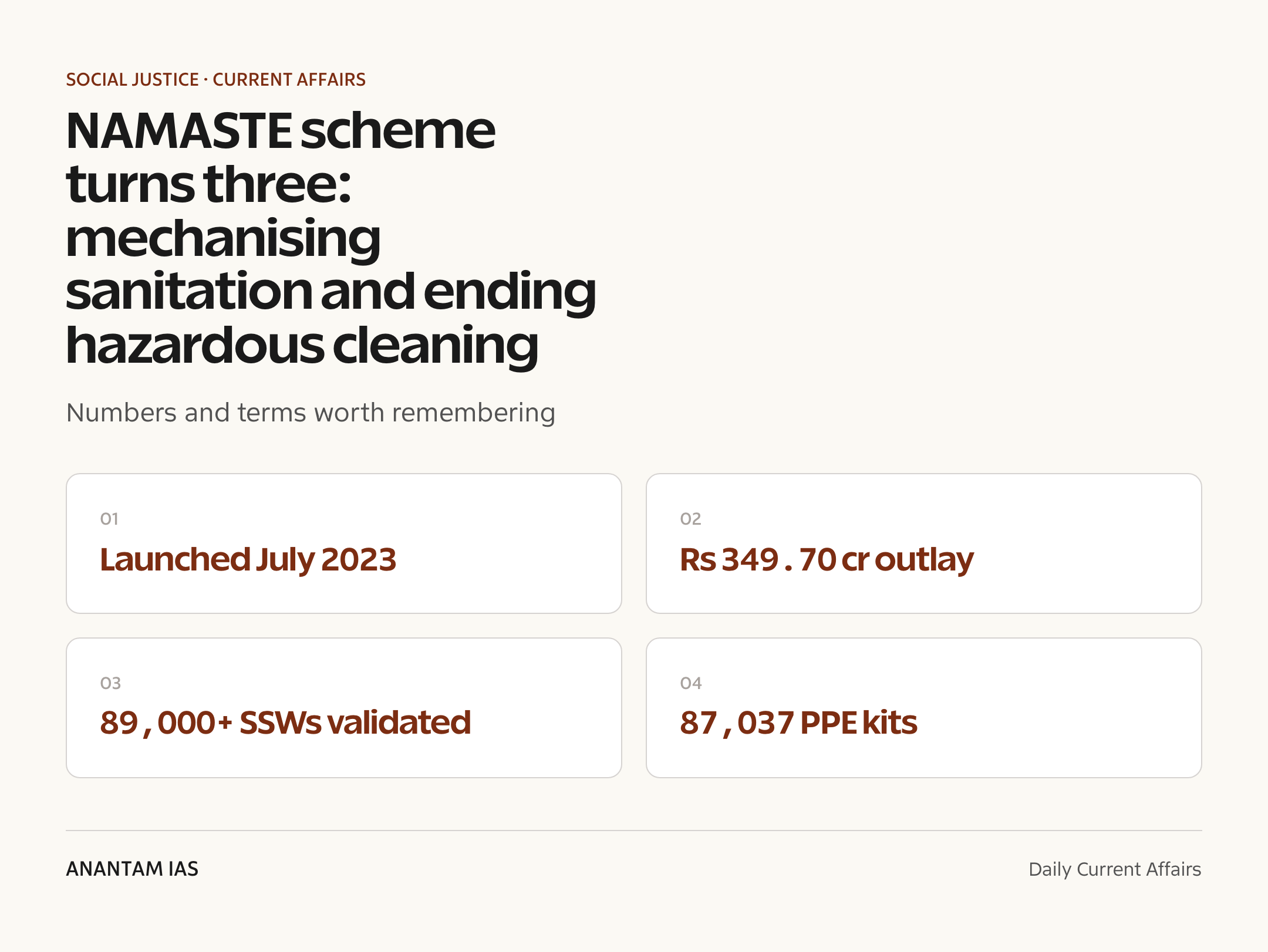
- NAMASTE launched in July 2023; jointly run by the Ministry of Social Justice & Empowerment (MoSJE) and the Ministry of Housing & Urban Affairs (MoHUA).
- Total outlay of Rs 349.70 crore, targeting all 4,800+ urban local bodies (ULBs) by 2025-26.
- As of 2026, over 89,000 SSWs profiled and validated and about 87,037 PPE kits distributed.
- Around 76,000+ workers covered under health insurance via AB-PMJAY.
- Coverage widened in 2026 to include waste pickers, with roughly 37,980 waste pickers validated.
- NAMASTE replaces the earlier Self Employment Scheme for Rehabilitation of Manual Scavengers (SRMS).
The development matters in the context of:
- The scheme operationalises the Prohibition of Employment as Manual Scavengers and their Rehabilitation Act, 2013, which outlawed manual scavenging.
- It reflects the constitutional promise of Article 17 (abolition of untouchability) and Article 46 (protection of weaker sections).
- Sanitation work in India is deeply tied to caste, making occupational safety a question of both labour rights and social justice.
UPSC Relevance
Prelims Relevance
- NAMASTE full form — National Action for Mechanised Sanitation Ecosystem.
- Nodal ministries — MoSJE and MoHUA (originally with the Department of Drinking Water & Sanitation).
- Implementing body for training — National Safai Karamcharis Finance & Development Corporation (NSKFDC).
- Health cover routed through Ayushman Bharat PM-JAY (AB-PMJAY).
- Target beneficiaries — Sewer and Septic-Tank Workers (SSWs) and, from 2026, waste pickers.
- Emergency Response Sanitation Units (ERSUs) — city-level mechanised response teams with safety devices.
- Governing law — Prohibition of Employment as Manual Scavengers and their Rehabilitation Act, 2013.
- Predecessor law — Employment of Manual Scavengers and Construction of Dry Latrines (Prohibition) Act, 1993.
- Predecessor challenge — Safaimitra Suraksha Challenge, 2020.
- Outlay — Rs 349.70 crore; target — all 4,800+ ULBs.
Mains Relevance
GS Paper 2
- Welfare schemes for vulnerable sections and mechanisms for their protection and betterment.
- Issues relating to the development and management of the social sector — health, safety and dignity of sanitation workers.
- Government policies aimed at operationalising the 2013 anti-manual-scavenging law.
GS Paper 1
- Social empowerment and caste; the persistence of caste-linked occupations despite legal prohibition.
Essay
- Dignity of labour and the unfinished journey against caste-based occupations.
- Technology as an instrument of social justice — mechanising the most degrading work.
Background and Context
What NAMASTE is and why it was created
NAMASTE is a national action plan to make sanitation work safe, mechanised and dignified, replacing charity-style rehabilitation with a rights-based occupational-safety ecosystem.
- Launched in July 2023 as a joint venture of MoSJE and MoHUA, replacing the Self Employment Scheme for Rehabilitation of Manual Scavengers (SRMS), which had focused narrowly on one-time cash and loan-based rehabilitation.
- Its stated outcomes — zero fatalities in sanitation work, no direct human contact with faecal matter, all cleaning via mechanised safety devices, and work done only by skilled, formalised workers.
- The scheme is built on the recognition that manual scavenging and hazardous sewer entry are illegal, dangerous and caste-linked, so a purely welfare framing was inadequate for a problem rooted in social hierarchy and informal labour.
- It reframes the sanitation worker from a passive beneficiary into a recognised, insured, tooled-up service provider with a formal identity in municipal systems.
- Total outlay of Rs 349.70 crore, aiming to cover all 4,800+ ULBs nationwide within the 2023-24 to 2025-26 window.
The scheme's core components
NAMASTE bundles profiling, safety gear, insurance, training and equipment subsidies into one ecosystem so that recognition, protection and livelihood support move together.
- Profiling and validation of every SSW and, from 2026, waste pickers, each issued a NAMASTE ID card that anchors them in a verifiable national database.
- Occupational safety training delivered through the NSKFDC and state agencies, covering safe entry protocols, gas-hazard awareness and the correct use of equipment.
- PPE kits (protective suits, masks, gloves, boots, gas detectors) plus safety devices for city response units, so that any unavoidable intervention is protected by gear rather than bare hands.
- Health insurance for workers and families under AB-PMJAY, extending a financial cushion against occupational illness and injury.
- Upfront capital subsidy for workers or self-help groups procuring sanitation vehicles and equipment, turning them into ‘sanipreneurs’ who own the machines that displace manual entry.
- Linkage to livelihood and credit support so that workers exiting hazardous cleaning have an alternative income path rather than being pushed back into it.
- An IEC (awareness) campaign to change public and municipal behaviour and reduce the demand for illegal manual cleaning.
Emergency Response Sanitation Units (ERSUs)
ERSUs are the institutional muscle for mechanised, on-call sanitation response, converting the promise of no manual entry into a standing operational capacity.
- Set up in larger municipal corporations and districts to respond to sewer and septic-tank emergencies without manual entry, so that no blockage or overflow forces a worker into a hazardous confined space.
- Equipped with mechanised cleaning machines, jetting-suction vehicles and rescue gear, and staffed by trained crews who follow standardised safety drills.
- Roughly 753 safety devices had been dispatched to ERSUs by early 2026, seeding cities with the hardware needed to retire manual entry.
- Designed to give each participating city a single accountable unit for hazardous cleaning, rather than leaving the task to ad-hoc contractors and informal labour.
- The goal is a 0-manual-entry protocol — machines and trained crews replace a worker climbing into a manhole, making mechanisation the routine response instead of the exception.
Progress after three years
The scheme’s reach has expanded steadily, though from a low base of formal recognition and with wide state-to-state variation.
- Over 89,000 SSWs profiled and validated across states and ULBs by 2026, giving the state its first credible, name-by-name picture of who does this work.
- About 87,037 PPE kits distributed to sanitation workers, pushing protective gear into the field rather than leaving it on paper.
- More than 76,000 workers brought under health-insurance cover through AB-PMJAY.
- Around 37,980 waste pickers validated after the 2026 expansion of coverage, marking the scheme’s move beyond sewer and septic-tank work into the wider sanitation workforce.
- The widening to waste pickers acknowledges that hazardous, low-status sanitation labour extends well past manholes into dumpsites and streets.
- On the 3rd NAMASTE Day, MoS B.L. Verma distributed PPE kits and Ayushman cards to SSWs and waste pickers, with the flagship event in Kolkata.
The legal and constitutional backbone
NAMASTE is the delivery arm of a long legal effort to abolish degrading sanitation labour.
- The Prohibition of Employment as Manual Scavengers and their Rehabilitation Act, 2013 bans manual scavenging and mandates rehabilitation.
- It replaced the weaker Employment of Manual Scavengers and Construction of Dry Latrines (Prohibition) Act, 1993.
- The Safaimitra Suraksha Challenge (2020) pushed cities toward mechanised, death-free sewer cleaning.
- The mission draws constitutional strength from Article 17 (untouchability), Article 21 (life and dignity), Article 23 (against forced labour) and Article 46.
- The Supreme Court, in Safai Karamchari Andolan v. Union of India (2014), directed compensation of Rs 10 lakh for each sewer or septic-tank death.
The gap between claims and ground reality
Official figures and civil-society data diverge sharply on deaths, exposing a definitional problem.
- The government has told Parliament there have been no ‘manual scavenging’ deaths in recent years — because deaths in sewers and tanks are classified as ‘hazardous cleaning’ deaths, not manual scavenging.
- Activist body Safai Karamchari Andolan (SKA) records dozens of sewer and septic-tank deaths every year, pointing to persistent illegal manual entry.
- Weak data tracking, caste stigma and informal, sub-contracted work keep many workers outside official rolls.
- Mechanisation coverage remains uneven — small towns and private septic-tank cleaning lag behind large corporations.
Way Forward
Close the definitional and data gap
- Adopt a single, transparent definition so every sewer or septic-tank death is counted, investigated and compensated.
- Build a real-time national registry linking NAMASTE ID cards, insurance and death-audit data.
Make mechanisation the default
- Scale ERSUs and mechanised equipment to smaller ULBs and rural areas, not just metros.
- Enforce a strict zero-manual-entry protocol with penalties for violating municipalities and contractors.
Formalise and uplift the workforce
- Convert validated workers into sanipreneurs through capital subsidy, skilling and assured municipal contracts.
- Guarantee living wages, social security and caste-sensitive rehabilitation for exiting families.
Conclusion
Three years on, NAMASTE has done the hard, unglamorous work of counting, insuring and equipping people who were long invisible to the state. Validation numbers, PPE kits and Ayushman cards are real gains, and the widening to waste pickers signals ambition beyond a single occupation. By tying identity, safety gear, insurance and livelihood support into one package, the scheme has begun to treat sanitation labour as a formal occupation rather than a caste-fixed burden.
But dignity is measured by deaths avoided, not kits distributed. As long as sewer fatalities are recorded under a softer label and mechanisation stops at the big-city boundary, the scheme’s promise stays partly unmet. Small towns, rural areas and the vast informal septic-tank cleaning market remain the weakest links, where equipment is scarce and enforcement thin.
The next phase must turn an entitlement ecosystem into an enforceable guarantee that no Indian dies cleaning another’s waste — by counting every death honestly, extending ERSUs and mechanised equipment far beyond the metros, and giving formalised workers secure, well-paid livelihoods. Only then does an anniversary of profiling and PPE distribution mature into the deeper social-justice goal behind the 2013 law.
UPSC Practice Questions
Prelims MCQ 1
With reference to the NAMASTE scheme, consider the following statements:
- It is jointly implemented by the Ministry of Social Justice & Empowerment and the Ministry of Housing & Urban Affairs.
- It provides health insurance coverage to sanitation workers through Ayushman Bharat PM-JAY.
- Its coverage is restricted only to sewer and septic-tank workers and excludes waste pickers.
How many of the above statements are correct?
(a) Only one (b) Only two (c) All three (d) None
Answer: (b) Only two
Explanation:
Statements 1 and 2 are correct. Statement 3 is wrong — coverage was expanded in 2026 to include waste pickers alongside SSWs.
Prelims MCQ 2
The ‘Prohibition of Employment as Manual Scavengers and their Rehabilitation Act’ was enacted in which year?
(a) 1993 (b) 2005 (c) 2013 (d) 2020
Answer: (c) 2013
Explanation:
The 2013 Act replaced the 1993 Act, widened the definition of manual scavenging to hazardous cleaning, and mandated rehabilitation. The Safaimitra Suraksha Challenge came in 2020.
UPSC Mains Questions
- The NAMASTE scheme reflects a shift from rehabilitating manual scavengers to mechanising sanitation itself. Examine how far this approach addresses the caste and safety dimensions of sanitation work in India. (250 words)
- Despite a robust legal framework, deaths during sewer and septic-tank cleaning persist in India. Critically analyse the reasons and suggest measures to ensure genuine mechanisation and dignity of sanitation labour. (250 words)
Sources: PIB, Ministry of Social Justice & Empowerment and DD News / Akashvani News.
Frequently Asked Questions
What does NAMASTE stand for?
NAMASTE is the National Action for Mechanised Sanitation Ecosystem, a central scheme launched in July 2023. It is jointly run by the Ministry of Social Justice & Empowerment and the Ministry of Housing & Urban Affairs to make sanitation work safe, mechanised and dignified, and to protect sewer and septic-tank workers.
Which workers does NAMASTE cover?
The scheme covers sewer and septic-tank workers (SSWs) across urban local bodies. In 2026 its coverage was widened to include waste pickers. Each validated worker receives a NAMASTE ID card, a PPE kit, occupational-safety training and health cover under Ayushman Bharat PM-JAY.
How is NAMASTE different from manual scavenging law?
The Prohibition of Employment as Manual Scavengers Act, 2013 legally bans manual scavenging. NAMASTE is the delivery mechanism that operationalises that ban — by profiling workers, supplying safety equipment, funding mechanised cleaning machines and rehabilitating workers into safer, formal livelihoods.
What is an Emergency Response Sanitation Unit (ERSU)?
An ERSU is a city or district-level mechanised sanitation team set up under NAMASTE. Equipped with jetting-suction machines and safety devices, it responds to sewer and septic-tank emergencies without any worker manually entering a manhole, supporting the scheme’s zero-manual-entry goal.
Why do sanitation deaths still occur despite the ban?
The government counts these as hazardous-cleaning deaths rather than manual-scavenging deaths, so official figures show near-zero manual scavenging fatalities. Civil-society groups like Safai Karamchari Andolan record dozens of sewer deaths yearly, driven by informal sub-contracting, weak enforcement and uneven mechanisation.
What has NAMASTE achieved so far?
By 2026 the scheme had profiled and validated over 89,000 SSWs, distributed about 87,037 PPE kits, covered more than 76,000 workers under health insurance, and validated nearly 37,980 waste pickers. It targets all 4,800-plus urban local bodies with an outlay of Rs 349.70 crore.
Source: https://anantamias.com/current-affairs/namaste-scheme-third-anniversary-sanitation-workers/
Lok Samvardhan Parv: showcasing India’s minority artisanal heritage
Why in News?
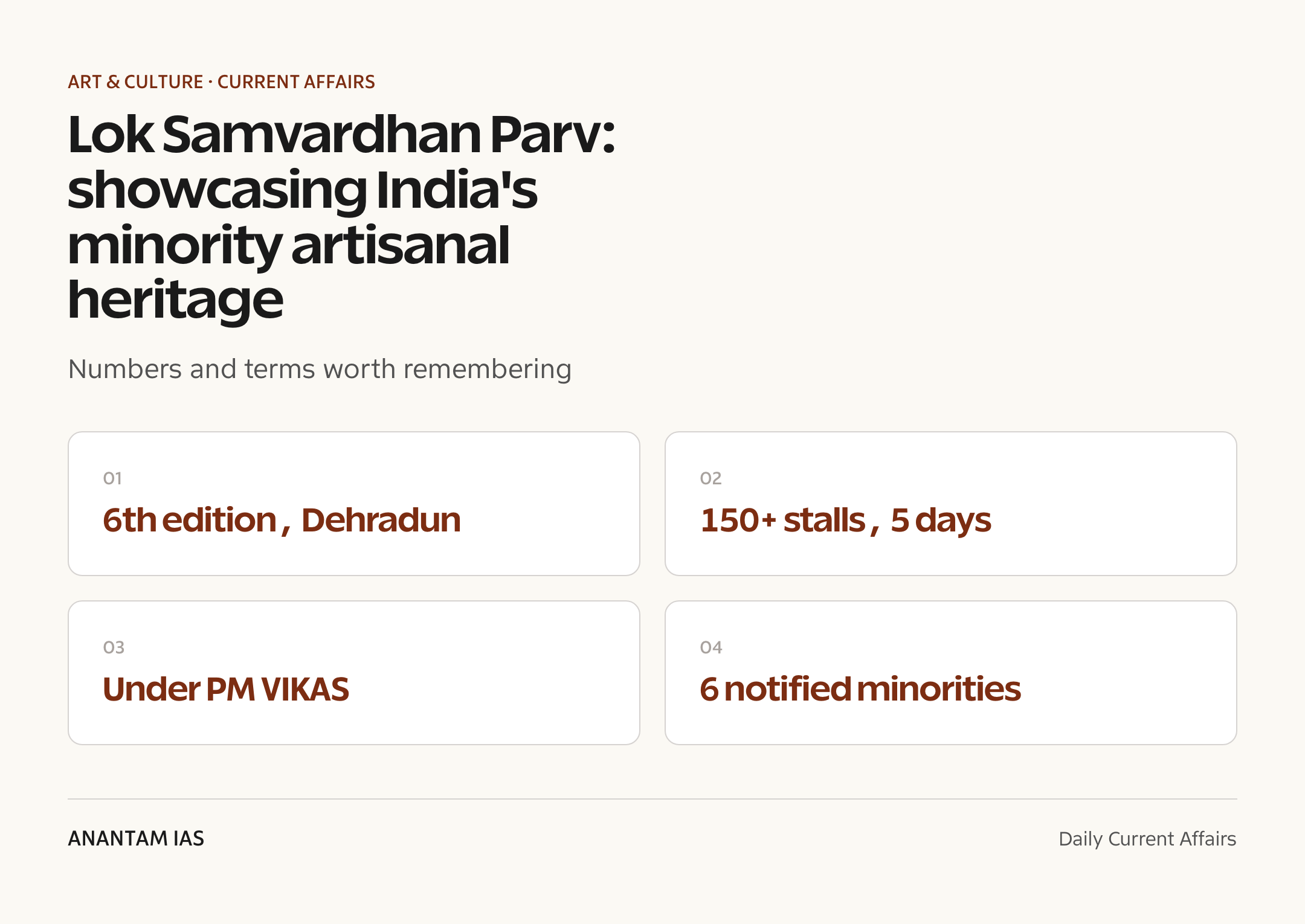
The Ministry of Minority Affairs opened the 6th Lok Samvardhan Parv at the Parade Ground, Dehradun, on 11 July 2026, a five-day showcase of traditional crafts, cuisine and cultural performances by artisans from India’s minority communities.
Union Minister Kiren Rijiju inaugurated the fair alongside Uttarakhand Chief Minister Pushkar Singh Dhami — the first edition run in formal partnership with a state government, held under the PM VIKAS scheme.
The event matters as a working example of an inclusion-through-livelihood model: it treats a community’s traditional crafts as both intangible cultural heritage worth preserving and an economic asset worth monetising, connecting artisans directly to buyers, exporters and market trends rather than to one-time subsidy.
- Over 150 artisanal and food stalls with live craft demonstrations and cultural performances across five days.
- Organised under Pradhan Mantri Virasat Ka Samvardhan (PM VIKAS) by the Ministry of Minority Affairs.
- First Lok Samvardhan Parv co-hosted with a state — the Uttarakhand government.
- Aimed at connecting minority artisans to national and international buyers and current market trends.
- Framed as a celebration for all Indians, not only minorities, to preserve shared cultural heritage.
- Successor to the earlier Hunar Haat exhibitions, now run under PM VIKAS after the older USTTAD scheme was folded into it.
- Positioned to link craft clusters with tourism, e-commerce and export channels, so market access outlives the five-day event.
The development matters in the context of:
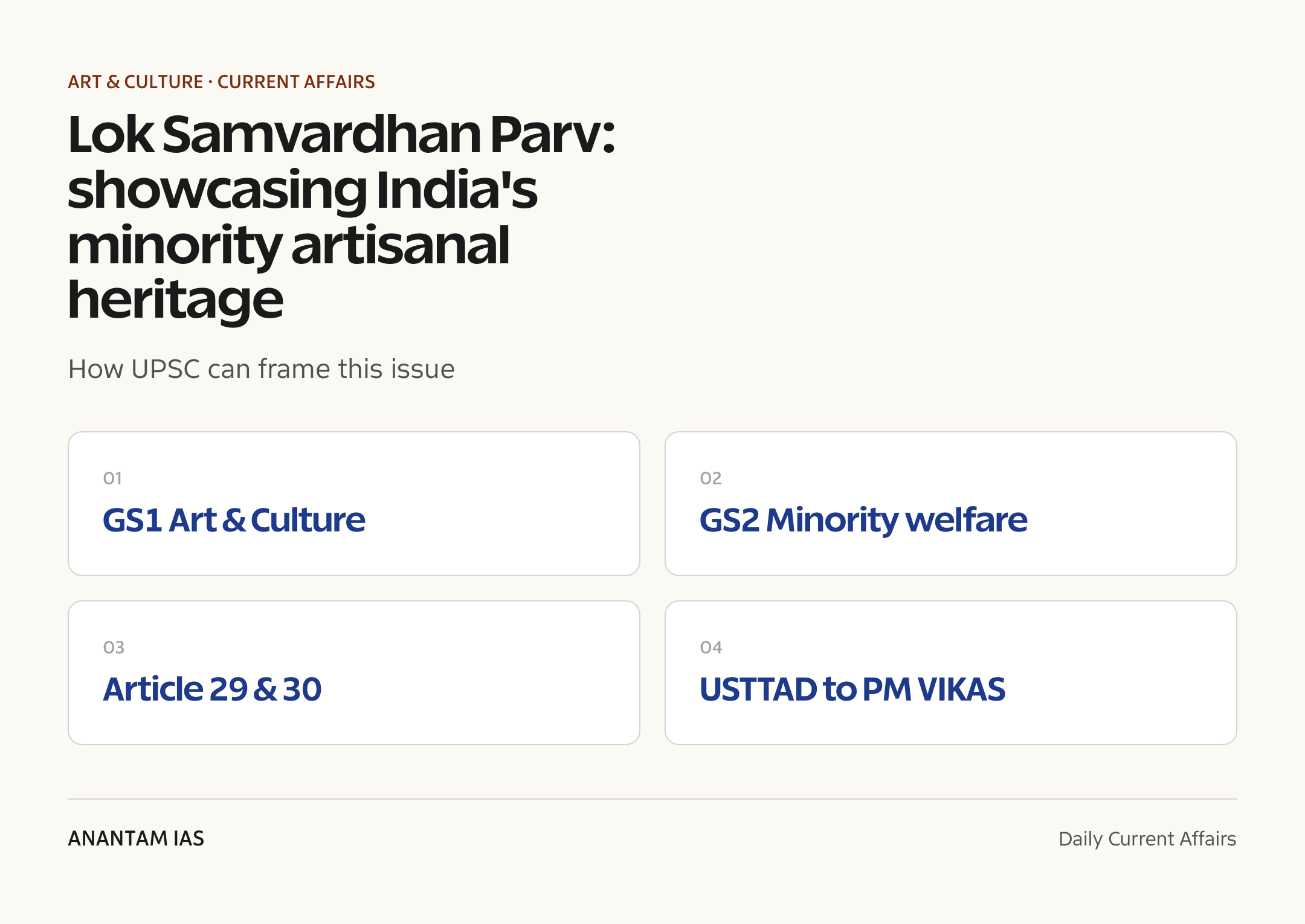
- Lok Samvardhan Parv is the successor to the earlier Hunar Haat craft fairs, now run under PM VIKAS instead of the older USTTAD scheme.
- It ties cultural-heritage preservation (a GS1 theme) to minority welfare and market access (a GS2 social-justice theme).
UPSC Relevance
Prelims Relevance
- Lok Samvardhan Parv — craft-and-culture fair of the Ministry of Minority Affairs.
- PM VIKAS — Pradhan Mantri Virasat Ka Samvardhan, launched 2023 by merging five schemes.
- Five merged schemes: Seekho Aur Kamao, Nai Manzil, Nai Roshni, USTTAD, Hamari Dharohar.
- Six notified minorities: Muslims, Christians, Sikhs, Buddhists, Jains, Zoroastrians (Parsis).
- Notification is under the National Commission for Minorities Act, 1992; Jains added in 2014.
- USTTAD = Upgrading the Skills and Training in Traditional Arts/Crafts for Development.
- Vishwakarma Villages — art-and-craft hubs under PM VIKAS’s hub-and-spoke model.
- Constitutional anchors: Article 29 (conserve culture) and Article 30 (minority educational institutions).
- Nodal ministry: Ministry of Minority Affairs, carved out in 2006.
- Venue 2026: Parade Ground, Dehradun, Uttarakhand.
Mains Relevance
GS Paper 1
- Role of traditional arts, crafts and handicrafts in India’s cultural heritage and their transmission.
- Preserving intangible cultural heritage of minority communities while making it economically viable.
GS Paper 2
- Government schemes for the welfare of minorities and vulnerable sections; skilling and livelihood interventions.
- Constitutional and statutory safeguards for minorities and their cultural rights.
Essay
- Heritage as livelihood: markets, dignity and the artisan.
- Inclusion is not charity — it is the return of what a community already gives.
Background and Context
What the Parv is
A recurring craft-and-culture festival that doubles as a marketplace for minority artisans.
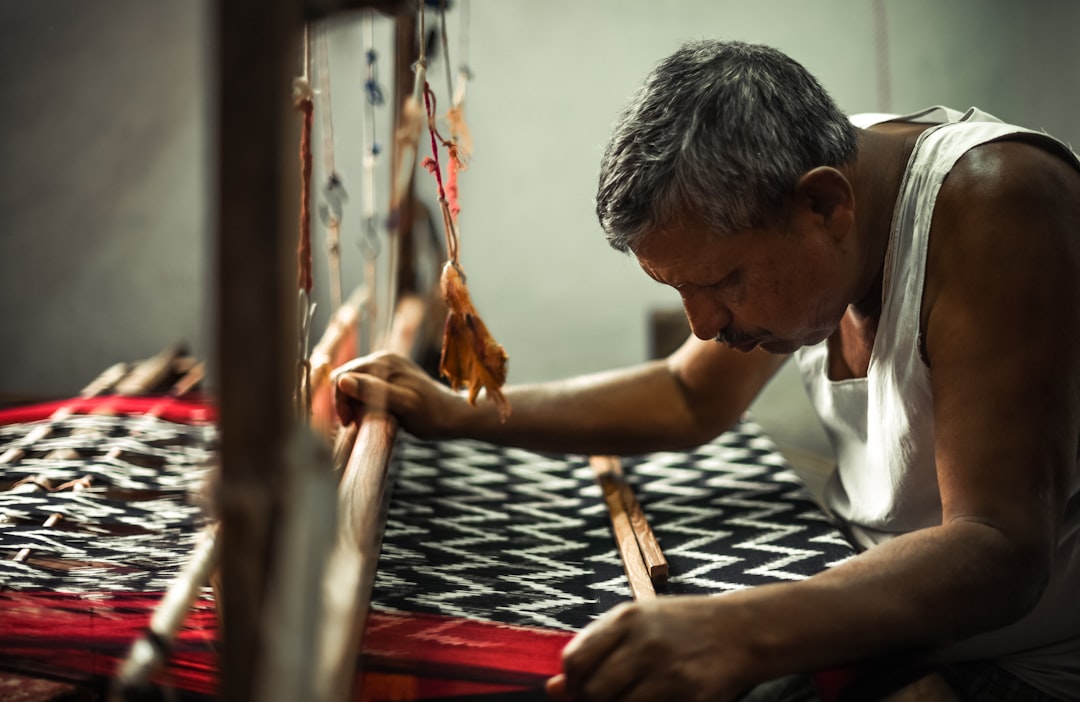
- The Lok Samvardhan Parv gathers weavers, craftspersons, culinary experts and entrepreneurs to display and sell traditional products.
- PIB describes it as a national platform for artisans and craftspersons to reach buyers, read market trends and find new business.
- The Ministry frames it as a festival for all Indians to celebrate the country’s plural heritage, not a minorities-only event.
- The 2026 Dehradun edition is the 6th, and the first held in partnership with a state government.
- Over 150 stalls spread crafts, textiles, cuisine and cultural performances across five days, with live demonstrations of skills.
- The state-partnership model is meant to plug the fair into local tourism circuits and craft clusters, giving it roots beyond a single Union-ministry showcase.
The PM VIKAS umbrella
The Parv is the shop-window of a larger skilling scheme launched in 2023.
- PM VIKAS (Pradhan Mantri Virasat Ka Samvardhan) merged five older schemes — Seekho Aur Kamao, Nai Manzil, Nai Roshni, USTTAD and Hamari Dharohar.
- It focuses on skilling, entrepreneurship, leadership training for minority women and educational support for school dropouts.
- A traditional-training sub-component targets skilling of about one lakh minority artisans.
- Infrastructure runs on a hub-and-spoke model through Vishwakarma Villages that blend crafts with tourism and commerce.
- The scheme’s design pairs skill upgradation with credit and market linkage, aiming to turn artisans into micro-entrepreneurs rather than wage-earners.
- It sits within the Ministry of Minority Affairs’ wider portfolio of scholarships, skilling and welfare for the six notified minority communities.
From Hunar Haat to Lok Samvardhan Parv
The fair is a rebranding and reset of an older marketing platform.
- The Ministry earlier ran Hunar Haat under the USTTAD scheme to market artisans’ work.
- With USTTAD folded into PM VIKAS, the marketing exhibitions were relaunched as the Lok Samvardhan Parv.
- The purpose stays constant: giving craftspeople direct market access and cutting out exploitative middlemen.
- Live demonstrations let visitors watch skills that are otherwise invisible in a finished product.
- By hosting artisans from across the country in one venue, the fair also builds peer networks and exposure to design and pricing practices beyond a craftsperson’s home region.
Who the minorities are
The scheme’s beneficiaries are the six communities notified by the Union government.
- Notified minorities: Muslims, Christians, Sikhs, Buddhists, Zoroastrians (Parsis) and Jains.
- The first five were notified in 1993 under the National Commission for Minorities Act, 1992; Jains were added in 2014.
- Many artisanal crafts — from Kashmiri weaves to embroidery and metalwork — sit within these communities’ living traditions.
- The National Commission for Minorities is the statutory body that safeguards their interests.
Constitutional and cultural stakes
Craft preservation connects to the Constitution’s cultural-rights guarantees.
- Article 29 protects the right of any section of citizens to conserve its distinct language, script or culture.
- Article 30 gives minorities the right to establish and administer educational institutions of their choice.
- Traditional crafts are a form of intangible cultural heritage — knowledge carried in hands and passed down generations.
- Several such crafts also carry Geographical Indication (GI) tags, linking cultural identity to legal and market protection.
- Article 29 is a general cultural right available to any section of citizens, while Article 30 is a special right of religious and linguistic minorities — together they anchor India’s protection of plural traditions.
- Preserving a craft protects not just a product but a transmission chain of skill, motif and technique that dies out if the next generation cannot earn a living from it.
Why it matters for policy
The Parv is a small event but a useful test of an inclusion-through-livelihood model.
- It reframes minority welfare from subsidy toward enterprise, skilling and dignity of work.
- Craft-based livelihoods are labour-intensive and can retain artisans in their home regions, easing distress migration.
- Physical fairs still matter where artisans lack the digital literacy or capital to sell online at scale.
- But one-off fairs need to connect to durable channels — e-marketplaces, GI branding and steady procurement — to move the needle.
- The state-partnership template, if repeated, could weave craft clusters into tourism circuits and give artisans a year-round rather than seasonal market.
- Success is best judged not by footfall or stall count but by whether artisan incomes, repeat orders and access to credit actually rise after the fair.
Way Forward
From fairs to markets
- Link the Parv to permanent digital storefronts so sales continue after the stalls close.
- Push GI tagging and design support to lift value capture for the artisan, not the trader.
Deepen the skilling
- Pair traditional training with literacy, digital and financial skills so artisans run their own enterprises.
- Track outcomes — incomes, repeat buyers, credit access — rather than counting footfall alone.
Institutionalise state partnerships, as with Uttarakhand, so craft clusters and tourism circuits reinforce each other rather than being showcased once a year.
Conclusion
The Lok Samvardhan Parv is a modest but telling intervention: it treats a community’s heritage as an economic asset and its artisans as entrepreneurs, not welfare recipients.
Its lasting value will depend on whether the fair becomes a gateway to steady markets, credit and design support — or stays an annual celebration that fades when the stalls are packed away.
For UPSC, the Parv is a compact case study bridging GS1 art and culture (handicrafts, intangible heritage, GI-tagged crafts) and GS2 governance (minority-welfare schemes, constitutional safeguards under Articles 29 and 30, and the shift from subsidy to enterprise) — useful for answers on preserving living heritage while building sustainable artisan livelihoods.
UPSC Practice Questions
Prelims MCQ 1
With reference to the PM VIKAS scheme, consider the following statements:
- It is implemented by the Ministry of Minority Affairs.
- It was formed by merging several earlier minority-focused schemes, including USTTAD.
- It exclusively provides scholarships and has no skilling or entrepreneurship component.
How many of the above statements are correct?
(a) Only one (b) Only two (c) All three (d) None
Answer: (b) Only two
Explanation:
PM VIKAS is run by the Ministry of Minority Affairs and merged five schemes such as USTTAD, Seekho Aur Kamao and Nai Manzil. Statement 3 is wrong — its core is skilling, entrepreneurship and leadership training, not just scholarships.
Prelims MCQ 2
The ‘Lok Samvardhan Parv’ is best described as:
(a) A craft-and-culture fair marketing the products of minority artisans (b) A stock-market index for the handicrafts sector (c) An inter-state river-water dispute mechanism (d) A defence-technology exhibition
Answer: (a) A craft-and-culture fair marketing the products of minority artisans
Explanation:
The Lok Samvardhan Parv, held under PM VIKAS, is the Ministry of Minority Affairs’ exhibition-cum-marketplace for artisans, weavers and culinary experts — the successor to Hunar Haat.
UPSC Mains Questions
- Traditional crafts are a form of living cultural heritage as much as an economic activity. Examine how schemes like PM VIKAS attempt to preserve minority artisanal heritage while improving livelihoods, and the challenges they face.
- Government support to artisans often stops at showcasing rather than market-building. Discuss how craft fairs such as the Lok Samvardhan Parv can be linked to durable market access for minority and other artisans.
Sources: PIB, Ministry of Minority Affairs and News on AIR.
Frequently Asked Questions
What is the Lok Samvardhan Parv?
It is a craft-and-culture festival organised by the Ministry of Minority Affairs where artisans, weavers and culinary experts from India’s minority communities showcase and sell traditional products. Held under the PM VIKAS scheme, it also offers live demonstrations and cultural performances, and helps craftspeople reach buyers and understand market trends.
Under which scheme is it held?
It is organised under PM VIKAS — Pradhan Mantri Virasat Ka Samvardhan — a skilling and livelihood scheme of the Ministry of Minority Affairs launched in 2023. PM VIKAS merged five earlier schemes, including USTTAD, and the Parv is essentially the successor to the older Hunar Haat craft fairs.
Which communities are ‘notified minorities’ in India?
Six communities are notified by the Union government under the National Commission for Minorities Act, 1992: Muslims, Christians, Sikhs, Buddhists and Zoroastrians (Parsis), with Jains added in 2014. PM VIKAS and the Lok Samvardhan Parv are aimed at artisans and craftspeople from these communities.
How is the 2026 edition different?
The 6th edition, at the Parade Ground in Dehradun, is the first Lok Samvardhan Parv held in formal partnership with a state government — Uttarakhand. It features over 150 artisanal and food stalls across five days, with live craft demonstrations and cultural performances.
How does it relate to the Constitution?
Craft and cultural preservation connect to Article 29, which lets any section of citizens conserve its language, script or culture, and Article 30, which protects minorities’ right to run educational institutions. Traditional crafts are intangible cultural heritage, and many also carry Geographical Indication tags.
Why is it important for UPSC?
It links two syllabus themes — GS1 Indian art and culture (heritage crafts, intangible heritage) and GS2 welfare of minorities (schemes, constitutional safeguards). It is a compact example of an inclusion-through-livelihood model and a ready case study for questions on artisans and cultural preservation.
Source: https://anantamias.com/current-affairs/lok-samvardhan-parv-minority-artisanal-heritage/
Rising Life Insurance Surrenders: What India’s Premature Exits Signal
Why in News?
Surrenders and withdrawals of life insurance policies before maturity have climbed steadily over five years, with The Indian Express reporting (citing IRDAI data) that they now nearly match payouts to policyholders who complete the full term.
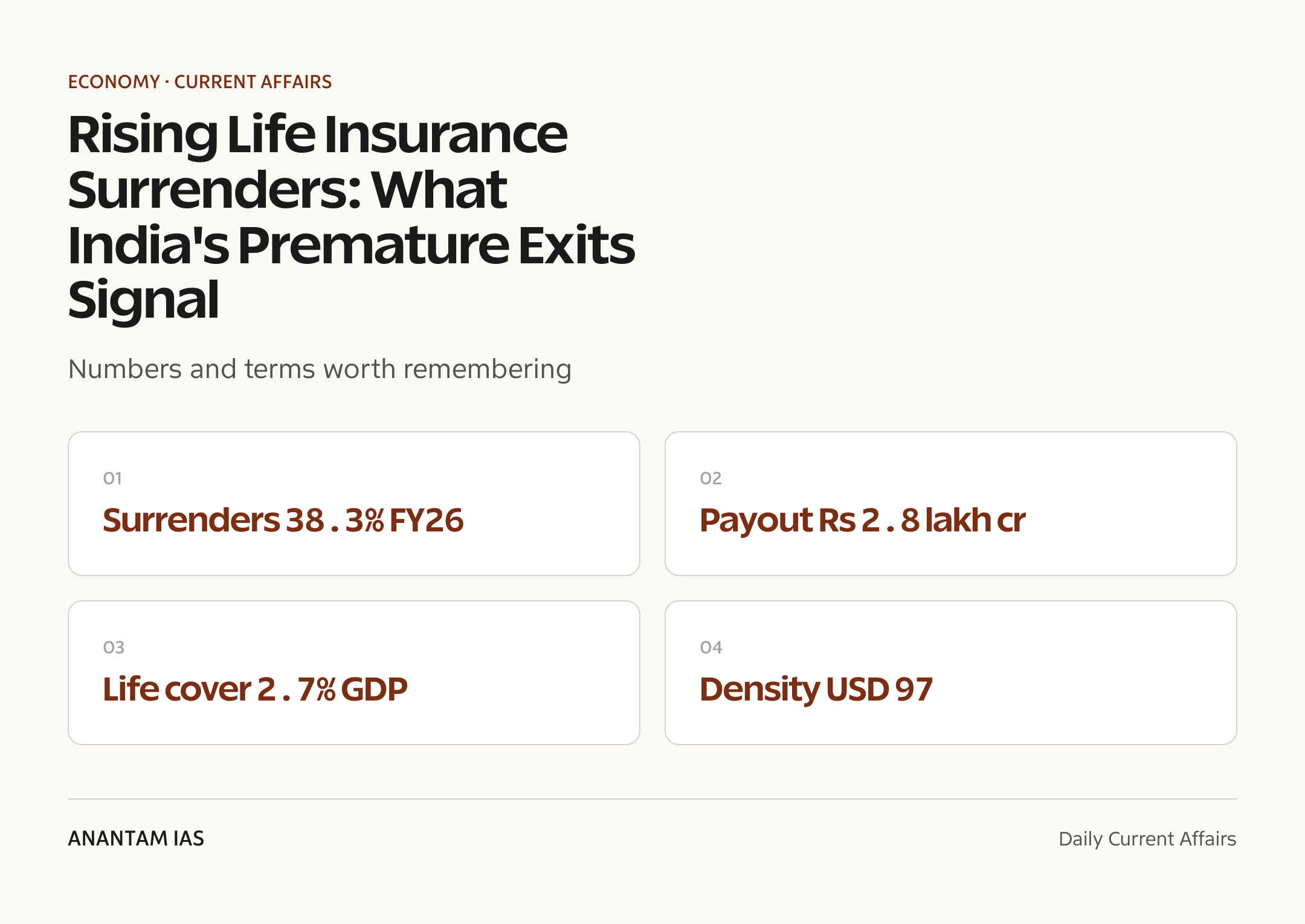
In 2025-26, life insurers paid Rs 7.3 lakh crore in total benefits; 38.3% of this – about Rs 2.8 lakh crore – was premature surrender or withdrawal, versus Rs 2.69 lakh crore paid as maturity benefit.
The trend matters because life insurance is meant to be a long-term protection and savings instrument, not a short-tenure parking of cash. When exits before maturity rival orderly completions, it signals a mix of household financial stress, weak product design and mis-selling – and it feeds directly into the GS3 debate on the financialisation of savings and the health of the insurance sector.
- Surrender/withdrawal share of total benefits rose from about 30% in FY2022 to 38.3% in FY2026, per IRDAI data.
- Share of policyholders completing the full term fell from roughly 48% in 2021-22 to 36.9% in 2025-26.
- The RBI Financial Stability Report flags this near-parity as a risk to insurers’ asset-liability management (ALM).
- Officials attribute exits to mis-selling and household financial stress – inflation, rising living costs and loan repayments.
- The surge persists despite IRDAI‘s revised surrender-value norms of October 2024, which were meant to make early exits less punitive and discourage impulsive quitting.
- It coincides with a third straight yearly fall in life-insurance penetration, underscoring that India’s protection gap is widening even as the economy formalises.
The development matters in the context of:
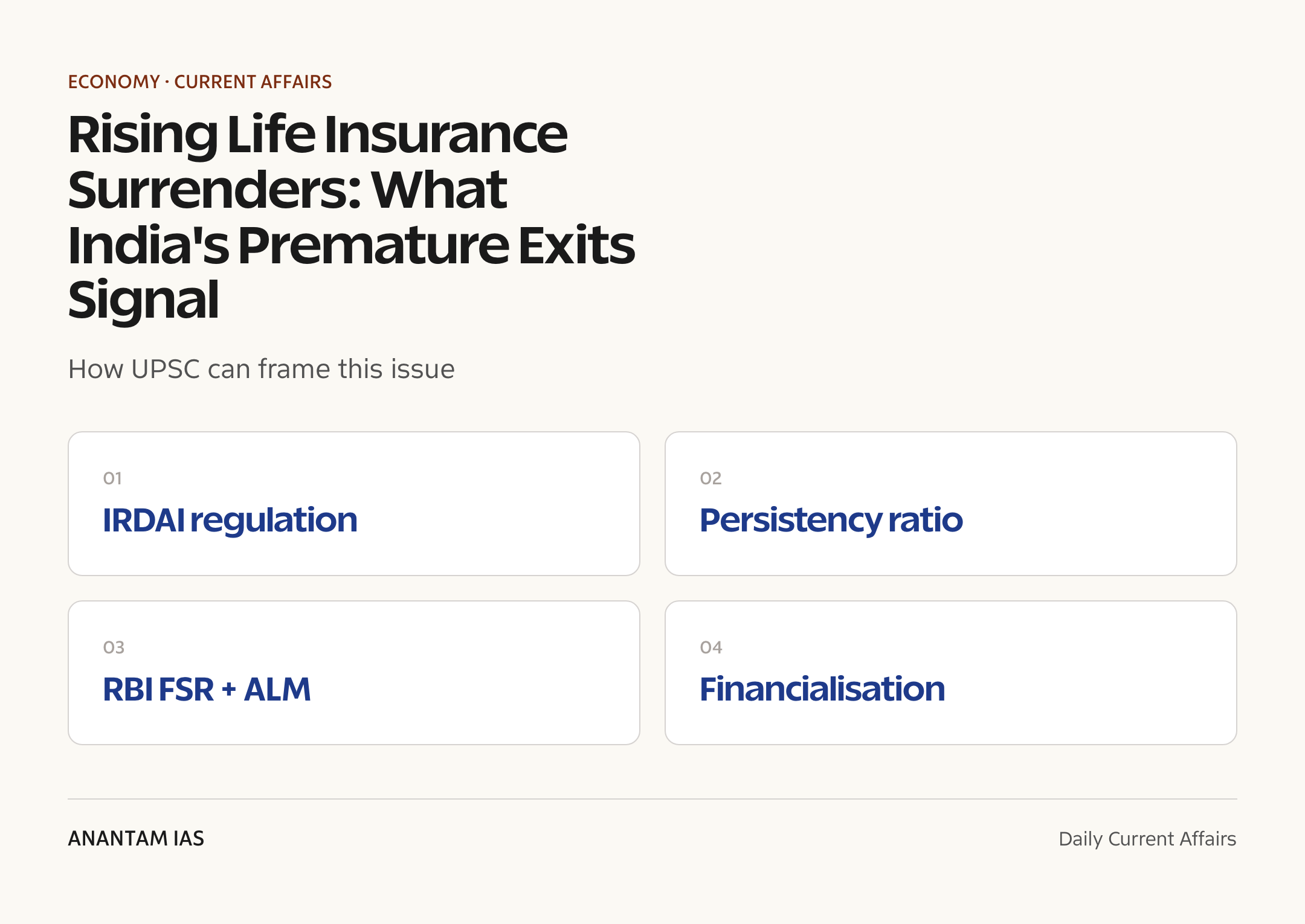
- Fits the GS3 theme of household savings, financialisation and financial-sector regulation.
- Surrenders penalise policyholders, who forgo full benefits and may book losses on early exit.
- Weak persistency undermines insurance penetration – a proxy for social-security depth.
UPSC Relevance
Prelims Relevance
- IRDAI – statutory regulator under the IRDA Act, 1999; regulates life and general insurance.
- Surrender value – amount paid to a policyholder who exits before maturity.
- Special Surrender Value (SSV) and Guaranteed Surrender Value (GSV).
- IRDAI’s 2024 surrender-value norms, effective 1 October 2024.
- Persistency ratio – measured at 13th, 25th, 37th, 49th and 61st month.
- Insurance penetration (premium as % of GDP) and insurance density (premium per capita).
- Asset-liability management (ALM) in life insurance.
- RBI Financial Stability Report (FSR) – half-yearly systemic-risk assessment.
- Net household financial savings as a share of GNDI.
- 10-Year G-Sec yield as a benchmark rate.
Mains Relevance
GS Paper 3
- Financialisation of household savings and its risks – shift from physical to financial assets, and premature exits.
- Insurance-sector regulation: mis-selling, consumer protection and the ALM stability angle in the RBI FSR.
GS Paper 2
- Insurance as social security: low penetration, protection gap, and the state’s role in universalising cover.
Essay
- “Financial inclusion without financial literacy is a half-built bridge.”
- Trust, protection and the promise of insurance in a stressed economy.
Background and Context
What the IRDAI data shows
The core signal is that premature exits are catching up with orderly maturities.
- Total benefits paid by life insurers in 2025-26 stood at Rs 7.3 lakh crore, per IRDAI.
- Premature surrender/withdrawal made up 38.3% (about Rs 2.8 lakh crore), up from roughly 30% in FY2022.
- By contrast, maturity benefits after the full term were Rs 2.69 lakh crore – so exits and completions now run near-parity.
- The share completing the full policy term slid from about 48% (2021-22) to 36.9% (2025-26).
- The five-year climb – from about 30% (FY2022) to 38.3% (FY2026) – shows a structural drift, not a one-off spike.
- Because a rupee paid out early is a rupee not compounding for the saver, the shift also quietly erodes the long-term wealth-building role that life insurance is supposed to play.
Why policyholders are exiting early
Insurance experts cited by The Indian Express point to a mix of stress, mis-selling and better alternatives.
- Households surrender traditional policies to meet urgent cash needs amid inflation, higher living costs and loan repayments.
- Many buyers expect short-term, FD-like returns and quit on learning of the long lock-in and surrender penalties.
- Rising returns on bank FDs, equities and mutual funds pull savers away from low-yield insurance products.
- Mis-selling by agents, banks and NBFCs – long flagged by RBI and IRDAI – inflates early lapses.
- Bancassurance channels, where policies are bundled with loans or pushed for commissions, often place products with buyers who neither need nor understand them.
- Low financial literacy means many first-time buyers cannot tell a pure-protection term plan from a bundled savings-cum-investment product, and abandon it once expectations are not met.
Why premature surrenders hurt
Early exits are a bad deal for the saver and a stability worry for the insurer.
- A policyholder who surrenders forgoes full benefits and may even book a loss on the amount paid in.
- The RBI FSR warns that elevated surrenders disrupt the long-duration assumptions behind insurers’ investment strategies.
- Early exits can force asset liquidation ahead of schedule, straining asset-liability management (ALM).
- Persistently high surrenders signal policyholder dissatisfaction, product mis-selling and competitive pressure from other instruments.
Persistency: the deeper weakness
Surrenders are the visible edge of a long-standing persistency problem.
- Persistency ratio tracks how many policies stay in force at the 13th, 25th, 37th, 49th and 61st month.
- Industry 13th-month persistency for private insurers sits around 65-70% – meaning up to a third lapse within a year.
- It falls further by the 61st month to roughly 45-55% for many insurers.
- LIC historically holds higher persistency on its traditional, agent-driven book.
The IRDAI 2024 surrender-value reform
The regulator has tried to make early exits less punitive.
- New surrender-value norms took effect on 1 October 2024.
- Special Surrender Value (SSV) can now be paid after just the first policy year, once one full year’s premium is received – earlier the first year paid nothing and two years were needed.
- SSV must at least equal the present value of the paid-up sum assured and vested benefits.
- The discount rate is capped at the 10-Year G-Sec yield plus 50 basis points, curbing deep deductions.
The savings and penetration backdrop
Surrender trends sit inside a wider story of financialisation and shallow insurance cover.
- Overall insurance penetration was flat at 3.7% of GDP, against a global average near 7.3%.
- Life-insurance penetration slipped to 2.7% in 2024-25 from 2.8% – a third straight yearly fall.
- Insurance density edged up to USD 97 (life at USD 72); India is the world’s 10th-largest insurance market at 1.8% global share.
- Net household financial savings rebounded to 5.1% of GNDI in 2023-24 after a multi-year low, even as savers rotate toward equities and deposits.
- A shallow, lapse-prone life book weakens insurers as long-term institutional investors in infrastructure and government debt – a channel the economy relies on.
- The government’s stated goal of Insurance for All by 2047 depends on both widening cover and keeping policies in force, making persistency a policy metric, not just a business one.
Way Forward
Curb mis-selling
- Tighten conduct rules for banks and NBFCs and enforce suitability checks at the point of sale.
- Act on IRDAI‘s move to rein in dark patterns and opaque product design.
Reward persistency
- Align agent commissions and incentives with renewals, not just first-year sales.
- Simplify traditional products and disclose surrender penalties up front.
Deepen penetration
- Push term cover and micro-insurance to close the protection gap.
- Build financial literacy so buyers match products to real goals and horizons.
Conclusion
The near-parity between premature surrenders and maturity payouts is a warning light. It tells us that many Indians treat life insurance as a stop-gap savings pot rather than long-term protection – and exit the moment cash is tight or returns look better elsewhere.
Fixing this needs work on both sides: cleaner selling and better-designed products from insurers, and stronger financial literacy among savers. Only then can insurance play its intended role as durable social security rather than a leaky store of value.
For UPSC, the theme threads through GS3 and GS2 alike – the financialisation of household savings, the conduct-regulation mandate of IRDAI, the systemic-stability lens of the RBI Financial Stability Report, and insurance as a pillar of social security. Rising surrenders are a compact case study on how consumer protection, product design and financial literacy together decide whether a savings instrument actually delivers.
UPSC Practice Questions
Prelims MCQ 1
With reference to life insurance in India, consider the following statements:
- The persistency ratio measures how many policies remain in force at set anniversaries such as the 13th and 61st month.
- The Insurance Regulatory and Development Authority of India (IRDAI) is a statutory body.
- Insurance penetration is defined as insurance premium expressed as a percentage of GDP.
How many of the above statements are correct?
(a) Only one (b) Only two (c) All three (d) None
Answer: (c) All three
Explanation:
All three are correct. Persistency tracks in-force policies at anniversaries; IRDAI is statutory under the IRDA Act, 1999; penetration is premium as a share of GDP (density is premium per capita).
Prelims MCQ 2
IRDAI’s revised surrender-value norms, effective 1 October 2024, primarily aimed to:
(a) Ban surrender of traditional policies before maturity (b) Allow a Special Surrender Value from the first policy year and reduce deductions (c) Make all life insurance premiums tax-free (d) Transfer surrender decisions to the RBI
Answer: (b) Allow a Special Surrender Value from the first policy year and reduce deductions
Explanation:
The 2024 norms let the Special Surrender Value be paid after the first policy year and cap the discount rate near the 10-Year G-Sec yield, giving policyholders higher, fairer refunds.
UPSC Mains Questions
- Premature surrenders of life insurance policies in India now nearly equal maturity payouts. Examine the causes of this trend and its implications for household savings and financial stability. (250 words)
- “Low insurance penetration reflects a deeper failure of financial literacy and product design, not just of income.” Critically analyse in the context of India’s life insurance sector. (250 words)
Sources: The Indian Express (Explained) and IRDAI / RBI Financial Stability Report.
Frequently Asked Questions
What is a surrender value in life insurance?
It is the amount an insurer pays a policyholder who exits a policy before it matures. Because charges and penalties are deducted, the surrender value is usually far lower than the premiums paid, so early exit often means the policyholder loses money.
Why are life insurance surrenders rising in India?
IRDAI data cited by The Indian Express show families surrendering traditional policies to meet urgent cash needs amid inflation and loan repayments. Mis-selling, long lock-ins, surrender penalties and more attractive returns on FDs, equities and mutual funds also drive early exits.
What did IRDAI change about surrender values in 2024?
From 1 October 2024, the Special Surrender Value can be paid after the first policy year once a full year’s premium is received, instead of nothing in year one. The discount rate is capped near the 10-Year G-Sec yield plus 50 basis points, giving savers higher, fairer refunds.
What is the persistency ratio?
It measures the share of policies still in force at set anniversaries – the 13th, 25th, 37th, 49th and 61st month. A high ratio means customers keep renewing. India’s persistency is weak, with a large share of private-insurer policies lapsing within the first year or two.
Why does the RBI worry about high surrenders?
The RBI Financial Stability Report notes that early exits disrupt the long-duration assumptions behind insurers’ investments and can force asset sales ahead of schedule. This strains asset-liability management and signals policyholder dissatisfaction, mis-selling and competitive pressure.
What is the difference between insurance penetration and density?
Penetration is insurance premium as a percentage of GDP, measuring how deep insurance is in the economy. Density is premium per person. India’s penetration is about 3.7% against a global average near 7.3%, showing a wide protection gap.
Source: https://anantamias.com/current-affairs/life-insurance-policy-surrenders-surge-india/
Regional Languages in Legal Education: A Ten-Year Action Plan
Why in News?
The Department of Legal Affairs, Ministry of Law & Justice, in collaboration with the Bar Council of India (BCI), held a National Conference on Strengthening Legal Education through Integration of Regional Languages at the BCI premises in New Delhi. As PIB confirmed on 11 July 2026, the two bodies deliberated on a structured roadmap to teach law in Hindi and other Indian languages.
The headline outcome was agreement to formulate a Ten-Year Perspective Action Plan for multilingual legal education, backed by a National Declaration on Indian Languages in Legal Education and a jointly-anchored National Steering Committee to monitor implementation.
The conference matters because it moves a long-standing idea — that justice should be delivered in a language the litigant understands — from rhetoric into an institutional plan with owners, phases and review machinery. It also ties professional-education reform directly to constitutional goals under Articles 39A and 348, and to the government’s larger Viksit Bharat @2047 and Bharatiya Bhasha push.
- Conference co-organised by the Department of Legal Affairs and the Bar Council of India on 11 July 2026, New Delhi.
- Aim: a phased, measurable, quality-assured framework for a bilingual and progressively multilingual legal-education model.
- English retained as an important national and international link language; Indian languages added in a calibrated manner.
- Attended by Justice Rajendra Menon (Chairperson, Armed Forces Tribunal), Manan Kumar Mishra (Chairman, BCI and Rajya Sabha MP) and Dr. Rajiv Mani (Secretary, Legal Affairs).
- Three deliverables: a National Declaration, the Ten-Year Action Plan, and a National Steering Committee.
- Emphasis on AI-enabled translation, digital legal repositories and standardised glossaries, all to be validated by legal and linguistic experts before classroom use.
- Framed as a contribution to the vision of Viksit Bharat @2047 and the promotion of Bharatiya Bhasha in higher education.
The development matters in the context of:
- Touches the constitutional debate over the language of courts (Article 348) and the promotion of Hindi and Indian languages.
- Directly links a professional-education reform to the fundamental goal of equal access to justice under Article 39A.
- Signals a governance shift toward localisation of law for district and subordinate courts, where most litigants operate in regional languages.
UPSC Relevance
Prelims Relevance
- Bar Council of India — statutory body under the Advocates Act, 1961; regulates legal education and the legal profession.
- Article 348 — language to be used in the Supreme Court and High Courts and for authoritative texts of Acts/Bills (English).
- Article 348(2) — Governor, with the President’s prior consent, may authorise Hindi or a State language in High Court proceedings.
- Article 39A — Directive Principle on equal justice and free legal aid (inserted by the 42nd Amendment, 1976).
- Article 343 — Hindi in Devanagari as the official language of the Union; Article 351 — directive to promote Hindi.
- Eighth Schedule — lists 22 scheduled languages of India.
- SUVAS (Supreme Court Vidhik Anuvaad Software) — AI translation tool launched in 2019 for judgments.
- Department of Legal Affairs is under the Ministry of Law & Justice (along with the Legislative Department and Department of Justice).
Mains Relevance
GS Paper 2
- Government policies and interventions for development in the education and justice sectors, and issues in their design and implementation.
- Mechanisms and institutions for the protection and betterment of access to justice for vulnerable and rural populations.
- Role of statutory and regulatory bodies (Bar Council of India) in reforming professional education.
GS Paper 1
- Salient features of Indian society and the role of language and linguistic diversity in social inclusion.
Essay
- Justice in one’s own language: is legal reform incomplete without linguistic access?
- Bridging the gap between the letter of the law and the language of the litigant.
Background and Context
What the Conference decided
The meeting set a concrete institutional agenda rather than a general endorsement.
- Agreed to draft a Ten-Year Perspective Action Plan for phased, measurable integration of Indian languages into legal education.
- Resolved to adopt a National Declaration on Indian Languages in Legal Education to anchor the reform politically and institutionally.
- Decided to set up a National Steering Committee, jointly anchored by the Department of Legal Affairs and the Bar Council of India, to oversee and monitor rollout.
- Chose a bilingual-to-multilingual model — adding Indian languages while retaining English as a link language, not replacing it.
- Stressed that the shift must be phased, measurable and quality-assured, so that comprehension improves without any drop in professional standards.
- Positioned the reform as a joint government-and-profession effort rather than a top-down mandate, giving the regulator, the bar and law schools shared ownership.
Why access to justice is the core rationale
The reform is pitched less as a language project and more as a justice-delivery project.
- Most litigation happens in district and subordinate courts, where proceedings and litigants overwhelmingly use regional languages.
- Article 39A makes equal justice and free legal aid a State obligation — comprehension in one’s own language is central to that promise.
- A lawyer trained only in English can struggle to serve first-generation and rural litigants; the plan explicitly targets legal aid and clinical legal education.
- Better legal comprehension is meant to reduce dependence on intermediaries and lower the cost of seeking justice.
- A pipeline of lawyers fluent in the local language can strengthen district judiciary, legal aid clinics and para-legal services where the demand is greatest.
- The move complements judicial steps such as translating Supreme Court and High Court judgments into Indian languages, so both the practice and the teaching of law become more accessible.
The constitutional language backdrop
The initiative sits inside a long-running Rajbhasha and language-of-courts debate.
- Under Article 348, proceedings in the Supreme Court and High Courts, and authoritative texts of laws, are in English.
- Article 348(2) lets a Governor, with the President’s prior consent, authorise Hindi or a State language in High Court proceedings — but judgments still issue in English.
- Some High Courts (for example in Uttar Pradesh, Bihar, Madhya Pradesh and Rajasthan) already permit Hindi in proceedings under this route.
- Articles 343 and 351 and the Eighth Schedule (22 languages) frame the constitutional push to promote Indian languages.
Bar Council of India and the regulation of legal education
The BCI is the statutory gatekeeper any such reform must run through.
- The Bar Council of India is a statutory body under the Advocates Act, 1961, and prescribes standards of legal education and recognition of law degrees.
- It approves law colleges, sets curriculum norms and conducts the All India Bar Examination (AIBE) for enrolment.
- Its co-ownership of the plan gives the reform regulatory teeth — curriculum and accreditation changes flow through the BCI.
- Legal education is also shaped by the UGC and by the National Education Policy 2020, which promotes teaching in the mother tongue and Indian languages up to higher and professional levels.
- The BCI’s own Legal Education Rules govern the three-year and five-year LLB, clinical courses and moot-court training — the very components that would carry bilingual material.
- Because enrolment as an advocate runs through the BCI and state bar councils, only the regulator can make a regional-language stream count toward a recognised law degree.
The technology lever
Delegates saw language technology as an accelerator, not a substitute for expert validation.
- Emphasis on AI-enabled translation tools, digital legal repositories, and standardised legal glossaries and terminology databases.
- All tools to be subject to rigorous validation by legal and linguistic experts before use in teaching.
- Builds on existing efforts such as SUVAS (Supreme Court Vidhik Anuvaad Software) for translating judgments into Indian languages.
- A shared, standardised legal vocabulary across languages is essential to avoid inconsistent or misleading translations of legal terms.
Challenges and criticisms
The gap between intent and delivery is where earlier language reforms have stalled.
- Acute shortage of quality legal textbooks, commentaries and case material in Indian languages.
- Risk of a two-tier profession if regional-language graduates are seen as less employable in higher courts and corporate practice.
- Standardising legal terminology across many languages is technically hard; a mistranslated term can change legal meaning.
- Faculty capacity, examination standards and cross-State mobility of students need safeguards so quality is not diluted.
- Balancing promotion of Indian languages with English as the link language for appeals and inter-State practice remains politically sensitive.
Way Forward
Build the knowledge base
- Fund translation of core statutes, leading judgments and standard textbooks into Indian languages with expert review.
- Create validated, open legal glossaries and terminology databases so terms stay consistent across States.
Phase it and measure it
- Roll out the Ten-Year Action Plan in clear phases with measurable targets and a public dashboard via the National Steering Committee.
- Pilot bilingual streams in select law schools before scaling, and evaluate outcomes on comprehension and bar-exam performance.
Protect quality and mobility
- Keep English proficiency mandatory as a link-language skill so graduates can practise across States and before higher courts.
- Align the reform with the National Education Policy 2020 and UGC norms to avoid a two-tier degree.
Conclusion
The push to teach law in Hindi and Indian languages reframes a language question as a justice question. For a litigant in a district court, the plan’s success will be measured by whether the law finally speaks in a language they understand.
The design choices matter more than the declaration. A phased, quality-assured framework that keeps English as a link language and invests in translated material and expert-validated terminology can widen access without diluting standards — the test now is delivery over the next decade.
For UPSC, the story is a clean intersection of governance, the Constitution and access to justice: it links Articles 348, 39A, 343 and 351 with the role of a statutory regulator, the NEP 2020 mother-tongue push and the wider debate on Indianising legal and administrative processes — a ready case study for GS2 answers on justice-delivery reform.
UPSC Practice Questions
Prelims MCQ 1
With reference to the Bar Council of India (BCI), consider the following statements:
- It is a statutory body established under the Advocates Act, 1961.
- It lays down standards of legal education in India.
- It conducts the All India Bar Examination for enrolment as an advocate.
How many of the above statements are correct?
(a) Only one (b) Only two (c) All three (d) None
Answer: (c) All three
Explanation:
The BCI is a statutory body under the Advocates Act, 1961; it prescribes standards of legal education (with universities) and conducts the All India Bar Examination (AIBE). All three statements are correct.
Prelims MCQ 2
Which one of the following constitutional provisions deals with the language to be used in the Supreme Court and the High Courts?
(a) Article 343 (b) Article 348 (c) Article 351 (d) Article 39A
Answer: (b) Article 348
Explanation:
Article 348 provides that proceedings in the Supreme Court and High Courts, and authoritative texts of laws, shall be in English, until Parliament provides otherwise. Article 343 concerns the official language of the Union, 351 the promotion of Hindi, and 39A equal justice and free legal aid.
UPSC Mains Questions
- Access to justice remains hollow if the litigant cannot understand the language of the law. In light of the proposed Ten-Year Action Plan on regional languages in legal education, examine how linguistic access advances the goal of equal justice under Article 39A.
- Integrating Indian languages into legal education promises inclusion but risks a two-tier profession. Discuss the design safeguards needed to promote multilingual legal education without diluting standards or restricting the mobility of law graduates.
Sources: PIB, Ministry of Law & Justice and Bar Council of India.
Frequently Asked Questions
What was the July 2026 conference about?
The Department of Legal Affairs and the Bar Council of India jointly held a National Conference on strengthening legal education through regional languages in New Delhi. They agreed to draft a Ten-Year Perspective Action Plan to teach law in Hindi and other Indian languages, alongside a National Declaration and a National Steering Committee to guide the reform.
Will English be removed from legal education?
No. The framework keeps English as an important national and international link language. The model is bilingual and progressively multilingual — Indian languages are added in a calibrated way, not as a replacement, so graduates can still practise across States and before higher courts.
Why does the language of law matter for access to justice?
Most cases are heard in district and subordinate courts, where litigants use regional languages. If law is taught and practised only in English, first-generation and rural litigants struggle to understand proceedings. Teaching law in Indian languages supports the Article 39A goal of equal justice and effective legal aid.
What does Article 348 say about court language?
Article 348 provides that proceedings in the Supreme Court and every High Court, and the authoritative texts of Bills and Acts, shall be in English. Under Article 348(2), a Governor may, with the President’s prior consent, authorise Hindi or a State language in High Court proceedings, though judgments still issue in English.
What role does the Bar Council of India play?
The Bar Council of India is a statutory body under the Advocates Act, 1961. It sets standards of legal education, recognises law degrees, approves law colleges and conducts the All India Bar Examination. Its co-ownership of the plan means curriculum and accreditation changes can be implemented through it.
How will technology help?
Delegates highlighted AI-enabled translation tools, digital legal repositories and standardised legal glossaries and terminology databases. These can speed up producing study material in Indian languages, but the conference stressed that all tools must be rigorously validated by legal and linguistic experts before use.
Source: https://anantamias.com/current-affairs/legal-education-regional-languages-bci/
FPI Flows and India’s Market Underperformance: Beyond the AI-and-Geopolitics Alibi
Why in News?
After a four-month retreat, Foreign Portfolio Investors (FPIs) turned net buyers of Indian equities in early July, prompting a debate on whether India’s roughly two-year market underperformance can really be blamed on the global AI rally and geopolitics, or whether it reflects stretched valuations and weak earnings.
An Indian Express Explained piece reported that FPIs bought Indian shares worth about $1.6 billion in the first ten days of July, even as brokerages including Kotak Institutional Equities called the AI-and-geopolitics explanation for India’s lag ‘superficial’.
The distinction matters for policy and for aspirants alike: if the weakness is cyclical — driven by where global money happens to be flowing — it should reverse on its own; if it is structural — rooted in overpriced stocks and thin profit growth — no return of foreign flows will fix it, and the fix must come from the real economy.
- A West Asia conflict in late February triggered a roughly $28-billion FPI exit from Indian equities over the following four months.
- Sentiment turned after a US-Iran de-escalation around mid-June; the second half of June saw net inflows of about $1.1 billion after outflows of $6.7 billion in the first half.
- India’s equity valuation premium over emerging-market peers compressed to a historic low of about 18% in June, well below its long-term average near 73% and a CY22 peak of 147%, per Motilal Oswal.
- Foreign inflows into the debt market jumped to roughly $5.8 billion in June from just $291 million in May, aiding a steadier rupee.
The development matters in the context of:
- FPI is the classic ‘hot money’ whose sudden entry and exit swings the Sensex, Nifty, the rupee and the Balance of Payments — a core GS3 external-sector theme.
- The episode tests whether market weakness is a cyclical global-flows story or a structural earnings-and-valuation problem.
UPSC Relevance
Prelims Relevance
- FPI — investment below 10% stake in listed securities, regulated by SEBI under the FPI Regulations, 2019 and by the RBI under FEMA, 1999.
- FDI — investment of 10% or more with a lasting interest/management intent, under the FDI Policy and FEMA.
- FII (Foreign Institutional Investor) — the older term now subsumed under the FPI framework.
- MSCI Emerging Markets Index — China carries the largest weight (near a third); India is among the top components.
- Hot money — short-term, volatile capital that chases yield and exits fast.
- Balance of Payments (BoP) — FPI is recorded in the capital account; FDI too, but with different stability.
- Price-to-earnings (P/E) ratio — a valuation gauge; India’s forward P/E has hovered near its long-run average.
- Capital-gains tax on listed equity — STCG at 20% and LTCG at 12.5% (post-2024 rates).
Mains Relevance
GS Paper 3
- The role of FPI in India’s capital markets and external sector — liquidity benefits versus ‘hot money’ volatility.
- Whether India’s market underperformance is cyclical (global flows) or structural (earnings, valuations, business-model risk).
GS Paper 2
- SEBI and RBI as co-regulators of foreign capital — governance of markets and investor protection.
Essay
- Markets reward substance, not narratives — the limits of the ‘story stock’ in a real economy.
- Openness with resilience: managing volatile capital in a globalised economy.
Background and Context
FPI versus FDI — the durable distinction
The single most-tested idea here is how portfolio money differs from direct investment, in both intent and stability.
- FDI is a lasting stake — typically 10% or more of equity — carrying management interest; it builds factories, jobs, technology and supply chains and does not exit quickly.
- FPI is passive investment in listed shares and bonds below the 10% threshold, purely for financial returns, with no control over the company.
- Regulator split: FDI falls under the government’s FDI Policy and FEMA (RBI); FPI is governed by SEBI under the FPI Regulations, 2019, alongside RBI’s FEMA rules.
- The older term FII (Foreign Institutional Investor) has now been merged into the single FPI category to simplify the framework.
- Both flows are recorded in the capital account of the Balance of Payments, but they behave very differently under stress.
- Because FPI can be pulled out in days, it is called ‘hot money’ — it deepens markets and lowers the cost of capital in good times, but amplifies shocks when it flees, transmitting global sentiment straight into Indian asset prices.
What the numbers show
The flow data frames the story of exit, return and a shrinking premium.
- A late-February West Asia conflict set off a roughly $28-billion FPI outflow from equities over four months.
- A mid-June US-Iran de-escalation flipped sentiment; June’s second half saw about $1.1 billion of net inflows against $6.7 billion of outflows in its first half.
- In the first ten days of July, FPIs bought about $1.6 billion of Indian shares.
- The recovery was fragile — equities fell over 2% mid-week on renewed West Asia tension, underlining how geopolitics whipsaws sentiment.
The valuation angle
India has long traded at a premium to peers on the promise of faster growth; that cushion has thinned sharply.
- A valuation premium means investors pay more per rupee of earnings for Indian stocks than for peers, betting on stronger future growth.
- Per Motilal Oswal, India’s valuation premium over emerging markets fell to a historic low of about 18% in June, versus a long-term average near 73% and a CY22 peak of 147%.
- A lower premium leaves ‘limited downside’, so some desks argue foreigners may treat India as a relatively safe AI alternative after AI-driven markets ran hot.
- The price-to-earnings (P/E) ratio compares share price to per-share profit — a quick gauge of whether a market is cheap or expensive.
- India’s forward P/E has stayed close to its long-run average, but bulls and bears read the same number differently — cheap-relative-to-history versus still-expensive-on-weak-earnings.
The AI and geopolitics 'alibi'
The headline debate is whether external factors truly explain a two-year lag.
- Global money has crowded into AI-heavy markets such as South Korea, drawing flows away from India — a convenient external explanation.
- Kotak Institutional Equities (analysts led by Sanjeev Prasad) called this ‘superficial’, arguing the market was ‘too complacent’ on business-model quality, ‘too generous’ on valuations and ‘too optimistic’ on earnings.
- They flagged the sharp erosion in the market value of IT services firms as evidence of real disruption risk, not just a passing mood.
The earnings problem
Valuations can only be justified by profit growth, and that has disappointed for several quarters.
- Average net profit of Nifty 50 companies grew in mid-to-high single digits in FY26 — better than the 0.8% of a year earlier, but far below the 15-20% seen just after Covid.
- Systematix’s Dhananjay Sinha argued the market stays ‘expensive’ with ‘no earnings growth to match it’, doubting a strong profit rebound from here.
- When prices ran up faster than profits, the gap had to close either through stronger earnings or weaker prices — and so far it is prices that have given way.
- Weak earnings plus high starting valuations is the classic recipe for underperformance regardless of foreign flows.
- This is why analysts frame the slump as at least partly structural — a domestic profit problem that cheap money from abroad cannot paper over.
The debt-inflow and rupee link
Policy nudges on debt indirectly steadied the currency that equity investors watch.
- The government and RBI announced early-June measures to boost debt inflows; foreign debt investment surged to about $5.8 billion in June from just $291 million in May.
- A steadier rupee matters because currency depreciation can ‘significantly erode’ dollar-denominated returns for overseas equity investors.
- Better debt flows also support the Balance of Payments and deeper foreign participation — indirect positives for equities.
Way Forward
Deepen domestic buffers
- Grow the domestic institutional base — mutual funds, SIPs, insurance and pension money — so markets lean less on volatile foreign flows.
- Sustain the shift toward stable, long-term FDI and quality debt inflows over pure portfolio money.
Fix the fundamentals
- Corporate earnings growth, not narrative, is the durable driver — support demand, capex and productivity so profits justify valuations.
- Guard against complacency on business-model disruption risk, especially in export-facing sectors like IT services.
Keep external buffers strong
- Adequate forex reserves, a stable rupee and a manageable current account help absorb sudden FPI reversals.
Conclusion
The return of FPIs is welcome but modest, and it does not settle the deeper question. Blaming India’s two-year lag entirely on the AI rally and geopolitics risks ignoring what analysts see as stretched valuations and soft earnings — a distinction between a passing external mood and a home-grown fundamentals problem.
The policy takeaway is to reduce dependence on volatile foreign flows by deepening the domestic investor base, sustaining stable FDI and quality debt inflows, and keeping external buffers like forex reserves and the rupee strong enough to absorb sudden reversals.
For aspirants, the episode is a clean case study in how hot money, currency and the real economy interact. Markets ultimately track profits and macro fundamentals; foreign flows amplify moves but rarely create value on their own.
UPSC Practice Questions
Prelims MCQ 1
With reference to Foreign Portfolio Investment (FPI) in India, consider the following statements:
- FPI in listed securities is regulated by SEBI under the FPI Regulations, 2019.
- An equity stake of 10% or more by a single foreign investor is treated as FDI rather than FPI.
- FPI is generally regarded as more stable, long-term capital than FDI.
How many of the above statements are correct?
(a) Only one (b) Only two (c) All three (d) None
Answer: (b) Only two
Explanation:
Statements 1 and 2 are correct. FPI is SEBI-regulated under the FPI Regulations, 2019, and a stake of 10% or more is classified as FDI. Statement 3 is wrong — FPI is volatile ‘hot money’; FDI is the more stable, long-term capital.
Prelims MCQ 2
The term ‘hot money’, often used in discussions of India’s external sector, most appropriately refers to:
(a) Currency printed by the RBI during a fiscal deficit (b) Short-term, volatile foreign portfolio capital that can exit rapidly (c) Black money circulating in the domestic economy (d) Long-term foreign direct investment in manufacturing
Answer: (b) Short-term, volatile foreign portfolio capital that can exit rapidly
Explanation:
‘Hot money’ denotes short-term FPI flows that chase returns and can be withdrawn quickly, swinging markets, the rupee and the Balance of Payments.
UPSC Mains Questions
- ‘India’s stock-market underperformance reflects fundamentals more than foreign-flow narratives.’ In light of recent FPI behaviour, examine the roles of valuations, corporate earnings and geopolitics in shaping equity market outcomes. (250 words)
- Distinguish between Foreign Direct Investment and Foreign Portfolio Investment, and assess why an economy dependent on ‘hot money’ faces greater external-sector vulnerability. Suggest measures to reduce this dependence. (150 words)
Sources: The Indian Express (Explained Economics) and SEBI FPI Regulations, 2019.
Frequently Asked Questions
What is the difference between FPI and FDI?
FDI is a lasting stake — usually 10% or more of a company’s equity — that brings management interest and builds real productive capacity like factories and jobs. FPI is passive investment in listed shares and bonds below that threshold, made only for financial returns without control. FDI is stable and long-term; FPI can exit quickly.
Why is FPI called ‘hot money’?
Because it is short-term and highly mobile. Foreign portfolio investors can buy and sell listed securities within days, chasing better returns elsewhere. Large, sudden inflows or outflows swing the Sensex, Nifty, the rupee and the Balance of Payments, making FPI a key source of external-sector volatility for India.
Who regulates FPI in India?
FPI is regulated by SEBI under the SEBI (Foreign Portfolio Investors) Regulations, 2019, and by the Reserve Bank of India under the Foreign Exchange Management Act, 1999. FDI, by contrast, is governed by the government’s FDI Policy and FEMA, with the RBI overseeing the foreign-exchange side.
Why have India’s markets underperformed recently?
Global money crowded into AI-heavy markets, drawing flows away from India, and a West Asia conflict triggered a large FPI exit. But analysts like Kotak argue the deeper reasons are stretched valuations and weak corporate earnings, calling the AI-and-geopolitics explanation ‘superficial’.
How does the rupee affect foreign equity investors?
Overseas investors earn returns in dollars, so a falling rupee erodes those returns even if Indian share prices rise. A stable currency, by protecting dollar returns, encourages foreign equity inflows. Stronger debt inflows and healthy forex reserves help keep the rupee steady, indirectly supporting equity sentiment.
What is the MSCI Emerging Markets Index?
It is a benchmark tracking large and mid-cap stocks across emerging economies. China carries the largest weight, close to a third, and India is among its top components. Global funds allocate money by such index weights, so shifts in the index influence how much foreign capital flows into Indian equities.
Source: https://anantamias.com/current-affairs/fpi-flows-india-market-underperformance/
Digital India at 11: eSARAS and DPI-led rural digital commerce
Why in News?
The Digital India programme, launched on 1 July 2015, completed 11 years in July 2026, and the government has spotlighted the eSARAS online marketplace as a flagship example of Digital Public Infrastructure (DPI) being channelled into rural livelihoods rather than only into payments and identity.
PIB and the Ministry of Rural Development note that eSARAS (SARAS Aajeevika), the official e-commerce portal for products made by women Self-Help Groups (SHGs), now anchors a network of nearly 9 crore SHG members under DAY-NRLM, and has been plugged into the open ONDC network to widen its market reach.
The anniversary reframes a familiar debate: after a decade of building world-scale digital rails, the test now is whether those rails can deliver tangible income to the poorest — here, rural women artisans — and not just efficiency to the already-connected.
- eSARAS is the official online marketplace of DAY-NRLM, run under the Ministry of Rural Development with Digital India Corporation (MeitY).
- The DAY-NRLM ecosystem covers about 8.99 crore registered SHG women members across 7,627 blocks.
- eSARAS products are now live on ONDC across 11+ buyer apps reaching 20 crore+ potential buyers.
- The portal esaras.in was first launched on 28 October 2022; a mobile app and a Fulfilment Centre followed.
- IANS reported on 11 July 2026 that eSARAS is boosting digital commerce for close to 9 crore SHG members.
The development matters in the context of:
- Shows how India’s DPI stack (Aadhaar, UPI, ONDC, DigiLocker) is being used for livelihoods, not just payments and identity.
- Links women-led development and the rural craft economy to national digital markets, a live GS2 governance and GS3 economy theme.
UPSC Relevance
Prelims Relevance
- Digital India launched 1 July 2015; nodal ministry is MeitY.
- eSARAS / SARAS Aajeevika is the SHG e-commerce portal of DAY-NRLM.
- DAY-NRLM = Deendayal Antyodaya Yojana–National Rural Livelihoods Mission, under Ministry of Rural Development.
- ONDC (Open Network for Digital Commerce) is an interoperable e-commerce network, not an app.
- Digital India Corporation is a not-for-profit under MeitY.
- Digital economy contributes about 12–14% of India’s GDP.
- UMANG is a unified mobile app for government services; eSARAS is listed on it.
- SARAS Aajeevika Gallery is a permanent retail outlet at Baba Kharak Singh Marg, New Delhi.
Mains Relevance
GS Paper 2
- Digital Public Infrastructure as a governance model for last-mile welfare and market access.
- Government schemes for vulnerable sections and women’s empowerment through SHGs.
GS Paper 3
- Digital economy, e-commerce and inclusive growth for the rural non-farm sector.
- Role of technology and e-marketplaces in raising rural incomes and formalising producers.
Essay
- Technology must serve humanity: digital tools for grassroots empowerment.
- Women-led development and the dignity of rural work.
Background and Context
Digital India at 11 — the DPI backbone
The programme’s core is a stack of open, interoperable digital rails often described as India’s Digital Public Infrastructure.
- Digital India was launched on 1 July 2015 around three visions — digital infrastructure as a utility, governance and services on demand, and the digital empowerment of citizens.
- DPI is built on the ‘India Stack’ idea of open, interoperable, population-scale rails for identity, payments and data, layered so private and public players can build on top.
- Aadhaar crossed 144 crore registrations by March 2026 and underpins over 3,100 welfare schemes as a foundational digital identity.
- UPI grew from about 20 million transactions in 2017 to over 240 billion, handling nearly 49% of global real-time payments.
- DigiLocker had over 70 crore users and issued more than 850 crore documents by March 2026, cutting paperwork for citizens.
- Direct Benefit Transfer has routed over ₹51 lakh crore to bank accounts, cutting leakages and middlemen.
- ONDC extends the same open-network logic from payments to e-commerce, and eSARAS is a live test of that extension for the rural economy.
What is eSARAS?
A dedicated, government-run online marketplace built only for SHG products, so rural makers are not lost among mass sellers.
- eSARAS (SARAS Aajeevika) is the official e-commerce portal of DAY-NRLM for goods made by women SHGs and their federations.
- The SARAS brand — long known through SARAS Aajeevika Melas (fairs) held across the country — has been carried online to give those products a year-round digital shopfront.
- It is built by Digital India Corporation under MeitY with the Ministry of Rural Development, an example of two ministries pooling digital and livelihood mandates.
- The portal esaras.in was launched on 28 October 2022 for better marketing of Saras products directly to consumers.
- It sells handloom, handicrafts, processed food, honey, dairy, herbal and home-décor items — from Chanderi sarees to Pashmina and Rajasthan marble craft.
- By selling directly, it aims to give producers a fair price and buyers an authentic, traceable rural product.
Scale and grassroots architecture
eSARAS sits on one of the world’s largest women-led livelihood networks, which gives it enormous latent supply and scale.
- DAY-NRLM, launched in 2011 and renamed in 2015, mobilises poor rural women into Self-Help Groups, village organisations and cluster-level federations.
- It now covers about 8.99 crore registered SHG women members — a base larger than the population of most countries.
- The mission operates across 7,627 blocks with a community cadre of about 1.51 crore members who act as local trainers and mobilisers.
- Over 8.62 crore SHG members have a digital storefront, most directly linked to the Ministry’s network (Feb 2024).
- The design deliberately eliminates intermediaries so more of the final price reaches the artisan rather than middlemen.
- This scale is what lets a single portal aggregate craft from thousands of villages into one national catalogue.
From a portal to a full-stack ecosystem
eSARAS has evolved beyond a single website.
- A mobile app was launched alongside an eSARAS Fulfilment Centre for processing, packaging and shipping.
- A permanent SARAS Aajeevika Gallery operates at Baba Kharak Singh Marg, New Delhi.
- A premium SARAS Shakti Collection targets institutional and corporate gifting.
- eSARAS is also listed on UMANG, widening its reach to government-app users.
ONDC and DPI-led market access
The biggest leap is plugging SHG goods into open digital commerce so they surface wherever buyers already shop.
- eSARAS products are available on ONDC across 11+ buyer apps with 800+ handcrafted items listed.
- This exposes SHG products to 20 crore+ potential buyers on the network, far beyond the traffic a single government site could draw.
- ONDC (Open Network for Digital Commerce) is an open, interoperable protocol — sellers reach many buyer apps without being locked to one dominant platform or paying its high commissions.
- It unbundles e-commerce, so any compliant buyer app can discover any compliant seller, breaking the walled-garden model of large marketplaces.
- It turns eSARAS from a standalone store into a node on India’s Digital Public Infrastructure, benefiting from network effects rather than competing against them.
Capacity-building and significance
Technology is paired with training so women can run online businesses.
- SHG women get training in digital onboarding, branding, product photography, packaging and inventory.
- They also learn digital marketing, customer service and financial literacy.
- The model advances women-led development, formalises rural producers and preserves craft heritage.
- It illustrates how DPI can lift rural incomes, not just deliver payments or identity.
Gaps and challenges
Scaling digital rural commerce faces real frictions.
- Uneven digital literacy and connectivity in remote blocks limit uptake.
- Logistics, quality control and returns remain hard for scattered, small producers.
- Competition from large e-commerce brands can squeeze thin SHG margins.
- Sustained sales depend on consumer demand, not just listing more products.
Way Forward
Deepen digital skilling
- Scale hands-on training in cataloguing, pricing and after-sales so SHGs run stores independently.
- Use community cadres as local digital mentors for onboarding.
Strengthen logistics and trust
- Expand fulfilment centres and standardised packaging to cut delivery friction.
- Build quality assurance and grievance redress to earn repeat buyers.
Grow demand and integrations
- Push deeper ONDC and institutional/corporate buying, plus export linkages via GI-tagged crafts.
- Bundle credit and working capital so SHGs can meet larger orders.
Conclusion
At 11 years, Digital India’s real test has shifted from building rails to putting them to work for the poorest. eSARAS is a concrete answer — using open digital infrastructure like ONDC to place rural, women-made goods in national markets that were once out of reach for a village artisan.
The promise is real but conditional. A listing is not a sale, and a portal is not an income. If digital skilling, dependable logistics and steady consumer demand keep pace with the technology, the model can convert a marketplace into durable livelihoods for close to 9 crore women.
That is the larger lesson of Digital India’s second decade: DPI succeeds only when inclusion, not just scale, is treated as the goal — when the last-mile artisan, and not merely the transaction count, is the measure of success.
UPSC Practice Questions
Prelims MCQ 1
With reference to eSARAS, consider the following statements:
- It is the online marketplace of DAY-NRLM for products made by women Self-Help Groups.
- It is implemented by the Ministry of Rural Development along with a MeitY body.
- Its products are made available to buyers through the ONDC network.
How many of the above statements are correct?
(a) Only one (b) Only two (c) All three (d) None
Answer: (c) All three
Explanation:
eSARAS (SARAS Aajeevika) is DAY-NRLM’s SHG marketplace, built by Digital India Corporation (MeitY) with the Ministry of Rural Development, and integrated with ONDC. All three are correct.
Prelims MCQ 2
The Open Network for Digital Commerce (ONDC) is best described as:
(a) A single government-owned shopping app (b) An open, interoperable network connecting buyer and seller apps (c) A digital payments system like UPI (d) A subsidy-transfer platform
Answer: (b) An open, interoperable network connecting buyer and seller apps
Explanation:
ONDC is an open protocol that lets sellers reach many buyer apps without being tied to one platform; it is not itself an app, a payment system or a DBT tool.
UPSC Mains Questions
- Digital Public Infrastructure is often described as India’s key governance innovation. Using the example of the eSARAS marketplace, examine how DPI can widen rural and women-led livelihoods. (250 words)
- “Building digital rails is easier than ensuring inclusion.” In the light of Digital India completing 11 years, discuss the challenges in making e-commerce work for rural Self-Help Groups. (250 words)
Sources: PIB, Ministry of Rural Development and Digital India, MeitY.
Frequently Asked Questions
What is eSARAS?
eSARAS, also called SARAS Aajeevika, is the official online marketplace of DAY-NRLM that sells products made by women Self-Help Groups. It is run by the Ministry of Rural Development with Digital India Corporation, and its goods reach buyers through the ONDC network and its own portal and app.
When did Digital India start?
The Digital India programme was launched on 1 July 2015 under the Ministry of Electronics and Information Technology. It completed 11 years in July 2026, and its digital public infrastructure now spans Aadhaar, UPI, DigiLocker and ONDC, among other platforms.
What is DAY-NRLM?
DAY-NRLM is the Deendayal Antyodaya Yojana–National Rural Livelihoods Mission of the Ministry of Rural Development. It mobilises poor rural women into Self-Help Groups and their federations, providing training, credit and market linkages. It covers about 8.99 crore women members across thousands of blocks.
How does ONDC help eSARAS sellers?
ONDC is an open, interoperable e-commerce network. By integrating with it, eSARAS makes SHG products visible across more than 11 buyer apps and a base of over 20 crore potential buyers, instead of being limited to a single shopping platform.
Why is eSARAS a Digital Public Infrastructure example?
eSARAS shows DPI being used for livelihoods, not just identity or payments. It plugs rural, women-made goods into open digital rails like ONDC and UMANG, so small producers can reach national markets with institutional support for logistics and marketing.
What products are sold on eSARAS?
eSARAS offers handloom and handicraft goods, processed food, honey, dairy, herbal and home-décor items. These range from Chanderi sarees and Pashmina to Rajasthan marble craft, each linked directly to the artisan who made it.
Source: https://anantamias.com/current-affairs/digital-india-11-years-esaras-dpi-rural-commerce/
China lands a reusable rocket for the first time: what it means for the space race
Why in News?
China has, for the first time, launched and vertically recovered the booster of a reusable rocket, a milestone that directly challenges the American lead in low-cost space access. The Indian Express reported that the Long March 10B lifted off from the Wenchang Commercial Space Launch Site in Hainan and its booster returned to a floating sea platform, where it was caught by a net.
Before this test, only SpaceX and Blue Origin had demonstrated the ability to launch a rocket and land its booster back for reuse. China’s success makes it the third entity worldwide to prove the technology, sharpening a two-way space race with the United States over satellite constellations and crewed lunar landings.
For India, the test resets the competitive benchmark. ISRO and a young private sector are still moving from reusable-landing experiments toward an operational reusable stage, and the widening gap in cost-per-launch is now the sharpest measure of how far Indian space has to travel to stay commercially relevant.
- The Long March 10B can carry up to 16 metric tonnes to low Earth orbit (LEO, the band between 160 km and 2,000 km).
- About six minutes after liftoff, the booster separated from the upper stage and began a controlled descent to a floating platform at sea.
- Unlike SpaceX and Blue Origin, the Chinese booster used landing hooks to catch a suspended wire net, not hydraulic legs.
- The Long March 10 series is central to China’s plan to land astronauts on the Moon by 2030.
The development matters in the context of:
- Reusability is the single biggest lever on cost per kg to orbit — the metric that now decides who dominates space.
- The test lands as the world races to deploy mega satellite constellations and prepare crewed lunar missions.
UPSC Relevance
Prelims Relevance
- Long March 10B — reusable rocket, 16-tonne LEO payload, launched from Wenchang, Hainan
- Low Earth Orbit (LEO) — 160 km to 2,000 km altitude
- Reusable-rocket recovery methods: hydraulic landing legs, drone ship, mechanical ‘chopstick’ arms (SpaceX Starship, 2024), and China’s net-and-hooks capture
- SpaceX Falcon 9 and Blue Origin — the two entities that pioneered launch-and-land reusability
- Grid fins and thrust-managed retro-burn used to steer and brake a returning booster
- China’s military-civil fusion (MCF) strategy; CASC (China Aerospace Science and Technology Corporation)
- India’s RLV-TD ‘Pushpak’ LEX landing experiments; Two-Stage-To-Orbit (TSTO) goal
- IN-SPACe, Skyroot (Vikram), Agnikul (Agnibaan) — India’s private launch ecosystem
Mains Relevance
GS Paper 3
- Reusable launch technology and its impact on the economics of space access and India’s launch competitiveness
- Indigenisation of critical space technologies and the role of the private sector after the 2020 opening
GS Paper 2
- India-China strategic competition extending into the space and dual-use technology domain
Essay
- The race to the final frontier: cost, competition and the new economics of space
- Technology as an instrument of national power
Background and Context
What a reusable rocket does — and why it is hard
A reusable rocket lets the expensive booster fly home instead of being discarded, collapsing the biggest recurring cost of spaceflight.
- All rockets stage: the first stage (booster) holds most of the engines and fuel, powers the ascent, then separates while the upper stage continues to orbit.
- In a conventional expendable rocket that spent booster falls away and is lost — the equivalent of scrapping an airliner after one flight.
- In a reusable design the booster flips using pressurised nitrogen, re-orients its engines, and flies a controlled powered return trajectory back toward a landing point.
- During re-entry — at roughly the speed of sound (1,225 km/h) — grid fins (lattice-like control surfaces) provide aerodynamic steering and stability.
- The hardest step is thrust management: a precise retro-burn must brake the near-empty, lightweight shell to a soft touchdown without either crashing it or bouncing it back into the sky.
- Getting this reliably right demands deep-throttling engines, sturdy avionics and repeated testing — which is why so few players have mastered it.
How China's method differs from SpaceX and Blue Origin
The novelty of the Long March test is the final capture mechanism, not the flight profile.
- SpaceX and Blue Origin land boosters on hydraulic landing legs, touching down on a ground pad or a drone ship at sea.
- In 2024 SpaceX went further, using giant mechanical ‘chopstick’ arms to catch a descending Starship booster in mid-air.
- The Long March 10B instead uses landing hooks that snag a suspended wire net aligned by a maritime landing vessel as the engines shut down.
- Auxiliary cables and an automated locking platform then clamp the captured booster to stop it swinging.
- Dropping the heavy hydraulic legs cuts booster mass and raises the payload margin — a deliberate design trade-off.
Why reusability rewrites the cost of space
Reflying boosters has cut the price of reaching orbit by more than 90% in a decade, and that single number now decides who leads in space.
- The Space Shuttle cost about $54,000 per kg to LEO; expendable rockets of the 2000s ran $10,000-20,000 per kg.
- SpaceX’s Falcon 9 has pushed the effective figure to roughly $3,000 per kg, with reused boosters cheaper still.
- Individual Falcon 9 boosters have flown 20+ times; analysts estimate a reused launch’s marginal cost near $15-20 million against a ~$67 million list price.
- Cheaper launch is not just an accounting saving — it changes what missions are even possible, from thousand-satellite constellations to frequent lunar cargo runs.
- It also lifts cadence: a recoverable fleet can fly far more often than one that must build a new rocket for every mission.
- The trade-off: fuel kept back for recovery means a reusable launch lifts less payload than the same rocket flown expendable, so operators size the rocket for the margin they need.
Strategic stakes — Moon, constellations and military-civil fusion
The test is less about one landing than about China matching the United States across three strategic fronts.
- Lunar race: the Long March 10 series underpins China’s goal of a crewed Moon landing by 2030, competing with the US Artemis programme for the Moon’s South Pole and its water-ice (a source of rocket propellant).
- LEO constellations: China plans three communications satellite constellations of thousands of satellites each — economically viable only with cheap, reusable heavy lift.
- Military-civil fusion (MCF): elevated by Xi Jinping in 2015 as national strategy, it channels commercial aerospace advances into dual-use military capability.
- State giant CASC and a dedicated PLA aerospace force give Beijing tight, whole-of-nation control, per Takshashila Institution analyst Anushka Saxena quoted by The Indian Express.
Where India stands: ISRO and the private sector
India is building the same capabilities in stages, but the gap to SpaceX and China is real.
- ISRO’s RLV-TD ‘Pushpak’ completed a third autonomous runway landing (LEX-03) in June 2024, a step toward a Two-Stage-To-Orbit (TSTO) reusable vehicle.
- India opened space to private players in 2020 and set up IN-SPACe as the single-window regulator-promoter; 300+ space startups now operate.
- Skyroot Aerospace (Hyderabad) is preparing its first orbital flight, Vikram-1, in a July-August 2026 window; Agnikul Cosmos flies the largely 3D-printed Agnibaan.
- As Saxena cautioned, for other spacefaring nations like India it “might take a long time” to enter this top tier — see the linked note on India’s private space and defence-satellite push.
- India’s advantage remains frugal engineering: ISRO’s proven PSLV and GSLV/LVM3 workhorses already win commercial payloads on price, a base that reusability can extend.
The wider space economy and why it matters for India
The contest over reusable launch sits inside a fast-growing global space economy that India wants a larger share of.
- The global space economy is valued at roughly $400 billion and is projected to cross $1 trillion by 2040, with launch and satellite services at its core.
- India’s share is still small — around 2-3% — and the government’s Indian Space Policy 2023 aims to expand it sharply by opening launch, satellites and ground systems to private firms.
- A dedicated ₹1,000-crore venture fund for space startups and 100% FDI in parts of the sector (2024) signal a push to build commercial launch capacity.
- Low-cost reusable heavy lift is the enabling technology for India’s own planned communications and Earth-observation constellations and for a future Bharatiya Antariksha Station.
- Falling launch prices are strategic as much as commercial — cheap access to orbit underpins navigation (NavIC), surveillance and disaster-management capability.
Way Forward
For ISRO and the state programme
- Accelerate the move from Pushpak landing tests to an operational reusable first stage and a Next-Generation Launch Vehicle.
- Prioritise cost-per-kg as an explicit design target, not just mission success, to stay commercially competitive.
For the private ecosystem
- Use IN-SPACe and technology-transfer to let Skyroot, Agnikul and others build indigenous reusable heavy lift.
- Grow demand through India’s own satellite constellation plans so private launchers have a stable order book.
India should treat reusability as strategic infrastructure — linking launch cost, defence dual-use needs and lunar ambition into one coherent space-industrial policy rather than isolated demonstrations.
Conclusion
China’s first booster recovery does not overtake SpaceX, which reflies boosters routinely and at scale, but it closes a decade-old gap and confirms a genuine two-power contest in reusable space access. The value of the test lies less in the single landing than in what it unlocks — cheaper, more frequent launches that feed constellations, lunar ambitions and dual-use military capability.
For India, the message is twofold: the economic logic of reusability is now unavoidable, and the window to convert ISRO’s Pushpak demonstrations and a fast-growing private sector into competitive, low-cost launch capability is narrowing. Treating cost-per-kg as a first-order design goal, funding indigenous reusable heavy lift, and anchoring demand through India’s own satellite plans are the levers that will decide whether the country stays a frugal launch leader or slips behind in the new orbital economy.
UPSC Practice Questions
Prelims MCQ 1
With reference to reusable launch vehicles, consider the following statements:
- Reusability lowers the cost per launch by recovering and reflying the rocket’s booster.
- Before China’s Long March 10B test, only the United States’ SpaceX and Blue Origin had demonstrated landing a rocket booster.
- The Long March 10B recovered its booster using hydraulic landing legs on a ground pad.
How many of the above statements are correct?
(a) Only one (b) Only two (c) All three (d) None
Answer: (b) Only two
Explanation:
Statements 1 and 2 are correct. Statement 3 is wrong: the Long March 10B used landing hooks to catch a suspended net on a floating sea platform, not hydraulic legs.
Prelims MCQ 2
‘Low Earth Orbit’ (LEO), frequently mentioned in the context of satellite constellations, is generally defined as the region at an altitude of:
(a) 160 km to 2,000 km (b) 2,000 km to 20,000 km (c) about 36,000 km (geostationary) (d) below 100 km
Answer: (a) 160 km to 2,000 km
Explanation:
LEO spans roughly 160-2,000 km. Geostationary orbit lies near 36,000 km; below 100 km is not a stable orbit.
UPSC Mains Questions
- The economics of reusable launch vehicles has become the decisive factor in the new space race. Examine how this shift affects India’s space competitiveness and outline the steps ISRO and private players must take to respond. (250 words)
- China’s Long March 10B landing reflects the fusion of commercial innovation and strategic ambition in its space programme. Discuss the strategic implications of reusable-rocket technology for India-China competition. (250 words)
Source: The Indian Express (Explained).
Frequently Asked Questions
What is the Long March 10B?
The Long March 10B is a Chinese reusable rocket capable of lifting up to 16 metric tonnes to low Earth orbit. In its 2026 test it launched from the Wenchang site in Hainan and recovered its booster on a floating sea platform, making China the third entity after SpaceX and Blue Origin to land a booster for reuse.
How does China’s landing method differ from SpaceX’s?
SpaceX and Blue Origin land boosters on hydraulic legs on a pad or drone ship, and SpaceX has caught a Starship booster with mechanical ‘chopstick’ arms. The Long March 10B instead uses landing hooks that snag a suspended wire net aligned by a sea vessel, dropping heavy legs to save mass and boost payload.
Why does reusability matter so much?
Reflying boosters slashes the cost of reaching orbit. It fell from about $54,000 per kg on the Space Shuttle to roughly $3,000 per kg on SpaceX’s Falcon 9 — more than a 90% drop in a decade. Cheap, repeatable launch is what makes mega satellite constellations and frequent lunar missions affordable.
Where does India stand on reusable rockets?
ISRO has flown its RLV-TD ‘Pushpak’ technology demonstrator through autonomous landing experiments (LEX-01 to LEX-03) as a step toward a Two-Stage-To-Orbit reusable vehicle. Private firms like Skyroot and Agnikul, enabled by IN-SPACe and the 2020 opening of the sector, are building indigenous launch vehicles.
What is ‘military-civil fusion’ in China’s space programme?
Military-civil fusion (MCF), elevated by Xi Jinping in 2015, is a national strategy that channels commercial and civilian technological advances into military capability. In space it means dual-use innovation from state giants like CASC and a dedicated PLA aerospace force, giving Beijing whole-of-nation control over the sector.
Why is the Moon’s South Pole strategically important?
Permanently shadowed craters near the lunar South Pole hold large quantities of water-ice, which can be split into hydrogen and oxygen to make rocket propellant. This makes the region prized real estate for any sustained deep-space programme, and the focus of competition between China’s 2030 crewed-landing plan and the US Artemis programme.
Source: https://anantamias.com/current-affairs/china-reusable-rocket-long-march-10b-first-landing/