

Why in News?
China has, for the first time, launched and vertically recovered the booster of a reusable rocket, a milestone that directly challenges the American lead in low-cost space access. The Indian Express reported that the Long March 10B lifted off from the Wenchang Commercial Space Launch Site in Hainan and its booster returned to a floating sea platform, where it was caught by a net.
Before this test, only SpaceX and Blue Origin had demonstrated the ability to launch a rocket and land its booster back for reuse. China’s success makes it the third entity worldwide to prove the technology, sharpening a two-way space race with the United States over satellite constellations and crewed lunar landings.
For India, the test resets the competitive benchmark. ISRO and a young private sector are still moving from reusable-landing experiments toward an operational reusable stage, and the widening gap in cost-per-launch is now the sharpest measure of how far Indian space has to travel to stay commercially relevant.
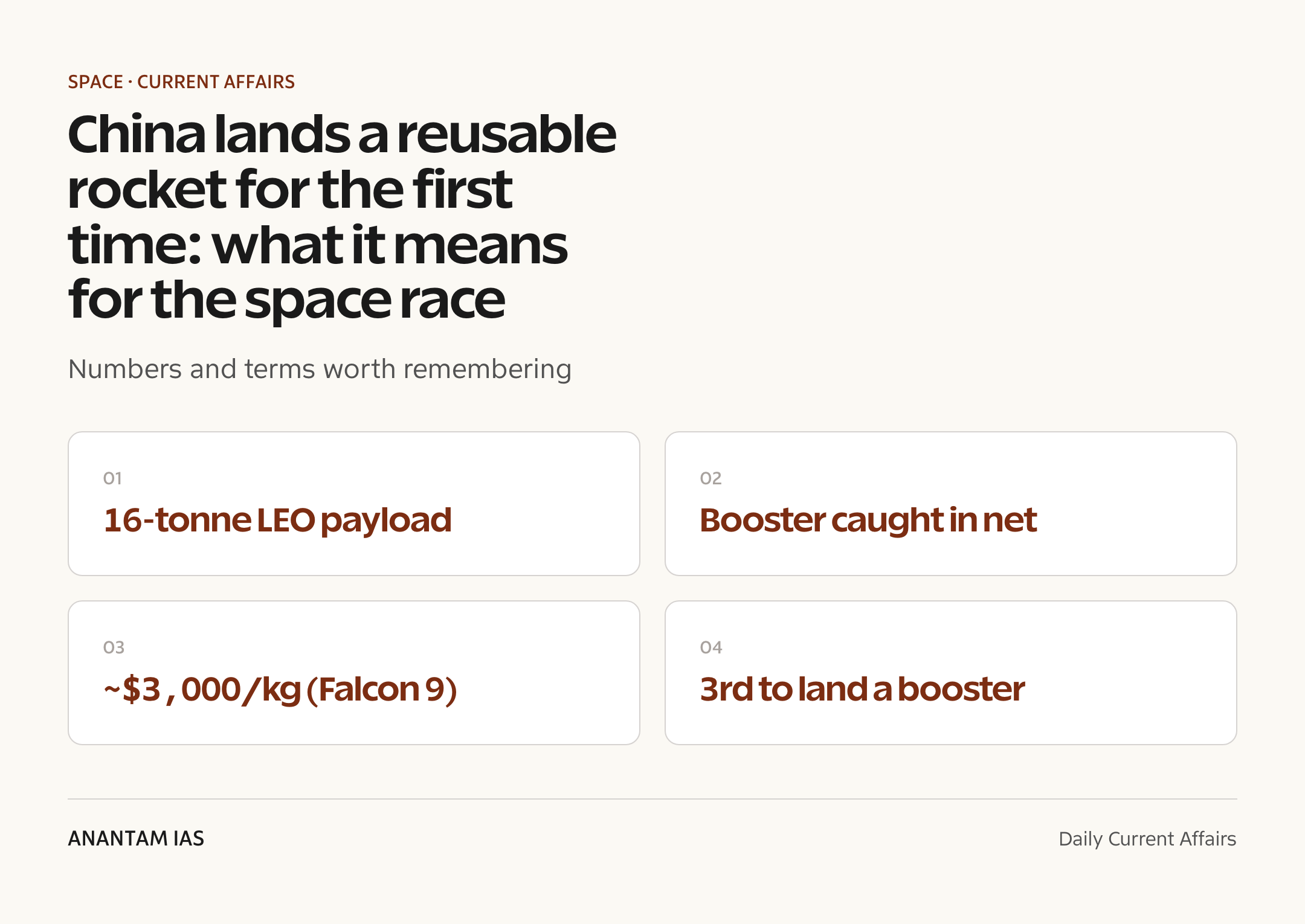
- The Long March 10B can carry up to 16 metric tonnes to low Earth orbit (LEO, the band between 160 km and 2,000 km).
- About six minutes after liftoff, the booster separated from the upper stage and began a controlled descent to a floating platform at sea.
- Unlike SpaceX and Blue Origin, the Chinese booster used landing hooks to catch a suspended wire net, not hydraulic legs.
- The Long March 10 series is central to China’s plan to land astronauts on the Moon by 2030.
The development matters in the context of:
- Reusability is the single biggest lever on cost per kg to orbit — the metric that now decides who dominates space.
- The test lands as the world races to deploy mega satellite constellations and prepare crewed lunar missions.
UPSC Relevance
Prelims Relevance
- Long March 10B — reusable rocket, 16-tonne LEO payload, launched from Wenchang, Hainan
- Low Earth Orbit (LEO) — 160 km to 2,000 km altitude
- Reusable-rocket recovery methods: hydraulic landing legs, drone ship, mechanical ‘chopstick’ arms (SpaceX Starship, 2024), and China’s net-and-hooks capture
- SpaceX Falcon 9 and Blue Origin — the two entities that pioneered launch-and-land reusability
- Grid fins and thrust-managed retro-burn used to steer and brake a returning booster
- China’s military-civil fusion (MCF) strategy; CASC (China Aerospace Science and Technology Corporation)
- India’s RLV-TD ‘Pushpak’ LEX landing experiments; Two-Stage-To-Orbit (TSTO) goal
- IN-SPACe, Skyroot (Vikram), Agnikul (Agnibaan) — India’s private launch ecosystem
Mains Relevance
GS Paper 3
- Reusable launch technology and its impact on the economics of space access and India’s launch competitiveness
- Indigenisation of critical space technologies and the role of the private sector after the 2020 opening
GS Paper 2
- India-China strategic competition extending into the space and dual-use technology domain
Essay
- The race to the final frontier: cost, competition and the new economics of space
- Technology as an instrument of national power
Background and Context
What a reusable rocket does — and why it is hard
A reusable rocket lets the expensive booster fly home instead of being discarded, collapsing the biggest recurring cost of spaceflight.
- All rockets stage: the first stage (booster) holds most of the engines and fuel, powers the ascent, then separates while the upper stage continues to orbit.
- In a conventional expendable rocket that spent booster falls away and is lost — the equivalent of scrapping an airliner after one flight.
- In a reusable design the booster flips using pressurised nitrogen, re-orients its engines, and flies a controlled powered return trajectory back toward a landing point.
- During re-entry — at roughly the speed of sound (1,225 km/h) — grid fins (lattice-like control surfaces) provide aerodynamic steering and stability.
- The hardest step is thrust management: a precise retro-burn must brake the near-empty, lightweight shell to a soft touchdown without either crashing it or bouncing it back into the sky.
- Getting this reliably right demands deep-throttling engines, sturdy avionics and repeated testing — which is why so few players have mastered it.
How China's method differs from SpaceX and Blue Origin
The novelty of the Long March test is the final capture mechanism, not the flight profile.
- SpaceX and Blue Origin land boosters on hydraulic landing legs, touching down on a ground pad or a drone ship at sea.
- In 2024 SpaceX went further, using giant mechanical ‘chopstick’ arms to catch a descending Starship booster in mid-air.
- The Long March 10B instead uses landing hooks that snag a suspended wire net aligned by a maritime landing vessel as the engines shut down.
- Auxiliary cables and an automated locking platform then clamp the captured booster to stop it swinging.
- Dropping the heavy hydraulic legs cuts booster mass and raises the payload margin — a deliberate design trade-off.
Why reusability rewrites the cost of space
Reflying boosters has cut the price of reaching orbit by more than 90% in a decade, and that single number now decides who leads in space.
- The Space Shuttle cost about $54,000 per kg to LEO; expendable rockets of the 2000s ran $10,000-20,000 per kg.
- SpaceX’s Falcon 9 has pushed the effective figure to roughly $3,000 per kg, with reused boosters cheaper still.
- Individual Falcon 9 boosters have flown 20+ times; analysts estimate a reused launch’s marginal cost near $15-20 million against a ~$67 million list price.
- Cheaper launch is not just an accounting saving — it changes what missions are even possible, from thousand-satellite constellations to frequent lunar cargo runs.
- It also lifts cadence: a recoverable fleet can fly far more often than one that must build a new rocket for every mission.
- The trade-off: fuel kept back for recovery means a reusable launch lifts less payload than the same rocket flown expendable, so operators size the rocket for the margin they need.
Strategic stakes — Moon, constellations and military-civil fusion
The test is less about one landing than about China matching the United States across three strategic fronts.
- Lunar race: the Long March 10 series underpins China’s goal of a crewed Moon landing by 2030, competing with the US Artemis programme for the Moon’s South Pole and its water-ice (a source of rocket propellant).
- LEO constellations: China plans three communications satellite constellations of thousands of satellites each — economically viable only with cheap, reusable heavy lift.
- Military-civil fusion (MCF): elevated by Xi Jinping in 2015 as national strategy, it channels commercial aerospace advances into dual-use military capability.
- State giant CASC and a dedicated PLA aerospace force give Beijing tight, whole-of-nation control, per Takshashila Institution analyst Anushka Saxena quoted by The Indian Express.
Where India stands: ISRO and the private sector
India is building the same capabilities in stages, but the gap to SpaceX and China is real.
- ISRO’s RLV-TD ‘Pushpak’ completed a third autonomous runway landing (LEX-03) in June 2024, a step toward a Two-Stage-To-Orbit (TSTO) reusable vehicle.
- India opened space to private players in 2020 and set up IN-SPACe as the single-window regulator-promoter; 300+ space startups now operate.
- Skyroot Aerospace (Hyderabad) is preparing its first orbital flight, Vikram-1, in a July-August 2026 window; Agnikul Cosmos flies the largely 3D-printed Agnibaan.
- As Saxena cautioned, for other spacefaring nations like India it “might take a long time” to enter this top tier — see the linked note on India’s private space and defence-satellite push.
- India’s advantage remains frugal engineering: ISRO’s proven PSLV and GSLV/LVM3 workhorses already win commercial payloads on price, a base that reusability can extend.
The wider space economy and why it matters for India
The contest over reusable launch sits inside a fast-growing global space economy that India wants a larger share of.
- The global space economy is valued at roughly $400 billion and is projected to cross $1 trillion by 2040, with launch and satellite services at its core.
- India’s share is still small — around 2-3% — and the government’s Indian Space Policy 2023 aims to expand it sharply by opening launch, satellites and ground systems to private firms.
- A dedicated ₹1,000-crore venture fund for space startups and 100% FDI in parts of the sector (2024) signal a push to build commercial launch capacity.
- Low-cost reusable heavy lift is the enabling technology for India’s own planned communications and Earth-observation constellations and for a future Bharatiya Antariksha Station.
- Falling launch prices are strategic as much as commercial — cheap access to orbit underpins navigation (NavIC), surveillance and disaster-management capability.
Way Forward
For ISRO and the state programme
- Accelerate the move from Pushpak landing tests to an operational reusable first stage and a Next-Generation Launch Vehicle.
- Prioritise cost-per-kg as an explicit design target, not just mission success, to stay commercially competitive.
For the private ecosystem
- Use IN-SPACe and technology-transfer to let Skyroot, Agnikul and others build indigenous reusable heavy lift.
- Grow demand through India’s own satellite constellation plans so private launchers have a stable order book.
India should treat reusability as strategic infrastructure — linking launch cost, defence dual-use needs and lunar ambition into one coherent space-industrial policy rather than isolated demonstrations.
Conclusion
China’s first booster recovery does not overtake SpaceX, which reflies boosters routinely and at scale, but it closes a decade-old gap and confirms a genuine two-power contest in reusable space access. The value of the test lies less in the single landing than in what it unlocks — cheaper, more frequent launches that feed constellations, lunar ambitions and dual-use military capability.
For India, the message is twofold: the economic logic of reusability is now unavoidable, and the window to convert ISRO’s Pushpak demonstrations and a fast-growing private sector into competitive, low-cost launch capability is narrowing. Treating cost-per-kg as a first-order design goal, funding indigenous reusable heavy lift, and anchoring demand through India’s own satellite plans are the levers that will decide whether the country stays a frugal launch leader or slips behind in the new orbital economy.
UPSC Practice Questions
Prelims MCQ 1
With reference to reusable launch vehicles, consider the following statements:
- Reusability lowers the cost per launch by recovering and reflying the rocket’s booster.
- Before China’s Long March 10B test, only the United States’ SpaceX and Blue Origin had demonstrated landing a rocket booster.
- The Long March 10B recovered its booster using hydraulic landing legs on a ground pad.
How many of the above statements are correct?
(a) Only one (b) Only two (c) All three (d) None
Answer: (b) Only two
Explanation:
Statements 1 and 2 are correct. Statement 3 is wrong: the Long March 10B used landing hooks to catch a suspended net on a floating sea platform, not hydraulic legs.
Prelims MCQ 2
‘Low Earth Orbit’ (LEO), frequently mentioned in the context of satellite constellations, is generally defined as the region at an altitude of:
(a) 160 km to 2,000 km (b) 2,000 km to 20,000 km (c) about 36,000 km (geostationary) (d) below 100 km
Answer: (a) 160 km to 2,000 km
Explanation:
LEO spans roughly 160-2,000 km. Geostationary orbit lies near 36,000 km; below 100 km is not a stable orbit.
UPSC Mains Questions
- The economics of reusable launch vehicles has become the decisive factor in the new space race. Examine how this shift affects India’s space competitiveness and outline the steps ISRO and private players must take to respond. (250 words)
- China’s Long March 10B landing reflects the fusion of commercial innovation and strategic ambition in its space programme. Discuss the strategic implications of reusable-rocket technology for India-China competition. (250 words)
Source: The Indian Express (Explained).
Frequently Asked Questions
What is the Long March 10B?
The Long March 10B is a Chinese reusable rocket capable of lifting up to 16 metric tonnes to low Earth orbit. In its 2026 test it launched from the Wenchang site in Hainan and recovered its booster on a floating sea platform, making China the third entity after SpaceX and Blue Origin to land a booster for reuse.
How does China’s landing method differ from SpaceX’s?
SpaceX and Blue Origin land boosters on hydraulic legs on a pad or drone ship, and SpaceX has caught a Starship booster with mechanical ‘chopstick’ arms. The Long March 10B instead uses landing hooks that snag a suspended wire net aligned by a sea vessel, dropping heavy legs to save mass and boost payload.
Why does reusability matter so much?
Reflying boosters slashes the cost of reaching orbit. It fell from about $54,000 per kg on the Space Shuttle to roughly $3,000 per kg on SpaceX’s Falcon 9 — more than a 90% drop in a decade. Cheap, repeatable launch is what makes mega satellite constellations and frequent lunar missions affordable.
Where does India stand on reusable rockets?
ISRO has flown its RLV-TD ‘Pushpak’ technology demonstrator through autonomous landing experiments (LEX-01 to LEX-03) as a step toward a Two-Stage-To-Orbit reusable vehicle. Private firms like Skyroot and Agnikul, enabled by IN-SPACe and the 2020 opening of the sector, are building indigenous launch vehicles.
What is ‘military-civil fusion’ in China’s space programme?
Military-civil fusion (MCF), elevated by Xi Jinping in 2015, is a national strategy that channels commercial and civilian technological advances into military capability. In space it means dual-use innovation from state giants like CASC and a dedicated PLA aerospace force, giving Beijing whole-of-nation control over the sector.
Why is the Moon’s South Pole strategically important?
Permanently shadowed craters near the lunar South Pole hold large quantities of water-ice, which can be split into hydrogen and oxygen to make rocket propellant. This makes the region prized real estate for any sustained deep-space programme, and the focus of competition between China’s 2030 crewed-landing plan and the US Artemis programme.
Tell Google you want more of this.
Add Anantam IAS as a preferred sourceOne tap, and this site shows up more often in your own Top Stories, AI Overviews and AI Mode. Remove it any time.






