Daily Digest
UPSC · Civil Services Examination
Current Affairs · Thursday, 13 August 2026
Current affairs curated and edited by Anantam IAS faculty — pulled from The Hindu, PIB, IDSA, Foreign Affairs and the ministries. Read, annotate, revise.
Old Rajinder Nagar · Delhi 110005 · anantamias.com
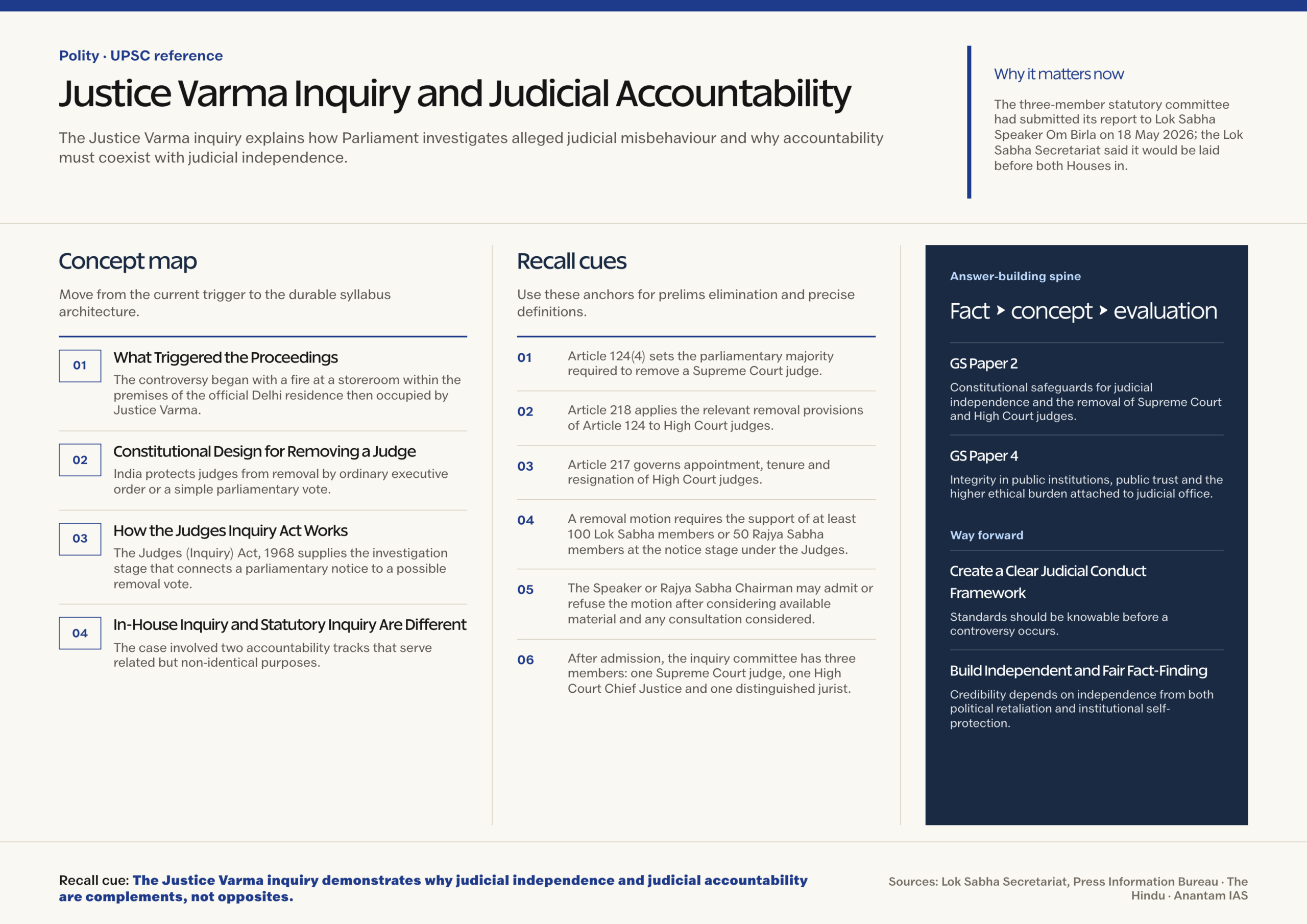
Justice Varma Inquiry and Judicial Accountability
Why in News?
A statutory Judges Inquiry Committee report concerning Justice Yashwant Varma was placed before Parliament, bringing its findings on the cash-at-residence allegations into the formal constitutional removal process.
- The three-member statutory committee had submitted its report to Lok Sabha Speaker Om Birla on 18 May 2026; the Lok Sabha Secretariat said it would be laid before both Houses in due course.
- The committee was originally constituted by the Speaker on 12 August 2025 under the Judges (Inquiry) Act, 1968 after admission of a motion seeking removal.
- Its members at the time of submission were Supreme Court judge Justice Aravind Kumar, Bombay High Court Chief Justice Shree Chandrashekhar and senior advocate B.V. Acharya, the distinguished-jurist member.
- The statutory report is distinct from the earlier in-house judicial inquiry ordered within the Supreme Court’s administrative system. The first supports Parliament’s constitutional process; the second is an internal accountability mechanism.
- Justice Varma denied ownership or knowledge of the cash and questioned the evidentiary basis and fairness of the proceedings. Those objections form part of the due-process debate and should not be erased when discussing the committee’s.
- Higher-court judges require strong decisional independence, but independence is not immunity from a constitutionally structured inquiry into alleged misbehaviour or incapacity.
- The Constitution deliberately sets a high removal threshold so that a temporary political majority cannot easily punish a judge for unpopular decisions.
- A resignation during an inquiry exposes a recurring institutional gap: fact-finding may continue, while the practical purpose and consequences of a removal motion can become contested.
UPSC Relevance
Prelims Relevance
- Article 124(4) sets the parliamentary majority required to remove a Supreme Court judge.
- Article 218 applies the relevant removal provisions of Article 124 to High Court judges.
- Article 217 governs appointment, tenure and resignation of High Court judges.
- A removal motion requires the support of at least 100 Lok Sabha members or 50 Rajya Sabha members at the notice stage under the Judges (Inquiry) Act, 1968.
- The Speaker or Rajya Sabha Chairman may admit or refuse the motion after considering available material and any consultation considered appropriate.
- After admission, the inquiry committee has three members: one Supreme Court judge, one High Court Chief Justice and one distinguished jurist.
Mains Relevance
GS Paper 2
- Constitutional safeguards for judicial independence and the removal of Supreme Court and High Court judges.
- Institutional accountability, natural justice and the legitimacy of fact-finding in cases involving constitutional office-holders.
GS Paper 4
- Integrity in public institutions, public trust and the higher ethical burden attached to judicial office.
- Balancing confidentiality, dignity of office, transparency and fairness to the person under inquiry.
Essay
- Institutions retain public trust when independence is paired with answerability rather than secrecy.
Background and Context
What Triggered the Proceedings
The controversy began with a fire at a storeroom within the premises of the official Delhi residence then occupied by Justice Varma.
- The fire occurred on the night of 14 March 2025. Responders recorded material that appeared to include bundles of partially burnt currency notes, generating questions about possession, access and preservation of evidence.
- Justice Varma consistently denied that the cash belonged to him or his family and said he and his wife were away from Delhi when the fire occurred. He described the storeroom as detached from the main.
- The then Chief Justice of India initiated an in-house inquiry. Judicial work was withdrawn from Justice Varma, and he was transferred from the Delhi High Court to his parent Allahabad High Court without being assigned.
- The in-house committee’s conclusions and the Chief Justice of India’s subsequent recommendation supplied institutional material, but they did not themselves remove the judge. Removal is governed by the Constitution and parliamentary legislation.
Constitutional Design for Removing a Judge
India protects judges from removal by ordinary executive order or a simple parliamentary vote.
- Under Article 124(4), a Supreme Court judge may be removed by the President after each House presents an address supported by a majority of the House’s total membership and by at least two-thirds of members.
- The grounds are proved misbehaviour or incapacity. The Constitution does not define every act that amounts to misbehaviour, allowing the inquiry to assess conduct while requiring proof through a regulated process.
- Article 218 extends the relevant removal safeguards to High Court judges. Article 217 also provides the route by which a High Court judge may resign by writing addressed to the President.
- The word impeachment is common in public discussion, but the constitutional text speaks of an address by Parliament and an order of removal by the President.
How the Judges Inquiry Act Works
The Judges (Inquiry) Act, 1968 supplies the investigation stage that connects a parliamentary notice to a possible removal vote.
- A notice must be signed by at least 100 members of the Lok Sabha or 50 members of the Rajya Sabha. The presiding officer may admit or refuse it after examining the available material.
- Once admitted, the motion remains pending while a three-member committee investigates. The composition combines judicial experience and an external juristic perspective: a Supreme Court judge, a High Court Chief Justice and a distinguished jurist.
- The committee must frame definite charges, communicate the grounds to the judge and provide a reasonable opportunity to submit a defence, cross-examine witnesses, adduce evidence and be heard.
- Section 5 gives the committee civil-court powers for specified purposes, including compelling attendance, obtaining documents, receiving evidence on oath and issuing commissions for examination of witnesses or documents.
- The committee records findings on each charge separately. If it finds no misbehaviour or incapacity, the pending motion cannot proceed. If it records an adverse finding, the motion and report may be considered by the.
In-House Inquiry and Statutory Inquiry Are Different
The case involved two accountability tracks that serve related but non-identical purposes.
- The judiciary’s in-house procedure is an internal mechanism concerned with maintaining standards, allocating judicial work and deciding whether the Chief Justice of India should recommend further action.
- A committee under the 1968 Act operates after a parliamentary motion is admitted. Its powers, composition, defence safeguards, report and consequences arise from statute.
- The statutory committee may consider its own evidentiary record. Fairness requires that charges be definite, adverse material be disclosed in accordance with law and the judge receive a meaningful opportunity to respond.
- UPSC answers should avoid describing either inquiry as a criminal trial. Criminal investigation and prosecution involve separate legal thresholds, agencies, offences and courts.
Way Forward
Create a Clear Judicial Conduct Framework
- Codify or formally publish enforceable standards on asset disclosure, conflicts of interest, gifts, recusal, financial propriety and preservation of evidence.
- Provide clear rules for public disclosure of conclusions, redaction of sensitive material and protection of complainants and witnesses.
- Use transparent selection criteria for inquiry members, conflict checks and published procedural rules.
- Guarantee notice of definite charges, access to relied-on material, reasonable time, representation, cross-examination where appropriate and reasoned findings on each charge.
Conclusion
- The Justice Varma inquiry demonstrates why judicial independence and judicial accountability are complements , not opposites.
- A credible system must preserve the high constitutional threshold for removal while ensuring that serious allegations receive timely, evidence-led and publicly intelligible resolution.
UPSC Practice Questions
Prelims MCQ 1
With reference to the removal of a High Court judge in India, consider the following statements:
- A notice under the Judges (Inquiry) Act, 1968 requires at least 100 Lok Sabha members or 50 Rajya Sabha members.
- The inquiry committee consists of one Supreme Court judge, one High Court Chief Justice and one distinguished jurist.
- An adverse inquiry committee report automatically removes the judge from office.
How many of the above statements are correct?
(a) Only one (b) Only two (c) All three (d) None
Answer: (b) Only two
Explanation:
Statements 1 and 2 reflect Section 3 of the Judges (Inquiry) Act, 1968. Statement 3 is incorrect: each House must adopt the motion with the constitutional special majority, after which the President may issue the removal order.
Prelims MCQ 2
Which constitutional provision applies the removal safeguards concerning Supreme Court judges to judges of High Courts?
(a) Article 136 (b) Article 217 alone (c) Article 218 (d) Article 226
Answer: (c) Article 218
Explanation:
Article 218 applies specified clauses of Article 124, including the removal framework, to High Courts. Article 217 addresses appointment and conditions of a High Court judge’s office, while Articles 136 and 226 concern jurisdiction.
UPSC Mains Questions
- Judicial independence cannot be sustained without credible judicial accountability. Discuss with reference to India’s constitutional procedure for the removal of higher-court judges.
- Examine the distinction between the judiciary’s in-house inquiry mechanism and an inquiry under the Judges (Inquiry) Act, 1968. Why does the distinction matter for due process?
Sources: Lok Sabha Secretariat, Press Information Bureau and The Hindu.
Frequently Asked Questions
What did the Judges Inquiry Committee reportedly find in the Justice Varma matter?
The Hindu reported that the statutory committee found all three framed charges proved. This was a finding within the Judges (Inquiry) Act process, not a criminal conviction and not an automatic order of removal. The judge disputed the evidence and.
Who can remove a High Court judge?
The President issues the removal order after each House of Parliament adopts an address in the same session with the constitutionally required special majority. Parliament’s role follows investigation under the statutory process; neither the executive nor a judicial in-house committee.
What majority is required in Parliament?
Each House must approve the motion by a majority of its total membership and by at least two-thirds of members present and voting. Both conditions must be met. This demanding threshold is designed to protect judges from removal based on.
How is a Judges Inquiry Committee constituted?
After admitting a properly supported motion, the Speaker or Rajya Sabha Chairman constitutes a three-member committee. It includes one Supreme Court judge, one Chief Justice of a High Court and one distinguished jurist. Special rules apply when notices are given.
Is an in-house inquiry the same as a parliamentary inquiry?
No. An in-house inquiry is an internal judicial mechanism used for institutional discipline and recommendations. A committee under the Judges (Inquiry) Act, 1968 is a statutory body connected to a pending parliamentary removal motion, with defined membership, evidentiary powers and.
Source: https://anantamias.com/current-affairs/justice-varma-inquiry-judicial-accountability/
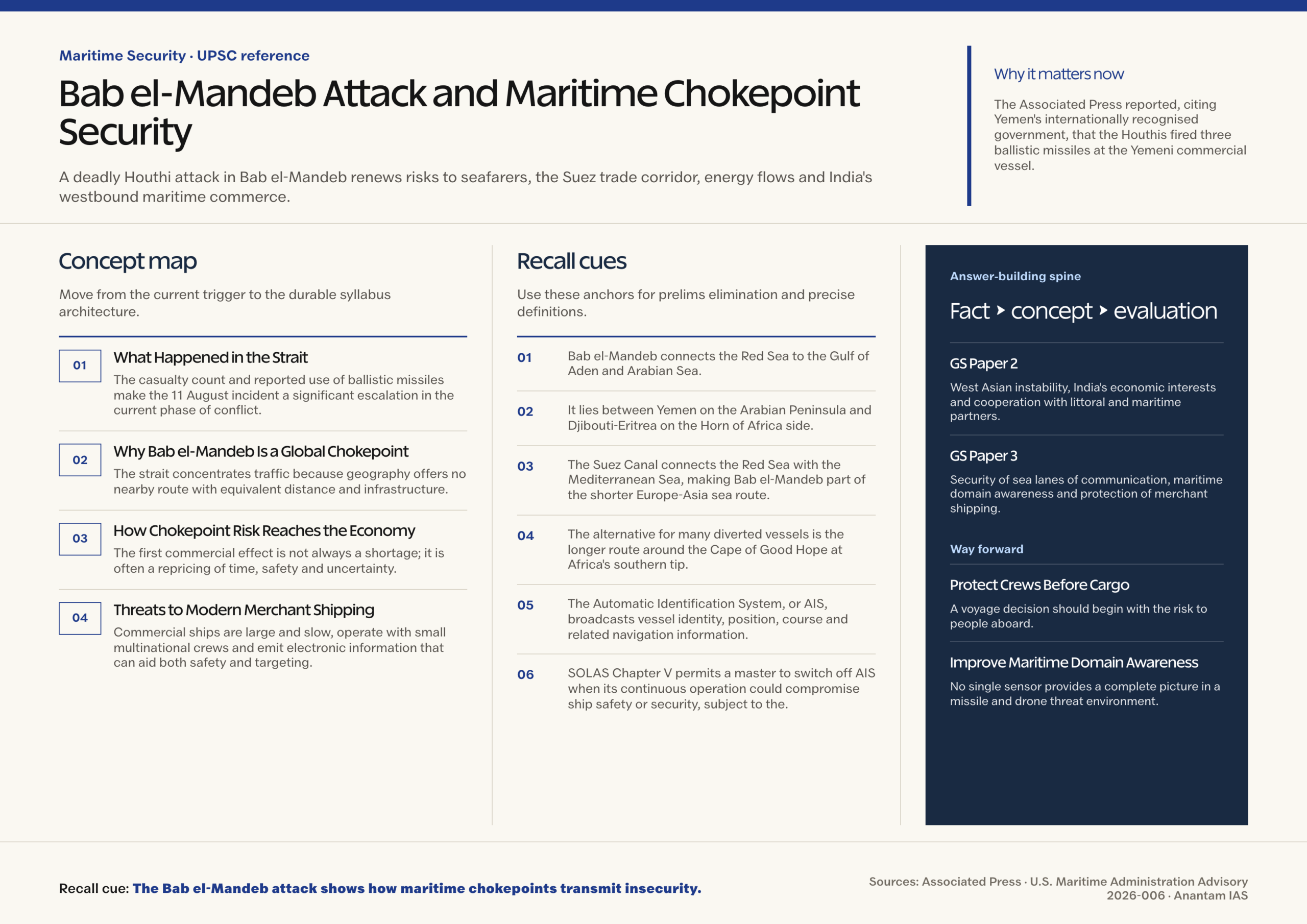
Bab el-Mandeb Attack and Maritime Chokepoint Security
Why in News?
Yemeni authorities said Houthi forces attacked a commercial vessel in the Bab el-Mandeb Strait on 11 August 2026, killing six people in the first known deaths from attacks on shipping off Yemen during the latest round of fighting.
- The Associated Press reported, citing Yemen’s internationally recognised government, that the Houthis fired three ballistic missiles at the Yemeni commercial vessel.
- Yemen’s coast guard said the six dead comprised four crew members and two members of the government-allied National Resistance Forces.
- A subsequent official statement identified three of the dead crew as Pakistani nationals and one as Indonesian; Pakistan also reported that another Pakistani was wounded.
- The incident occurred amid broader fighting involving the Houthis, Yemen’s internationally recognised government and Saudi-linked interests. Claims about the vessel’s cargo or military purpose should not be treated as verified unless independently established.
- The active U.S. Maritime Administration advisory identifies missiles, one-way unmanned aerial vehicles, uncrewed surface and underwater vehicles, small boats, illegal boarding and seizure as possible threats in the Red Sea-Gulf of Aden operating area.
- Bab el-Mandeb is a narrow maritime chokepoint connecting the Red Sea with the Gulf of Aden and Arabian Sea; ships using the Suez route between Asia and Europe generally pass through it.
- An attack can impose costs far beyond the damaged vessel through higher war-risk premiums, rerouting, delayed cargo, additional fuel use and pressure on seafarers.
- For India, the risk concerns westbound trade, energy and fertiliser logistics, shipping services, Indian seafarers and the stability of the wider Indian Ocean neighbourhood.
UPSC Relevance
Prelims Relevance
- Bab el-Mandeb connects the Red Sea to the Gulf of Aden and Arabian Sea.
- It lies between Yemen on the Arabian Peninsula and Djibouti-Eritrea on the Horn of Africa side.
- The Suez Canal connects the Red Sea with the Mediterranean Sea, making Bab el-Mandeb part of the shorter Europe-Asia sea route.
- The alternative for many diverted vessels is the longer route around the Cape of Good Hope at Africa’s southern tip.
- The Automatic Identification System, or AIS, broadcasts vessel identity, position, course and related navigation information.
- SOLAS Chapter V permits a master to switch off AIS when its continuous operation could compromise ship safety or security, subject to the master’s responsibility for safe navigation and applicable requirements.
Mains Relevance
GS Paper 2
- West Asian instability, India’s economic interests and cooperation with littoral and maritime partners.
- Freedom of navigation, international maritime law and protection of civilian seafarers.
GS Paper 3
- Security of sea lanes of communication, maritime domain awareness and protection of merchant shipping.
- Economic effects of chokepoint disruption through freight, insurance, fuel, inventories and delivery time.
Essay
- A narrow strait can transmit a local conflict into a global economic shock.
Background and Context
What Happened in the Strait
The casualty count and reported use of ballistic missiles make the 11 August incident a significant escalation in the current phase of conflict.
- According to the Associated Press, Yemen’s Transportation Ministry said Houthi forces fired three ballistic missiles at a Yemeni commercial vessel in Bab el-Mandeb.
- Yemen’s coast guard reported six deaths: four crew members and two personnel of the government-allied National Resistance Forces. Later reporting identified three Pakistani and one Indonesian crew member among those killed.
- The incident was described as the first known fatal attack on shipping off Yemen in the latest bout of fighting. This description is limited to the current phase, not the entire Red Sea campaign since 2023.
- The Houthis are an armed movement controlling much of north-western Yemen, including the capital Sana’a. They have used maritime attacks to pressure regional and external adversaries during interconnected conflicts.
Why Bab el-Mandeb Is a Global Chokepoint
The strait concentrates traffic because geography offers no nearby route with equivalent distance and infrastructure.
- Bab el-Mandeb sits between Yemen and the Horn of Africa, linking the Red Sea to the Gulf of Aden and the wider Arabian Sea.
- Northbound ships can continue through the Red Sea and Suez Canal into the Mediterranean. Southbound ships enter the Gulf of Aden before connecting with Indian Ocean routes.
- The U.S. Energy Information Administration estimated that about 4.2 million barrels per day of crude oil and petroleum products transited Bab el-Mandeb in the first half of 2025, roughly half the 2023 flow.
- A ship avoiding the Red Sea usually sails around the Cape of Good Hope. The EIA has estimated that an Arabian Sea-Europe journey by this route can take about 15 days longer than the Bab el-Mandeb-Suez.
How Chokepoint Risk Reaches the Economy
The first commercial effect is not always a shortage; it is often a repricing of time, safety and uncertainty.
- Insurers may raise war-risk premiums, impose tighter conditions or limit cover. Shipowners then decide whether the risk-adjusted cost of transit is lower than the cost of a longer voyage.
- Cape diversion increases distance, fuel consumption, charter time and pressure on available vessel capacity. The same fleet carries fewer annual voyages when each voyage takes longer.
- Longer lead times encourage firms to hold more inventory and working capital. Time-sensitive or low-margin cargo can face disproportionate disruption even when aggregate trade continues.
- Energy effects depend on which cargoes are rerouted, available pipelines and spare shipping capacity. A chokepoint incident can raise price volatility without physically stopping all oil flows.
Threats to Modern Merchant Shipping
Commercial ships are large and slow, operate with small multinational crews and emit electronic information that can aid both safety and targeting.
- MARAD Advisory 2026-006 lists ballistic and cruise missiles, one-way UAVs, uncrewed surface and underwater vehicles, small-arms fire, explosive boats, illegal boarding, detention and seizure among credible threats.
- AIS improves collision avoidance and maritime awareness by broadcasting vessel data. The same signal can reveal a target’s identity, position, course and speed to a hostile actor.
- SOLAS allows the master to turn AIS off when continued operation could compromise safety or security. This is a risk decision, not a general licence for invisible navigation; the master remains responsible for safe operation and.
- MARAD notes that hostile actors may also use small boats, UAVs and commercial electronic data to locate ships. Security requires control of unnecessary emissions, varied voyage planning, vigilant lookout and coordination with maritime information centres.
Way Forward
Protect Crews Before Cargo
- Require route-specific threat assessment, rehearsed citadel and fire response, medical preparation, redundant communication and clear authority for the master to delay or divert.
- Share verified warnings rapidly with multilingual crews and avoid commercial pressure that forces a transit beyond an accepted risk threshold.
- Fuse coastal radar, satellite data, naval reporting, vessel reports and validated open-source information through centres such as UKMTO and the Joint Maritime Information Center.
- Give masters current guidance on AIS, electronic emissions, route variation, speed, lookout and incident reporting without compromising collision safety.
Conclusion
- The Bab el-Mandeb attack shows how maritime chokepoints transmit insecurity .
- India’s best response combines crew-first risk management, maritime domain awareness, resilient trade planning and regional diplomacy.
UPSC Practice Questions
Prelims MCQ 1
With reference to the Bab el-Mandeb Strait, consider the following statements:
- It connects the Red Sea with the Gulf of Aden.
- It lies between Yemen and the Horn of Africa.
- Ships diverted from it can use the Cape of Good Hope route to travel between the Indian Ocean and Europe.
How many of the above statements are correct?
(a) Only one (b) Only two (c) All three (d) None
Answer: (c) All three
Explanation:
Bab el-Mandeb is the southern entrance to the Red Sea between Yemen and the Djibouti-Eritrea side of the Horn of Africa. Cape of Good Hope diversion avoids both Bab el-Mandeb and the Suez Canal.
Prelims MCQ 2
Under SOLAS guidance, when may a ship’s master switch off the Automatic Identification System?
(a) Whenever a ship enters any territorial sea (b) When continuous AIS operation could compromise the ship’s safety or security (c) Only after receiving permission from a coastal navy (d) Only when the vessel is carrying military cargo
Answer: (b) When continuous AIS operation could compromise the ship's safety or security
Explanation:
SOLAS Chapter V permits the master to switch AIS off when its continuous operation could compromise safety or security or when security incidents are imminent. The master remains responsible for safe navigation and applicable reporting requirements.
UPSC Mains Questions
- How does insecurity at Bab el-Mandeb convert a regional conflict into a global trade and energy-security challenge? Explain the transmission channels.
- Examine the role and limits of maritime domain awareness in protecting commercial shipping from missiles, drones and illegal boarding in the Red Sea-Gulf of Aden region.
Sources: Associated Press and U.S. Maritime Administration Advisory 2026-006.
Frequently Asked Questions
What happened in Bab el-Mandeb on 11 August 2026?
Yemeni authorities said Houthi forces fired three ballistic missiles at a Yemeni commercial vessel. Six people were reported killed: four crew members and two members of government-allied forces. The incident produced the first known shipping deaths off Yemen in the.
Why is Bab el-Mandeb strategically important?
The strait connects the Red Sea with the Gulf of Aden and Arabian Sea. Ships using the Suez route between Asia and Europe normally pass through it. Disruption can force longer Cape of Good Hope voyages, raising fuel use, shipping.
Where is Bab el-Mandeb located?
Bab el-Mandeb lies between Yemen on the Arabian Peninsula and Djibouti-Eritrea on the Horn of Africa side. It forms the southern gateway of the Red Sea. Northbound traffic can continue toward the Suez Canal, while southbound traffic enters the Gulf.
Why can AIS create both safety and security benefits?
AIS improves vessel identification, collision avoidance and maritime awareness by broadcasting position and movement data. In a hostile area, the same signal may help an attacker track a ship. SOLAS permits the master to switch it off when continuous operation.
Are Houthi attacks on ships automatically piracy?
No. Piracy has specific legal elements under UNCLOS, including location and private ends. An attack connected with an armed conflict or conducted by an organised armed group may fall under other international and domestic legal frameworks. The classification depends on.
Source: https://anantamias.com/current-affairs/bab-el-mandeb-houthi-attack-maritime-security/
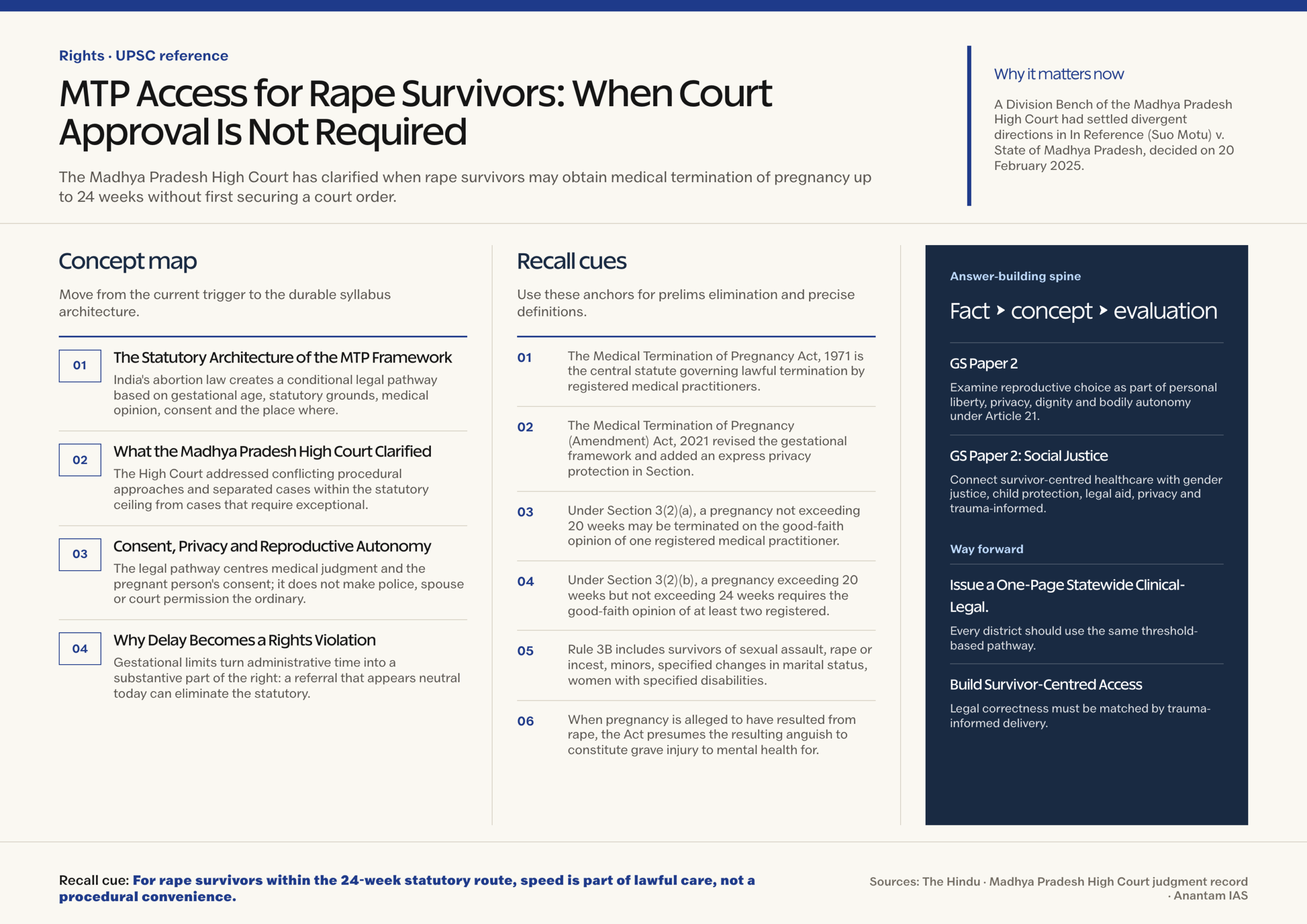
MTP Access for Rape Survivors: When Court Approval Is Not Required
Why in News?
The Hindu reported the Madhya Pradesh High Court’s clarification that a survivor of sexual assault, rape or incest does not need a High Court order to obtain a lawful medical termination of pregnancy when the gestation is within 24 weeks.
- A Division Bench of the Madhya Pradesh High Court had settled divergent directions in In Reference (Suo Motu) v. State of Madhya Pradesh, decided on 20 February 2025.
- The Bench held that up to 20 weeks, one registered medical practitioner may form the required good-faith opinion; from over 20 weeks to 24 weeks, two registered medical practitioners are required for women covered by the.
- Rule 3B of the Medical Termination of Pregnancy Rules includes survivors of sexual assault, rape or incest among those eligible for the 20-to-24-week window.
- In July 2026, the High Court again questioned why officials were seeking judicial permission in a case involving a minor survivor whose pregnancy was below 24 weeks, and asked State health authorities to prevent repeated, unnecessary.
- The legal point is not that every requested termination is automatic. The required practitioner opinion, consent, approved facility and other safeguards under the Act and Rules still apply.
- Abortion access in India is structured through a medical-opinion model, not an unrestricted request model. Courts should not be converted into a routine approval layer that Parliament did not prescribe.
- For a survivor, delay can deepen trauma, raise medical complexity and push the pregnancy beyond a statutory threshold. Administrative hesitation can operate like a denial even without a written refusal.
- The subject joins constitutional values under Articles 14 and 21 with public-health capacity, survivor-centred criminal justice and the practical accountability of hospitals, police and district authorities.
UPSC Relevance
Prelims Relevance
- The Medical Termination of Pregnancy Act, 1971 is the central statute governing lawful termination by registered medical practitioners.
- The Medical Termination of Pregnancy (Amendment) Act, 2021 revised the gestational framework and added an express privacy protection in Section 5A.
- Under Section 3(2)(a), a pregnancy not exceeding 20 weeks may be terminated on the good-faith opinion of one registered medical practitioner when a statutory ground is satisfied.
- Under Section 3(2)(b), a pregnancy exceeding 20 weeks but not exceeding 24 weeks requires the good-faith opinion of at least two registered medical practitioners and applies to categories prescribed by rules.
- Rule 3B includes survivors of sexual assault, rape or incest, minors, specified changes in marital status, women with specified disabilities, specified foetal malformations and women in declared humanitarian or emergency settings.
- When pregnancy is alleged to have resulted from rape, the Act presumes the resulting anguish to constitute grave injury to mental health for the relevant statutory assessment.
Mains Relevance
GS Paper 2
- Examine reproductive choice as part of personal liberty, privacy, dignity and bodily autonomy under Article 21.
- Assess how a needless judicial-permission practice creates a gap between statutory rights and access to public services.
GS Paper 2: Social Justice
- Connect survivor-centred healthcare with gender justice, child protection, legal aid, privacy and trauma-informed administration.
- Evaluate barriers such as delayed detection, provider shortages, unclear referral chains, fear of liability and weak awareness of the amended law.
Essay
- A right measured in weeks can be defeated by a system that measures action in files and referrals.
Background and Context
The Statutory Architecture of the MTP Framework
India’s abortion law creates a conditional legal pathway based on gestational age, statutory grounds, medical opinion, consent and the place where the procedure is performed.
- Section 3 protects a registered medical practitioner from criminal liability when a termination is performed in accordance with the Act. It is an enabling and protective provision, but only within its stated conditions.
- Up to 20 weeks, one practitioner must form a good-faith opinion that continuation risks the woman’s life, causes grave injury to physical or mental health, or that the child, if born, would face a substantial risk.
- From over 20 weeks through 24 weeks, the same core grounds apply, but at least two practitioners must form the opinion and the woman must fall within a category prescribed by Rule 3B.
- The rape-related presumption matters because the statute directs the medical assessment to treat anguish from a pregnancy alleged to have been caused by rape as grave injury to mental health. The survivor is not required to.
- Section 4 also limits where termination may be performed, including government hospitals and places approved for the purpose. The absence of a court-order requirement does not remove clinical safety or facility requirements.
What the Madhya Pradesh High Court Clarified
The High Court addressed conflicting procedural approaches and separated cases within the statutory ceiling from cases that require exceptional judicial consideration.
- In its 20 February 2025 suo motu decision, the Division Bench said survivors of sexual assault, rape or incest may obtain termination up to 20 weeks through one registered medical practitioner and from over 20 weeks.
- The Bench expressly said such within-limit cases do not require recourse to the High Court under Article 226. This prevents an extra approval barrier from being added by administrative practice.
- The Court framed standard operating procedures for cases up to 24 weeks and for cases exceeding 24 weeks. For the first category, the medical officer or board was expected to examine the survivor expeditiously and, where.
- For pregnancies beyond 24 weeks arising from sexual assault, the Court contemplated a medical report followed by reference to the High Court. Such cases sit outside the ordinary Rule 3B route unless another statutory exception, such.
- The Court also directed post-operative care and preservation of foetal material for DNA examination where relevant to the criminal case. This shows that healthcare access and evidence preservation can proceed together rather than one being used.
Consent, Privacy and Reproductive Autonomy
The legal pathway centres medical judgment and the pregnant person’s consent; it does not make police, spouse or court permission the ordinary source of authority.
- For an adult with decision-making capacity, her own consent is required. The law does not prescribe spousal consent as a condition for termination.
- For a person below 18 years, the guardian-consent rule applies. Child survivors also require a coordinated response under the POCSO framework, but emergency medical care should not be held back for want of legal or magisterial.
- Section 5A provides a specific confidentiality safeguard by prohibiting a registered medical practitioner from revealing identifying particulars except to a person authorised by law. Breach can attract imprisonment up to one year, a fine, or both.
- In X v. Principal Secretary, Health and Family Welfare Department (2022), the Supreme Court read the MTP framework in a purposive, rights-based way, rejected an artificial married-unmarried distinction for access under Rule 3B and linked reproductive.
- Privacy is operational, not symbolic. Hospitals need restricted records, discreet counselling, protected communication and clear rules on who may receive information. A survivor should not be made to repeat intimate facts across avoidable desks and hearings.
Why Delay Becomes a Rights Violation
Gestational limits turn administrative time into a substantive part of the right: a referral that appears neutral today can eliminate the statutory option days later.
- Sexual-assault survivors may discover pregnancy late because of trauma, fear, isolation, young age, irregular cycles or lack of access to confidential care. The system must respond to that vulnerability rather than add sequential permissions.
- Unclear responsibility encourages risk-shifting: police refer to district courts, courts seek medical reports, hospitals wait for orders and the survivor bears the delay. A written protocol should identify who examines, decides, records consent and arranges.
- Delay can increase clinical complexity, travel costs, exposure of identity and emotional distress. It can also move a case from the ordinary two-practitioner route into a legally and medically harder beyond-24-week category.
- A court order obtained after avoidable delay does not cure the institutional failure that caused the delay. Accountability should examine referral timestamps, reasons for refusal, availability of qualified staff and whether a higher facility was contacted.
- The correct administrative lesson is not to eliminate medical scrutiny. It is to make the scrutiny fast, competent and lawful, with escalation used only when the statute or the clinical situation calls for it.
Way Forward
Issue a One-Page Statewide Clinical-Legal Protocol
- State health departments should circulate the Section 3, Rule 3B, Section 5 and consent requirements in a simple flow that clearly states when court approval is not required.
- The protocol should name 24-hour nodal officers and referral hospitals, specify maximum response times and require reasons for any refusal or transfer.
- Provide private counselling, interpreters where needed, safe transport, post-procedure care, mental-health support and a single point of contact so the survivor does not repeatedly narrate the assault.
- Keep consent informed and voluntary. Explain the procedure, risks, alternatives and likely timelines in accessible language without moral judgment.
Conclusion
- The Madhya Pradesh High Court’s central message is administratively simple: where the MTP Act and Rules authorise qualified medical practitioners to decide, a hospital cannot invent a routine court-permission requirement.
- A balanced policy protects autonomy, safety and accountability together.
UPSC Practice Questions
Prelims MCQ 1
With reference to the Medical Termination of Pregnancy framework in India, consider the following statements:
- A pregnancy exceeding 20 weeks but not exceeding 24 weeks may require the opinion of at least two registered medical practitioners for prescribed categories of women.
- Rule 3B includes survivors of sexual assault, rape or incest among the categories eligible for termination up to 24 weeks.
- Every termination sought by a rape survivor within 24 weeks requires prior permission from the High Court.
How many of the above statements are correct?
(a) Only one (b) Only two (c) All three (d) None
Answer: (b) Only two
Explanation:
Statements 1 and 2 reflect Section 3(2)(b) and Rule 3B. Statement 3 is incorrect: when the statutory conditions are satisfied, prior High Court permission is not an additional requirement for the within-24-week route.
Prelims MCQ 2
Which provision of the Medical Termination of Pregnancy Act specifically protects the identity and particulars of a woman whose pregnancy has been terminated?
(a) Section 3(2B) (b) Section 4 (c) Section 5A (d) Section 8
Answer: (c) Section 5A
Explanation:
Section 5A restricts a registered medical practitioner from revealing the woman’s name and other particulars except to a person authorised by law, and provides a penalty for contravention.
UPSC Mains Questions
- Administrative delay can convert a legally available medical service into a denial of reproductive autonomy. Discuss with reference to the MTP framework and the Madhya Pradesh High Court’s directions.
- Explain the legal pathways for termination of pregnancy up to 20 weeks, from over 20 to 24 weeks, and beyond 24 weeks. Why must medical safeguards not be confused with a universal requirement of judicial permission?
Sources: The Hindu and Madhya Pradesh High Court judgment record.
Frequently Asked Questions
Do rape survivors need court permission for MTP up to 24 weeks?
No prior High Court order is ordinarily required when the pregnancy is within 24 weeks and the case satisfies the MTP Act and Rules. Up to 20 weeks, one registered medical practitioner forms the required opinion; from over 20 to.
Does the 24-week rule mean termination is automatic?
No. The appropriate registered medical practitioner or practitioners must form the statutory good-faith opinion, valid consent must be obtained, and the procedure must occur at a lawful facility. The court’s clarification removes an extra judicial-permission barrier; it does not remove.
Why are rape survivors covered under Rule 3B?
Rule 3B expressly lists survivors of sexual assault, rape or incest among the categories eligible for the over-20-to-24-week pathway. The Act also presumes that anguish caused by a pregnancy alleged to result from rape constitutes grave injury to the pregnant.
Whose consent is required for termination?
An adult pregnant woman’s consent is central, and spousal consent is not prescribed. When the pregnant person is below 18 years, or falls within the Act’s specified category concerning mental illness, written guardian consent is required. Counselling should inform the.
What happens when pregnancy exceeds 24 weeks?
The ordinary Rule 3B pathway no longer applies. The Act permits a Medical Board route for qualifying substantial foetal abnormalities and contains a separate life-saving exception. Constitutional courts have also considered exceptional petitions, including sexual-assault cases, using medical evidence and.
Source: https://anantamias.com/current-affairs/rape-survivors-mtp-without-court-approval/
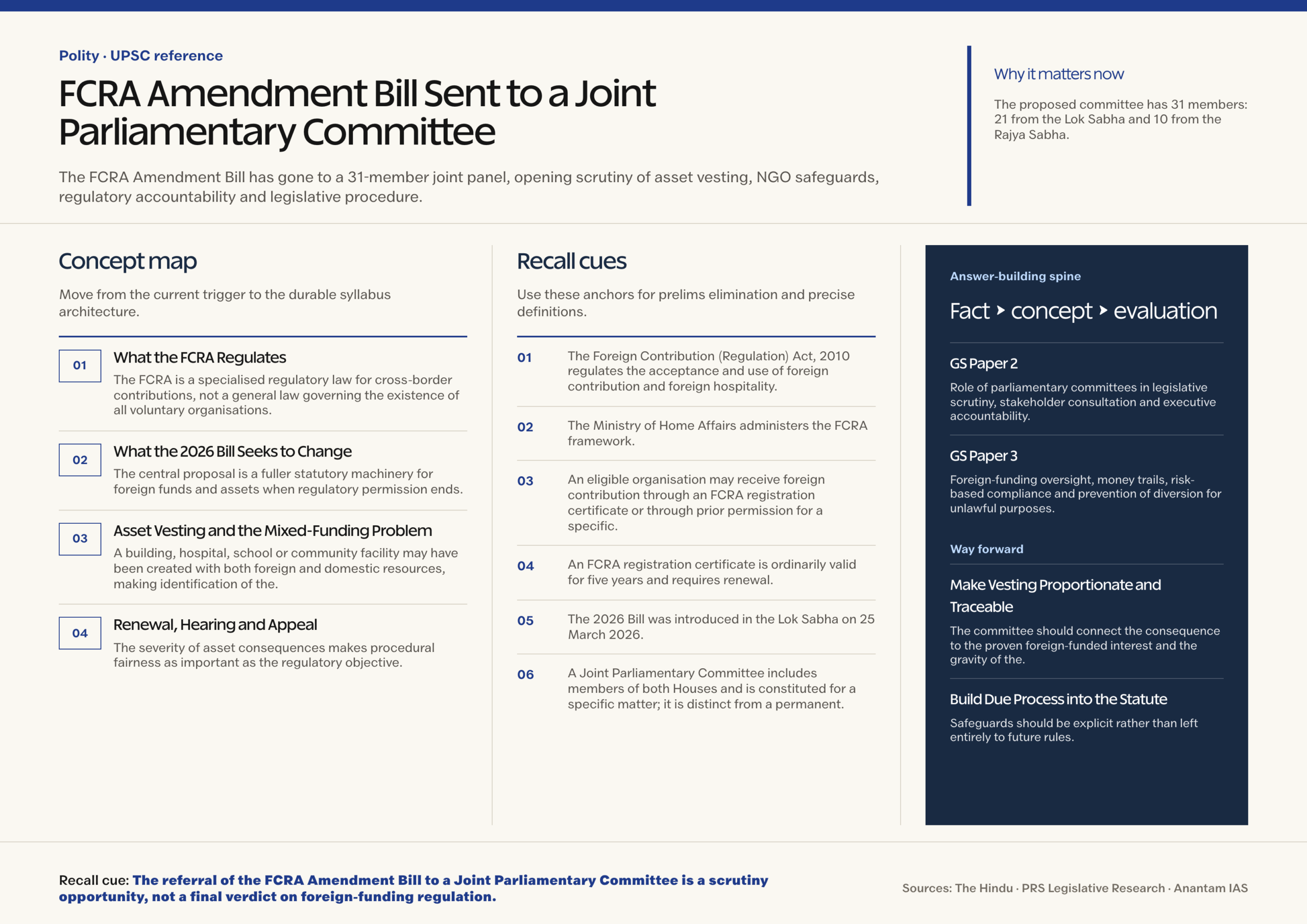
FCRA Amendment Bill Sent to a Joint Parliamentary Committee
Why in News?
On 12 August 2026 , the Lok Sabha adopted a motion referring the Foreign Contribution (Regulation) Amendment Bill, 2026 to a Joint Parliamentary Committee after sustained objections from Opposition parties and civil-society and minority organisations.
- The proposed committee has 31 members: 21 from the Lok Sabha and 10 from the Rajya Sabha.
- Lok Sabha members are to be nominated by the Speaker, while Rajya Sabha members are to be nominated by the Chairman of that House.
- The committee must report to the Lok Sabha by the last day of the first week of the 2026 Winter Session.
- The Bill was introduced in the Lok Sabha on 25 March 2026 but was not taken up for passage during the Budget Session.
- The referral followed demands for deeper scrutiny of the proposed Designated Authority, the treatment of assets partly financed by domestic funds, and remedies available when registration is not renewed.
- The policy challenge is to reconcile national-interest regulation of cross-border funds with the autonomy and continuity of lawful charities, educational bodies, hospitals, research organisations and faith-based welfare institutions.
- The constitutional question is not whether foreign contributions may be regulated; it is whether coercive consequences are backed by clear standards, notice, hearing, review and proportionate treatment.
- The parliamentary question is how committees improve legislation by collecting evidence, comparing competing claims and identifying drafting gaps that a floor debate may not resolve.
UPSC Relevance
Prelims Relevance
- The Foreign Contribution (Regulation) Act, 2010 regulates the acceptance and use of foreign contribution and foreign hospitality.
- The Ministry of Home Affairs administers the FCRA framework.
- An eligible organisation may receive foreign contribution through an FCRA registration certificate or through prior permission for a specific source and purpose.
- An FCRA registration certificate is ordinarily valid for five years and requires renewal.
- The 2026 Bill was introduced in the Lok Sabha on 25 March 2026.
- A Joint Parliamentary Committee includes members of both Houses and is constituted for a specific matter; it is distinct from a permanent Department-related Standing Committee.
Mains Relevance
GS Paper 2
- Role of parliamentary committees in legislative scrutiny, stakeholder consultation and executive accountability.
- Application of natural justice, reasoned decision-making and effective appeal to high-impact administrative action.
GS Paper 3
- Foreign-funding oversight, money trails, risk-based compliance and prevention of diversion for unlawful purposes.
- Design of custody, asset-management and disposal mechanisms for organisations that lose regulatory permission.
Essay
- Strong regulation earns legitimacy when state power is matched by clear rules, fair procedure and review.
Background and Context
What the FCRA Regulates
The FCRA is a specialised regulatory law for cross-border contributions, not a general law governing the existence of all voluntary organisations.
- It governs acceptance and use of a contribution from a foreign source, including covered articles, currency and foreign securities, so that such flows do not harm sovereignty, security, public order or other protected interests.
- The law prohibits specified categories, including candidates for election, judges, public servants, legislators and political parties, from accepting foreign contribution.
- Other eligible persons and associations generally require registration or prior permission and must comply with designated banking, accounting, utilisation and reporting rules.
- Regulation of the funding channel must be distinguished from regulation of an organisation’s lawful activities financed entirely from domestic resources.
What the 2026 Bill Seeks to Change
The central proposal is a fuller statutory machinery for foreign funds and assets when regulatory permission ends.
- A certificate may cease because it is cancelled or surrendered, because no renewal application is made, because renewal is denied, or because renewal is not obtained before expiry.
- The Bill proposes a Designated Authority in which covered foreign contribution and assets created wholly or partly from that contribution may provisionally vest.
- The Authority may supervise assets and activities during the provisional period. If registration is restored, renewed or freshly granted within the prescribed period, the unutilised contribution or assets are to be returned under the proposed scheme.
- If regulatory status is not restored within the prescribed period, vesting may become permanent. The Authority may use assets for public purposes, transfer them to public agencies, or dispose of them through a prescribed process.
- For a permanently vested asset that is wholly or partly a place of worship, the proposed authority must preserve its religious character and entrust management in the prescribed manner.
Asset Vesting and the Mixed-Funding Problem
A building, hospital, school or community facility may have been created with both foreign and domestic resources, making identification of the covered asset a central drafting issue.
- A sound law should distinguish the traceable foreign-funded share from the domestic-funded share where the two are distinct or reasonably ascertainable.
- Rules are needed for valuation, records, liabilities, depreciation, later domestic improvements and assets that provide an ongoing public service.
- Temporary custody should not silently become irreversible deprivation merely because an organisation encounters an administrative delay in renewal.
- The JPC can test whether the Bill’s return, transfer and disposal provisions adequately protect third parties such as employees, students, patients, beneficiaries, creditors and co-owners.
Renewal, Hearing and Appeal
The severity of asset consequences makes procedural fairness as important as the regulatory objective.
- The existing Act provides specified remedies in some situations, including cancellation, but PRS Legislative Research identified a gap regarding an effective appeal when renewal is denied and cessation triggers vesting.
- The committee should examine mandatory notice, disclosure of reasons, reasonable opportunity to respond, time-bound decisions and an independent appellate route before permanent vesting.
- An interim mechanism is needed so essential welfare services continue while a renewal or appeal remains pending.
- Judicial review under constitutional jurisdiction remains important, but accessible statutory review can correct error faster and reduce avoidable litigation.
Way Forward
Make Vesting Proportionate and Traceable
- Define methods to identify and value the foreign-funded component of a mixed asset, with audited records and an opportunity for the organisation to contest the calculation.
- Set a clear outer limit for provisional control and require a reasoned order before permanent vesting, transfer or sale.
- Protect ongoing public services through temporary management plans that preserve access for students, patients and other beneficiaries.
Conclusion
- The referral of the FCRA Amendment Bill to a Joint Parliamentary Committee is a scrutiny opportunity , not a final verdict on foreign-funding regulation.
- A durable law should protect India from misuse of foreign funds while preserving lawful social work and public confidence.
UPSC Practice Questions
Prelims MCQ 1
With reference to the Foreign Contribution (Regulation) Amendment Bill, 2026, consider the following statements:
- It was introduced in the Lok Sabha.
- It proposes a Designated Authority for specified foreign contribution and assets when an FCRA certificate ceases.
- It proposes to increase the general maximum imprisonment for contravention from one year to five years.
How many of the above statements are correct?
(a) Only one (b) Only two (c) All three (d) None
Answer: (b) Only two
Explanation:
Statements 1 and 2 are correct. The Bill was introduced in the Lok Sabha on 25 March 2026 and proposes a Designated Authority. Statement 3 is reversed: the Bill proposes to reduce the maximum imprisonment from five years to one year.
Prelims MCQ 2
Which one of the following best describes the status of a recommendation made by a Joint Parliamentary Committee examining a Bill?
(a) It automatically becomes part of the Bill (b) It binds the President but not Parliament (c) It is advisory, and Parliament decides whether to accept it (d) It has the same force as a Supreme Court judgment
Answer: (c) It is advisory, and Parliament decides whether to accept it
Explanation:
A parliamentary committee examines the referred matter and submits recommendations. The House or Houses retain legislative authority over the Bill and may accept, modify or reject those recommendations.
UPSC Mains Questions
- Parliamentary committees are instruments of both legislative competence and democratic accommodation. Discuss with reference to the referral of the Foreign Contribution (Regulation) Amendment Bill, 2026 to a Joint Parliamentary Committee.
- How should India balance national-security oversight of foreign contributions with procedural fairness and the autonomy of lawful civil-society organisations? Suggest safeguards for asset vesting and disposal.
Sources: The Hindu and PRS Legislative Research.
Frequently Asked Questions
What happened to the FCRA Amendment Bill on 12 August 2026?
The Lok Sabha adopted a motion sending the Foreign Contribution (Regulation) Amendment Bill, 2026 to a 31-member Joint Parliamentary Committee. The committee is to examine the proposal and report by the last day of the first week of the 2026.
Does referral to a JPC mean the Bill has become law?
No. Referral is a stage of parliamentary scrutiny. The committee will examine the Bill and recommend changes, but its report is advisory. Parliament must still consider the legislation, pass an agreed text through the required process, and obtain presidential assent.
What is the main asset-related proposal in the Bill?
The Bill proposes a Designated Authority to receive, supervise, manage and, in specified circumstances, dispose of foreign contribution and assets created wholly or partly from it when an organisation’s FCRA certificate is cancelled, surrendered or deemed to have ceased.
Why are mixed-funded assets a difficult issue?
A school, hospital or building may combine foreign donations, domestic donations and later local investment. Fair administration requires a traceable method to identify the covered foreign-funded share, protect other ownership interests and avoid disrupting beneficiaries while valuation or renewal is.
What due-process safeguards should the JPC examine?
Key safeguards include prior notice, access to relevant material, a meaningful hearing, written reasons, a fixed period for provisional control, independent and time-bound appeal, and interim protection against an irreversible sale while a renewal or vesting dispute is under review.
Source: https://anantamias.com/current-affairs/fcra-amendment-bill-joint-parliamentary-committee/
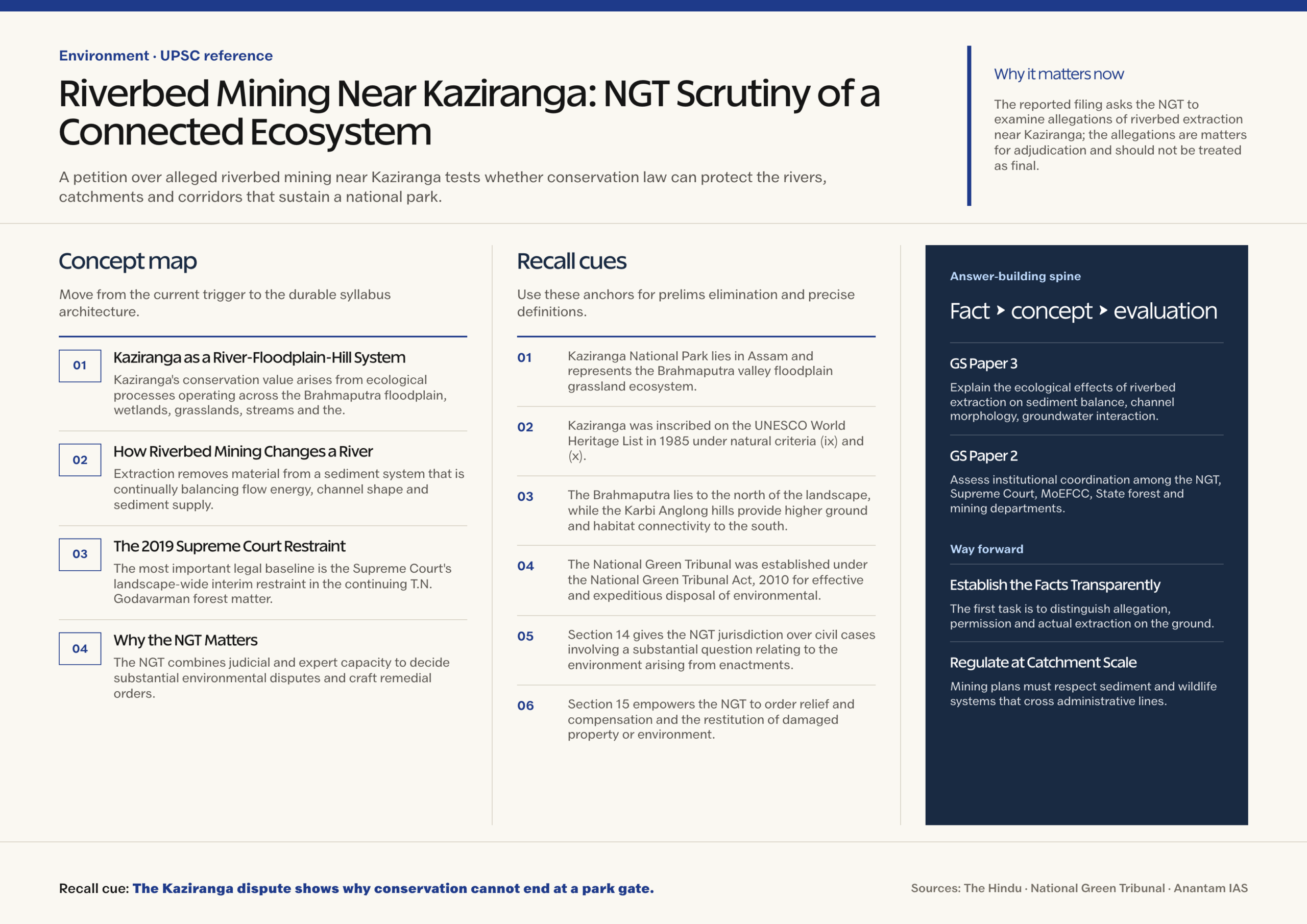
Riverbed Mining Near Kaziranga: NGT Scrutiny of a Connected Ecosystem
Why in News?
The National Green Tribunal has been petitioned over alleged illegal riverbed mining near the Kaziranga landscape in Assam, according to The Hindu.
- The reported filing asks the NGT to examine allegations of riverbed extraction near Kaziranga; the allegations are matters for adjudication and should not be treated as final findings at the petition stage.
- Kaziranga is a UNESCO World Heritage Site, a national park and part of a tiger-reserve landscape in Assam’s Brahmaputra floodplain.
- A Supreme Court order dated 12 April 2019 restrained mining and related activity along Kaziranga’s southern boundary and across the catchments of rivers, streams and rivulets originating in the Karbi Anglong hill ranges and flowing into.
- The same order directed that no new construction be permitted on private lands forming part of the nine identified animal corridors and called for enforcement against transport of illegally mined material.
- A Union government reply in 2025 recorded closure orders for 28 stone quarries and 18 stone crushers in the Dolamara area, along with closure of 10 permits or operational areas involving stone, sand and sand-cum-gravel extraction.
- A riverbed is not an inert stockpile. Its sediment controls channel form, bank stability, pools, bars, infiltration and habitat for aquatic and riparian species.
- Kaziranga functions as a seasonally dynamic floodplain. During floods, animals move toward higher ground in Karbi Anglong, making the southern landscape and its corridors integral to survival.
- Mining governance is divided across environmental clearance, mineral concessions, pollution control, wildlife protection, forest administration, district enforcement and transport monitoring. Gaps between agencies can turn a valid prohibition into weak ground-level compliance.
UPSC Relevance
Prelims Relevance
- Kaziranga National Park lies in Assam and represents the Brahmaputra valley floodplain grassland ecosystem.
- Kaziranga was inscribed on the UNESCO World Heritage List in 1985 under natural criteria (ix) and (x).
- The Brahmaputra lies to the north of the landscape, while the Karbi Anglong hills provide higher ground and habitat connectivity to the south.
- The National Green Tribunal was established under the National Green Tribunal Act, 2010 for effective and expeditious disposal of environmental cases.
- Section 14 gives the NGT jurisdiction over civil cases involving a substantial question relating to the environment arising from enactments listed in Schedule I.
- Section 15 empowers the NGT to order relief and compensation and the restitution of damaged property or environment.
Mains Relevance
GS Paper 3
- Explain the ecological effects of riverbed extraction on sediment balance, channel morphology, groundwater interaction, aquatic habitat and flood behaviour.
- Use Kaziranga to show why protected-area policy must shift from an isolated-core model to landscape-scale conservation.
GS Paper 2
- Assess institutional coordination among the NGT, Supreme Court, MoEFCC, State forest and mining departments, pollution-control boards, police and autonomous councils.
- Discuss tribunal-based environmental justice, compliance with judicial directions and accountability for administrative inaction.
Essay
- A protected boundary can stop a fence, but it cannot stop a river, a flood or a migrating animal.
Background and Context
Kaziranga as a River-Floodplain-Hill System
Kaziranga’s conservation value arises from ecological processes operating across the Brahmaputra floodplain, wetlands, grasslands, streams and the adjoining Karbi Anglong hills.
- The park’s floodplain is shaped by recurring erosion and deposition. Floods replenish wetlands and grasslands, redistribute sediment and maintain the shifting habitat mosaic on which many species depend.
- Floods also temporarily submerge low-lying habitat. Wildlife then moves south across roads and settled areas toward the higher Karbi Anglong terrain, making functional corridors a seasonal necessity rather than an optional buffer.
- Streams descending from the hills carry water, sediment and nutrients toward the floodplain. Mining in their beds or catchments can transmit effects downstream even when the extraction point lies outside the notified park boundary.
- The Assam government has notified nine animal corridors connecting Kaziranga and Karbi Anglong. Their ecological function depends on more than an unobstructed strip: noise, blasting, trucks, lighting, dust and altered watercourses can reduce safe use.
- The landscape supports species with large spatial needs, including elephants and tigers, alongside the greater one-horned rhinoceros, wild water buffalo, swamp deer and diverse aquatic and bird life.
How Riverbed Mining Changes a River
Extraction removes material from a sediment system that is continually balancing flow energy, channel shape and sediment supply.
- Removing sand, gravel or boulders faster than natural replenishment can deepen or widen the channel, trigger bed degradation and shift erosion toward banks or adjoining reaches.
- Changes in bed level can affect the relationship between surface water and shallow groundwater. Excessive incision may lower nearby water tables or disconnect side channels and wetlands during low-flow periods.
- Heavy machinery can compact banks, disturb nesting or spawning areas, create access tracks and raise turbidity. Night operations add noise and light in a landscape used by wildlife for movement.
- River bars, pools and riffles create varied habitats. Flattening or repeatedly excavating these features simplifies the channel and can reduce refuge, feeding and breeding areas for fish, invertebrates and riverine birds.
- Poorly located stockpiles and approach roads can obstruct flood paths. Mining pits and altered cross-sections may redirect currents during high flows, increasing local erosion or exposing nearby settlements and infrastructure to changed risk.
The 2019 Supreme Court Restraint
The most important legal baseline is the Supreme Court’s landscape-wide interim restraint in the continuing T.N. Godavarman forest matter.
- On 12 April 2019, after considering a Central Empowered Committee report on illegal mining around Kaziranga, the Supreme Court ordered a halt to mining and related activities along the park’s southern boundary.
- The restraint extended to the entire catchment of rivers, streams and rivulets originating in the Karbi Anglong hill ranges and flowing into Kaziranga National Park. This wording tracks hydrological connection, not only distance from a boundary.
- The Court also ordered that no new construction be permitted on private lands forming part of the nine identified animal corridors. It called on the Assam police leadership to prevent mining in the relevant catchments and.
- The order illustrates the precautionary approach: where the conservation stakes are high and ecological pathways are connected, regulation may act before damage becomes irreversible or fully quantified.
- Later government statements reported closure of quarries, crushers and mining permits in areas near the southern landscape. Such administrative action is evidence of compliance steps, but continuing allegations make independent verification essential.
Why the NGT Matters
The NGT combines judicial and expert capacity to decide substantial environmental disputes and craft remedial orders.
- Under Section 14 of the NGT Act, the Tribunal can settle civil disputes involving a substantial environmental question arising under the enactments listed in Schedule I. Section 15 allows relief, compensation and environmental restitution.
- Section 20 directs the Tribunal to apply sustainable development, the precautionary principle and the polluter-pays principle. These principles guide both interim protection and final remedies.
- In a mining dispute, the Tribunal may examine environmental clearance, consent conditions, lease boundaries, transport records, satellite evidence, district survey reports, replenishment studies and compliance with court directions.
- A petition is not proof. Fair adjudication requires notice to the respondents, verified records and expert assessment. Reporting should separate the applicant’s allegations from findings made by a committee or the Tribunal.
- The strongest fact-finding design is a multi-agency joint inspection with geo-referenced sampling, pre- and post-monsoon imagery, extraction-volume estimates, channel cross-sections and a transparent chain of custody for records.
Way Forward
Establish the Facts Transparently
- Conduct a time-bound joint inspection using satellite imagery, drone surveys where lawful, geo-tagged photographs, channel cross-sections, lease coordinates and transport records.
- Publish a site-wise table showing legal status, environmental clearance, permitted quantity, extraction recorded, catchment linkage, corridor overlap and action taken.
- Prepare independent replenishment and cumulative-impact studies for connected river reaches before permitting any extraction outside the judicially restrained area.
- Create a no-go layer combining the Supreme Court restraint, notified corridors, protected-area boundaries, sensitive catchments and critical aquatic habitats.
Conclusion
- The Kaziranga dispute shows why conservation cannot end at a park gate.
- The sound governance test is evidence-led and precautionary: verify the allegations fairly, enforce the Supreme Court’s catchment-based restraint, assess cumulative impacts, restore proven damage and keep lawful mineral supply away from irreplaceable corridors and river systems.
UPSC Practice Questions
Prelims MCQ 1
With reference to Kaziranga National Park and its surrounding landscape, consider the following statements:
- Kaziranga is part of the Brahmaputra floodplain ecosystem in Assam.
- The Karbi Anglong hills provide higher-ground connectivity used by wildlife during floods.
- The National Green Tribunal is a constitutional body created directly by Article 323B.
How many of the above statements are correct?
(a) Only one (b) Only two (c) All three (d) None
Answer: (b) Only two
Explanation:
Statements 1 and 2 are correct. Statement 3 is incorrect because the NGT is a statutory tribunal established under the National Green Tribunal Act, 2010, not a constitutional body created directly by Article 323B.
Prelims MCQ 2
Which one of the following is expressly listed among the principles to be applied by the National Green Tribunal under Section 20 of the NGT Act?
(a) Pleasure doctrine (b) Colourable legislation (c) Polluter-pays principle (d) Doctrine of eclipse
Answer: (c) Polluter-pays principle
Explanation:
Section 20 directs the Tribunal to apply sustainable development, the precautionary principle and the polluter-pays principle while passing orders, decisions or awards.
UPSC Mains Questions
- Protected areas cannot be conserved as ecological islands. Examine this statement through the river, catchment and wildlife-corridor connections between Kaziranga and Karbi Anglong.
- Explain how excessive riverbed mining changes channel morphology, groundwater interaction and biodiversity. Suggest a monitoring system that can detect both illegal extraction and cumulative legal over-extraction.
Sources: The Hindu and National Green Tribunal.
Frequently Asked Questions
Why can mining outside Kaziranga affect the national park?
Kaziranga is connected to the Karbi Anglong hills by streams, catchments and wildlife corridors. Extraction outside the legal boundary can alter sediment and water flows, increase erosion or disturbance, and degrade routes animals use to reach higher ground during floods.
What did the Supreme Court order in April 2019?
The Court restrained mining and related activities along Kaziranga’s southern boundary and in the catchments of rivers, streams and rivulets originating in the Karbi Anglong hills and flowing into the park. It also restricted new construction on private lands forming.
What is the NGT’s role in a riverbed-mining dispute?
The NGT can decide substantial environmental disputes arising under scheduled environmental laws, examine expert and official evidence, and order relief, compensation or environmental restitution. It applies sustainable development, precaution and polluter pays. A filed petition contains allegations; findings follow notice.
How does riverbed mining alter channel morphology?
Extraction can create a sediment deficit, deepen the bed, shift currents and transfer erosion toward banks or downstream reaches. It may simplify pools, riffles and bars, disturb aquatic habitat and alter surface-water interaction with groundwater. The severity depends on volume.
What is a replenishment study?
A replenishment study estimates how much riverbed material is naturally restored by sediment transport over a defined reach and period. It helps set extraction limits that do not exceed renewal. A credible study uses field measurements, seasonal data and catchment.
Source: https://anantamias.com/current-affairs/kaziranga-riverbed-mining-ngt-ecological-risk/
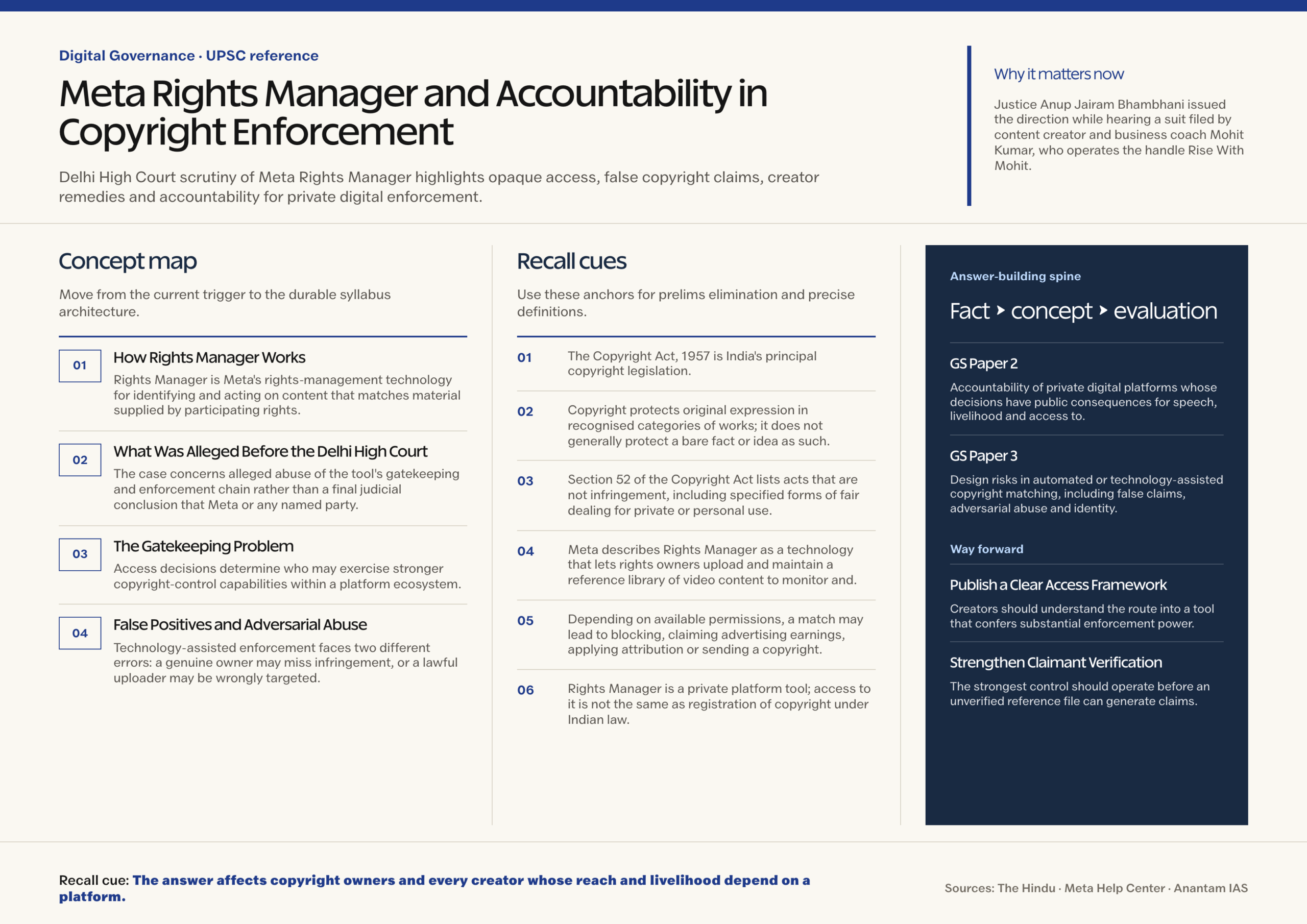
Meta Rights Manager and Accountability in Copyright Enforcement
Why in News?
On 12 August 2026 , the Delhi High Court asked Meta to place on record the policy, norms and eligibility criteria governing access to its Rights Manager tool, along with the grounds on which an application may be rejected.
- Justice Anup Jairam Bhambhani issued the direction while hearing a suit filed by content creator and business coach Mohit Kumar, who operates the handle Rise With Mohit.
- The plaintiff told the court that he had applied for Rights Manager access three times but received rejections without a specific reason.
- Meta informed the court that the disputed copyright strikes were reversed after technical verification and that the removed content was restored.
- Meta also stated that the plaintiff’s accounts had not been suspended and remained accessible.
- The court observed that alleged misuse of copyright-enforcement mechanisms appeared to recur in disputes involving content creators and warranted closer examination.
- A platform enforcement tool can affect expression, income, audience reach and reputation even though access to the tool and its operating rules are designed by a private company.
- The dispute exposes a double asymmetry: a claimant may receive powerful enforcement capabilities, while the person affected may not know why the claimant obtained access or how the claim was verified.
- Copyright systems must act quickly enough to limit genuine piracy but cautiously enough to avoid rewarding impersonation, mistaken matching or strategic complaints.
UPSC Relevance
Prelims Relevance
- The Copyright Act, 1957 is India’s principal copyright legislation.
- Copyright protects original expression in recognised categories of works; it does not generally protect a bare fact or idea as such.
- Section 52 of the Copyright Act lists acts that are not infringement, including specified forms of fair dealing for private or personal use including research, criticism or review, and reporting current events and current affairs.
- Meta describes Rights Manager as a technology that lets rights owners upload and maintain a reference library of video content to monitor and protect.
- Depending on available permissions, a match may lead to blocking, claiming advertising earnings, applying attribution or sending a copyright report.
- Rights Manager is a private platform tool; access to it is not the same as registration of copyright under Indian law.
Mains Relevance
GS Paper 2
- Accountability of private digital platforms whose decisions have public consequences for speech, livelihood and access to markets.
- Application of natural-justice principles such as notice, reasons, opportunity to contest and impartial review in platform governance.
GS Paper 3
- Design risks in automated or technology-assisted copyright matching, including false claims, adversarial abuse and identity verification failure.
- Digital creator economy, intellectual-property enforcement, platform concentration and the economic cost of wrongful content removal.
Essay
- When private code performs a regulatory function, procedural fairness becomes part of digital citizenship.
Background and Context
How Rights Manager Works
Rights Manager is Meta’s rights-management technology for identifying and acting on content that matches material supplied by participating rights owners.
- An approved rights owner can upload and maintain a reference library containing video material, including live streams, that the owner wants to monitor and protect.
- Meta’s Help Center says available responses to a match may include blocking the matched video, claiming advertising earnings, applying attribution or submitting a copyright report that may lead to removal.
- A match is an enforcement signal, not by itself a judicial determination of authorship, ownership, licence scope or infringement.
- System accuracy depends on trustworthy onboarding, reliable reference files, territorial and licence information, careful matching and a usable dispute process.
What Was Alleged Before the Delhi High Court
The case concerns alleged abuse of the tool’s gatekeeping and enforcement chain rather than a final judicial conclusion that Meta or any named party committed wrongdoing.
- The plaintiff alleged that scammers copied his original videos and uploaded them into Rights Manager while falsely presenting themselves as rights holders.
- According to the plaintiff, those registrations were then relied upon to issue copyright strikes against his accounts and remove content.
- He also alleged that repeated applications for his own access to Rights Manager were rejected without specific reasons, despite other creators with smaller audiences receiving access.
- Meta told the court that technical verification led to reversal of the strikes and restoration of the removed content. These statements and allegations remain subject to the proceeding.
The Gatekeeping Problem
Access decisions determine who may exercise stronger copyright-control capabilities within a platform ecosystem.
- If eligibility criteria are unclear, applicants cannot understand what evidence of ownership, catalogue size, infringement risk or organisational capacity is required.
- An unexplained rejection limits correction: the applicant does not know whether the issue concerns identity, documentation, account history, territorial rights or an internal risk score.
- Opaque access can produce unequal enforcement capacity between similarly situated creators and between established rights organisations and independent creators.
- Publishing criteria does not require disclosure of security-sensitive thresholds. A platform can explain categories of evidence, rejection grounds and review paths while protecting anti-abuse controls.
False Positives and Adversarial Abuse
Technology-assisted enforcement faces two different errors: a genuine owner may miss infringement, or a lawful uploader may be wrongly targeted.
- A false positive may occur when lawful content is treated as infringing because of a mistaken match, incomplete licence data or failure to recognise an exception.
- Adversarial abuse is different: a bad actor may impersonate an owner, submit copied material as a reference file or make coordinated claims to suppress a rival.
- High-impact actions should use layered checks, including identity verification, proof of rights, reference-file provenance, account history and human review when ownership is disputed.
- Repeat false claimants require sanctions, but safeguards should distinguish deliberate abuse from an honest mistake in a complicated licensing chain.
Way Forward
Publish a Clear Access Framework
- State the categories of eligible applicants, evidence of rights required, main rejection grounds and process for reconsideration.
- Give each rejected applicant a reason code and a practical explanation of what can be corrected or supplied.
- Review access periodically so that small and independent creators are assessed by ownership and abuse risk rather than audience size alone.
Conclusion
- The Delhi High Court proceeding puts a narrow operational question into a wider governance frame: who receives private enforcement power, on what criteria, and with what safeguards against misuse ?
- Effective digital enforcement needs speed, but speed should rest on verified claimants, explainable decisions, accessible counter-notice, human review and repair of wrongful consequences.
UPSC Practice Questions
Prelims MCQ 1
With reference to copyright and digital platforms in India, consider the following statements:
- Section 52 of the Copyright Act, 1957 recognises specified acts that do not constitute copyright infringement.
- Meta Rights Manager access is equivalent to statutory copyright registration in India.
- Section 79 of the Information Technology Act, 2000 provides conditional safe-harbour protection to intermediaries.
How many of the above statements are correct?
(a) Only one (b) Only two (c) All three (d) None
Answer: (b) Only two
Explanation:
Statements 1 and 3 are correct. Section 52 contains specified copyright exceptions, and Section 79 provides conditional intermediary protection. Statement 2 is incorrect because Rights Manager is a private platform tool, not statutory copyright registration.
Prelims MCQ 2
Which one of the following is the most appropriate first-line safeguard against a bad actor uploading another creator’s work as a rights-management reference file?
(a) Removing all copyright tools from social media (b) Claimant identity, authority and reference-file provenance checks (c) Treating every content match as conclusive proof of infringement (d) Allowing only government departments to claim copyright
Answer: (b) Claimant identity, authority and reference-file provenance checks
Explanation:
Verification of the claimant’s identity and authority, together with provenance checks for the reference file, addresses the alleged abuse before it can generate enforcement actions. Matching alone cannot conclusively decide ownership or infringement.
UPSC Mains Questions
- Private digital platforms increasingly exercise quasi-regulatory power over speech and livelihood. Discuss the procedural safeguards needed in technology-assisted copyright enforcement.
- How can India protect copyright owners without allowing automated or private enforcement systems to become tools of impersonation and strategic suppression?
Sources: The Hindu and Meta Help Center.
Frequently Asked Questions
What did the Delhi High Court ask Meta to disclose?
The court asked Meta to place on record its policy, norms and eligibility criteria for granting access to Rights Manager, as well as the grounds on which applications may be rejected. This was an information-seeking direction during an ongoing suit.
What is Meta Rights Manager?
Rights Manager is Meta’s copyright-management technology. Approved rights owners can maintain a reference library of video content and monitor matches. Depending on permissions, possible actions include blocking a video, claiming advertising earnings, applying attribution or submitting a copyright report that.
What misuse was alleged in the case?
The plaintiff alleged that scammers copied his original videos, uploaded them into Rights Manager while posing as the owners, and then used those registrations to issue copyright strikes against his content. Meta said the disputed strikes were later reversed after.
Why are reasons for denying tool access important?
A reason lets an applicant know whether identity, rights documents, account history or another criterion was deficient. It supports correction and review, reduces arbitrary treatment and helps courts assess consistency without forcing the platform to reveal security-sensitive anti-abuse thresholds.
Does a content match prove copyright infringement?
No. A match can identify similarity, but legal infringement may depend on authorship, ownership, licence, territorial scope, substantiality, purpose and statutory exceptions. The affected user needs a route to present evidence and obtain human review before severe or lasting penalties.
Source: https://anantamias.com/current-affairs/meta-rights-manager-platform-accountability/
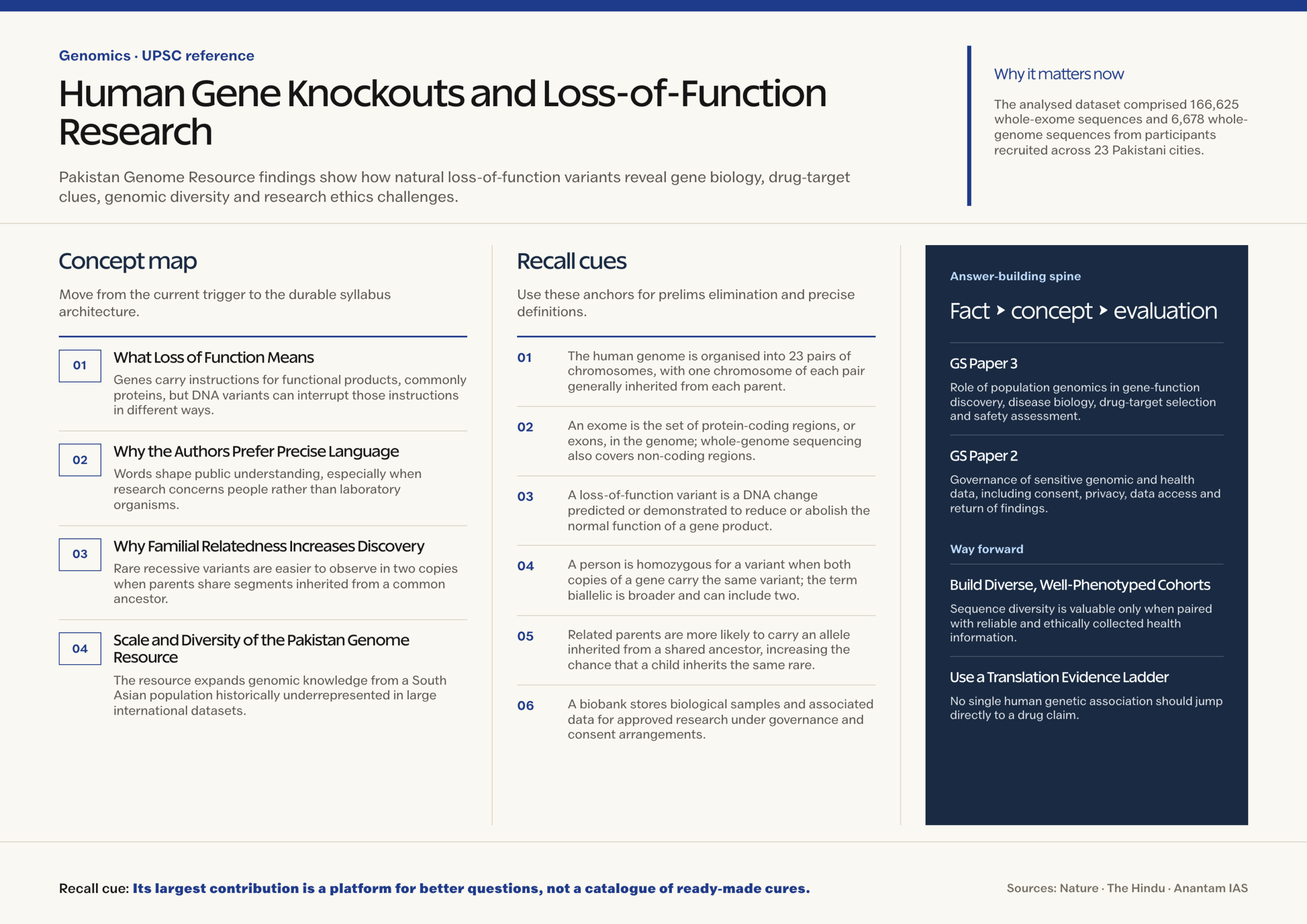
Human Gene Knockouts and Loss-of-Function Research
Why in News?
A large open-access study published in Nature on 17 June 2026 analysed exomes and whole genomes from 173,303 participants in the Pakistan Genome Resource to study naturally occurring homozygous loss-of-function variants.
- The analysed dataset comprised 166,625 whole-exome sequences and 6,678 whole-genome sequences from participants recruited across 23 Pakistani cities.
- At least one homozygous loss-of-function gene was identified in 34,364 participants, about 20% of the sequenced cohort.
- For 3,323 of the 6,476 genes, such carriers were unique to the Pakistan resource when compared with 761,616 non-South-Asian individuals in the gnomAD reference used by the researchers.
- The study linked genomic data with medical histories, clinical measures and disease status, and supported recall-by-genotype studies in which consenting participants and relatives could undergo focused follow-up.
- The researchers use the precise term homozygous loss-of-function carriers; “human knockout” is convenient shorthand but can wrongly suggest deliberate gene deletion.
- A naturally occurring loss-of-function variant can act like a long-term biological experiment, showing what may happen when a gene’s normal product is greatly reduced or absent.
- Human evidence can complement cell and animal models, but lifelong genetic loss differs from partial, temporary or adult-onset inhibition by a drug.
- The study demonstrates why ancestry-diverse genomics matters: variants rare or missing in global databases may be informative in populations that have been underrepresented in sequencing research.
UPSC Relevance
Prelims Relevance
- The human genome is organised into 23 pairs of chromosomes, with one chromosome of each pair generally inherited from each parent.
- An exome is the set of protein-coding regions, or exons, in the genome; whole-genome sequencing also covers non-coding regions.
- A loss-of-function variant is a DNA change predicted or demonstrated to reduce or abolish the normal function of a gene product.
- A person is homozygous for a variant when both copies of a gene carry the same variant; the term biallelic is broader and can include two different variants affecting the two copies.
- Related parents are more likely to carry an allele inherited from a shared ancestor, increasing the chance that a child inherits the same rare recessive variant from both sides.
- A biobank stores biological samples and associated data for approved research under governance and consent arrangements.
Mains Relevance
GS Paper 3
- Role of population genomics in gene-function discovery, disease biology, drug-target selection and safety assessment.
- Scientific differences among whole-exome sequencing, whole-genome sequencing, association analysis and recall-by-genotype research.
GS Paper 2
- Governance of sensitive genomic and health data, including consent, privacy, data access and return of findings.
- Protection of communities from stigma, discrimination and extractive research practices.
Essay
- Human diversity is not noise around a scientific average; it is a source of knowledge that can improve both discovery and fairness.
Background and Context
What Loss of Function Means
Genes carry instructions for functional products, commonly proteins, but DNA variants can interrupt those instructions in different ways.
- A predicted loss-of-function variant may introduce a premature stop signal, disrupt a splice site or shift the reading frame, reducing the chance of producing a normal protein.
- Prediction is not certainty. Some apparently disruptive variants may be rescued by alternative splicing, another start site or their position near the end of a transcript.
- The Nature study applied quality-control and annotation filters to reduce false classification of predicted loss-of-function variants.
- When both gene copies carry a genuine disruptive variant and little or no functional product remains, researchers may informally describe the person as a natural human gene knockout.
Why the Authors Prefer Precise Language
Words shape public understanding, especially when research concerns people rather than laboratory organisms.
- In experimental biology, a knockout usually means a gene has been purposefully disabled in a cell or model organism.
- Participants in the Pakistan Genome Resource inherited naturally occurring variants; researchers did not engineer their genomes.
- The phrase “homozygous loss-of-function carrier” states the observed genotype without implying that every gene function is completely absent in every tissue.
- Person-first, non-stigmatising language also avoids reducing participants to biological anomalies or presenting a community as a research instrument.
Why Familial Relatedness Increases Discovery
Rare recessive variants are easier to observe in two copies when parents share segments inherited from a common ancestor.
- Most genes are represented by a maternal and a paternal copy. A single rare loss-of-function copy may be masked by the other functional copy.
- When parents are related, both may carry the same ancestral variant, raising the probability that a child inherits that variant on both copies.
- This population structure helps researchers identify rare homozygous genotypes, but it also increases the risk of some recessive genetic disorders.
- The scientific finding must not be presented as approval of consanguineous marriage or as a judgement about any culture. Public-health responses should emphasise voluntary counselling, informed choice and accessible care.
Scale and Diversity of the Pakistan Genome Resource
The resource expands genomic knowledge from a South Asian population historically underrepresented in large international datasets.
- The study analysed 173,303 participants from 23 cities, combining 166,625 exomes with 6,678 whole genomes.
- Researchers found homozygous loss-of-function variants across 6,476 genes; 2,397 of those genes had only one identified carrier in the resource.
- Nearly half of the variants catalogued by the project were not observed in the comparison databases available to the study, underscoring the incompleteness of existing references.
- The cohort is a nested case-control resource rather than a simple nationally representative survey, so its disease frequencies and knockout prevalence should not be generalised mechanically to Pakistan’s entire population.
Way Forward
Build Diverse, Well-Phenotyped Cohorts
- Expand recruitment across regions and underrepresented groups without treating any community as a convenient source of rare variants.
- Use harmonised clinical measurements and longitudinal follow-up so genotype-phenotype relationships can be replicated.
- Support recall-by-genotype only under explicit consent, with counselling and a clear plan for clinically important findings.
Conclusion
- The Pakistan Genome Resource shows how naturally occurring loss-of-function variation can reveal which human genes tolerate disruption, which pathways may be useful to investigate and where a proposed therapy may need extra safety scrutiny.
- The same research also sets a governance test.
UPSC Practice Questions
Prelims MCQ 1
With reference to human genomics, consider the following statements:
- The exome consists mainly of protein-coding regions of the genome.
- A homozygous loss-of-function genotype means both copies of a gene carry the same loss-of-function variant.
- A naturally occurring human gene knockout necessarily results from laboratory gene editing.
How many of the above statements are correct?
(a) Only one (b) Only two (c) All three (d) None
Answer: (b) Only two
Explanation:
Statements 1 and 2 are correct. Statement 3 is incorrect because the Pakistan Genome Resource studied naturally inherited loss-of-function variants, not laboratory editing of participants’ genomes.
Prelims MCQ 2
Which one of the following best explains why a naturally occurring loss-of-function variant is not automatic proof that a drug blocking the same protein will be safe?
(a) Human genes never produce proteins (b) Drugs cannot affect gene products (c) Lifelong genetic loss may allow compensation, while drug timing, dose and off-target effects differ (d) Whole-genome sequencing measures only environmental exposure
Answer: (c) Lifelong genetic loss may allow compensation, while drug timing, dose and off-target effects differ
Explanation:
Natural loss can prioritise or question a target, but therapeutic translation needs functional validation and clinical testing because genetic loss and pharmacological inhibition differ in timing, degree, tissue distribution and secondary effects.
UPSC Mains Questions
- How can naturally occurring loss-of-function variants improve drug-target discovery while also preventing costly therapeutic failures? Discuss the limits of translating such findings into medicine.
- Population diversity is both a scientific resource and an ethical responsibility in genomics. Examine with reference to consent, privacy, representation and benefit sharing.
Sources: Nature and The Hindu.
Frequently Asked Questions
What is a natural human gene knockout?
It is informal shorthand for a person who inherited disruptive variants affecting both copies of a gene, leaving little or no normal gene function. Researchers prefer terms such as homozygous loss-of-function carrier because “knockout” can wrongly imply that scientists deliberately.
What did the Pakistan Genome Resource study find?
The Nature study analysed 173,303 participants, including 166,625 exomes and 6,678 whole genomes. It found 34,364 participants with at least one homozygous loss-of-function gene and identified such carriers across 6,476 genes, about one-third of human protein-coding genes.
Why does familial relatedness help identify rare variants in two copies?
Related parents are more likely to share a rare allele inherited from a common ancestor. Their child has a higher chance of receiving that allele from both parents. This aids discovery of recessive gene effects but can also raise the.
Can a protective loss-of-function finding directly produce a medicine?
No. It can suggest a target and provide human evidence, but lifelong genetic loss differs from drug treatment in timing, dose, tissue exposure and off-target effects. Researchers still need molecular validation, replication, safety studies and controlled clinical trials before making.
What is recall-by-genotype?
It is a research design in which consenting participants are invited for focused follow-up because their genotype raises a specific question. Specialised measurements and, where separately consented, study of relatives can help connect the variant to a phenotype more directly.
Source: https://anantamias.com/current-affairs/human-gene-knockouts-loss-of-function-research/
Tathyakosh: Making Public Data Discoverable for Evidence-Based Governance
Why in News?
Karnataka has launched Tathyakosh , described as a public-good data discovery platform and an Indian data catalogue.
- Tathyakosh is a discovery and cataloguing layer. Dataset pages direct users to the originating portal; discovery should not be confused with ownership, legal authority or guaranteed hosting of the underlying data.
- Its live statistics endpoint on 13 August 2026 reported 461 data sources, 341,876 catalogued datasets, 1,550,877 source links and coverage across 17 domains. These platform totals are dynamic and can change as indexing continues.
- The same live readout reported 24% open-access coverage, 61% machine-readable coverage and an average platform quality score of 63.4. These are Tathyakosh’s current catalogue metrics, not official national performance indicators.
- Users can search or filter by domain, subdomain, geography, State, data format, access type, platform type, machine readability, API availability and quality score.
- The platform says its quality score uses six dimensions: accessibility, freshness, granularity, coverage, relevance and data quality.
- Open data has value only when people can find, understand, access and lawfully reuse it. Publication without metadata or machine-readable formats can create formal transparency but little practical usability.
- A catalogue can reduce search costs for officials, researchers, journalists, civil-society groups and start-ups, while source-level verification remains essential before a dataset is used for policy or public claims.
- Public-data governance must balance reuse with privacy, confidentiality, security, intellectual property, statistical quality and the risk of re-identifying people from apparently anonymised records.
UPSC Relevance
Prelims Relevance
- The National Data Sharing and Accessibility Policy was notified in 2012 and concerns access to shareable, non-sensitive data generated using public funds.
- The Open Government Data Platform India, data.gov.in, is implemented through the National Informatics Centre and hosts data contributed by ministries, departments and public organisations.
- The Government Open Data License – India permits lawful commercial and non-commercial reuse of covered data, subject to conditions including attribution and non-endorsement.
- The licence excludes personal information, non-shareable or sensitive data, official symbols and material the provider is not authorised to license.
- Metadata means data about data, such as title, publisher, geography, time period, format, update frequency, granularity, access method and licence.
- Machine-readable formats such as CSV, JSON, XML, RDF, KML and APIs support automated processing more effectively than scanned documents.
Mains Relevance
GS Paper 2
- Assess how discoverable public data can improve transparency, legislative scrutiny, programme monitoring and evidence-based policymaking.
- Examine institutional duties for data quality, metadata, grievance correction, archival continuity and authoritative version control.
GS Paper 3
- Evaluate machine-readable public data as an input for research, artificial intelligence, civic technology and innovation.
- Analyse risks from biased, stale or incomplete datasets, automated quality scores and the digital divide in data literacy.
Essay
- Data becomes a public good only when citizens can find it, understand it and question it.
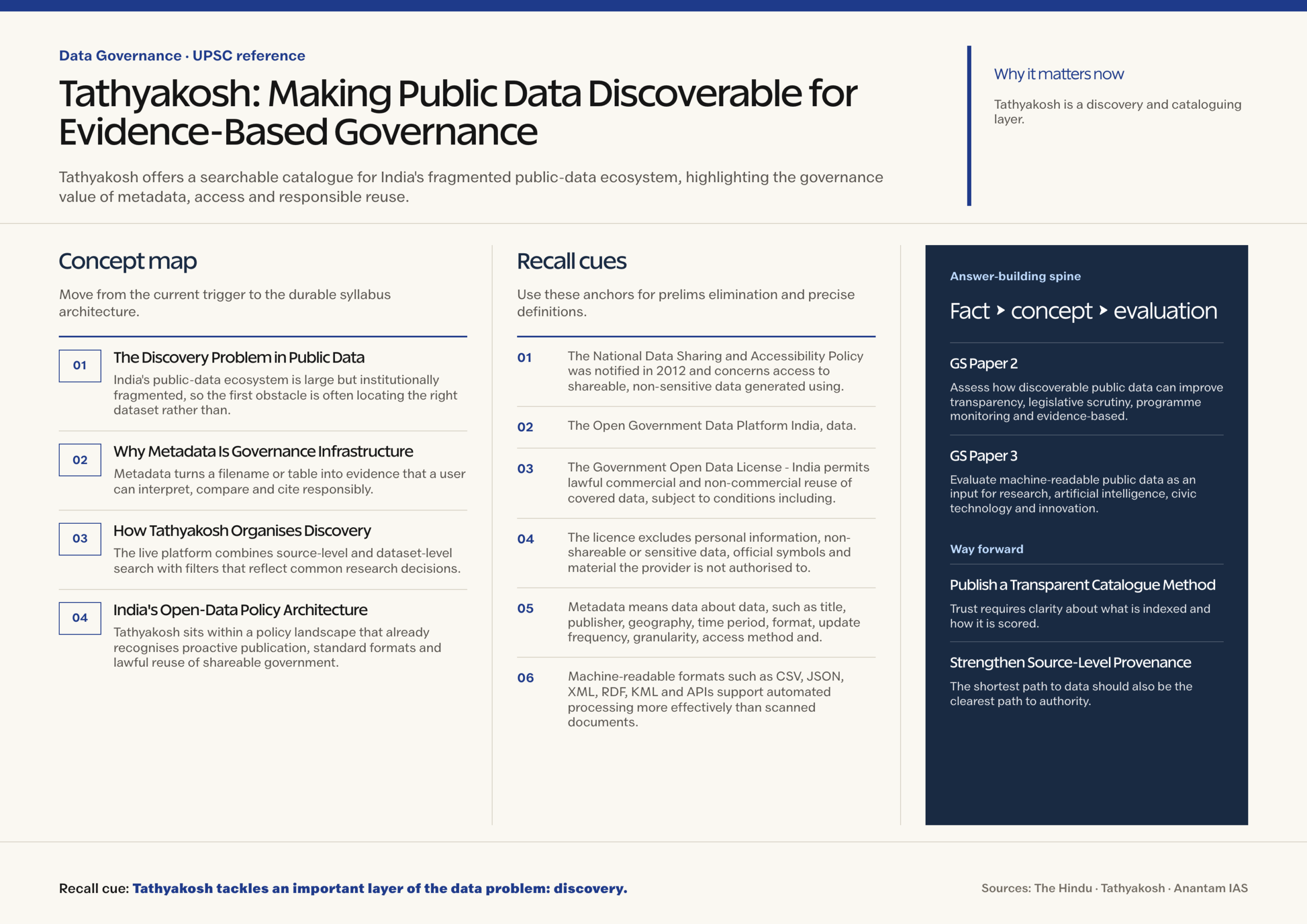
Background and Context
The Discovery Problem in Public Data
India’s public-data ecosystem is large but institutionally fragmented, so the first obstacle is often locating the right dataset rather than analysing it.
- Different ministries, States, regulators, public-sector bodies, statistical agencies and research institutions publish through separate websites with different navigation, naming and update practices.
- A search engine may find a report but miss the underlying table or API. A departmental portal may contain the data but use an unfamiliar administrative term. Broken links and redesigned sites can make older resources.
- Discovery is especially difficult when one policy question spans sectors. Studying district nutrition, for example, may require health, food distribution, sanitation, income, population and geospatial datasets from multiple custodians.
- Tathyakosh responds by creating a federated catalogue: it standardises descriptive fields and points users toward source resources rather than claiming that one organisation produced every dataset.
- This model can expand without relocating every file. It also preserves the source institution as the place where licences, methods, revisions and access conditions should be checked.
Why Metadata Is Governance Infrastructure
Metadata turns a filename or table into evidence that a user can interpret, compare and cite responsibly.
- A useful record identifies the data producer, title, subject, unit of observation, geographic level, time period, release date, update frequency, format, access route and licence.
- Methodological metadata should explain definitions, sampling, revisions, missing values and breaks in a series. Without it, two columns with the same label may measure different populations or reference periods.
- Controlled vocabularies help join similar concepts across publishers. Standard terms for districts, sectors, formats and access types make filtering more reliable than free-text descriptions alone.
- Granularity matters. State-level averages cannot answer a village-level targeting question, while record-level data may create privacy risks that an aggregated table avoids.
- Provenance records the chain from original collection through cleaning, aggregation and publication. It lets users distinguish an authoritative source from a copy, derivative model or journalistic visualisation.
How Tathyakosh Organises Discovery
The live platform combines source-level and dataset-level search with filters that reflect common research decisions.
- The homepage describes Tathyakosh as an open catalogue covering fields such as census, agriculture, public health, climate and governance, with direct access links to the original sources.
- Dataset filters include subject domain, subdomain, Indian or international origin, access type, geographic level, State, source, platform type and file format.
- Usability filters allow a user to request machine-readable resources or datasets with API or JSON access. This can save time for researchers who need repeatable processing rather than manual transcription.
- The platform publishes a quality score from zero to 100 across accessibility, freshness, granularity, coverage, relevance and data quality. A score can help triage a large result set, but it is a platform assessment rather than.
- A dataset detail page can expose metadata and source links. Users must still read the source’s methodology, update notice, licence and access conditions before relying on it.
India's Open-Data Policy Architecture
Tathyakosh sits within a policy landscape that already recognises proactive publication, standard formats and lawful reuse of shareable government data.
- The National Data Sharing and Accessibility Policy, 2012 seeks access to shareable, non-sensitive data generated with public funds and underpins the Open Government Data Platform India.
- The OGD implementation model uses departmental Chief Data Officers and a publication workflow. Data owners remain responsible for the substance, while the platform improves publication and access.
- The Government Open Data License – India grants a worldwide, royalty-free and non-exclusive licence for lawful use, adaptation, publication, translation and derivative works, including commercial use, for data covered by the licence.
- Users must give attribution, avoid suggesting endorsement and respect exclusions. A link discovered through a catalogue does not automatically place the underlying resource under this licence; the dataset’s own licence metadata controls reuse.
- Karnataka published an Open Data Policy in 2021 and operates a State instance of the OGD platform. Its policy experience provides an institutional foundation for newer discovery and data-use initiatives.
Way Forward
Publish a Transparent Catalogue Method
- Tathyakosh should publish machine-readable definitions for each metadata field, inclusion criteria, crawl frequency, link-status rules and the formula behind each quality-score dimension.
- Every score should show its assessment date and components so users can challenge a stale or misleading rating.
- Use persistent dataset identifiers and capture the original publisher, canonical URL, licence, version, release date, update frequency and methodology link.
- Flag mirrors and derivatives clearly, and preserve archived metadata when a source link changes without presenting an old copy as current.
Conclusion
- Tathyakosh tackles an important layer of the data problem: discovery.
- Its public value will depend on disciplined boundaries.
UPSC Practice Questions
Prelims MCQ 1
With reference to open government data in India, consider the following statements:
- The National Data Sharing and Accessibility Policy concerns shareable, non-sensitive data generated using public funds.
- The Government Open Data License – India permits covered data to be reused for lawful commercial as well as non-commercial purposes, subject to its conditions.
- Personal information is automatically covered by the Government Open Data License – India whenever it is held by a public authority.
How many of the above statements are correct?
(a) Only one (b) Only two (c) All three (d) None
Answer: (b) Only two
Explanation:
Statements 1 and 2 are correct. Statement 3 is incorrect because personal information is among the exclusions from the Government Open Data License – India; government possession alone does not make it open data.
Prelims MCQ 2
Which one of the following best describes a public-data catalogue such as Tathyakosh?
(a) It is necessarily the legal owner of every indexed dataset (b) It replaces the need to verify data at the original source (c) It organises metadata and links so users can discover datasets across sources (d) It converts all indexed datasets into open-licensed data
Answer: (c) It organises metadata and links so users can discover datasets across sources
Explanation:
A discovery catalogue indexes and describes datasets and usually directs users to source portals. Ownership, official authority, access conditions and licensing continue to depend on the underlying producer and resource.
UPSC Mains Questions
- India’s public-data challenge is no longer only scarcity, but fragmentation, weak metadata and uncertain reuse conditions. Discuss with reference to Tathyakosh and the open-government-data framework.
- A data-discovery platform can improve evidence-based governance without becoming a central warehouse. Explain the benefits and safeguards of such a federated model.
Sources: The Hindu and Tathyakosh.
Frequently Asked Questions
What is Tathyakosh?
Tathyakosh is an Indian data discovery and cataloguing platform launched as a public-good initiative. It indexes metadata from many government, research, geospatial and other repositories, lets users search and filter datasets, and links them to the original sources. It is.
Does Tathyakosh host every dataset it lists?
No. Its core role is discovery. Dataset records contain metadata and links that take users to source portals, where actual files, APIs, authentication requirements, methods and licences are controlled. A catalogue link can become stale, so important evidence should be.
What does Tathyakosh’s quality score mean?
The platform says it scores datasets across accessibility, freshness, granularity, coverage, relevance and data quality. The score helps users filter and compare results, but it is a Tathyakosh assessment, not government certification. Users should inspect component criteria, methodology and source.
What is the difference between public data and open data?
Publicly visible data can be read online, but open data also needs usable access, a machine-readable format where appropriate and a licence allowing reuse. A visible PDF may be difficult to process, while a downloadable file may still carry restrictions.
How can a data catalogue support evidence-based governance?
It lowers the cost of finding comparable evidence across departments and sectors, exposes metadata and update gaps, and helps officials, researchers and citizens trace a claim to its source. Better discovery supports decisions, but causal analysis still needs sound methods.
Source: https://anantamias.com/current-affairs/tathyakosh-public-data-discovery-platform/