Why in News?
On 12 August 2026 , the Delhi High Court asked Meta to place on record the policy, norms and eligibility criteria governing access to its Rights Manager tool, along with the grounds on which an application may be rejected.
- Justice Anup Jairam Bhambhani issued the direction while hearing a suit filed by content creator and business coach Mohit Kumar, who operates the handle Rise With Mohit.
- The plaintiff told the court that he had applied for Rights Manager access three times but received rejections without a specific reason.
- Meta informed the court that the disputed copyright strikes were reversed after technical verification and that the removed content was restored.
- Meta also stated that the plaintiff’s accounts had not been suspended and remained accessible.
- The court observed that alleged misuse of copyright-enforcement mechanisms appeared to recur in disputes involving content creators and warranted closer examination.
- A platform enforcement tool can affect expression, income, audience reach and reputation even though access to the tool and its operating rules are designed by a private company.
- The dispute exposes a double asymmetry: a claimant may receive powerful enforcement capabilities, while the person affected may not know why the claimant obtained access or how the claim was verified.
- Copyright systems must act quickly enough to limit genuine piracy but cautiously enough to avoid rewarding impersonation, mistaken matching or strategic complaints.
UPSC Relevance
Prelims Relevance
- The Copyright Act, 1957 is India’s principal copyright legislation.
- Copyright protects original expression in recognised categories of works; it does not generally protect a bare fact or idea as such.
- Section 52 of the Copyright Act lists acts that are not infringement, including specified forms of fair dealing for private or personal use including research, criticism or review, and reporting current events and current affairs.
- Meta describes Rights Manager as a technology that lets rights owners upload and maintain a reference library of video content to monitor and protect.
- Depending on available permissions, a match may lead to blocking, claiming advertising earnings, applying attribution or sending a copyright report.
- Rights Manager is a private platform tool; access to it is not the same as registration of copyright under Indian law.
Mains Relevance
GS Paper 2
- Accountability of private digital platforms whose decisions have public consequences for speech, livelihood and access to markets.
- Application of natural-justice principles such as notice, reasons, opportunity to contest and impartial review in platform governance.
GS Paper 3
- Design risks in automated or technology-assisted copyright matching, including false claims, adversarial abuse and identity verification failure.
- Digital creator economy, intellectual-property enforcement, platform concentration and the economic cost of wrongful content removal.
Essay
- When private code performs a regulatory function, procedural fairness becomes part of digital citizenship.
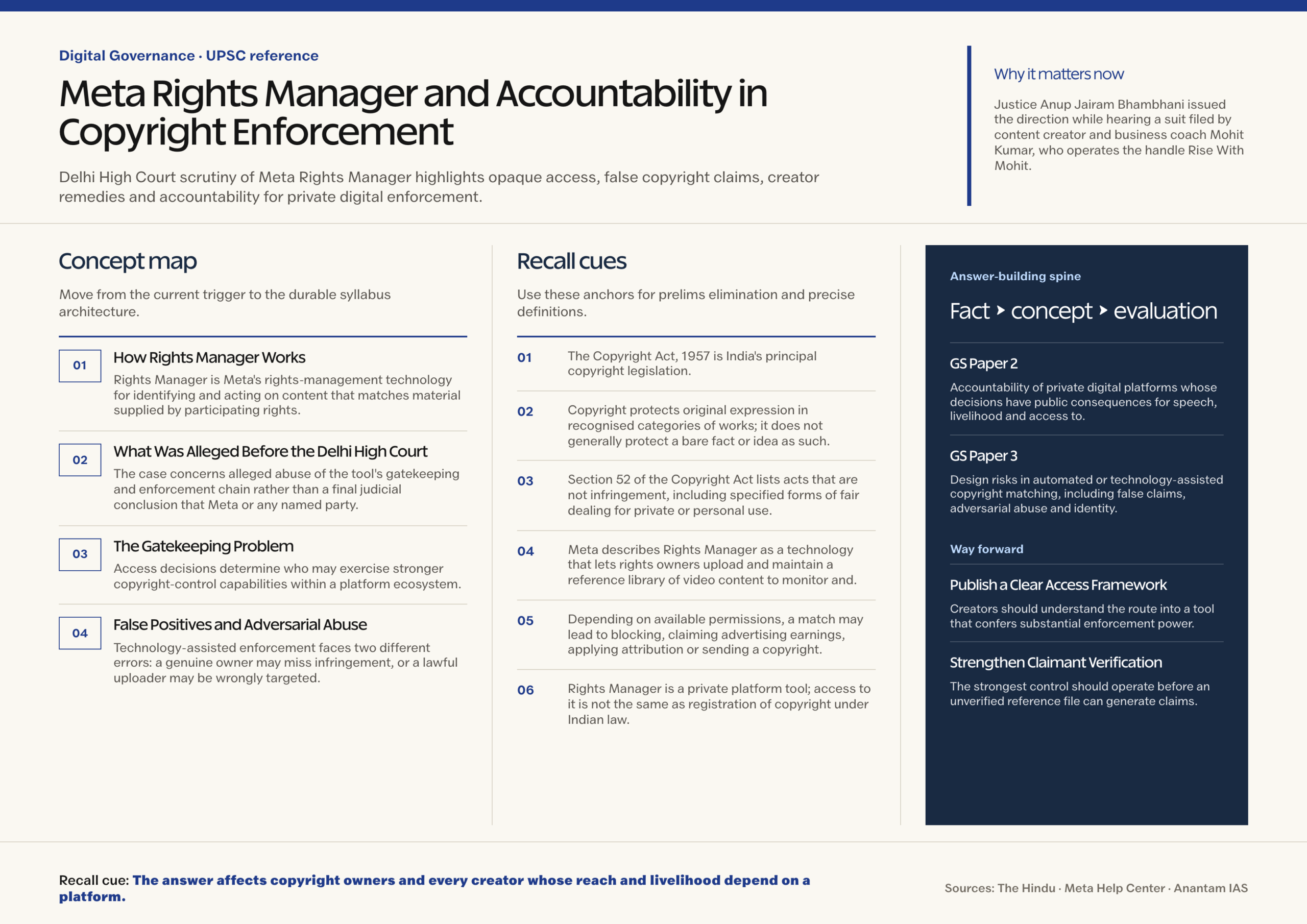
Background and Context
How Rights Manager Works
Rights Manager is Meta’s rights-management technology for identifying and acting on content that matches material supplied by participating rights owners.
- An approved rights owner can upload and maintain a reference library containing video material, including live streams, that the owner wants to monitor and protect.
- Meta’s Help Center says available responses to a match may include blocking the matched video, claiming advertising earnings, applying attribution or submitting a copyright report that may lead to removal.
- A match is an enforcement signal, not by itself a judicial determination of authorship, ownership, licence scope or infringement.
- System accuracy depends on trustworthy onboarding, reliable reference files, territorial and licence information, careful matching and a usable dispute process.
What Was Alleged Before the Delhi High Court
The case concerns alleged abuse of the tool’s gatekeeping and enforcement chain rather than a final judicial conclusion that Meta or any named party committed wrongdoing.
- The plaintiff alleged that scammers copied his original videos and uploaded them into Rights Manager while falsely presenting themselves as rights holders.
- According to the plaintiff, those registrations were then relied upon to issue copyright strikes against his accounts and remove content.
- He also alleged that repeated applications for his own access to Rights Manager were rejected without specific reasons, despite other creators with smaller audiences receiving access.
- Meta told the court that technical verification led to reversal of the strikes and restoration of the removed content. These statements and allegations remain subject to the proceeding.
The Gatekeeping Problem
Access decisions determine who may exercise stronger copyright-control capabilities within a platform ecosystem.
- If eligibility criteria are unclear, applicants cannot understand what evidence of ownership, catalogue size, infringement risk or organisational capacity is required.
- An unexplained rejection limits correction: the applicant does not know whether the issue concerns identity, documentation, account history, territorial rights or an internal risk score.
- Opaque access can produce unequal enforcement capacity between similarly situated creators and between established rights organisations and independent creators.
- Publishing criteria does not require disclosure of security-sensitive thresholds. A platform can explain categories of evidence, rejection grounds and review paths while protecting anti-abuse controls.
False Positives and Adversarial Abuse
Technology-assisted enforcement faces two different errors: a genuine owner may miss infringement, or a lawful uploader may be wrongly targeted.
- A false positive may occur when lawful content is treated as infringing because of a mistaken match, incomplete licence data or failure to recognise an exception.
- Adversarial abuse is different: a bad actor may impersonate an owner, submit copied material as a reference file or make coordinated claims to suppress a rival.
- High-impact actions should use layered checks, including identity verification, proof of rights, reference-file provenance, account history and human review when ownership is disputed.
- Repeat false claimants require sanctions, but safeguards should distinguish deliberate abuse from an honest mistake in a complicated licensing chain.
Way Forward
Publish a Clear Access Framework
- State the categories of eligible applicants, evidence of rights required, main rejection grounds and process for reconsideration.
- Give each rejected applicant a reason code and a practical explanation of what can be corrected or supplied.
- Review access periodically so that small and independent creators are assessed by ownership and abuse risk rather than audience size alone.
Conclusion
- The Delhi High Court proceeding puts a narrow operational question into a wider governance frame: who receives private enforcement power, on what criteria, and with what safeguards against misuse ?
- Effective digital enforcement needs speed, but speed should rest on verified claimants, explainable decisions, accessible counter-notice, human review and repair of wrongful consequences.
UPSC Practice Questions
Prelims MCQ 1
With reference to copyright and digital platforms in India, consider the following statements:
- Section 52 of the Copyright Act, 1957 recognises specified acts that do not constitute copyright infringement.
- Meta Rights Manager access is equivalent to statutory copyright registration in India.
- Section 79 of the Information Technology Act, 2000 provides conditional safe-harbour protection to intermediaries.
How many of the above statements are correct?
(a) Only one (b) Only two (c) All three (d) None
Answer: (b) Only two
Explanation:
Statements 1 and 3 are correct. Section 52 contains specified copyright exceptions, and Section 79 provides conditional intermediary protection. Statement 2 is incorrect because Rights Manager is a private platform tool, not statutory copyright registration.
Prelims MCQ 2
Which one of the following is the most appropriate first-line safeguard against a bad actor uploading another creator’s work as a rights-management reference file?
(a) Removing all copyright tools from social media (b) Claimant identity, authority and reference-file provenance checks (c) Treating every content match as conclusive proof of infringement (d) Allowing only government departments to claim copyright
Answer: (b) Claimant identity, authority and reference-file provenance checks
Explanation:
Verification of the claimant’s identity and authority, together with provenance checks for the reference file, addresses the alleged abuse before it can generate enforcement actions. Matching alone cannot conclusively decide ownership or infringement.
UPSC Mains Questions
- Private digital platforms increasingly exercise quasi-regulatory power over speech and livelihood. Discuss the procedural safeguards needed in technology-assisted copyright enforcement.
- How can India protect copyright owners without allowing automated or private enforcement systems to become tools of impersonation and strategic suppression?
Sources: The Hindu and Meta Help Center.
Frequently Asked Questions
What did the Delhi High Court ask Meta to disclose?
The court asked Meta to place on record its policy, norms and eligibility criteria for granting access to Rights Manager, as well as the grounds on which applications may be rejected. This was an information-seeking direction during an ongoing suit.
What is Meta Rights Manager?
Rights Manager is Meta’s copyright-management technology. Approved rights owners can maintain a reference library of video content and monitor matches. Depending on permissions, possible actions include blocking a video, claiming advertising earnings, applying attribution or submitting a copyright report that.
What misuse was alleged in the case?
The plaintiff alleged that scammers copied his original videos, uploaded them into Rights Manager while posing as the owners, and then used those registrations to issue copyright strikes against his content. Meta said the disputed strikes were later reversed after.
Why are reasons for denying tool access important?
A reason lets an applicant know whether identity, rights documents, account history or another criterion was deficient. It supports correction and review, reduces arbitrary treatment and helps courts assess consistency without forcing the platform to reveal security-sensitive anti-abuse thresholds.
Does a content match prove copyright infringement?
No. A match can identify similarity, but legal infringement may depend on authorship, ownership, licence, territorial scope, substantiality, purpose and statutory exceptions. The affected user needs a route to present evidence and obtain human review before severe or lasting penalties.
Tell Google you want more of this.
Add Anantam IAS as a preferred sourceOne tap, and this site shows up more often in your own Top Stories, AI Overviews and AI Mode. Remove it any time.