

Why in News?
A statutory Judges Inquiry Committee report concerning Justice Yashwant Varma was placed before Parliament, bringing its findings on the cash-at-residence allegations into the formal constitutional removal process.
- The three-member statutory committee had submitted its report to Lok Sabha Speaker Om Birla on 18 May 2026; the Lok Sabha Secretariat said it would be laid before both Houses in due course.
- The committee was originally constituted by the Speaker on 12 August 2025 under the Judges (Inquiry) Act, 1968 after admission of a motion seeking removal.
- Its members at the time of submission were Supreme Court judge Justice Aravind Kumar, Bombay High Court Chief Justice Shree Chandrashekhar and senior advocate B.V. Acharya, the distinguished-jurist member.
- The statutory report is distinct from the earlier in-house judicial inquiry ordered within the Supreme Court’s administrative system. The first supports Parliament’s constitutional process; the second is an internal accountability mechanism.
- Justice Varma denied ownership or knowledge of the cash and questioned the evidentiary basis and fairness of the proceedings. Those objections form part of the due-process debate and should not be erased when discussing the committee’s.
- Higher-court judges require strong decisional independence, but independence is not immunity from a constitutionally structured inquiry into alleged misbehaviour or incapacity.
- The Constitution deliberately sets a high removal threshold so that a temporary political majority cannot easily punish a judge for unpopular decisions.
- A resignation during an inquiry exposes a recurring institutional gap: fact-finding may continue, while the practical purpose and consequences of a removal motion can become contested.
UPSC Relevance
Prelims Relevance
- Article 124(4) sets the parliamentary majority required to remove a Supreme Court judge.
- Article 218 applies the relevant removal provisions of Article 124 to High Court judges.
- Article 217 governs appointment, tenure and resignation of High Court judges.
- A removal motion requires the support of at least 100 Lok Sabha members or 50 Rajya Sabha members at the notice stage under the Judges (Inquiry) Act, 1968.
- The Speaker or Rajya Sabha Chairman may admit or refuse the motion after considering available material and any consultation considered appropriate.
- After admission, the inquiry committee has three members: one Supreme Court judge, one High Court Chief Justice and one distinguished jurist.
Mains Relevance
GS Paper 2
- Constitutional safeguards for judicial independence and the removal of Supreme Court and High Court judges.
- Institutional accountability, natural justice and the legitimacy of fact-finding in cases involving constitutional office-holders.
GS Paper 4
- Integrity in public institutions, public trust and the higher ethical burden attached to judicial office.
- Balancing confidentiality, dignity of office, transparency and fairness to the person under inquiry.
Essay
- Institutions retain public trust when independence is paired with answerability rather than secrecy.
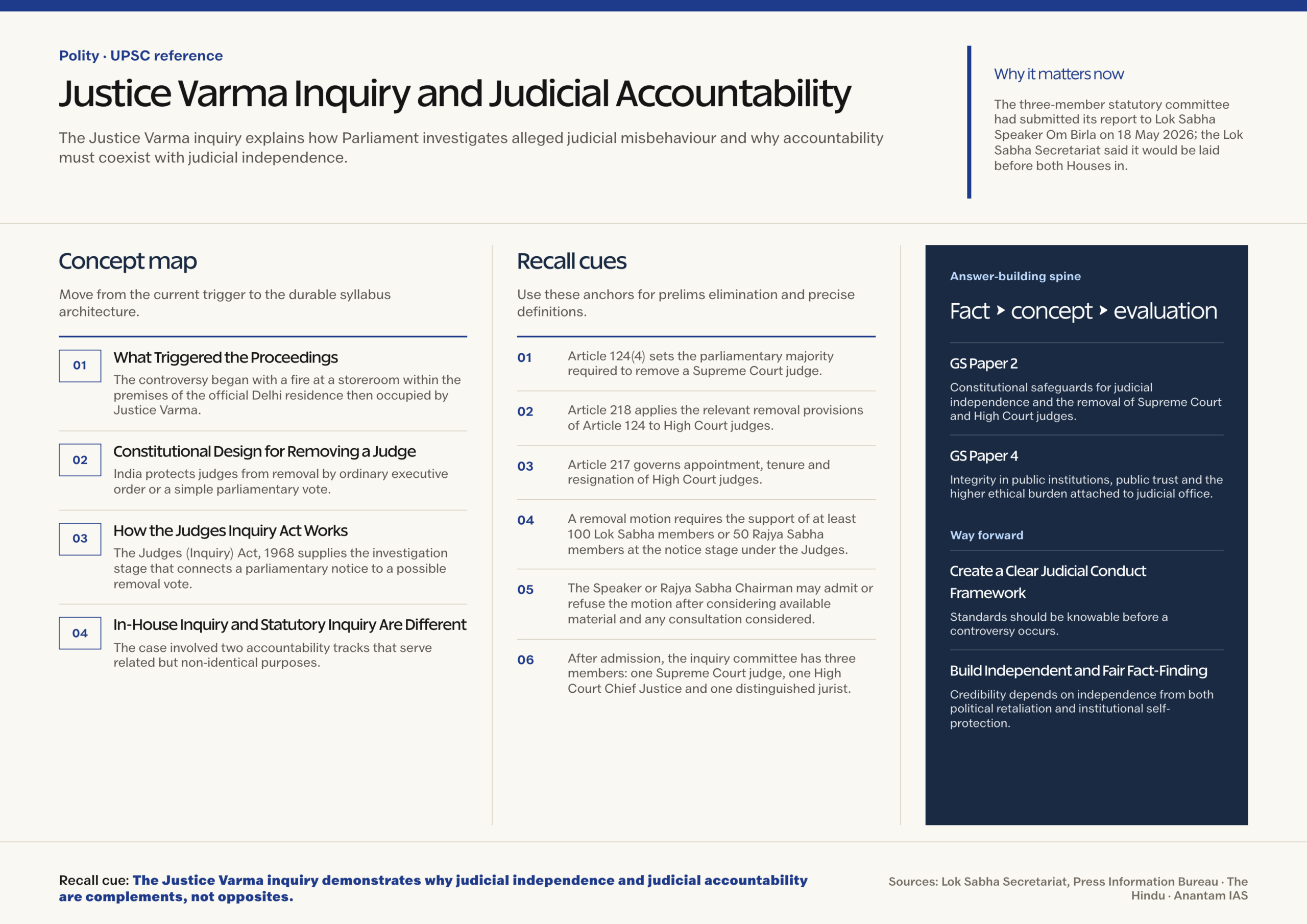
Background and Context
What Triggered the Proceedings
The controversy began with a fire at a storeroom within the premises of the official Delhi residence then occupied by Justice Varma.
- The fire occurred on the night of 14 March 2025. Responders recorded material that appeared to include bundles of partially burnt currency notes, generating questions about possession, access and preservation of evidence.
- Justice Varma consistently denied that the cash belonged to him or his family and said he and his wife were away from Delhi when the fire occurred. He described the storeroom as detached from the main.
- The then Chief Justice of India initiated an in-house inquiry. Judicial work was withdrawn from Justice Varma, and he was transferred from the Delhi High Court to his parent Allahabad High Court without being assigned.
- The in-house committee’s conclusions and the Chief Justice of India’s subsequent recommendation supplied institutional material, but they did not themselves remove the judge. Removal is governed by the Constitution and parliamentary legislation.
Constitutional Design for Removing a Judge
India protects judges from removal by ordinary executive order or a simple parliamentary vote.
- Under Article 124(4), a Supreme Court judge may be removed by the President after each House presents an address supported by a majority of the House’s total membership and by at least two-thirds of members.
- The grounds are proved misbehaviour or incapacity. The Constitution does not define every act that amounts to misbehaviour, allowing the inquiry to assess conduct while requiring proof through a regulated process.
- Article 218 extends the relevant removal safeguards to High Court judges. Article 217 also provides the route by which a High Court judge may resign by writing addressed to the President.
- The word impeachment is common in public discussion, but the constitutional text speaks of an address by Parliament and an order of removal by the President.
How the Judges Inquiry Act Works
The Judges (Inquiry) Act, 1968 supplies the investigation stage that connects a parliamentary notice to a possible removal vote.
- A notice must be signed by at least 100 members of the Lok Sabha or 50 members of the Rajya Sabha. The presiding officer may admit or refuse it after examining the available material.
- Once admitted, the motion remains pending while a three-member committee investigates. The composition combines judicial experience and an external juristic perspective: a Supreme Court judge, a High Court Chief Justice and a distinguished jurist.
- The committee must frame definite charges, communicate the grounds to the judge and provide a reasonable opportunity to submit a defence, cross-examine witnesses, adduce evidence and be heard.
- Section 5 gives the committee civil-court powers for specified purposes, including compelling attendance, obtaining documents, receiving evidence on oath and issuing commissions for examination of witnesses or documents.
- The committee records findings on each charge separately. If it finds no misbehaviour or incapacity, the pending motion cannot proceed. If it records an adverse finding, the motion and report may be considered by the.
In-House Inquiry and Statutory Inquiry Are Different
The case involved two accountability tracks that serve related but non-identical purposes.
- The judiciary’s in-house procedure is an internal mechanism concerned with maintaining standards, allocating judicial work and deciding whether the Chief Justice of India should recommend further action.
- A committee under the 1968 Act operates after a parliamentary motion is admitted. Its powers, composition, defence safeguards, report and consequences arise from statute.
- The statutory committee may consider its own evidentiary record. Fairness requires that charges be definite, adverse material be disclosed in accordance with law and the judge receive a meaningful opportunity to respond.
- UPSC answers should avoid describing either inquiry as a criminal trial. Criminal investigation and prosecution involve separate legal thresholds, agencies, offences and courts.
Way Forward
Create a Clear Judicial Conduct Framework
- Codify or formally publish enforceable standards on asset disclosure, conflicts of interest, gifts, recusal, financial propriety and preservation of evidence.
- Provide clear rules for public disclosure of conclusions, redaction of sensitive material and protection of complainants and witnesses.
- Use transparent selection criteria for inquiry members, conflict checks and published procedural rules.
- Guarantee notice of definite charges, access to relied-on material, reasonable time, representation, cross-examination where appropriate and reasoned findings on each charge.
Conclusion
- The Justice Varma inquiry demonstrates why judicial independence and judicial accountability are complements , not opposites.
- A credible system must preserve the high constitutional threshold for removal while ensuring that serious allegations receive timely, evidence-led and publicly intelligible resolution.
UPSC Practice Questions
Prelims MCQ 1
With reference to the removal of a High Court judge in India, consider the following statements:
- A notice under the Judges (Inquiry) Act, 1968 requires at least 100 Lok Sabha members or 50 Rajya Sabha members.
- The inquiry committee consists of one Supreme Court judge, one High Court Chief Justice and one distinguished jurist.
- An adverse inquiry committee report automatically removes the judge from office.
How many of the above statements are correct?
(a) Only one (b) Only two (c) All three (d) None
Answer: (b) Only two
Explanation:
Statements 1 and 2 reflect Section 3 of the Judges (Inquiry) Act, 1968. Statement 3 is incorrect: each House must adopt the motion with the constitutional special majority, after which the President may issue the removal order.
Prelims MCQ 2
Which constitutional provision applies the removal safeguards concerning Supreme Court judges to judges of High Courts?
(a) Article 136 (b) Article 217 alone (c) Article 218 (d) Article 226
Answer: (c) Article 218
Explanation:
Article 218 applies specified clauses of Article 124, including the removal framework, to High Courts. Article 217 addresses appointment and conditions of a High Court judge’s office, while Articles 136 and 226 concern jurisdiction.
UPSC Mains Questions
- Judicial independence cannot be sustained without credible judicial accountability. Discuss with reference to India’s constitutional procedure for the removal of higher-court judges.
- Examine the distinction between the judiciary’s in-house inquiry mechanism and an inquiry under the Judges (Inquiry) Act, 1968. Why does the distinction matter for due process?
Sources: Lok Sabha Secretariat, Press Information Bureau and The Hindu.
Frequently Asked Questions
What did the Judges Inquiry Committee reportedly find in the Justice Varma matter?
The Hindu reported that the statutory committee found all three framed charges proved. This was a finding within the Judges (Inquiry) Act process, not a criminal conviction and not an automatic order of removal. The judge disputed the evidence and.
Who can remove a High Court judge?
The President issues the removal order after each House of Parliament adopts an address in the same session with the constitutionally required special majority. Parliament’s role follows investigation under the statutory process; neither the executive nor a judicial in-house committee.
What majority is required in Parliament?
Each House must approve the motion by a majority of its total membership and by at least two-thirds of members present and voting. Both conditions must be met. This demanding threshold is designed to protect judges from removal based on.
How is a Judges Inquiry Committee constituted?
After admitting a properly supported motion, the Speaker or Rajya Sabha Chairman constitutes a three-member committee. It includes one Supreme Court judge, one Chief Justice of a High Court and one distinguished jurist. Special rules apply when notices are given.
Is an in-house inquiry the same as a parliamentary inquiry?
No. An in-house inquiry is an internal judicial mechanism used for institutional discipline and recommendations. A committee under the Judges (Inquiry) Act, 1968 is a statutory body connected to a pending parliamentary removal motion, with defined membership, evidentiary powers and.
Tell Google you want more of this.
Add Anantam IAS as a preferred sourceOne tap, and this site shows up more often in your own Top Stories, AI Overviews and AI Mode. Remove it any time.






