Daily Digest
UPSC · Civil Services Examination
Current Affairs · Saturday, 15 August 2026
Current affairs curated and edited by Anantam IAS faculty — pulled from The Hindu, PIB, IDSA, Foreign Affairs and the ministries. Read, annotate, revise.
Old Rajinder Nagar · Delhi 110005 · anantamias.com
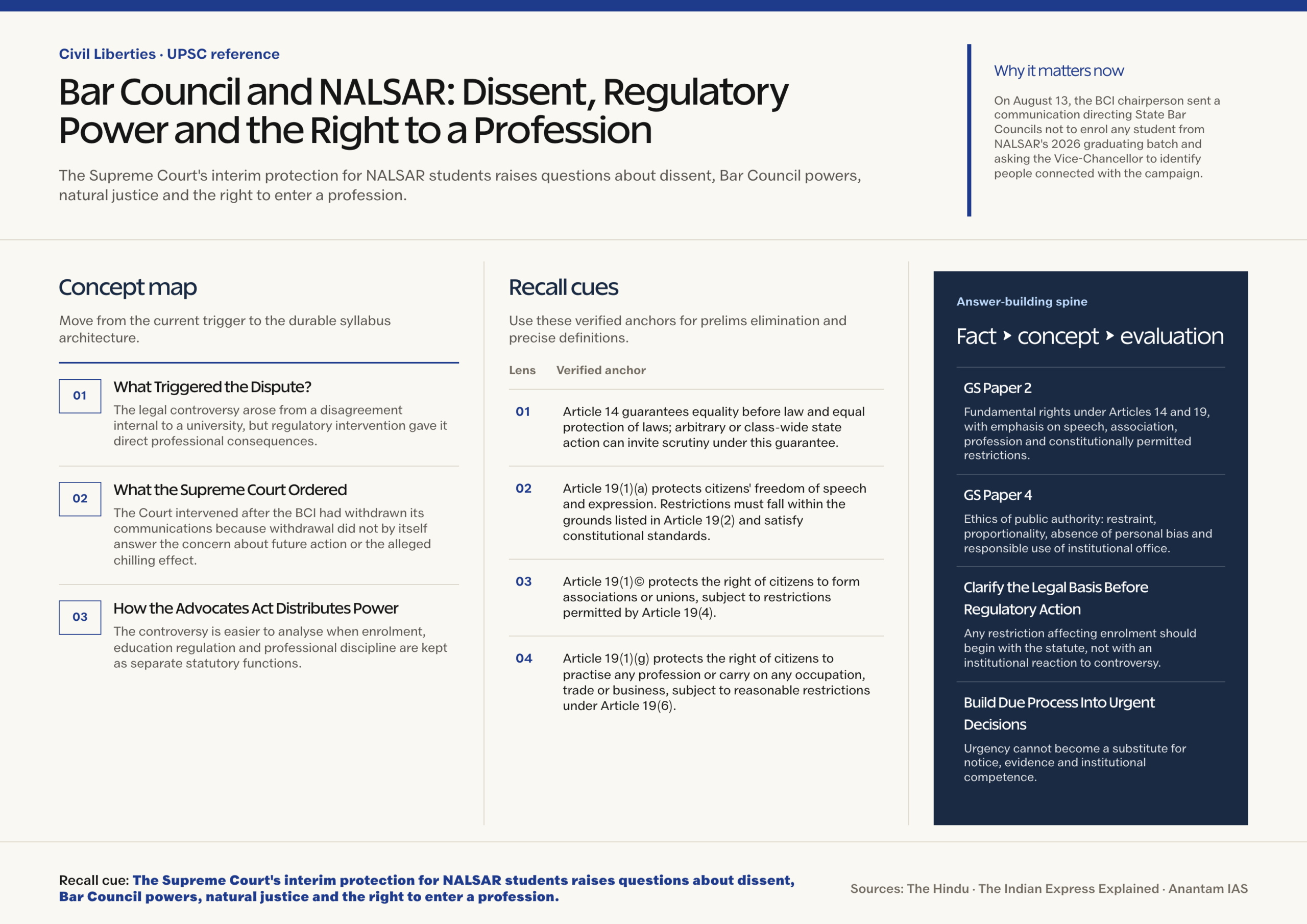
Bar Council and NALSAR: Dissent, Regulatory Power and the Right to a Profession
Why in News?
On August 14, 2026, the Supreme Court restrained the Bar Council of India from taking coercive action against NALSAR University of Law students, faculty members or administrators over a student campaign concerning the invitation to the Chief Justice of India.
- On August 13, the BCI chairperson sent a communication directing State Bar Councils not to enrol any student from NALSAR’s 2026 graduating batch and asking the Vice-Chancellor to identify people connected with the campaign.
- The Indian Express reported that several BCI office-bearers said the first directive had been issued by the chairperson before collective approval. The BCI modified the direction within hours, removed the batch-wide enrolment bar and initially retained.
- NALSAR’s Vice-Chancellor said the proposed inquiry would first have to be examined for constitutional permissibility and compatibility with the university’s governance framework.
- Early on August 14, the BCI announced that all proceedings against the batch were closed and that the university administration need take no further action.
- Despite that withdrawal, the Supreme Court recorded a protective order against coercive action and gave the BCI two weeks to file an affidavit explaining its directives.
- The controversy connects freedom of speech under Article 19(1)(a) with the freedom to practise a profession under Article 19(1)(g), both subject to the Constitution’s permitted restrictions.
- It also tests Article 14’s protection against arbitrary state action, especially when an entire graduating batch faces consequences without an individual allegation, notice or hearing.
- The Advocates Act, 1961 divides functions between the BCI and State Bar Councils. That statutory design matters because regulatory purpose does not create an unlimited power to impose new enrolment disqualifications.
UPSC Relevance
Prelims Relevance
- Article 14 guarantees equality before law and equal protection of laws; arbitrary or class-wide state action can invite scrutiny under this guarantee.
- Article 19(1)(a) protects citizens’ freedom of speech and expression. Restrictions must fall within the grounds listed in Article 19(2) and satisfy constitutional standards.
- Article 19(1)(c) protects the right of citizens to form associations or unions, subject to restrictions permitted by Article 19(4).
- Article 19(1)(g) protects the right of citizens to practise any profession or carry on any occupation, trade or business, subject to reasonable restrictions under Article 19(6).
- Under Section 6 of the Advocates Act, 1961, admitting persons as advocates on a State roll is a function of the State Bar Council.
- Under Section 7, the BCI sets professional-conduct standards, promotes legal education, recognises qualifying universities and exercises general supervision and control over State Bar Councils.
Mains Relevance
GS Paper 2
- Fundamental rights under Articles 14 and 19, with emphasis on speech, association, profession and constitutionally permitted restrictions.
- The rule of law principle that every public body’s action must have a legal source, remain within statutory purpose and follow fair procedure.
GS Paper 4
- Ethics of public authority: restraint, proportionality, absence of personal bias and responsible use of institutional office.
- Conflict-of-interest safeguards when regulatory action concerns criticism of a person or office closely connected to the triggering dispute.
Essay
- Dissent is not the opposite of institutional loyalty; it can be a method of making institutions answerable to their own principles.
Background and Context
What Triggered the Dispute?
The legal controversy arose from a disagreement internal to a university, but regulatory intervention gave it direct professional consequences.
- A group of NALSAR students opposed inviting Chief Justice of India Surya Kant as chief guest for their convocation and communicated their objections to the university administration.
- On August 13, the BCI chairperson’s first letter sought a report identifying those involved in the campaign and directed all State Bar Councils to halt enrolment of the university’s entire 2026 graduating batch.
- The batch-wide character mattered. The directive did not identify misconduct by each graduate or distinguish organisers, supporters, non-participants and students who may have had no connection with the campaign.
- After objections from within the BCI and outside it, a second letter withdrew the enrolment bar but retained the inquiry. A later communication closed the inquiry as well.
What the Supreme Court Ordered
The Court intervened after the BCI had withdrawn its communications because withdrawal did not by itself answer the concern about future action or the alleged chilling effect.
- The Court restrained the BCI from taking coercive action against NALSAR students, faculty or administrators on the basis of the incidents referred to in the August 13 communications.
- It directed the BCI to file an affidavit within two weeks explaining the circumstances and basis of its actions.
- The Chief Justice orally criticised the BCI’s intervention and said the dispute was a dialogue between the students and him. He also linked the issue to the right to a profession and students’ freedom to protest.
- For answer writing, distinguish an oral observation from an operative judicial direction. Also distinguish a temporary protective order from a final judgment after pleadings and legal issues have been fully considered.
- The pending process may examine statutory jurisdiction, fundamental rights, natural justice and the legal effect of withdrawal. None of those questions should be presented as finally decided merely because interim relief was granted.
How the Advocates Act Distributes Power
The controversy is easier to analyse when enrolment, education regulation and professional discipline are kept as separate statutory functions.
- A State Bar Council admits qualified persons to its roll and maintains that roll. An application is processed by its enrolment committee under the Act.
- The Bar Council of India lays down professional-conduct standards for advocates, promotes legal education, recognises law degrees for enrolment purposes and supervises State Bar Councils.
- Section 26 gives the BCI a defined role when a State enrolment committee proposes to reject a particular application: the State body refers the application and its grounds for the BCI’s opinion.
- The legal issue is not whether the BCI has any influence over enrolment or legal education. It plainly has statutory functions in both domains. The issue is whether those functions authorised a prior, blanket direction tied.
- A regulator cannot infer a new punitive power solely from a broad regulatory purpose. Its action must remain connected to the text, scheme and object of the parent statute.
Free Speech, Profession and the Chilling Effect
The case joins two freedoms that are often studied separately: speaking as a citizen and entering a regulated profession.
- Article 19(1)(a) protects speech, including criticism of public institutions and office-holders. It does not protect every mode of protest in every setting; any restriction still needs a valid Article 19(2) ground and must meet constitutional scrutiny.
- Article 19(1)(g) protects citizens’ freedom to practise a profession. Article 19(6) permits reasonable restrictions in the public interest and allows laws prescribing professional or technical qualifications.
- The constitutional question is sharper when access to a profession is threatened because of expression that is not itself shown to violate a lawful professional-entry condition.
- A chilling effect occurs when the threat of serious consequences causes people to avoid protected expression even without final punishment. A withdrawn order can still matter if it signals that criticism may endanger education or employment.
- Legal education has a special democratic role. Training future advocates requires discipline and professional ethics, but it also requires the capacity to question power, test arguments and disagree without fear.
Way Forward
Clarify the Legal Basis Before Regulatory Action
- Record the exact provision conferring power, the statutory purpose served and the facts connecting each affected person to the proposed action.
- Use individual enrolment procedures under the Advocates Act instead of batch-wide presumptions when eligibility is genuinely in question.
- Publish reasoned decisions so affected persons and reviewing courts can test jurisdiction, relevance and proportionality.
Conclusion
- The NALSAR episode is not only a free-speech controversy.
- The Supreme Court’s present order supplies immediate protection and demands an explanation from the BCI.
UPSC Practice Questions
Prelims MCQ 1
With reference to the Advocates Act, 1961, consider the following statements:
- Admitting persons as advocates on a State roll is a function of the State Bar Council.
- The Bar Council of India promotes legal education and recognises universities whose law degrees qualify for enrolment.
- Expression of dissent against a public authority is expressly listed in Section 24A as a disqualification for enrolment.
How many of the above statements are correct?
(a) Only one (b) Only two (c) All three (d) None
Answer: (b) Only two
Explanation:
Statements 1 and 2 follow Sections 6 and 7 of the Advocates Act. Section 24A contains specified disqualifications linked to moral turpitude and certain employment consequences; it does not list dissent as a disqualification.
Prelims MCQ 2
Which one of the following best describes the Supreme Court’s intervention in the NALSAR-Bar Council matter as reported on August 14, 2026?
(a) A final judgment striking down the entire Advocates Act (b) A final ruling abolishing the BCI’s supervision over State Bar Councils (c) An interim restraint against coercive action accompanied by a direction to the BCI to explain its actions (d) A criminal conviction of the BCI chairperson
Answer: (c) An interim restraint against coercive action accompanied by a direction to the BCI to explain its actions
Explanation:
The Court protected NALSAR students, faculty and administrators from coercive action based on the August 13 communications and sought a BCI affidavit within two weeks. The merits were not finally adjudicated.
UPSC Mains Questions
- The power to regulate entry into a profession cannot become a power to punish disagreement. Discuss with reference to Articles 14 and 19 and the statutory scheme of the Advocates Act, 1961. (15 marks, 250 words)
- How do natural justice and proportionality constrain collective regulatory measures that affect educational or professional opportunities? Explain with suitable constitutional principles. (15 marks, 250 words)
Sources: The Hindu and The Indian Express Explained.
Frequently Asked Questions
What did the Bar Council of India initially direct in the NALSAR matter?
The first August 13 communication directed State Bar Councils not to enrol graduates from NALSAR’s 2026 batch and asked the university to report on people connected with the student campaign. The enrolment restraint was withdrawn within hours, and the retained.
What protection did the Supreme Court grant?
The Supreme Court restrained the BCI from taking coercive action against NALSAR students, faculty members or administrators on the basis of the incidents mentioned in the August 13 communications. It also gave the BCI two weeks to file an affidavit.
Did the Supreme Court finally declare the BCI communications unconstitutional?
No. The reported order was an interim protective measure, not a final adjudication of every statutory and constitutional issue. The Court’s oral criticism and the operative restraint are important, but a final holding requires consideration of pleadings, evidence and legal.
Who enrols a law graduate as an advocate?
Under the Advocates Act, a State Bar Council admits qualified persons to its roll through its enrolment process. The BCI has major supervisory, rule-making and legal-education functions and gives an opinion when a State enrolment committee proposes to refuse a.
What is the chilling effect in free-speech law?
The chilling effect describes how a threat of sanction can deter people from exercising protected speech even when punishment is never finally imposed. In this dispute, the concern is that linking student criticism to professional enrolment could discourage lawful expression.
Source: https://anantamias.com/current-affairs/bar-council-nalsar-dissent-professional-rights/
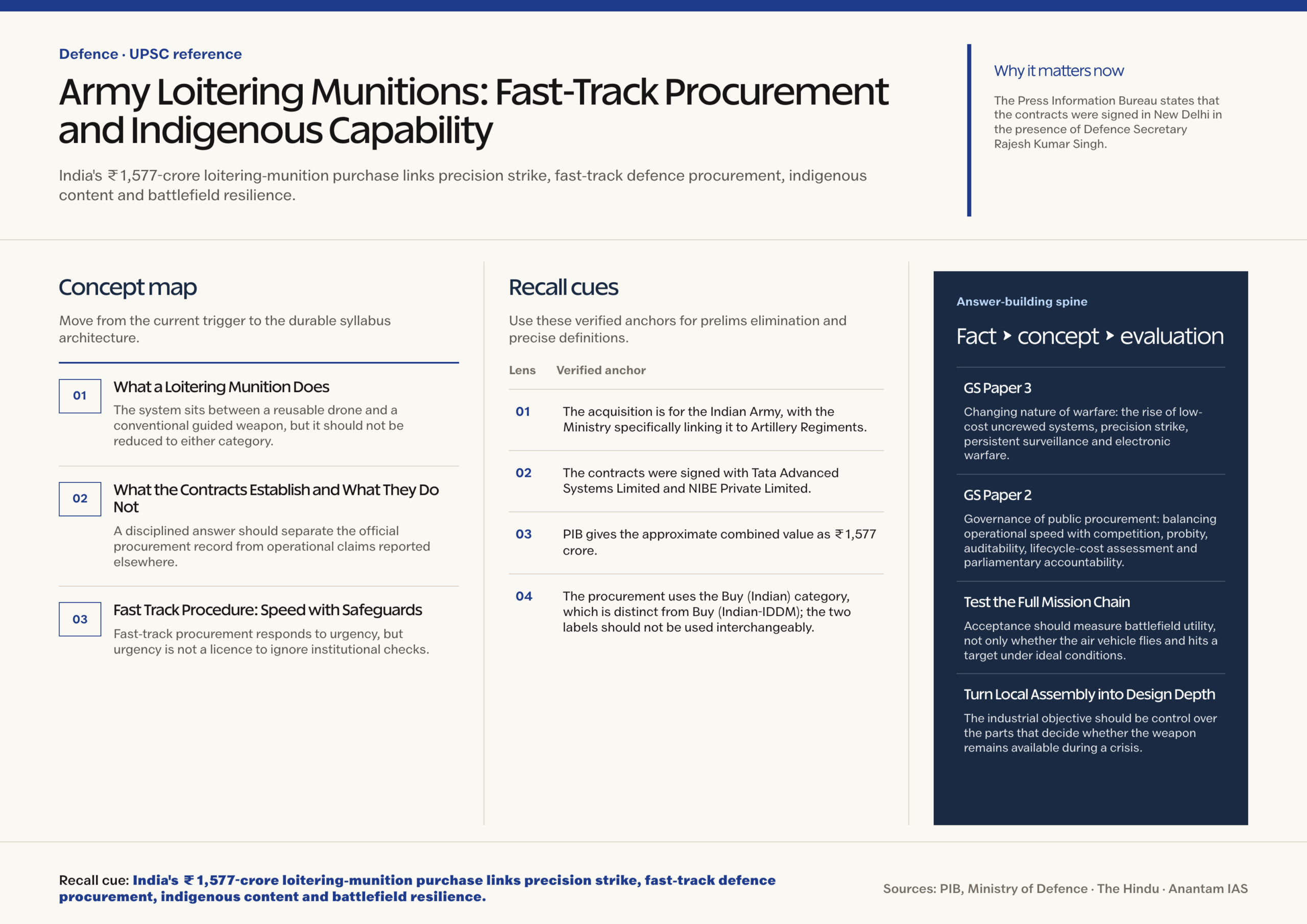
Army Loitering Munitions: Fast-Track Procurement and Indigenous Capability
Why in News?
On August 14, 2026, the Ministry of Defence signed two contracts with Tata Advanced Systems Limited and NIBE Private Limited to procure loiter munition systems, munitions and accessories for the Indian Army.
- The Press Information Bureau states that the contracts were signed in New Delhi in the presence of Defence Secretary Rajesh Kumar Singh.
- The official release identifies the procurement category as Buy (Indian) and the route as the Fast Track Procedure.
- The Ministry describes the equipment as intended to enhance the capability of Artillery Regiments and the Army’s overall operational effectiveness.
- The Hindu reports a total of 84 loiter munition systems, 840 munitions and associated accessories, with a stated range of up to 100 km. These quantities and the range appear in the newspaper report, not.
- According to The Hindu, TASL is to supply 54 systems and 540 munitions for ₹1,013.77 crore, while NIBE is to supply 30 systems and 300 munitions for ₹563.36 crore. The two quoted contract values add to.
- A loitering munition combines surveillance, target selection and one-way attack in a single expendable system. Unlike a conventional missile launched at a pre-fixed target, it can remain airborne for a period before an operator commits it.
- For artillery, the important change is not merely greater range. A loitering munition can shorten the sensor-to-shooter chain by linking observation, target confirmation and precision engagement more closely.
- Fast acquisition can close an urgent capability gap, but long-term military value depends on reliable communications, electronic-warfare resilience, training, stocks, maintenance, quality assurance and integration with command networks.
UPSC Relevance
Prelims Relevance
- The acquisition is for the Indian Army, with the Ministry specifically linking it to Artillery Regiments.
- The contracts were signed with Tata Advanced Systems Limited and NIBE Private Limited.
- PIB gives the approximate combined value as ₹1,577 crore.
- The procurement uses the Buy (Indian) category, which is distinct from Buy (Indian-IDDM); the two labels should not be used interchangeably.
- The Fast Track Procedure is designed for urgent operational requirements and compresses acquisition timelines; it does not remove the need for evaluation, contracting, accountability or quality assurance.
- The Hindu reports 84 systems and 840 munitions, divided between TASL and NIBE, and a range of up to 100 km.
Mains Relevance
GS Paper 3
- Changing nature of warfare: the rise of low-cost uncrewed systems, precision strike, persistent surveillance and electronic warfare.
- Internal security and defence preparedness: closing capability gaps while building resilient command, communications and counter-drone ecosystems.
GS Paper 2
- Governance of public procurement: balancing operational speed with competition, probity, auditability, lifecycle-cost assessment and parliamentary accountability.
- Ethics and international humanitarian law: distinction, proportionality, precautions in attack, operator accountability and meaningful human judgement in the use of force.
Essay
- Technology changes the speed of war faster than institutions change the rules of responsibility.
Background and Context
What a Loitering Munition Does
The system sits between a reusable drone and a conventional guided weapon, but it should not be reduced to either category.
- A conventional missile is usually launched against a target already identified. A loitering munition can remain over or near a target area while its sensors and operator search, confirm or update the engagement.
- The air vehicle carries its own warhead and is consumed in the strike. This separates it from a typical reusable ISR drone, whose primary role is intelligence, surveillance and reconnaissance and which is expected to.
- Its operational value comes from combining persistence and precision: a unit may observe a changing situation, delay commitment, or engage a time-sensitive target when authorised.
- Public descriptions often use the phrase ‘kamikaze drone’, but loitering munition is the more precise analytical term because it identifies a weapon category rather than relying on a sensational label.
- Capabilities differ across products. Range, endurance, payload, launch method, recovery options, navigation, data link, terminal guidance and the degree of operator control must be verified for the specific system; none should be inferred from the category.
What the Contracts Establish and What They Do Not
A disciplined answer should separate the official procurement record from operational claims reported elsewhere.
- PIB confirms the signing of contracts, the two companies, approximate aggregate value, Army end user, Buy (Indian) category, Fast Track Procedure and intended support to artillery capability.
- The official release does not publish the model names, detailed performance parameters, individual contract values, delivery calendar, test results or deployment locations. Such details cannot be filled with assumptions about either vendor’s publicly marketed products.
- The Hindu supplies additional reported terms: 84 systems, 840 munitions, up to 100 km range, a 54:30 division of systems, the individual contract amounts and a 12-month delivery window after advance payment.
- The newspaper also says the procurement is intended to bridge a precision-strike gap beyond roughly 40-50 km, where existing capability is largely dependent on BrahMos. That is a reported assessment, not wording in the PIB release.
- The safe analytical conclusion is that the Army is widening its precision-strike options. It is not safe to conclude from the public material that loitering munitions replace missiles, rockets, guns or surveillance platforms; they complement.
Fast Track Procedure: Speed with Safeguards
Fast-track procurement responds to urgency, but urgency is not a licence to ignore institutional checks.
- The Ministry has long described the Fast Track Procedure as a route for urgent operational requirements, including needs arising from an imminent situation or a crisis without prior warning.
- A shorter acquisition cycle can reduce the time between identifying a battlefield gap and fielding equipment. This is especially relevant to fast-changing technologies such as drones, where a slow cycle risks purchasing an already dated configuration.
- Speed creates its own governance risks: narrowly framed requirements can lock in a vendor, compressed trials may miss environmental or electronic-warfare weaknesses, and urgent orders can understate lifecycle costs.
- The sound principle is speed with traceability. Technical evaluation, commercial reasonableness, acceptance testing, cybersecurity review, contract milestones and audit records should remain clear even when stages run concurrently.
- Fast-track purchases should inform, not substitute for, long-range capability planning. Follow-on orders need performance evidence from training and deployment, an updated threat assessment and a sustainable ammunition-stock policy.
Why Indigenous Content Must Be Read Carefully
A procurement category indicates an industrial-policy choice, but true strategic autonomy depends on which parts of the capability are controlled in India.
- The contracts fall under Buy (Indian). This should not be casually rewritten as Buy (Indian-IDDM), a separate category that explicitly foregrounds indigenous design, development and manufacture.
- The Hindu reports 60% overall indigenous content and a minimum 50% indigenous contribution in materials, components and software. Those percentages are useful only alongside a transparent method for calculating and verifying value addition.
- Critical dependence may hide inside a high aggregate percentage. Imported seekers, navigation modules, engines, encrypted data-link components or software libraries can become bottlenecks during a supply disruption even if many structural parts are local.
- A stronger measure of indigenous capability asks whether Indian entities control source code, integration knowledge, testing, repair, upgrades, intellectual property and alternative suppliers for critical sub-systems.
- The two-vendor structure can broaden private-sector capacity and reduce single-supplier dependence. Its benefits will depend on common standards, quality consistency, assured component supply and whether operational units can train and maintain both systems without unnecessary duplication.
Way Forward
Test the Full Mission Chain
- Conduct trials in heat, cold, altitude, dust, rain and contested electromagnetic conditions, including degraded satellite navigation and data links.
- Test the complete chain from target detection and authorisation to launch, handover, strike assessment and safe termination, with representative artillery units.
- Use operational data to track reliability, launch success, mission aborts, communications loss, accuracy and turnaround time without publishing sensitive specifications.
Conclusion
- The ₹1,577-crore procurement is a significant step because it places loitering munitions inside the Army’s artillery modernisation and uses Indian private-sector suppliers under a fast-track route.
- The deeper test is whether rapid purchase becomes durable strategic autonomy : systems that work in a contested environment, trained units that can employ them lawfully, domestic capacity that can sustain and improve them, and procurement records that remain accountable.
UPSC Practice Questions
Prelims MCQ 1
With reference to the Ministry of Defence’s August 2026 procurement of loiter munition systems for the Indian Army, consider the following statements:
- The contracts were signed with Tata Advanced Systems Limited and NIBE Private Limited.
- The procurement was processed under the Buy (Indian) category through the Fast Track Procedure.
- The Ministry’s press release classifies the procurement as Buy (Indian-IDDM).
How many of the above statements are correct?
(a) Only one (b) Only two (c) All three (d) None
Answer: (b) Only two
Explanation:
Statements 1 and 2 are correct. PIB names TASL and NIBE and identifies Buy (Indian) through the Fast Track Procedure. It does not classify these contracts as Buy (Indian-IDDM), which is a distinct procurement category.
Prelims MCQ 2
Which one of the following best distinguishes a loitering munition from a conventional reusable surveillance UAV?
(a) It cannot carry any sensor and depends entirely on ground radar (b) It is designed only to return imagery and must not engage a target (c) It combines surveillance or target search with a warhead and is expended in a one-way strike (d) It necessarily selects and attacks targets without any human involvement
Answer: (c) It combines surveillance or target search with a warhead and is expended in a one-way strike
Explanation:
A loitering munition carries a warhead, can remain in a target area before engagement and is consumed in the strike. It may automate some functions, but the category does not by itself prove fully autonomous target selection.
UPSC Mains Questions
- Loitering munitions compress the sensor-to-shooter chain, but they do not remove the need for layered fires, electronic-warfare resilience and human judgement. Discuss in the context of India’s artillery modernisation. (250 words)
- Fast-track defence procurement must close urgent capability gaps without weakening accountability or long-term self-reliance. Examine the institutional and industrial safeguards required. (250 words)
Sources: PIB, Ministry of Defence and The Hindu.
Frequently Asked Questions
What did the Ministry of Defence sign on August 14, 2026?
The Ministry signed contracts with Tata Advanced Systems Limited and NIBE Private Limited for loiter munition systems, munitions and accessories for the Indian Army. PIB placed the approximate combined cost at ₹1,577 crore and said the equipment would enhance the.
What is a loitering munition?
It is an uncrewed weapon that can remain airborne in or near a target area while searching, observing or waiting for an authorised engagement, then conducts a one-way strike with its onboard warhead. Exact endurance, range, guidance and human-control arrangements.
How is a loitering munition different from a missile and a surveillance drone?
A conventional missile is normally fired at a target identified before launch. A surveillance drone usually gathers information and returns. A loitering munition combines a sensor-enabled search or wait period with an expendable strike, giving forces another option against mobile.
What does the Fast Track Procedure mean in defence procurement?
It is an acquisition route intended to meet urgent operational requirements within a shorter period. Fast track does not mean an absence of scrutiny: technical evaluation, commercial checks, acceptance testing, contract management, quality assurance and auditability remain necessary to protect.
Does Buy (Indian) mean that every component is designed and made in India?
No. Buy (Indian) is a procurement category with indigenous-content conditions, but it is distinct from Buy (Indian-IDDM). Strategic autonomy also depends on who controls design knowledge, software, critical components, testing, repair, upgrades and supply chains, not only the aggregate local-content.
Source: https://anantamias.com/current-affairs/army-loiter-munitions-fast-track-procurement/
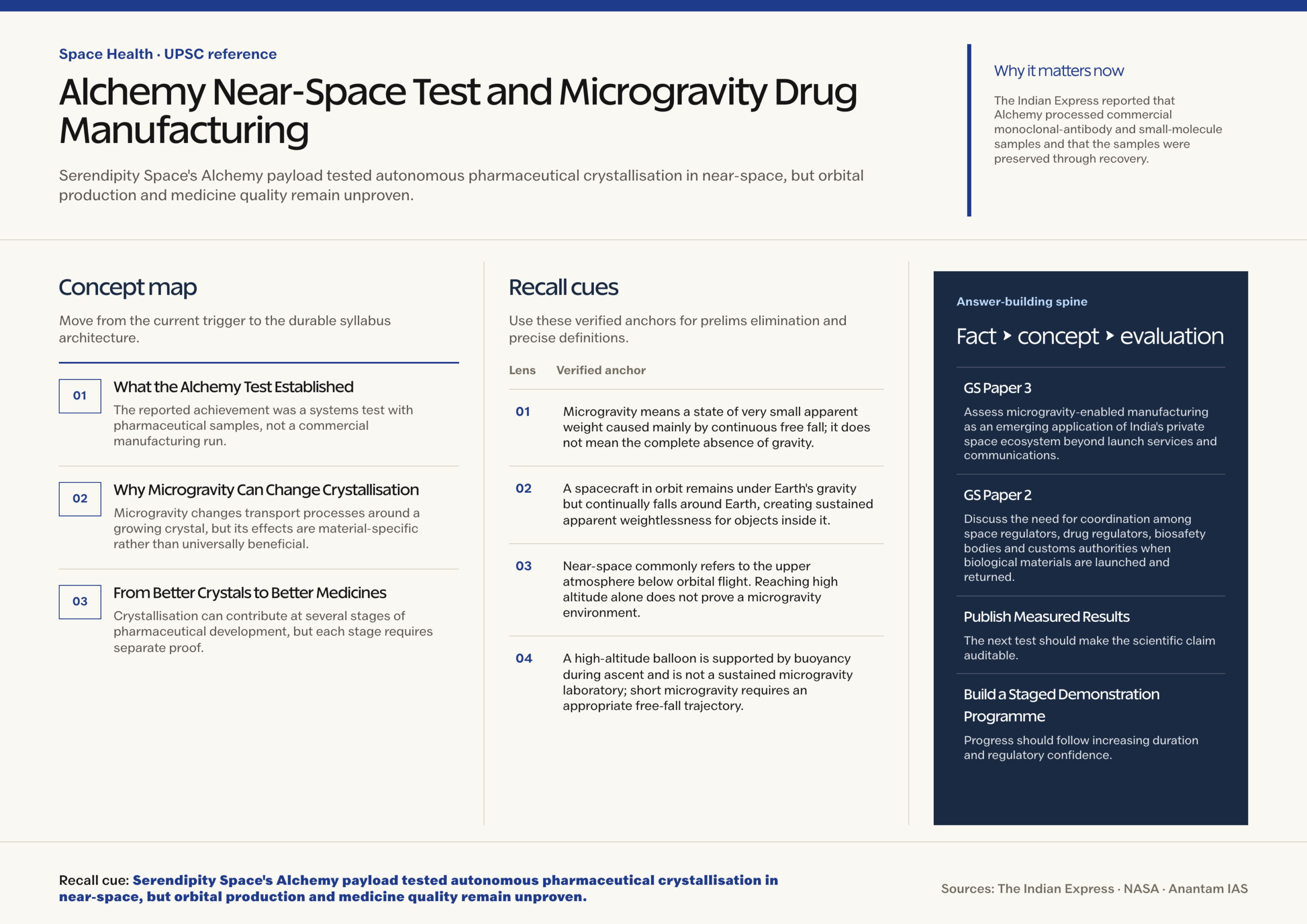
Alchemy Near-Space Test and Microgravity Drug Manufacturing
Why in News?
Bhubaneswar-based Serendipity Space reported a near-space test of Alchemy , its autonomous pharmaceutical crystallisation payload, bringing attention to India’s emerging interest in microgravity drug manufacturing .
- The Indian Express reported that Alchemy processed commercial monoclonal-antibody and small-molecule samples and that the samples were preserved through recovery.
- The payload was designed to automate operations such as controlled crystallisation, monitoring and sample protection without an onboard human operator.
- The reported flight was a near-space mission. It was not described as a satellite placed in low Earth orbit, and the public report did not establish sustained orbital microgravity.
- A near-space platform validates hardware under low pressure, thermal variation, vibration and recovery loads. It does not automatically reproduce the long-duration microgravity available on an orbiting spacecraft.
- The result is relevant because autonomous payloads and recoverable spacecraft are two enabling technologies for future in-space research and manufacturing.
- Gravity influences fluid motion, sedimentation and crystal growth. Reducing those effects can change how proteins and pharmaceutical compounds nucleate, grow and arrange themselves.
- NASA notes that microgravity protein-crystal experiments can sometimes produce larger or more orderly crystals, supporting molecular-structure studies and drug formulation research.
- Scientific promise is not the same as commercial readiness: material made in space must still pass analytical, safety, efficacy, regulatory and cost tests on Earth.
UPSC Relevance
Prelims Relevance
- Microgravity means a state of very small apparent weight caused mainly by continuous free fall; it does not mean the complete absence of gravity.
- A spacecraft in orbit remains under Earth’s gravity but continually falls around Earth, creating sustained apparent weightlessness for objects inside it.
- Near-space commonly refers to the upper atmosphere below orbital flight. Reaching high altitude alone does not prove a microgravity environment.
- A high-altitude balloon is supported by buoyancy during ascent and is not a sustained microgravity laboratory; short microgravity requires an appropriate free-fall trajectory.
- Low Earth orbit is the region of Earth orbit generally used by crewed stations and many research satellites; an object must have sufficient horizontal velocity to remain in orbit.
- Crystallisation is the ordered formation of a solid crystal from a solution, melt or vapour, and it can affect purity, particle size, solubility and stability.
Mains Relevance
GS Paper 3
- Assess microgravity-enabled manufacturing as an emerging application of India’s private space ecosystem beyond launch services and communications.
- Explain how automation, miniaturised laboratories and recoverable spacecraft can connect space science with biotechnology and advanced manufacturing.
GS Paper 2
- Discuss the need for coordination among space regulators, drug regulators, biosafety bodies and customs authorities when biological materials are launched and returned.
- Examine how public research infrastructure and transparent validation standards can support innovation while protecting patient safety.
Essay
- Frontier technologies become socially valuable only when spectacular demonstrations are converted into reproducible evidence, affordable systems and trustworthy regulation.
Background and Context
What the Alchemy Test Established
The reported achievement was a systems test with pharmaceutical samples, not a commercial manufacturing run.
- Alchemy is described as an autonomous crystallisation module intended eventually to operate on a reusable satellite and return processed samples to Earth.
- According to the company account carried by The Indian Express, the payload initiated pharmaceutical crystallisation and protected the samples during recovery.
- That result can provide evidence about automation, sample handling, environmental control, telemetry and recovery robustness under a demanding flight profile.
- The publicly available report does not provide peer-reviewed measurements of crystal size, defect density, polymorph, purity, yield, microgravity level or exposure duration.
- It also does not show that the payload completed an orbit. Calling the event an orbital factory would erase a crucial distinction between a precursor test and the intended operational system.
Why Microgravity Can Change Crystallisation
Microgravity changes transport processes around a growing crystal, but its effects are material-specific rather than universally beneficial.
- On Earth, density differences can produce buoyancy-driven convection, while gravity can make particles or crystals settle. Both processes influence how solute reaches a crystal surface.
- In sustained microgravity, diffusion becomes more important because sedimentation and buoyancy-driven convection are greatly reduced. Under suitable conditions, growth can be slower and more orderly.
- NASA reports that some protein-crystal experiments have produced larger or more uniform crystals, which can yield clearer diffraction data and a more precise view of molecular structure.
- For small-molecule drugs, the important questions can include crystal form or polymorph, particle-size distribution, stability, dissolution and manufacturability.
- Microgravity does not guarantee a better crystal. Temperature gradients, vibrations, impurities, nucleation conditions, hardware design and mission duration can all change the outcome. A ground-control sample is essential for comparison.
From Better Crystals to Better Medicines
Crystallisation can contribute at several stages of pharmaceutical development, but each stage requires separate proof.
- Well-ordered protein crystals can help researchers resolve a target’s molecular structure and identify where a potential drug might bind. This supports drug discovery rather than directly producing a treatment.
- Crystal engineering can also help select a stable solid form, improve processability or study how a compound dissolves. These are formulation advantages, not automatic evidence of clinical benefit.
- NASA describes International Space Station work on monoclonal-antibody crystallisation that explored whether concentrated crystalline suspensions could support easier routes of administration than prolonged intravenous infusion.
- A candidate formulation must still undergo physical and chemical characterisation, stability studies, pre-clinical work where applicable, controlled clinical trials and regulatory review.
- Claims such as ‘purer’, ‘more soluble’ or ‘more effective’ must be tied to measurements for the specific compound. They cannot be inferred merely from the word microgravity.
What Decades of Orbital Research Show
Established space-station research gives the idea a scientific basis while also showing why careful qualification matters.
- NASA says protein-crystal growth has been one of the most extensively studied categories of research aboard the International Space Station. The objective is often to obtain crystals suitable for structural analysis, not to mass-produce a.
- NASA’s macromolecular-crystal guide explains that reduced sedimentation and convection can support larger and more ordered crystals. Its wording is conditional because results vary across proteins, crystallisation methods and flight environments.
- Space-station experiments have examined proteins linked to disease targets and the crystallisation behaviour of monoclonal antibodies. Such experiments can generate structural knowledge or formulation leads that researchers then test on Earth.
- An orbiting laboratory offers long exposure and well-characterised environmental data, but it is expensive and dependent on launch schedules. A free-flying autonomous payload seeks to reduce crew time and make missions more repeatable.
- A commercially useful platform needs a matched terrestrial experiment with the same sample, hardware, thermal history and operating sequence. Without this control, researchers cannot isolate the contribution of microgravity from other flight stresses.
Way Forward
Publish Measured Results
- Release the flight profile, acceleration record, temperature history, exposure duration and recovery timeline alongside results from a matched ground-control sample.
- Use independent laboratories to compare crystal structure, polymorph, purity, particle size, stability and dissolution with pre-declared methods.
- Separate engineering success, process success and pharmaceutical improvement in all public reporting.
Conclusion
- Alchemy’s near-space flight is a credible signal that Indian start-ups are exploring autonomous laboratories and recoverable manufacturing payloads.
- The larger opportunity is real but conditional.
UPSC Practice Questions
Prelims MCQ 1
With reference to microgravity and pharmaceutical crystallisation, consider the following statements:
- An orbiting spacecraft experiences microgravity mainly because it and its contents are in continuous free fall.
- Every payload taken to near-space necessarily experiences sustained microgravity.
- Reduced sedimentation and buoyancy-driven convection can alter crystal growth in microgravity.
How many of the above statements are correct?
(a) Only one (b) Only two (c) All three (d) None
Answer: (b) Only two
Explanation:
Statements 1 and 3 are correct. Orbit produces apparent weightlessness through continuous free fall, and reduced sedimentation and convection can affect crystal growth. Near-space denotes a region or flight environment; altitude alone does not guarantee sustained microgravity.
Prelims MCQ 2
Which one of the following most accurately describes a pharmaceutical protein-crystal experiment in microgravity?
(a) It proves that the resulting medicine is safe and effective in humans (b) It eliminates the need for ground-control samples (c) It may improve structural or formulation research, but the specific result still requires measurement and regulatory validation (d) It can operate only when astronauts manually handle every sample
Answer: (c) It may improve structural or formulation research, but the specific result still requires measurement and regulatory validation
Explanation:
Microgravity can sometimes improve crystal order or enable useful formulation studies, but it does not establish clinical safety, efficacy or commercial manufacturability. Autonomous payloads can also operate without continuous astronaut handling.
UPSC Mains Questions
- Microgravity manufacturing is as much a problem of evidence and regulation as it is of spacecraft engineering. Discuss with reference to pharmaceutical crystallisation. (250 words)
- Differentiate near-space testing, suborbital microgravity and orbital manufacturing. How should India design a staged pathway for commercial space-biotechnology missions? (250 words)
Sources: The Indian Express and NASA.
Frequently Asked Questions
What is microgravity drug manufacturing?
Microgravity drug manufacturing uses the near-weightless environment of a free-falling spacecraft to study or process pharmaceutical materials. Reduced sedimentation and buoyancy-driven convection can alter protein or small-molecule crystallisation. The phrase covers research and formulation work; it does not mean every.
What did Serendipity Space test with Alchemy?
The company reported that its autonomous Alchemy payload initiated crystallisation of monoclonal-antibody and small-molecule samples during a near-space mission and preserved them through recovery. The public report supports an early technology demonstration, not a completed orbital manufacturing campaign or a.
Is near-space the same as low Earth orbit?
No. Near-space generally refers to high-altitude atmospheric flight below orbit. An orbital spacecraft has enough horizontal velocity to keep falling around Earth. A near-space test can validate hardware and recovery, but sustained orbital microgravity requires a different trajectory and usually.
Why can microgravity produce different crystals?
On Earth, gravity drives sedimentation and can contribute to buoyancy-driven fluid motion around a growing crystal. In microgravity those effects are reduced, so diffusion can dominate transport. Under suitable conditions this may support larger or better-ordered crystals, though the outcome.
Do better crystals automatically mean a better drug?
No. Better-ordered protein crystals may improve structural analysis, while a useful pharmaceutical crystal form may affect stability or dissolution. Each claim requires compound-specific measurements. Any medicine or formulation must still pass quality, safety, efficacy and regulatory requirements before it can.
Source: https://anantamias.com/current-affairs/microgravity-drug-manufacturing-autonomous-satellite/
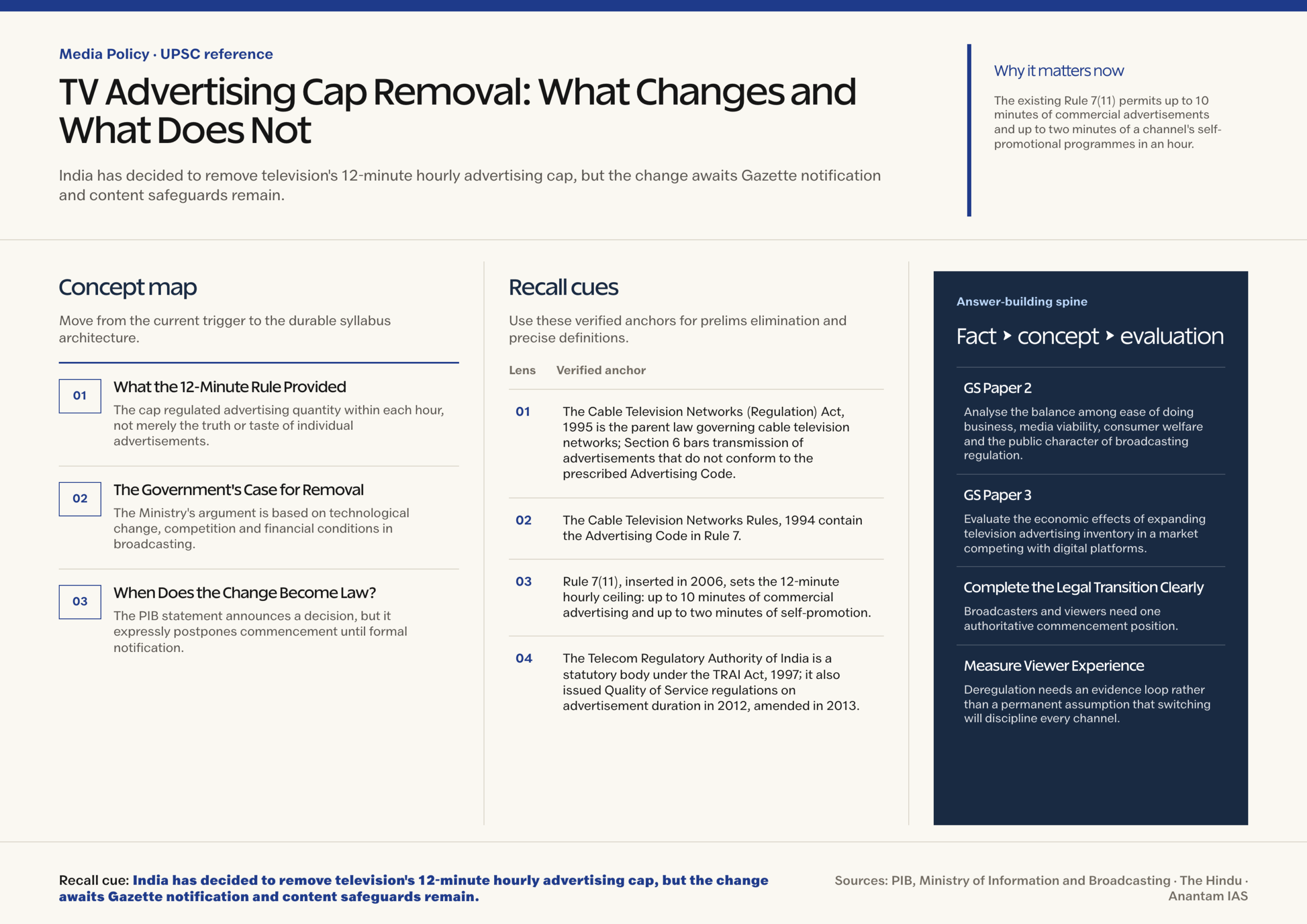
TV Advertising Cap Removal: What Changes and What Does Not
Why in News?
On August 14, 2026, the Ministry of Information and Broadcasting announced the TV advertising cap removal , ending the policy of limiting advertisements to 12 minutes in each hour.
- The existing Rule 7(11) permits up to 10 minutes of commercial advertisements and up to two minutes of a channel’s self-promotional programmes in an hour.
- The government said the cap was introduced in 2006, when India had 62 television channels, compared with more than 900 at present.
- It cited digitisation of Cable TV, DTH, HITS and IPTV, wider channel choice, reliance of pay and free-to-air channels on advertising, and competition from digital media.
- The announcement removes a proposed quantitative ceiling; it does not repeal the remaining Advertising Code or legal restrictions on misleading, prohibited, unsafe or offensive advertisements.
- A separate TRAI regulation also contains a 12-minute-per-clock-hour ceiling. The PIB release spoke only of amending the Cable Television Networks Rules and did not identify a parallel amendment or repeal by TRAI.
- The distinction between a policy announcement and an operative rule matters: a statutory rule continues until the legally prescribed amendment is notified.
- The change may increase advertising inventory and broadcaster revenue options, but it can also increase interruptions and reduce the viewer’s effective programme time.
- Competition can discipline some channels because viewers may switch, yet market choice does not protect every viewer equally, particularly for unique news, sports or regional content.
UPSC Relevance
Prelims Relevance
- The Cable Television Networks (Regulation) Act, 1995 is the parent law governing cable television networks; Section 6 bars transmission of advertisements that do not conform to the prescribed Advertising Code.
- The Cable Television Networks Rules, 1994 contain the Advertising Code in Rule 7.
- Rule 7(11), inserted in 2006, sets the 12-minute hourly ceiling: up to 10 minutes of commercial advertising and up to two minutes of self-promotion.
- The Telecom Regulatory Authority of India is a statutory body under the TRAI Act, 1997; it also issued Quality of Service regulations on advertisement duration in 2012, amended in 2013.
- TRAI Regulation 3 uses a clock hour, meaning a fixed sixty-minute period such as 2 p.m. to 3 p.m., rather than any rolling sixty minutes.
- The Delhi High Court in 9X Media Pvt. Ltd. v. TRAI, decided on May 29, 2026, upheld Rule 7(11) and TRAI’s duration regulation as constitutionally valid.
Mains Relevance
GS Paper 2
- Analyse the balance among ease of doing business, media viability, consumer welfare and the public character of broadcasting regulation.
- Explain how the parent Act, delegated rules, TRAI regulations, self-regulation and consumer law form overlapping layers of advertisement governance.
GS Paper 3
- Evaluate the economic effects of expanding television advertising inventory in a market competing with digital platforms.
- Discuss regulatory convergence and asymmetry between linear television and internet advertising.
Essay
- Deregulation is not the absence of rules; it is a decision about which risks markets can manage and which safeguards the state must preserve.
Background and Context
What the 12-Minute Rule Provided
The cap regulated advertising quantity within each hour, not merely the truth or taste of individual advertisements.
- Rule 7(11) of the 1994 Rules states that no programme may carry advertisements exceeding 12 minutes per hour, divided into a maximum of 10 commercial minutes and two self-promotional minutes.
- The limit was added through notification R. 452(E) dated July 31, 2006. It created a uniform statutory ceiling across covered television programming.
- TRAI’s 2012 Quality of Service framework also limited broadcasters to 12 minutes in a clock hour. The 2013 amendment simplified the operative rule while retaining the same overall ceiling.
- The fixed-clock-hour method prevents a broadcaster from carrying unused advertising time from one hour into the next and clustering unusually long breaks around popular programmes.
- The quantitative cap served a quality-of-experience purpose: subscribers pay for access to programming, while excessive interruptions can reduce the service they effectively receive.
The Government's Case for Removal
The Ministry’s argument is based on technological change, competition and financial conditions in broadcasting.
- PIB contrasted 62 channels in 2006 with more than 900 channels at present, arguing that viewers now have far greater choice among services.
- The earlier analogue cable system had limited carriage capacity. Digitised Cable TV, DTH, HITS and IPTV platforms can carry hundreds of channels and support greater genre and language diversity.
- Both pay and free-to-air channels remain dependent on advertising. Removing a rigid ceiling gives broadcasters more freedom to choose a mix of subscription, sponsorship, self-promotion and commercial inventory.
- Digital platforms do not face the same television-specific hourly cap. The Ministry views this as a non-level playing field when linear broadcasters compete for advertising expenditure and audience attention.
- The government considers competition within television and between television and digital media adequate to restrain poor choices, because viewers and advertisers can shift to alternatives.
When Does the Change Become Law?
The PIB statement announces a decision, but it expressly postpones commencement until formal notification.
- The August 14 release says the decision shall take effect from the date on which the amendment to the 1994 Rules is notified in the Official Gazette.
- Until that notification is issued and its commencement clause is read, the press release should not be treated as authority for exceeding the extant Rule 7(11) ceiling.
- The Gazette text will show the exact drafting device, likely deletion or substitution of Rule 7(11), the effective date and whether any transitional provision applies.
- There is also a distinct legal layer: Regulation 3 of TRAI’s advertisement-duration regulations. The Delhi High Court treated the statutory rule and TRAI regulation as related but separately sourced measures.
- The PIB release does not say that TRAI has repealed or amended Regulation 3. A complete legal transition requires the government and TRAI to clarify how the separate regulation will be aligned.
What the Delhi High Court Had Upheld
The removal is a policy reversal after the existing framework survived constitutional review, not a court-ordered deletion.
- In 9X Media Pvt. Ltd. and connected petitions, broadcasters challenged Rule 7(11) and TRAI’s 2012 and 2013 regulations under Articles 14 and 19 of the Constitution.
- Broadcasters argued that the restriction constrained commercial expression and revenue and that TRAI lacked authority to regulate advertisement duration as a Quality of Service matter.
- The Delhi High Court held that advertisement duration materially affects viewer experience and falls within TRAI’s evolving Quality of Service mandate.
- It treated the cap as a neutral time-based regulation, found the classification between programming and advertising rational, and upheld it as a reasonable restriction serving the general public.
- The judgment also stressed that airwaves are public property and that there is no constitutional guarantee of unlimited monetisation or broadcaster profitability.
Way Forward
Complete the Legal Transition Clearly
- Publish the Gazette amendment with an unambiguous effective date and a plain-language explanation of which part of Rule 7 changes.
- TRAI should formally state whether Regulation 3 remains, is amended or is repealed, rather than leaving compliance to inference.
- Update the Ministry’s consolidated Programme and Advertising Code and the Broadcast Seva guidance after the change takes effect.
Conclusion
- The government’s decision marks a major shift from a uniform hourly ceiling toward broadcaster discretion and market competition.
- The reform is narrower than full deregulation.
UPSC Practice Questions
Prelims MCQ 1
With reference to regulation of television advertisements in India, consider the following statements:
- The Advertising Code for cable television is prescribed in Rule 7 of the Cable Television Networks Rules, 1994.
- TRAI has issued a separate Quality of Service regulation concerning the duration of advertisements in television channels.
- Removal of the hourly duration cap automatically repeals all restrictions on misleading television advertisements.
How many of the above statements are correct?
(a) Only one (b) Only two (c) All three (d) None
Answer: (b) Only two
Explanation:
Statements 1 and 2 are correct. Rule 7 contains the television Advertising Code, and TRAI separately regulated duration as a Quality of Service matter. Removing a quantitative time ceiling does not erase content restrictions under the Code, consumer law or sector-specific statutes.
Prelims MCQ 2
The Union government’s August 2026 decision to remove the 12-minute television advertising cap was stated to become effective from which event?
(a) Publication of the PIB press release (b) Pronouncement of the Delhi High Court judgment (c) Gazette notification of the amendment to the Cable Television Networks Rules, 1994 (d) Adoption of a voluntary code by every broadcaster
Answer: (c) Gazette notification of the amendment to the Cable Television Networks Rules, 1994
Explanation:
PIB expressly stated that the decision would take effect from the date of Gazette notification of the amendment to the 1994 Rules. The press announcement communicates policy but is not itself the delegated legislation.
UPSC Mains Questions
- Removing a quantitative ceiling on television advertisements does not amount to removing advertisement regulation. Examine the legal and institutional safeguards that continue in India. (250 words)
- Can market competition adequately protect television viewers from excessive advertising? Discuss the case for evidence-based regulation in a converging television and digital-media market. (250 words)
Sources: PIB, Ministry of Information and Broadcasting and The Hindu.
Frequently Asked Questions
What was India’s 12-minute television advertising cap?
Rule 7(11) of the Cable Television Networks Rules limited a programme to 12 advertising minutes per hour: up to 10 minutes of commercial advertisements and two minutes of channel self-promotion. TRAI also maintained a 12-minute-per-clock-hour Quality of Service regulation for.
Did the PIB announcement immediately remove the cap?
No. The August 14, 2026 PIB release said the decision would take effect from the date of Gazette notification of the amendment to the Cable Television Networks Rules, 1994. The operative notification and commencement clause must be checked before treating.
Does removal allow misleading television advertisements?
No. The change concerns duration, not the legality of advertisement content. Section 6 of the 1995 Act, the remaining Rule 7 Advertising Code, the Consumer Protection Act, CCPA guidelines, ASCI-linked standards and product-specific advertising prohibitions continue to apply.
Why did the government decide to remove the cap?
The Ministry cited digitisation, growth from 62 channels in 2006 to more than 900, greater carrying capacity and viewer choice, dependence of pay and free-to-air channels on advertising, and competition with digital media that does not face the same hourly.
What is the issue with the separate TRAI regulation?
TRAI’s Regulation 3 independently states a 12-minute-per-clock-hour limit. The PIB release referred to amending the Cable Television Networks Rules but did not identify a TRAI repeal. Legal clarity requires a formal TRAI action or authoritative explanation aligning that separate regulatory.
Source: https://anantamias.com/current-affairs/tv-ad-duration-cap-removal-media-regulation/
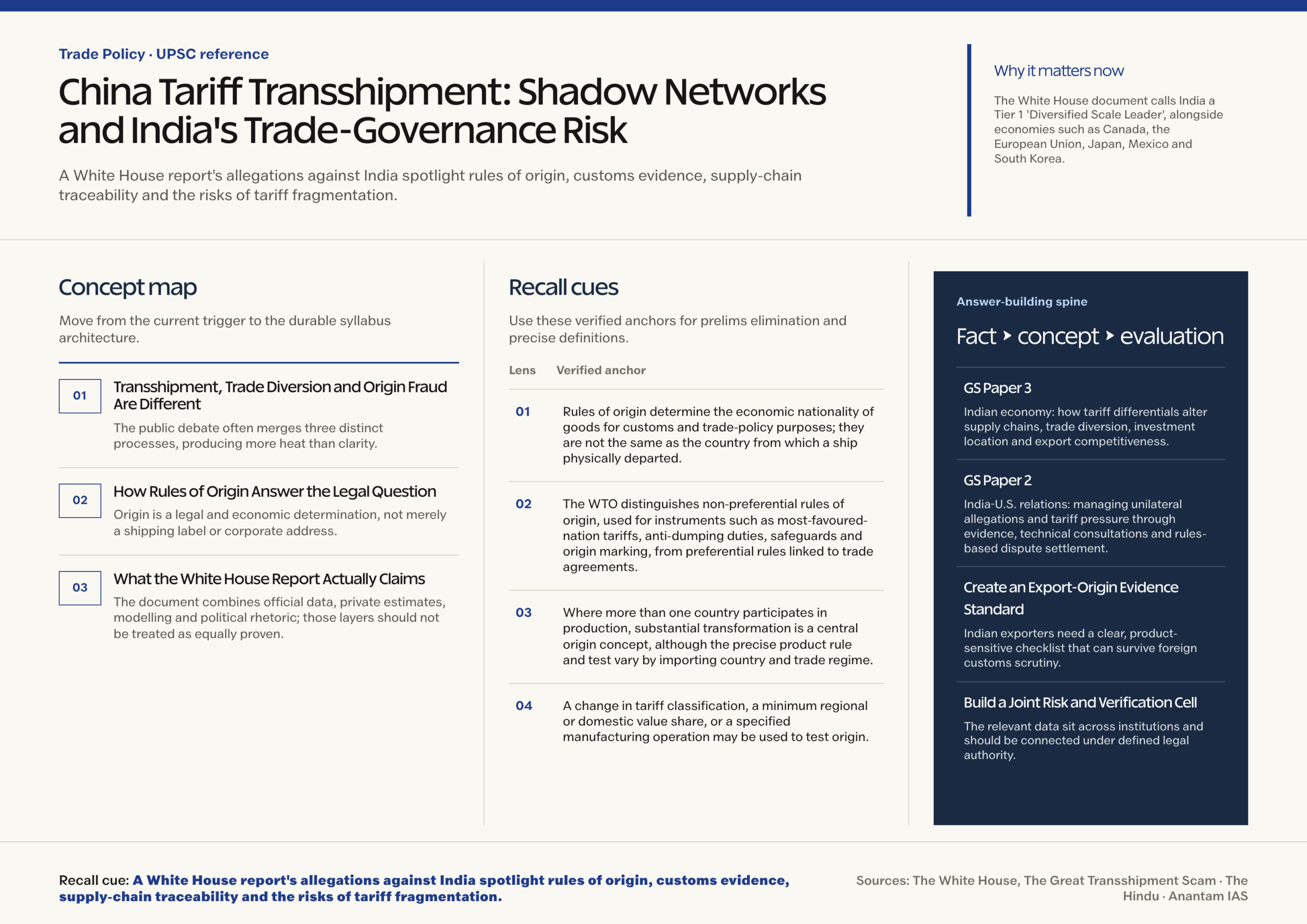
China Tariff Transshipment: Shadow Networks and India’s Trade-Governance Risk
Why in News?
An August 2026 White House report titled The Great Transshipment Scam placed India among more than 40 jurisdictions that it associates with elevated risk of illegal rerouting of China-linked goods into the United States.
- The White House document calls India a Tier 1 ‘Diversified Scale Leader’, alongside economies such as Canada, the European Union, Japan, Mexico and South Korea.
- Its own description says that this tier has large trade volumes and diversified industrial bases, with alleged transshipment risk embedded within broad legitimate trade flows.
- The report alleges that the Pune-Gujarat-Chennai production belt handles China-linked pumps and compressors under HS headings 8413-8414 for onward U.S. trade. The document does not publicly identify individual Indian firms or present a judicial finding against.
- A U.S. Department of Commerce Office of Trade and Economic Analysis estimate reproduced in the report flags about $67 billion in 2025 U.S.-bound goods across Mexico, India and Vietnam, with an estimated $28 billion tariff loss.
- The White House report acknowledges that the fall in China’s direct share of U.S. imports and the rise of imports from third countries do not establish that all displaced trade was illegally transshipped; some change reflects.
- Transshipment in its ordinary logistics sense is not illegal: cargo is routinely transferred through an intermediate port or country. Illegality arises when routing or minor handling is used to make a false country-of-origin declaration or evade.
- A product can lawfully become originating in a third country if it meets the importing country’s applicable rules of origin, often through substantial transformation, specified processing, a tariff-classification change or a value-content test.
- The importing country applies its own origin law to decide tariff treatment. A certificate of origin is important evidence, but customs authorities may examine production records, input sourcing, factory capacity, ownership, invoices, bills of lading and.
UPSC Relevance
Prelims Relevance
- Rules of origin determine the economic nationality of goods for customs and trade-policy purposes; they are not the same as the country from which a ship physically departed.
- The WTO distinguishes non-preferential rules of origin, used for instruments such as most-favoured-nation tariffs, anti-dumping duties, safeguards and origin marking, from preferential rules linked to trade agreements.
- Where more than one country participates in production, substantial transformation is a central origin concept, although the precise product rule and test vary by importing country and trade regime.
- A change in tariff classification, a minimum regional or domestic value share, or a specified manufacturing operation may be used to test origin.
- Simple relabeling, repackaging, re-invoicing, warehousing or minor processing usually does not by itself prove a new origin; the applicable legal rule decides the result.
- HS refers to the Harmonized Commodity Description and Coding System. The White House report links its India allegation to pumps and compressors under HS headings 8413 and 8414.
Mains Relevance
GS Paper 3
- Indian economy: how tariff differentials alter supply chains, trade diversion, investment location and export competitiveness.
- Trade governance: origin certification, customs risk management, data interoperability, factory-level verification and prevention of shell trading entities.
GS Paper 2
- India-U.S. relations: managing unilateral allegations and tariff pressure through evidence, technical consultations and rules-based dispute settlement.
- International institutions: the WTO Agreement on Rules of Origin, customs cooperation and the limits of global harmonisation in non-preferential origin rules.
Essay
- In a fragmented trading system, the credibility of a product’s origin can become as valuable as the product itself.
Background and Context
Transshipment, Trade Diversion and Origin Fraud Are Different
The public debate often merges three distinct processes, producing more heat than clarity.
- Ordinary transshipment occurs when cargo is transferred through an intermediate hub for logistical reasons. The origin of the product does not automatically change, and the shipment can remain fully lawful.
- Trade diversion occurs when tariffs or other policies shift sourcing toward a different country. A Chinese producer may move real investment, machinery, workers and production to India; if the required transformation occurs, the resulting export may.
- Origin fraud occurs when a trader falsely declares origin, alters paperwork, or uses insufficient processing to obtain tariff treatment that the product does not legally qualify for. That is the conduct at issue in the White.
- A rise in Indian imports of inputs from China followed by higher Indian exports of related goods to the U.S. is a risk indicator, not proof. Investigators must test firm-level production, timing, value addition, product.
- The distinction matters for the burden of proof. Customs may select a shipment for examination based on risk, but an adverse determination should identify the relevant rule, verified facts and why the declared processing did.
How Rules of Origin Answer the Legal Question
Origin is a legal and economic determination, not merely a shipping label or corporate address.
- Goods wholly obtained in one country, such as many agricultural or mineral products, present the simpler case. Manufactured goods with inputs from several countries require a product-specific origin test.
- One test asks whether processing created a specified change in tariff classification. Another calculates local or regional value content. A third requires a named manufacturing operation; rules may combine these approaches.
- The phrase substantial transformation captures the general idea that processing should create a product with a new identity or economically meaningful manufacturing contribution. Its exact legal application is jurisdiction- and product-specific.
- Minimal operations such as sorting, simple packing, affixing labels or routing goods through a bonded warehouse usually cannot carry the same origin weight as machining, casting, complex assembly or production of essential components.
- The WTO Agreement on Rules of Origin seeks clarity, objectivity, predictability and impartial administration for non-preferential rules. The unfinished harmonisation project means national practices can still differ, adding compliance risk for exporters.
What the White House Report Actually Claims
The document combines official data, private estimates, modelling and political rhetoric; those layers should not be treated as equally proven.
- The report identifies more than 40 jurisdictions associated with elevated risk and places India in a tier of large, diversified trade partners. Its tier label is a risk classification created by the report, not a multilateral.
- It uses the term ‘China-linked goods’ broadly for goods showing possible Chinese content, ownership, finance, suppliers, production steps or routing history. Such links may guide scrutiny but do not by themselves establish Chinese customs origin or.
- For India, it highlights pumps and compressors under HS 8413-8414 and the Pune-Gujarat-Chennai belt. The corridor comparison is illustrative and does not name a charged shipment, company, customs ruling or completed enforcement case.
- The report reproduces an OTEA method that matched the same HS8 product imported from China and exported to the U.S. from the same local region in the same quarter. Exact product and time matching improve targeting.
- Its approximately $67 billion estimate covers Mexico, India and Vietnam together. Any statement assigning that full sum, or a guessed portion, to India would go beyond the published evidence.
Customs Traceability: From Certificate to Production Evidence
A defensible origin claim needs a continuous evidence chain from input purchase to finished export.
- Core records include purchase orders, supplier declarations, bills of material, invoices, transport documents, inventory movements, production logs, job-work records, energy use, wage records and export documentation.
- A customs authority can compare declared factory output with production capacity. If exports greatly exceed plausible production or follow Chinese imports too closely for the required processing, a shipment deserves closer review.
- Bills of lading, container identifiers, port dwell time, related-party invoices and repeated changes in consignee can reveal a routing pattern. Each signal remains contextual: efficient logistics and group-company trade are not illegal by definition.
- Digital certificates can reduce forgery and improve verification, but a valid certificate does not automatically prove the truth of the underlying production claim. Data from the factory, supplier and customs declaration must reconcile.
- Risk-based targeting should concentrate inspections on anomalies while allowing low-risk exporters faster clearance. This protects enforcement resources and avoids turning every global supply chain into a suspect transaction.
Way Forward
Create an Export-Origin Evidence Standard
- Link non-preferential certificate applications to a secure evidence pack containing bills of material, supplier origin, transformation steps, value addition and production records, with proportional requirements for risk and firm size.
- Publish sector-specific examples of sufficient and insufficient processing without pretending that one formula governs every importing country’s law.
- Enable rapid verification of certificate authenticity and authorised issuing agencies while preserving commercially confidential factory data.
Conclusion
- The White House report puts India inside a politically charged account of Chinese tariff evasion, but its India references are risk indicators and allegations, not a completed legal finding.
- India’s strongest response is neither denial by slogan nor acceptance of another government’s narrative.
UPSC Practice Questions
Prelims MCQ 1
With reference to rules of origin in international trade, consider the following statements:
- They help determine the economic nationality of goods for the application of trade-policy measures.
- Preferential and non-preferential rules of origin serve exactly the same legal purpose in every case.
- A change in tariff classification or a value-content requirement may be used to assess whether sufficient production occurred in a country.
How many of the above statements are correct?
(a) Only one (b) Only two (c) All three (d) None
Answer: (b) Only two
Explanation:
Statements 1 and 3 are correct. Preferential rules determine eligibility for a trade preference, while non-preferential rules may be used for MFN tariffs, trade remedies, quotas, origin marking and statistics. Their functions are not identical in every case.
Prelims MCQ 2
Which one of the following would be the strongest evidence that goods exported from a third country acquired origin there rather than merely passing through it?
(a) The goods spent several days in a bonded warehouse (b) The exporter replaced the outer packaging and invoice (c) Verified production records show that the product met the applicable substantial-transformation rule (d) The vessel carrying the goods departed from a port in that country
Answer: (c) Verified production records show that the product met the applicable substantial-transformation rule
Explanation:
Physical routing, warehousing, repackaging or a new invoice does not by itself confer origin. The strongest evidence is that actual production met the importing country’s applicable origin rule, supported by verifiable records.
UPSC Mains Questions
- A change in trade route is an investigative signal, not proof of origin fraud. Explain how rules of origin and customs traceability should distinguish legitimate value addition from tariff evasion. (250 words)
- How should India respond when a major trading partner links Indian production corridors to third-country tariff evasion? Discuss the economic, diplomatic and governance dimensions. (250 words)
Sources: The White House, The Great Transshipment Scam and The Hindu.
Frequently Asked Questions
What has the White House report alleged about India?
It places India among jurisdictions it associates with elevated illegal-transshipment risk and highlights the Pune-Gujarat-Chennai belt for pumps and compressors. This is a U.S. executive-branch risk assessment and allegation, not a court or customs finding against India or every firm.
Is transshipment itself illegal?
No. Cargo is routinely transferred through intermediate ports and logistics hubs. It becomes unlawful when routing, relabeling, false documentation or insufficient processing is used to misstate origin and obtain tariff treatment that the goods do not qualify for under the.
What are rules of origin?
They are laws and administrative criteria used to determine a product’s economic nationality. Depending on the regime and product, origin may depend on where a good was wholly obtained, whether substantial transformation occurred, a tariff-classification change, a value-content threshold or.
Does using Chinese inputs make an Indian export Chinese?
Not automatically. Modern manufacturing often uses imported components. The answer depends on the applicable origin rule and the processing performed in India. Genuine transformation supported by production and cost records may confer Indian origin; minor handling or relabeling usually will.
What does the report’s $67 billion figure say about India?
The figure is an aggregate estimate for U.S.-bound goods routed through Mexico, India and Vietnam in 2025 under one Office of Trade and Economic Analysis method. The report does not publish an India-only amount, so assigning the whole figure or.
Source: https://anantamias.com/current-affairs/china-tariff-transshipment-shadow-networks-india/
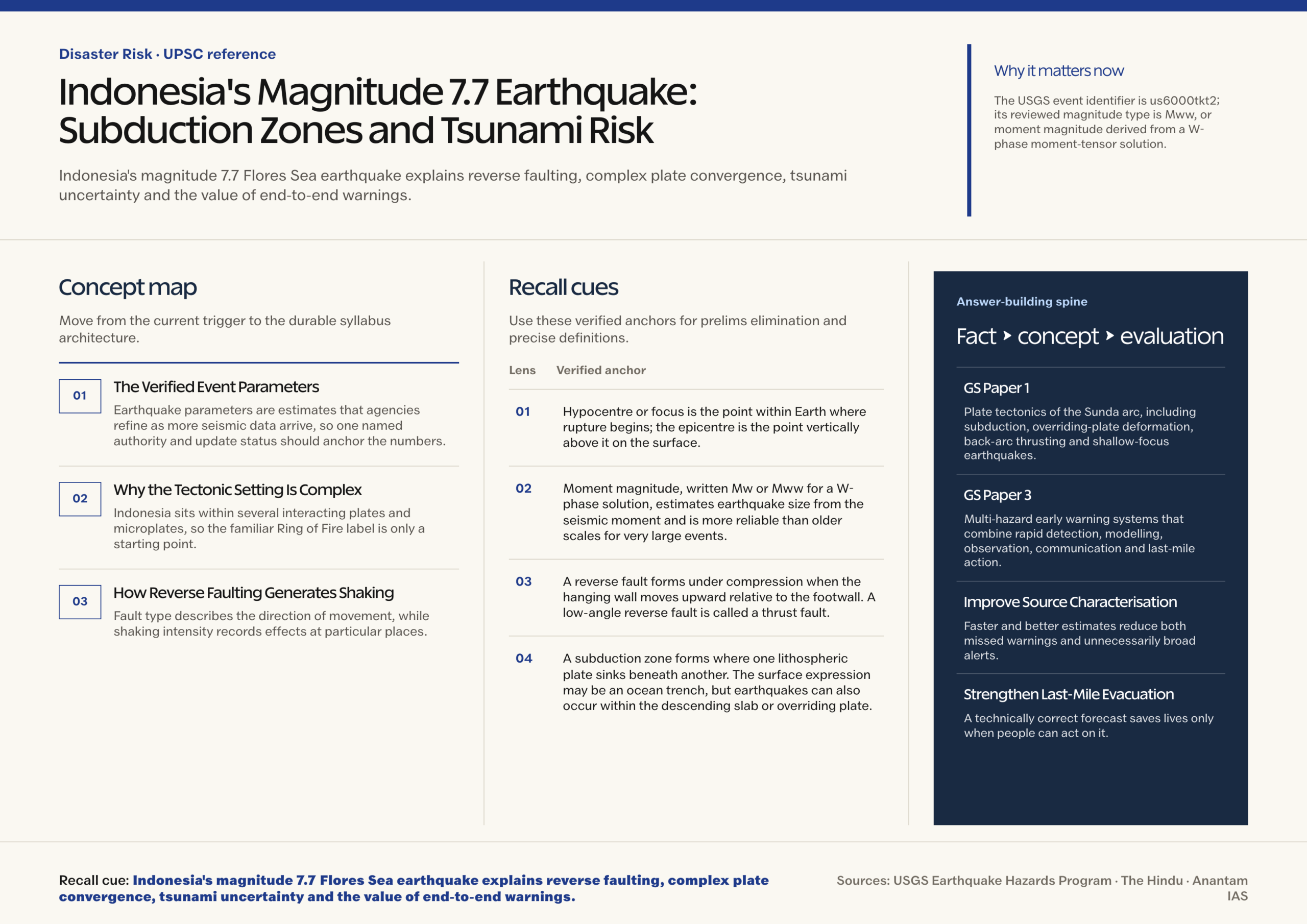
Indonesia’s Magnitude 7.7 Earthquake: Subduction Zones and Tsunami Risk
Why in News?
A major magnitude 7.7 earthquake struck the Flores Sea region of Indonesia early on August 15, 2026, local and Indian time.
- The USGS event identifier is us6000tkt2; its reviewed magnitude type is Mww, or moment magnitude derived from a W-phase moment-tensor solution.
- The origin time was 21:58:21 UTC on August 14, equivalent to 03:28:21 IST on August 15. The epicentre was at about 8.31° south latitude and 121.35° east longitude.
- USGS described the event as shallow reverse faulting off the northern coast of East Nusa Tenggara, in a region shaped by convergence between the Australian and Sunda plates.
- Its preliminary mechanism and location indicate that rupture likely occurred on a thrust fault within the overriding Sunda plate. It should not be casually described as a rupture directly on the Sunda Trench megathrust, which lies.
- Indonesia’s Meteorology, Climatology and Geophysics Agency, BMKG, issued a tsunami warning after the earthquake. Such a warning is a protective decision under uncertainty, not proof that a damaging tsunami has already formed.
- The earthquake occurred north of Flores, while the Sunda Trench, where the Australian plate descends beneath the Sunda plate, lies roughly 350 km south of the event according to USGS.
- USGS estimates relative northward motion of the Australian plate at about 69 mm per year at this location, but deformation is distributed across a complex plate-boundary zone rather than one simple fault line.
- A tsunami warning system must act before every parameter is final. Initial seismic data support a rapid forecast; tide gauges, deep-ocean sensors and revised source models then confirm, revise or cancel the threat.
UPSC Relevance
Prelims Relevance
- Hypocentre or focus is the point within Earth where rupture begins; the epicentre is the point vertically above it on the surface.
- Moment magnitude, written Mw or Mww for a W-phase solution, estimates earthquake size from the seismic moment and is more reliable than older scales for very large events.
- A reverse fault forms under compression when the hanging wall moves upward relative to the footwall. A low-angle reverse fault is called a thrust fault.
- A subduction zone forms where one lithospheric plate sinks beneath another. The surface expression may be an ocean trench, but earthquakes can also occur within the descending slab or overriding plate.
- The Sunda Trench runs along the southern side of the Indonesian island arc. The Flores region also contains active back-arc thrust structures north of the volcanic arc.
- Shallow offshore reverse faulting can favour vertical seafloor displacement, but magnitude alone cannot establish whether a destructive tsunami has been generated.
Mains Relevance
GS Paper 1
- Plate tectonics of the Sunda arc, including subduction, overriding-plate deformation, back-arc thrusting and shallow-focus earthquakes.
- Difference between an earthquake’s point location and the much larger fault area that actually ruptures.
GS Paper 3
- Multi-hazard early warning systems that combine rapid detection, modelling, observation, communication and last-mile action.
- Risk as the interaction of hazard, exposure, vulnerability and capacity, rather than magnitude as a stand-alone measure.
Essay
- Preparedness is the institutional ability to act before uncertainty has disappeared.
Background and Context
The Verified Event Parameters
Earthquake parameters are estimates that agencies refine as more seismic data arrive, so one named authority and update status should anchor the numbers.
- The reviewed USGS solution records Mww 7.7, a location 68 km north-northwest of Ende, Indonesia, and a hypocentral depth of 10 km.
- The event occurred in the Flores Sea off the northern coast of East Nusa Tenggara. This geographic placement is more precise than simply saying that it occurred on Indonesia’s Pacific Ring of Fire.
- Depth strongly affects shaking near the source. A shallow earthquake usually sends seismic energy through less overlying rock before it reaches the surface, though damage still depends on distance, site conditions and buildings.
- A map symbol marks the epicentre, but the rupture is not a point. USGS notes that a reverse-faulting earthquake of this size is typically associated with slip across a fault area roughly 90 km long and.
- Aftershocks are expected as the crust adjusts to the new stress distribution. Their timing and exact magnitude cannot be predicted, so already weakened structures require caution.
Why the Tectonic Setting Is Complex
Indonesia sits within several interacting plates and microplates, so the familiar Ring of Fire label is only a starting point.
- South of the Lesser Sunda Islands, oceanic lithosphere of the Australian plate converges with and descends beneath the Sunda plate along the Sunda Trench.
- USGS places the trench about 350 km south of this earthquake and gives the local relative plate motion as approximately 69 mm per year toward the north.
- Continued convergence does not vanish after subduction at the trench. Compression can be transferred into the overriding plate, producing folds and thrust faults behind the volcanic arc.
- North of Flores, the Flores back-arc thrust system accommodates part of this shortening. The earthquake’s shallow reverse-faulting mechanism is consistent with compressional deformation in the overriding Sunda plate.
- The reviewed USGS summary says the rupture was likely on a thrust fault within the overriding plate. Calling it a megathrust earthquake would erase the distinction between the plate-interface fault at the trench and faults inside.
How Reverse Faulting Generates Shaking
Fault type describes the direction of movement, while shaking intensity records effects at particular places.
- Compression pushes blocks of crust together. On a reverse fault, the block above the inclined fault surface moves up relative to the block below it.
- The focal mechanism is derived from seismic waves and shows two possible nodal planes. Additional evidence is needed to identify which plane was the actual fault surface.
- Magnitude measures the energy scale of the source and is one value for the event. Intensity varies from place to place with distance, rupture direction, soil, topography and building response.
- Soft sediment can amplify shaking, while liquefaction may occur where saturated loose sediment loses strength. Steep terrain can experience earthquake-triggered landslides.
- Disaster assessment should keep direct shaking, ground failure, tsunami and cascading failures as related but distinct hazard pathways.
When an Earthquake Produces a Tsunami
A large offshore earthquake is a reason for rapid assessment, but only certain ruptures efficiently displace the water column.
- The main seismic mechanism is rapid vertical displacement of the seabed across a broad area. Reverse and thrust faults are often capable of this, especially when rupture is shallow and beneath the sea.
- Magnitude helps estimate potential rupture size and slip, but tsunami generation also depends on depth, mechanism, fault orientation, location relative to the seabed and how much rupture reaches shallow layers.
- Submarine landslides can generate or amplify local tsunamis, sometimes adding uncertainty beyond the initial fault model.
- Bathymetry refracts and focuses waves. Bays, shelves, reefs, headlands and coastal topography can produce very different water levels at places separated by short distances.
- The USGS event record currently carries a tsunami flag of zero, while BMKG issued an initial local warning. These fields serve different systems and can reflect different mandates, data streams and update times; neither should be.
Way Forward
Improve Source Characterisation
- Integrate dense seismic networks, high-rate GNSS, ocean-bottom instruments and rapid finite-fault models to estimate rupture extent and seafloor displacement.
- Maintain redundant tide gauges and deep-ocean pressure sensors with transparent uptime monitoring and rapid data sharing.
- Design warning software to display parameter revisions and confidence, not only a single magnitude.
Conclusion
- Indonesia’s Mww 7.7 earthquake shows why tectonic precision matters.
- It also shows why warnings are provisional by design.
UPSC Practice Questions
Prelims MCQ 1
With reference to earthquake-generated tsunamis, consider the following statements:
- Every offshore earthquake of magnitude 7 or greater necessarily generates a destructive tsunami.
- Vertical displacement of the seabed over a broad area can transfer energy to the overlying water column.
- Tide gauges and deep-ocean pressure sensors can help confirm and update an initial tsunami forecast.
How many of the above statements are correct?
(a) Only one (b) Only two (c) All three (d) None
Answer: (b) Only two
Explanation:
Statements 2 and 3 are correct. Magnitude is important, but depth, fault mechanism, rupture geometry, seafloor displacement and local bathymetry also determine whether a damaging tsunami forms.
Prelims MCQ 2
Which one of the following best describes the tectonic interpretation of the August 2026 Mww 7.7 Flores Sea earthquake in the reviewed USGS summary?
(a) Normal faulting within the Australian plate at the Sunda Trench (b) Strike-slip faulting along the Mid-Atlantic Ridge (c) Shallow reverse faulting likely within the overriding Sunda plate (d) Volcanic collapse with no tectonic component
Answer: (c) Shallow reverse faulting likely within the overriding Sunda plate
Explanation:
USGS attributes the event to shallow reverse faulting and considers thrust faulting within the overriding Sunda plate the likely source. The Sunda Trench lies roughly 350 km south of the event.
UPSC Mains Questions
- A large offshore earthquake is necessary neither sufficient nor certain to generate a destructive tsunami. Explain the physical controls on tsunami generation and coastal impact. (15 marks, 250 words)
- Using the August 2026 Flores Sea earthquake as a case, explain how plate convergence can produce damaging earthquakes away from the main ocean trench. (15 marks, 250 words)
Sources: USGS Earthquake Hazards Program and The Hindu.
Frequently Asked Questions
What were the USGS parameters for the Indonesia earthquake?
The reviewed USGS record lists Mww 7.7, an epicentre 68 km north-northwest of Ende, Indonesia, and a depth of 10 km. The event began at 21:58:21 UTC on August 14, which was 03:28:21 IST on August 15.
Was the earthquake on the Sunda megathrust?
USGS does not describe it that way. Its event summary says the shallow reverse-faulting earthquake likely ruptured a thrust fault within the overriding Sunda plate. The Sunda Trench plate boundary lies approximately 350 km south of the earthquake.
Why can a reverse-fault earthquake cause a tsunami?
Reverse or thrust motion can lift or lower a large area of seabed and displace the water column above it. Tsunami size still depends on rupture depth, area, slip, orientation, water depth, bathymetry and coastal shape, so fault type alone.
Why might USGS and BMKG displays differ on tsunami status?
They serve different operational purposes and may use different data, geographic responsibilities, flags and update times. A local warning agency may issue precautionary action while source parameters are incomplete. Users should follow the latest timestamped bulletin from the responsible national.
What should coastal residents do after strong earthquake shaking?
Where a local tsunami is possible, people should move immediately to designated safe ground after strong or prolonged shaking and follow official evacuation instructions. They should remain away from the coast until the competent authority issues an all-clear because later.
Source: https://anantamias.com/current-affairs/indonesia-77-earthquake-tsunami-risk/
Jammu and Kashmir Business Rules and the Elected Union Territory
Why in News?
The Jammu and Kashmir Transaction of Business Rules returned to focus after Chief Minister Omar Abdullah said on August 14, 2026 that revised rules proposed by the elected government were still awaiting finalisation.
- The Hindu reported that the elected government had answered queries, modified its proposal and was waiting for the revised framework to be implemented.
- The report said the Lieutenant Governor’s office and Chief Minister’s office had not yet finalised the proposed rules for the elected-government phase.
- This does not mean Jammu and Kashmir has no business rules: the 2019 Rules, notified by the President in August 2020 during the Section 73 proclamation, already regulate government business and were amended in 2024.
- Section 55 of the Jammu and Kashmir Reorganisation Act says the Lieutenant Governor shall make allocation and transaction rules on the advice of the Council of Ministers, including a procedure for differences of opinion.
- The unresolved question is how a revised set will operate within powers that the Act itself assigns to the elected institutions and to the Lieutenant Governor.
- Jammu and Kashmir became a Union Territory with a legislature on October 31, 2019 under the Jammu and Kashmir Reorganisation Act, 2019.
- An elected Legislative Assembly and Council of Ministers took office in 2024, converting previously theoretical power-sharing clauses into everyday administrative questions.
- Business rules are procedural delegated legislation. They can organise statutory power, but cannot enlarge or erase powers fixed by the Constitution or the Reorganisation Act.
UPSC Relevance
Prelims Relevance
- Jammu and Kashmir is a Union Territory with a Legislative Assembly; Ladakh is a Union Territory without one.
- Article 239 provides for administration of a Union Territory by the President acting through an administrator; in Jammu and Kashmir the administrator is designated the Lieutenant Governor.
- Section 32 of the Reorganisation Act allows the J&K Assembly to legislate on applicable State List subjects except entries 1 and 2, Public Order and Police, and on applicable Concurrent List subjects.
- Parliament retains power to legislate for Jammu and Kashmir on any subject; Section 33 contains a rule on repugnancy that generally gives parliamentary or earlier law priority, subject to presidential assent and Parliament’s continuing power.
- Section 53 establishes a Council of Ministers headed by the Chief Minister to aid and advise the Lieutenant Governor within the Assembly’s legislative sphere, except where discretion applies.
- Section 53 expressly identifies matters outside the Assembly’s power, legally required discretion or judicial functions, and matters related to All India Services and the Anti-Corruption Bureau within the Lieutenant Governor’s discretionary field.
Mains Relevance
GS Paper 2
- Explain the constitutional position of a legislature-bearing Union Territory and the tension between representative accountability and centrally administered subjects.
- Distinguish statutory power under the Reorganisation Act from procedural allocation under Transaction of Business Rules.
GS Paper 3
- Examine why police, public order, All India Services and anti-corruption administration have special implications for security and civilian governance.
- Discuss the effect of prolonged administrative uncertainty on service delivery, public finance and development decisions.
Essay
- Democratic responsibility becomes credible only when citizens can identify who had the lawful power to decide and who must explain delay or failure.
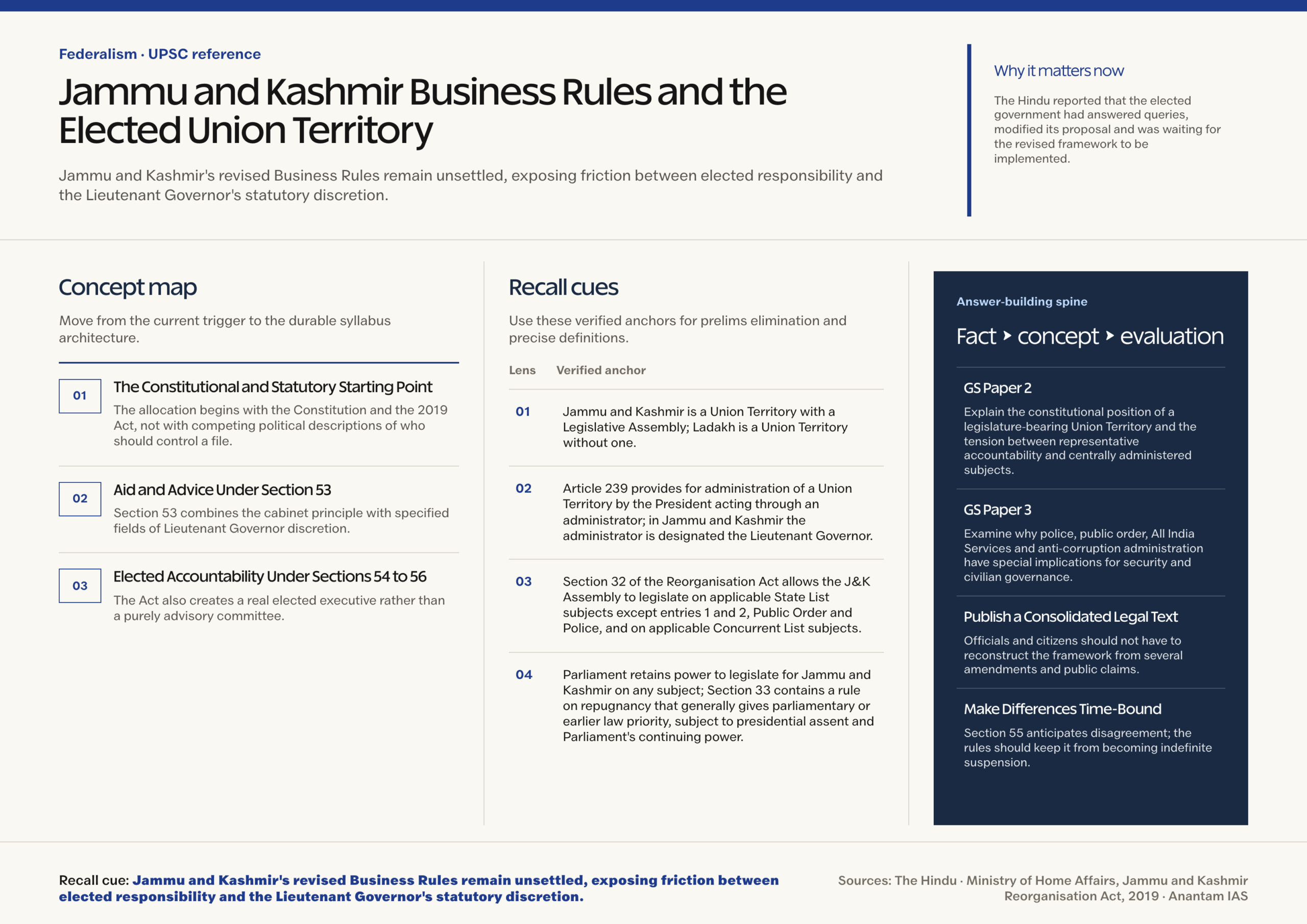
Background and Context
The Constitutional and Statutory Starting Point
The allocation begins with the Constitution and the 2019 Act, not with competing political descriptions of who should control a file.
- Under Article 239, every Union Territory is administered by the President through an appointed administrator, subject to the constitutional scheme and any law made by Parliament.
- The Reorganisation Act created the Union Territory of Jammu and Kashmir with a legislature and the Union Territory of Ladakh without a legislature from October 31, 2019.
- Section 32 gives the J&K Assembly substantial but not state-equivalent legislative competence. It excludes Public Order and Police from its State List field, while Parliament retains a plenary power to legislate for the Union Territory.
- Executive responsibility broadly follows the legislative domain, but the Act adds express discretionary areas for the Lieutenant Governor and retains Union control characteristic of a Union Territory.
- This makes J&K neither an ordinary State nor a Union Territory without representative government. It is a hybrid constitutional design whose institutions must work through carefully drawn boundaries.
Aid and Advice Under Section 53
Section 53 combines the cabinet principle with specified fields of Lieutenant Governor discretion.
- There must be a Council of Ministers, limited to not more than 10% of the Assembly’s total membership, with the Chief Minister at its head.
- The Council aids and advises the Lieutenant Governor on matters within the Legislative Assembly’s power, except where the Act or another law requires the Lieutenant Governor to act in discretion.
- Section 53(2) identifies discretion for matters outside the Assembly’s legislative power, matters where a law requires discretion or a judicial function, and matters related to All India Services and the Anti-Corruption Bureau.
- Public Order and Police fall outside the Assembly’s Section 32 competence. Their executive treatment cannot be inferred merely from a department’s name or from ordinary cabinet practice in a State.
- The Act says the Lieutenant Governor’s decision is final if a question arises on whether a matter falls within required discretion. That clause is part of the statutory text, though particular exercises of public power remain.
Elected Accountability Under Sections 54 to 56
The Act also creates a real elected executive rather than a purely advisory committee.
- The Lieutenant Governor appoints the Chief Minister and appoints other Ministers on the Chief Minister’s advice. The Council is collectively responsible to the Legislative Assembly.
- Collective responsibility means the Ministry must defend government policy in the Assembly and may remain in office only while it commands legislative confidence.
- Section 55 says the Lieutenant Governor shall make rules on the Council’s advice for allocating business to Ministers and transacting business with them.
- The same section specifically requires those rules to contain a procedure for a difference of opinion between the Lieutenant Governor and the Council or an individual Minister.
- Section 55 also provides that executive action is expressed in the Lieutenant Governor’s name and that authenticated orders cannot be challenged merely on the ground that they were not made by the Lieutenant Governor.
What Transaction of Business Rules Actually Do
Business rules convert a high-level legal settlement into a repeatable administrative workflow.
- They distribute subjects among departments, allow allocation of departments to Ministers and specify which matters a Minister, the Council, Chief Minister or Lieutenant Governor must see.
- They prescribe consultation among departments, especially with Finance and Law, and identify proposals that cannot be issued without prior concurrence.
- They define how Cabinet agendas, minutes, legislation, contracts, appointments, prosecution decisions and references to the Union Government are processed.
- They also establish the administrative chain through the Chief Secretary and departmental Secretaries, who must ensure compliance and flag departures.
- Good rules make routine cases routine and exceptional cases visible. Badly drawn or ambiguous routing can turn every file into a jurisdictional contest and make delay hard to attribute.
Way Forward
Publish a Consolidated Legal Text
- Notify the final agreed rules and publish a consolidated version incorporating the 2020 notification and all amendments.
- Include a subject-and-route schedule showing ministerial matters, discretionary matters, mandatory consultation and Union-reference cases.
- Explain the legal source beside each exceptional route so that a procedural rule is not mistaken for a new substantive power.
Conclusion
- Jammu and Kashmir’s business-rules dispute is not a contest that can be resolved by slogans about absolute control.
- The immediate need is a final, consolidated and legally faithful workflow for the elected-government phase.
UPSC Practice Questions
Prelims MCQ 1
With reference to the Jammu and Kashmir Reorganisation Act, 2019, consider the following statements:
- The Legislative Assembly of Jammu and Kashmir may make laws on Public Order and Police.
- The Council of Ministers is collectively responsible to the Legislative Assembly.
- Section 55 provides for rules covering allocation of business and the procedure for differences between the Lieutenant Governor and Ministers.
How many of the above statements are correct?
(a) Only one (b) Only two (c) All three (d) None
Answer: (b) Only two
Explanation:
Statements 2 and 3 are correct. Section 32 excludes State List entries 1 and 2, Public Order and Police, from the J&K Assembly’s legislative competence. Sections 54 and 55 provide collective responsibility and the business-rules framework respectively.
Prelims MCQ 2
Which one of the following best describes the status of the proposed revised J&K Transaction of Business Rules reported in August 2026?
(a) No business rules exist for the Union Territory (b) The Supreme Court has drafted and notified the revised rules (c) Existing rules continue, while a revised post-election framework was reported as awaiting finalisation (d) The Legislative Assembly can amend Section 53 by a simple resolution
Answer: (c) Existing rules continue, while a revised post-election framework was reported as awaiting finalisation
Explanation:
The President notified the existing 2019 Rules in August 2020 and they were later amended. Public reporting in August 2026 concerned the pending finalisation of revised rules proposed after the elected government took office, not the absence of any operative framework.
UPSC Mains Questions
- Transaction of Business Rules can clarify statutory power but cannot redistribute it beyond the parent Act. Examine this proposition in the context of Jammu and Kashmir’s elected Union Territory government. (250 words)
- How can institutional design reconcile Lieutenant Governor discretion with collective ministerial responsibility in a Union Territory with a legislature? Suggest procedural safeguards. (250 words)
Sources: The Hindu and Ministry of Home Affairs, Jammu and Kashmir Reorganisation Act, 2019.
Frequently Asked Questions
What are the J&K Transaction of Business Rules?
They are procedural rules under Section 55 of the Jammu and Kashmir Reorganisation Act. They allocate government business among Ministers, regulate file and Cabinet processes, identify matters requiring Lieutenant Governor or Union attention, and prescribe a method for handling differences.
Does Jammu and Kashmir currently have no Business Rules?
No. The Transaction of Business Rules titled as the 2019 Rules were notified by the President on August 27, 2020 and later amended. The current dispute concerns finalisation of a revised framework after an elected Council of Ministers took office.
Which subjects are outside the J&K Assembly’s legislative power?
Section 32 excludes State List entries 1 and 2, Public Order and Police. The Assembly may legislate on other applicable State List subjects and applicable Concurrent List matters, subject to the Reorganisation Act. Parliament retains power to legislate for the.
What does Section 55 require?
Section 55 says the Lieutenant Governor shall make rules on the advice of the Council of Ministers for allocating business to Ministers and for convenient transaction of business. The rules must include a procedure for a difference of opinion between.
What did the 2024 Second Amendment do?
It revised routes for specified matters involving Police, Public Order, All India Services, the Anti-Corruption Bureau, law-officer appointments, prosecution sanctions, appeals, prisons, forensic science and senior personnel postings. It amended procedural rules under Section 55; it did not amend the.
Source: https://anantamias.com/current-affairs/jammu-kashmir-transaction-business-rules/
Reform Utsav: Building a Citizen-to-Policy Governance Pipeline
Why in News?
The Indian Express reported on August 15, 2026 that the Union government plans to launch a three-month initiative called Reform Utsav to collect citizen suggestions and convert selected ideas into actionable reforms.
- According to the report, the initiative would aim to institutionalise reform through citizen participation and create a responsive pipeline from suggestion to action.
- The reported three stages are Jan Manthan or discovery, Vimarsh or deliberation, and Samadhan and Sankalp Siddhi or resolution.
- The first stage would reportedly begin on October 2, 2026 and run for one month, using a designated portal, public meetings and webinars to gather suggestions. The date and activities are plans described by newspaper sources.
- The report says artificial intelligence would sort submissions and that a multilingual call centre might be established. It does not publish the AI model, data policy, audit method or final decision rule.
- In the second stage, officials would reportedly identify quick-win reforms and prepare roadmaps for structural changes.
- Participatory governance is more than receiving comments. It requires accessible entry points, representative participation, reasoned consideration, feedback to contributors and evidence that public input changed a decision or its implementation.
- India already has distinct participation channels: MyGov for engagement, CPGRAMS for service-delivery grievances, pre-legislative consultation for draft laws, Gram Sabhas for local participation and statutory social audits in programmes such as MGNREGA.
- A new pipeline should complement these mechanisms rather than collect the same submission in several portals with different tracking numbers and no clear institutional owner.
UPSC Relevance
Prelims Relevance
- The specific Reform Utsav described in the August 2026 report is a proposal; it should not be treated as launched until an official notification or portal confirms operation.
- The reported stages are Jan Manthan, Vimarsh, and Samadhan and Sankalp Siddhi.
- MyGov is the Government of India’s citizen-engagement platform for participation in discussions, tasks, polls and consultations.
- CPGRAMS is the Centralised Public Grievance Redress and Monitoring System; it routes grievances to public authorities and provides status tracking and an appeal facility.
- The Pre-legislative Consultation Policy, 2014 calls for proposed legislation or key information about it to be placed in the public domain, ordinarily for at least 30 days, with a summary of feedback placed before the approving.
- Article 243A of the Constitution allows a Gram Sabha to exercise powers and perform functions at village level as a State legislature provides by law.
Mains Relevance
GS Paper 2
- Participatory governance: moving from one-way consultation to co-design, reasoned response, implementation tracking and public evaluation.
- Transparency and accountability: publishing selection criteria, responsible departments, deadlines, budgets, progress and reasons for accepting or rejecting proposals.
GS Paper 3
- AI in governance: multilingual classification, clustering and routing of suggestions, with safeguards against bias, manipulation, privacy breaches and opaque ranking.
- Digital public infrastructure: interoperable case identifiers, consent-based data sharing, audit logs and secure links between consultation and departmental workflow systems.
Essay
- Participation becomes democratic power only when institutions listen, explain and act.
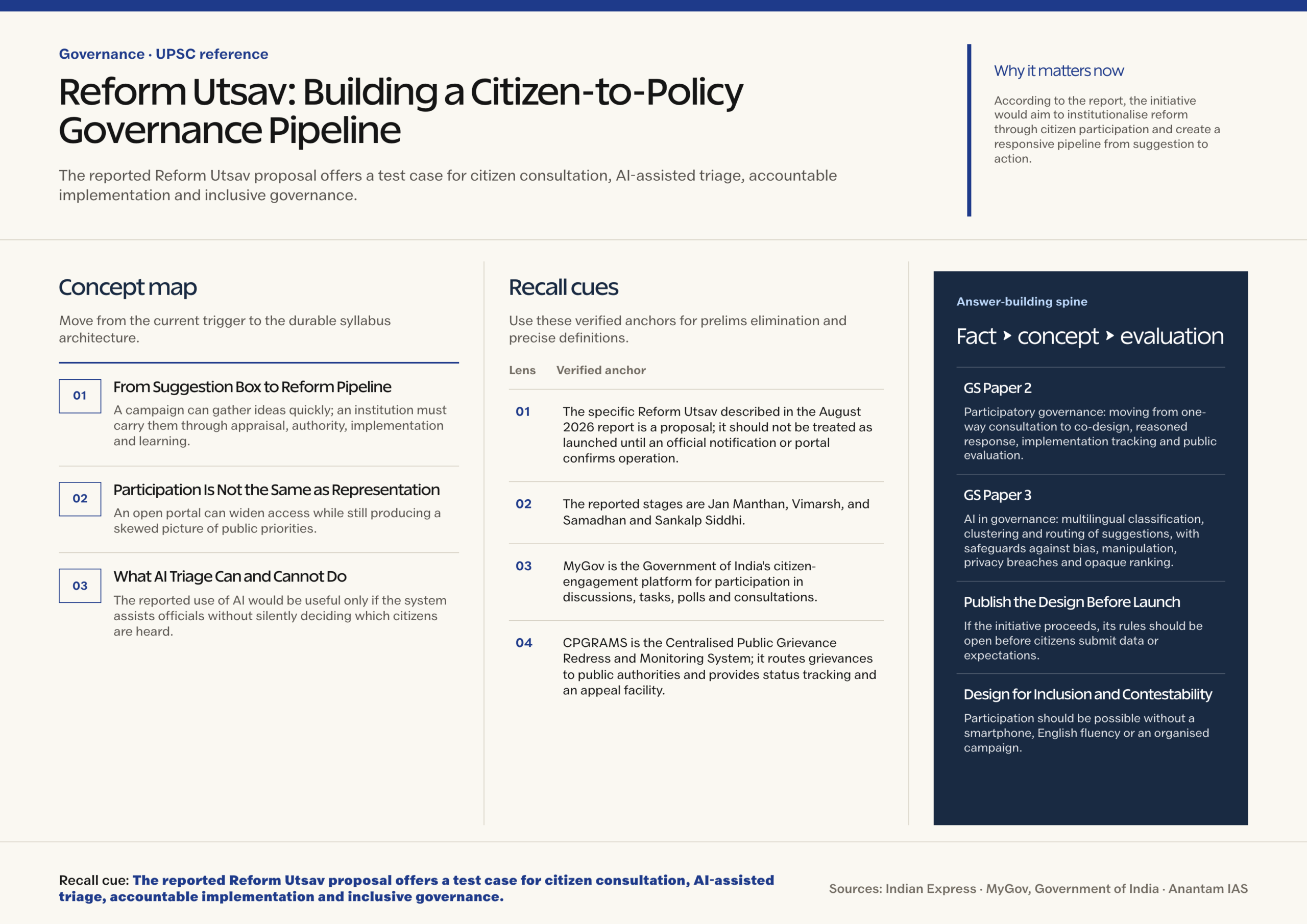
Background and Context
From Suggestion Box to Reform Pipeline
A campaign can gather ideas quickly; an institution must carry them through appraisal, authority, implementation and learning.
- The first step is intake: a citizen should be able to describe a problem, affected group, location, proposed change and supporting evidence without navigating bureaucratic categories.
- The second step is triage: submissions should be checked for duplicates, classified by theme and jurisdiction, separated from personal grievances, and routed to the office capable of acting.
- The third step is appraisal. Officials need to test legality, fiscal cost, distributional impact, administrative capacity, environmental effects, federal competence and interaction with existing policy.
- The fourth step is a reasoned decision: adopt, pilot, merge, refer, defer or reject. Each outcome should have a short public explanation rather than an unexplained status label.
- The final step is implementation and evaluation: assign an owner, milestone, resources, success measure and review date, then report whether the promised outcome occurred.
Participation Is Not the Same as Representation
An open portal can widen access while still producing a skewed picture of public priorities.
- People with reliable internet, spare time, formal education and organised networks can submit more frequently and frame requests in administrative language. Submission volume is not a representative sample of public opinion.
- A coordinated campaign may generate thousands of near-identical messages. Those messages show mobilisation, but counting each as an independent policy argument can crowd out quieter groups.
- Women, migrant workers, persons with disabilities, remote communities, linguistic minorities and people affected by digital exclusion need offline and assisted participation routes.
- Public meetings can surface local context that a web form misses, but they need advance notice, accessible venues, facilitation and records that prevent dominant speakers from controlling the agenda.
- A sound design combines open participation with targeted outreach, stakeholder mapping, representative sampling where suitable, and consultation through elected local institutions.
What AI Triage Can and Cannot Do
The reported use of AI would be useful only if the system assists officials without silently deciding which citizens are heard.
- Language models can cluster similar suggestions, detect probable duplicates, produce draft summaries, identify departments and surface recurring themes. These functions can reduce manual workload in a high-volume campaign.
- Models may perform unevenly across Indian languages, dialects, code-mixed text, voice transcripts and low-literacy expression. Fluent official prose may be ranked as clearer even when a brief local-language submission identifies a serious problem.
- Summarisation can erase qualifiers, merge incompatible proposals or convert an experience into a recommendation the citizen did not make. Officials should retain access to the original submission.
- Automated popularity scores can amplify organised campaigns and penalise novel issues with few submissions. Urgency, rights impact and severity require separate signals from frequency.
- The system should disclose where AI is used, record model and prompt versions, measure routing errors, permit human correction and periodically audit outcomes across language and social groups.
Accountability Must Close the Feedback Loop
Citizens lose trust when participation ends with a thank-you message and no visible consequence.
- Each accepted submission should receive a trackable identifier, subject classification, responsible office and current stage, while personal data remain protected.
- Departments should publish common reasons for merger, referral, rejection or delay. A reasoned response makes constraints visible and allows citizens to challenge a factual or jurisdictional error.
- A quick win should not mean a symbolic announcement. It should have a baseline, deadline, named owner, measurable service or compliance improvement and a public completion record.
- Structural reform needs a roadmap that distinguishes study, consultation, legal amendment, budget approval, technology build, field implementation and independent evaluation.
- Bi-weekly review, if adopted as reported, would improve internal follow-up only when decisions, bottlenecks and revised dates are recorded. A meeting count is not an outcome metric.
Way Forward
Publish the Design Before Launch
- Issue an official framework setting out scope, stages, decision rights, participating governments, timelines, privacy terms, moderation rules and the relationship with MyGov and CPGRAMS.
- Publish selection criteria for quick wins and structural reforms, including legality, public value, equity, cost, feasibility and strength of supporting evidence.
- Conduct a data-protection and algorithmic-impact assessment covering call recordings, sensitive narratives, multilingual models, third-party access and data retention.
Conclusion
- Reform Utsav, as reported, could create a useful bridge between scattered citizen input and cross-government action.
- Its success would depend less on the festival label or the volume of suggestions than on a durable citizen-to-policy chain : inclusive participation, transparent triage, reasoned decisions, lawful authority, named implementation owners and publicly verifiable outcomes.
UPSC Practice Questions
Prelims MCQ 1
With reference to citizen participation mechanisms in India, consider the following statements:
- CPGRAMS is primarily a platform for lodging and tracking public grievances concerning service delivery.
- Article 243A allows a Gram Sabha to exercise powers and perform functions at village level as provided by State law.
- The Pre-legislative Consultation Policy requires every public suggestion to be accepted into the final law.
How many of the above statements are correct?
(a) Only one (b) Only two (c) All three (d) None
Answer: (b) Only two
Explanation:
Statements 1 and 2 are correct. Pre-legislative consultation provides an opportunity for comments and requires consideration and documentation; it does not compel the government to accept every suggestion.
Prelims MCQ 2
In a large-scale citizen consultation, which one of the following is the most appropriate role for artificial intelligence?
(a) Automatically reject suggestions submitted by very few people (b) Make final policy decisions without departmental review (c) Cluster, summarise and route submissions subject to human oversight and audit (d) Replace statutory consultation and legislative scrutiny
Answer: (c) Cluster, summarise and route submissions subject to human oversight and audit
Explanation:
AI can assist high-volume administrative triage, but public authorities retain responsibility for legality, rights, fiscal choices and final decisions. Human review, access to original submissions, bias testing and correction mechanisms remain essential.
UPSC Mains Questions
- Participatory governance begins with consultation but succeeds only when the feedback loop is closed. Design an accountable citizen-to-policy pipeline for India. (250 words)
- Artificial intelligence can help governments hear more voices while making some voices easier to ignore. Examine the opportunities and safeguards for AI-assisted citizen consultation. (250 words)
Sources: Indian Express and MyGov, Government of India.
Frequently Asked Questions
Has Reform Utsav been officially launched?
Not on the evidence reviewed for this note. The Indian Express reported that the Union government planned a three-month initiative expected to begin on October 2, 2026. No official launch notification or operational portal for this specific campaign was identified.
What are the proposed stages of Reform Utsav?
The report describes Jan Manthan for discovery, Vimarsh for deliberation, and Samadhan and Sankalp Siddhi for resolution. Citizens would reportedly submit ideas during the first stage, officials would identify quick wins and structural roadmaps during the second, and a coordination.
How is a reform suggestion different from a grievance?
A grievance usually seeks redress for a specific service failure or administrative wrong, as through CPGRAMS. A reform suggestion proposes a systemic change affecting rules, processes or institutions. Repeated grievances may reveal a reform need, but shifting them into a.
What could AI do in a citizen-suggestion system?
AI could detect probable duplicates, cluster themes, identify language, draft summaries and route submissions to departments. It should not decide policy merit by popularity or reject citizens without review. Original submissions, audit logs, bias tests, human correction and a clear.
How can the government prevent consultation from becoming tokenistic?
It can publish selection criteria, give each shortlisted proposal a responsible office and timeline, explain acceptance or rejection, disclose progress and commission independent outcome checks. Citizens need to see not only that a comment was received but how it affected.
Source: https://anantamias.com/current-affairs/reform-utsav-citizen-participation-governance/