

Why in News?
An August 2026 White House report titled The Great Transshipment Scam placed India among more than 40 jurisdictions that it associates with elevated risk of illegal rerouting of China-linked goods into the United States.
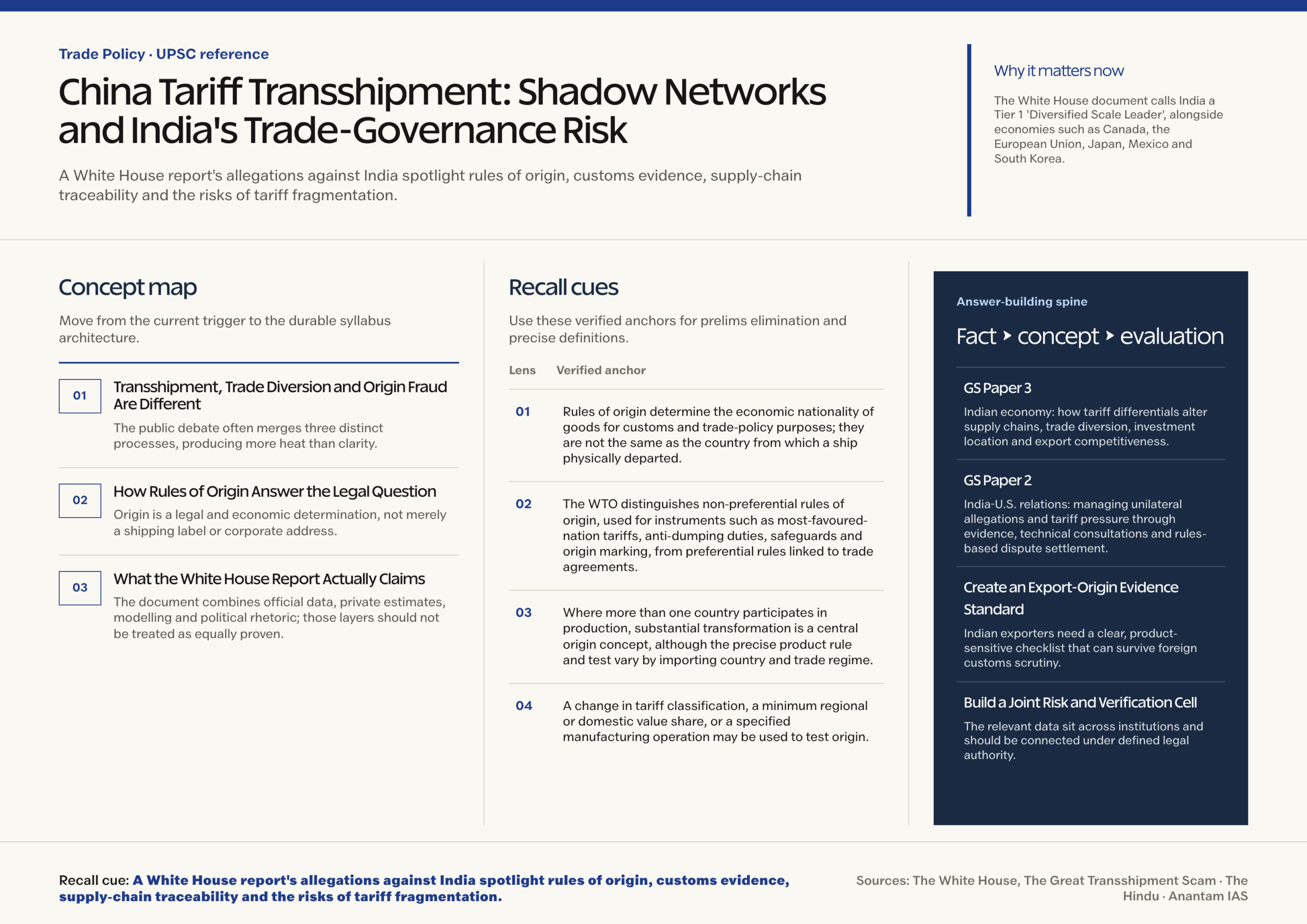
- The White House document calls India a Tier 1 ‘Diversified Scale Leader’, alongside economies such as Canada, the European Union, Japan, Mexico and South Korea.
- Its own description says that this tier has large trade volumes and diversified industrial bases, with alleged transshipment risk embedded within broad legitimate trade flows.
- The report alleges that the Pune-Gujarat-Chennai production belt handles China-linked pumps and compressors under HS headings 8413-8414 for onward U.S. trade. The document does not publicly identify individual Indian firms or present a judicial finding against.
- A U.S. Department of Commerce Office of Trade and Economic Analysis estimate reproduced in the report flags about $67 billion in 2025 U.S.-bound goods across Mexico, India and Vietnam, with an estimated $28 billion tariff loss.
- The White House report acknowledges that the fall in China’s direct share of U.S. imports and the rise of imports from third countries do not establish that all displaced trade was illegally transshipped; some change reflects.
- Transshipment in its ordinary logistics sense is not illegal: cargo is routinely transferred through an intermediate port or country. Illegality arises when routing or minor handling is used to make a false country-of-origin declaration or evade.
- A product can lawfully become originating in a third country if it meets the importing country’s applicable rules of origin, often through substantial transformation, specified processing, a tariff-classification change or a value-content test.
- The importing country applies its own origin law to decide tariff treatment. A certificate of origin is important evidence, but customs authorities may examine production records, input sourcing, factory capacity, ownership, invoices, bills of lading and.
UPSC Relevance
Prelims Relevance
- Rules of origin determine the economic nationality of goods for customs and trade-policy purposes; they are not the same as the country from which a ship physically departed.
- The WTO distinguishes non-preferential rules of origin, used for instruments such as most-favoured-nation tariffs, anti-dumping duties, safeguards and origin marking, from preferential rules linked to trade agreements.
- Where more than one country participates in production, substantial transformation is a central origin concept, although the precise product rule and test vary by importing country and trade regime.
- A change in tariff classification, a minimum regional or domestic value share, or a specified manufacturing operation may be used to test origin.
- Simple relabeling, repackaging, re-invoicing, warehousing or minor processing usually does not by itself prove a new origin; the applicable legal rule decides the result.
- HS refers to the Harmonized Commodity Description and Coding System. The White House report links its India allegation to pumps and compressors under HS headings 8413 and 8414.
Mains Relevance
GS Paper 3
- Indian economy: how tariff differentials alter supply chains, trade diversion, investment location and export competitiveness.
- Trade governance: origin certification, customs risk management, data interoperability, factory-level verification and prevention of shell trading entities.
GS Paper 2
- India-U.S. relations: managing unilateral allegations and tariff pressure through evidence, technical consultations and rules-based dispute settlement.
- International institutions: the WTO Agreement on Rules of Origin, customs cooperation and the limits of global harmonisation in non-preferential origin rules.
Essay
- In a fragmented trading system, the credibility of a product’s origin can become as valuable as the product itself.
Background and Context
Transshipment, Trade Diversion and Origin Fraud Are Different
The public debate often merges three distinct processes, producing more heat than clarity.
- Ordinary transshipment occurs when cargo is transferred through an intermediate hub for logistical reasons. The origin of the product does not automatically change, and the shipment can remain fully lawful.
- Trade diversion occurs when tariffs or other policies shift sourcing toward a different country. A Chinese producer may move real investment, machinery, workers and production to India; if the required transformation occurs, the resulting export may.
- Origin fraud occurs when a trader falsely declares origin, alters paperwork, or uses insufficient processing to obtain tariff treatment that the product does not legally qualify for. That is the conduct at issue in the White.
- A rise in Indian imports of inputs from China followed by higher Indian exports of related goods to the U.S. is a risk indicator, not proof. Investigators must test firm-level production, timing, value addition, product.
- The distinction matters for the burden of proof. Customs may select a shipment for examination based on risk, but an adverse determination should identify the relevant rule, verified facts and why the declared processing did.
How Rules of Origin Answer the Legal Question
Origin is a legal and economic determination, not merely a shipping label or corporate address.
- Goods wholly obtained in one country, such as many agricultural or mineral products, present the simpler case. Manufactured goods with inputs from several countries require a product-specific origin test.
- One test asks whether processing created a specified change in tariff classification. Another calculates local or regional value content. A third requires a named manufacturing operation; rules may combine these approaches.
- The phrase substantial transformation captures the general idea that processing should create a product with a new identity or economically meaningful manufacturing contribution. Its exact legal application is jurisdiction- and product-specific.
- Minimal operations such as sorting, simple packing, affixing labels or routing goods through a bonded warehouse usually cannot carry the same origin weight as machining, casting, complex assembly or production of essential components.
- The WTO Agreement on Rules of Origin seeks clarity, objectivity, predictability and impartial administration for non-preferential rules. The unfinished harmonisation project means national practices can still differ, adding compliance risk for exporters.
What the White House Report Actually Claims
The document combines official data, private estimates, modelling and political rhetoric; those layers should not be treated as equally proven.
- The report identifies more than 40 jurisdictions associated with elevated risk and places India in a tier of large, diversified trade partners. Its tier label is a risk classification created by the report, not a multilateral.
- It uses the term ‘China-linked goods’ broadly for goods showing possible Chinese content, ownership, finance, suppliers, production steps or routing history. Such links may guide scrutiny but do not by themselves establish Chinese customs origin or.
- For India, it highlights pumps and compressors under HS 8413-8414 and the Pune-Gujarat-Chennai belt. The corridor comparison is illustrative and does not name a charged shipment, company, customs ruling or completed enforcement case.
- The report reproduces an OTEA method that matched the same HS8 product imported from China and exported to the U.S. from the same local region in the same quarter. Exact product and time matching improve targeting.
- Its approximately $67 billion estimate covers Mexico, India and Vietnam together. Any statement assigning that full sum, or a guessed portion, to India would go beyond the published evidence.
Customs Traceability: From Certificate to Production Evidence
A defensible origin claim needs a continuous evidence chain from input purchase to finished export.
- Core records include purchase orders, supplier declarations, bills of material, invoices, transport documents, inventory movements, production logs, job-work records, energy use, wage records and export documentation.
- A customs authority can compare declared factory output with production capacity. If exports greatly exceed plausible production or follow Chinese imports too closely for the required processing, a shipment deserves closer review.
- Bills of lading, container identifiers, port dwell time, related-party invoices and repeated changes in consignee can reveal a routing pattern. Each signal remains contextual: efficient logistics and group-company trade are not illegal by definition.
- Digital certificates can reduce forgery and improve verification, but a valid certificate does not automatically prove the truth of the underlying production claim. Data from the factory, supplier and customs declaration must reconcile.
- Risk-based targeting should concentrate inspections on anomalies while allowing low-risk exporters faster clearance. This protects enforcement resources and avoids turning every global supply chain into a suspect transaction.
Way Forward
Create an Export-Origin Evidence Standard
- Link non-preferential certificate applications to a secure evidence pack containing bills of material, supplier origin, transformation steps, value addition and production records, with proportional requirements for risk and firm size.
- Publish sector-specific examples of sufficient and insufficient processing without pretending that one formula governs every importing country’s law.
- Enable rapid verification of certificate authenticity and authorised issuing agencies while preserving commercially confidential factory data.
Conclusion
- The White House report puts India inside a politically charged account of Chinese tariff evasion, but its India references are risk indicators and allegations, not a completed legal finding.
- India’s strongest response is neither denial by slogan nor acceptance of another government’s narrative.
UPSC Practice Questions
Prelims MCQ 1
With reference to rules of origin in international trade, consider the following statements:
- They help determine the economic nationality of goods for the application of trade-policy measures.
- Preferential and non-preferential rules of origin serve exactly the same legal purpose in every case.
- A change in tariff classification or a value-content requirement may be used to assess whether sufficient production occurred in a country.
How many of the above statements are correct?
(a) Only one (b) Only two (c) All three (d) None
Answer: (b) Only two
Explanation:
Statements 1 and 3 are correct. Preferential rules determine eligibility for a trade preference, while non-preferential rules may be used for MFN tariffs, trade remedies, quotas, origin marking and statistics. Their functions are not identical in every case.
Prelims MCQ 2
Which one of the following would be the strongest evidence that goods exported from a third country acquired origin there rather than merely passing through it?
(a) The goods spent several days in a bonded warehouse (b) The exporter replaced the outer packaging and invoice (c) Verified production records show that the product met the applicable substantial-transformation rule (d) The vessel carrying the goods departed from a port in that country
Answer: (c) Verified production records show that the product met the applicable substantial-transformation rule
Explanation:
Physical routing, warehousing, repackaging or a new invoice does not by itself confer origin. The strongest evidence is that actual production met the importing country’s applicable origin rule, supported by verifiable records.
UPSC Mains Questions
- A change in trade route is an investigative signal, not proof of origin fraud. Explain how rules of origin and customs traceability should distinguish legitimate value addition from tariff evasion. (250 words)
- How should India respond when a major trading partner links Indian production corridors to third-country tariff evasion? Discuss the economic, diplomatic and governance dimensions. (250 words)
Sources: The White House, The Great Transshipment Scam and The Hindu.
Frequently Asked Questions
What has the White House report alleged about India?
It places India among jurisdictions it associates with elevated illegal-transshipment risk and highlights the Pune-Gujarat-Chennai belt for pumps and compressors. This is a U.S. executive-branch risk assessment and allegation, not a court or customs finding against India or every firm.
Is transshipment itself illegal?
No. Cargo is routinely transferred through intermediate ports and logistics hubs. It becomes unlawful when routing, relabeling, false documentation or insufficient processing is used to misstate origin and obtain tariff treatment that the goods do not qualify for under the.
What are rules of origin?
They are laws and administrative criteria used to determine a product’s economic nationality. Depending on the regime and product, origin may depend on where a good was wholly obtained, whether substantial transformation occurred, a tariff-classification change, a value-content threshold or.
Does using Chinese inputs make an Indian export Chinese?
Not automatically. Modern manufacturing often uses imported components. The answer depends on the applicable origin rule and the processing performed in India. Genuine transformation supported by production and cost records may confer Indian origin; minor handling or relabeling usually will.
What does the report’s $67 billion figure say about India?
The figure is an aggregate estimate for U.S.-bound goods routed through Mexico, India and Vietnam in 2025 under one Office of Trade and Economic Analysis method. The report does not publish an India-only amount, so assigning the whole figure or.
Tell Google you want more of this.
Add Anantam IAS as a preferred sourceOne tap, and this site shows up more often in your own Top Stories, AI Overviews and AI Mode. Remove it any time.






